Home > Comparison > Technology > NOW vs FICO
The strategic rivalry between ServiceNow, Inc. and Fair Isaac Corporation shapes the evolution of enterprise software solutions. ServiceNow operates as a broad-based cloud workflow automation leader, while Fair Isaac specializes in analytic-driven decision management software. This head-to-head highlights a contest between expansive platform integration and niche analytic excellence. This analysis aims to identify which model delivers superior risk-adjusted returns for diversified portfolios navigating the dynamic technology sector.

Table of contents
Companies Overview
ServiceNow and Fair Isaac Corporation both hold influential positions in the software application market, shaping enterprise technology landscapes.
ServiceNow, Inc.: Enterprise Cloud Workflow Leader
ServiceNow dominates in enterprise cloud computing, providing its Now platform that automates workflows through AI, machine learning, and robotic process automation. Its core revenue derives from subscription-based services that streamline IT, HR, security, and customer operations. In 2026, the company emphasizes expanding automation capabilities and strategic partnerships to deepen customer integration and operational efficiency.
Fair Isaac Corporation: Decision Analytics Pioneer
Fair Isaac Corporation leads with analytic software and data management products that automate decision-making in financial services and marketing. Its revenue splits between Scores and Software segments, delivering scoring solutions and decision management platforms. In 2026, FICO focuses on enhancing its modular FICO Platform and broadening its global footprint to address complex business processes with advanced analytics.
Strategic Collision: Similarities & Divergences
Both companies prioritize automation and analytics but diverge in approach: ServiceNow offers a broad workflow platform across industries, while FICO specializes in decision analytics within financial services. Their battleground is enterprise digital transformation, competing for influence over how organizations streamline operations and decisions. ServiceNow appeals to scale and integration, whereas FICO targets specialized analytics, defining distinct investment profiles.
Income Statement Comparison
This data dissects the core profitability and scalability of both corporate engines to reveal who dominates the bottom line:
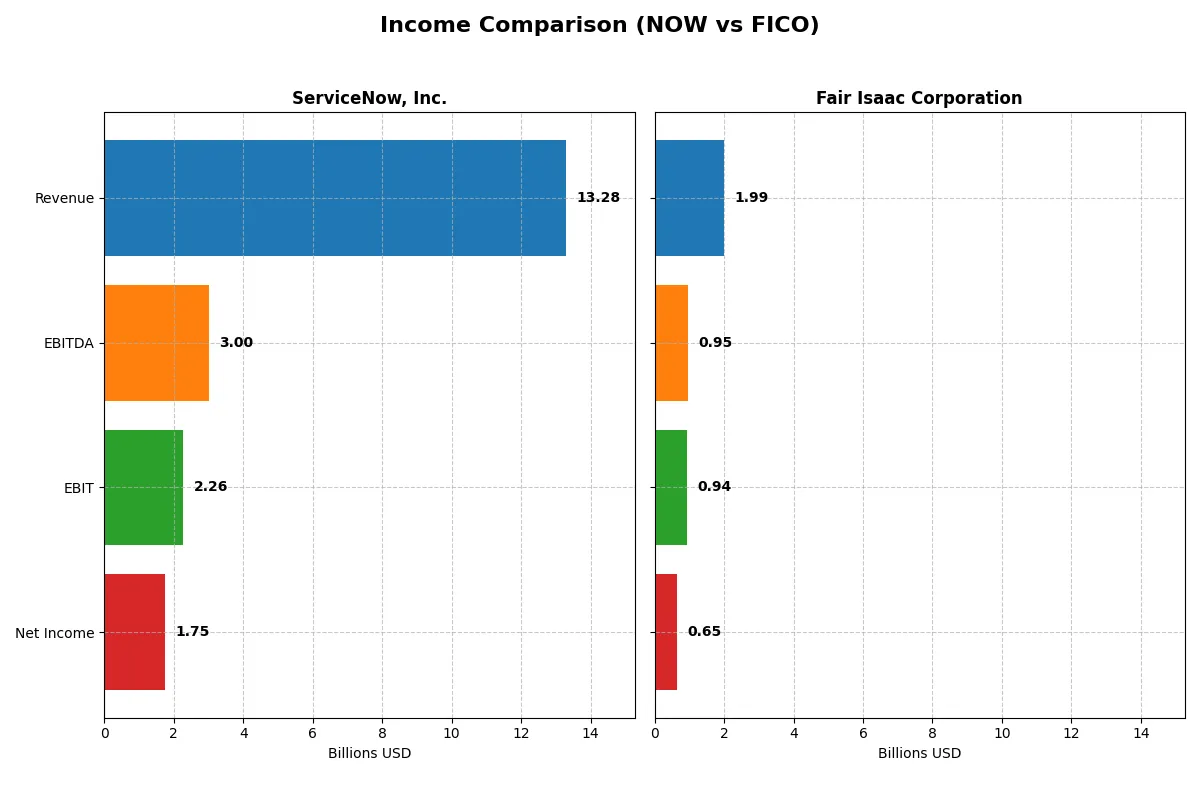
| Metric | ServiceNow, Inc. (NOW) | Fair Isaac Corporation (FICO) |
|---|---|---|
| Revenue | 13.3B | 1.99B |
| Cost of Revenue | 2.98B | 354M |
| Operating Expenses | 8.47B | 712M |
| Gross Profit | 10.3B | 1.64B |
| EBITDA | 3.00B | 951M |
| EBIT | 2.26B | 936M |
| Interest Expense | 0 | 134M |
| Net Income | 1.75B | 652M |
| EPS | 1.69 | 26.9 |
| Fiscal Year | 2025 | 2025 |
Income Statement Analysis: The Bottom-Line Duel
This income statement comparison reveals which company runs a more efficient and profitable business engine in the current market landscape.
ServiceNow, Inc. Analysis
ServiceNow’s revenue surged from 5.9B in 2021 to 13.3B in 2025, showing robust growth momentum. Net income expanded dramatically to 1.75B in 2025, supported by a strong gross margin of 77.5% and a net margin of 13.2%. The company’s operating efficiency improved, with EBIT margin rising to 17%, reflecting effective cost control amid rapid expansion.
Fair Isaac Corporation Analysis
Fair Isaac’s revenue climbed steadily from 1.3B in 2021 to 2.0B in 2025, with consistent profitability gains. The firm boasts an impressive 82.2% gross margin and a commanding 32.7% net margin in 2025, signaling exceptional operational leverage. EBIT margin reached 47%, underscoring robust earnings quality despite moderate interest expenses impacting net income growth.
Margin Power vs. Revenue Scale
Fair Isaac delivers far superior margins with a net margin over twice that of ServiceNow, indicating stronger profitability per dollar earned. However, ServiceNow outpaces Fair Isaac in revenue scale and growth velocity, tripling its top line over five years. Investors seeking high-margin stability may favor Fair Isaac, while those prioritizing growth potential might lean toward ServiceNow’s expanding footprint.
Financial Ratios Comparison
These vital ratios act as a diagnostic tool to expose the underlying fiscal health, valuation premiums, and capital efficiency of the companies compared below:
| Ratios | ServiceNow (NOW) | Fair Isaac Corp (FICO) |
|---|---|---|
| ROE | 13.5% | -37.3% |
| ROIC | 9.0% | 53.0% |
| P/E | 90.9 | 55.6 |
| P/B | 12.3 | -20.8 |
| Current Ratio | 0.95 | 0.83 |
| Quick Ratio | 0.95 | 0.83 |
| D/E (Debt-to-Equity) | 0.25 | -1.76 |
| Debt-to-Assets | 12.3% | 164.6% |
| Interest Coverage | 0 | 6.9 |
| Asset Turnover | 0.51 | 1.07 |
| Fixed Asset Turnover | 4.29 | 21.2 |
| Payout ratio | 0 | 0 |
| Dividend yield | 0% | 0% |
| Fiscal Year | 2025 | 2025 |
Efficiency & Valuation Duel: The Vital Signs
Ratios serve as a company’s financial DNA, unveiling hidden risks and operational strengths crucial for investment insight.
ServiceNow, Inc.
ServiceNow posts a solid 13.5% ROE and a favorable 13.2% net margin, indicating steady profitability. However, its P/E at 90.9 signals a stretched valuation, challenging growth expectations. The firm pays no dividend, opting instead to reinvest heavily in R&D, fueling innovation and future expansion.
Fair Isaac Corporation
Fair Isaac exhibits an impressive 32.8% net margin and a robust 53.0% ROIC, demonstrating high operational efficiency. Its P/E of 55.6, while lower than ServiceNow’s, remains elevated. Despite negative ROE, the company’s strong cash flow and asset turnover suggest reinvestment in growth rather than shareholder payouts.
Premium Valuation vs. Operational Efficiency
ServiceNow’s valuation appears more stretched but balances solid profitability with growth reinvestment. Fair Isaac offers stronger returns on capital but carries risk with negative equity returns. Investors seeking operational efficiency may lean toward Fair Isaac; those prioritizing stability and innovation reinvestment might prefer ServiceNow.
Which one offers the Superior Shareholder Reward?
I see both ServiceNow (NOW) and Fair Isaac Corporation (FICO) pay no dividends, focusing on reinvestment and buybacks. ServiceNow’s payout ratio is zero, signaling full reinvestment in growth and R&D. Its free cash flow per share stands at $4.41B with a robust buyback program, supporting capital return and valuation. FICO also pays no dividend but shows a stronger free cash flow per share at $31.76B and a more aggressive buyback approach. However, FICO’s negative equity and high financial leverage raise sustainability concerns. I judge ServiceNow’s balanced reinvestment and moderate leverage offer a more sustainable total return profile in 2026.
Comparative Score Analysis: The Strategic Profile
The radar chart reveals the fundamental DNA and trade-offs of ServiceNow, Inc. and Fair Isaac Corporation, highlighting their financial strengths and vulnerabilities:
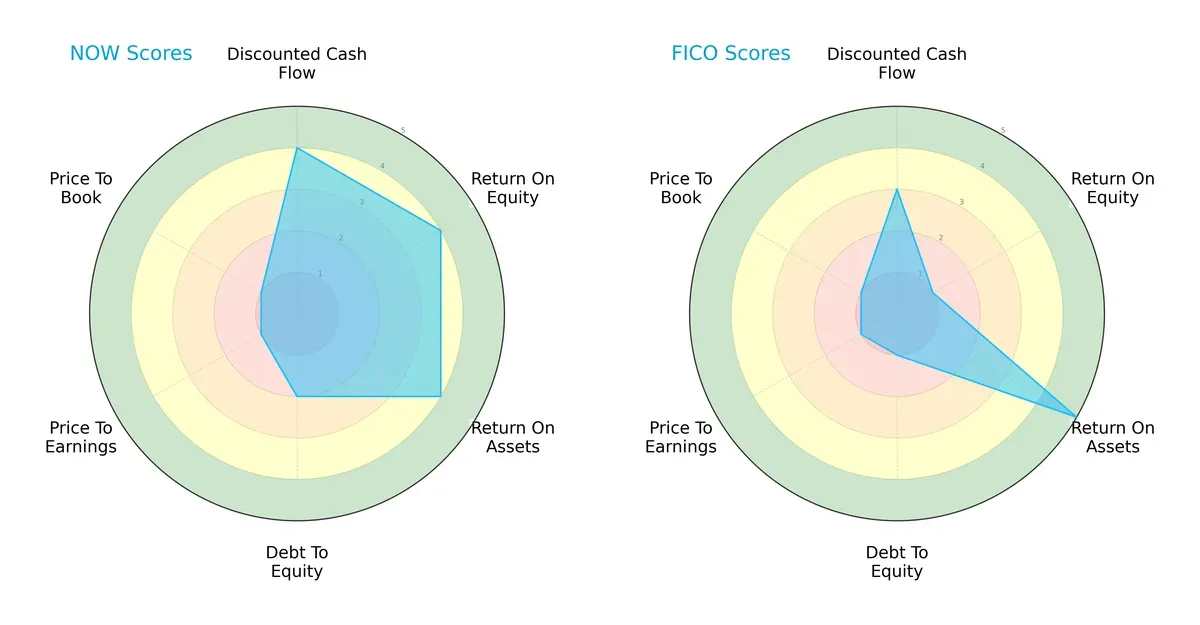
ServiceNow shows balanced strength in DCF, ROE, and ROA with moderate debt management but weak valuation metrics. Fair Isaac leans heavily on asset efficiency (ROA) but struggles with equity returns and carries higher debt risk. ServiceNow’s profile is more balanced, while Fair Isaac relies on operational efficiency as its key advantage.
Bankruptcy Risk: Solvency Showdown
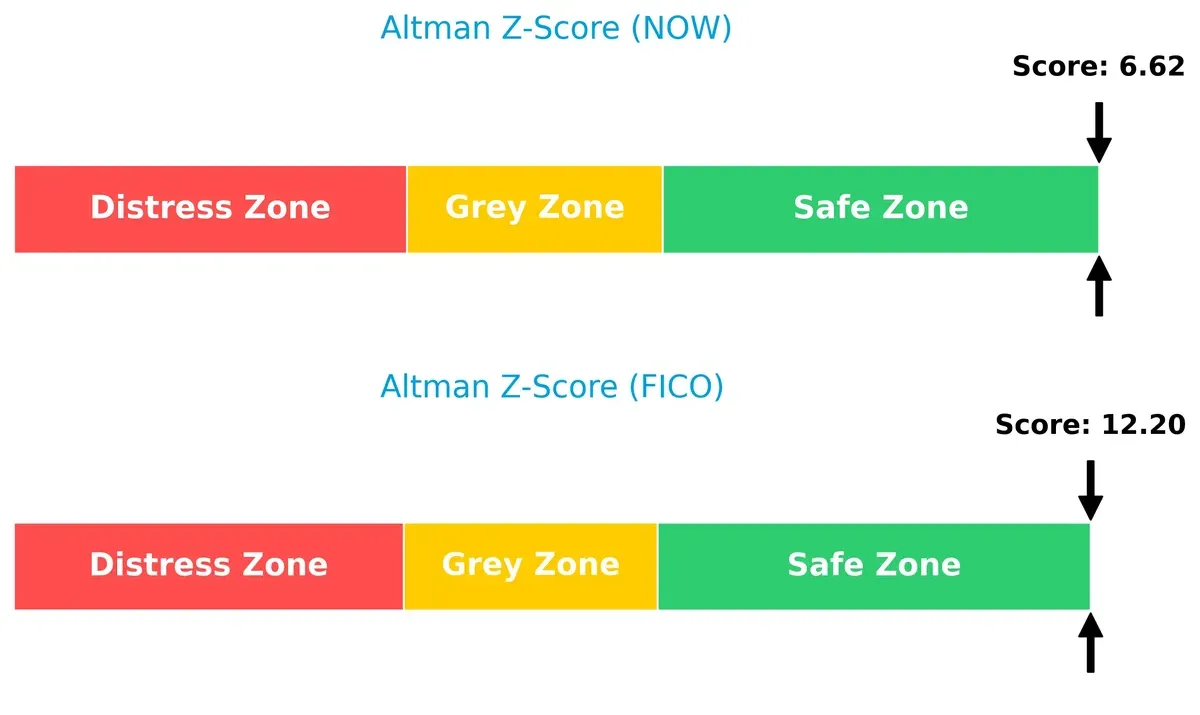
The Altman Z-Scores place both firms securely in the safe zone, with Fair Isaac’s 12.2 well above ServiceNow’s 6.6, indicating a stronger buffer against bankruptcy risk in this economic cycle:
Financial Health: Quality of Operations
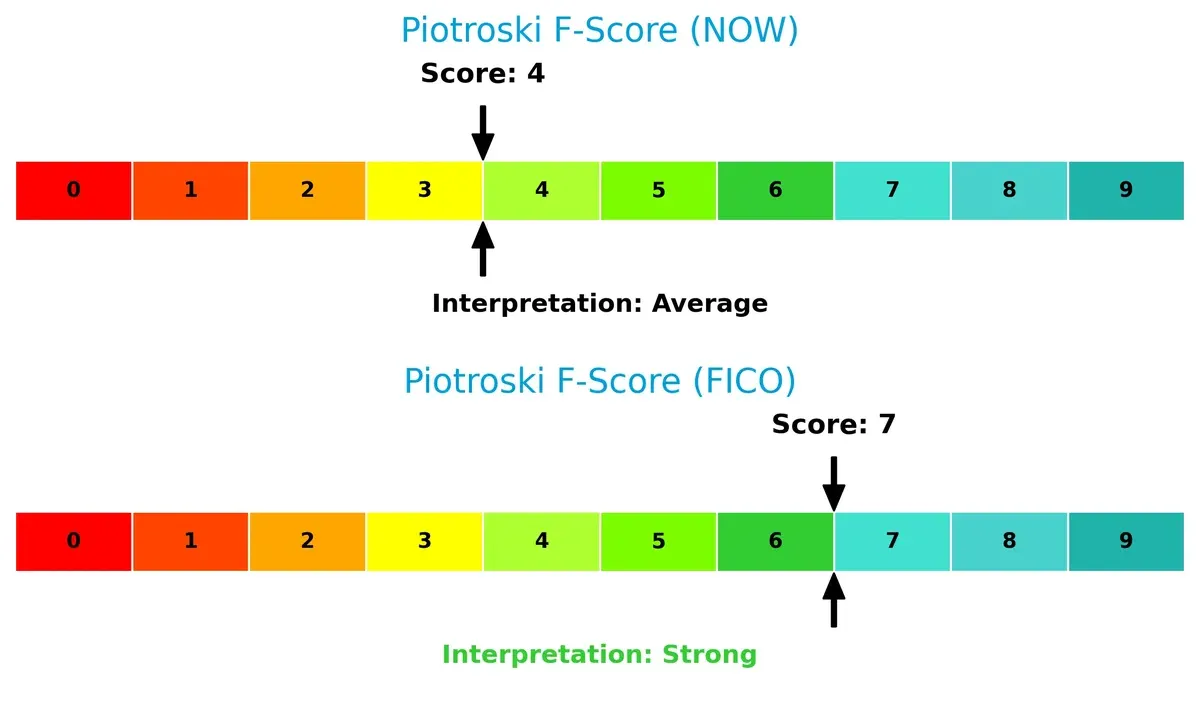
Fair Isaac’s Piotroski score of 7 signals robust financial health, outperforming ServiceNow’s average score of 4, which raises caution due to weaker internal metrics:
How are the two companies positioned?
This section dissects the operational DNA of ServiceNow and Fair Isaac by comparing their revenue distribution and internal dynamics. The goal is to confront their economic moats to reveal which model offers the most resilient competitive advantage today.
Revenue Segmentation: The Strategic Mix
This comparison dissects how ServiceNow and Fair Isaac diversify their income streams and where their primary sector bets lie:
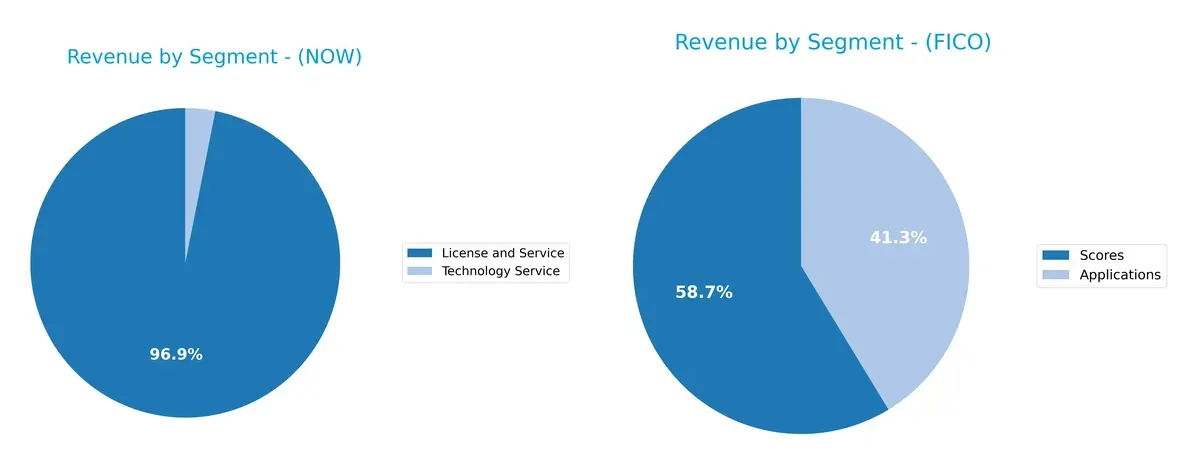
ServiceNow leans heavily on its License and Service segment, with $12.9B in 2025 revenue, dwarfing its $414M Technology Service. Fair Isaac shows a more balanced split: $1.17B from Scores and $822M from Applications. ServiceNow’s concentration signals strong ecosystem lock-in but higher concentration risk. Fair Isaac’s split suggests diversified product reliance, reducing risk and anchoring its credit analytics infrastructure.
Strengths and Weaknesses Comparison
This table compares the strengths and weaknesses of ServiceNow and Fair Isaac Corporation based on diversification, profitability, financials, innovation, global presence, and market share:
ServiceNow Strengths
- Strong revenue growth in License and Service segments
- Favorable net margin at 13.16%
- Low debt-to-assets ratio at 12.3%
- Excellent fixed asset turnover of 4.29
- Broad global presence with $8.3B North America revenue
- Consistent innovation in digital workflow products
Fair Isaac Corporation Strengths
- High net margin at 32.75%
- Outstanding ROIC of 52.96% well above WACC
- Favorable PB despite negative value
- Strong asset turnover at 1.07 and fixed asset turnover at 21.2
- Good interest coverage of 7.01
- Balanced product segmentation between Scores and Applications
ServiceNow Weaknesses
- Unfavorable valuation multiples: PE 90.88, PB 12.25
- Current ratio below 1 at 0.95 signals liquidity risk
- Zero dividend yield limits income investors
- ROE and ROIC only neutral despite growth
- Heavy reliance on North America for majority of revenue
- Moderate debt-to-equity ratio of 0.25
Fair Isaac Corporation Weaknesses
- Negative ROE at -37.34 signals profitability challenges
- High debt-to-assets ratio at 164.6% raises solvency concerns
- PE still elevated at 55.64 despite profitability
- Current ratio below 1 at 0.83 indicates liquidity risk
- Zero dividend yield limits income potential
- Concentrated Americas revenue with limited Asia Pacific and EMEA reach
Both companies show solid operational strengths but face liquidity and valuation challenges. ServiceNow’s strengths lie in diversified revenue streams and asset efficiency, while Fair Isaac excels in profitability and capital returns but carries higher financial risk. These factors shape their strategic priorities in managing growth and financial stability.
The Moat Duel: Analyzing Competitive Defensibility
A structural moat is the only reliable shield protecting long-term profits from relentless competition erosion:
ServiceNow, Inc.: Workflow Automation Switching Costs
ServiceNow’s primary moat lies in high switching costs embedded in its Now platform. Its growing ROIC signals improving profitability. Expansion into AI-driven workflow automation in 2026 could deepen this advantage.
Fair Isaac Corporation: Predictive Analytics Intangible Assets
FICO’s moat centers on proprietary analytic models and data assets. It commands a wide margin gap and strong ROIC well above WACC, reflecting efficient capital use. Ongoing innovation in decision management software supports durable growth opportunities.
Verdict: Switching Costs vs. Intangible Data Assets
FICO holds the deeper moat, evidenced by a 44% ROIC premium over WACC versus ServiceNow’s negative spread. FICO’s entrenched data assets better defend market share amid evolving tech landscapes.
Which stock offers better returns?
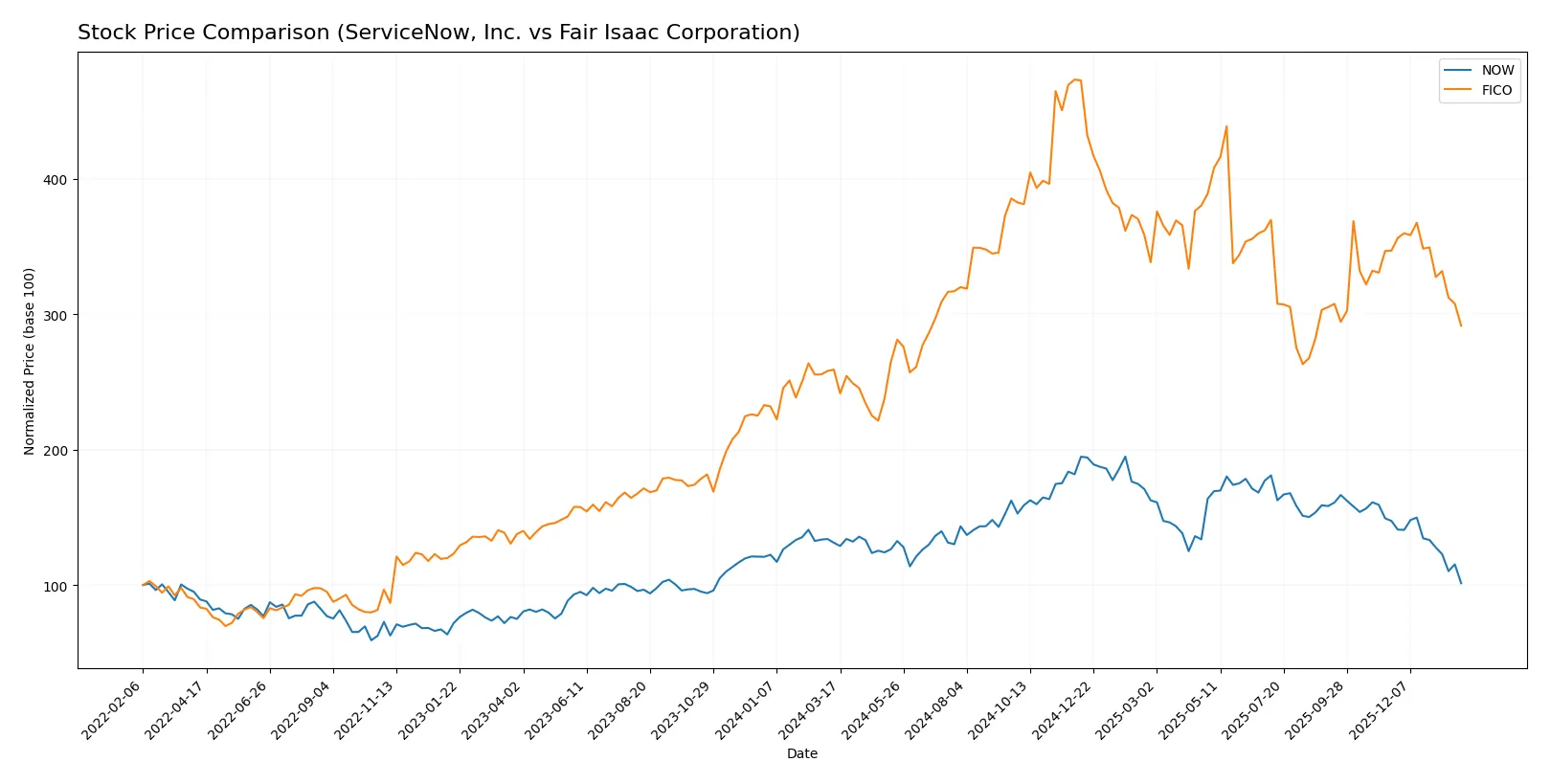
The past year shows divergent price dynamics for ServiceNow, Inc. and Fair Isaac Corporation, with NOW facing sustained losses while FICO posts gains amid decelerating trends.
Trend Comparison
ServiceNow’s stock declined 22.79% over the past year, marking a bearish trend with decelerating losses from a high of 225 to a low near 117. Recent months intensified the downtrend with a -31.21% price drop.
Fair Isaac’s shares rose 12.51% during the last 12 months, reflecting a bullish but slowing upward trend. Despite this, recent activity shows a -15.98% dip, indicating short-term weakness after hitting 2375 at peak.
Comparing both, Fair Isaac delivered superior market returns over the year, while ServiceNow experienced notable declines and greater volatility throughout the period.
Target Prices
Analysts present a wide range of target prices for ServiceNow, Inc. and Fair Isaac Corporation, reflecting diverse expectations.
| Company | Target Low | Target High | Consensus |
|---|---|---|---|
| ServiceNow, Inc. | 115 | 1,315 | 440.14 |
| Fair Isaac Corporation | 1,640 | 2,400 | 2,115 |
ServiceNow’s consensus target is nearly four times its current price, indicating high growth expectations. Fair Isaac’s target price consensus sits about 45% above its current price, signaling moderate optimism from analysts.

Don’t Let Luck Decide Your Entry Point
Optimize your entry points with our advanced ProRealTime indicators. You’ll get efficient buy signals with precise price targets for maximum performance. Start outperforming now!
How do institutions grade them?
ServiceNow, Inc. Grades
The following table summarizes recent grades assigned to ServiceNow, Inc. by reputable institutions:
| Grading Company | Action | New Grade | Date |
|---|---|---|---|
| Citigroup | Maintain | Buy | 2026-01-30 |
| BTIG | Maintain | Buy | 2026-01-29 |
| Stifel | Maintain | Buy | 2026-01-29 |
| RBC Capital | Maintain | Outperform | 2026-01-29 |
| Macquarie | Maintain | Neutral | 2026-01-29 |
| DA Davidson | Maintain | Buy | 2026-01-29 |
| Needham | Maintain | Buy | 2026-01-29 |
| Keybanc | Maintain | Underweight | 2026-01-29 |
| Evercore ISI Group | Maintain | Outperform | 2026-01-29 |
| Cantor Fitzgerald | Maintain | Overweight | 2026-01-29 |
Fair Isaac Corporation Grades
Below is a summary of recent institutional grades for Fair Isaac Corporation:
| Grading Company | Action | New Grade | Date |
|---|---|---|---|
| Needham | Maintain | Buy | 2026-01-29 |
| Jefferies | Maintain | Buy | 2026-01-16 |
| Wells Fargo | Maintain | Overweight | 2026-01-14 |
| JP Morgan | Maintain | Neutral | 2025-11-06 |
| Baird | Maintain | Outperform | 2025-11-06 |
| Jefferies | Maintain | Buy | 2025-11-06 |
| BMO Capital | Maintain | Outperform | 2025-11-06 |
| Wells Fargo | Maintain | Overweight | 2025-10-14 |
| Barclays | Maintain | Overweight | 2025-10-02 |
| Needham | Maintain | Buy | 2025-10-02 |
Which company has the best grades?
ServiceNow, Inc. holds mostly Buy and Outperform grades, with a few Neutral and Underweight ratings. Fair Isaac Corporation also receives predominantly Buy and Outperform grades, with several Overweight ratings. Both companies show strong institutional support, but ServiceNow’s broader mix includes more conservative takes, potentially indicating varying risk assessments for investors.
Risks specific to each company
The following categories identify the critical pressure points and systemic threats facing both firms in the 2026 market environment:
1. Market & Competition
ServiceNow, Inc.
- Faces intense competition in enterprise cloud software, with pressure to innovate rapidly to maintain market leadership.
Fair Isaac Corporation
- Competes in analytics and decision software with niche specialization but must defend against larger platform integrators.
2. Capital Structure & Debt
ServiceNow, Inc.
- Maintains a conservative debt profile with low debt-to-assets (12.3%) and strong interest coverage, suggesting financial flexibility.
Fair Isaac Corporation
- Exhibits a risky capital structure with debt-to-assets at 164.6%, indicating high leverage and potential solvency concerns.
3. Stock Volatility
ServiceNow, Inc.
- Beta near 1 (0.979) signals market-correlated volatility, typical for tech sector but relatively stable.
Fair Isaac Corporation
- Higher beta (1.293) shows elevated volatility risk, exposing investors to sharper price swings in turbulent markets.
4. Regulatory & Legal
ServiceNow, Inc.
- Subject to data privacy and cloud security regulations globally, requiring constant compliance investment.
Fair Isaac Corporation
- Faces regulatory scrutiny around credit scoring and data usage, with legal challenges tied to consumer protection laws.
5. Supply Chain & Operations
ServiceNow, Inc.
- Relies on cloud infrastructure partnerships; operational risks stem from service outages or integration failures.
Fair Isaac Corporation
- Operational risks center on software delivery and data accuracy, with less dependence on physical supply chains.
6. ESG & Climate Transition
ServiceNow, Inc.
- Increasing pressure to enhance ESG disclosures and reduce environmental footprint in data centers.
Fair Isaac Corporation
- ESG risks focus on ethical data use and transparency in algorithmic decision-making processes.
7. Geopolitical Exposure
ServiceNow, Inc.
- Global operations expose it to trade tensions and cross-border data flow restrictions.
Fair Isaac Corporation
- International presence mandates navigating diverse regulatory regimes, especially in financial services sectors.
Which company shows a better risk-adjusted profile?
ServiceNow’s prudent debt management and moderate stock volatility provide a more balanced risk profile. Fair Isaac’s excessive leverage and higher volatility amplify financial and market risks. ServiceNow’s stable Altman Z-score (6.62) contrasts with Fair Isaac’s riskier capital structure. Yet, Fair Isaac’s strong profitability and operational efficiency mitigate some concerns. The single most impactful risk for ServiceNow is its valuation premium, which could pressure returns. For Fair Isaac, capital structure fragility dominates, raising solvency red flags. Given these factors, I find ServiceNow’s overall risk-adjusted profile superior in the 2026 environment.
Final Verdict: Which stock to choose?
ServiceNow’s superpower lies in its relentless revenue growth fueled by expanding cloud adoption and operational efficiency. Its main point of vigilance is a current ratio below 1, signaling liquidity pressure that could challenge short-term resilience. It fits well in aggressive growth portfolios that tolerate volatility for outsized tech gains.
Fair Isaac commands a durable moat through its high ROIC and entrenched analytics platform that safeguards recurring revenue. Despite heavier debt and lower liquidity than ServiceNow, it offers better stability and margin expansion prospects. This stock suits investors favoring GARP—growth at a reasonable price—seeking quality income with capital appreciation.
If you prioritize rapid expansion and market disruption, ServiceNow is the compelling choice due to its accelerating profitability and innovation pipeline. However, if you seek a durable competitive advantage combined with superior capital efficiency and steadier returns, Fair Isaac offers better stability and a proven moat that outshines in value creation.
Disclaimer: Investment carries a risk of loss of initial capital. The past performance is not a reliable indicator of future results. Be sure to understand risks before making an investment decision.
Go Further
I encourage you to read the complete analyses of ServiceNow, Inc. and Fair Isaac Corporation to enhance your investment decisions: