UnitedHealth’s stock price has plunged nearly 20% today, despite its status as a leading diversified healthcare company with significant market presence. This sharp decline raises critical questions about the factors destabilizing investor confidence in an otherwise dominant player in healthcare plans and services. This analysis will explore the key elements influencing UnitedHealth’s valuation and the implications for investors navigating the healthcare sector.
Table of contents
Key Points
- UnitedHealth returned $78B to shareholders via dividends and buybacks.
- Revenue forecast misses and weak Medicare payment growth triggered share drop.
- Ongoing regulatory scrutiny adds uncertainty to UnitedHealth’s future earnings.
UnitedHealth Group Business Overview and Financial Performance
UnitedHealth Group operates in the healthcare industry, focusing on two main segments: UnitedHealthcare, its insurance division, and Optum, its health services segment. The company operates primarily in the United States and has demonstrated strong revenue growth and profitability trends. Over the past decade, it returned $78B to shareholders through dividends and share repurchases while pursuing strategic acquisitions to expand its healthcare ecosystem.
Why Did UnitedHealth’s Stock Plunge 20% Today?
UnitedHealth’s stock price dropped sharply after a government proposal to increase Medicare insurer payments by only 0.09% in 2027, far below the industry-expected 4% to 6%. This comes amid a Department of Justice investigation over alleged diagnosis practices, which UnitedHealth denies. These developments raised concerns about future reimbursement growth and regulatory risks.
Additionally, UnitedHealth reported Q4 revenue of $113.22B and adjusted EPS of $2.11, near analyst estimates, but its 2026 revenue forecast fell short of expectations. This cautious outlook, combined with regulatory scrutiny, triggered a 16% premarket share decline and broader sell-offs in health insurers, reflecting investor uncertainty about the company’s medium-term growth and profitability.
Recent Market Moves
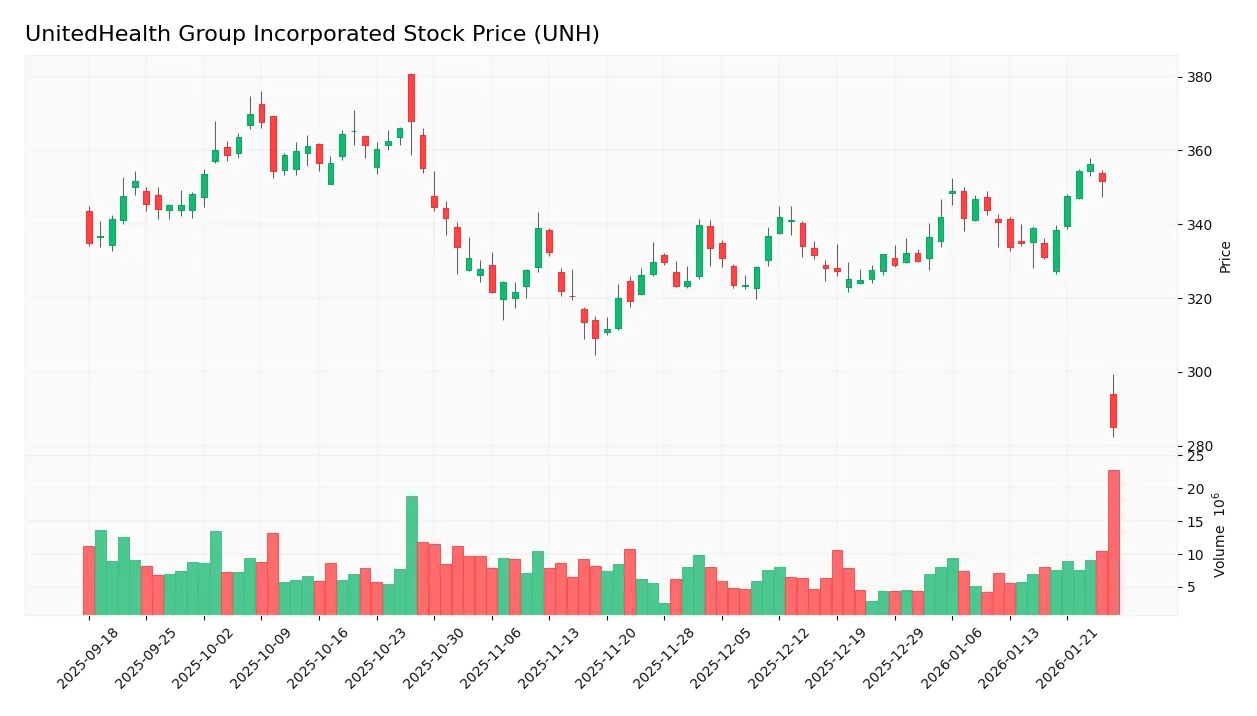
UnitedHealth Group Incorporated’s stock price declined sharply, reflecting the market’s reaction to recent developments that have impacted the company’s outlook. The stock price fell sharply by 18.9% over one trading day:
Target Prices
There is an analyst consensus on UnitedHealth Group Incorporated’s target prices. The target range reflects the expected price variation for the stock based on current analyst evaluations.
| Target High | Target Low | Consensus |
|---|---|---|
| 444 | 198 | 394.38 |
Latest Insider Trading
On January 2, 2026, multiple UnitedHealth Group directors received awards totaling 2,335 common shares at no cost. These awards were reported on January 6, 2026, involving directors such as Paul R. Garcia, Timothy Patrick Flynn, and others.
This insider activity reflects equity grants to directors, increasing their holdings without sales or purchases, consistent with typical compensation practices rather than market-driven transactions.
What about the fundamentals?
The income statement shows a gross margin of 22.33% labeled as favorable, an EBIT margin of 5.99% labeled as neutral, and a net margin of 3.6% labeled as neutral. Interest expense at 0.98% is favorable. Overall, the income statement evaluation is unfavorable due to mixed growth and margin changes.
The company experienced a 7.71% revenue growth over one year, which is neutral, while gross profit and EBIT declined by 1.71% and 25.9%, respectively, both unfavorable. Net margin and EPS also decreased significantly, with net margin down 40.25% and EPS down 35.0%, negatively impacting income statement metrics.
Stock Grades
Current stock grades for UnitedHealth Group Incorporated are available from recognized financial institutions. The most recent grades maintain a generally positive outlook on the stock, with no changes in rating levels.
| Grading Company | Action | New Grade | Date |
|---|---|---|---|
| Morgan Stanley | maintain | Overweight | 2026-01-23 |
| Barclays | maintain | Overweight | 2026-01-05 |
| Bernstein | maintain | Outperform | 2025-10-30 |
| TD Cowen | maintain | Hold | 2025-10-30 |
| UBS | maintain | Buy | 2025-10-29 |
Conclusion
UnitedHealth Group’s recent financial results are overall unfavorable, with a sharp 19% decline in its stock price triggered by lower-than-expected Medicare payment growth and regulatory scrutiny. Despite stable near-term earnings, the company’s 2026 revenue forecast fell short of market expectations, prompting investor concern.
Long-term, UnitedHealth has demonstrated strong shareholder returns and value creation, supported by growth in its UnitedHealthcare and Optum segments. Key factors to monitor include regulatory developments, Medicare reimbursement policies, and the company’s ability to sustain cash flow amid these challenges.
Disclaimer: This content is for informational purposes only and does not constitute financial, investment, or other professional advice. Investing in financial markets involves a significant risk of loss, and past performance is not indicative of future results.
Sources
I wrote this article based on the following sources. I encourage you to consult them to deepen your understanding of UnitedHealth Group’s recent performance and market outlook.
- How UNH Stock Returned $78 Billion To Shareholders – Forbes
An analysis of UnitedHealth’s decade-long strategy that generated $78B in shareholder returns through dividends and buybacks.
- UnitedHealth shares plunge on weak guidance, quarterly revenue miss – Proactive Investors
Coverage of the sharp stock decline following UnitedHealth’s cautious 2026 revenue forecast and recent earnings report.
- 5 Things to Know Before the Stock Market Opens – Investopedia
A broader market context including UnitedHealth’s stock reaction to government Medicare payment proposals and other major corporate earnings.
UnitedHealth Group Incorporated Analysis
I encourage you to read the comprehensive analysis of UnitedHealth Group Incorporated to enhance your investment decisions: UnitedHealth Group Incorporated Analysis