Intel’s stock has plunged sharply despite its status as a semiconductor giant with diverse technology offerings, raising questions about the sustainability of its market position. This sudden price collapse contrasts with the company’s extensive product portfolio and strategic initiatives, spotlighting underlying challenges. The key issue is whether this decline signals a fundamental shift toward a bearish trend or a temporary market reaction.
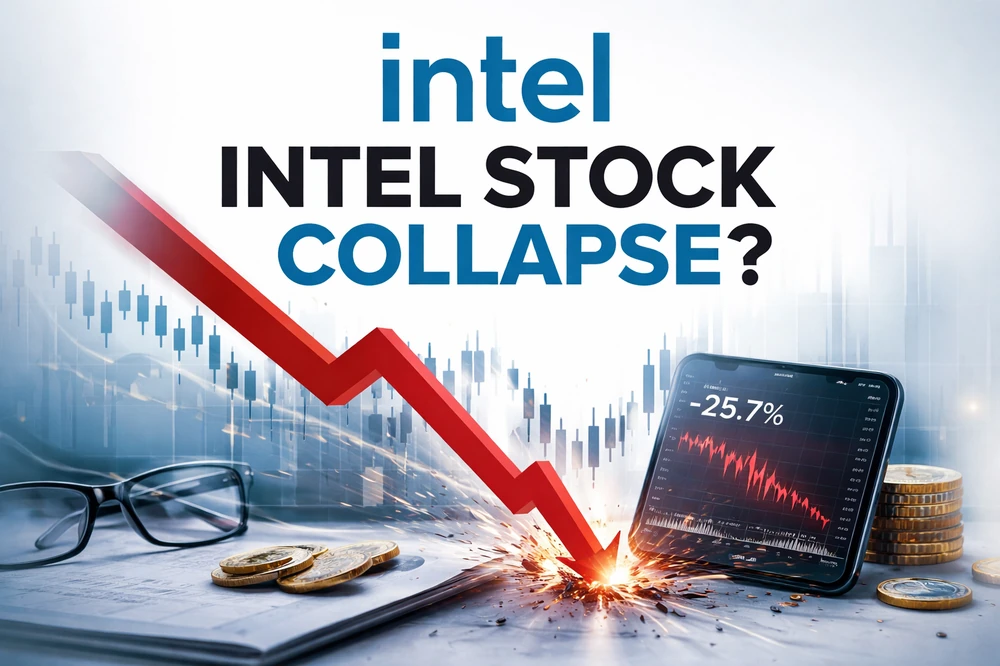
Table of contents
Key Points
- Highlight Intel’s Data Center and AI segments as key growth drivers.
- Note Intel’s sharp stock decline following weaker-than-expected guidance.
- Emphasize ongoing margin pressures and production yield challenges.
Intel’s Financial Performance and Market Challenges
Intel is a major player in the semiconductor industry, focusing on the production of microprocessors and related technologies. Its key business segments include Client Computing, Data Center, and AI markets. Operating globally, Intel recently reported mixed Q4 results with $13.67B revenue, a 4% decline year-over-year, driven by a 7% revenue drop in Client Computing but a 9% growth in Data Center and AI. The company is advancing product launches and adjusting its server roadmap.
Intel’s stock price collapsed following an earnings report that beat profit estimates but included weaker-than-expected Q1 guidance. Shares fell by more than 14% amid concerns about margin pressures, production yield challenges, and supply constraints. The downturn also affected leveraged ETFs tied to Intel, reflecting rapidly shifting investor sentiment and sector-wide repricing in the semiconductor market.
Why Did Intel’s Stock Price Collapse?
Intel’s stock price dropped over 15% following its Q4 earnings report despite exceeding revenue and earnings expectations with $13.67B revenue and 15 cents adjusted EPS. The decline was driven by weaker-than-expected Q1 guidance, projecting revenue between $11.7B and $12.7B and breakeven adjusted earnings, which fell short of analyst estimates and triggered investor concerns about near-term growth and margin pressures.
The stock selloff also reflects ongoing operational challenges, including production yield issues and supply constraints at key process nodes, which are affecting shipment volumes and margins. While Intel’s Data Center and AI segments grew 9% to $4.7B, offsetting declines in Client Computing, competitive pressure, and cautious guidance created volatility, with leveraged ETFs tied to Intel experiencing sharp losses amid shifting market sentiment.
Recent Market Moves
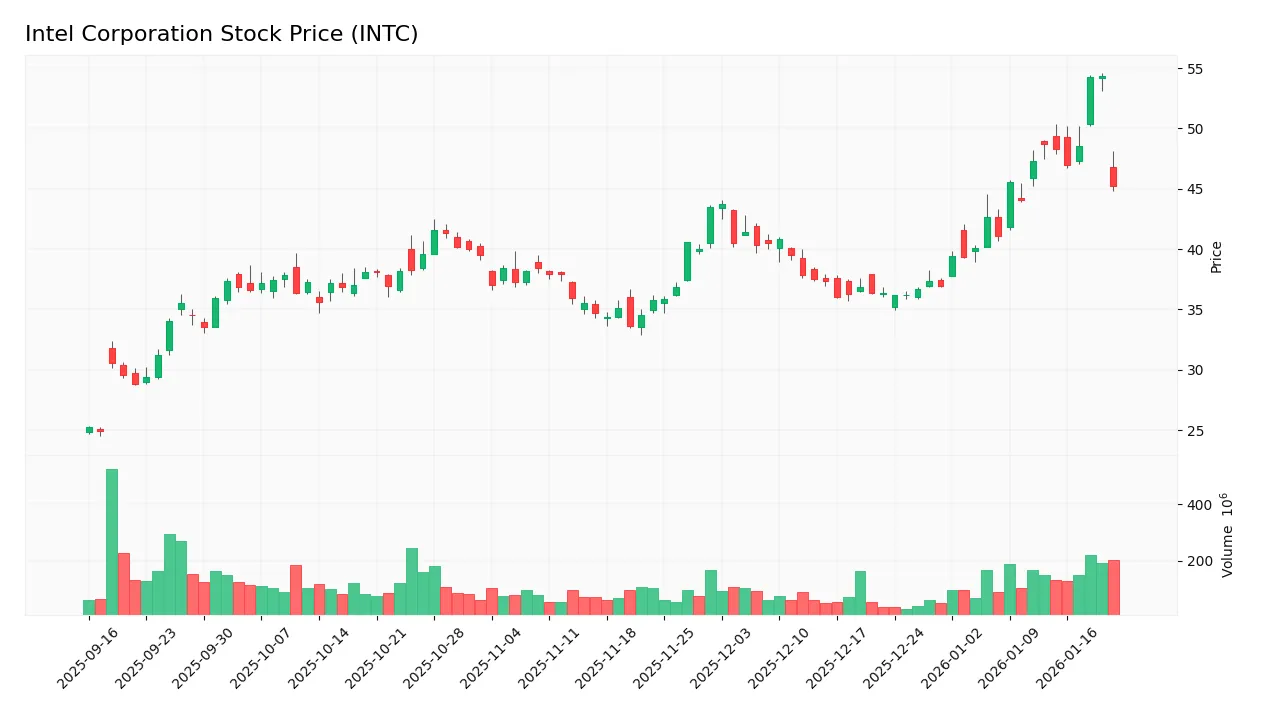
Intel Corporation’s stock price dropped 17.07% in a single trading day, reflecting significant investor reaction to recent developments. The stock closed with a 1D change of -17.07%:
Target Prices
There is an analyst consensus on Intel Corporation’s target prices. The target range provides a spectrum of expected price points based on current market analysis for Intel’s stock.
| Target High | Target Low | Consensus |
|---|---|---|
| 65 | 20 | 46.65 |
Latest Insider Trading
Intel’s latest insider trading activity on December 1, 2025, involved multiple transactions by Scott Gawel, the Chief Accounting Officer. The transactions included both acquisitions and dispositions of common stock and restricted stock units, with no cash price reported for most trades.
This activity reflects a mix of purchases and disposals totaling over 18K securities disposed of and 12K acquired in Q4 2025, indicating balanced insider movements amid concerns about the stock price collapse and potential bearish reversal.
What about the fundamentals?
The income statement shows a gross margin of 34.96% (favorable), an EBIT margin of 4.75% (neutral), an interest expense of 1.8% (favorable), and a net margin of -0.51% (unfavorable). Overall, the global income statement opinion is slightly favorable, with 50% of metrics favorable and 42.86% unfavorable.
Stock Grades
Current verified stock grades for Intel Corporation are available from recognized financial institutions. The most recent grades for Intel all indicate a maintenance of previous ratings as of 2026-01-23.
| Grading Company | Action | New Grade | Date |
|---|---|---|---|
| Benchmark | maintain | Buy | 2026-01-23 |
| Evercore ISI Group | maintain | In Line | 2026-01-23 |
| Rosenblatt | maintain | Sell | 2026-01-23 |
| Needham | maintain | Hold | 2026-01-23 |
| Keybanc | maintain | Overweight | 2026-01-23 |
Conclusion
Intel Corporation’s recent financial results present a mixed picture with overall favorable income statement metrics but unfavorable revenue and net margin trends. Despite beating Q4 profit expectations, the company’s stock price collapsed due to weaker-than-expected first-quarter guidance and ongoing operational challenges.
Longer-term developments emphasize Intel’s strategic focus on Data Center and AI segments as critical growth drivers. Key factors to monitor include production yield improvements, margin pressures, market share dynamics vis-à-vis competitors, and external risks such as memory price volatility and regulatory involvement.
Investors should remember that all investments carry risk, and this article does not constitute investment advice.
Sources
I wrote this article based on the following sources to provide you with a clear and accurate analysis of Intel Corporation’s recent performance and market outlook. I invite you to consult these sources directly to delve deeper into the details and form your own informed perspective.
- Intel: I Like The Demand Story, I Don’t Like The Margin Story (Downgrade) – Seeking Alpha
An insightful piece analyzing Intel’s demand strength alongside margin challenges, highlighting supply issues and Q1 2026 revenue guidance.
- Intel Earnings Spark Sell-Off, But Leveraged ETF Traders Eye Opportunity – Benzinga
Coverage of the market reaction to Intel’s earnings report and how leveraged ETF traders are positioning themselves amid volatility.
- Intel’s AI Surge Hits Brick Wall As Capacity Crunch Throttles Growth: Analyst – Benzinga
An analysis of Intel’s mixed Q4 results, focusing on supply constraints and margin pressure limiting near-term growth despite strong AI demand.
Intel Corporation Analysis
I encourage you to read the comprehensive analysis of Intel Corporation to enhance your investment decisions: Intel Corporation Analysis