Home > Analyses > Technology > GoDaddy Inc.
GoDaddy Inc. powers the digital identities of millions, shaping how small businesses and individuals establish their online presence. Renowned for its domain registration and cloud-based hosting services, GoDaddy leads with innovation and a comprehensive suite of tools that simplify web management and e-commerce. As the digital landscape evolves, I’m keen to explore whether GoDaddy’s strong market position and expanding product lineup justify its current valuation and promise sustained growth.

Table of contents
Business Model & Company Overview
GoDaddy Inc., founded in 2014 and headquartered in Tempe, Arizona, commands a dominant position in software infrastructure. The company builds a comprehensive ecosystem around cloud-based technology, enabling customers to establish and grow their digital identities. Its offerings span domain registration, website hosting, security, and marketing tools, forming an integrated platform for small businesses and individual entrepreneurs worldwide.
GoDaddy’s revenue engine balances scalable hardware and software with high-margin recurring services. Its portfolio includes shared and managed hosting, e-commerce solutions, payment facilitation, and business applications, serving markets across the Americas, Europe, and Asia. I see its competitive advantage in seamlessly combining these elements, securing its role as a cornerstone of the internet economy.
Financial Performance & Fundamental Metrics
I analyze GoDaddy Inc.’s income statement, key financial ratios, and dividend payout policy to assess its profitability, efficiency, and shareholder returns.
Income Statement
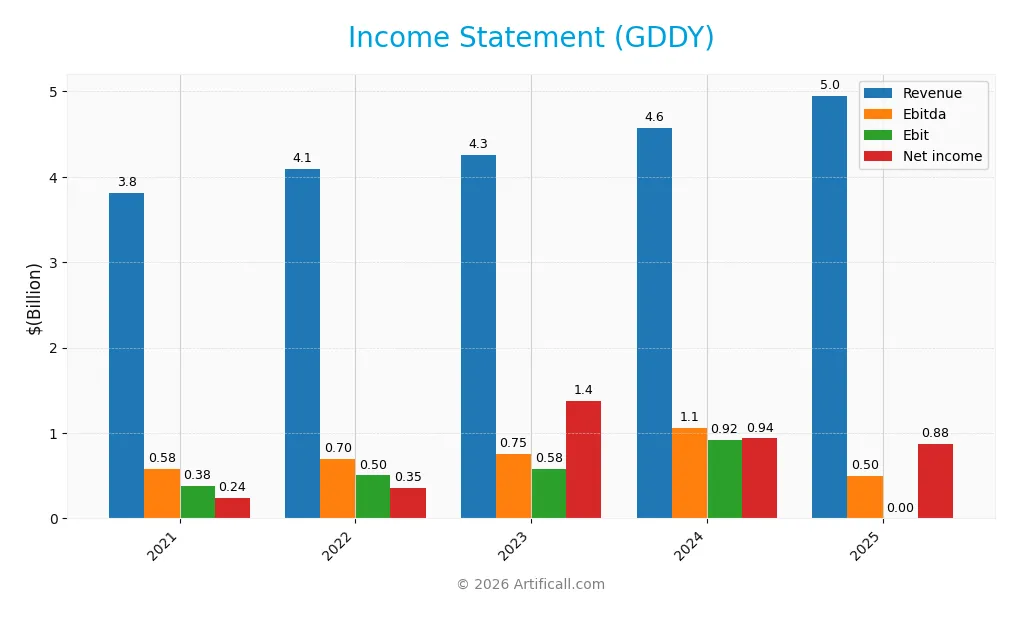
The table below details GoDaddy Inc.’s key income statement figures over the past five fiscal years, reflecting revenue, expenses, profits, and earnings per share.
| 2021 | 2022 | 2023 | 2024 | 2025 | |
|---|---|---|---|---|---|
| Revenue | 3.82B | 4.09B | 4.25B | 4.57B | 4.95B |
| Cost of Revenue | 1.37B | 1.48B | 1.57B | 1.65B | 1.80B |
| Operating Expenses | 2.06B | 2.11B | 2.13B | 2.03B | 2.02B |
| Gross Profit | 2.44B | 2.61B | 2.68B | 2.92B | 3.15B |
| EBITDA | 579M | 697M | 754M | 1.06B | 496M |
| EBIT | 380M | 503M | 583M | 924M | 0 |
| Interest Expense | 126M | 146M | 179M | 158M | 302M |
| Net Income | 242M | 352M | 1.37B | 937M | 875M |
| EPS | 1.44 | 2.22 | 9.27 | 6.63 | 6.35 |
| Filing Date | 2022-02-17 | 2023-02-16 | 2024-02-29 | 2025-02-20 | 2026-02-24 |
Income Statement Evolution
GoDaddy’s revenue rose steadily by 8.3% from 2024 to 2025, marking a 29.8% increase over five years. Gross profit also grew by 7.8% last year, sustaining a healthy gross margin near 64%. However, EBIT dropped sharply to zero in 2025, causing a decline in net margin and EPS despite overall income growth.
Is the Income Statement Favorable?
The 2025 income statement shows mixed signals. Revenue and gross margin remain strong, supporting a favorable revenue and profitability base. Yet, EBIT’s collapse to zero and a 13.7% net margin decline raise caution. Interest expense is well-controlled at 6.1% of revenue, but the 3.3% EPS dip suggests near-term earnings pressure. Overall, fundamentals skew favorable but contain notable risks.
Financial Ratios
The table below presents key financial ratios for GoDaddy Inc. over the past five fiscal years, illustrating profitability, liquidity, leverage, and valuation metrics:
| Ratios | 2021 | 2022 | 2023 | 2024 | 2025 |
|---|---|---|---|---|---|
| Net Margin | 6.4% | 8.6% | 32.3% | 20.5% | 17.7% |
| ROE | 3.0% | -1.1% | 22.1% | 1.4% | 4.1% |
| ROIC | 7.3% | 10.8% | 11.1% | 16.0% | 22.4% |
| P/E | 58.8 | 33.7 | 11.5 | 29.8 | 19.1 |
| P/B | 174.4 | -35.8 | 253.1 | 40.3 | 77.8 |
| Current Ratio | 0.78 | 0.64 | 0.47 | 0.72 | 0.61 |
| Quick Ratio | 0.78 | 0.64 | 0.47 | 0.72 | 0.61 |
| D/E | 49.7 | -12.0 | 63.3 | 5.6 | 0.36 |
| Debt-to-Assets | 54.8% | 57.1% | 52.0% | 47.3% | 1.0% |
| Interest Coverage | 3.0x | 3.4x | 3.1x | 5.6x | -3.7x |
| Asset Turnover | 0.51 | 0.59 | 0.56 | 0.56 | 0.62 |
| Fixed Asset Turnover | 11.6 | 13.2 | 17.3 | 22.2 | 26.4 |
| Dividend Yield | 0% | 0% | 0% | 0% | 0% |
Evolution of Financial Ratios
GoDaddy’s Return on Equity (ROE) fluctuated, peaking sharply in 2023 before declining to 4.07% in 2025. The Current Ratio showed volatility, falling from 0.78 in 2021 to 0.61 in 2025, indicating weakening liquidity. Debt-to-Equity steadily improved, dropping to 0.36 in 2025, suggesting reduced leverage and enhanced financial stability.
Are the Financial Ratios Favorable?
In 2025, profitability ratios like net margin (17.67%) and ROE (4.07%) are favorable, supported by a strong ROIC of 22.37% exceeding the WACC of 7.99%. Liquidity ratios remain unfavorable, with current and quick ratios at 0.61. Leverage is low and favorable, with debt-to-equity at 0.36. Valuation metrics are mixed; the price-to-earnings ratio is neutral, while price-to-book is unfavorable. Overall, ratios are slightly favorable.
Shareholder Return Policy
GoDaddy Inc. does not pay dividends, reflecting a reinvestment strategy likely focused on growth or operational priorities. The company does not currently engage in share buybacks either, signaling a conservative capital return approach.
This policy aligns with potential long-term value creation by retaining cash for business development. However, investors should monitor for any shifts in capital allocation that might affect sustainability and shareholder returns.
Score analysis
The radar chart below illustrates GoDaddy Inc.’s key financial scores across valuation, profitability, and leverage metrics:
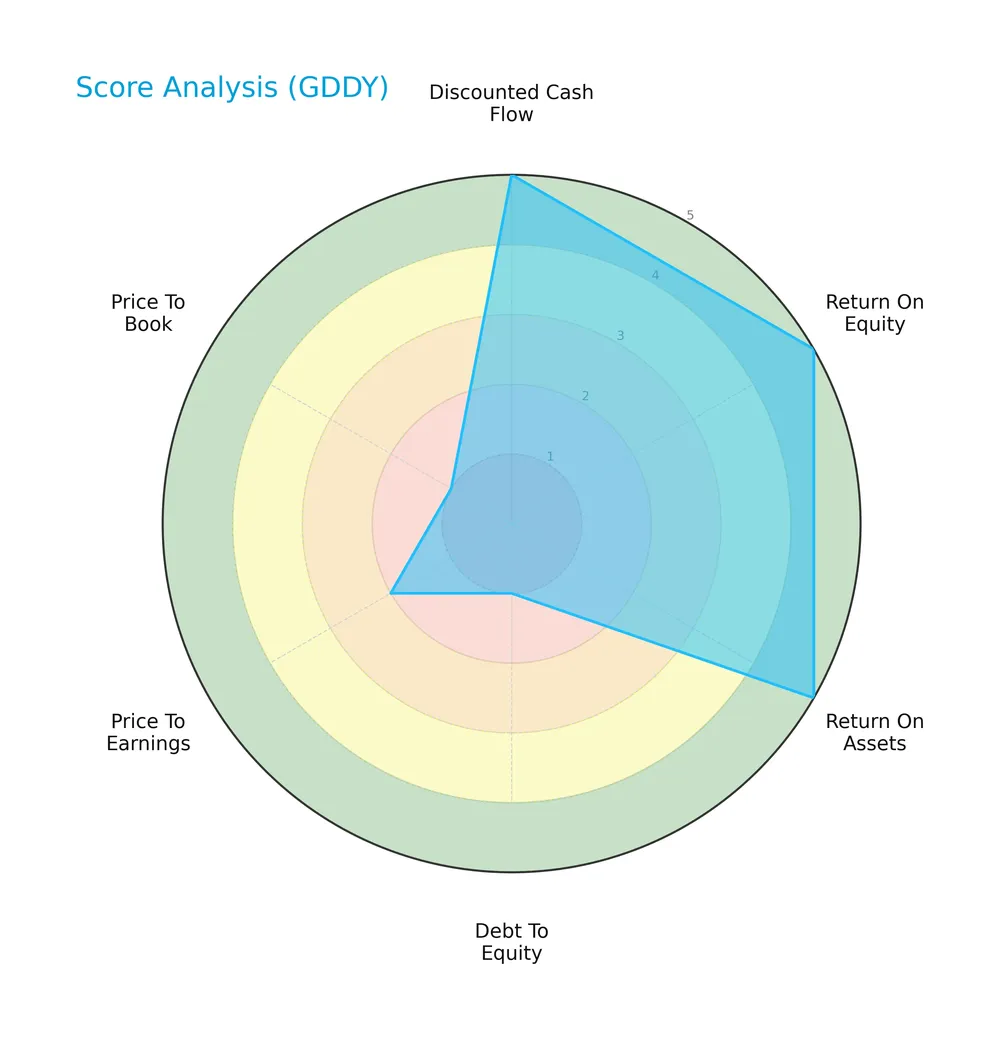
GoDaddy scores very favorably on discounted cash flow, return on equity, and return on assets, each rated 5. However, its debt-to-equity ratio is very unfavorable at 1, and valuation multiples like price-to-earnings and price-to-book rates are also weak at 2 and 1 respectively.
Analysis of the company’s bankruptcy risk
GoDaddy’s Altman Z-Score places it in the distress zone, signaling a high risk of financial distress and potential bankruptcy:

Is the company in good financial health?
The Piotroski Score diagram highlights GoDaddy’s strong financial health based on profitability, leverage, and efficiency factors:

With a very strong Piotroski score of 8, the company demonstrates robust financial strength, suggesting solid fundamentals despite some leverage concerns.
Competitive Landscape & Sector Positioning
This section analyzes GoDaddy Inc.’s position within the technology sector, focusing on its strategic positioning and product segments. I will assess whether GoDaddy holds a competitive advantage over its main competitors.
Strategic Positioning
GoDaddy concentrates on cloud-based infrastructure with a diversified product suite spanning domains, hosting, security, marketing, and commerce solutions. Its revenue mix shows significant growth in Core Platform and Applications & Commerce segments, with a strong U.S. base complemented by expanding international sales.
Revenue by Segment
The pie chart illustrates GoDaddy Inc.’s revenue distribution by product segment for the fiscal year 2024, highlighting the relative contributions of Core Platform and Applications And Commerce.
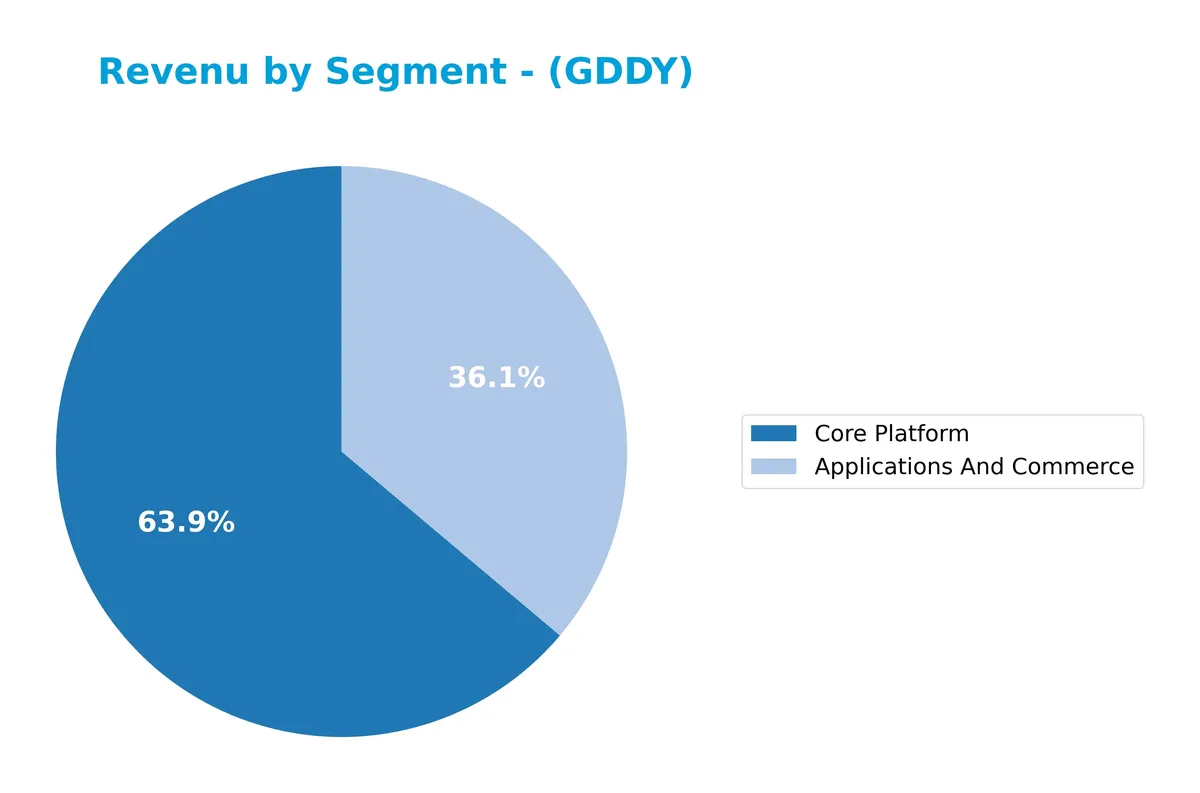
Core Platform dominates GoDaddy’s revenue with $2.9B in 2024, showing steady growth from $1.9B in 2022. Applications And Commerce nearly doubled from $795M in 2022 to $1.65B in 2024, reflecting accelerated expansion. The company has clearly shifted from its older domain and hosting segments to platform-centric services, increasing revenue concentration in these two segments. This signals focused capital allocation on scalable, higher-margin business lines.
Key Products & Brands
The following table summarizes GoDaddy Inc.’s key products and brands with brief descriptions:
| Product | Description |
|---|---|
| Domain Name Registration | Enables customers to establish a digital identity by registering domain names. |
| Shared Website Hosting | Offers web analytics, SSL certificates, WordPress, and other applications for hosted sites. |
| Virtual Private & Dedicated Servers | Provides server configurations tailored to customer applications and growth needs. |
| Managed Hosting | Includes setup, monitoring, maintenance, security, and patching of software and servers. |
| Security Products | Suite of tools designed to secure customers’ online presence. |
| Websites + Marketing | DIY mobile-optimized website builder with e-commerce capabilities and marketing tools. |
| Search Engine Optimization | Helps customers improve website visibility on search engines. |
| Social Media Management | Services to manage and engage customers through social channels. |
| Business Applications | Includes Microsoft Office 365, email accounts, email marketing, and Internet telephony. |
| Online Store Capabilities | Enables direct business transactions on customer websites. |
| GoDaddy Payments & POS | Payment facilitator services and point-of-sale devices and software. |
GoDaddy’s product suite spans domain registration, hosting, security, marketing, and business applications. This broad offering supports small businesses and individuals in building and securing their digital presence while enabling e-commerce and customer engagement.
Main Competitors
There are 32 competitors in the Technology – Software Infrastructure sector; here are the top 10 leaders by market capitalization:
| Competitor | Market Cap. |
|---|---|
| Microsoft Corporation | 3.5T |
| Oracle Corporation | 553B |
| Palantir Technologies Inc. | 383B |
| Adobe Inc. | 140B |
| Palo Alto Networks, Inc. | 120B |
| CrowdStrike Holdings, Inc. | 113B |
| Synopsys, Inc. | 92B |
| Cloudflare, Inc. | 69B |
| Fortinet, Inc. | 59B |
| Block, Inc. | 40B |
GoDaddy Inc. ranks 17th among 32 competitors in this sector. Its market cap represents just 0.36% of the leader, Microsoft. The company sits below both the average market cap of the top 10 competitors (508B) and the sector median (19B). It maintains a 65% market cap gap to its closest larger competitor, highlighting a significant scale difference.
Comparisons with competitors
Check out how we compare the company to its competitors:
Does GoDaddy have a competitive advantage?
GoDaddy presents a sustainable competitive advantage, evidenced by a ROIC exceeding WACC by 14.4% and a strong upward ROIC trend of 208%. This indicates efficient capital use and consistent value creation.
Looking ahead, GoDaddy’s broad portfolio—including domain registration, hosting, security, marketing tools, and payment solutions—positions it well for growth in small business digital services and international markets.
SWOT Analysis
This SWOT analysis highlights GoDaddy Inc.’s core strategic factors to guide investment decisions.
Strengths
- strong brand in domain registration
- growing ROIC at 22.4%, well above WACC
- diversified cloud-based product suite
Weaknesses
- low current and quick ratios at 0.61 signal liquidity risk
- very high price-to-book ratio at 77.8
- interest coverage near zero indicates debt servicing challenges
Opportunities
- expanding international market with 1.46B non-US revenue
- increasing demand for cloud and security services
- potential cross-selling via GoDaddy Payments and POS
Threats
- intense competition in software infrastructure
- technological disruption risk
- regulatory and cybersecurity threats
GoDaddy’s strong moat and international growth offer solid upside. However, liquidity constraints and valuation extremes require cautious capital allocation. Investors should weigh growth potential against financial risks carefully.
Stock Price Action Analysis
The weekly stock chart of GoDaddy Inc. (GDDY) illustrates price fluctuations and trend movements over the past 12 months:

Trend Analysis
Over the past 12 months, GoDaddy’s stock price declined by 26.71%, indicating a bearish trend. The price dropped from a high of 212.65 to a low of 89.12. Volatility is high, with a standard deviation of 29.56. The downward trend shows deceleration, signaling a slower pace of decline.
Volume Analysis
Trading volume is increasing, with a total of 866M shares traded in the analyzed period. Buyer volume slightly exceeds seller volume at 52%. However, in the recent three months, sellers dominated with 72% of volume, suggesting growing bearish sentiment and cautious market participation.
Target Prices
Analysts show a moderately bullish consensus for GoDaddy Inc. with a wide valuation range.
| Target Low | Target High | Consensus |
|---|---|---|
| 70 | 173 | 138.5 |
The target prices reflect optimism tempered by uncertainty. The consensus suggests upside potential near 20% from current levels.

Don’t Let Luck Decide Your Entry Point
Optimize your entry points with our advanced ProRealTime indicators. You’ll get efficient buy signals with precise price targets for maximum performance. Start outperforming now!
Analyst & Consumer Opinions
This section examines recent analyst ratings and consumer feedback to provide a balanced view of GoDaddy Inc.’s performance.
Stock Grades
Here are the latest verified analyst grades for GoDaddy Inc. from recognized financial institutions:
| Grading Company | Action | New Grade | Date |
|---|---|---|---|
| Jefferies | Maintain | Hold | 2026-02-23 |
| Benchmark | Maintain | Buy | 2026-02-23 |
| Morgan Stanley | Maintain | Equal Weight | 2026-01-15 |
| Cantor Fitzgerald | Maintain | Neutral | 2026-01-08 |
| Jefferies | Maintain | Hold | 2026-01-05 |
| JP Morgan | Maintain | Overweight | 2025-10-31 |
| Evercore ISI Group | Maintain | In Line | 2025-10-31 |
| B. Riley Securities | Maintain | Buy | 2025-10-31 |
| Citigroup | Maintain | Buy | 2025-10-31 |
| UBS | Maintain | Neutral | 2025-10-31 |
The consensus reflects a cautious but generally positive outlook, with the majority rating GoDaddy as a Buy or equivalent. Notably, all firms have maintained their previous grades, indicating a stable analyst sentiment without recent shifts.
Consumer Opinions
Consumer sentiment around GoDaddy Inc. reveals a mix of strong brand loyalty and some frustrations with service consistency.
| Positive Reviews | Negative Reviews |
|---|---|
| Fast and easy domain registration process. | Customer support response time can be slow. |
| Competitive pricing with frequent promotions. | Website interface sometimes feels cluttered. |
| Reliable uptime and solid performance for hosting. | Upselling during checkout feels aggressive. |
| Helpful knowledge base for DIY troubleshooting. | Limited flexibility on certain advanced features. |
Overall, customers appreciate GoDaddy’s ease of use and reliable hosting. However, recurring complaints about support delays and upselling tactics suggest areas for improvement in customer experience.
Risk Analysis
Below is a summary table outlining key risks facing GoDaddy Inc., categorized by type, with probability and impact assessments:
| Category | Description | Probability | Impact |
|---|---|---|---|
| Financial Health | Altman Z-Score at 1.35 signals distress zone risk of bankruptcy. | High | High |
| Liquidity | Current and quick ratios at 0.61 indicate weak short-term liquidity. | High | Medium |
| Valuation | Extremely high PB ratio of 77.82 suggests overvaluation risk. | Medium | Medium |
| Debt Structure | Debt-to-equity ratio is low at 0.36, reducing financial leverage risk. | Low | Low |
| Earnings Quality | Negative interest coverage raises concerns on debt servicing capacity. | Medium | High |
| Dividend Policy | No dividend yield may deter income-focused investors. | Medium | Low |
The most pressing risk is the financial distress indicated by the low Altman Z-Score, which historically correlates with higher bankruptcy probabilities in tech infrastructure firms. Despite strong operational metrics like ROIC (22.37%) and a robust Piotroski score of 8, liquidity constraints and poor interest coverage demand caution. The inflated price-to-book ratio signals speculative valuation, heightening downside risk if market sentiment shifts. Investors should weigh GoDaddy’s solid profitability against these red flags carefully.
Should You Buy GoDaddy Inc.?
GoDaddy Inc. appears to be profitable with growing ROIC, suggesting strong value creation and a durable moat. Despite a very unfavorable leverage profile and distress-zone Altman Z-score, its B+ rating reflects a balanced but cautious investment profile.
Strength & Efficiency Pillars
GoDaddy Inc. delivers operational strength with a robust net margin of 17.67% and an extraordinary return on equity at 406.79%. Its return on invested capital (ROIC) stands at 22.37%, comfortably above the weighted average cost of capital (WACC) of 7.99%. This signals that GoDaddy is a clear value creator, generating returns well in excess of its capital costs. The firm also benefits from a very favorable competitive moat, with a growing ROIC trend underscoring sustainable profitability.
Weaknesses and Drawbacks
GoDaddy finds itself in financial distress, evidenced by an Altman Z-Score of 1.35, placing it firmly in the distress zone and indicating heightened bankruptcy risk. The balance sheet shows vulnerability with a low current ratio of 0.61 and unfavorable liquidity metrics. Valuation concerns emerge from an extremely elevated price-to-book ratio of 77.82, suggesting overvaluation. Market pressure intensifies as recent trading is seller-dominant, with buyers representing only 27.81%, signaling short-term headwinds.
Our Final Verdict about GoDaddy Inc.
Despite GoDaddy’s strong operational margins and impressive returns, its distressed financial position, highlighted by the Altman Z-Score of 1.35, makes the investment profile highly speculative. The solvency risk overshadows profitability and growth, suggesting the stock may be too risky for conservative capital. Investors might consider waiting for clearer signs of financial stabilization before committing.
Disclaimer: This content is for informational purposes only and does not constitute financial, investment, or other professional advice. Investing in financial markets involves a significant risk of loss, and past performance is not indicative of future results.
Additional Resources
- GoDaddy Inc. Reports Fourth Quarter and Fiscal Year 2025 Financial Results – PR Newswire (Feb 24, 2026)
- GoDaddy Inc. (NYSE:GDDY) Stock Falls on Weak Q1 Revenue Guidance Despite Q4 EPS Beat – ChartMill (Feb 24, 2026)
- GoDaddy (GDDY) Stock Is Trending Overnight — Here’s What You Should Know – Benzinga (Feb 25, 2026)
- GoDaddy (GDDY) Surpasses Q4 Earnings and Revenue Estimates – Yahoo Finance (Feb 25, 2026)
- GoDaddy (GDDY) Stock Is Trending Overnight – Here’s What You Should Know – Bitget (Feb 25, 2026)
For more information about GoDaddy Inc., please visit the official website: godaddy.com