In the fast-evolving technology sector, Zscaler, Inc. and Veritone, Inc. stand out as innovators in software infrastructure, yet they approach the market with distinct strategies. Zscaler focuses on cloud security, safeguarding enterprise access and digital experiences, while Veritone leverages artificial intelligence to transform data insights across industries. This comparison will help investors discern which company offers the most compelling opportunity in today’s dynamic tech landscape. Let’s explore which is the better pick for your portfolio.
Table of contents
Companies Overview
I will begin the comparison between Zscaler and Veritone by providing an overview of these two companies and their main differences.
Zscaler Overview
Zscaler, Inc. operates globally as a cloud security provider, offering solutions that secure access to externally managed applications, including SaaS and Internet destinations. Its platform also supports workload segmentation and digital experience monitoring, targeting diverse industries such as financial services, healthcare, and telecommunications. Founded in 2007 and headquartered in San Jose, California, Zscaler is positioned as a key player in the software infrastructure sector with a market cap of 34B USD.
Veritone Overview
Veritone, Inc. is a U.S.-based technology company specializing in artificial intelligence computing solutions through its aiWARE platform, which applies machine learning for data insights across media, government, and legal sectors. The company also offers media advertising agency services. Incorporated in 2014 and headquartered in Denver, Colorado, Veritone operates within the software infrastructure industry with a market cap of approximately 225M USD and a smaller workforce compared to Zscaler.
Key similarities and differences
Both Zscaler and Veritone operate in the technology sector under the software infrastructure industry, focusing on innovative solutions involving cloud and AI technologies. Zscaler emphasizes cloud security and workload segmentation, while Veritone centers on AI-driven data analysis and media services. Notably, Zscaler’s market capitalization and employee count are significantly larger, reflecting its broader market reach and enterprise scale compared to Veritone’s more specialized AI platform and service offerings.
Income Statement Comparison
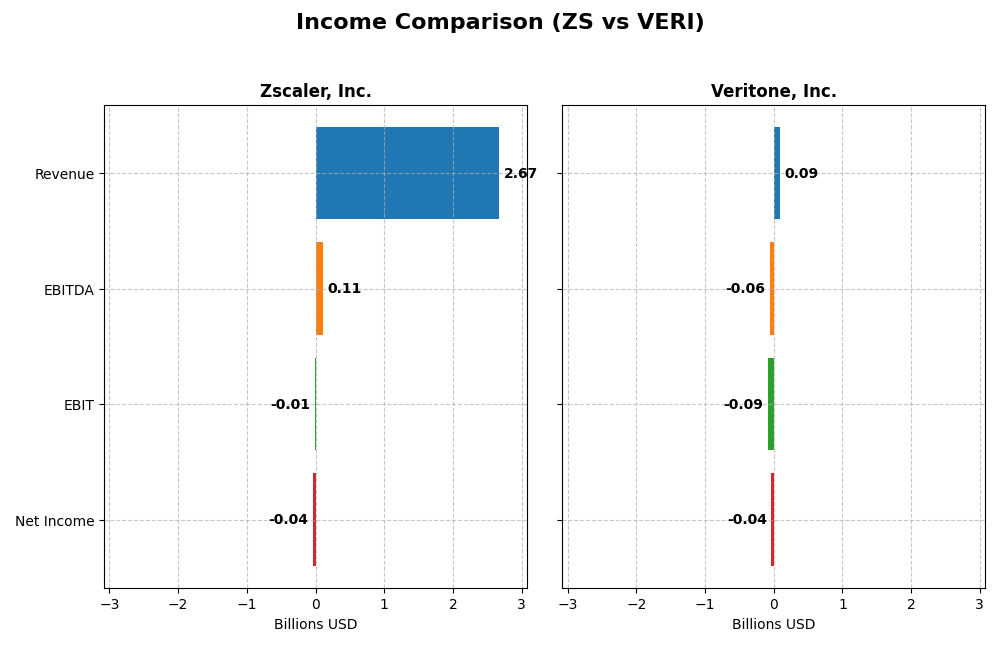
The table below presents a side-by-side comparison of the latest fiscal year income statement metrics for Zscaler, Inc. and Veritone, Inc., highlighting key financial performance indicators.
| Metric | Zscaler, Inc. (ZS) | Veritone, Inc. (VERI) |
|---|---|---|
| Market Cap | 34.1B | 225M |
| Revenue | 2.67B | 93M |
| EBITDA | 112M | -59M |
| EBIT | -8.8M | -88M |
| Net Income | -41M | -37M |
| EPS | -0.27 | -0.98 |
| Fiscal Year | 2025 | 2024 |
Income Statement Interpretations
Zscaler, Inc.
Zscaler, Inc. showed robust revenue growth from 2021 to 2025, increasing from $673M to $2.67B, with net income losses narrowing significantly from -$262M to -$41M. Gross margin remained strong at 76.87%, while EBIT and net margins stayed negative but improved. The 2025 fiscal year marked favorable growth in revenue (+23.3%) and net margin (+41.7%), indicating margin improvement and operational progress.
Veritone, Inc.
Veritone, Inc. experienced revenue growth overall from $57.7M in 2020 to $92.6M in 2024 but saw a decline of 7.35% in the last year. Net income remained negative, though the net margin improved by 31.2% in 2024, despite an unfavorable EBIT margin of -95.13%. Gross margin was stable at 70.58%, but high interest expenses and operating losses persisted, reflecting ongoing profitability challenges.
Which one has the stronger fundamentals?
Zscaler presents stronger fundamentals with significantly larger scale, higher gross margin, and consistent revenue and net income improvement over five years. Although both companies report losses, Zscaler’s narrowing losses and positive margin trends contrast with Veritone’s smaller scale and more volatile profitability. Zscaler’s income statement shows a higher proportion of favorable metrics, indicating more stable operational performance.
Financial Ratios Comparison
The table below presents the most recent key financial ratios for Zscaler, Inc. (ZS) and Veritone, Inc. (VERI), providing a snapshot of their financial health and performance as of fiscal year 2025 for ZS and 2024 for VERI.
| Ratios | Zscaler, Inc. (ZS) | Veritone, Inc. (VERI) |
|---|---|---|
| ROE | -2.31% | -277.91% |
| ROIC | -3.18% | -58.27% |
| P/E | -1063 | -3.34 |
| P/B | 24.51 | 9.27 |
| Current Ratio | 2.01 | 0.97 |
| Quick Ratio | 2.01 | 0.97 |
| D/E (Debt-to-Equity) | 1.00 | 8.91 |
| Debt-to-Assets | 27.98% | 60.54% |
| Interest Coverage | -13.49 | -7.31 |
| Asset Turnover | 0.42 | 0.47 |
| Fixed Asset Turnover | 4.22 | 8.51 |
| Payout ratio | 0 | 0 |
| Dividend yield | 0 | 0 |
Interpretation of the Ratios
Zscaler, Inc.
Zscaler exhibits a mixed ratio profile with favorable liquidity ratios (current and quick ratios at 2.01) and a strong fixed asset turnover of 4.22. However, profitability ratios such as net margin (-1.55%), ROE (-2.31%), and ROIC (-3.18%) are unfavorable, alongside a high price-to-book ratio of 24.51. The company does not pay dividends, reflecting a focus on reinvestment and growth rather than shareholder returns.
Veritone, Inc.
Veritone shows weak financial ratios overall, with significant unfavorable metrics including net margin (-40.36%), ROE (-277.91%), ROIC (-58.27%), and a high debt-to-equity ratio of 8.91. Liquidity is also a concern, with a current ratio below 1 at 0.97. Veritone does not pay dividends, likely due to ongoing losses and a focus on development and strategic investments.
Which one has the best ratios?
Between the two, Zscaler demonstrates a stronger liquidity position and a more balanced ratio profile despite some profitability weaknesses. Veritone’s ratios are broadly unfavorable, especially its leverage and profitability measures, indicating higher financial risk. Thus, Zscaler’s ratios are comparatively more favorable in this analysis.
Strategic Positioning
This section compares the strategic positioning of Zscaler and Veritone, including Market position, Key segments, and Exposure to technological disruption:
Zscaler, Inc.
- Leading cloud security provider with strong market cap and moderate beta, facing competitive software infrastructure market.
- Focuses on cloud security solutions across industries including SaaS, data centers, and public clouds, driving revenue with cloud-based platforms.
- Positioned in cloud security with evolving digital experience and workload segmentation but must adapt to rapid cloud security tech changes.
Veritone, Inc.
- Smaller AI platform company with high beta, operating in competitive software infrastructure industry.
- Diverse AI computing solutions including media advertising and managed services across multiple verticals.
- AI-driven platform exposed to fast-evolving AI technology and media analytics disruption risks.
Zscaler vs Veritone Positioning
Zscaler has a concentrated focus on cloud security with a large market presence and diversified industry applications, while Veritone pursues a more diversified AI and media services approach but with smaller scale and narrower market capitalization.
Which has the best competitive advantage?
Based on MOAT evaluation, both companies are shedding value, but Zscaler shows a growing ROIC trend indicating improving profitability, whereas Veritone faces declining ROIC and very unfavorable profitability trends, suggesting Zscaler has a comparatively stronger competitive advantage.
Stock Comparison
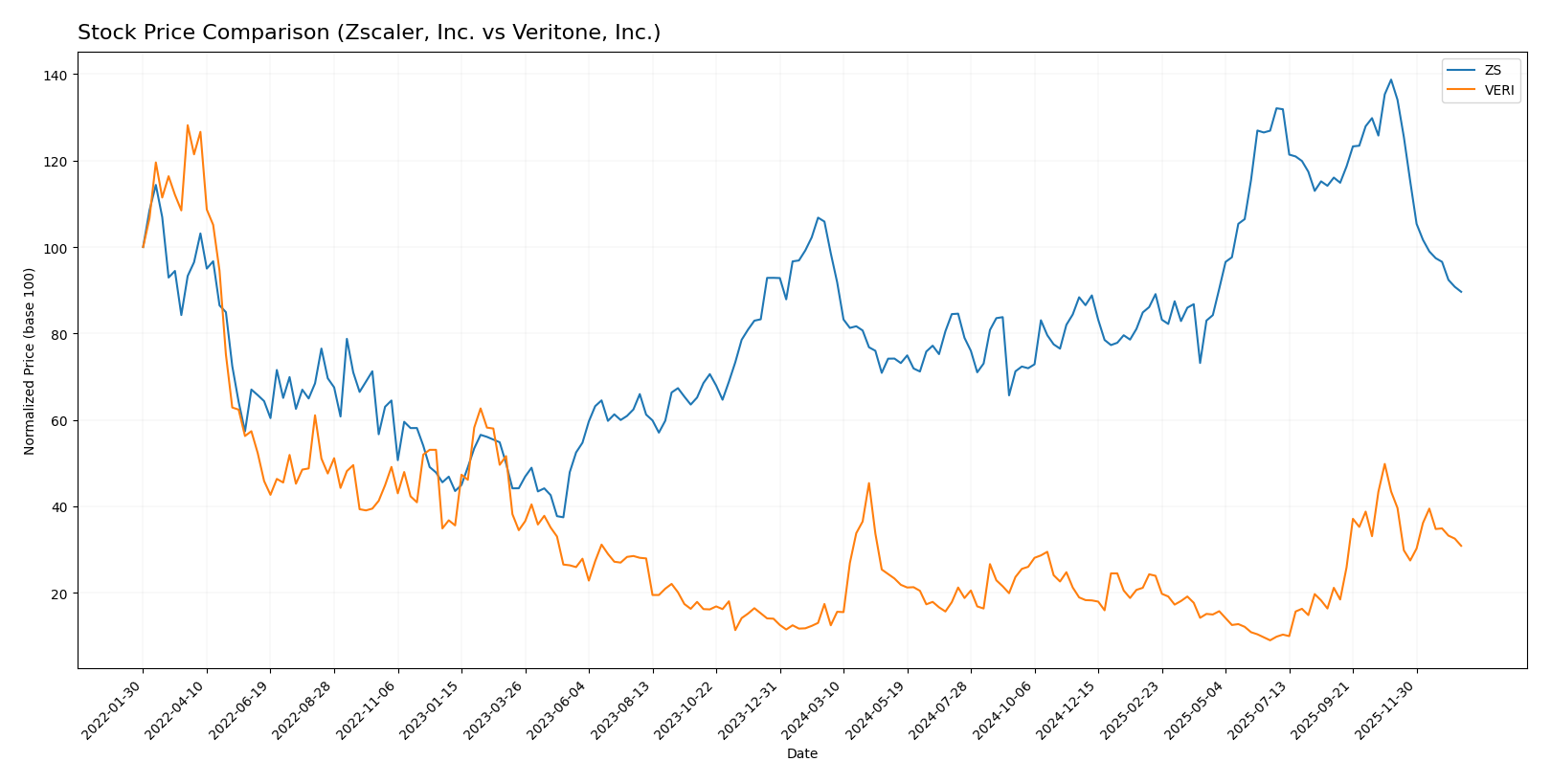
The following chart illustrates the stock price movements of Zscaler, Inc. (ZS) and Veritone, Inc. (VERI) over the past 12 months, highlighting significant directional trends and trading dynamics for both equities.
Trend Analysis
Zscaler, Inc. exhibited a bearish trend over the past year with a price decline of 9.03%, accompanied by decelerating downward momentum and high volatility, reflected in a 47.11 standard deviation. The stock reached a high of 331.14 and a low of 156.78.
Veritone, Inc. showed a bullish trend with a 147.22% price increase over the same period, despite decelerating growth and low volatility at 1.26 standard deviation. The stock’s price ranged between 1.3 and 7.18.
Comparatively, Veritone delivered the highest market performance with substantial gains, while Zscaler faced a notable decline, indicating divergent investor sentiment and market outcomes for these two stocks.
Target Prices
The current analyst consensus for target prices reveals a moderate upside potential for both Zscaler, Inc. and Veritone, Inc.
| Company | Target High | Target Low | Consensus |
|---|---|---|---|
| Zscaler, Inc. | 360 | 260 | 311.41 |
| Veritone, Inc. | 10 | 9 | 9.5 |
Analysts expect Zscaler’s stock to appreciate from its current price of $213.98 toward a consensus target of $311.41, indicating strong growth potential. Veritone’s consensus target of $9.5 also suggests significant upside from its current $4.45 price.
Analyst Opinions Comparison
This section compares analysts’ ratings and grades for Zscaler, Inc. and Veritone, Inc.:
Rating Comparison
ZS Rating
- Rating: C- with a very favorable status.
- Discounted Cash Flow Score: 4, indicating favorable future cash flow prospects.
- ROE Score: 1, classified as very unfavorable in generating profit from equity.
- ROA Score: 1, very unfavorable efficiency in asset utilization.
- Debt To Equity Score: 1, very unfavorable financial risk profile.
- Overall Score: 1, very unfavorable overall financial standing.
VERI Rating
- Rating: C with a very favorable status.
- Discounted Cash Flow Score: 5, indicating very favorable future cash flow prospects.
- ROE Score: 1, classified as very unfavorable in generating profit from equity.
- ROA Score: 1, very unfavorable efficiency in asset utilization.
- Debt To Equity Score: 1, very unfavorable financial risk profile.
- Overall Score: 2, moderate overall financial standing.
Which one is the best rated?
Veritone, Inc. holds a slightly better overall rating and financial standing with a moderate overall score of 2 compared to Zscaler’s very unfavorable score of 1. Veritone also scores higher on discounted cash flow, indicating stronger valuation prospects.
Scores Comparison
Here is a comparison of the Altman Z-Score and Piotroski Score for the two companies:
ZS Scores
- Altman Z-Score: 4.89, indicating a safe zone from bankruptcy risk.
- Piotroski Score: 3, classified as very weak financial strength.
VERI Scores
- Altman Z-Score: -0.07, indicating a distress zone with high bankruptcy risk.
- Piotroski Score: 3, also classified as very weak financial strength.
Which company has the best scores?
ZS exhibits a significantly stronger Altman Z-Score, placing it in the safe zone, unlike VERI in distress. Both have equally weak Piotroski Scores, indicating financial weakness despite ZS’s better bankruptcy risk profile.
Grades Comparison
Here is a comparison of the latest grades issued by recognized grading companies for Zscaler, Inc. and Veritone, Inc.:
Zscaler, Inc. Grades
The table below shows recent grades assigned by established financial institutions for Zscaler, Inc.:
| Grading Company | Action | New Grade | Date |
|---|---|---|---|
| Citigroup | Maintain | Buy | 2026-01-13 |
| Keybanc | Maintain | Overweight | 2026-01-12 |
| Piper Sandler | Maintain | Neutral | 2026-01-05 |
| RBC Capital | Maintain | Outperform | 2026-01-05 |
| Mizuho | Upgrade | Outperform | 2025-12-16 |
| Bernstein | Downgrade | Market Perform | 2025-12-01 |
| Citigroup | Maintain | Buy | 2025-12-01 |
| JP Morgan | Maintain | Overweight | 2025-11-26 |
| Baird | Maintain | Outperform | 2025-11-26 |
| BTIG | Maintain | Buy | 2025-11-26 |
Zscaler’s grades predominantly indicate a positive outlook with multiple buy and outperform ratings, though there was a recent downgrade to market perform.
Veritone, Inc. Grades
Below is the table of recent grades for Veritone, Inc. from a key grading institution:
| Grading Company | Action | New Grade | Date |
|---|---|---|---|
| D. Boral Capital | Maintain | Buy | 2025-12-09 |
| D. Boral Capital | Maintain | Buy | 2025-12-04 |
| Needham | Maintain | Buy | 2025-12-02 |
| D. Boral Capital | Maintain | Buy | 2025-12-02 |
| D. Boral Capital | Maintain | Buy | 2025-11-07 |
| D. Boral Capital | Maintain | Buy | 2025-10-28 |
| HC Wainwright & Co. | Maintain | Buy | 2025-10-20 |
| D. Boral Capital | Maintain | Buy | 2025-10-15 |
| D. Boral Capital | Maintain | Buy | 2025-09-24 |
| D. Boral Capital | Maintain | Buy | 2025-09-09 |
Veritone’s ratings consistently maintain a buy status from D. Boral Capital and other recognized firms, signaling steady analyst confidence.
Which company has the best grades?
Zscaler, Inc. shows a broader diversity of ratings including buy, outperform, and overweight grades, while Veritone, Inc. has uniform buy ratings predominantly from one grading firm. Zscaler’s varied strong grades could indicate wider analyst support, which may influence investor sentiment differently compared to Veritone’s consistent but less varied ratings.
Strengths and Weaknesses
Below is a comparison of key strengths and weaknesses for Zscaler, Inc. (ZS) and Veritone, Inc. (VERI) based on the most recent financial and operational data.
| Criterion | Zscaler, Inc. (ZS) | Veritone, Inc. (VERI) |
|---|---|---|
| Diversification | High revenue concentration in cloud security segment; limited diversification but strong niche focus. | More diversified product lines including licensing, managed services, and software products, but smaller scale. |
| Profitability | Negative net margin (-1.55%), ROIC -3.18%, but improving profitability trend. | Large negative net margin (-40.36%), ROIC -58.27%, and declining profitability trend. |
| Innovation | Strong innovation in cloud security solutions; growing ROIC indicates improving operational efficiency. | Innovation present but struggling to translate into profitability; high R&D costs and operational inefficiencies. |
| Global presence | Significant global footprint in cybersecurity market. | More limited global reach, primarily focused on US markets. |
| Market Share | Leading player in cloud security with $2.67B revenue in 2025. | Smaller market share with $61M in software products and services in 2024. |
Key takeaway: Zscaler shows stronger market position and improving profitability despite current value destruction, whereas Veritone faces significant profitability and operational challenges with a more limited scale and declining financial health. Investors should weigh Zscaler’s growth potential against its current losses and be cautious with Veritone due to its unfavorable financial ratios and shrinking returns.
Risk Analysis
Below is a comparison table highlighting key risks for Zscaler, Inc. (ZS) and Veritone, Inc. (VERI) based on the most recent data from 2025 and 2024 respectively:
| Metric | Zscaler, Inc. (ZS) | Veritone, Inc. (VERI) |
|---|---|---|
| Market Risk | Beta 1.02, moderate market sensitivity | Beta 2.05, high market volatility risk |
| Debt level | Debt-to-Equity 1.0 (neutral), Debt-to-Assets 28% (favorable) | Debt-to-Equity 8.91 (unfavorable), Debt-to-Assets 61% (high leverage) |
| Regulatory Risk | Moderate, cloud security industry subject to data/privacy regulations | Moderate, AI sector faces evolving regulatory scrutiny |
| Operational Risk | Scaling challenges, high employee base (7,348) | Smaller scale (469 employees), but high operational leverage |
| Environmental Risk | Low, technology sector with limited direct environmental impact | Low, similar sector with limited direct impact |
| Geopolitical Risk | US-based, global customer base, moderate exposure | US and UK markets, potential exposure to geopolitical tensions |
In synthesis, Veritone faces the most significant financial risk due to its very high debt levels and unfavorable liquidity ratios, which increase its vulnerability to market downturns and interest rate hikes. Zscaler, while having a more stable balance sheet and safer Altman Z-Score, still shows slightly unfavorable profitability and efficiency metrics, suggesting operational risks. Both companies are exposed to regulatory risks inherent in technology sectors, but Veritone’s high market beta and financial distress indicators make it riskier for conservative investors.
Which Stock to Choose?
Zscaler, Inc. (ZS) shows strong income growth with a 297% revenue increase over five years and generally favorable income statement metrics despite a slightly unfavorable net margin and profitability ratios. The company maintains a solid current ratio of 2.01 and manageable debt, but its return on invested capital is below WACC, indicating value destruction with improving profitability. Its overall rating is very favorable, supported by a safe zone Altman Z-Score but a weak Piotroski score.
Veritone, Inc. (VERI) displays mixed income trends, with a 60.5% revenue growth overall but recent declines and weak profitability metrics, including a highly negative net margin and return on equity. Financial ratios are largely unfavorable, featuring high debt levels and low liquidity. The company is assessed as very unfavorable in moat terms, shedding value with declining profitability. Its rating is very favorable but with moderate overall scores and a distress zone Altman Z-Score.
Investors focused on growth and improving profitability might find Zscaler’s improving income trends and stable financial position more attractive, while those considering speculative opportunities with recent price appreciation could regard Veritone’s bullish price trend as noteworthy despite its financial challenges. Risk-tolerant investors may see potential in either, but risk-averse profiles could view Zscaler’s safer financial footing as more suitable.
Disclaimer: Investment carries a risk of loss of initial capital. The past performance is not a reliable indicator of future results. Be sure to understand risks before making an investment decision.
Go Further
I encourage you to read the complete analyses of Zscaler, Inc. and Veritone, Inc. to enhance your investment decisions: