In the dynamic world of specialty retail, PDD Holdings Inc. and eBay Inc. stand out as two prominent e-commerce giants with distinct strategies and market footprints. PDD, known for its innovative platforms like Pinduoduo and Temu, focuses on integrating businesses and consumers into the digital economy, while eBay has long been a leader in online marketplaces connecting buyers and sellers globally. This article will explore their competitive edges and growth potential to help you decide which company merits a place in your investment portfolio.

Table of contents
Companies Overview
I will begin the comparison between PDD Holdings Inc. and eBay Inc. by providing an overview of these two companies and their main differences.
PDD Holdings Inc. Overview
PDD Holdings Inc. is a multinational commerce group operating a portfolio of businesses that includes Pinduoduo and Temu, e-commerce platforms offering a wide range of products from agricultural produce to electronics. The company focuses on integrating businesses and consumers into the digital economy. Founded in 2015 and headquartered in Dublin, Ireland, PDD has established itself in the specialty retail sector with a market cap of approximately 169B USD.
eBay Inc. Overview
eBay Inc. operates global marketplace platforms connecting buyers and sellers through its website and mobile apps. Its services enable transactions across various online and offline channels, including retailers and distributors. Founded in 1995 and based in San Jose, California, eBay is a well-established player in the specialty retail industry with a market cap near 41B USD, employing around 11,500 people.
Key similarities and differences
Both PDD Holdings and eBay operate within the specialty retail sector, focusing on online marketplaces that facilitate commerce between buyers and sellers. PDD emphasizes broad category coverage and integration into the digital economy, while eBay centers on a diverse marketplace platform connecting multiple commerce participants. PDD’s market cap and employee base are significantly larger, reflecting its rapid growth since 2015 compared to eBay’s longer-established presence since 1995.
Income Statement Comparison
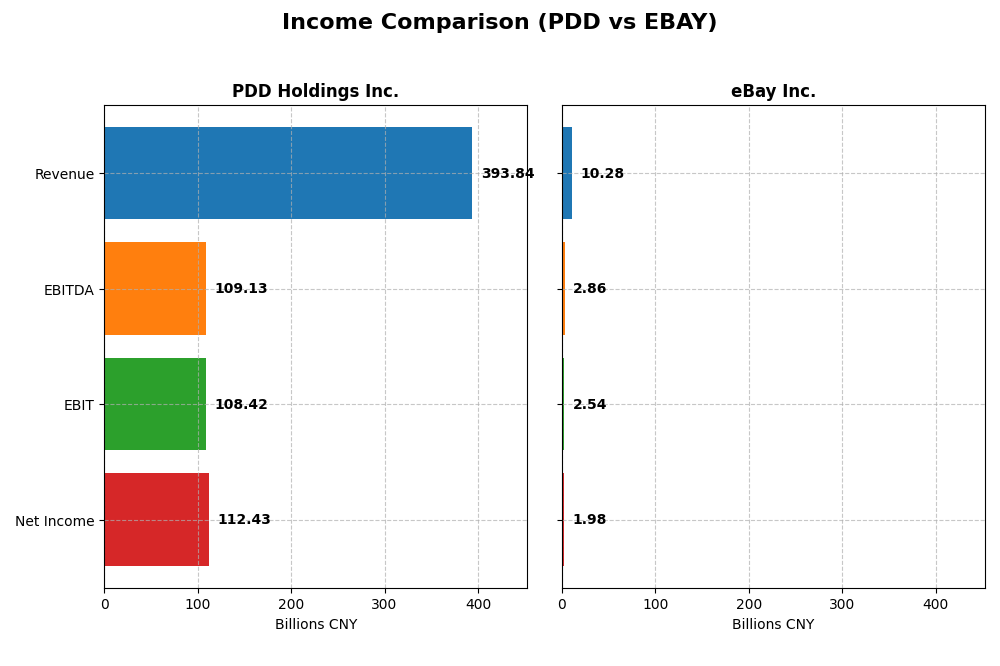
The table below presents a side-by-side comparison of key income statement metrics for PDD Holdings Inc. and eBay Inc. for the fiscal year 2024, reflecting their latest reported financial results.
| Metric | PDD Holdings Inc. (CNY) | eBay Inc. (USD) |
|---|---|---|
| Market Cap | 169B | 41B |
| Revenue | 394B | 10.3B |
| EBITDA | 109B | 2.9B |
| EBIT | 108B | 2.5B |
| Net Income | 112B | 2.0B |
| EPS | 81.24 | 3.98 |
| Fiscal Year | 2024 | 2024 |
Income Statement Interpretations
PDD Holdings Inc.
PDD Holdings Inc. exhibited strong revenue and net income growth from 2020 to 2024, with revenue surging from 59.5B CNY to nearly 394B CNY. Margins remained robust and improved, with a gross margin of 60.92% and a net margin of 28.55% in 2024. The latest year showed accelerated growth, with revenue up 59% and net margin rising by 17.78%, reflecting solid operational efficiency.
eBay Inc.
eBay Inc.’s revenue showed modest growth over the same period, increasing from 8.9B USD in 2020 to 10.3B USD in 2024, though net income declined significantly. Margins were stable but with a lower net margin of 19.21% in 2024. The most recent year experienced a slight revenue increase of 1.69%, but net income and EPS fell sharply, indicating challenges in profitability and margin management.
Which one has the stronger fundamentals?
PDD Holdings demonstrates stronger fundamentals with vigorous revenue and net income growth paired with improving margins and zero interest expense, signaling efficient cost control and profitable expansion. In contrast, eBay shows mixed results with stable but lower margins and declining net income, reflecting less favorable profitability trends and growth challenges over the period.
Financial Ratios Comparison
The table below compares key financial ratios for PDD Holdings Inc. and eBay Inc. based on their latest fiscal year data from 2024.
| Ratios | PDD Holdings Inc. | eBay Inc. |
|---|---|---|
| ROE | 35.9% | 38.3% |
| ROIC | 28.4% | 13.4% |
| P/E | 8.7 | 15.6 |
| P/B | 3.13 | 5.96 |
| Current Ratio | 2.21 | 1.24 |
| Quick Ratio | 2.20 | 1.24 |
| D/E (Debt-to-Equity) | 0.034 | 1.52 |
| Debt-to-Assets | 2.1% | 40.6% |
| Interest Coverage | 0 (not meaningful) | 8.95 |
| Asset Turnover | 0.78 | 0.53 |
| Fixed Asset Turnover | 66.3 | 6.08 |
| Payout ratio | 0% | 27.0% |
| Dividend yield | 0% | 1.73% |
Interpretation of the Ratios
PDD Holdings Inc.
PDD displays overall strong financial ratios with a high net margin of 28.55%, ROE at 35.89%, and ROIC of 28.35%, signaling efficient profitability and capital use. Its current and quick ratios exceed 2, indicating solid short-term liquidity, though a relatively high price-to-book ratio at 3.13 may concern value investors. PDD does not pay dividends, likely prioritizing reinvestment and growth.
eBay Inc.
eBay shows favorable profitability ratios, with a net margin of 19.21% and an impressive ROE of 38.29%, but a moderate ROIC of 13.39%. Liquidity is average, with a current ratio of 1.24 and a debt-to-equity ratio of 1.52 posing some leverage concerns. eBay pays dividends with a 1.73% yield, supported by a reasonable interest coverage ratio of 9.8, reflecting manageable financial obligations.
Which one has the best ratios?
PDD’s ratios are generally more favorable, boasting superior profitability, liquidity, and low leverage, despite a high valuation metric in price-to-book. eBay’s strengths lie in its high ROE and dividend payments, but its leverage and neutral liquidity ratios temper the overall picture. Therefore, PDD holds a clearer edge in fundamental ratio quality.
Strategic Positioning
This section compares the strategic positioning of PDD Holdings Inc. and eBay Inc., focusing on Market position, Key segments, and Exposure to technological disruption:
PDD Holdings Inc.
- Large market cap of 168B USD, low beta, competing in specialty retail with significant growth potential.
- Key segments include online marketing services and transaction services, driven by platforms like Pinduoduo and Temu.
- Operates digital commerce platforms focusing on integrating businesses and consumers into the digital economy.
eBay Inc.
- Market cap of 41B USD, higher beta, well-established in specialty retail and marketplace segments.
- Main revenue from marketplaces and advertising, connecting buyers and sellers globally via multiple channels.
- Marketplace platform reliant on online and mobile channels, with exposure to evolving e-commerce technologies.
PDD Holdings Inc. vs eBay Inc. Positioning
PDD pursues a diversified e-commerce portfolio through multiple platforms and broad product categories, while eBay concentrates on marketplace services connecting global buyers and sellers. PDD’s larger scale contrasts with eBay’s established international marketplace presence.
Which has the best competitive advantage?
Both companies demonstrate a very favorable moat with growing ROIC. PDD shows a stronger value creation and ROIC growth, indicating a more durable competitive advantage compared to eBay’s moderate ROIC improvement.
Stock Comparison
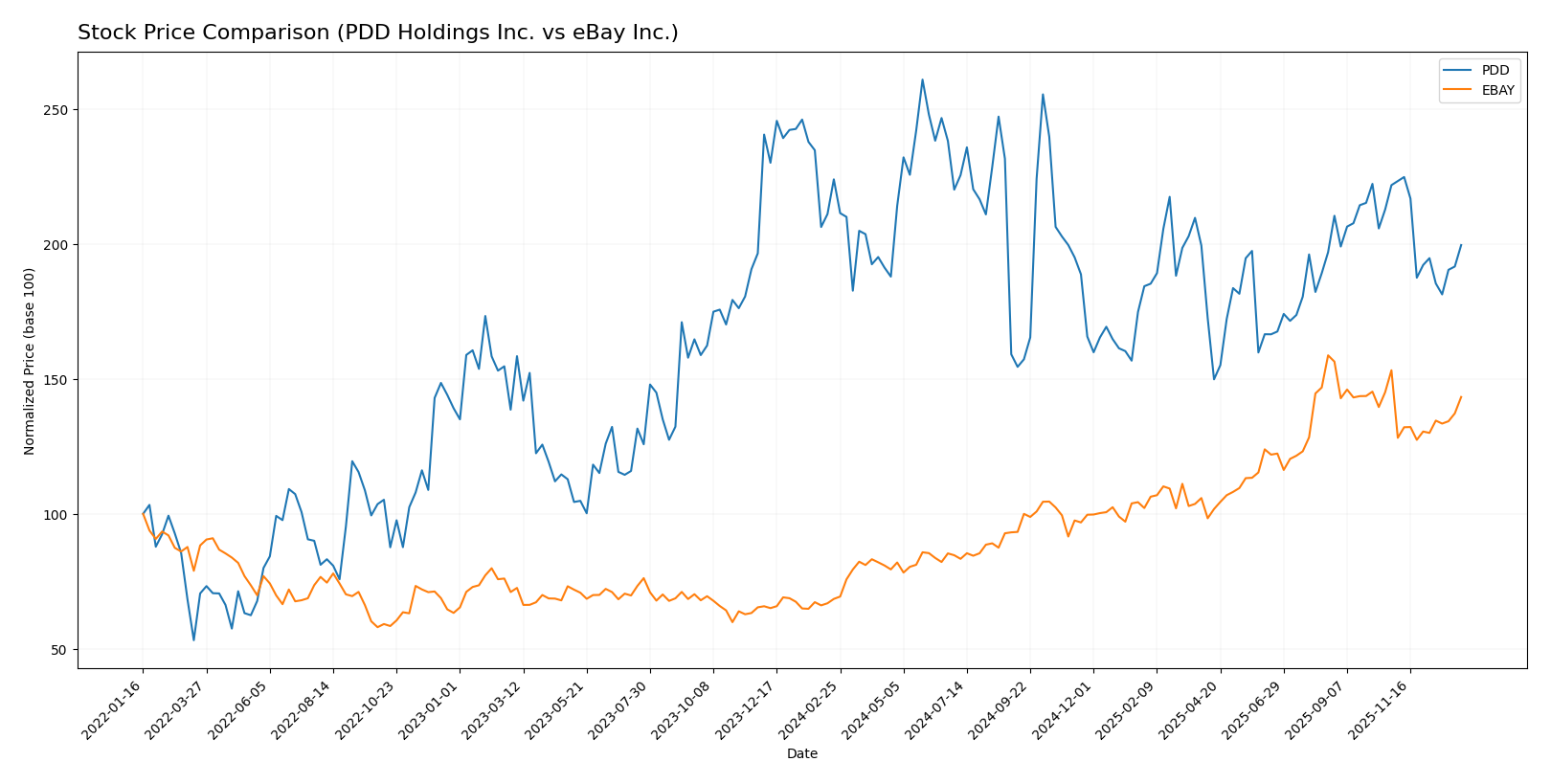
The stock prices of PDD Holdings Inc. and eBay Inc. have exhibited markedly different trajectories over the past 12 months, with eBay showing significant gains while PDD experienced a decline, reflecting contrasting market dynamics and trading volumes.
Trend Analysis
PDD Holdings Inc. recorded a bearish trend with a price decrease of -10.88% over the past year, accompanied by a deceleration in decline and notable volatility, as indicated by a 15.64 standard deviation and a price range from 90.5 to 157.57.
eBay Inc. demonstrated a strong bullish trend with a 109.23% price increase over the same period, despite decelerating growth and a standard deviation of 14.19, with prices fluctuating between 43.45 and 100.7.
Comparing both stocks, eBay delivered the highest market performance with a substantial positive return, while PDD showed a significant negative trend, highlighting a clear divergence in their yearly stock trajectories.
Target Prices
Analysts present a clear consensus on target prices for PDD Holdings Inc. and eBay Inc., indicating moderate upside potential.
| Company | Target High | Target Low | Consensus |
|---|---|---|---|
| PDD Holdings Inc. | 170 | 120 | 147.29 |
| eBay Inc. | 115 | 65 | 96.69 |
The consensus target for PDD at 147.29 suggests upside from its current price of 120.55, while eBay’s target consensus of 96.69 also indicates potential gains above its current 90.91. Both stocks show analyst optimism relative to their market prices.
Analyst Opinions Comparison
This section compares analysts’ ratings and grades for PDD Holdings Inc. and eBay Inc.:
Rating Comparison
PDD Rating
- Rating: A+ indicating a very favorable outlook.
- Discounted Cash Flow Score: 4, showing favorable valuation based on cash flow.
- ROE Score: 5, very favorable efficiency in generating profit from equity.
- ROA Score: 5, very favorable asset utilization for earnings.
- Debt To Equity Score: 5, very favorable low financial risk.
- Overall Score: 4, favorable overall financial standing.
EBAY Rating
- Rating: B+ indicating a very favorable outlook.
- Discounted Cash Flow Score: 3, showing a moderate valuation assessment.
- ROE Score: 5, very favorable efficiency in generating profit from equity.
- ROA Score: 5, very favorable asset utilization for earnings.
- Debt To Equity Score: 1, very unfavorable indicating higher financial risk.
- Overall Score: 3, moderate overall financial standing.
Which one is the best rated?
Based strictly on the data, PDD holds a higher overall rating (A+ vs. B+) and stronger scores in discounted cash flow and debt to equity, suggesting a more favorable financial profile than eBay.
Scores Comparison
Here is a comparison of the Altman Z-Score and Piotroski Score for both companies:
PDD Scores
- Altman Z-Score: 2.84, indicating a moderate risk in the grey zone.
- Piotroski Score: 6, classified as average financial strength.
EBAY Scores
- Altman Z-Score: 5.84, indicating strong financial safety in the safe zone.
- Piotroski Score: 6, classified as average financial strength.
Which company has the best scores?
EBAY has a clearly stronger Altman Z-Score, placing it in the safe zone, while PDD is in the grey zone. Both have the same average Piotroski Score of 6, indicating similar financial strength by that measure.
Grades Comparison
The following section compares the recent grades and rating trends of PDD Holdings Inc. and eBay Inc.:
PDD Holdings Inc. Grades
This table shows recent grades and actions from established grading companies for PDD Holdings Inc.:
| Grading Company | Action | New Grade | Date |
|---|---|---|---|
| Freedom Capital Markets | Maintain | Buy | 2026-01-06 |
| B of A Securities | Maintain | Neutral | 2025-11-19 |
| B of A Securities | Maintain | Neutral | 2025-08-26 |
| Barclays | Maintain | Overweight | 2025-08-26 |
| Benchmark | Maintain | Buy | 2025-08-26 |
| New Street Research | Downgrade | Neutral | 2025-08-26 |
| China Renaissance | Downgrade | Hold | 2025-05-28 |
| Benchmark | Maintain | Buy | 2025-05-28 |
| JP Morgan | Maintain | Neutral | 2025-05-28 |
| Jefferies | Maintain | Buy | 2025-05-27 |
PDD Holdings Inc. shows a majority of Buy and Neutral ratings, with some recent downgrades from Buy to Neutral and Hold, indicating mixed but generally positive sentiment.
eBay Inc. Grades
This table presents recent grades and rating actions from reputable grading companies for eBay Inc.:
| Grading Company | Action | New Grade | Date |
|---|---|---|---|
| Wells Fargo | Maintain | Equal Weight | 2026-01-08 |
| Truist Securities | Maintain | Hold | 2025-11-03 |
| Piper Sandler | Maintain | Overweight | 2025-10-30 |
| Barclays | Maintain | Overweight | 2025-10-30 |
| Wells Fargo | Maintain | Equal Weight | 2025-10-30 |
| Benchmark | Maintain | Buy | 2025-10-30 |
| UBS | Maintain | Neutral | 2025-10-30 |
| Needham | Maintain | Buy | 2025-10-30 |
| Cantor Fitzgerald | Maintain | Neutral | 2025-10-30 |
| Evercore ISI Group | Maintain | In Line | 2025-10-30 |
eBay Inc. receives a broad mix of Hold, Buy, Overweight, and Neutral ratings, with no recent changes, reflecting a stable but cautious outlook.
Which company has the best grades?
PDD Holdings Inc. holds a consensus Buy rating with more consistent Buy grades, while eBay Inc. shows a consensus Hold with more varied opinions. This suggests investors may perceive PDD as having stronger growth potential, whereas eBay is viewed with more caution, potentially influencing portfolio positioning and risk assessment.
Strengths and Weaknesses
Below is a comparison of key strengths and weaknesses of PDD Holdings Inc. and eBay Inc. based on their latest financial and operational data.
| Criterion | PDD Holdings Inc. | eBay Inc. |
|---|---|---|
| Diversification | Strong focus on online marketing and transaction services, rapidly growing revenue streams in both areas | Mainly marketplaces and advertising, less diversified revenue streams |
| Profitability | High net margin (28.55%), ROE (35.89%), and ROIC (28.35%), indicating efficient capital use and strong profitability | Favorable profitability with net margin (19.21%), ROE (38.29%), and ROIC (13.39%), but lower than PDD |
| Innovation | Demonstrates very favorable economic moat with strong ROIC growth (333%), indicating innovation and competitive advantage | Also has very favorable moat status but with modest ROIC growth (5.6%), suggesting slower innovation pace |
| Global presence | Large presence primarily in China with rapid growth in online marketing services | Established global marketplace presence, especially in North America and Europe |
| Market Share | Rapidly expanding market share in e-commerce and online marketing in Asia | Stable market share in global online marketplaces with strong brand recognition |
Key takeaways: PDD Holdings shows exceptional growth and profitability with strong innovation and capital efficiency, making it a compelling choice for investors seeking growth exposure. eBay offers a stable, moderately growing platform with a solid global footprint but slower innovation and diversification. Risk management favors PDD’s dynamic profile, while eBay suits investors prioritizing stability.
Risk Analysis
Below is a comparative risk table for PDD Holdings Inc. and eBay Inc. based on the most recent financial and market data from 2024 and 2026 insights.
| Metric | PDD Holdings Inc. | eBay Inc. |
|---|---|---|
| Market Risk | Very low beta (0.006) indicates minimal market volatility exposure | Higher beta (1.348) implies greater market sensitivity |
| Debt level | Extremely low debt-to-equity (0.03) and debt-to-assets (2.1%) | High debt-to-equity (1.52) and moderate debt-to-assets (40.6%) |
| Regulatory Risk | Moderate: operates internationally with exposure to varying regulations, especially in China | Moderate: US-based but global operations face regulatory scrutiny |
| Operational Risk | Moderate: rapid growth in e-commerce with integration challenges | Moderate: reliance on platform stability and competition pressures |
| Environmental Risk | Low: limited direct environmental impact, primarily digital commerce | Low to moderate: digital operations with some physical logistics impact |
| Geopolitical Risk | Moderate to high: exposure to China and international trade tensions | Moderate: US base with global exposure but less China-centric |
The most likely and impactful risks are PDD’s geopolitical exposure due to its China ties and eBay’s higher market volatility and debt burden. PDD’s very low beta and strong financial health mitigate market risk, but trade tensions could disrupt growth. eBay’s higher leverage increases financial risk despite a stable Altman Z-Score, highlighting caution for investors sensitive to debt levels.
Which Stock to Choose?
PDD Holdings Inc. shows strong income growth with a 59.04% revenue rise in 2024 and a highly favorable profitability profile, including a 28.55% net margin and 35.89% ROE. Its low debt, excellent liquidity, and very favorable rating (A+) reflect robust financial health.
eBay Inc. exhibits modest income growth with a 1.69% revenue increase in 2024 but faces unfavorable net margin and EPS trends. Despite a solid ROE of 38.29%, its higher debt levels and mixed financial ratios contribute to a slightly favorable overall rating (B+).
Considering ratings and financials, PDD might appeal to growth-oriented investors due to its strong profitability and financial stability, whereas eBay could be more suitable for risk-tolerant investors valuing established profitability amid leverage concerns.
Disclaimer: Investment carries a risk of loss of initial capital. The past performance is not a reliable indicator of future results. Be sure to understand risks before making an investment decision.
Go Further
I encourage you to read the complete analyses of PDD Holdings Inc. and eBay Inc. to enhance your investment decisions: