Home > Comparison > Technology > PLTR vs BBAI
The strategic rivalry between Palantir Technologies Inc. and BigBear.ai Holdings, Inc. shapes the evolution of the technology sector. Palantir excels as a software infrastructure powerhouse, delivering complex data integration platforms. In contrast, BigBear.ai operates as a specialized AI-driven information technology services provider, focusing on analytics and cybersecurity consulting. This analysis will dissect their contrasting operational models to identify which company presents a superior risk-adjusted opportunity for a diversified portfolio in today’s dynamic tech landscape.

Table of contents
Companies Overview
Palantir Technologies and BigBear.ai stand as pivotal players in the evolving AI and data analytics landscape.
Palantir Technologies Inc.: Data-Driven Intelligence Innovator
Palantir is a software infrastructure leader specializing in advanced data integration. It generates revenue primarily through its Gotham and Foundry platforms, which serve government and commercial clients by transforming complex data into actionable intelligence. In 2026, Palantir focuses strategically on expanding its AI-driven software ecosystem, including its Artificial Intelligence Platform, to enhance operational decision-making across sectors.
BigBear.ai Holdings, Inc.: AI-Powered Decision Support Specialist
BigBear.ai operates within information technology services, leveraging AI and machine learning to enable real-time decision support. Its revenue streams arise from two segments: Cyber & Engineering and Analytics, delivering consulting and predictive analytics solutions. The company’s 2026 strategy emphasizes deepening its foothold in cybersecurity and big data analytics to meet growing enterprise demand for integrated AI-driven insights.
Strategic Collision: Similarities & Divergences
Both companies harness AI to transform data into actionable insights but differ in approach. Palantir pursues a platform-centric, integrated software model, focusing on scalability and cross-sector application. BigBear.ai adopts a consulting-driven, service-oriented business, emphasizing tailored solutions in cybersecurity and analytics. Their primary battleground is the AI-enabled decision support market, where Palantir’s broad platform competes against BigBear.ai’s specialized services. These distinctions define unique risk and growth profiles for investors to consider.
Income Statement Comparison
The following data dissects the core profitability and scalability of both corporate engines to reveal who dominates the bottom line:
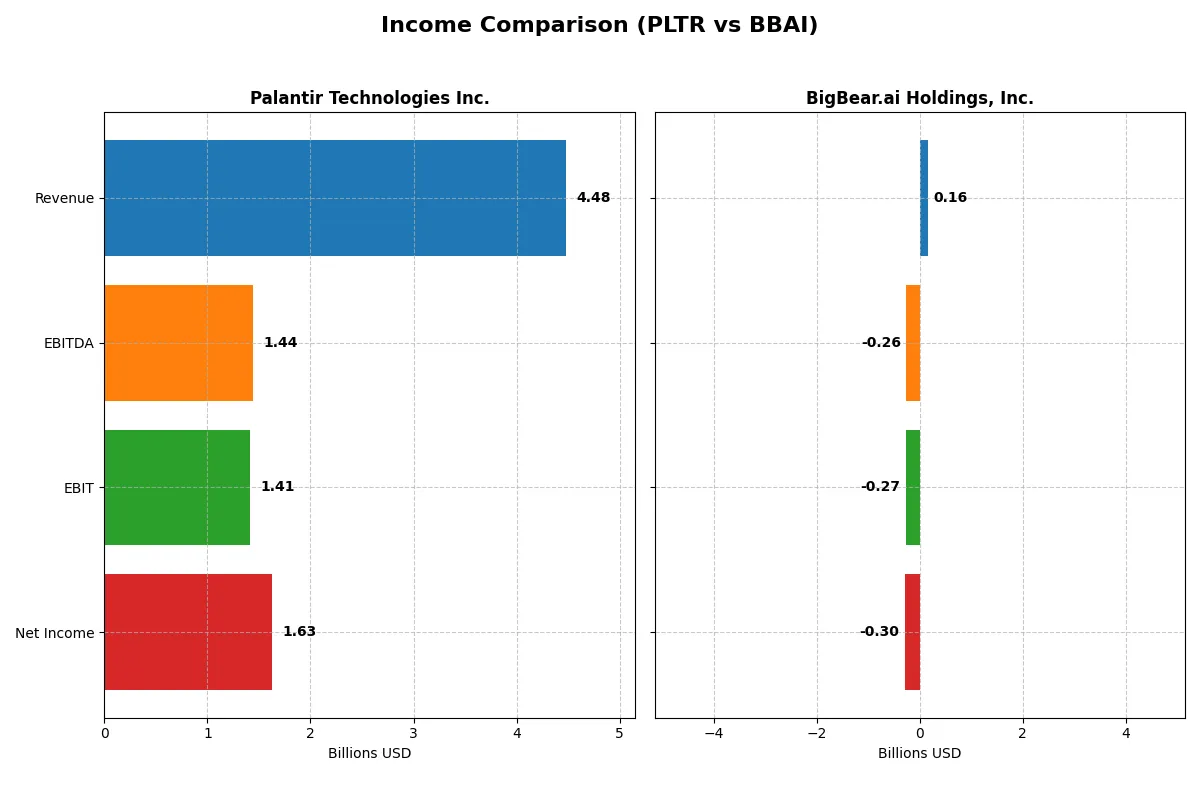
| Metric | Palantir Technologies Inc. (PLTR) | BigBear.ai Holdings, Inc. (BBAI) |
|---|---|---|
| Revenue | 4.48B | 158M |
| Cost of Revenue | 789M | 113M |
| Operating Expenses | 2.27B | 179M |
| Gross Profit | 3.69B | 45M |
| EBITDA | 1.44B | -258M |
| EBIT | 1.41B | -270M |
| Interest Expense | 0 | 26M |
| Net Income | 1.63B | -296M |
| EPS | 0.69 | -1.27 |
| Fiscal Year | 2025 | 2024 |
Income Statement Analysis: The Bottom-Line Duel
This comparison reveals each company’s operational efficiency and profitability through their income statement performance over recent years.
Palantir Technologies Inc. Analysis
Palantir’s revenue surged from 1.54B in 2021 to 4.48B in 2025, with net income climbing from a loss of -520M to a strong 1.63B. Its gross margin maintains a robust 82.4%, while the net margin reached 36.3% in 2025. Palantir demonstrates accelerating profitability and expanding margins, signaling strong operational leverage and disciplined cost control.
BigBear.ai Holdings, Inc. Analysis
BigBear.ai’s revenue grew modestly from 145M in 2021 to 158M in 2024, but net income consistently remained negative, hitting -296M in 2024. Its gross margin of 28.6% contrasts with a deeply negative net margin near -187%. The company struggles with heavy operating and interest expenses, reflecting weak profitability and deteriorating bottom-line momentum.
Verdict: Robust Margin Expansion vs. Persistent Losses
Palantir delivers clear fundamental superiority with significant revenue growth and expanding margins, showcasing a scalable and profitable business model. BigBear.ai lags with stagnant top-line growth and worsening net losses. For investors prioritizing financial health and efficiency, Palantir’s profile offers a far more attractive investment foundation.
Financial Ratios Comparison
These vital ratios act as a diagnostic tool to expose the underlying fiscal health, valuation premiums, and capital efficiency of the companies compared below:
| Ratios | Palantir Technologies Inc. (PLTR) | BigBear.ai Holdings, Inc. (BBAI) |
|---|---|---|
| ROE | 22.0% | 79.6% |
| ROIC | 17.9% | -93.4% |
| P/E | 259.2 | -3.52 |
| P/B | 57.0 | -279.9 |
| Current Ratio | 7.11 | 0.46 |
| Quick Ratio | 7.11 | 0.46 |
| D/E | 0.031 | -39.4 |
| Debt-to-Assets | 2.58% | 42.6% |
| Interest Coverage | 0 | -5.20 |
| Asset Turnover | 0.50 | 0.46 |
| Fixed Asset Turnover | 17.8 | 14.6 |
| Payout Ratio | 0 | 0 |
| Dividend Yield | 0% | 0% |
| Fiscal Year | 2025 | 2024 |
Efficiency & Valuation Duel: The Vital Signs
Financial ratios act as the company’s DNA, exposing hidden risks and operational strengths essential to investor insight.
Palantir Technologies Inc.
Palantir demonstrates robust profitability with a 22% ROE and a strong 36.31% net margin. Yet, its valuation appears stretched, trading at a P/E of 259.19 and P/B of 57.02. The company reinvests heavily in R&D, foregoing dividends to fuel growth and shareholder value creation.
BigBear.ai Holdings, Inc.
BigBear.ai shows a volatile profitability profile with a massive 7,958% ROE but suffers from a negative net margin of -186.78%. Valuation metrics like P/E and P/B are negative, signaling distress. The firm lacks liquidity with a 0.46 current ratio and retains earnings to support operations rather than returning cash to shareholders.
Valuation Stretch vs. Profitability Volatility
Palantir offers a favorable profitability base but at a premium valuation, reflecting high growth expectations. BigBear.ai presents higher risk with poor liquidity and negative margins despite an eye-catching ROE. Risk-averse investors may prefer Palantir’s stability; those chasing speculative upside might consider BigBear.ai’s rollercoaster profile.
Which one offers the Superior Shareholder Reward?
Palantir (PLTR) pays no dividends but boasts strong free cash flow (0.89/share in 2025) and maintains a robust buyback capacity, supported by a pristine balance sheet (current ratio 7.1). BigBear.ai (BBAI) also pays no dividends and posts negative free cash flow (-0.21/share in 2024), with a strained liquidity profile (current ratio 0.46) and heavy debt burden. Palantir’s zero payout ratio reflects reinvestment in growth, yet its sustainable cash flow and minimal debt underpin a superior buyback potential. BigBear.ai’s aggressive leverage and losses limit shareholder returns. I conclude Palantir offers a more attractive total return profile in 2026.
Comparative Score Analysis: The Strategic Profile
The radar chart reveals the fundamental DNA and strategic trade-offs of Palantir Technologies and BigBear.ai Holdings, Inc., highlighting their core financial strengths and weaknesses:
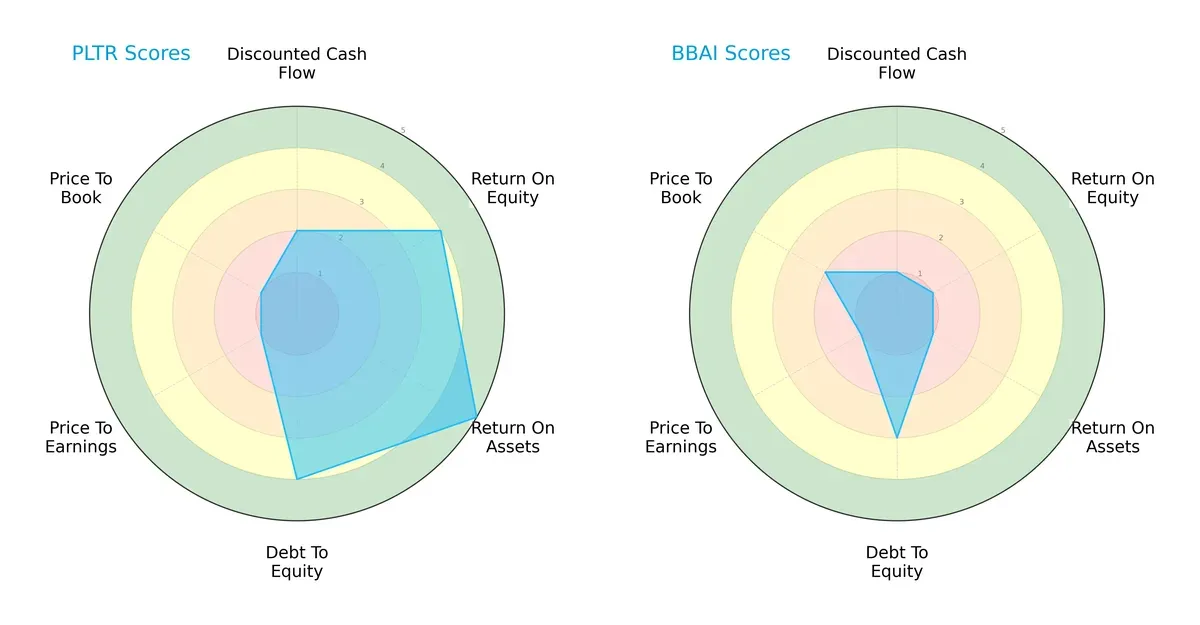
Palantir shows a more balanced financial profile, excelling in ROA (score 5) and ROE (4), with moderate leverage control (debt/equity score 4). BigBear.ai lags significantly, posting very unfavorable scores in profitability and cash flow, relying mainly on moderate debt management (score 3). Palantir’s valuation metrics are weak (P/E and P/B both 1), indicating possible market skepticism despite operational efficiency. BigBear.ai struggles broadly, lacking a clear competitive edge.
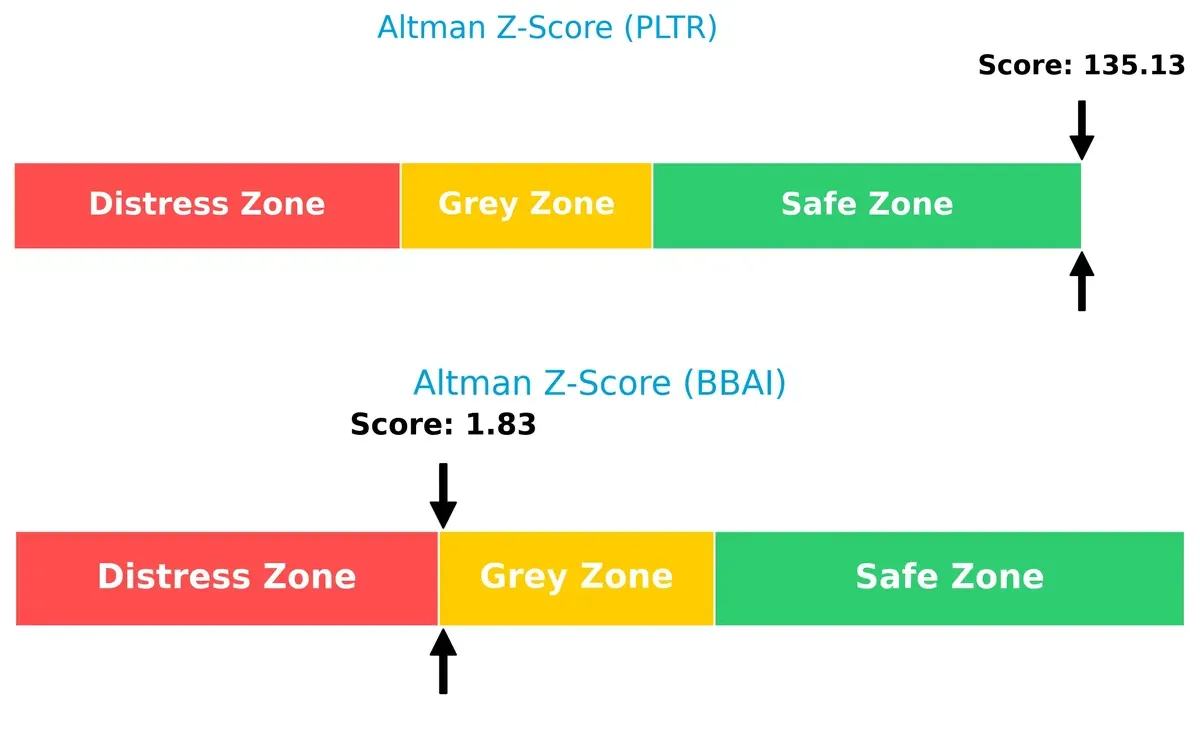
Bankruptcy Risk: Solvency Showdown
Palantir’s Altman Z-Score of 135 places it deep in the safe zone, signaling exceptional solvency and long-term survival prospects. BigBear.ai’s score of 1.83 lies in the grey zone, highlighting moderate bankruptcy risk during economic stress:
Financial Health: Quality of Operations
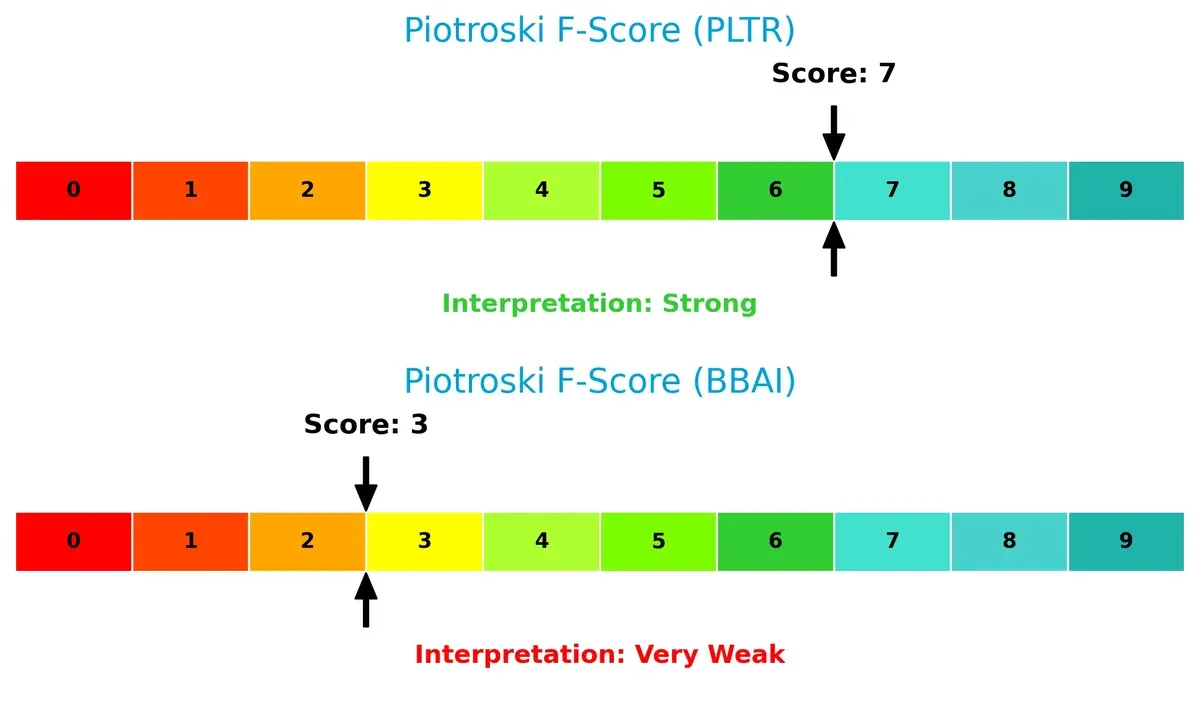
Palantir’s Piotroski F-Score of 7 signals strong financial health, reflecting robust profitability and operational efficiency. BigBear.ai’s score of 3 flags internal weaknesses and potential red flags in cash flow and leverage management:
How are the two companies positioned?
This section dissects the operational DNA of Palantir and BigBear.ai by comparing their revenue distribution and internal dynamics. The goal is to confront their economic moats and identify which business model offers the most resilient, sustainable advantage today.
Revenue Segmentation: The Strategic Mix
This comparison dissects how Palantir Technologies Inc. and BigBear.ai Holdings, Inc. diversify their revenue streams and reveal their primary sector bets:
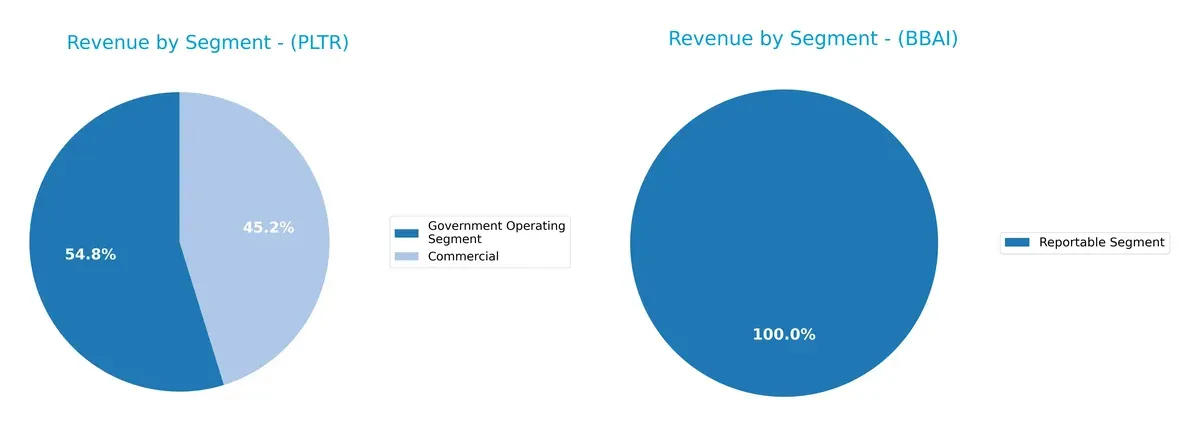
Palantir anchors its 2024 revenue in two major segments: Government at $1.57B and Commercial at $1.30B, showing a balanced yet government-tilted mix. BigBear.ai, by contrast, reports a single $158M segment in 2024, indicating high concentration risk. Palantir’s dual-segment approach supports ecosystem lock-in with diverse clients, while BigBear.ai’s narrow focus suggests vulnerability to market shifts and less infrastructure dominance.
Strengths and Weaknesses Comparison
This table compares the Strengths and Weaknesses of Palantir Technologies Inc. and BigBear.ai Holdings, Inc.:
Palantir Strengths
- Strong profitability with 36.31% net margin and 22% ROE
- Robust ROIC of 17.95% above WACC
- Low debt levels with 2.58% debt to assets
- High quick ratio of 7.11 supports liquidity
- Diverse revenue from commercial and government segments
- Significant global presence with strong US and UK sales
BigBear.ai Strengths
- Exceptional ROE at 7957.65%, indicating shareholder value creation
- Favorable PE and PB ratios suggesting undervaluation
- Positive fixed asset turnover of 14.61
- Low debt-to-equity ratio reflecting conservative leverage
- Expanding revenue from analytics and cyber segments
Palantir Weaknesses
- Unfavorable high WACC at 11.72% vs. ROIC
- Extremely high valuation multiples: PE 259.19, PB 57.02
- Unusually high current ratio of 7.11 may indicate inefficient asset use
- Zero dividend yield limits income for investors
- Moderate asset turnover at 0.5 suggests average operational efficiency
BigBear.ai Weaknesses
- Negative net margin at -186.78% signals heavy losses
- Negative ROIC of -93.42% below WACC of 18.34%
- Poor liquidity with current and quick ratios at 0.46
- Negative interest coverage indicates financial distress
- Unfavorable asset turnover of 0.46 implies weak asset utilization
- Zero dividend yield and high debt to assets at 42.59% raise risk concerns
Overall, Palantir demonstrates strong profitability and diversified revenue streams but faces valuation and capital efficiency challenges. BigBear.ai shows potential in equity returns and asset management but suffers from operational losses and liquidity constraints, indicating a need to strengthen its financial fundamentals.
The Moat Duel: Analyzing Competitive Defensibility
A structural moat shields long-term profits from relentless competition erosion. Without it, profits erode rapidly, leaving firms vulnerable:
Palantir Technologies Inc.: Network Effects Powerhouse
Palantir’s moat centers on powerful network effects linking intelligence and enterprise data. This drives high ROIC above WACC by 6.2%, sustaining 214% ROIC growth through 2025. Expanding AI platforms deepen its defensibility in 2026.
BigBear.ai Holdings, Inc.: Struggling Cost Structure
BigBear.ai relies on niche analytics but lacks scale and network effects. Its ROIC lags WACC by over 110%, with a steep ROIC decline. Cost inefficiencies and shrinking margins threaten its competitive position in 2026.
Verdict: Network Effects vs. Cost Disadvantages
Palantir’s widening moat rooted in network effects and robust capital efficiency outmatches BigBear.ai’s deteriorating cost and profitability profile. Palantir is far better positioned to defend and grow market share.
Which stock offers better returns?
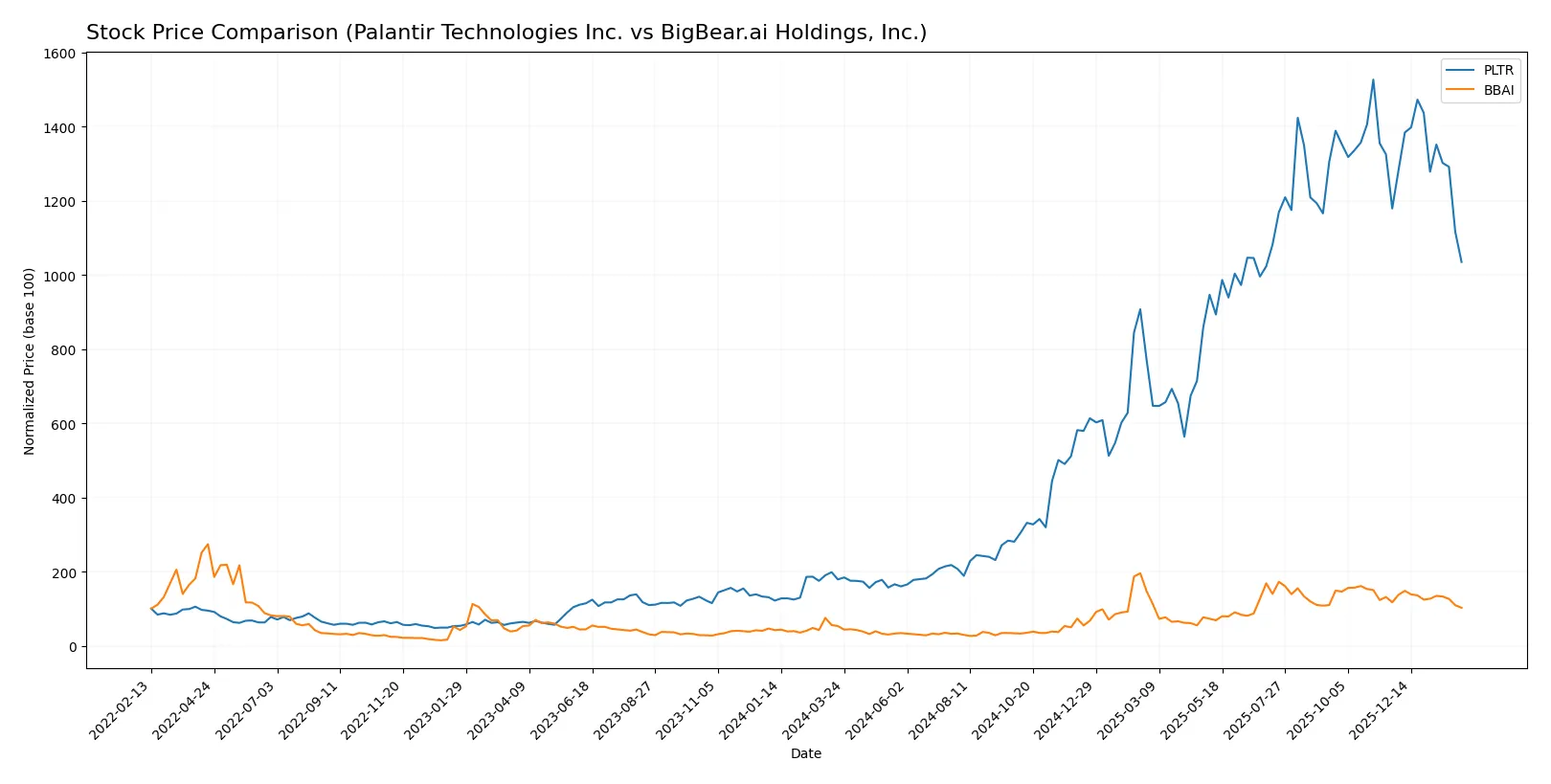
The past year showed strong gains for both stocks, with Palantir Technologies reaching a peak near 200 before recent weakness, while BigBear.ai displayed steady growth but lower volatility.
Trend Comparison
Palantir Technologies (PLTR) posted a 479% price rise over the past year, marking a bullish trend with decelerating momentum and high volatility, hitting a high of 200.47 and a low of 20.47.
BigBear.ai (BBAI) gained 93% over the same period, also bullish but with much lower volatility and decelerating upward momentum, ranging between 1.21 and 9.02.
PLTR’s returns vastly outpaced BBAI’s, delivering the highest market performance despite recent short-term declines in both stocks.
Target Prices
Analysts present a clear upside potential for Palantir Technologies Inc. and a stable outlook for BigBear.ai Holdings, Inc.
| Company | Target Low | Target High | Consensus |
|---|---|---|---|
| Palantir Technologies Inc. | 180 | 230 | 200.15 |
| BigBear.ai Holdings, Inc. | 6 | 6 | 6 |
Palantir’s target consensus at 200.15 suggests a 47% upside from the current 135.9 USD price. BigBear.ai trades below its flat 6 USD target, indicating modest analyst expectations.

Don’t Let Luck Decide Your Entry Point
Optimize your entry points with our advanced ProRealTime indicators. You’ll get efficient buy signals with precise price targets for maximum performance. Start outperforming now!
How do institutions grade them?
Palantir Technologies Inc. Grades
The latest grades from major institutions for Palantir are as follows:
| Grading Company | Action | New Grade | Date |
|---|---|---|---|
| UBS | Maintain | Neutral | 2026-02-03 |
| Citigroup | Maintain | Buy | 2026-02-03 |
| DA Davidson | Maintain | Neutral | 2026-02-03 |
BigBear.ai Holdings, Inc. Grades
The recent institutional grades for BigBear.ai are summarized below:
| Grading Company | Action | New Grade | Date |
|---|---|---|---|
| Cantor Fitzgerald | Downgrade | Neutral | 2026-01-07 |
| HC Wainwright & Co. | Maintain | Buy | 2025-11-11 |
Which company has the best grades?
Palantir holds a mix of Neutral and Buy ratings from top firms, while BigBear.ai mostly retains Buy ratings but experienced a recent downgrade. Palantir’s stable and slightly more positive outlook may suggest greater analyst confidence.
Risks specific to each company
The following categories identify the critical pressure points and systemic threats facing both firms in the 2026 market environment:
1. Market & Competition
Palantir Technologies Inc.
- Dominates software infrastructure with strong government and commercial contracts. Faces intense competition from large tech firms.
BigBear.ai Holdings, Inc.
- Smaller AI and analytics firm struggling to scale. Faces fierce competition in niche AI and cybersecurity sectors.
2. Capital Structure & Debt
| Palantir Technologies Inc. | BigBear.ai Holdings, Inc. | | Maintains very low debt levels (D/E 0.03), ensuring financial flexibility and low risk. | Exhibits unstable debt metrics (-39.42 D/E) with moderate debt to assets (42.59%), indicating capital structure stress. |
3. Stock Volatility
| Palantir Technologies Inc. | BigBear.ai Holdings, Inc. | | Beta of 1.69 indicates above-market volatility but within tech sector norms. | Extremely high beta of 3.21 signals risky, volatile stock prone to wide swings. |
4. Regulatory & Legal
| Palantir Technologies Inc. | BigBear.ai Holdings, Inc. | | Operates in sensitive intelligence sectors, exposed to stringent regulations and government scrutiny. | Faces regulatory complexity in AI and cybersecurity, but less exposure to national security oversight. |
5. Supply Chain & Operations
| Palantir Technologies Inc. | BigBear.ai Holdings, Inc. | | Relies heavily on software delivery, reducing physical supply chain risks. | Operational risks from scaling technology and client delivery challenges remain significant. |
6. ESG & Climate Transition
| Palantir Technologies Inc. | BigBear.ai Holdings, Inc. | | Limited explicit ESG risks but under pressure to enhance transparency and data privacy standards. | Emerging firm still developing ESG policies; faces investor scrutiny on governance and sustainability. |
7. Geopolitical Exposure
| Palantir Technologies Inc. | BigBear.ai Holdings, Inc. | | Significant geopolitical risk due to international intelligence contracts and government dependence. | Primarily US-focused with less direct geopolitical risk but exposed to cyber warfare trends. |
Which company shows a better risk-adjusted profile?
Palantir’s most impactful risk is geopolitical exposure tied to government contracts. BigBear.ai’s critical weakness lies in capital structure instability and extreme stock volatility. Palantir shows a superior risk-adjusted profile, reflected in its strong Altman Z-score (135.13, safe zone) and robust financial ratios. BigBear.ai’s grey zone Z-score (1.83) and weak Piotroski score (3) underscore financial distress. Palantir’s strong liquidity and low leverage offer greater resilience against 2026 market uncertainties.
Final Verdict: Which stock to choose?
Palantir Technologies Inc. boasts a superpower in delivering robust and growing returns on invested capital, reflecting a sustainable competitive advantage. Its strong cash generation and operational efficiency stand out. However, its sky-high valuation multiples warrant caution as a point of vigilance. Palantir suits an aggressive growth portfolio willing to pay a premium for innovation leadership.
BigBear.ai Holdings, Inc. offers a strategic moat rooted in specialized AI capabilities, but it struggles with profitability and value creation. Its financial fragility and declining operational returns mark it as a higher-risk option. Relative to Palantir, it presents a more speculative profile, fitting best within a high-risk, early-stage growth portfolio.
If you prioritize durable value creation and proven operational efficiency, Palantir outshines as the compelling choice due to its expanding moat and solid financial footing. However, if you seek speculative upside in emerging AI niches and can tolerate financial instability, BigBear.ai offers a higher-risk, potentially higher-reward scenario. Each stock appeals to distinctly different investor avatars, emphasizing the importance of aligning choices with risk tolerance and strategy.
Disclaimer: Investment carries a risk of loss of initial capital. The past performance is not a reliable indicator of future results. Be sure to understand risks before making an investment decision.
Go Further
I encourage you to read the complete analyses of Palantir Technologies Inc. and BigBear.ai Holdings, Inc. to enhance your investment decisions: