As cloud technology reshapes the software infrastructure landscape, Zscaler, Inc. and MongoDB, Inc. stand out as influential players driving innovation. Both U.S.-based companies specialize in cutting-edge software solutions—Zscaler in cloud security and MongoDB in database platforms—competing in overlapping markets with strong growth potential. In this article, I will analyze their strengths and risks to help you identify the most compelling investment opportunity today.
Table of contents
Companies Overview
I will begin the comparison between Zscaler and MongoDB by providing an overview of these two companies and their main differences.
Zscaler Overview
Zscaler, Inc. is a cloud security company headquartered in San Jose, California. It provides secure access solutions to users and devices for both externally managed and internally hosted applications, including SaaS and private clouds. Zscaler’s platform also offers workload segmentation and digital experience monitoring to enhance security and compliance across various industries. Founded in 2007, it serves a global customer base with 7,348 employees.
MongoDB Overview
MongoDB, Inc., based in New York City, offers a general-purpose database platform used worldwide. Its product suite includes MongoDB Enterprise Advanced for enterprises, MongoDB Atlas, a multi-cloud database-as-a-service, and a free Community Server for developers. Founded in 2007, MongoDB supports cloud, on-premise, and hybrid environments, and provides consulting and training services. The company employs 5,558 full-time staff.
Key similarities and differences
Both Zscaler and MongoDB operate in the software infrastructure industry within the technology sector, serving enterprise clients globally. While Zscaler focuses on cloud security and access management solutions, MongoDB specializes in database platforms and services. Both companies offer cloud-based products but differ in their core offerings: security versus data management. Additionally, Zscaler has a larger workforce and a slightly higher market capitalization than MongoDB.
Income Statement Comparison
The table below presents a side-by-side comparison of key income statement metrics for Zscaler, Inc. and MongoDB, Inc. for the most recent fiscal year available.
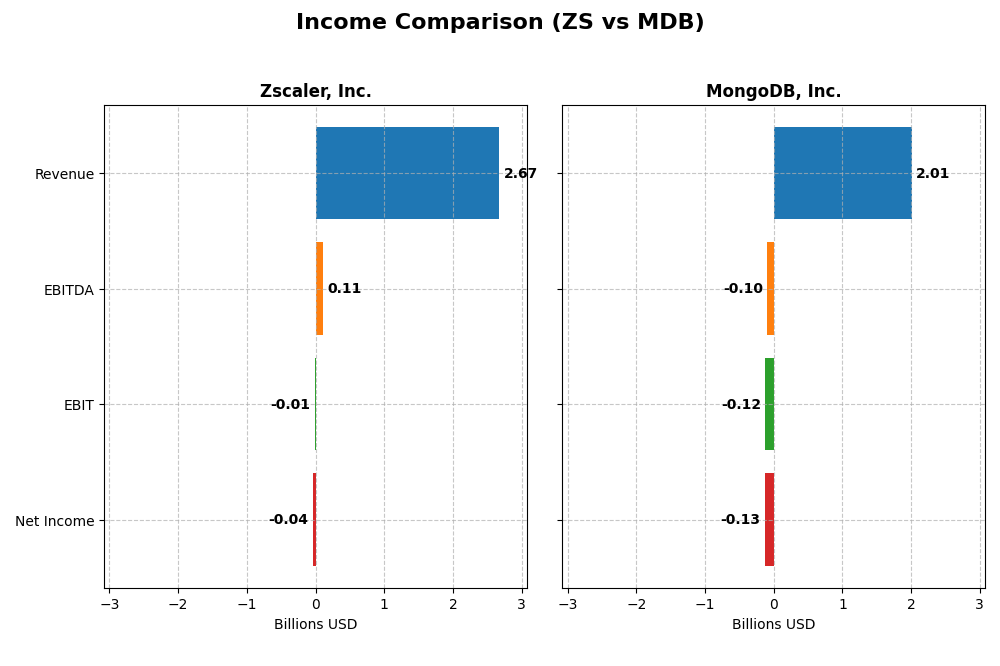
| Metric | Zscaler, Inc. (ZS) | MongoDB, Inc. (MDB) |
|---|---|---|
| Market Cap | 34.1B | 32.5B |
| Revenue | 2.67B | 2.01B |
| EBITDA | 112M | -97M |
| EBIT | -8.8M | -124M |
| Net Income | -41.5M | -129.1M |
| EPS | -0.27 | -1.73 |
| Fiscal Year | 2025 | 2025 |
Income Statement Interpretations
Zscaler, Inc.
Zscaler’s revenue rose significantly from $673M in 2021 to $2.67B in 2025, reflecting robust growth. Despite this, the company reported negative net income throughout, though losses narrowed from -$262M to -$41M. Gross margins remained strong around 77%, but EBIT and net margins stayed negative, with slight improvements in 2025 indicating operational progress amid continued investment.
MongoDB, Inc.
MongoDB’s revenue increased steadily from $590M in 2021 to $2.01B in 2025. Net income losses also decreased from -$267M to -$129M over the same period. Gross margins were stable near 73%, while EBIT and net margins remained negative but improved by 2025. The company showed consistent growth and margin enhancements, reflecting ongoing scaling with controlled expenses.
Which one has the stronger fundamentals?
Both Zscaler and MongoDB exhibit favorable revenue growth and gross margins, yet both report negative net and EBIT margins. Zscaler displays higher gross margin and stronger margin improvements, while MongoDB shows steadier revenue growth and larger absolute net losses. Each company presents merits and challenges, with neither demonstrating clear fundamental dominance solely on income statement metrics.
Financial Ratios Comparison
This table presents the latest available financial ratios for Zscaler, Inc. and MongoDB, Inc. for a clear side-by-side comparison of key performance metrics as of their most recent fiscal years.
| Ratios | Zscaler, Inc. (ZS) 2025 | MongoDB, Inc. (MDB) 2025 |
|---|---|---|
| ROE | -2.31% | -4.64% |
| ROIC | -3.18% | -7.36% |
| P/E | -1063 | -158 |
| P/B | 24.51 | 7.32 |
| Current Ratio | 2.01 | 5.20 |
| Quick Ratio | 2.01 | 5.20 |
| D/E | 1.00 | 0.01 |
| Debt-to-Assets | 27.98% | 1.06% |
| Interest Coverage | -13.49 | -26.70 |
| Asset Turnover | 0.42 | 0.58 |
| Fixed Asset Turnover | 4.22 | 24.78 |
| Payout Ratio | 0 | 0 |
| Dividend Yield | 0% | 0% |
Interpretation of the Ratios
Zscaler, Inc.
Zscaler shows mixed financial ratios in 2025, with strong liquidity indicated by a current ratio of 2.01 and favorable fixed asset turnover at 4.22. However, profitability measures such as net margin (-1.55%), ROE (-2.31%), and ROIC (-3.18%) are unfavorable, signaling operational challenges. The company does not pay dividends, likely focusing on reinvestment and growth strategies without share buybacks.
MongoDB, Inc.
MongoDB exhibits several unfavorable ratios in 2025, including a negative net margin of -6.43% and ROE of -4.64%, reflecting ongoing profitability issues. The company’s current ratio is very high at 5.2, but this is marked as unfavorable, possibly due to inefficient asset use. It also does not pay dividends, suggesting a reinvestment approach prioritizing research and development rather than shareholder returns.
Which one has the best ratios?
Both companies face profitability challenges with negative margins and returns on equity. Zscaler benefits from stronger liquidity ratios and a more favorable fixed asset turnover, while MongoDB shows a higher debt efficiency and quick ratio. Overall, Zscaler’s ratios are slightly more favorable, but both present significant risks from an investment perspective.
Strategic Positioning
This section compares the strategic positioning of Zscaler and MongoDB, focusing on market position, key segments, and exposure to technological disruption:
Zscaler, Inc. (ZS)
- Leading cloud security player with competitive pressure in software infrastructure.
- Focused on cloud security solutions for SaaS, private access, and workload segmentation.
- Operates in a highly dynamic cloud security environment with ongoing innovation demands.
MongoDB, Inc. (MDB)
- Prominent general purpose database provider facing competitive pressures in software infrastructure.
- Primarily offers multi-cloud database services and enterprise database platforms.
- Exposed to evolving database technologies and cloud service disruptions.
Zscaler vs MongoDB Positioning
Zscaler concentrates on cloud security with diversified industry applications, while MongoDB centers on database platforms with multi-cloud deployment. Zscaler leverages broad security use cases; MongoDB emphasizes database adaptability and service variety.
Which has the best competitive advantage?
Both companies have a slightly unfavorable moat status, shedding value despite growing ROIC trends. Neither currently demonstrates a clear competitive advantage based on return on invested capital versus cost of capital.
Stock Comparison
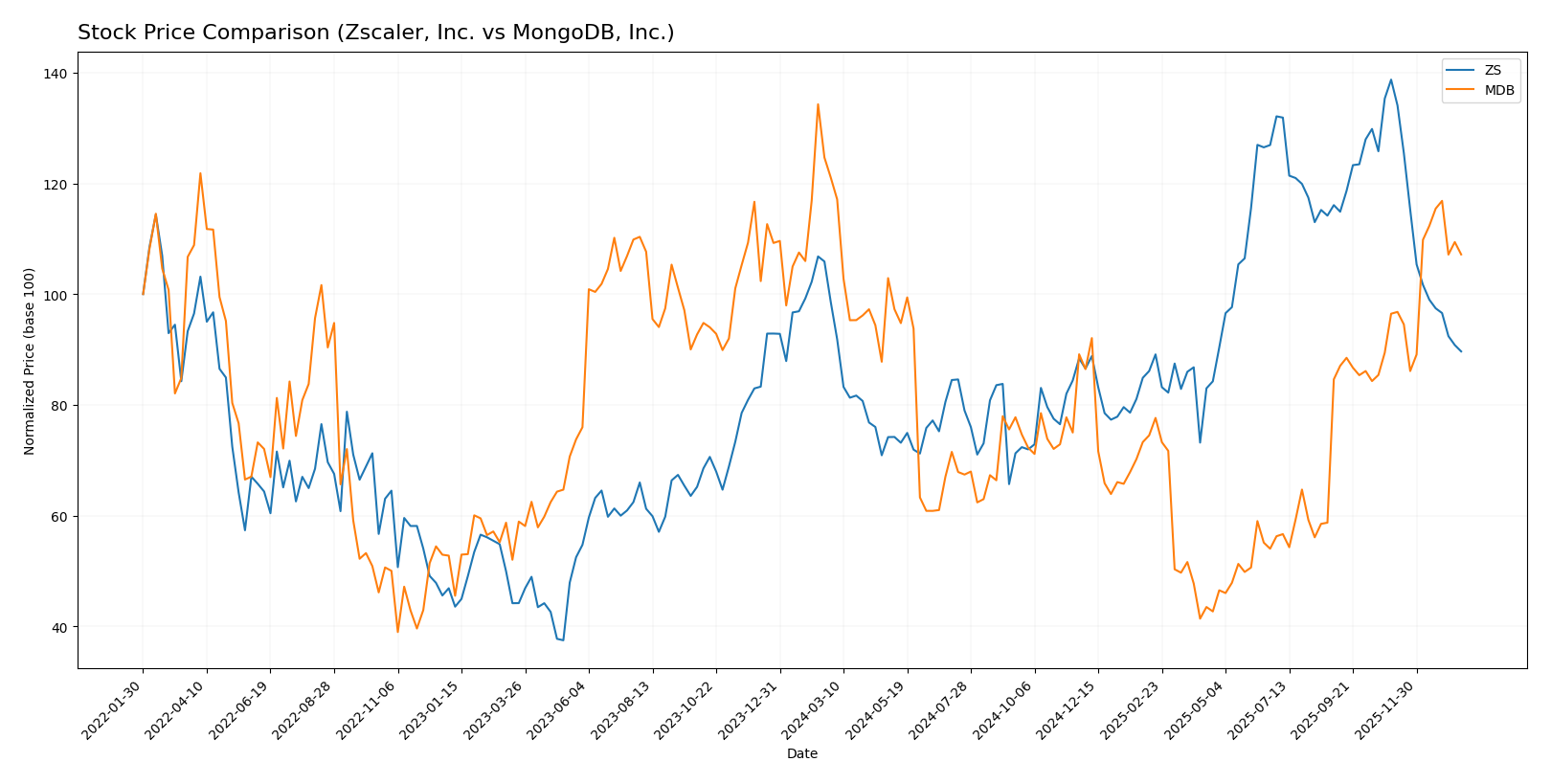
The stock price movements of Zscaler, Inc. and MongoDB, Inc. over the past 12 months reveal contrasting trading dynamics, with both showing overall bearish trends but differing recent momentum and volume patterns.
Trend Analysis
Zscaler, Inc. experienced a 9.03% price decline over the past 12 months, confirming a bearish trend with decelerating losses. The stock ranged between 156.78 and 331.14, showing moderate volatility with a 47.11 standard deviation.
MongoDB, Inc. posted an 11.46% decrease over the same period, also bearish but with accelerating losses. It showed higher volatility (72.49 std deviation) fluctuating between 154.39 and 451.52, though recent weeks indicate a positive 11.1% price rebound.
Comparing both, MongoDB delivered the lower overall market performance with a deeper decline but a recent bullish recovery, while Zscaler’s losses slowed without recent gains, positioning MongoDB as more volatile but currently gaining momentum.
Target Prices
The current target price consensus for these technology infrastructure companies suggests notable upside potential.
| Company | Target High | Target Low | Consensus |
|---|---|---|---|
| Zscaler, Inc. | 360 | 260 | 311.41 |
| MongoDB, Inc. | 500 | 375 | 445.20 |
Analysts expect Zscaler’s stock to rise significantly above its current price of $214, while MongoDB’s consensus target also indicates a strong potential increase from its $400 trading level.
Analyst Opinions Comparison
This section compares analysts’ ratings and grades for Zscaler, Inc. and MongoDB, Inc.:
Rating Comparison
ZS Rating
- Rating: C-, rated as Very Favorable overall.
- Discounted Cash Flow Score: 4, indicating a Favorable valuation based on cash flow.
- ROE Score: 1, considered Very Unfavorable for profitability from equity.
- ROA Score: 1, considered Very Unfavorable for asset efficiency.
- Debt To Equity Score: 1, indicating Very Unfavorable financial risk profile.
- Overall Score: 1, classified as Very Unfavorable financial standing.
MDB Rating
- Rating: C, rated as Very Favorable overall.
- Discounted Cash Flow Score: 2, indicating a Moderate valuation based on cash flow.
- ROE Score: 1, considered Very Unfavorable for profitability from equity.
- ROA Score: 1, considered Very Unfavorable for asset efficiency.
- Debt To Equity Score: 4, indicating a Favorable financial risk profile.
- Overall Score: 2, classified as Moderate financial standing.
Which one is the best rated?
Based strictly on the provided data, MongoDB holds a better overall rating and financial risk profile than Zscaler, with a higher overall score and more favorable debt-to-equity score. However, Zscaler scores better on discounted cash flow valuation.
Scores Comparison
Here is a comparison of the Altman Z-Score and Piotroski Score for the two companies:
ZS Scores
- Altman Z-Score: 4.89, indicating a safe zone.
- Piotroski Score: 3, classified as very weak.
MDB Scores
- Altman Z-Score: 30.24, indicating a safe zone.
- Piotroski Score: 4, classified as average.
Which company has the best scores?
MDB shows a significantly higher Altman Z-Score and a better Piotroski Score compared to ZS. Therefore, MDB has stronger financial stability and slightly better financial strength based on these scores.
Grades Comparison
Here is a comparison of the recent grades assigned to Zscaler, Inc. and MongoDB, Inc. by several reputable grading companies:
Zscaler, Inc. Grades
The following table summarizes the latest grades issued by major financial institutions for Zscaler, Inc.:
| Grading Company | Action | New Grade | Date |
|---|---|---|---|
| Citigroup | Maintain | Buy | 2026-01-13 |
| Keybanc | Maintain | Overweight | 2026-01-12 |
| Piper Sandler | Maintain | Neutral | 2026-01-05 |
| RBC Capital | Maintain | Outperform | 2026-01-05 |
| Mizuho | Upgrade | Outperform | 2025-12-16 |
| Bernstein | Downgrade | Market Perform | 2025-12-01 |
| Citigroup | Maintain | Buy | 2025-12-01 |
| JP Morgan | Maintain | Overweight | 2025-11-26 |
| Baird | Maintain | Outperform | 2025-11-26 |
| BTIG | Maintain | Buy | 2025-11-26 |
Overall, Zscaler’s grades largely range from Neutral to Buy/Outperform, with a recent upgrade and one downgrade reflecting some variability but a generally positive outlook.
MongoDB, Inc. Grades
The following table shows the recent grades assigned to MongoDB, Inc. by recognized grading firms:
| Grading Company | Action | New Grade | Date |
|---|---|---|---|
| Needham | Maintain | Buy | 2026-01-12 |
| Barclays | Maintain | Overweight | 2026-01-12 |
| Truist Securities | Maintain | Buy | 2026-01-07 |
| Needham | Maintain | Buy | 2026-01-06 |
| RBC Capital | Maintain | Outperform | 2026-01-05 |
| Argus Research | Maintain | Buy | 2025-12-04 |
| Citigroup | Maintain | Buy | 2025-12-03 |
| Goldman Sachs | Maintain | Buy | 2025-12-03 |
| Canaccord Genuity | Maintain | Buy | 2025-12-02 |
| Morgan Stanley | Maintain | Overweight | 2025-12-02 |
MongoDB’s grades are consistently in the Buy to Outperform range, with no downgrades or Neutral ratings, indicating strong analyst confidence.
Which company has the best grades?
MongoDB, Inc. has received more consistently positive grades, predominantly Buy and Outperform, compared to Zscaler, Inc., which shows some variation including Neutral and Market Perform grades. For investors, MongoDB’s stronger consensus may suggest relatively higher analyst confidence in its prospects.
Strengths and Weaknesses
The following table presents a comparative overview of the strengths and weaknesses of Zscaler, Inc. (ZS) and MongoDB, Inc. (MDB) based on recent financial and operational data.
| Criterion | Zscaler, Inc. (ZS) | MongoDB, Inc. (MDB) |
|---|---|---|
| Diversification | Primarily focused on cloud security solutions; limited diversification within cybersecurity | More diversified revenue streams: MongoDB Atlas, other subscriptions, and services |
| Profitability | Negative net margin (-1.55%), ROIC (-3.18%); value destroying but improving ROIC trend | Larger negative net margin (-6.43%), ROIC (-7.36%); also value destroying with improving ROIC |
| Innovation | High innovation in cloud security technology; strong growth potential | Strong innovation in database technologies and cloud services; rapid revenue growth in Atlas segment |
| Global presence | Global cloud security footprint but relatively niche | Broad global adoption of database solutions; increasing enterprise reach |
| Market Share | Leading in cloud security with growing presence; market share challenged by competitors | Significant share in NoSQL database market; strong growth in Atlas subscriptions |
Key takeaways: Both companies face profitability challenges and currently destroy value, though their ROIC trends are improving, signaling potential future gains. Zscaler is more specialized in cloud security, while MongoDB benefits from a more diversified product portfolio and stronger revenue growth in cloud database services. Investors should weigh innovation and market positioning against current financial weaknesses.
Risk Analysis
Below is a comparison table of key risks for Zscaler, Inc. (ZS) and MongoDB, Inc. (MDB) based on the most recent data from 2025:
| Metric | Zscaler, Inc. (ZS) | MongoDB, Inc. (MDB) |
|---|---|---|
| Market Risk | Beta 1.02 – Moderate market volatility exposure | Beta 1.38 – Higher market sensitivity |
| Debt level | Debt-to-Equity 1.0 (neutral), Debt-to-Assets 28% (favorable) | Debt-to-Equity 0.01 (favorable), Debt-to-Assets 1.06% (favorable) |
| Regulatory Risk | Medium – Cloud security regulations evolving worldwide | Medium – Database privacy and compliance regulations evolving |
| Operational Risk | Moderate – Complex cloud infrastructure dependencies | Moderate – Platform reliability and service scalability |
| Environmental Risk | Low – Software sector with limited direct environmental impact | Low – Software sector with limited direct environmental impact |
| Geopolitical Risk | Moderate – US-based with global customers, sensitive to trade tensions | Moderate – US-based with global reach, exposure to international regulation |
In synthesis, MongoDB exhibits higher market risk due to its elevated beta and has a stronger balance sheet with very low debt levels compared to Zscaler. Both companies face moderate regulatory and operational risks typical of cloud infrastructure providers. The most impactful risks are market volatility for MongoDB and Zscaler’s moderate debt level combined with negative profitability metrics. Both firms remain financially stable with no significant environmental risks. Investors should monitor market conditions and regulatory changes closely when considering these stocks.
Which Stock to Choose?
Zscaler, Inc. (ZS) shows strong revenue growth of 23.31% in 2025 and a favorable income statement overall, despite negative profitability ratios and a slightly unfavorable global financial ratio evaluation. Its debt levels are moderate with a current ratio of 2.01, and it holds a very favorable rating of C-.
MongoDB, Inc. (MDB) also reports favorable revenue growth of 19.22% in 2025 and a positive income statement trend, yet it faces more pronounced negative profitability and a less favorable financial ratio profile. Its debt is low with a very favorable debt-to-equity score and a rating of C.
For investors prioritizing financial stability and growth potential, ZS might appear more favorable due to its stronger income growth and slightly better financial ratios, while MDB could appeal to those valuing lower leverage and an improving profitability trend despite a more cautious ratio outlook.
Disclaimer: Investment carries a risk of loss of initial capital. The past performance is not a reliable indicator of future results. Be sure to understand risks before making an investment decision.
Go Further
I encourage you to read the complete analyses of Zscaler, Inc. and MongoDB, Inc. to enhance your investment decisions: