Home > Comparison > Industrials > LMT vs TDG
The strategic rivalry between Lockheed Martin Corporation and TransDigm Group Incorporated shapes the aerospace and defense sector’s trajectory. Lockheed Martin operates as a capital-intensive industrial giant with diversified aerospace and defense systems. In contrast, TransDigm excels as a high-margin supplier of specialized aircraft components. This analysis pits broad defense manufacturing against niche component specialization to identify the superior risk-adjusted investment for a balanced portfolio.

Table of contents
Companies Overview
Lockheed Martin and TransDigm dominate distinct segments of the aerospace and defense market with complementary strengths.
Lockheed Martin Corporation: Aerospace & Defense Giant
Lockheed Martin commands a leading position in aerospace and defense, generating revenue through advanced technology systems across four segments. Its core lies in combat aircraft, missile defense, and space systems. In 2026, the company emphasizes integrated space and ground-based intelligence solutions to support national security and maintain its technological edge.
TransDigm Group Incorporated: Niche Aircraft Components Specialist
TransDigm excels as a specialist supplier of engineered aircraft components, focusing on power & control and airframe systems. It generates revenue by selling highly engineered parts to manufacturers, airlines, and military agencies. The firm’s 2026 strategy centers on expanding its portfolio of electro-mechanical actuators and cockpit security systems to deepen its aftermarket presence.
Strategic Collision: Similarities & Divergences
Lockheed Martin pursues a broad, integrated defense ecosystem, whereas TransDigm focuses on a modular, component-based approach. They primarily compete in military aviation supply chains but at different levels—Lockheed delivers full systems; TransDigm supplies critical parts. This creates distinct investment profiles: Lockheed offers scale and diversification, while TransDigm provides niche specialization with potentially higher margin visibility.
Income Statement Comparison
The following data dissects the core profitability and scalability of both corporate engines to reveal who dominates the bottom line:
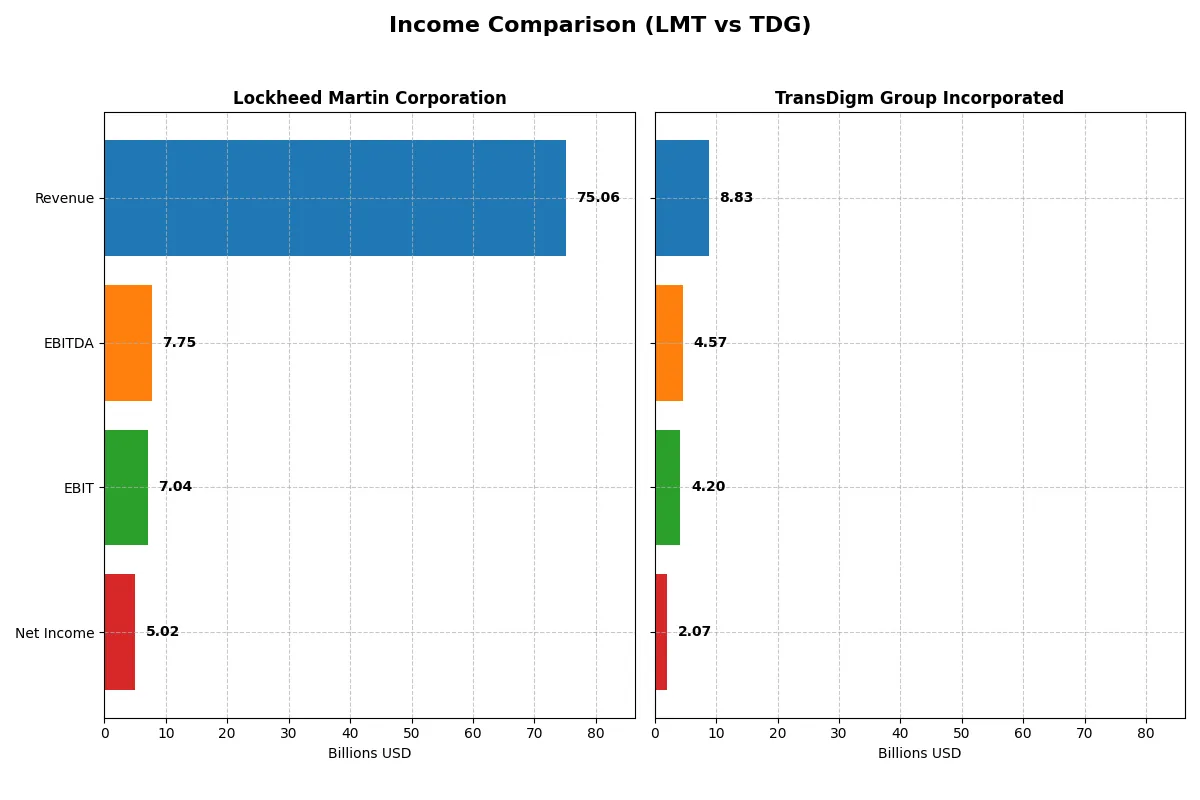
| Metric | Lockheed Martin Corporation (LMT) | TransDigm Group Incorporated (TDG) |
|---|---|---|
| Revenue | 75B | 8.8B |
| Cost of Revenue | 67.4B | 3.5B |
| Operating Expenses | -103M | 1.15B |
| Gross Profit | 7.6B | 5.3B |
| EBITDA | 7.75B | 4.57B |
| EBIT | 7.04B | 4.20B |
| Interest Expense | 1.12B | 1.57B |
| Net Income | 5.02B | 1.87B |
| EPS | 21.56 | 32.08 |
| Fiscal Year | 2025 | 2025 |
Income Statement Analysis: The Bottom-Line Duel
This income statement comparison reveals which company runs a more efficient and profitable corporate engine through recent financial cycles.
Lockheed Martin Corporation Analysis
Lockheed Martin’s revenue grew steadily from 67.0B in 2021 to 75.1B in 2025, but net income trended down from 6.3B to 5.0B. Gross margin hovered near 10%, signaling tight cost control but limited pricing power. The 2025 net margin at 6.7% reflects pressure on profitability, with EBIT and EPS showing recent declines, hinting at efficiency challenges.
TransDigm Group Incorporated Analysis
TransDigm’s revenue surged from 4.8B in 2021 to 8.8B in 2025, with net income soaring from 680M to 2.1B. Gross margin at 60% and net margin near 23.5% demonstrate exceptional pricing power and operational leverage. In 2025, EBIT rose nearly 20%, and EPS jumped 25%, underscoring strong momentum and capital allocation acumen despite heavy interest costs.
Margin Strength vs. Growth Momentum
TransDigm clearly outperforms Lockheed Martin in profitability and growth metrics. Lockheed’s steady revenue contrasts with shrinking net income and margins, signaling margin erosion. TransDigm delivers robust margin expansion paired with rapid revenue and earnings growth. For investors prioritizing earnings power and growth, TransDigm’s profile stands as the more compelling fundamental choice.
Financial Ratios Comparison
These vital ratios act as a diagnostic tool to expose the underlying fiscal health, valuation premiums, and capital efficiency of the companies compared below:
| Ratios | Lockheed Martin Corporation (LMT) | TransDigm Group Incorporated (TDG) |
|---|---|---|
| ROE | 74.6% | -21.4% |
| ROIC | 17.4% | 15.2% |
| P/E | 22.3x | 37.0x |
| P/B | 16.6x | -7.9x |
| Current Ratio | 1.09 | 3.21 |
| Quick Ratio | 0.94 | 2.25 |
| D/E (Debt-to-Equity) | 0.17 | -3.10 |
| Debt-to-Assets | 2.0% | 131.1% |
| Interest Coverage | 6.9x | 2.65x |
| Asset Turnover | 1.25 | 0.39 |
| Fixed Asset Turnover | 8.46 | 5.59 |
| Payout ratio | 62.4% | 464.3% |
| Dividend yield | 2.80% | 12.55% |
| Fiscal Year | 2025 | 2025 |
Efficiency & Valuation Duel: The Vital Signs
Financial ratios serve as a company’s DNA, uncovering hidden risks and highlighting operational strengths critical for investors’ decisions.
Lockheed Martin Corporation
Lockheed Martin posts a robust 74.65% ROE and solid 6.68% net margin, signaling strong profitability and operational efficiency. Its P/E of 22.26 is neutral, suggesting the stock is fairly valued relative to earnings. The firm rewards shareholders with a 2.8% dividend yield, reflecting steady income along with disciplined capital allocation.
TransDigm Group Incorporated
TransDigm shows an impressive 23.49% net margin but suffers a negative ROE of -21.41%, revealing profitability challenges. Its P/E of 36.99 marks the stock as expensive, reflecting high growth expectations. The company offers a hefty 12.55% dividend yield, though elevated debt and mixed asset turnover ratios raise caution about financial stability.
Balanced Profitability vs. Growth Premium
Lockheed Martin balances favorable returns and moderate valuation, reflecting operational safety with reliable dividends. TransDigm’s premium valuation and strong margins carry higher risk due to poor equity returns and leverage. Investors seeking income and stability may prefer Lockheed Martin, while growth-oriented profiles might tolerate TransDigm’s stretched metrics.
Which one offers the Superior Shareholder Reward?
I see Lockheed Martin (LMT) delivers steady dividends around 2.8% yield with a payout ratio near 62%, supported by strong free cash flow coverage above 80%. Its buybacks are consistent, balancing growth and shareholder return sustainably. TransDigm (TDG) offers a striking 12.5% dividend yield but with payout ratios exceeding 100%, signaling aggressive returns likely funded by debt. Its buyback activity complements this but raises sustainability concerns due to high leverage. I judge LMT’s balanced dividend and buyback strategy more sustainable and attractive for long-term total return in 2026.
Comparative Score Analysis: The Strategic Profile
The radar chart exposes the fundamental DNA and trade-offs shaping Lockheed Martin and TransDigm’s competitive and financial strategies:
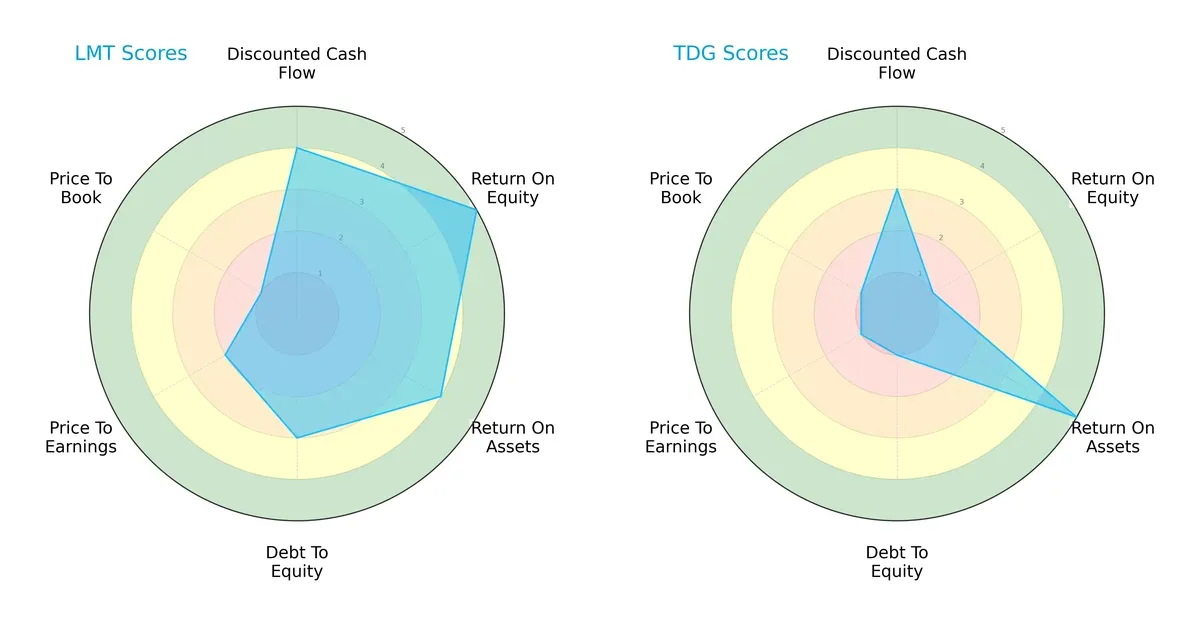
Lockheed Martin shows a balanced profile with strong ROE (5) and ROA (4) scores, reflecting efficient capital and asset use. Its moderate debt-to-equity (3) indicates manageable leverage. Conversely, TransDigm relies heavily on asset efficiency (ROA 5) but suffers in ROE (1) and is burdened by high leverage (debt-to-equity 1). Lockheed’s valuation metrics are weak (P/E 2, P/B 1), while TransDigm looks expensive and riskier on these fronts. I see Lockheed Martin as the more stable, diversified operator; TransDigm leans on a specific operational edge but with financial risk.
Bankruptcy Risk: Solvency Showdown
Lockheed Martin’s Altman Z-Score (3.69) places it firmly in the safe zone, whereas TransDigm’s 2.07 signals moderate distress risk in this cycle:
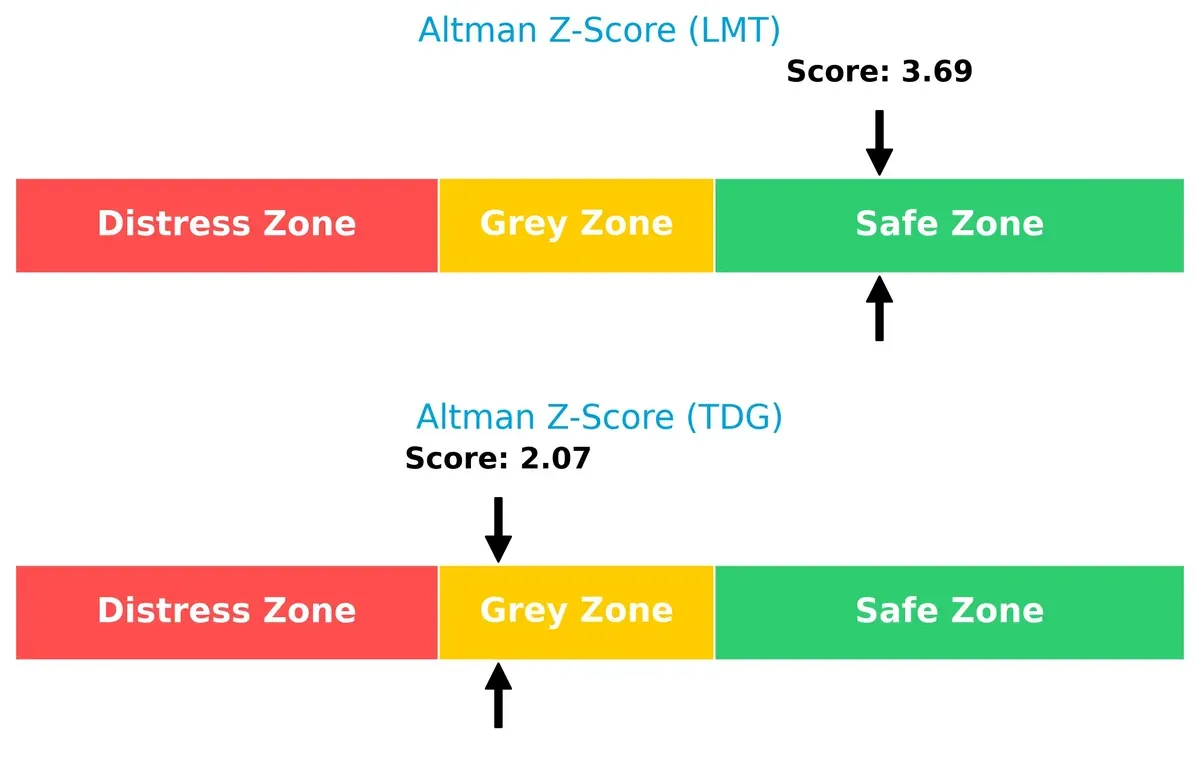
Lockheed’s stronger solvency reduces default risk, a key strength in volatile defense spending environments. TransDigm’s grey zone score warns investors to watch liquidity and leverage carefully.
Financial Health: Quality of Operations
Both companies share an average Piotroski F-Score of 6, implying decent but not peak financial health:
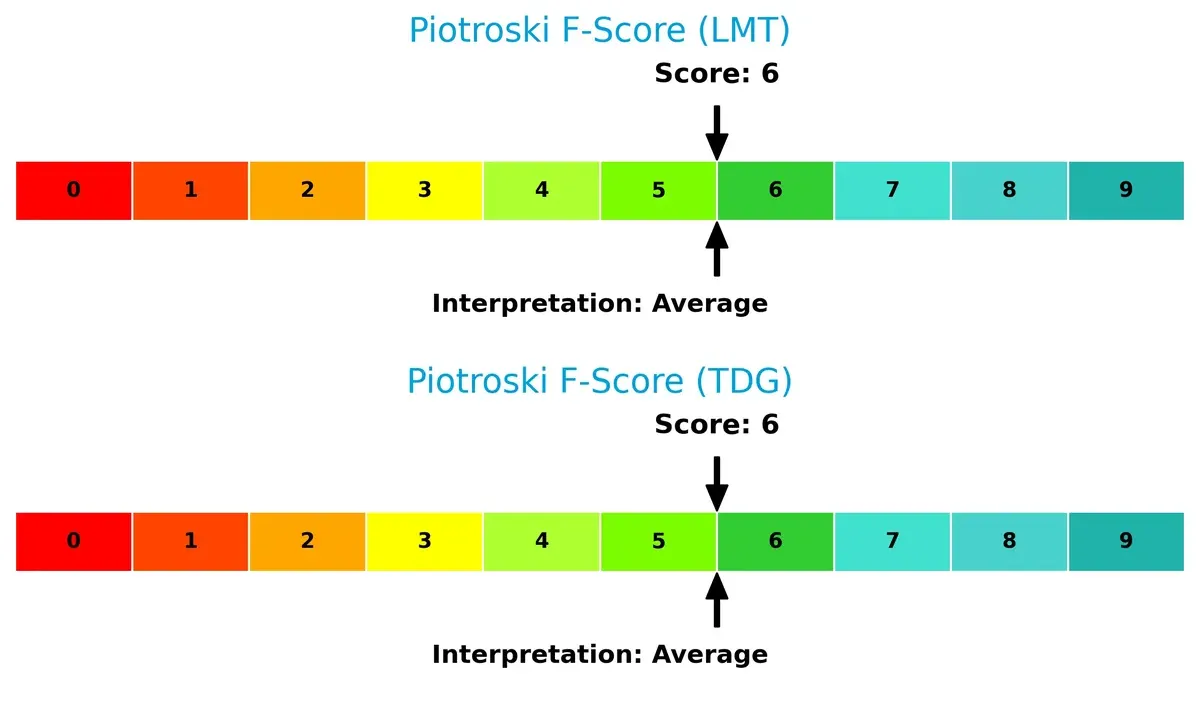
Neither firm raises immediate red flags internally, but this score suggests room for improvement in profitability, leverage, or efficiency. Investors should monitor operational execution trends to detect potential deterioration or improvement.
How are the two companies positioned?
This section dissects Lockheed Martin and TransDigm’s operational DNA by comparing revenue distribution and internal strengths and weaknesses. The goal is to confront their economic moats and reveal which model offers the most durable competitive advantage today.
Revenue Segmentation: The Strategic Mix
This visual comparison dissects how Lockheed Martin Corporation and TransDigm Group Incorporated diversify their income streams and where their primary sector bets lie:
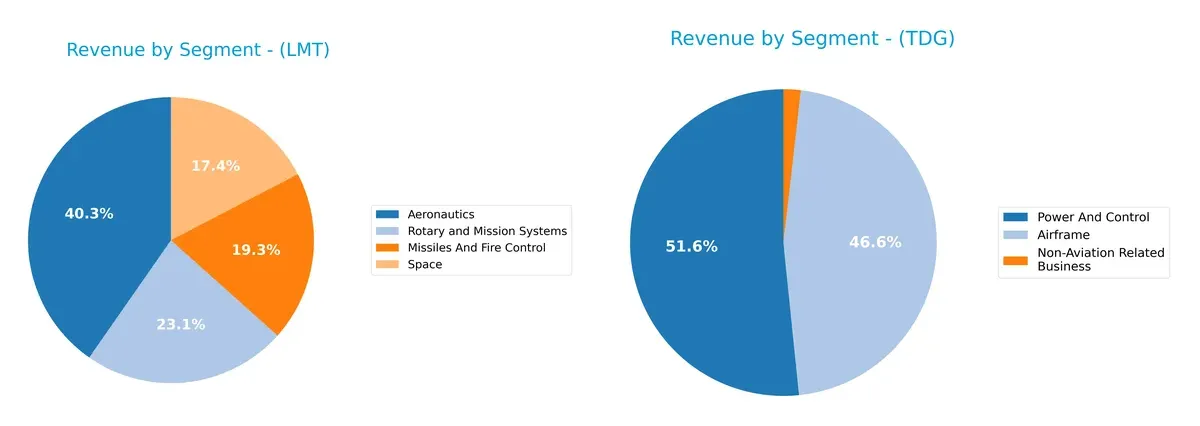
Lockheed Martin anchors its revenue in Aeronautics with $30.3B, followed by Rotary and Mission Systems at $17.3B, showing a balanced multi-segment strategy. TransDigm pivots on Power And Control ($4.56B) and Airframe ($4.11B), but these two segments dominate its smaller $9.7B total. Lockheed’s diverse portfolio reduces concentration risk, while TransDigm’s reliance on aviation components heightens exposure but benefits from specialized industry niches.
Strengths and Weaknesses Comparison
This table compares the strengths and weaknesses of Lockheed Martin Corporation and TransDigm Group Incorporated:
Lockheed Martin Corporation Strengths
- Diverse product segments including Aeronautics, Space, and Missiles
- Favorable ROE of 74.65% and ROIC of 17.39%
- Strong asset turnover ratios
- Global presence with significant US and international sales
- Stable dividend yield at 2.8%
TransDigm Group Incorporated Strengths
- High net margin of 23.49%
- Favorable ROIC of 15.22%
- Strong quick ratio at 2.25
- Favorable PB despite negative debt equity ratio
- Market focus on Airframe and Power & Control segments
Lockheed Martin Corporation Weaknesses
- Unfavorable price-to-book ratio at 16.62
- Neutral current and quick ratios indicate moderate liquidity
- Heavy US reliance with less geographic diversification
- Neutral net margin at 6.68%
- High valuation multiples with PE at 22.26
TransDigm Group Incorporated Weaknesses
- Negative ROE at -21.41% signals profitability issues
- Unfavorable debt-to-assets at 131.08% indicates high leverage risk
- Low asset turnover at 0.39 suggests inefficient use of assets
- Elevated PE ratio at 36.99 questions valuation
- Neutral interest coverage ratio at 2.67
Lockheed Martin exhibits strong profitability and diversified operations but faces valuation and liquidity concerns. TransDigm posts high margins and liquidity yet struggles with leverage and asset efficiency. These contrasting profiles highlight distinct strategic challenges and risk exposures.
The Moat Duel: Analyzing Competitive Defensibility
A structural moat alone defends long-term profits from competition’s relentless erosion. Let’s dissect the core competitive advantages of Lockheed Martin and TransDigm:
Lockheed Martin Corporation: Government Contract Longevity and Integrated Defense Systems
Lockheed Martin’s moat stems from high switching costs embedded in exclusive U.S. government contracts and integrated aerospace systems. This creates stable ROIC above WACC, though profitability shows a declining trend in 2026. Expansion into space and missile defense may deepen this moat but requires continuous innovation.
TransDigm Group Incorporated: Component Specialization and Pricing Power
TransDigm’s moat is built on proprietary, engineered aircraft components with strong pricing power and high gross margins, contrasting Lockheed’s broader defense platform. Its ROIC significantly outpaces WACC with a robust upward trend, signaling durable value creation. Expansion into non-aviation markets offers fresh growth avenues and moat reinforcement.
Exclusive Contracts vs. Specialized Components: The Moat Face-Off
TransDigm’s rapidly growing, high-margin specialization creates a wider, more durable moat than Lockheed’s traditional, contract-dependent model. TransDigm’s superior profitability and expanding markets position it better to defend and grow market share amid evolving aerospace demands.
Which stock offers better returns?
The past year shows strong bullish momentum for both stocks, with Lockheed Martin accelerating sharply and TransDigm also gaining steadily amid rising trading volumes.
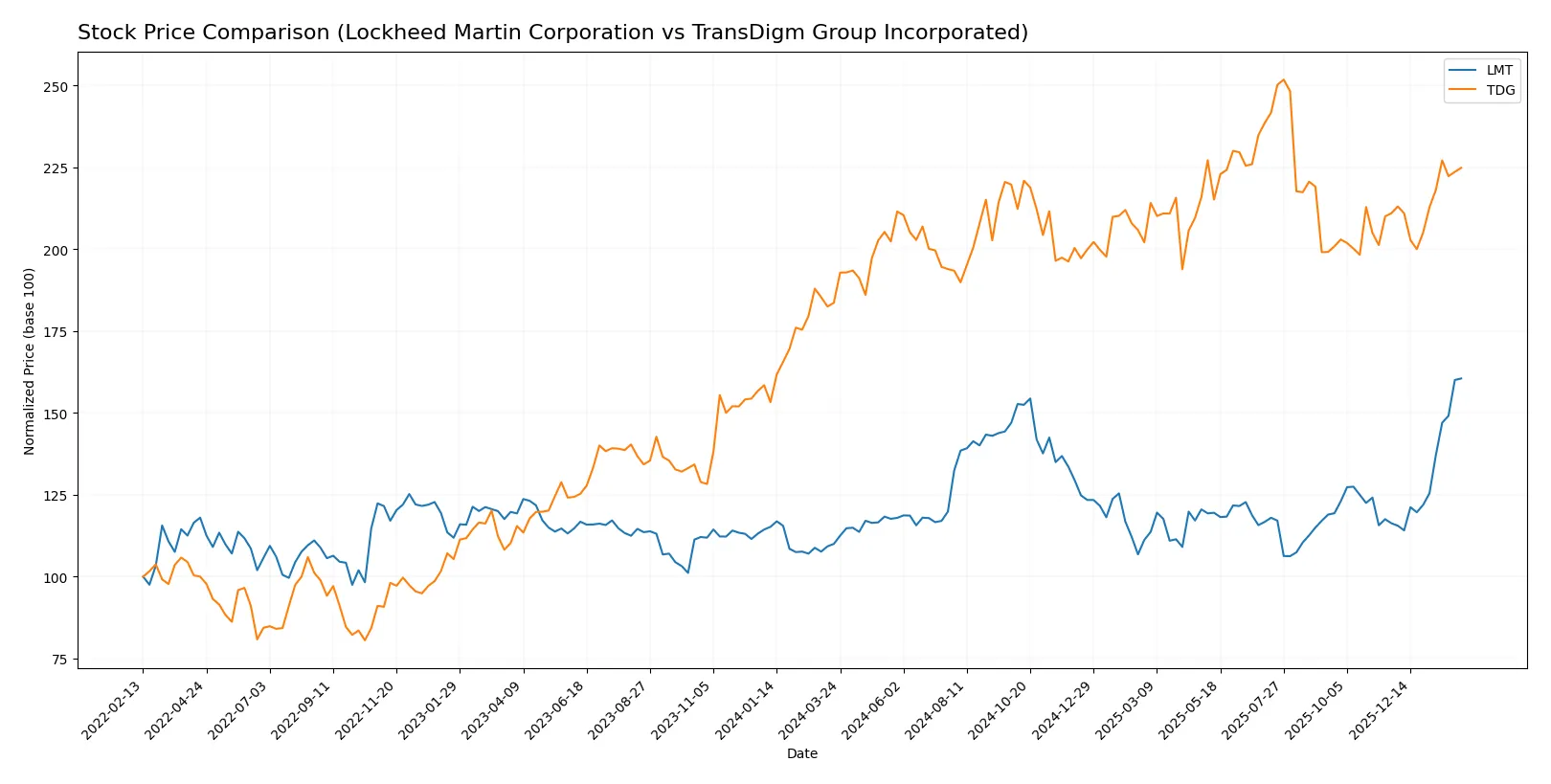
Trend Comparison
Lockheed Martin’s stock gained 45.93% over the last 12 months, showing bullish acceleration. It reached a high of 636.0 and a low of 421.01, with a volatility (std dev) of 49.72.
TransDigm’s stock rose 22.46% in the same period, also bullish with acceleration. Its price ranged between 1172.2 and 1607.45, but volatility was higher at 86.11.
Lockheed Martin outperformed TransDigm with a stronger price increase and momentum, delivering the highest market returns over the past year.
Target Prices
Analyst consensus presents a solid upside potential for both Lockheed Martin Corporation and TransDigm Group Incorporated.
| Company | Target Low | Target High | Consensus |
|---|---|---|---|
| Lockheed Martin Corporation | 517 | 695 | 607 |
| TransDigm Group Incorporated | 1370 | 1871 | 1601.5 |
Lockheed Martin’s consensus target of 607 sits slightly below its current price of 636, indicating limited near-term upside. TransDigm’s target consensus of 1601.5 suggests a robust 11.5% upside from the current price of 1435.52, reflecting stronger growth expectations.

Don’t Let Luck Decide Your Entry Point
Optimize your entry points with our advanced ProRealTime indicators. You’ll get efficient buy signals with precise price targets for maximum performance. Start outperforming now!
How do institutions grade them?
The following shows recent institutional grades for Lockheed Martin Corporation and TransDigm Group Incorporated:
Lockheed Martin Corporation Grades
This table summarizes recent grades assigned by major financial institutions to Lockheed Martin.
| Grading Company | Action | New Grade | Date |
|---|---|---|---|
| Goldman Sachs | Maintain | Sell | 2026-02-02 |
| RBC Capital | Maintain | Sector Perform | 2026-01-30 |
| TD Cowen | Maintain | Hold | 2026-01-30 |
| UBS | Maintain | Neutral | 2026-01-15 |
| Citigroup | Maintain | Neutral | 2026-01-13 |
| Jefferies | Maintain | Hold | 2026-01-12 |
| Truist Securities | Upgrade | Buy | 2026-01-09 |
| JP Morgan | Downgrade | Neutral | 2025-12-19 |
| Morgan Stanley | Downgrade | Equal Weight | 2025-12-16 |
| UBS | Maintain | Neutral | 2025-10-22 |
TransDigm Group Incorporated Grades
This table presents recent institutional grades for TransDigm Group from recognized analysts.
| Grading Company | Action | New Grade | Date |
|---|---|---|---|
| UBS | Maintain | Buy | 2026-01-15 |
| JP Morgan | Maintain | Neutral | 2025-11-14 |
| Morgan Stanley | Maintain | Overweight | 2025-11-14 |
| RBC Capital | Maintain | Sector Perform | 2025-11-13 |
| BMO Capital | Maintain | Outperform | 2025-11-13 |
| Stifel | Maintain | Buy | 2025-11-13 |
| UBS | Maintain | Buy | 2025-11-13 |
| Truist Securities | Maintain | Buy | 2025-10-15 |
| Morgan Stanley | Maintain | Overweight | 2025-10-15 |
| Susquehanna | Maintain | Neutral | 2025-10-09 |
Which company has the best grades?
TransDigm receives consistently higher grades like Buy, Overweight, and Outperform. Lockheed Martin holds mostly Neutral or Hold, with some Sell ratings. This difference may influence investor sentiment and portfolio positioning.
Risks specific to each company
The following categories identify critical pressure points and systemic threats facing Lockheed Martin Corporation and TransDigm Group Incorporated in the 2026 market environment:
1. Market & Competition
Lockheed Martin Corporation
- Dominates aerospace & defense with broad product lines and government contracts, but faces intense geopolitical shifts.
TransDigm Group Incorporated
- Niche aircraft components supplier with strong pricing power but limited diversification and higher exposure to commercial aviation cycles.
2. Capital Structure & Debt
Lockheed Martin Corporation
- Maintains low debt (D/E 0.17) with strong interest coverage (6.3x), signaling solid financial stability.
TransDigm Group Incorporated
- Exhibits highly leveraged balance sheet (debt-to-assets 131%) with weak interest coverage (2.67x), raising financial risk.
3. Stock Volatility
Lockheed Martin Corporation
- Low beta (0.23) indicates defensive stock behavior with limited price swings in volatile markets.
TransDigm Group Incorporated
- Beta near 0.9 suggests higher sensitivity to market fluctuations and greater price volatility.
4. Regulatory & Legal
Lockheed Martin Corporation
- Faces complex government regulations and export controls but benefits from strong government relationships.
TransDigm Group Incorporated
- Subject to aerospace safety standards and antitrust scrutiny, with less regulatory influence than prime contractors.
5. Supply Chain & Operations
Lockheed Martin Corporation
- Complex global supply chain risks mitigated by scale and integration capabilities.
TransDigm Group Incorporated
- Relies on specialized suppliers; vulnerable to component shortages and supply disruptions.
6. ESG & Climate Transition
Lockheed Martin Corporation
- Increasing pressure to improve sustainability and reduce emissions in defense manufacturing.
TransDigm Group Incorporated
- Emerging ESG focus with limited disclosure; faces challenges adapting to climate-related regulations.
7. Geopolitical Exposure
Lockheed Martin Corporation
- Heavy reliance on U.S. government and foreign military sales exposes it to geopolitical shifts and budget changes.
TransDigm Group Incorporated
- Moderate exposure via global aerospace markets but less sensitive to defense spending fluctuations.
Which company shows a better risk-adjusted profile?
Lockheed Martin’s dominant market position and conservative financial structure create a stronger risk-adjusted profile. Its most impactful risk is geopolitical dependency on government budgets. TransDigm’s high leverage and operational concentration pose greater financial and supply chain risks. Recent data shows Lockheed’s low beta and superior credit metrics justify investor confidence despite macro uncertainties.
Final Verdict: Which stock to choose?
Lockheed Martin’s superpower lies in its robust capital efficiency and consistent value creation, demonstrated by a strong ROIC well above its cost of capital. Its point of vigilance is the slightly declining profitability trend, which could signal upcoming margin pressures. It fits well in portfolios targeting steady, long-term industrial defense exposure.
TransDigm shines with a durable competitive moat fueled by high-margin, niche aerospace components and a growing ROIC trend. However, its elevated leverage and weaker equity returns introduce greater risk relative to Lockheed Martin. It suits investors who favor growth with a tolerance for balance sheet volatility.
If you prioritize stable value creation with a solid defense sector footprint, Lockheed Martin offers a compelling choice due to its disciplined capital allocation and financial resilience. However, if you seek accelerated growth driven by margin expansion and niche dominance, TransDigm outshines with a more dynamic profitability trajectory despite higher financial risk.
Disclaimer: Investment carries a risk of loss of initial capital. The past performance is not a reliable indicator of future results. Be sure to understand risks before making an investment decision.
Go Further
I encourage you to read the complete analyses of Lockheed Martin Corporation and TransDigm Group Incorporated to enhance your investment decisions: