Home > Comparison > Industrials > LECO vs IPGP
The strategic rivalry between Lincoln Electric Holdings, Inc. and IPG Photonics Corporation shapes the Industrials and Technology sectors respectively. Lincoln Electric, a capital-intensive manufacturer of welding and cutting tools, contrasts with IPG Photonics, a high-tech provider of fiber lasers and amplifiers. This analysis explores their divergent operational models and growth trajectories to identify which company offers superior risk-adjusted returns for a diversified portfolio.
Table of contents
Companies Overview
Lincoln Electric Holdings, Inc. and IPG Photonics Corporation stand as pivotal players in manufacturing and technology sectors respectively.
Lincoln Electric Holdings, Inc.: Welding Innovation Leader
Lincoln Electric commands the manufacturing tools and accessories market with a robust portfolio of welding, cutting, and brazing products. Its core revenue stems from sales of arc welding power sources, robotic welding packages, and consumables, serving heavy fabrication and infrastructure industries. In 2026, it focuses strategically on expanding global distribution and enhancing automation integration within its welding solutions.
IPG Photonics Corporation: Fiber Laser Pioneer
IPG Photonics dominates the fiber laser and semiconductor space, generating revenue through advanced fiber lasers, amplifiers, and integrated laser systems for materials processing and communications. Its 2026 strategy targets innovation in high-power fiber lasers and expanding applications in medical and telecommunications sectors, emphasizing direct sales and partnerships with OEMs and system integrators.
Strategic Collision: Similarities & Divergences
Both companies emphasize high-precision manufacturing but diverge philosophically: Lincoln Electric relies on tangible equipment and consumables, while IPG Photonics champions cutting-edge laser technology and integrated systems. Their competition centers on serving industrial and advanced manufacturing markets with differentiated technological approaches. These distinctions shape their investment profiles—Lincoln Electric offers industrial resilience; IPG Photonics presents technology-driven growth potential.
Income Statement Comparison
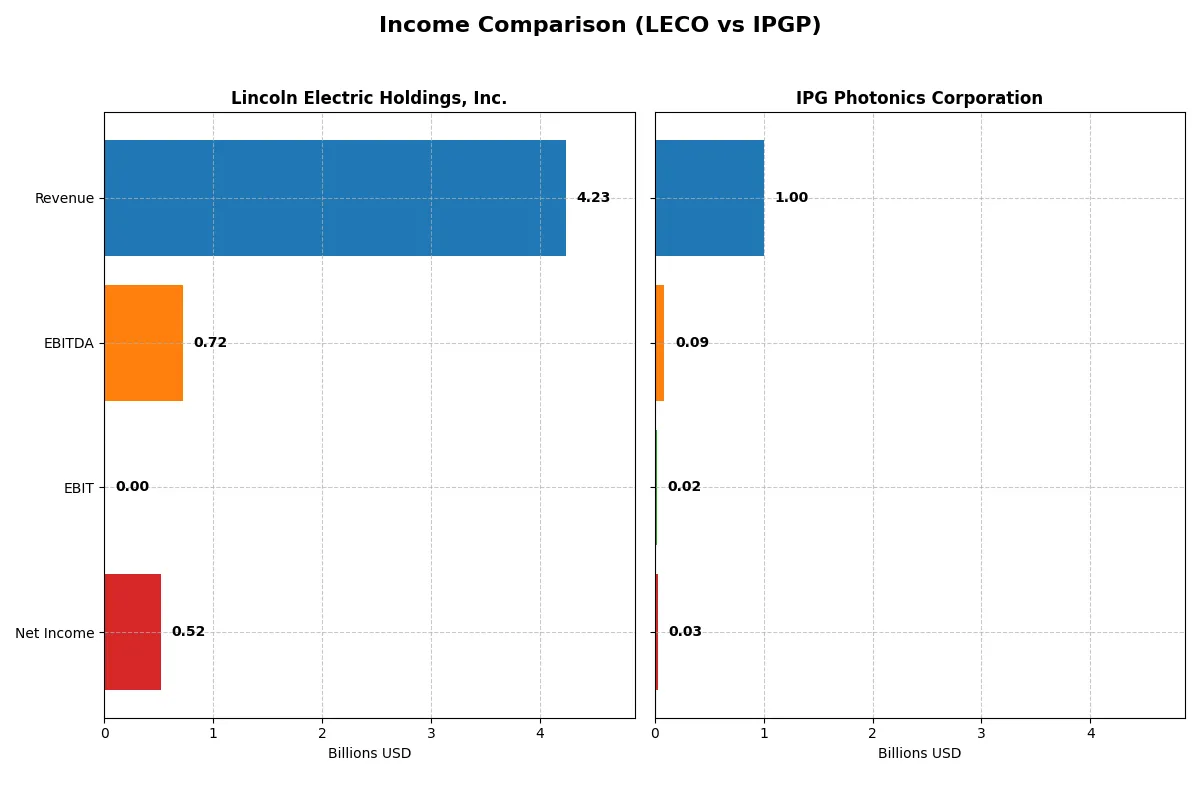
This data dissects the core profitability and scalability of both corporate engines to reveal who dominates the bottom line:
| Metric | Lincoln Electric Holdings, Inc. (LECO) | IPG Photonics Corporation (IPGP) |
|---|---|---|
| Revenue | 4.23B | 1.00B |
| Cost of Revenue | 2.70B | 622M |
| Operating Expenses | 798M | 368M |
| Gross Profit | 1.53B | 381M |
| EBITDA | 718M | 90M |
| EBIT | 0 | 23M |
| Interest Expense | 52M | 0 |
| Net Income | 521M | 31M |
| EPS | 9.39 | 0.73 |
| Fiscal Year | 2025 | 2025 |
Income Statement Analysis: The Bottom-Line Duel
This income statement comparison exposes the efficiency and profitability engines driving Lincoln Electric Holdings and IPG Photonics in 2025.
Lincoln Electric Holdings, Inc. Analysis
Lincoln Electric shows a steady revenue rise to 4.23B in 2025, up 5.6% year-over-year. Net income climbs to 520M, reflecting an 88.2% growth since 2021. Its gross margin holds favorably at 36.3%, while a 12.3% net margin signals solid profitability. Despite a zero EBIT margin, operating expenses align well with revenue growth, sustaining momentum.
IPG Photonics Corporation Analysis
IPG Photonics posts 1B revenue in 2025, a modest 2.7% increase but down significantly over five years. Net income rebounds to 31M after a loss in 2024, supported by a 38% gross margin and a lean 2.3% EBIT margin. The company’s net margin at 3.1% remains thin, though recent margin and EPS growth indicate recovering operational efficiency.
Margin Strength vs. Growth Resilience
Lincoln Electric outperforms IPG Photonics with robust revenue and net income growth, coupled with healthy margins. IPG’s recent recovery is notable but follows a prolonged decline in scale and profitability. For investors, Lincoln Electric’s consistent margin expansion and earnings growth profile present a more attractive, reliable earnings engine.
Financial Ratios Comparison
These vital ratios act as a diagnostic tool to expose the underlying fiscal health, valuation premiums, and capital efficiency of the companies analyzed:
| Ratios | Lincoln Electric Holdings, Inc. (LECO) | IPG Photonics Corporation (IPGP) |
|---|---|---|
| ROE | 35.1% (2024) | 1.5% (2025) |
| ROIC | 18.1% (2024) | 0.4% (2025) |
| P/E | 22.8 (2024) | 98.1 (2025) |
| P/B | 8.0 (2024) | 1.4 (2025) |
| Current Ratio | 1.87 (2024) | 6.08 (2025) |
| Quick Ratio | 1.25 (2024) | 4.74 (2025) |
| D/E | 0.99 (2024) | 0 (2025) |
| Debt-to-Assets | 37.4% (2024) | 0% (2025) |
| Interest Coverage | 14.9 (2024) | 0 (2025) |
| Asset Turnover | 1.14 (2024) | 0.41 (2025) |
| Fixed Asset Turnover | 6.47 (2024) | 1.57 (2025) |
| Payout ratio | 34.8% (2024) | 0% (2025) |
| Dividend yield | 1.53% (2024) | 0% (2025) |
| Fiscal Year | 2024 | 2025 |
Efficiency & Valuation Duel: The Vital Signs
Financial ratios serve as a company’s DNA, revealing hidden risks and operational excellence critical for investment decisions.
Lincoln Electric Holdings, Inc.
Lincoln Electric shows a mixed profile in 2025. Its net margin at 12.3% signals solid profitability, yet zero ROE and ROIC indicate weak capital efficiency. The P/E of 25.5 appears stretched compared to sector averages. Dividend yield of 1.25% contributes modest shareholder returns, balancing limited growth reinvestment signals.
IPG Photonics Corporation
IPG Photonics displays weak profitability with a 3.1% net margin and very low ROE at 1.46%. Its P/E ratio is high at 98, suggesting an expensive valuation. Despite a zero dividend, the firm maintains a strong balance sheet with favorable debt metrics and a high quick ratio, implying focus on liquidity and potential growth investments.
Profitability Stability vs. Growth Premium
Lincoln Electric offers better profitability and a modest dividend, though operational efficiency lags. IPG Photonics trades at a premium with weaker returns but strong liquidity. Investors prioritizing steady income may prefer Lincoln; growth-oriented investors might tolerate IPG’s valuation risk for potential long-term gains.
Which one offers the Superior Shareholder Reward?
Lincoln Electric Holdings, Inc. (LECO) pays a consistent dividend with a 1.5% yield and a sustainable payout ratio near 35%. It complements dividends with moderate buybacks, fueling steady shareholder returns. IPG Photonics Corporation (IPGP) pays no dividend, relying on reinvestment in R&D and growth, but its free cash flow is negative in 2025, raising sustainability concerns. LECO’s disciplined capital allocation and dividend-plus-buyback model offer a more reliable total return. I conclude LECO provides the superior shareholder reward for 2026 investors.
Comparative Score Analysis: The Strategic Profile
The radar chart reveals the fundamental DNA and trade-offs of Lincoln Electric Holdings and IPG Photonics Corporation:
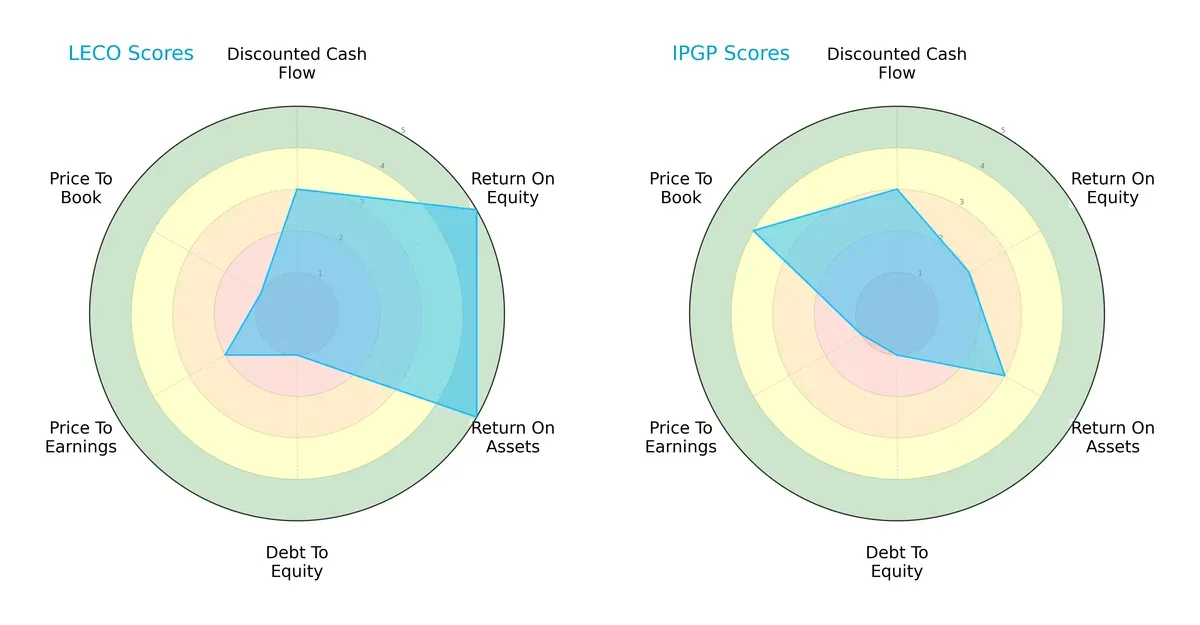
Lincoln Electric exhibits strong operational efficiency with top ROE and ROA scores of 5 each, signaling superior profitability and asset use. IPG Photonics lags with moderate scores but compensates with a favorable price-to-book ratio of 4, indicating better market valuation relative to book value. Both firms share weak debt-to-equity scores, raising red flags on leverage. Lincoln Electric shows a more balanced profile, while IPG relies heavily on valuation advantages.
Bankruptcy Risk: Solvency Showdown
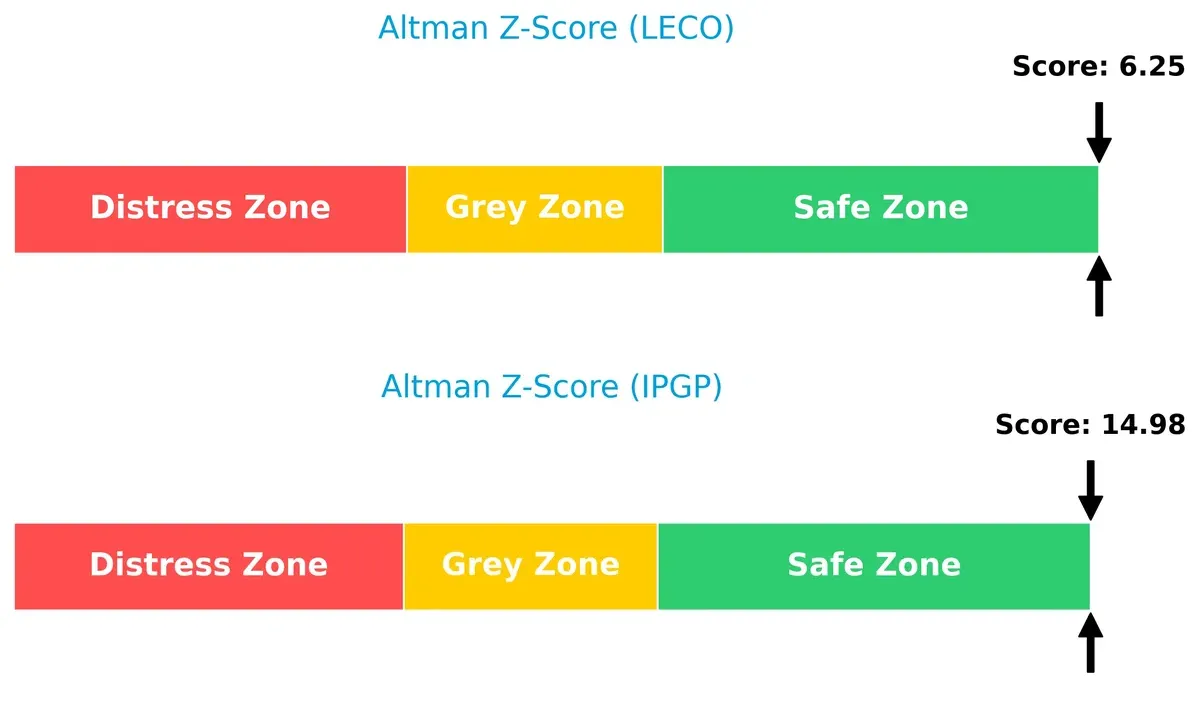
Lincoln Electric’s Altman Z-Score of 6.25 versus IPG Photonics’ 14.98 confirms both firms are well within the safe zone, with IPG holding a significantly stronger solvency buffer in this cycle:
Financial Health: Quality of Operations
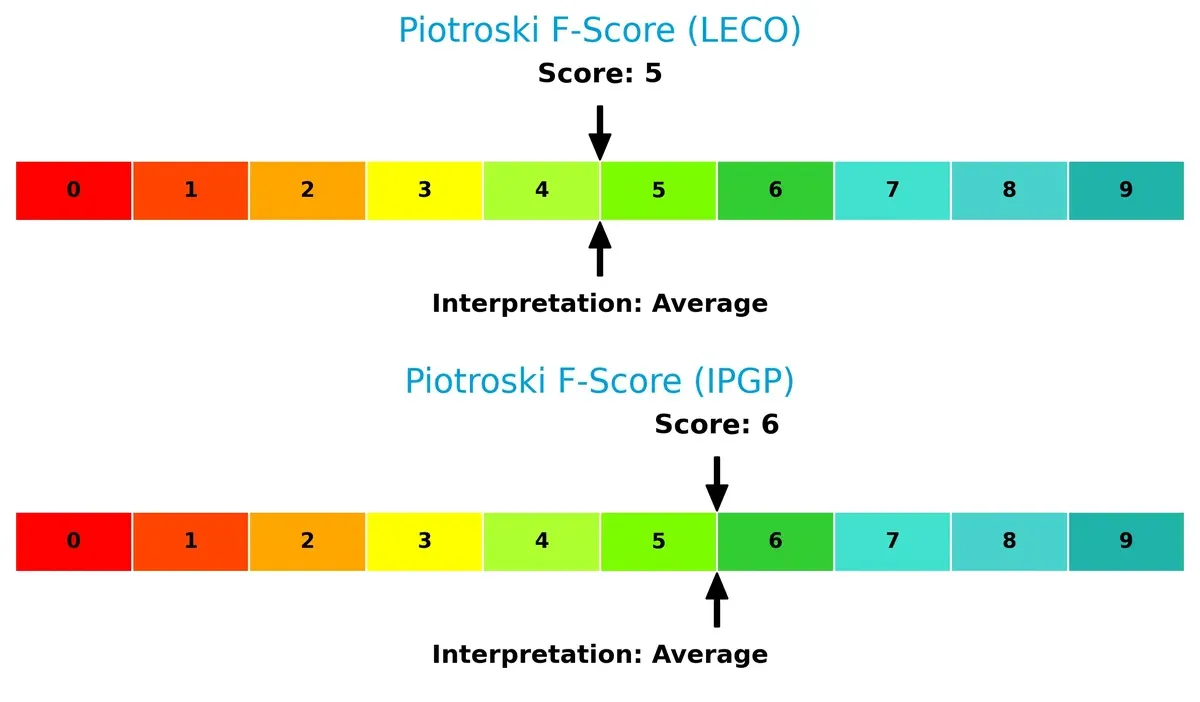
Lincoln Electric scores a 5 and IPG Photonics a 6 on the Piotroski F-Score, both indicating average financial health. IPG’s marginally higher score suggests slightly better operational quality, but neither company shows alarming red flags:
How are the two companies positioned?
This section dissects the operational DNA of LECO and IPGP by comparing their revenue distribution by segment and internal dynamics. The goal is to confront their economic moats and identify which model offers the most resilient competitive advantage today.
Revenue Segmentation: The Strategic Mix
This visual comparison dissects how Lincoln Electric Holdings and IPG Photonics diversify income streams and where their primary sector bets lie:
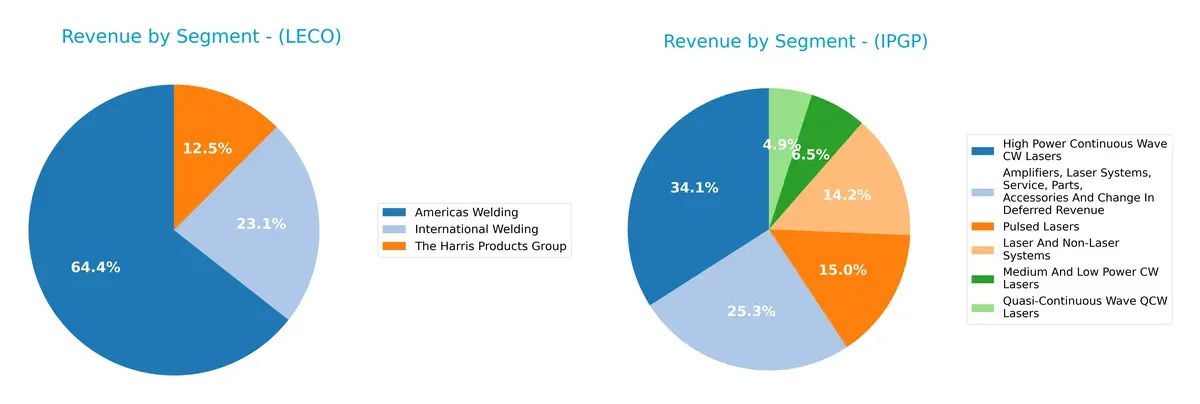
Lincoln Electric anchors its revenue in Americas Welding at $2.7B, complemented by International Welding at $970M and Harris Products at $520M. This mix reveals moderate diversification across geographic and product lines. Conversely, IPG Photonics pivots around High Power Continuous Wave Lasers at $333M, with several smaller laser segments under $250M each, signaling reliance on a core technology. Lincoln’s broad base reduces concentration risk, while IPG’s focus bets on laser innovation dominance.
Strengths and Weaknesses Comparison
This table compares the Strengths and Weaknesses of Lincoln Electric Holdings, Inc. and IPG Photonics Corporation:
LECO Strengths
- Strong Americas Welding segment with $2.7B revenue
- Diverse international presence with $969M in International Welding
- Solid Harris Products Group segment at $522M
- Favorable net margin at 12.3%
- Low debt-to-assets ratio and favorable debt to equity
IPGP Strengths
- Broad product range across lasers and amplifiers
- Favorable quick ratio at 4.74 indicates liquidity
- Favorable debt metrics and interest coverage
- Notable presence in China with $245M revenue
- Diversified geographic exposure including Europe and Asia
LECO Weaknesses
- Unfavorable return on equity and ROIC at 0%
- Poor liquidity ratios (current and quick ratios at 0)
- Unfavorable asset turnover and interest coverage
- Elevated P/E ratio at 25.51
- Limited innovation data
IPGP Weaknesses
- Low net margin at 3.1% and low ROIC at 0.41%
- High P/E ratio at 98.08 suggests valuation risk
- Unfavorable current ratio at 6.08
- No dividend yield
- Asset turnover is low at 0.41
Lincoln Electric demonstrates strong revenue diversification and profitability but faces liquidity and efficiency challenges. IPG Photonics shows solid liquidity and geographic diversification but struggles with profitability and high valuation metrics. These contrasts shape each company’s strategic priorities in financial and operational management.
The Moat Duel: Analyzing Competitive Defensibility
A structural moat shields long-term profits from relentless competitive pressures. Without it, market share and margins erode rapidly:
Lincoln Electric Holdings, Inc.: Switching Costs and Broad Distribution Network
Lincoln Electric’s moat stems from high switching costs and a vast distributor network, reflected in stable gross margins near 36%. Its diversified geographical reach supports resilience. In 2026, automation and integrated welding systems could deepen this advantage.
IPG Photonics Corporation: Intangible Assets and Technological Innovation
IPG’s moat relies on proprietary fiber laser technology and patents, unlike Lincoln’s distribution edge. Despite a 38% gross margin, IPG’s value creation falters with declining ROIC and shrinking revenue over five years. However, expanding laser applications in advanced manufacturing offer growth potential.
Durable Network vs. Innovation Edge: The Moat Battle
Lincoln Electric’s switching-cost moat is wider and more stable, supported by consistent margin and revenue growth. IPG’s technological moat is narrower and challenged by value destruction. Lincoln is better positioned to defend market share amid evolving industrial demand.
Which stock offers better returns?
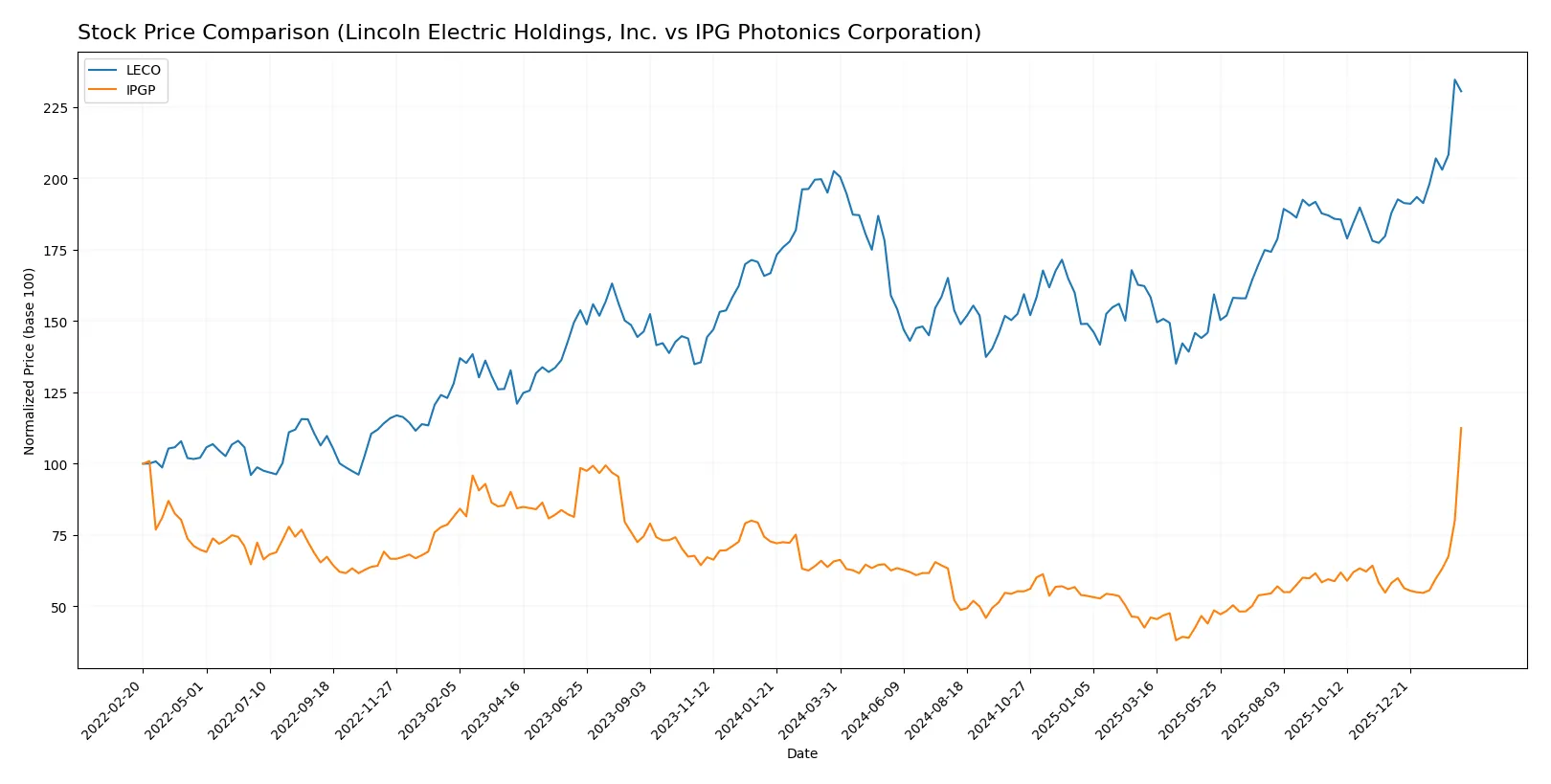
The past year shows notable price appreciation in both stocks, with IPG Photonics surging sharply and Lincoln Electric steadily gaining amid rising trading volumes and buyer dominance.
Trend Comparison
Lincoln Electric Holdings, Inc. (LECO) shows a 13.81% price increase over 12 months, indicating a bullish trend with acceleration. The stock fluctuated between 172.02 and 298.88, with volatility at 26.69%.
IPG Photonics Corporation (IPGP) posted a 71.01% gain over the same period, also bullish with acceleration. Its price ranged from 52.12 to 153.91, showing lower volatility at 12.46%.
IPGP outperformed LECO substantially, delivering the highest market return and stronger buyer dominance in the recent months analyzed.
Target Prices
Analysts present a bullish consensus for both Lincoln Electric Holdings and IPG Photonics, reflecting confidence in their growth prospects.
| Company | Target Low | Target High | Consensus |
|---|---|---|---|
| Lincoln Electric Holdings, Inc. | 208 | 340 | 297.5 |
| IPG Photonics Corporation | 110 | 180 | 151.67 |
The target consensus for Lincoln Electric slightly exceeds its current price of $293.68, signaling modest upside potential. IPG Photonics’ consensus sits just below its current price of $153.91, indicating expectations of stable valuation.

Don’t Let Luck Decide Your Entry Point
Optimize your entry points with our advanced ProRealTime indicators. You’ll get efficient buy signals with precise price targets for maximum performance. Start outperforming now!
How do institutions grade them?
This section summarizes the recent grades assigned to Lincoln Electric Holdings, Inc. and IPG Photonics Corporation by leading financial institutions:
Lincoln Electric Holdings, Inc. Grades
The table below shows the latest grades for Lincoln Electric Holdings, Inc. from major grading companies.
| Grading Company | Action | New Grade | Date |
|---|---|---|---|
| Keybanc | maintain | Overweight | 2026-02-13 |
| Barclays | maintain | Overweight | 2026-02-13 |
| Stifel | maintain | Hold | 2026-02-13 |
| Roth Capital | maintain | Buy | 2026-02-03 |
| Stifel | maintain | Hold | 2026-01-23 |
| Barclays | maintain | Overweight | 2026-01-23 |
| Morgan Stanley | maintain | Underweight | 2026-01-12 |
| Stifel | maintain | Hold | 2025-12-16 |
| Stifel | maintain | Hold | 2025-10-31 |
| Barclays | maintain | Overweight | 2025-10-20 |
IPG Photonics Corporation Grades
Below are the recent grades for IPG Photonics Corporation from recognized grading companies.
| Grading Company | Action | New Grade | Date |
|---|---|---|---|
| Stifel | maintain | Buy | 2026-02-13 |
| Raymond James | downgrade | Outperform | 2026-02-13 |
| Roth Capital | maintain | Buy | 2026-02-03 |
| Citigroup | upgrade | Buy | 2025-11-05 |
| Bernstein | upgrade | Outperform | 2025-08-07 |
| Raymond James | maintain | Strong Buy | 2025-05-07 |
| CL King | upgrade | Buy | 2025-03-18 |
| Citigroup | maintain | Sell | 2025-02-18 |
| Needham | maintain | Hold | 2025-02-12 |
| Stifel | maintain | Buy | 2025-02-12 |
Which company has the best grades?
IPG Photonics Corporation holds generally more bullish grades, including multiple Buy and Strong Buy ratings, compared to Lincoln Electric Holdings, Inc.’s mix of Overweight, Hold, and Buy ratings. This suggests a stronger institutional confidence in IPG’s near-term prospects.
Risks specific to each company
The following categories identify the critical pressure points and systemic threats facing both firms in the 2026 market environment:
1. Market & Competition
Lincoln Electric Holdings, Inc.
- Faces intense competition in manufacturing tools and welding equipment; cyclical industrial demand poses volatility risks.
IPG Photonics Corporation
- Operates in a highly innovative semiconductor sector; rapid technology shifts and competitor advances pressure margins.
2. Capital Structure & Debt
Lincoln Electric Holdings, Inc.
- Maintains a conservative debt profile with favorable debt-to-assets but weak interest coverage signals potential liquidity risks.
IPG Photonics Corporation
- Zero debt with solid interest coverage, supporting financial flexibility; current ratio is high but may indicate inefficient capital use.
3. Stock Volatility
Lincoln Electric Holdings, Inc.
- Beta at 1.27 suggests above-market volatility typical for industrial cyclicals; price range reflects steady upward momentum.
IPG Photonics Corporation
- Beta near 1.03 denotes moderate volatility; wider trading range reflects sensitivity to semiconductor market cycles.
4. Regulatory & Legal
Lincoln Electric Holdings, Inc.
- Subject to manufacturing and safety regulations globally; compliance costs and trade policies may impact margins.
IPG Photonics Corporation
- Faces strict tech export controls and IP litigation risks in semiconductor space; regulatory shifts could disrupt supply chains.
5. Supply Chain & Operations
Lincoln Electric Holdings, Inc.
- Relies on global supply chains for raw materials; industrial production disruptions could hinder delivery and increase costs.
IPG Photonics Corporation
- Dependent on specialized components; supply chain bottlenecks or tech material scarcity pose operational risks.
6. ESG & Climate Transition
Lincoln Electric Holdings, Inc.
- Industrial sector under pressure to reduce emissions; transition costs and regulatory compliance may affect profitability.
IPG Photonics Corporation
- Energy-efficient products offer ESG appeal; however, semiconductor manufacturing intensity raises environmental scrutiny.
7. Geopolitical Exposure
Lincoln Electric Holdings, Inc.
- Operations in Americas and international markets expose it to trade tariffs and geopolitical tensions.
IPG Photonics Corporation
- Global footprint in sensitive tech sectors increases vulnerability to geopolitical restrictions and export controls.
Which company shows a better risk-adjusted profile?
Lincoln Electric’s main risk lies in weak liquidity and operational leverage despite a stable market position. IPG Photonics faces technology cycle risks but benefits from a pristine balance sheet and strong liquidity. IPG’s safe-zone Altman Z-Score and moderately favorable Piotroski Score suggest a slightly better risk-adjusted profile. The key concern for Lincoln Electric is its unfavorable liquidity ratios, while IPG’s high P/E ratio flags valuation risk amid sector volatility. I view IPG as marginally safer but still exposed to semiconductor market swings.
Final Verdict: Which stock to choose?
Lincoln Electric Holdings (LECO) impresses with its robust cash generation and disciplined capital allocation. Its core strength lies in operational efficiency that drives consistent margin expansion. A point of vigilance remains its rising debt levels, which could pressure financial flexibility. LECO suits portfolios targeting steady income with moderate growth.
IPG Photonics (IPGP) leverages a strategic moat fueled by cutting-edge photonics tech and recurring revenue streams from long-term contracts. Its balance sheet exhibits strong liquidity and low leverage, offering relative safety. However, profitability challenges temper enthusiasm. IPGP fits growth-at-a-reasonable-price (GARP) investors seeking exposure to advanced industry niches.
If you prioritize efficient capital use and reliable profitability, LECO is the compelling choice due to its proven operational excellence and income potential. However, if you seek exposure to innovative tech sectors with better liquidity cushions, IPGP offers superior growth prospects despite its current profitability headwinds. Both demand close monitoring given their contrasting risk profiles.
Disclaimer: Investment carries a risk of loss of initial capital. The past performance is not a reliable indicator of future results. Be sure to understand risks before making an investment decision.
Go Further
I encourage you to read the complete analyses of Lincoln Electric Holdings, Inc. and IPG Photonics Corporation to enhance your investment decisions: