Home > Comparison > Financial Services > RF vs KEY
The strategic rivalry between Regions Financial Corporation and KeyCorp defines the trajectory of the regional banking sector in the U.S. Regions operates a diversified model with corporate, consumer, and wealth management services, while KeyCorp emphasizes retail and commercial banking with a strong focus on capital markets. This analysis pits diversification against focused scalability to identify which offers superior risk-adjusted returns for a balanced portfolio in financial services.
Table of contents
Companies Overview
Regions Financial Corporation and KeyCorp stand as major players in the US regional banking sector, driving significant financial services.
Regions Financial Corporation: Regional Bank with Diversified Segments
Regions Financial Corporation operates primarily as a regional bank serving the South, Midwest, and Texas. It generates revenue through three main segments: Corporate Bank, Consumer Bank, and Wealth Management. Its strategic focus in recent years has been balancing commercial lending with expanding wealth management, leveraging 1,300 branches and 2,000 ATMs for broad customer reach and diversified income streams.
KeyCorp: Comprehensive Banking with a Strong Mid-Market Presence
KeyCorp positions itself as a full-service bank focused on retail and commercial customers across 15 states. It earns from Consumer and Commercial banking, offering loans, deposits, wealth management, and capital markets products. In 2021, KeyCorp emphasized expanding its community development financing and digital banking capabilities to deepen relationships with small and medium-sized businesses.
Strategic Collision: Similarities & Divergences
Both banks embrace a multi-segment approach but differ in geographic scope and branch footprint. Regions leans heavily on its Southern and Midwestern stronghold, while KeyCorp targets broader regional diversification with a robust digital push. Their primary battlefield is commercial lending and wealth management services. These firms present distinct investment profiles: Regions offers scale and regional depth; KeyCorp focuses on innovation and community banking growth.
Income Statement Comparison
The following data dissects the core profitability and scalability of both corporate engines to reveal who dominates the bottom line:
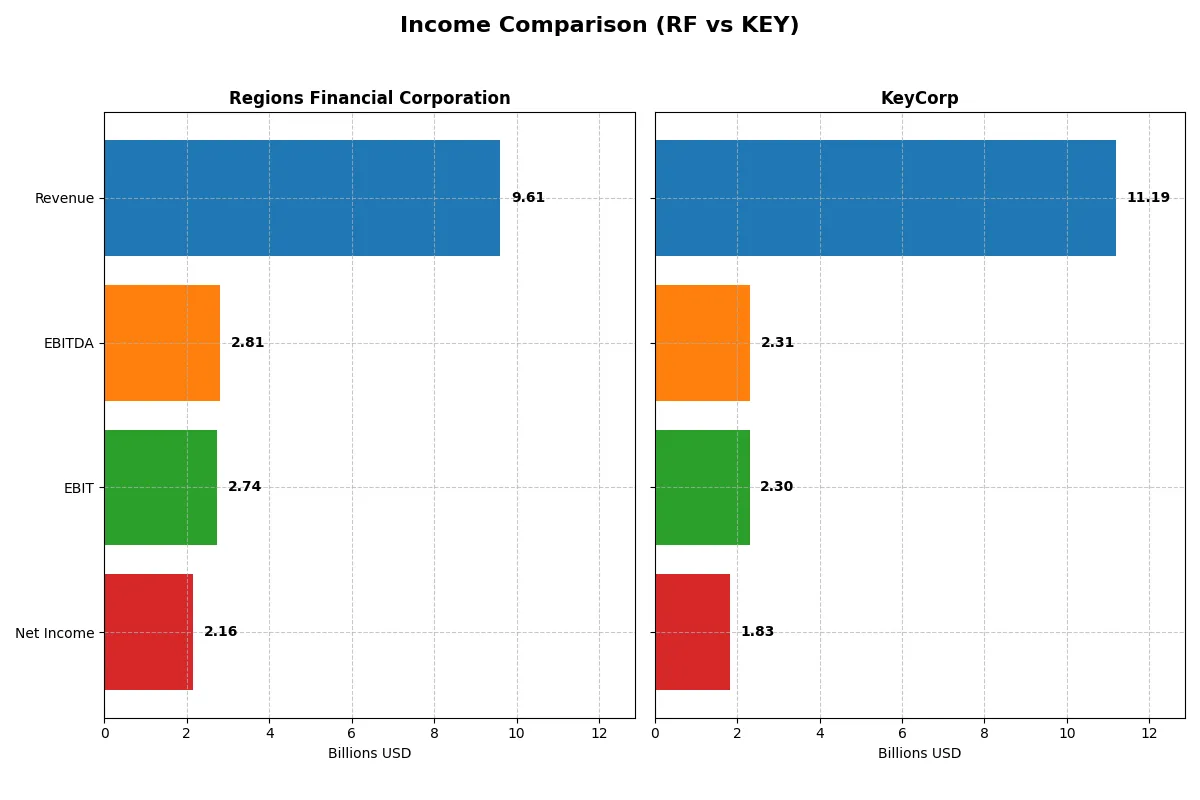
| Metric | Regions Financial Corporation (RF) | KeyCorp (KEY) |
|---|---|---|
| Revenue | 9.6B | 11.2B |
| Cost of Revenue | 2.4B | 4.2B |
| Operating Expenses | 4.4B | 4.7B |
| Gross Profit | 7.2B | 7.0B |
| EBITDA | 2.8B | 2.3B |
| EBIT | 2.7B | 2.3B |
| Interest Expense | 2.1B | 3.8B |
| Net Income | 2.2B | 1.8B |
| EPS | 2.31 | 1.66 |
| Fiscal Year | 2025 | 2025 |
Income Statement Analysis: The Bottom-Line Duel
This income statement comparison reveals which company deploys its financial engine with superior efficiency and momentum.
Regions Financial Corporation Analysis
Regions Financial’s revenue climbed steadily from $6.6B in 2021 to $9.6B in 2025, reflecting a 45.5% growth over five years. Gross margin remains robust at 74.6%, driving a strong net margin of 22.4% in 2025. Net income dipped overall but rebounded last year to $2.16B, supported by an 18.7% EPS growth and a 16.5% EBIT increase, signaling improved operational efficiency.
KeyCorp Analysis
KeyCorp’s revenue surged 52.6% from $7.3B in 2021 to $11.2B in 2025, with a notable 23.6% jump in the last year alone. Gross margin at 62.3% and net margin at 16.4% remain healthy though lower than Regions. KeyCorp’s net income fell 30% over five years but jumped sharply in 2025 to $1.83B, supported by a staggering 575% EPS growth and 853% EBIT rise, indicating a powerful momentum shift.
Margin Resilience vs. Revenue Momentum
Regions Financial delivers superior margins and steady net income recovery, reflecting disciplined cost control and interest expense management. KeyCorp impresses with rapid revenue and earnings acceleration but suffers from thinner margins and higher interest costs. For investors prioritizing margin quality and consistent profitability, Regions’ profile appears more attractive. KeyCorp suits those chasing high growth and earnings rebound potential.
Financial Ratios Comparison
These vital ratios act as a diagnostic tool to expose the underlying fiscal health, valuation premiums, and capital efficiency of each company:
| Ratios | Regions Financial Corporation (RF) | KeyCorp (KEY) |
|---|---|---|
| ROE | 11.3% | 9.0% |
| ROIC | 13.8% | 5.8% |
| P/E | 11.0 | 12.4 |
| P/B | 1.25 | 1.11 |
| Current Ratio | 0.30 | 0.77 |
| Quick Ratio | 0.30 | 0.77 |
| D/E (Debt to Equity) | 0.26 | 0.54 |
| Debt-to-Assets | 3.1% | 6.0% |
| Interest Coverage | 1.32 | 0.61 |
| Asset Turnover | 0.060 | 0.061 |
| Fixed Asset Turnover | 5.79 | 17.82 |
| Payout Ratio | 42% | 49% |
| Dividend Yield | 3.8% | 4.0% |
| Fiscal Year | 2025 | 2025 |
Efficiency & Valuation Duel: The Vital Signs
Financial ratios act as a company’s DNA, unveiling hidden risks and operational strengths that shape investment decisions.
Regions Financial Corporation
Regions shows solid profitability with an 11.3% ROE and a strong 22.4% net margin, indicating operational efficiency. Its valuation is attractive at an 11.0 P/E and 1.25 P/B, suggesting the stock is reasonably priced. Regions rewards shareholders with a 3.8% dividend yield, reflecting steady income distribution.
KeyCorp
KeyCorp posts a weaker 9.0% ROE and a 16.4% net margin, signaling moderate profitability. Its valuation is slightly higher, with a 12.4 P/E and 1.11 P/B, implying a stretched price relative to earnings. The 4.0% dividend yield provides consistent shareholder returns amid cautious growth prospects.
Balanced Efficiency vs. Valuation Discipline
Regions Financial balances superior profitability and favorable valuation metrics better than KeyCorp. Regions’ higher ROE and net margin, coupled with a reasonable P/E, offer a more compelling risk-reward profile. Investors seeking operational efficiency with steady income may prefer Regions, while those favoring yield might consider KeyCorp’s steadier dividend.
Which one offers the Superior Shareholder Reward?
I compare Regions Financial Corporation (RF) and KeyCorp (KEY) based on dividends, payout ratios, and buybacks. RF yields 3.8% with a 42% payout ratio, while KEY yields 4.0% with a 49% payout. RF’s dividend is well covered by free cash flow, signaling sustainability. KEY’s payout ratio is higher, pressuring cash flow amid weaker coverage ratios. RF shows consistent buyback activity supporting shareholder returns; KEY’s buybacks are less pronounced. RF’s balanced distribution model offers more sustainable long-term value. I conclude RF provides the superior total shareholder reward in 2026.
Comparative Score Analysis: The Strategic Profile
The radar chart reveals the fundamental DNA and trade-offs of Regions Financial Corporation and KeyCorp, highlighting core financial strengths and vulnerabilities:
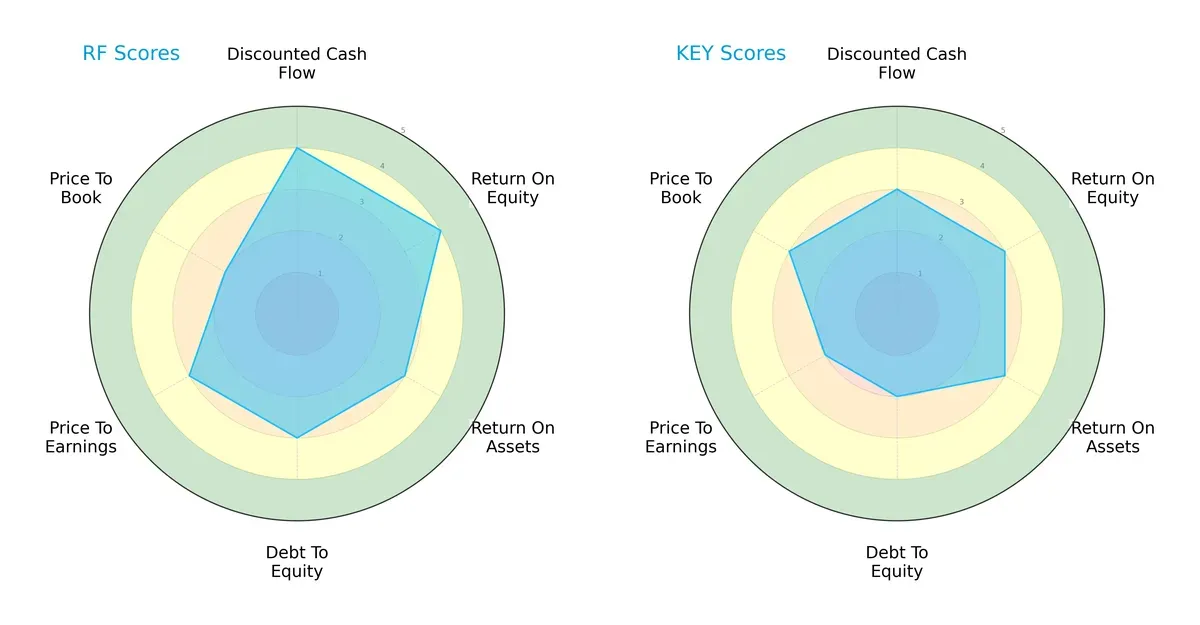
Regions Financial shows a stronger DCF (4 vs. 3) and ROE (4 vs. 3), indicating more efficient capital use and profit generation. Both firms match on ROA (3) but Regions carries a slightly higher debt-to-equity risk (3 vs. 2). Valuation metrics split: Regions scores better on P/E (3 vs. 2), while KeyCorp edges on P/B (3 vs. 2). Regions has a more balanced profile leveraging operational efficiency, whereas KeyCorp relies more on conservative leverage and book value support.
Bankruptcy Risk: Solvency Showdown
The Altman Z-Score gap signals contrasting survival outlooks in this cycle:
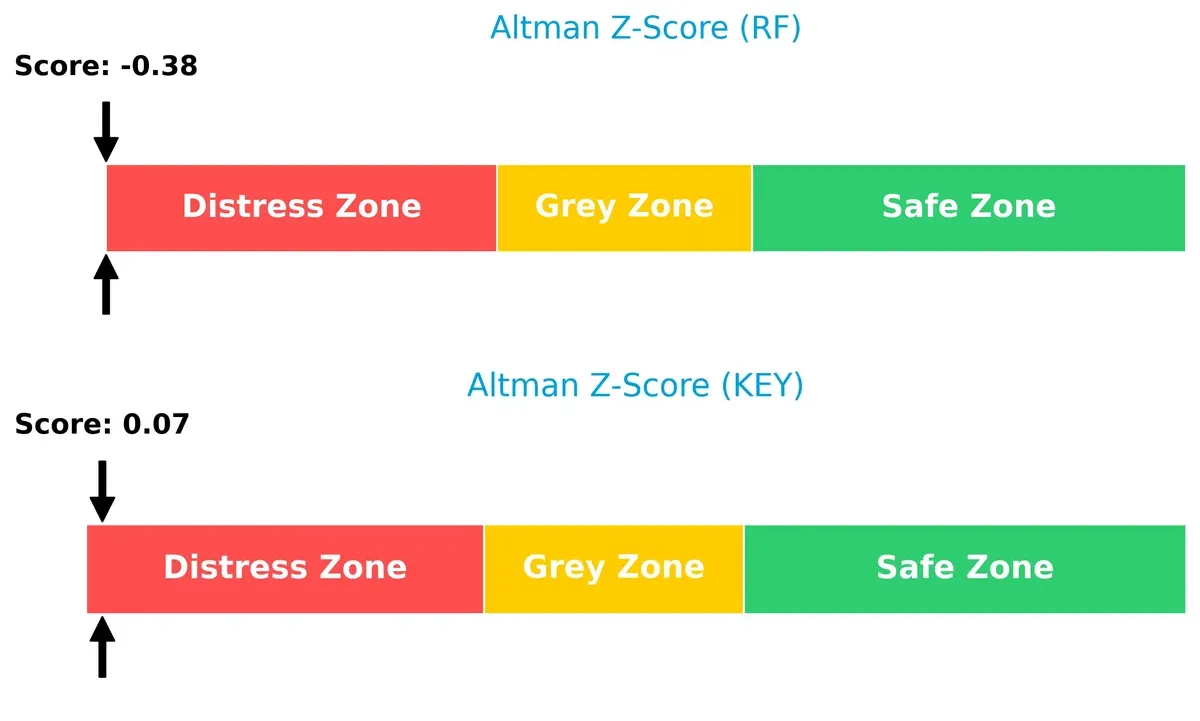
Regions Financial’s score (-0.38) places it deep in distress territory, suggesting elevated bankruptcy risk. KeyCorp’s slightly better score (0.07) still sits in distress but closer to the grey zone, implying marginally stronger solvency. Both require caution, but KeyCorp’s position offers a modestly safer long-term outlook.
Financial Health: Quality of Operations
Piotroski F-Score analysis differentiates operational quality clearly:
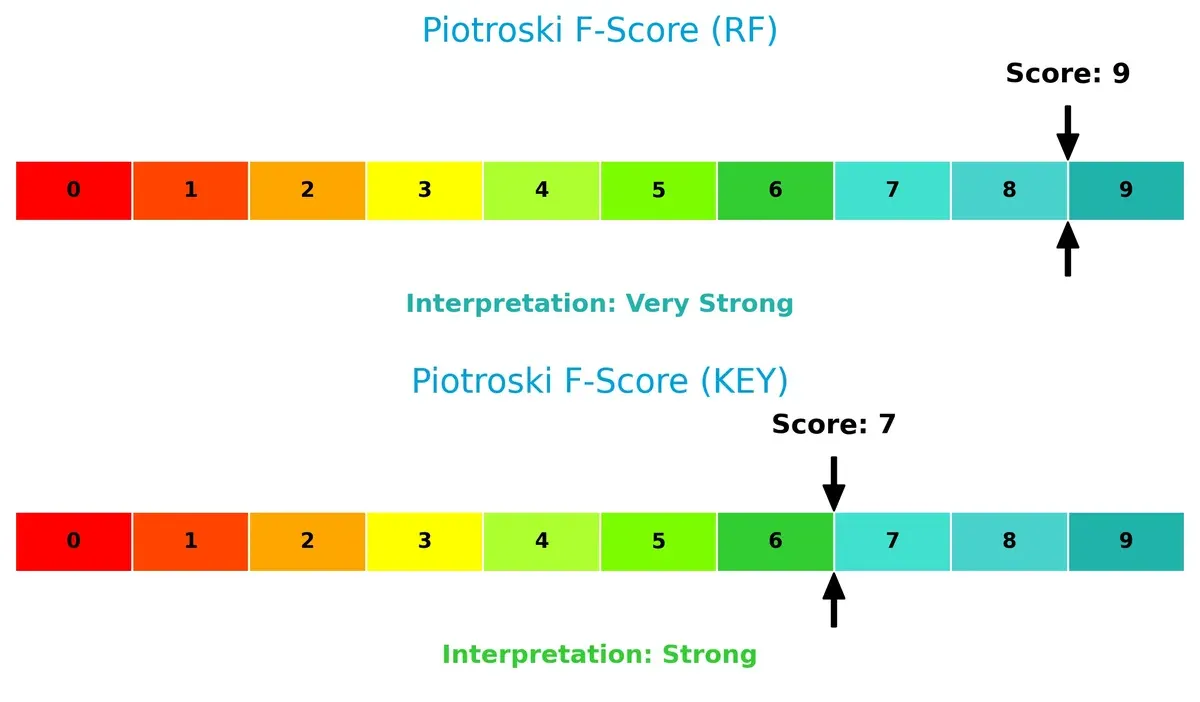
Regions scores a perfect 9, reflecting peak financial health and robust internal metrics across profitability, leverage, and efficiency. KeyCorp’s 7 is strong but indicates some internal weaknesses relative to Regions. The perfect score from Regions suggests superior quality of earnings and balance sheet discipline, while KeyCorp shows minor red flags worth monitoring closely.
How are the two companies positioned?
This section dissects the operational DNA of RF and KEY by comparing revenue distribution and internal dynamics through strengths and weaknesses. The objective is to confront their economic moats to reveal which model offers the most resilient competitive advantage today.
Revenue Segmentation: The Strategic Mix
This visual comparison dissects how Regions Financial Corporation and KeyCorp diversify their income streams and where their primary sector bets lie:
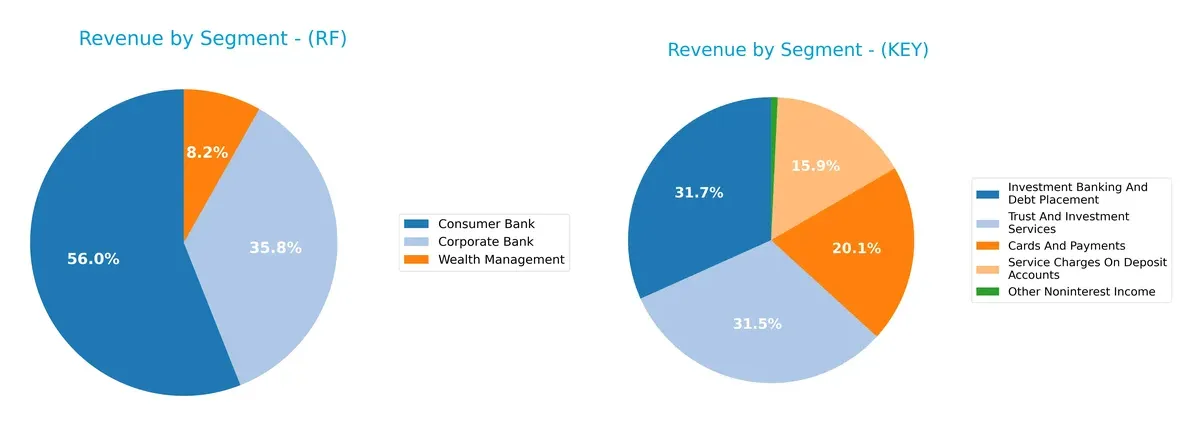
Regions Financial leans on Consumer Bank at $3.13B, anchoring its revenue with Corporate Bank at $2B and Wealth Management at $457M. KeyCorp shows a more diversified structure, splitting its $7.93B Net Interest Income and $2.47B Non-Interest Income across varied segments like Cards, Investment Banking, and Trust Services. Regions risks concentration, while KeyCorp pivots on a balanced ecosystem, reducing vulnerability to sector shifts.
Strengths and Weaknesses Comparison
This table compares the Strengths and Weaknesses of Regions Financial Corporation (RF) and KeyCorp (KEY):
RF Strengths
- Strong net margin at 22.44%
- ROIC above WACC at 13.79% vs 12.77%
- Favorable PE and PB ratios
- Low debt-to-assets at 3.06%
- High fixed asset turnover at 5.79
- Consistent dividend yield of 3.8%
- Diversified revenue from Consumer, Corporate, and Wealth Management segments
KEY Strengths
- Favorable net margin at 16.35%
- Favorable PE and PB ratios
- Higher fixed asset turnover at 17.82
- Competitive dividend yield at 3.97%
- Favorable debt-to-assets at 5.97%
- Diverse income streams including Cards, Investment Banking, and Trust Services
RF Weaknesses
- Low current and quick ratios at 0.3 signal liquidity risk
- Interest coverage barely above 1.3 times
- Asset turnover low at 0.06
- WACC exceeds ROIC, indicating capital cost challenges
- ROE neutral at 11.32%
KEY Weaknesses
- ROE weak at 8.97%
- WACC higher than ROIC at 14.27%
- Current and quick ratios below 1 at 0.77 signal liquidity issues
- Interest coverage weak at 0.61
- Asset turnover low at 0.06
Both companies demonstrate solid profitability and dividend yields, supported by diverse business segments. However, liquidity concerns and capital efficiency challenges present risks that require strategic attention.
The Moat Duel: Analyzing Competitive Defensibility
A structural moat is the only shield that protects long-term profits from relentless competition and market disruption. Let’s dissect the moats of Regions Financial and KeyCorp:
Regions Financial Corporation: Emerging Efficiency Advantage
Regions leverages improving operational efficiency and growing ROIC, reflecting a slight but rising moat. Its steady margin expansion signals better capital use. New markets and digital banking could strengthen this moat in 2026.
KeyCorp: Struggling Legacy Cost Burden
KeyCorp relies on scale and diverse service offerings but suffers from declining ROIC and profitability. Unlike Regions, KeyCorp’s competitive edge weakens, risking erosion. Opportunities in fintech partnerships could reverse this trend if executed well.
Efficiency Growth vs. Cost Drag: The Battle for Value Creation
Regions holds the deeper moat with rising ROIC and operational gains while KeyCorp’s declining returns highlight competitive fragility. Regions is better positioned to defend and grow its market share in a challenging banking landscape.
Which stock offers better returns?
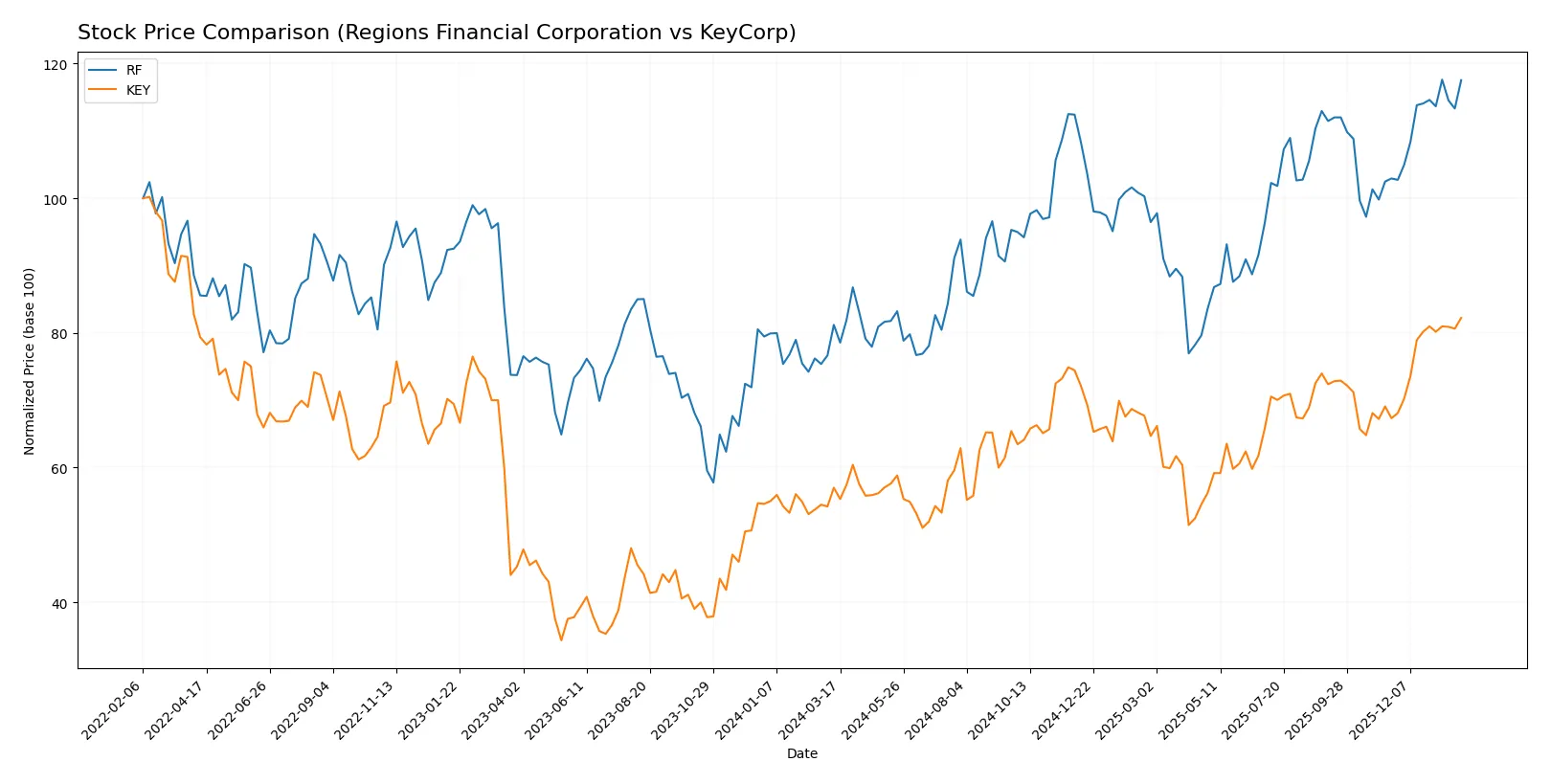
The past year shows strong price appreciation for both stocks, with accelerating bullish momentum and rising trading volumes signaling robust investor interest.
Trend Comparison
Regions Financial Corporation (RF) exhibits a 44.74% price increase over 12 months, confirming a bullish trend with accelerating momentum and a volatility of 2.78. The highest price reached 28.52, the lowest 18.6.
KeyCorp (KEY) gained 44.24% over the same period, also bullish with acceleration. Its volatility is slightly lower at 2.0. The stock hit a high of 21.52 and a low of 13.36.
Both stocks delivered similar strong gains, but RF’s 44.74% slightly outperformed KEY’s 44.24% over the past year.
Target Prices
Analysts present a cautiously optimistic target consensus for these regional banks.
| Company | Target Low | Target High | Consensus |
|---|---|---|---|
| Regions Financial Corporation | 27 | 32 | 29.89 |
| KeyCorp | 18 | 25 | 23.38 |
The consensus target for Regions Financial stands slightly above its current price of 28.5, suggesting modest upside. KeyCorp’s target exceeds its 21.52 stock price, reflecting positive analyst expectations but with a wider range.

Don’t Let Luck Decide Your Entry Point
Optimize your entry points with our advanced ProRealTime indicators. You’ll get efficient buy signals with precise price targets for maximum performance. Start outperforming now!
How do institutions grade them?
Regions Financial Corporation Grades
The table below summarizes recent grades assigned to Regions Financial Corporation by major institutions.
| Grading Company | Action | New Grade | Date |
|---|---|---|---|
| Piper Sandler | Maintain | Neutral | 2026-01-20 |
| Wells Fargo | Maintain | Underweight | 2026-01-20 |
| Keefe, Bruyette & Woods | Downgrade | Market Perform | 2026-01-20 |
| Wells Fargo | Downgrade | Underweight | 2026-01-16 |
| Evercore ISI Group | Downgrade | Underperform | 2026-01-06 |
| Barclays | Maintain | Underweight | 2026-01-05 |
| Truist Securities | Maintain | Hold | 2025-12-22 |
| Keefe, Bruyette & Woods | Maintain | Outperform | 2025-12-17 |
| Truist Securities | Maintain | Hold | 2025-10-20 |
| Stephens & Co. | Downgrade | Equal Weight | 2025-10-14 |
KeyCorp Grades
Below are recent grades from reputable institutions for KeyCorp.
| Grading Company | Action | New Grade | Date |
|---|---|---|---|
| Truist Securities | Maintain | Hold | 2026-01-26 |
| TD Cowen | Maintain | Buy | 2026-01-07 |
| Baird | Downgrade | Underperform | 2026-01-06 |
| Barclays | Maintain | Equal Weight | 2026-01-05 |
| Truist Securities | Maintain | Hold | 2025-12-22 |
| Keefe, Bruyette & Woods | Maintain | Outperform | 2025-12-17 |
| DA Davidson | Maintain | Buy | 2025-12-10 |
| Truist Securities | Maintain | Hold | 2025-10-17 |
| DA Davidson | Maintain | Buy | 2025-10-17 |
| UBS | Maintain | Buy | 2025-10-07 |
Which company has the best grades?
KeyCorp has generally received stronger grades, including multiple Buy and Outperform ratings. Regions Financial’s grades lean toward Neutral and Underweight, with several downgrades. Investors may view KeyCorp’s higher grades as a sign of comparatively better analyst confidence.
Risks specific to each company
The following categories identify critical pressure points and systemic threats facing Regions Financial Corporation and KeyCorp in the 2026 market environment:
1. Market & Competition
Regions Financial Corporation
- Faces intense regional banking competition in the South and Midwest, impacting margins.
KeyCorp
- Competes across 15 states with diversified services, but margin pressures persist.
2. Capital Structure & Debt
Regions Financial Corporation
- Maintains low debt-to-equity (0.26) and favorable debt-to-assets (3.06%), supporting financial stability.
KeyCorp
- Moderate debt-to-equity (0.54) and higher debt-to-assets (5.97%) increase leverage risk.
3. Stock Volatility
Regions Financial Corporation
- Beta near 1.04 suggests market-correlated but manageable volatility.
KeyCorp
- Slightly higher beta at 1.08 indicates marginally greater stock price fluctuations.
4. Regulatory & Legal
Regions Financial Corporation
- Subject to stringent banking regulations in multiple states; compliance costs are significant.
KeyCorp
- Faces regulatory complexity in 15 states; ongoing scrutiny on lending practices.
5. Supply Chain & Operations
Regions Financial Corporation
- Operates 1,300 branches and 2,000 ATMs; operational efficiency challenged by low current ratio (0.3).
KeyCorp
- Manages 999 branches and 1,317 ATMs; better current ratio (0.77) but still below ideal.
6. ESG & Climate Transition
Regions Financial Corporation
- Increasing pressure to align lending practices with climate goals; ESG disclosures evolving.
KeyCorp
- ESG initiatives progressing but face challenges integrating climate risk in loan portfolio.
7. Geopolitical Exposure
Regions Financial Corporation
- Primarily domestic US exposure; regional economic shifts pose risk but limited international exposure.
KeyCorp
- Similar US-focused footprint; economic shifts in key states could affect loan performance.
Which company shows a better risk-adjusted profile?
Regions Financial Corporation’s strongest risk is its distressed liquidity position (current ratio 0.3), raising operational concerns. KeyCorp’s most pressing risk is its weaker profitability and moderate leverage, reflected in a lower ROE and higher debt-to-equity. Despite Regions’ liquidity red flags and negative Altman Z-Score, its higher Piotroski Score (9 vs. 7) signals stronger overall financial health. KeyCorp’s higher WACC (14.27% vs. 12.77%) also weighs on capital efficiency. In sum, Regions shows a marginally better risk-adjusted profile, but liquidity risks require close monitoring amid tightening market conditions.
Final Verdict: Which stock to choose?
Regions Financial Corporation (RF) stands out with its rising profitability and efficient capital use. Its superpower lies in steadily expanding returns on invested capital, signaling improving operational strength. However, a low liquidity ratio remains a point of vigilance. RF suits investors aiming for an aggressive growth profile with a tolerance for operational risks.
KeyCorp (KEY) offers a strategic moat through solid dividend yields and a more conservative debt profile. Its recurring revenue streams contribute to relative safety compared to RF, despite a concerning downward trend in profitability metrics. KEY fits well within a GARP (Growth at a Reasonable Price) portfolio seeking balance between growth and stability.
If you prioritize dynamic profitability and capital efficiency, RF is the compelling choice due to its growth trajectory and improving returns. However, if you seek better stability with steady dividends and lower leverage risk, KEY offers a more cautious approach despite its profitability challenges. Both present distinct analytical scenarios depending on your risk appetite and investment horizon.
Disclaimer: Investment carries a risk of loss of initial capital. The past performance is not a reliable indicator of future results. Be sure to understand risks before making an investment decision.
Go Further
I encourage you to read the complete analyses of Regions Financial Corporation and KeyCorp to enhance your investment decisions: