Home > Comparison > Industrials > UPS vs JBHT
The strategic rivalry between United Parcel Service, Inc. (UPS) and J.B. Hunt Transport Services, Inc. (JBHT) shapes the dynamics of the integrated freight and logistics sector. UPS operates as a global logistics powerhouse with extensive air and ground networks, while JBHT focuses on surface transportation and niche intermodal solutions. This analysis pits scale and global reach against specialized operational agility to identify which path offers superior risk-adjusted returns for diversified portfolios.

Table of contents
Companies Overview
United Parcel Service and J.B. Hunt anchor the U.S. integrated freight and logistics sector with distinct operational models and scale.
United Parcel Service, Inc.: Global Logistics Powerhouse
United Parcel Service dominates as a global leader in package delivery and logistics. Its core revenue stems from U.S. domestic and international time-definite shipping services, leveraging a massive fleet and extensive global network. In 2026, UPS focuses on expanding technology-driven supply chain solutions and enhancing its international express offerings to maintain competitive advantage.
J.B. Hunt Transport Services, Inc.: Surface Freight Specialist
J.B. Hunt specializes in surface transportation and logistics across North America. It generates revenue through diversified segments including intermodal, dedicated contract services, and freight brokerage. In 2026, JB Hunt emphasizes integrated capacity solutions and final mile delivery services, aiming to optimize asset utilization and expand its multimodal marketplace.
Strategic Collision: Similarities & Divergences
UPS and JB Hunt both operate in integrated freight but diverge sharply in approach. UPS pursues a global, asset-heavy model with broad service layers, while JB Hunt favors a multi-segment, asset-light intermodal and brokerage strategy. Their competition centers on gaining market share in supply chain innovation and delivery speed. Investors face distinct profiles: UPS offers scale and global reach; JB Hunt provides operational flexibility and niche specialization.
Income Statement Comparison
This data dissects the core profitability and scalability of both corporate engines to reveal who dominates the bottom line:
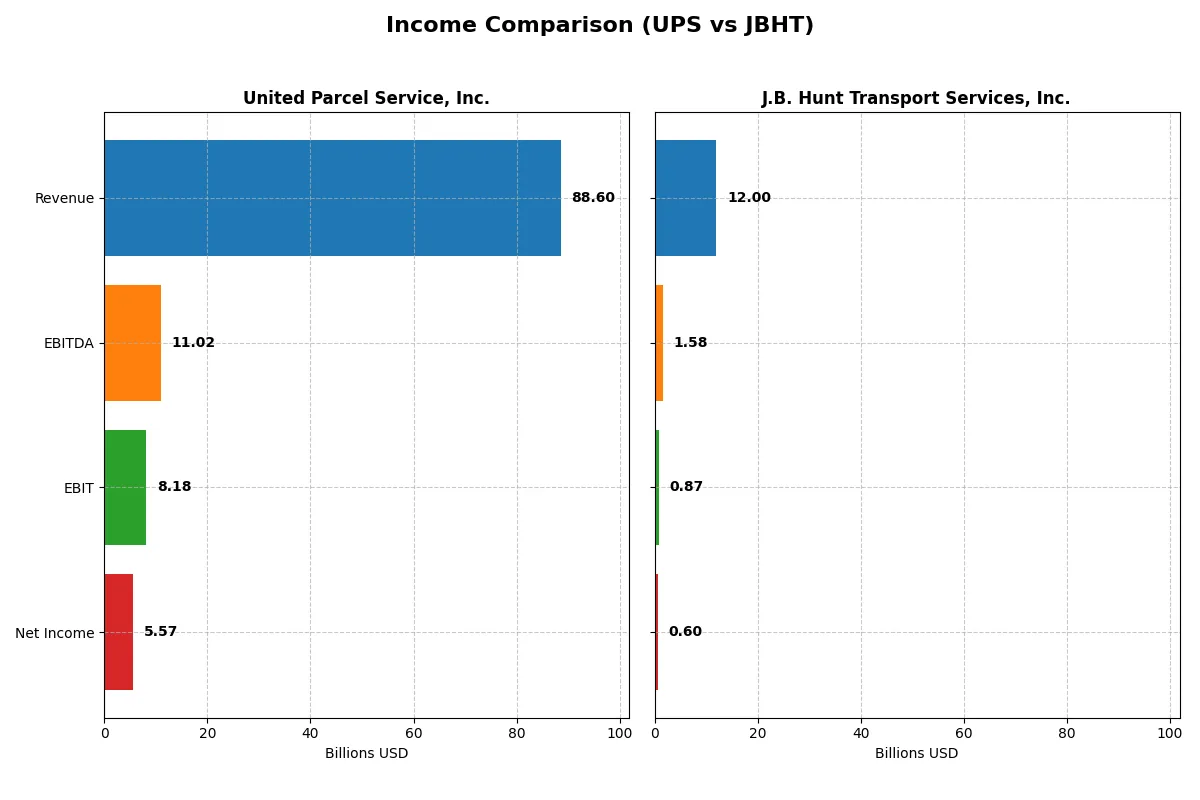
| Metric | United Parcel Service, Inc. (UPS) | J.B. Hunt Transport Services, Inc. (JBHT) |
|---|---|---|
| Revenue | 88.6B | 12.0B |
| Cost of Revenue | 53.2B | 10.7B |
| Operating Expenses | 27.5B | 397M |
| Gross Profit | 35.4B | 1.26B |
| EBITDA | 11.0B | 1.58B |
| EBIT | 8.18B | 865M |
| Interest Expense | 1.02B | 71M |
| Net Income | 5.57B | 598M |
| EPS | 6.57 | 6.12 |
| Fiscal Year | 2025 | 2025 |
Income Statement Analysis: The Bottom-Line Duel
Comparing these income statements reveals which company runs a more efficient and profitable business engine in a challenging market environment.
United Parcel Service, Inc. Analysis
UPS’s revenue declined slightly to 88.6B in 2025 from 90.9B in 2024, with net income dropping to 5.57B. Its gross margin surged to nearly 40%, a favorable sign, while net margin held steady at 6.3%. Despite revenue headwinds, UPS maintains strong margin control, though recent earnings show some downward momentum.
J.B. Hunt Transport Services, Inc. Analysis
JBHT’s revenue also fell, to 12.0B in 2025 from 12.1B the prior year. Net income decreased modestly to 598M. Its gross margin is much thinner at about 10.5%, with a net margin near 5%. JBHT posted a favorable net margin growth recently, showing resilience despite a 39% plunge in gross profit year-over-year.
Margin Strength vs. Revenue Scale
UPS’s scale delivers superior gross and net margins compared to JBHT, despite a revenue decline. UPS’s margin expansion offsets top-line weakness, highlighting operational efficiency. JBHT’s leaner margins and sharper gross profit drop weigh on its profitability. For investors, UPS offers a more robust margin profile, while JBHT’s smaller scale and variability present higher risk.
Financial Ratios Comparison
These vital ratios act as a diagnostic tool to expose the underlying fiscal health, valuation premiums, and capital efficiency of the companies compared here:
| Ratios | United Parcel Service, Inc. (UPS) | J.B. Hunt Transport Services, Inc. (JBHT) |
|---|---|---|
| ROE | 34.3% | N/A |
| ROIC | 10.4% | N/A |
| P/E | 15.1 | 31.7 |
| P/B | 5.19 | 0 |
| Current Ratio | 1.22 | 0 |
| Quick Ratio | 1.22 | 0 |
| D/E (Debt-to-Equity) | 1.53 | 0 |
| Debt-to-Assets | 34.1% | 0 |
| Interest Coverage | 7.78 | 12.19 |
| Asset Turnover | 1.21 | 0 |
| Fixed Asset Turnover | 2.11 | 0 |
| Payout Ratio | 96.9% | 28.7% |
| Dividend Yield | 6.41% | 0.91% |
| Fiscal Year | 2025 | 2025 |
Note: JBHT’s most recent available data for many ratios are zero or unavailable, reflecting limited disclosed figures for 2025.
Efficiency & Valuation Duel: The Vital Signs
Financial ratios act as the company’s DNA, revealing hidden risks and operational excellence that shape investor confidence and valuation.
United Parcel Service, Inc.
UPS demonstrates strong profitability with a 34.34% ROE and a favorable 10.44% ROIC, comfortably above its 7.35% WACC. The stock trades at a neutral P/E of 15.11 but shows an unfavorable PB ratio of 5.19, indicating a stretched valuation. UPS offers a 6.41% dividend yield, balancing shareholder returns amid steady operational efficiency.
J.B. Hunt Transport Services, Inc.
JBHT shows weaker profitability with a 4.99% net margin and zero recorded ROE and ROIC, signaling operational challenges. Its valuation appears expensive with a high P/E of 31.73 while lacking a meaningful dividend yield at 0.91%. The company’s limited financial data and unfavorable ratios highlight heightened risk and lower shareholder cash returns.
Premium Valuation vs. Operational Safety
UPS offers a better balance of profitability and shareholder rewards despite a stretched PB ratio. JBHT’s high P/E and weak profitability suggest elevated risk without compensating returns. Investors seeking operational safety and income might favor UPS, while those tolerating risk may find JBHT’s profile less reassuring.
Which one offers the Superior Shareholder Reward?
United Parcel Service (UPS) delivers a superior shareholder reward compared to J.B. Hunt Transport Services (JBHT). UPS offers a robust 6.4% dividend yield, backed by a nearly 94% payout ratio and strong free cash flow coverage, signaling a sustainable income stream. UPS couples this with consistent buybacks, enhancing total return. JBHT yields under 1%, with a modest 29% payout ratio and minimal buyback activity, relying more on reinvestment for growth. Historically in logistics, a balanced distribution through dividends and buybacks, as UPS practices, outperforms pure growth strategies in volatile markets. I conclude UPS provides the more attractive, sustainable total return profile for 2026 investors seeking income and capital appreciation.
Comparative Score Analysis: The Strategic Profile
The radar chart reveals the fundamental DNA and trade-offs of both firms, highlighting their financial strengths and valuation profiles:
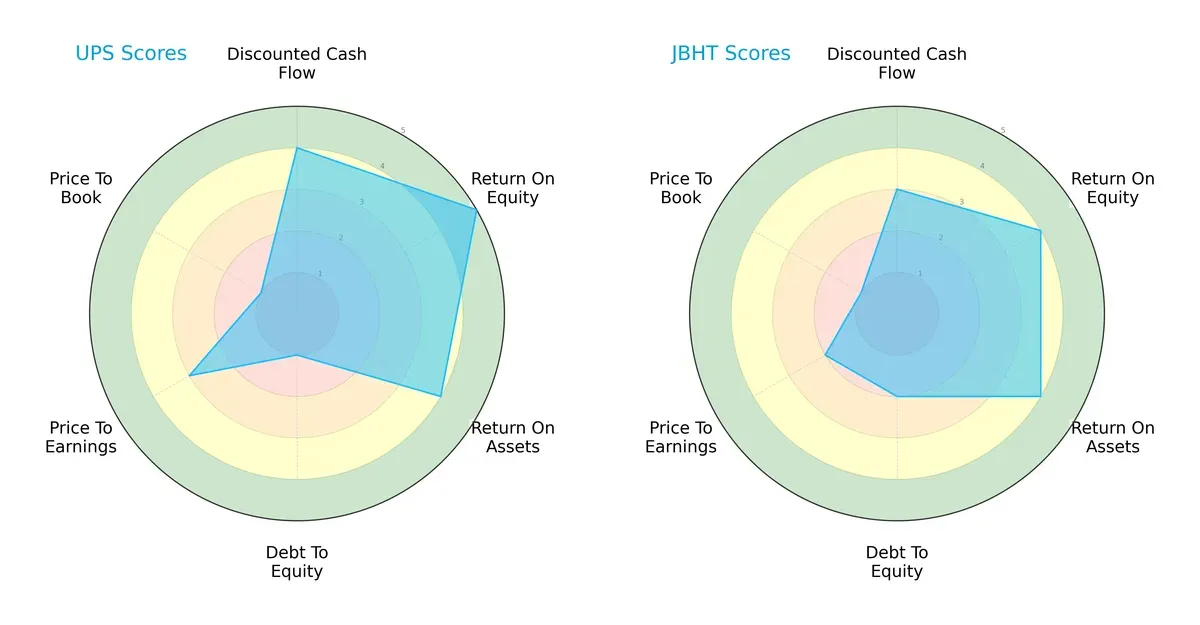
United Parcel Service, Inc. (UPS) exhibits a pronounced strength in return on equity (5) and discounted cash flow (4), showing robust profitability and cash flow generation. J.B. Hunt Transport Services, Inc. (JBHT) presents a more balanced profile, with moderate scores across DCF (3), ROE (4), and debt-to-equity (2). UPS’s very low debt-to-equity score (1) signals high financial leverage risk, while JBHT maintains a healthier balance sheet. Valuation metrics (P/E and P/B) appear weak for both, but UPS scores slightly better on P/E.
—
Bankruptcy Risk: Solvency Showdown
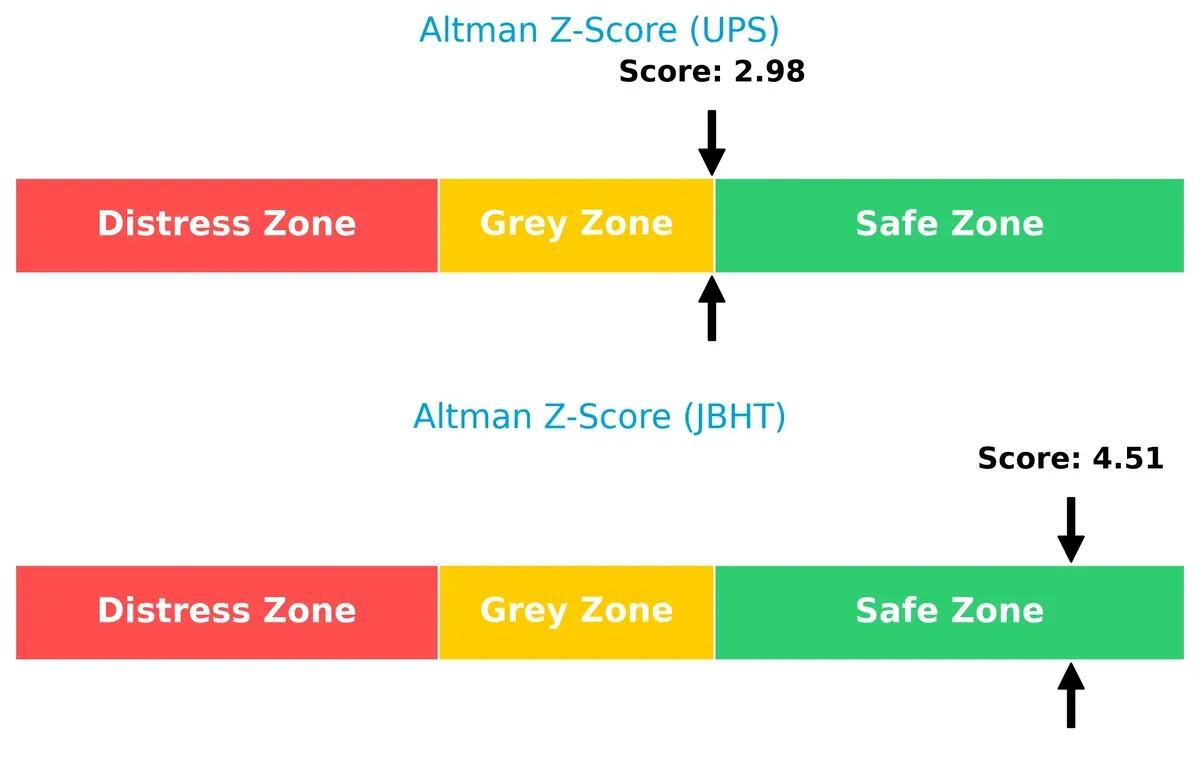
UPS’s Altman Z-Score sits at 2.98, placing it in the grey zone with moderate bankruptcy risk. JBHT’s 4.51 score firmly anchors it in the safe zone, indicating stronger solvency and long-term survival odds:
—
Financial Health: Quality of Operations
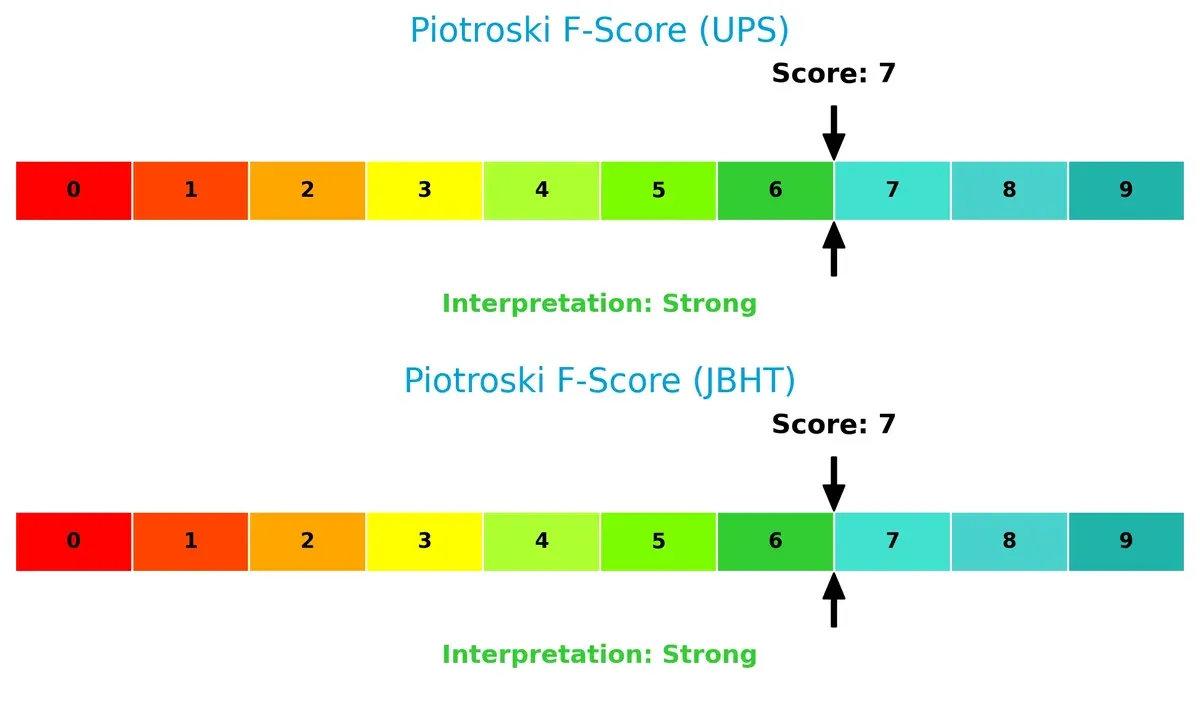
Both UPS and JBHT score a strong 7 on the Piotroski F-Score, reflecting solid operational quality and financial health. Neither firm exhibits red flags in profitability, leverage, or liquidity metrics:
How are the two companies positioned?
This section dissects the operational DNA of UPS and JBHT by comparing their revenue distribution and internal strengths and weaknesses. The goal is to confront their economic moats and identify which model offers the most resilient competitive advantage today.
Revenue Segmentation: The Strategic Mix
The following comparison dissects how United Parcel Service, Inc. and J.B. Hunt Transport Services, Inc. diversify their income streams and where their primary sector bets lie:
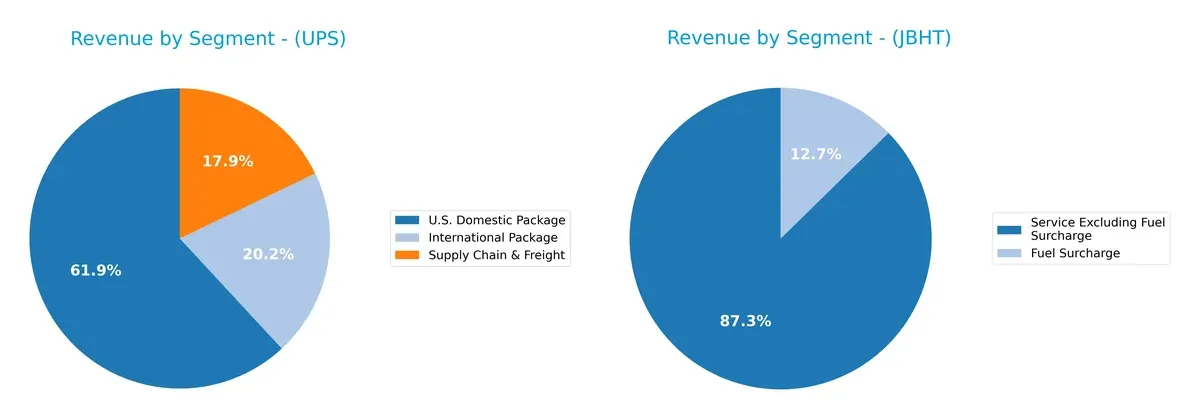
UPS anchors its revenue in the U.S. Domestic Package segment with $40.8B in 2017, dwarfing its International Package ($13.3B) and Supply Chain & Freight ($11.8B) units. This concentration signals a stronghold in domestic logistics but exposes UPS to regional economic shifts. Conversely, J.B. Hunt in 2017 spreads revenue across DCS ($1.7B), ICS ($1.0B), JBI ($4.1B), and JBT ($0.4B), reflecting a more diversified service portfolio that reduces dependency risk but demands effective capital allocation across segments.
Strengths and Weaknesses Comparison
This table compares the Strengths and Weaknesses of UPS and JBHT based on diversification, profitability, financials, innovation, global presence, and market share:
UPS Strengths
- Diversified revenue streams across U.S. Domestic, International, Supply Chain & Freight
- Strong profitability with 34.3% ROE and 10.4% ROIC above WACC
- Favorable quick ratio and interest coverage indicate solid liquidity and debt management
- Significant global presence with large U.S. and international revenues
- Asset turnover ratio of 1.21 suggests operational efficiency
JBHT Strengths
- Favorable debt-to-equity and debt-to-assets ratios indicate conservative leverage
- High interest coverage ratio of 12.19 shows strong ability to service debt
- PB ratio favorable, implying undervaluation relative to book value
UPS Weaknesses
- Unfavorable high PB ratio of 5.19 signals possible overvaluation
- Debt-to-equity ratio of 1.53 is relatively high, increasing financial risk
- Net margin of 6.29% is neutral, reflecting moderate profitability
- Current ratio neutral at 1.22, could be stronger for short-term resilience
JBHT Weaknesses
- Zero ROE and ROIC point to lack of profitability and capital efficiency
- Unfavorable net margin of 4.99% and high PE of 31.73 suggest weak earnings and high valuation
- Absence of liquidity ratios indicates potential short-term financial risk
- Asset turnover and fixed asset turnover unavailable or zero, limiting operational insight
- Minimal dividend yield of 0.91% may deter income-focused investors
Overall, UPS demonstrates a well-diversified business model with solid profitability and global scale, though some valuation and leverage concerns exist. JBHT’s strengths lie in conservative leverage and debt servicing, but its profitability and liquidity metrics highlight significant challenges for sustaining growth and shareholder returns.
The Moat Duel: Analyzing Competitive Defensibility
A structural moat is the only true shield protecting long-term profits from relentless competitive pressure. Here’s how these two logistics giants stack up:
United Parcel Service, Inc. (UPS): Scale and Network Effects Moat
UPS leverages massive scale and a global logistics network, driving consistent value creation with ROIC exceeding WACC by 3%. Despite a declining ROIC trend, its vast infrastructure supports margin stability. Expansion into supply chain tech in 2026 could deepen this moat but rising costs pose risks.
J.B. Hunt Transport Services, Inc. (JBHT): Specialized Contract Services Moat
JBHT’s moat anchors on dedicated contract services and integrated capacity solutions, contrasting UPS’s scale. Its competitive edge rests on operational flexibility and niche markets. However, declining ROIC and volatile profitability challenge long-term durability. Innovation in intermodal services may offer growth but faces stiff competition.
Moat Battle: Scale Dominance vs. Niche Specialization
UPS holds a wider, more durable moat with proven value creation above cost of capital, despite some erosion. JBHT’s specialized moat is narrower and faces more pressure from market shifts. UPS is better positioned to safeguard market share over the next decade.
Which stock offers better returns?
The past year saw divergent price movements for United Parcel Service and J.B. Hunt, with UPS showing a steep decline offset by recent gains, while JBHT maintained a near-flat overall trend but accelerated sharply late in the period.
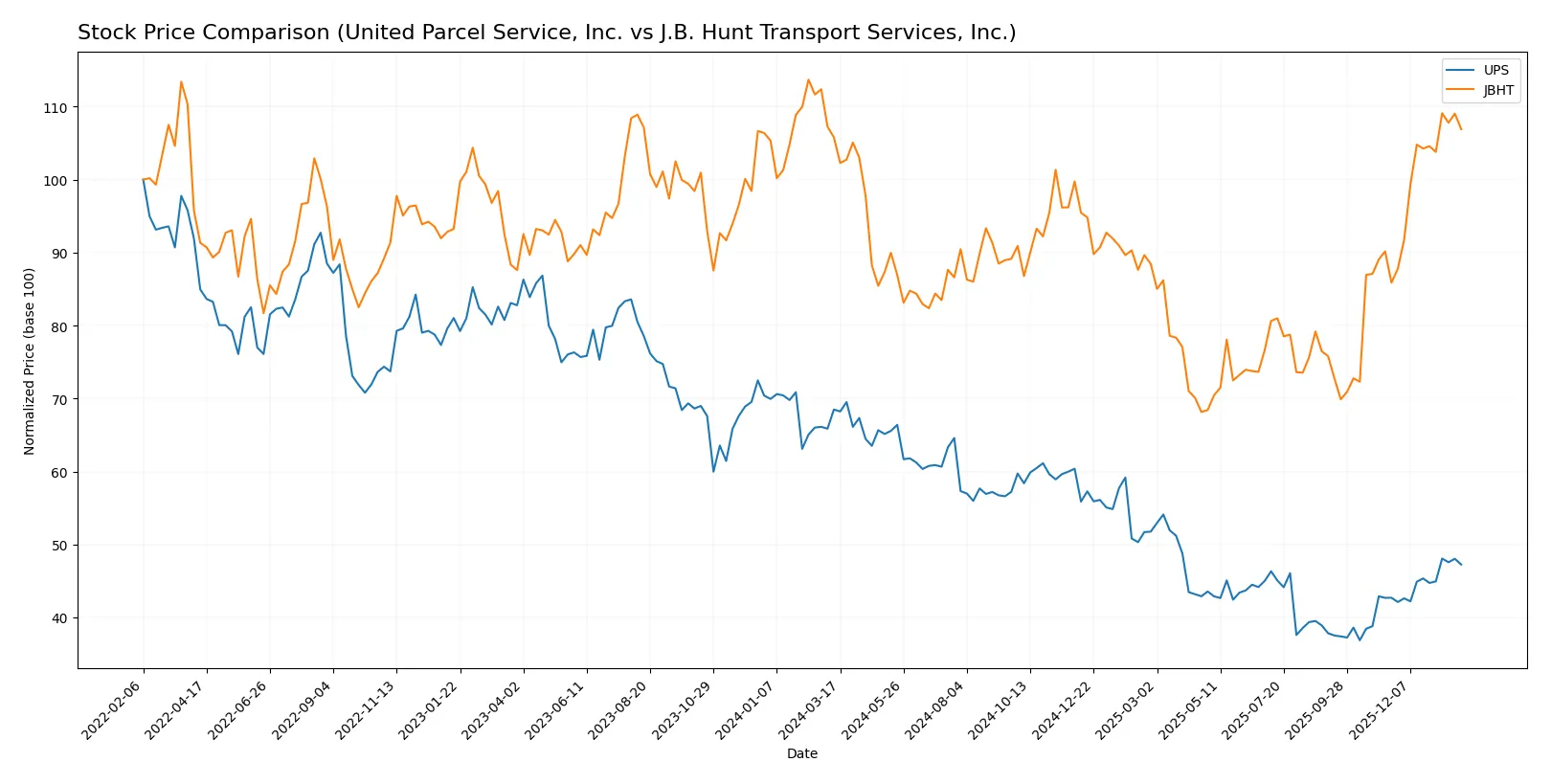
Trend Comparison
United Parcel Service’s stock declined 31.01% over the past year, indicating a bearish trend with accelerating downward momentum and significant price volatility. The stock hit a high of 156.27 and a low of 82.87.
J.B. Hunt’s stock rose 1.06% over the same period, displaying a mild bullish trend with accelerating gains recently. The price ranged between 129.23 and 206.85, with moderate volatility.
JBHT outperformed UPS in market returns over the past year, delivering a modest overall gain while UPS suffered a substantial loss despite recent recovery.
Target Prices
Analysts show a bullish outlook with solid upside potential for both UPS and J.B. Hunt.
| Company | Target Low | Target High | Consensus |
|---|---|---|---|
| United Parcel Service, Inc. | 85 | 128 | 110.6 |
| J.B. Hunt Transport Services, Inc. | 150 | 240 | 195 |
The target consensus for UPS sits about 4% above the current price of 106.22, signaling moderate upside. J.B. Hunt’s targets suggest a roughly 4% downside risk to 18% upside range around its current 202.72 price, reflecting wider analyst expectations.

Don’t Let Luck Decide Your Entry Point
Optimize your entry points with our advanced ProRealTime indicators. You’ll get efficient buy signals with precise price targets for maximum performance. Start outperforming now!
How do institutions grade them?
United Parcel Service, Inc. Grades
The table below summarizes recent institutional grades for UPS from key analysts.
| Grading Company | Action | New Grade | Date |
|---|---|---|---|
| Truist Securities | Maintain | Buy | 2026-01-28 |
| Wells Fargo | Maintain | Equal Weight | 2026-01-28 |
| JP Morgan | Maintain | Neutral | 2026-01-28 |
| UBS | Maintain | Buy | 2026-01-28 |
| Citigroup | Maintain | Buy | 2026-01-28 |
| Jefferies | Maintain | Buy | 2026-01-28 |
| Stephens & Co. | Maintain | Equal Weight | 2026-01-28 |
| Oppenheimer | Maintain | Outperform | 2026-01-28 |
| Stifel | Maintain | Buy | 2026-01-28 |
| Deutsche Bank | Maintain | Hold | 2026-01-28 |
J.B. Hunt Transport Services, Inc. Grades
Below is the recent grading summary for J.B. Hunt from respected financial institutions.
| Grading Company | Action | New Grade | Date |
|---|---|---|---|
| Benchmark | Maintain | Buy | 2026-01-20 |
| UBS | Maintain | Neutral | 2026-01-16 |
| Stifel | Maintain | Hold | 2026-01-16 |
| Barclays | Maintain | Equal Weight | 2026-01-15 |
| Truist Securities | Maintain | Hold | 2026-01-15 |
| Stifel | Maintain | Hold | 2026-01-14 |
| Evercore ISI Group | Maintain | Outperform | 2026-01-13 |
| JP Morgan | Maintain | Overweight | 2026-01-12 |
| Bernstein | Maintain | Market Perform | 2026-01-09 |
| Citigroup | Downgrade | Neutral | 2026-01-08 |
Which company has the best grades?
UPS holds stronger consensus with multiple Buy and Outperform ratings. J.B. Hunt shows more Neutral and Hold grades, plus a recent downgrade. Investors may see UPS as more favorably viewed by analysts.
Risks specific to each company
The following categories identify critical pressure points and systemic threats facing United Parcel Service, Inc. (UPS) and J.B. Hunt Transport Services, Inc. (JBHT) in the 2026 market environment:
1. Market & Competition
United Parcel Service, Inc. (UPS)
- Strong global footprint but faces intense pricing pressure in logistics.
J.B. Hunt Transport Services, Inc. (JBHT)
- Focused on North America but faces fierce competition in intermodal and trucking segments.
2. Capital Structure & Debt
United Parcel Service, Inc. (UPS)
- Leverage ratio (D/E 1.53) is elevated, raising financial risk.
J.B. Hunt Transport Services, Inc. (JBHT)
- Low or negligible debt levels, indicating conservative capital structure and lower financial risk.
3. Stock Volatility
United Parcel Service, Inc. (UPS)
- Beta at 1.09 shows moderate market sensitivity.
J.B. Hunt Transport Services, Inc. (JBHT)
- Higher beta at 1.27 signals greater stock price volatility.
4. Regulatory & Legal
United Parcel Service, Inc. (UPS)
- Operates globally, exposed to complex international trade regulations.
J.B. Hunt Transport Services, Inc. (JBHT)
- Primarily domestic operations reduce international regulatory complexity but remain exposed to U.S. transportation regulations.
5. Supply Chain & Operations
United Parcel Service, Inc. (UPS)
- Large fleet and container assets increase operational complexity and costs.
J.B. Hunt Transport Services, Inc. (JBHT)
- Asset-light brokerage services reduce fixed costs but rely heavily on third-party capacity.
6. ESG & Climate Transition
United Parcel Service, Inc. (UPS)
- Significant carbon footprint from global freight; faces pressure to accelerate decarbonization.
J.B. Hunt Transport Services, Inc. (JBHT)
- Growing investment in sustainable logistics solutions but slower overall ESG footprint reduction.
7. Geopolitical Exposure
United Parcel Service, Inc. (UPS)
- Extensive international operations expose UPS to trade tensions and tariffs.
J.B. Hunt Transport Services, Inc. (JBHT)
- Focused on U.S. markets, limiting geopolitical risks but vulnerable to domestic policy shifts.
Which company shows a better risk-adjusted profile?
UPS’s principal risk lies in its high leverage and international regulatory complexity. JBHT’s greatest risk is its narrower diversification and higher stock volatility. UPS’s strong profitability and global scale offer a buffer despite debt concerns. JBHT shows financial prudence but suffers from weaker profitability and operational concentration. Recent Altman Z-score data highlight UPS’s moderate bankruptcy risk, contrasting with JBHT’s safer zone. Thus, UPS presents a slightly better risk-adjusted profile, balancing growth opportunities against manageable financial risks.
Final Verdict: Which stock to choose?
United Parcel Service, Inc. (UPS) excels as a cash-generating powerhouse with a proven ability to create shareholder value through efficient capital use and strong returns on equity. Its point of vigilance lies in a declining profitability trend and elevated debt levels. UPS suits investors targeting steady income and value creation in a mature logistics portfolio.
J.B. Hunt Transport Services, Inc. (JBHT) leverages its niche in supply chain solutions with a strategic moat rooted in operational flexibility and service diversification. Compared to UPS, JBHT offers a cleaner balance sheet and a more dynamic recent price momentum, but faces challenges in consistent profitability. It aligns well with growth-oriented portfolios seeking cyclical upside and market agility.
If you prioritize resilient cash flow and proven capital efficiency, UPS is the compelling choice due to its strong return metrics and dividend yield. However, if you seek growth potential with a leaner financial structure and market acceleration, JBHT offers better stability and upside in a volatile environment. Both warrant cautious consideration given their distinct risk profiles.
Disclaimer: Investment carries a risk of loss of initial capital. The past performance is not a reliable indicator of future results. Be sure to understand risks before making an investment decision.
Go Further
I encourage you to read the complete analyses of United Parcel Service, Inc. and J.B. Hunt Transport Services, Inc. to enhance your investment decisions: