Micron Technology, Inc. (MU) and IPG Photonics Corporation (IPGP) are two prominent players in the semiconductor industry, each excelling in distinct yet overlapping technological niches. Micron focuses on memory and storage solutions, while IPG specializes in high-performance fiber lasers and amplifiers. Their innovation strategies and market applications make them compelling subjects for comparison. In this article, I will analyze both companies to help you identify which one presents the most attractive investment opportunity.
Table of contents
Companies Overview
I will begin the comparison between Micron Technology, Inc. and IPG Photonics Corporation by providing an overview of these two companies and their main differences.
Micron Technology, Inc. Overview
Micron Technology, Inc. specializes in designing, manufacturing, and selling memory and storage products worldwide. Operating through four segments, it offers DRAM, NAND, and NOR memory products under the Micron and Crucial brands. The company serves markets including cloud servers, enterprise, mobile devices, automotive, and industrial sectors, positioning itself as a key player in semiconductors with a comprehensive product portfolio.
IPG Photonics Corporation Overview
IPG Photonics Corporation develops and sells high-performance fiber lasers, amplifiers, and diode lasers for materials processing and communications. Its product range includes fiber and solid-state lasers, amplifiers for broadband networks, integrated laser systems, and precision laser tools. The company targets original equipment manufacturers, system integrators, and end users, focusing on advanced laser technologies primarily for industrial and communication applications.
Key similarities and differences
Both Micron and IPG Photonics operate within the semiconductor industry, focusing on advanced technology products. Micron emphasizes memory and storage solutions across multiple markets, while IPG Photonics specializes in laser technology for materials processing and communications. Micron’s broader product segmentation contrasts with IPG’s niche focus on fiber lasers and optical components, reflecting distinct business models within the technology sector.
Income Statement Comparison
This table compares the key income statement metrics for Micron Technology, Inc. and IPG Photonics Corporation for their most recent fiscal years.

| Metric | Micron Technology, Inc. (MU) | IPG Photonics Corporation (IPGP) |
|---|---|---|
| Market Cap | 373B | 3.3B |
| Revenue | 37.4B | 977M |
| EBITDA | 18.5B | 76M |
| EBIT | 10.1B | 14M |
| Net Income | 8.54B | -182M |
| EPS | 7.65 | -4.09 |
| Fiscal Year | 2025 | 2024 |
Income Statement Interpretations
Micron Technology, Inc.
Micron Technology demonstrated strong revenue growth from 2021 to 2025, increasing from $27.7B to $37.4B, with net income rising substantially from $5.9B to $8.5B. Margins improved notably, with a 2025 gross margin near 40% and net margin at 22.8%. The latest year showed exceptional growth in profitability, supported by a 48.9% revenue increase and a sevenfold EBIT rise, reflecting operational efficiency gains.
IPG Photonics Corporation
IPG Photonics experienced declining revenue over 2020-2024, falling from $1.2B to $977M, with net income turning negative in 2024 at -$182M. Gross margin remained favorable at 34.6%, but EBIT margin was nearly flat, and net margin was negative at -18.6%. The most recent year showed sharp declines in revenue, profits, and margins, highlighting challenges in sustaining operational profitability and revenue growth.
Which one has the stronger fundamentals?
Micron Technology exhibits stronger fundamentals, marked by consistent revenue and income growth alongside improving margins and profitability. In contrast, IPG Photonics faces declining revenues and significant net losses, with most key income metrics unfavorable. Micron’s positive growth trends and margin improvements contrast with IPG’s ongoing financial pressures and deteriorating income statement performance.
Financial Ratios Comparison
The following table presents key financial ratios for Micron Technology, Inc. (MU) and IPG Photonics Corporation (IPGP) based on their most recent fiscal year data, providing a snapshot for comparative analysis.
| Ratios | Micron Technology, Inc. (2025) | IPG Photonics Corporation (2024) |
|---|---|---|
| ROE | 15.76% | -8.97% |
| ROIC | 12.12% | -9.97% |
| P/E | 15.94 | -17.76 |
| P/B | 2.51 | 1.59 |
| Current Ratio | 2.52 | 6.98 |
| Quick Ratio | 1.79 | 5.59 |
| D/E (Debt-to-Equity) | 0.28 | 0.01 |
| Debt-to-Assets | 18.45% | 0.78% |
| Interest Coverage | 20.69 | 0 |
| Asset Turnover | 0.45 | 0.43 |
| Fixed Asset Turnover | 0.79 | 1.66 |
| Payout Ratio | 6.11% | 0% |
| Dividend Yield | 0.38% | 0% |
Interpretation of the Ratios
Micron Technology, Inc.
Micron Technology’s 2025 financial ratios show a generally favorable profile, with strong net margin (22.84%), ROE (15.76%), and ROIC (12.12%), though its WACC at 10.52% is unfavorable and asset turnover ratios are weak. The company pays dividends, but with a low yield of 0.38% and unfavorable payout metrics, indicating potential risks in distribution sustainability and limited share buybacks.
IPG Photonics Corporation
IPG Photonics displays several unfavorable profitability ratios in 2024, including negative net margin (-18.58%), ROE (-8.97%), and ROIC (-9.97%), though measures of liquidity and low leverage are positive. The company does not pay dividends, reflecting a likely reinvestment or growth strategy amid current negative earnings, with no share buybacks reported.
Which one has the best ratios?
Micron Technology exhibits a more favorable overall ratio profile with a majority of positive indicators and moderate concerns, while IPG Photonics shows significant profitability weaknesses despite solid liquidity and low debt. Based on these evaluations, Micron’s ratios are comparatively stronger in supporting operational efficiency and shareholder returns.
Strategic Positioning
This section compares the strategic positioning of Micron Technology, Inc. and IPG Photonics Corporation, focusing on market position, key segments, and exposure to technological disruption:
Micron Technology, Inc.
- Large market cap of 373B in semiconductors, facing competitive pressure in memory and storage markets.
- Diverse segments: DRAM, NAND, embedded, mobile, storage products serving cloud, enterprise, mobile, automotive.
- Operates in semiconductor memory technology, exposed to rapid innovation but established product lines.
IPG Photonics Corporation
- Smaller market cap of 3.3B, niche player in fiber lasers and amplifiers with moderate competition.
- Concentrated on high-performance fiber lasers and amplifiers for materials processing and communications.
- Focus on advanced fiber laser tech, potentially sensitive to innovation in laser and photonics fields.
Micron Technology, Inc. vs IPG Photonics Corporation Positioning
Micron shows a diversified product portfolio across multiple semiconductor memory segments, providing broad market exposure. IPG Photonics focuses on specialized laser systems, offering concentrated exposure but with less scale, which may imply different risk profiles based on industry dynamics.
Which has the best competitive advantage?
Both companies are currently shedding value relative to their cost of capital. Micron’s slightly favorable moat reflects improving profitability, while IPG Photonics faces a very unfavorable moat with declining returns, indicating weaker competitive advantage under current conditions.
Stock Comparison
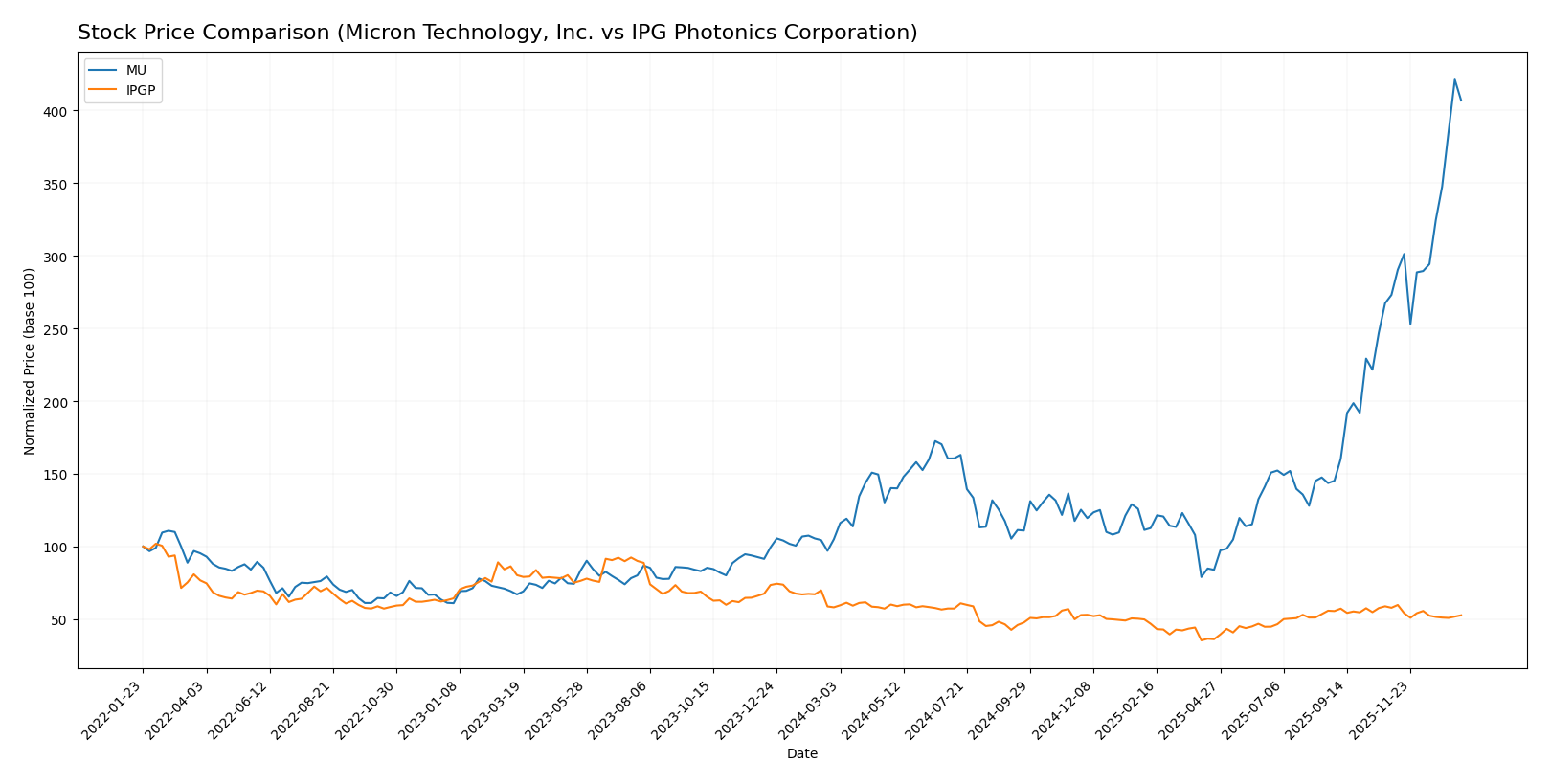
The stock price movements over the past 12 months reveal a stark contrast between Micron Technology, Inc. (MU), which experienced a strong bullish trend with significant acceleration, and IPG Photonics Corporation (IPGP), which faced a bearish trend marked by deceleration.
Trend Analysis
Micron Technology, Inc. (MU) showed a robust bullish trend over the past year with a price increase of 287.62%, accompanied by acceleration and high volatility (std deviation 57.56). The stock reached a peak of 345.09 and a low of 64.72.
IPG Photonics Corporation (IPGP) experienced a bearish trend over the same period, with a price decline of 9.39%, deceleration, and lower volatility (std deviation 9.27). Its highest and lowest prices were 90.69 and 52.12, respectively.
Comparing the two, MU delivered the highest market performance with a strong upward momentum, whereas IPGP showed negative returns and decelerating losses over the past year.
Target Prices
The current analyst target consensus for these semiconductor companies shows a varied outlook.
| Company | Target High | Target Low | Consensus |
|---|---|---|---|
| Micron Technology, Inc. | 450 | 190 | 328.22 |
| IPG Photonics Corporation | 96 | 92 | 94 |
Analysts expect Micron’s stock to remain near its current price of 333.35 USD, with a wide range reflecting some uncertainty. IPG Photonics shows a tighter target range and consensus well above its current price of 77.54 USD, indicating potential upside.
Analyst Opinions Comparison
This section compares analysts’ ratings and grades for Micron Technology, Inc. (MU) and IPG Photonics Corporation (IPGP):
Rating Comparison
MU Rating
- Rating: B, classified as Very Favorable
- Discounted Cash Flow Score: 1, indicating a Very Unfavorable valuation based on cash flows
- ROE Score: 4, considered Favorable for profit generation efficiency
- ROA Score: 5, very favorable utilization of assets to generate earnings
- Debt To Equity Score: 3, moderate financial risk level
- Overall Score: 3, moderate overall financial standing
IPGP Rating
- Rating: B+, classified as Very Favorable
- Discounted Cash Flow Score: 4, showing a Favorable valuation based on future cash flows
- ROE Score: 2, Moderate efficiency in generating profit from equity
- ROA Score: 3, Moderate effectiveness in asset utilization
- Debt To Equity Score: 4, favorable financial stability with lower reliance on debt
- Overall Score: 3, moderate overall financial standing
Which one is the best rated?
IPGP holds a higher overall rating (B+) compared to MU’s B, reflecting a generally more favorable analyst view. IPGP scores better in discounted cash flow and debt-to-equity, whereas MU excels in return on equity and assets. Both have a moderate overall score of 3.
Scores Comparison
Here is the comparison of the Altman Z-Score and Piotroski Score for both companies:
MU Scores
- Altman Z-Score: 10.5, indicating a safe zone status
- Piotroski Score: 7, classified as strong
IPGP Scores
- Altman Z-Score: 9.6, indicating a safe zone status
- Piotroski Score: 7, classified as strong
Which company has the best scores?
Both MU and IPGP display strong financial health with safe zone Altman Z-Scores and strong Piotroski Scores of 7. MU has a slightly higher Altman Z-Score, suggesting marginally better bankruptcy risk metrics.
Grades Comparison
Here is a detailed comparison of the latest grades assigned to Micron Technology, Inc. and IPG Photonics Corporation:
Micron Technology, Inc. Grades
The following table summarizes recent grades from reputable financial institutions for Micron Technology, Inc.:
| Grading Company | Action | New Grade | Date |
|---|---|---|---|
| Keybanc | Maintain | Overweight | 2026-01-13 |
| B of A Securities | Maintain | Buy | 2026-01-13 |
| Lynx Global | Maintain | Buy | 2026-01-12 |
| Mizuho | Maintain | Outperform | 2026-01-09 |
| UBS | Maintain | Buy | 2026-01-07 |
| Piper Sandler | Maintain | Overweight | 2026-01-07 |
| Piper Sandler | Maintain | Overweight | 2025-12-18 |
| Barclays | Maintain | Overweight | 2025-12-18 |
| Keybanc | Maintain | Overweight | 2025-12-18 |
| Wolfe Research | Maintain | Outperform | 2025-12-18 |
Overall, Micron Technology maintains strong positive ratings, consistently graded as Buy, Overweight, or Outperform by multiple respected firms.
IPG Photonics Corporation Grades
Below is a summary of recent grades from established grading companies for IPG Photonics Corporation:
| Grading Company | Action | New Grade | Date |
|---|---|---|---|
| Citigroup | Upgrade | Buy | 2025-11-05 |
| Bernstein | Upgrade | Outperform | 2025-08-07 |
| Raymond James | Maintain | Strong Buy | 2025-05-07 |
| CL King | Upgrade | Buy | 2025-03-18 |
| Citigroup | Maintain | Sell | 2025-02-18 |
| Stifel | Maintain | Buy | 2025-02-12 |
| Needham | Maintain | Hold | 2025-02-12 |
| Seaport Global | Downgrade | Neutral | 2024-08-01 |
| Stifel | Maintain | Buy | 2024-07-31 |
| Raymond James | Maintain | Strong Buy | 2024-07-31 |
IPG Photonics’ grades show more variability, with recent upgrades but also some holds, neutral, and even a sell rating, reflecting a mixed consensus among analysts.
Which company has the best grades?
Micron Technology, Inc. consistently holds strong buy and outperform ratings across multiple firms, indicating broad analyst confidence. IPG Photonics shows a wider range of grades, including some downgrades and a sell rating. This contrast suggests Micron’s grades may imply lower uncertainty for investors compared to IPG Photonics.
Strengths and Weaknesses
Below is a comparative overview of key strengths and weaknesses for Micron Technology, Inc. (MU) and IPG Photonics Corporation (IPGP) based on their latest financial and strategic data.
| Criterion | Micron Technology, Inc. (MU) | IPG Photonics Corporation (IPGP) |
|---|---|---|
| Diversification | Strong diversification with multiple segments including DRAM and NAND products, and diverse business units (CNBU, EBU, MBU, SBU) | Focused product portfolio mainly in laser systems and amplifiers; less diversified |
| Profitability | Favorable profitability with 22.8% net margin, 15.8% ROE, and positive ROIC of 12.1% | Unfavorable profitability with -18.6% net margin, negative ROE and ROIC around -10% |
| Innovation | Moderate innovation reflected in product mix improvements and increasing ROIC trend | Innovation challenged; significant declining ROIC trend and value destruction |
| Global presence | Large global presence supported by broad memory product demand | Niche global presence in photonics and laser markets |
| Market Share | Strong market share in memory semiconductor industry | Smaller market share focused on photonics laser applications |
Key takeaways: Micron Technology exhibits solid profitability, growing efficiency, and product diversification, making it a relatively favorable investment with a slightly positive moat. Conversely, IPG Photonics struggles with profitability and value creation, showing a very unfavorable moat and higher risk for investors. Caution and thorough risk management are advised when considering IPGP.
Risk Analysis
Below is a comparative risk table for Micron Technology, Inc. (MU) and IPG Photonics Corporation (IPGP) based on the most recent financial and market data:
| Metric | Micron Technology, Inc. (MU) | IPG Photonics Corporation (IPGP) |
|---|---|---|
| Market Risk | High beta of 1.503 indicates higher volatility vs. market | Moderate beta of 1.017 suggests near-market volatility |
| Debt level | Low debt-to-equity at 0.28, debt-to-assets 18.45% (favorable) | Very low debt-to-equity 0.01, minimal leverage (favorable) |
| Regulatory Risk | Moderate, typical for US semiconductor sector | Moderate, with exposure to tech export controls |
| Operational Risk | Moderate; complex global supply chain and manufacturing | Moderate; reliance on advanced fiber laser tech development |
| Environmental Risk | Semiconductor manufacturing environmental impact regulated | Lower environmental footprint, but laser tech has specific hazards |
| Geopolitical Risk | Significant exposure to US-China trade tensions | Moderate; supply chain and market dependencies in global tech sectors |
In synthesis, Micron’s most impactful risks lie in market volatility and geopolitical tensions affecting supply chains, while IPG Photonics faces challenges from weak profitability and operational complexity despite low leverage. Both firms maintain strong financial health with safe Altman Z-scores, but investors should weigh Micron’s higher market risk against IPG’s profitability concerns.
Which Stock to Choose?
Micron Technology, Inc. (MU) shows a strong income evolution with favorable growth in revenue and net margin, supported by solid profitability ratios such as a 15.76% ROE and a 12.12% ROIC. Its debt levels remain low with a net debt to EBITDA of 0.30, and its overall rating is very favorable, indicating improving financial health.
IPG Photonics Corporation (IPGP) presents a declining income trend with unfavorable net margin and earnings growth, alongside negative profitability metrics including an -8.97% ROE and -9.97% ROIC. Despite minimal debt and a high current ratio, its global ratios evaluation is slightly unfavorable and it carries a very unfavorable moat status.
Considering the ratings and financial evaluations, MU might appear more favorable for investors seeking growth and improving profitability, while IPGP could be interpreted as more suitable for those with a risk-tolerant profile who might consider longer-term recovery potential despite current challenges.
Disclaimer: Investment carries a risk of loss of initial capital. The past performance is not a reliable indicator of future results. Be sure to understand risks before making an investment decision.
Go Further
I encourage you to read the complete analyses of Micron Technology, Inc. and IPG Photonics Corporation to enhance your investment decisions: