Home > Comparison > Basic Materials > SHW vs IFF
The strategic rivalry between The Sherwin-Williams Company and International Flavors & Fragrances Inc. shapes the specialty chemicals sector’s future. Sherwin-Williams operates as a capital-intensive industrial coatings leader, while IFF focuses on high-margin flavor and fragrance solutions. This head-to-head highlights a contrast between scale-driven manufacturing and innovation-led specialty ingredients. This analysis will determine which trajectory offers superior risk-adjusted returns for a diversified portfolio in Basic Materials.

Table of contents
Companies Overview
The Sherwin-Williams Company and International Flavors & Fragrances Inc. shape the specialty chemicals landscape with distinct market footprints.
The Sherwin-Williams Company: Leader in Coatings and Paints
Sherwin-Williams dominates the architectural paints and coatings market, generating revenue through its Americas, Consumer Brands, and Performance Coatings segments. Its strategy in 2026 focuses on expanding company-operated stores and enhancing product innovation across industrial and retail channels. The firm’s wide geographic reach and diverse product portfolio strengthen its competitive advantage.
International Flavors & Fragrances Inc.: Specialist in Sensory Ingredients
International Flavors & Fragrances specializes in flavor and fragrance compounds, serving cosmetic, food, and pharmaceutical sectors globally. Its 2026 strategy emphasizes growth in natural and plant-based ingredients, plus biotech innovations via Nourish and Health & Biosciences segments. This focus on sustainability and health-driven products differentiates it in an evolving consumer market.
Strategic Collision: Similarities & Divergences
Both companies excel in specialty chemicals but pursue contrasting philosophies. Sherwin-Williams embraces a broad, vertically integrated model focused on coatings and industrial distribution. IFF champions innovation in niche, natural ingredient markets with a science-driven approach. Their primary battleground is product innovation and sustainability leadership. Investors face sharply different risk and growth profiles rooted in their unique industry niches.
Income Statement Comparison
This table dissects the core profitability and scalability of both corporate engines to reveal who dominates the bottom line:
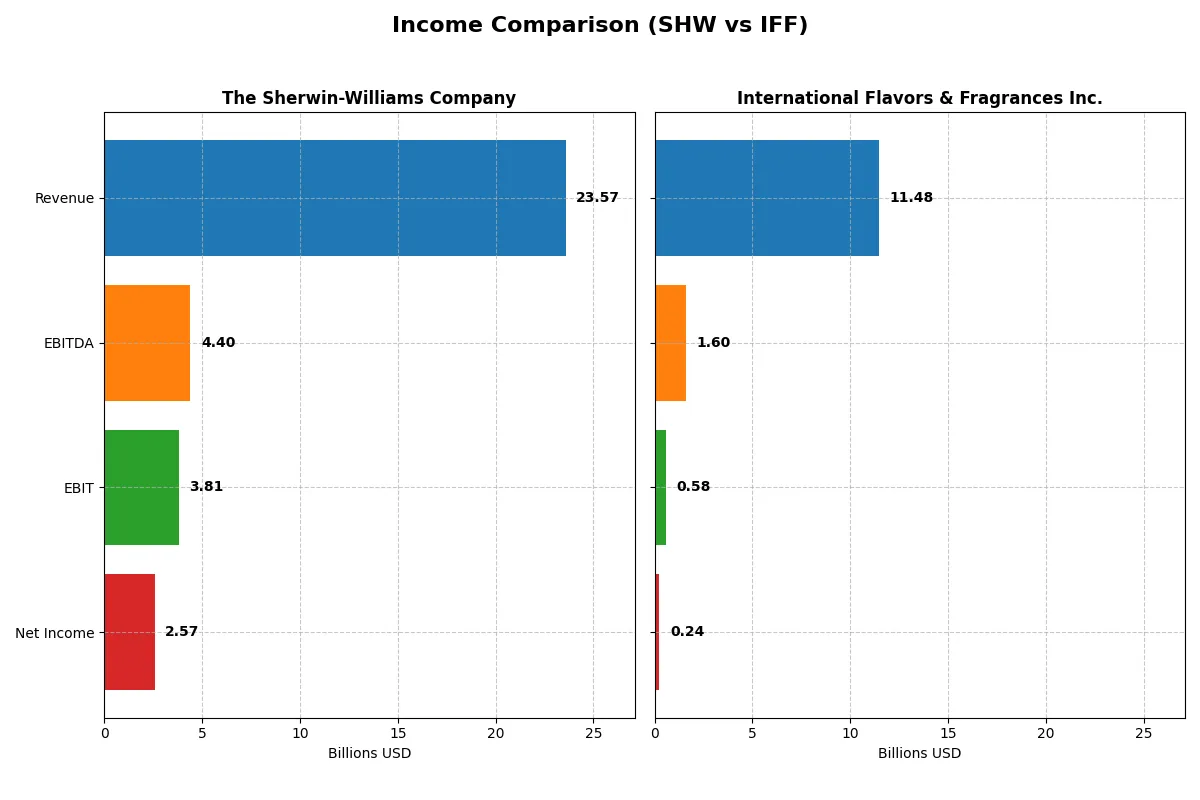
| Metric | The Sherwin-Williams Company (SHW) | International Flavors & Fragrances Inc. (IFF) |
|---|---|---|
| Revenue | 23.6B | 11.5B |
| Cost of Revenue | 12.0B | 7.4B |
| Operating Expenses | 7.7B | 3.4B |
| Gross Profit | 11.5B | 4.1B |
| EBITDA | 4.4B | 1.6B |
| EBIT | 3.8B | 0.6B |
| Interest Expense | 469M | 305M |
| Net Income | 2.6B | 243M |
| EPS | 10.38 | 0.95 |
| Fiscal Year | 2025 | 2024 |
Income Statement Analysis: The Bottom-Line Duel
This income statement comparison reveals which company runs a more efficient and profitable corporate engine through recent financial performance.
The Sherwin-Williams Company Analysis
Sherwin-Williams grew revenue steadily by 18.2% over five years, reaching $23.6B in 2025. Its net income rose 37.8% over the period, hitting $2.57B, reflecting strong earnings momentum. Gross margin remained favorable near 49%, while net margin held at a healthy 10.9%. Despite a slight dip in EBIT and EPS growth last year, Sherwin-Williams sustains robust profitability and margin discipline.
International Flavors & Fragrances Inc. Analysis
IFF’s revenue climbed sharply by 126% over five years but plateaued at $11.5B in 2024, showing minimal recent growth. The net income trend is weak, with a 33% decline overall and just $243M in 2024. Gross margin is solid at 36%, but EBIT and net margins are modest at 5.1% and 2.1%, respectively. However, recent year-over-year improvements in profitability and EPS growth indicate a turnaround in operational efficiency.
Margin Strength vs. Revenue Expansion
Sherwin-Williams delivers higher absolute profits and superior margins, demonstrating consistent earnings quality and margin stability. IFF shows impressive revenue growth but struggles with profitability and margin compression over time. For investors prioritizing durable earnings and margin resilience, Sherwin-Williams presents a clearer fundamental winner in this comparison.
Financial Ratios Comparison
These vital ratios act as a diagnostic tool to expose the underlying fiscal health, valuation premiums, and capital efficiency of the companies analyzed:
| Ratios | The Sherwin-Williams Company (SHW) | International Flavors & Fragrances Inc. (IFF) |
|---|---|---|
| ROE | 55.86% | 1.75% |
| ROIC | 15.21% | 2.63% |
| P/E | 31.08 | 89.07 |
| P/B | 17.36 | 1.56 |
| Current Ratio | 0.87 | 1.84 |
| Quick Ratio | 0.53 | 1.32 |
| D/E | 2.81 | 0.69 |
| Debt-to-Assets | 49.97% | 33.56% |
| Interest Coverage | 8.11 | 2.51 |
| Asset Turnover | 0.91 | 0.40 |
| Fixed Asset Turnover | 3.84 | 2.65 |
| Payout ratio | 30.31% | 211.52% |
| Dividend yield | 0.98% | 2.37% |
| Fiscal Year | 2025 | 2024 |
Efficiency & Valuation Duel: The Vital Signs
Financial ratios act as a company’s DNA, exposing hidden risks and revealing operational strengths essential for investors.
The Sherwin-Williams Company
Sherwin-Williams posts a robust 55.9% ROE and a solid 10.9% net margin, signaling strong profitability. However, its P/E ratio at 31.1 suggests the stock is expensive compared to historical averages. The company offers a modest 0.98% dividend yield, indicating limited shareholder returns with reinvestment likely focused on sustaining its moat and operational efficiency.
International Flavors & Fragrances Inc.
IFF shows weak profitability with a 1.75% ROE and a 2.12% net margin, reflecting operational challenges. Its P/E ratio of 89.1 marks the stock as stretched and highly valued by the market. The firm pays a healthier 2.37% dividend yield, balancing disappointing returns with some income generation despite its lower operational efficiency.
Premium Valuation vs. Operational Safety
Sherwin-Williams delivers superior profitability but at a premium valuation, while IFF’s valuation appears stretched amid weak returns. SHW offers a better risk-reward balance through operational strength, suiting growth-focused investors. IFF may appeal more to income seekers comfortable with operational uncertainty.
Which one offers the Superior Shareholder Reward?
I compare The Sherwin-Williams Company (SHW) and International Flavors & Fragrances Inc. (IFF) by their shareholder return strategies. SHW offers a modest 0.98% dividend yield with a sustainable 30% payout ratio, supported by strong free cash flow. Its buybacks, though less transparent in recent data, historically complement dividends well. IFF yields 2.37%, but its payout ratio exceeds 200%, signaling unsustainable dividends. IFF relies heavily on dividends rather than buybacks, which are minimal given weaker cash flow. SHW’s balanced dividend and buyback approach, backed by high profitability and free cash flow, provides more durable total returns in 2026. I favor SHW for superior, sustainable shareholder reward.
Comparative Score Analysis: The Strategic Profile
The radar chart reveals the fundamental DNA and trade-offs of The Sherwin-Williams Company and International Flavors & Fragrances Inc.:
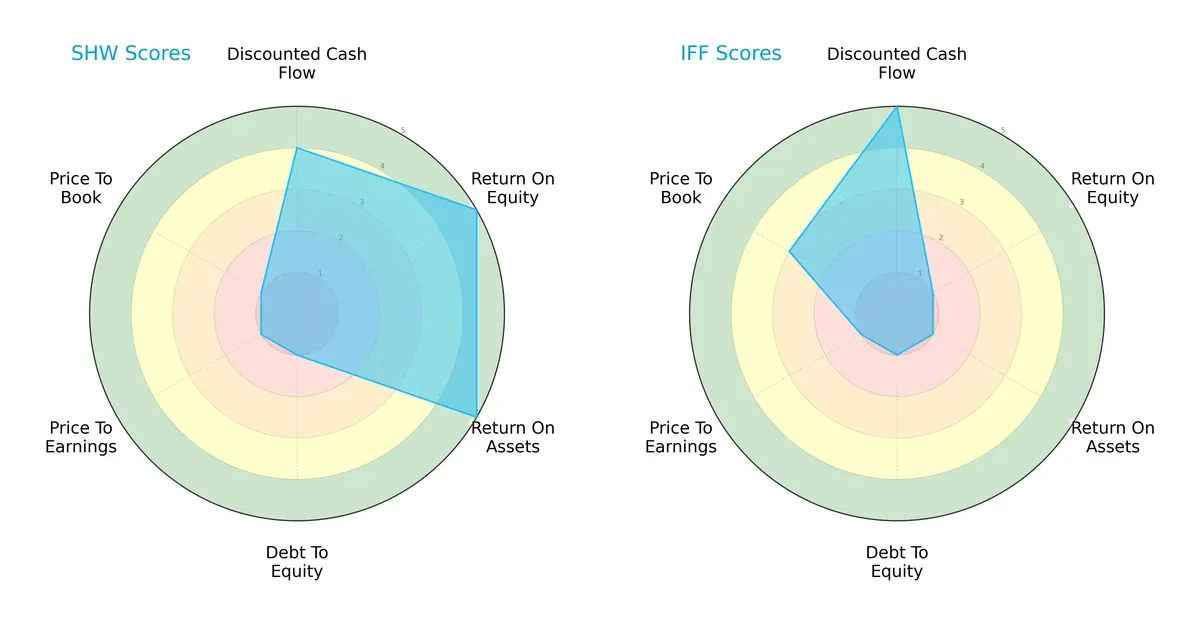
Sherwin-Williams dominates in profitability with top ROE and ROA scores of 5 each, reflecting excellent asset and equity efficiency. It lags sharply in valuation and leverage metrics, scoring very unfavorably on Debt/Equity, P/E, and P/B. IFF shows a more polarized profile, excelling in discounted cash flow with a perfect 5 but struggling severely in returns and leverage, mirroring Sherwin-Williams’ valuation challenges only partially mitigated by a better Price-to-Book score. Sherwin-Williams offers a more balanced operational profile, while IFF relies heavily on discounted cash flow strength.
Bankruptcy Risk: Solvency Showdown
Sherwin-Williams’ Altman Z-Score of 3.84 contrasts starkly with IFF’s 1.28, signaling a clear survival advantage for Sherwin-Williams:
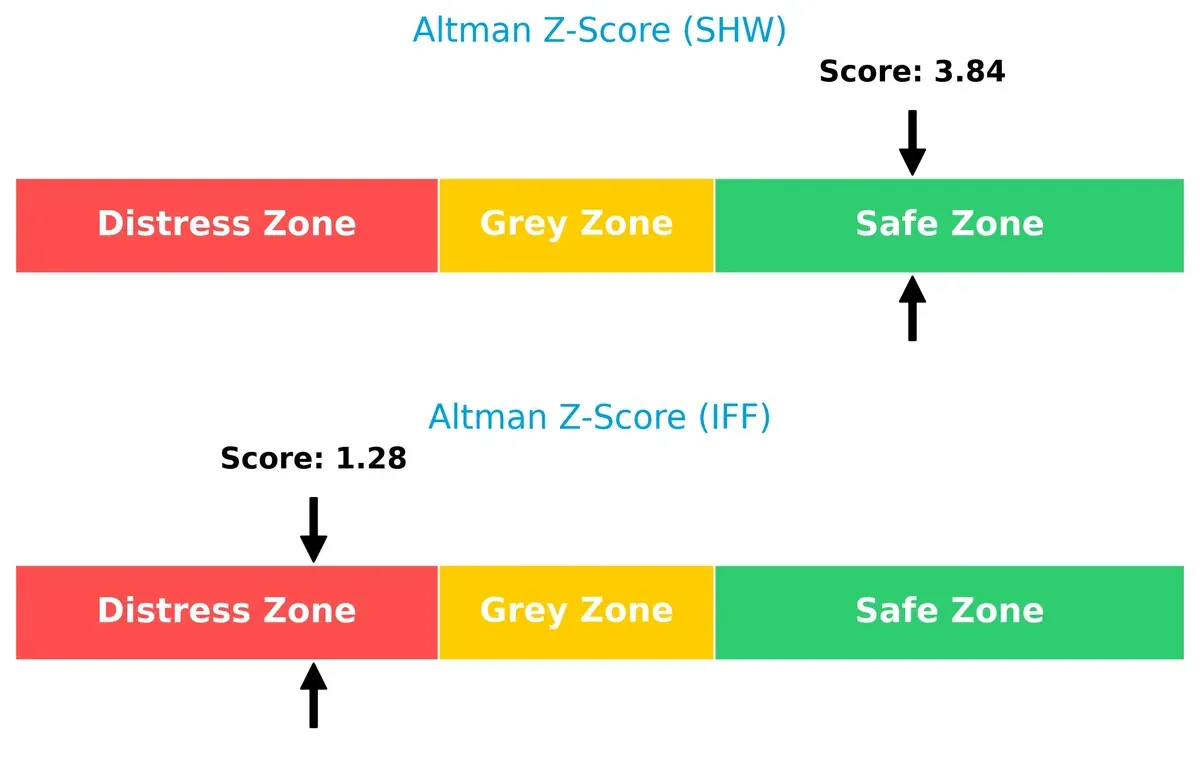
Sherwin-Williams sits firmly in the safe zone, implying strong financial stability and low bankruptcy risk amid this cycle. IFF’s position in the distress zone signals significant solvency concerns and elevated long-term risk, cautioning investors about potential financial distress.
Financial Health: Quality of Operations
Sherwin-Williams scores a strong 7 on the Piotroski F-Score, outperforming IFF’s average 5, underscoring superior financial health and operational quality:
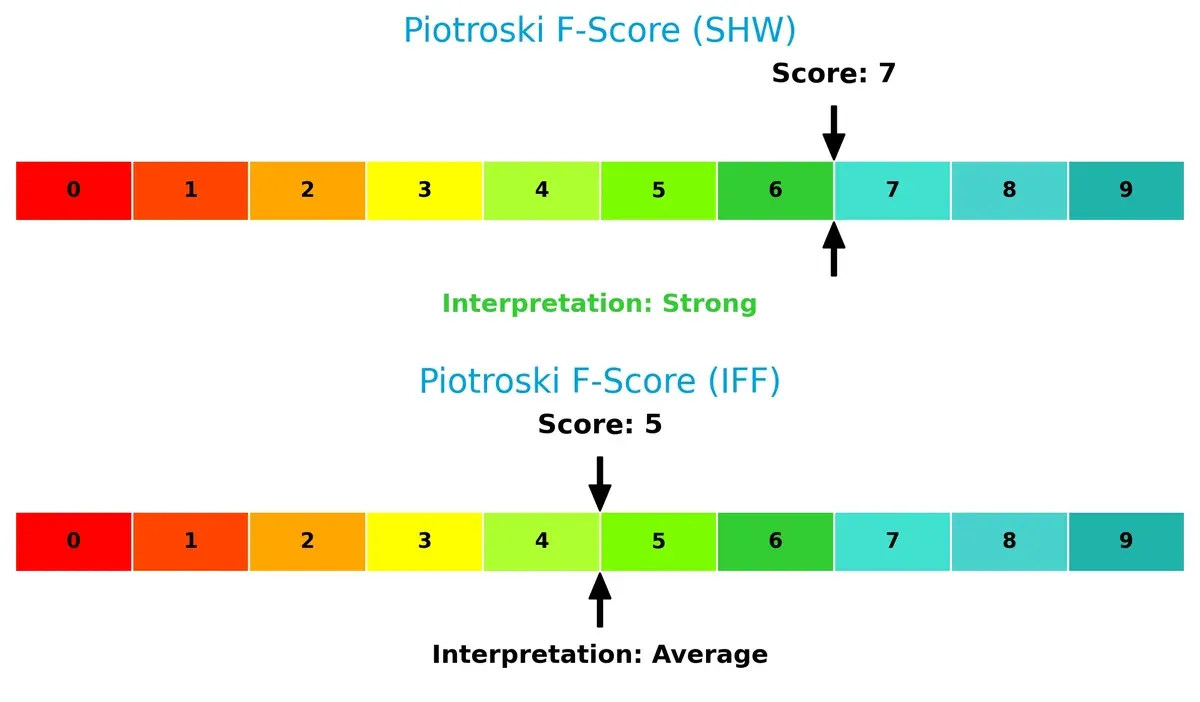
Sherwin-Williams demonstrates robust internal metrics and fewer red flags, reflecting sound profitability, leverage, and liquidity management. IFF’s average score indicates moderate operational risks and weaker financial discipline, requiring careful monitoring by investors.
How are the two companies positioned?
This section dissects the operational DNA of SHW and IFF by comparing their revenue distribution and internal dynamics. The goal is to confront their economic moats and reveal which model offers the most resilient competitive advantage today.
Revenue Segmentation: The Strategic Mix
This comparison dissects how The Sherwin-Williams Company and International Flavors & Fragrances Inc. diversify their income streams and reveal their primary sector bets:
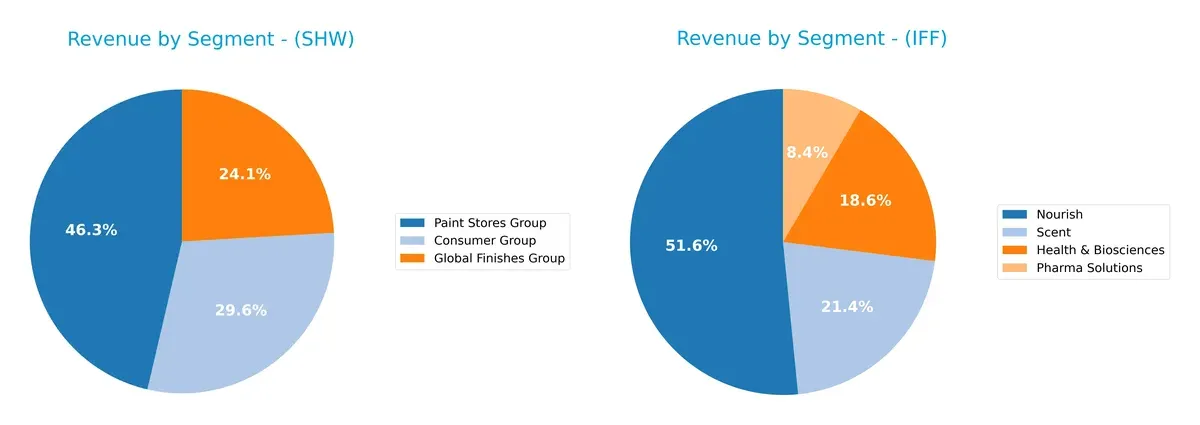
Sherwin-Williams anchors revenue heavily in its Paint Stores Group with $13.2B, dwarfing its Consumer and Global Finishes Groups at $8.4B and $6.9B. This concentration signals infrastructure dominance but exposes concentration risk. In contrast, IFF displays a more balanced mix with Nourish at $5.9B, Health & Biosciences at $2.1B, and Scent at $2.4B, showcasing diversified innovation-driven revenue streams that reduce dependency on any single market.
Strengths and Weaknesses Comparison
This table compares the Strengths and Weaknesses of The Sherwin-Williams Company (SHW) and International Flavors & Fragrances Inc. (IFF):
SHW Strengths
- Strong profitability with 10.9% net margin and 55.86% ROE
- Robust ROIC at 15.21% above WACC
- High fixed asset turnover of 3.84
- Leading market share in Paint Stores Group and Consumer Group
- Diversified product segments across paints and finishes
IFF Strengths
- Favorable capital cost with WACC at 6.89%
- Healthy liquidity ratios: current ratio 1.84, quick ratio 1.32
- Diversified revenue streams including Nourish, Scent, Pharma Solutions
- Global presence with balanced revenues across Asia, EMEA, North America, Latin America
- Dividend yield at 2.37% attractive for income investors
SHW Weaknesses
- Weak liquidity with current ratio 0.87, quick ratio 0.53 below 1.0
- High leverage with debt/equity at 2.81
- Expensive valuation: PE 31.08, PB 17.36
- Slightly unfavorable global ratios with 42.86% unfavorable metrics
- Low dividend yield 0.98%
IFF Weaknesses
- Poor profitability metrics: net margin 2.12%, ROE 1.75% below industry norm
- Low ROIC 2.63% barely above WACC
- Low asset turnover at 0.4 indicates inefficiency
- Weak interest coverage ratio at 1.91
- High PE ratio of 89.07 suggests valuation risk
The Sherwin-Williams Company excels in profitability and asset efficiency but faces liquidity and valuation challenges. International Flavors & Fragrances shows strong liquidity and global diversification but suffers from weak profitability and operational inefficiency. These factors distinctly shape each company’s strategic priorities.
The Moat Duel: Analyzing Competitive Defensibility
A structural moat is the only true shield protecting long-term profits from relentless competition erosion. Let’s dissect how these two firms defend their turf:
The Sherwin-Williams Company: Dominant Switching Costs
Sherwin-Williams leverages intense switching costs via proprietary coatings and exclusive distribution. Its 6.3% ROIC premium signals efficient capital use and durable margin stability. New industrial coatings in 2026 may deepen this advantage.
International Flavors & Fragrances Inc.: Innovation-Dependent Intangible Assets
IFF’s moat stems from intangible assets like proprietary flavor and fragrance formulas. Unlike Sherwin-Williams, its ROIC lags WACC by 4.3%, reflecting value erosion. Innovation in cosmetic actives offers some upside but faces stiff market disruption risks.
Durable Capital Efficiency vs. Innovation Volatility
Sherwin-Williams boasts a wider, more durable moat with growing ROIC and consistent value creation. IFF struggles with declining profitability and weaker capital returns. Sherwin-Williams is better equipped to sustain market share and fend off competition.
Which stock offers better returns?
The past year shows contrasting stock price movements: one company gains steadily with acceleration, while the other suffers a significant decline despite recent recovery signs.
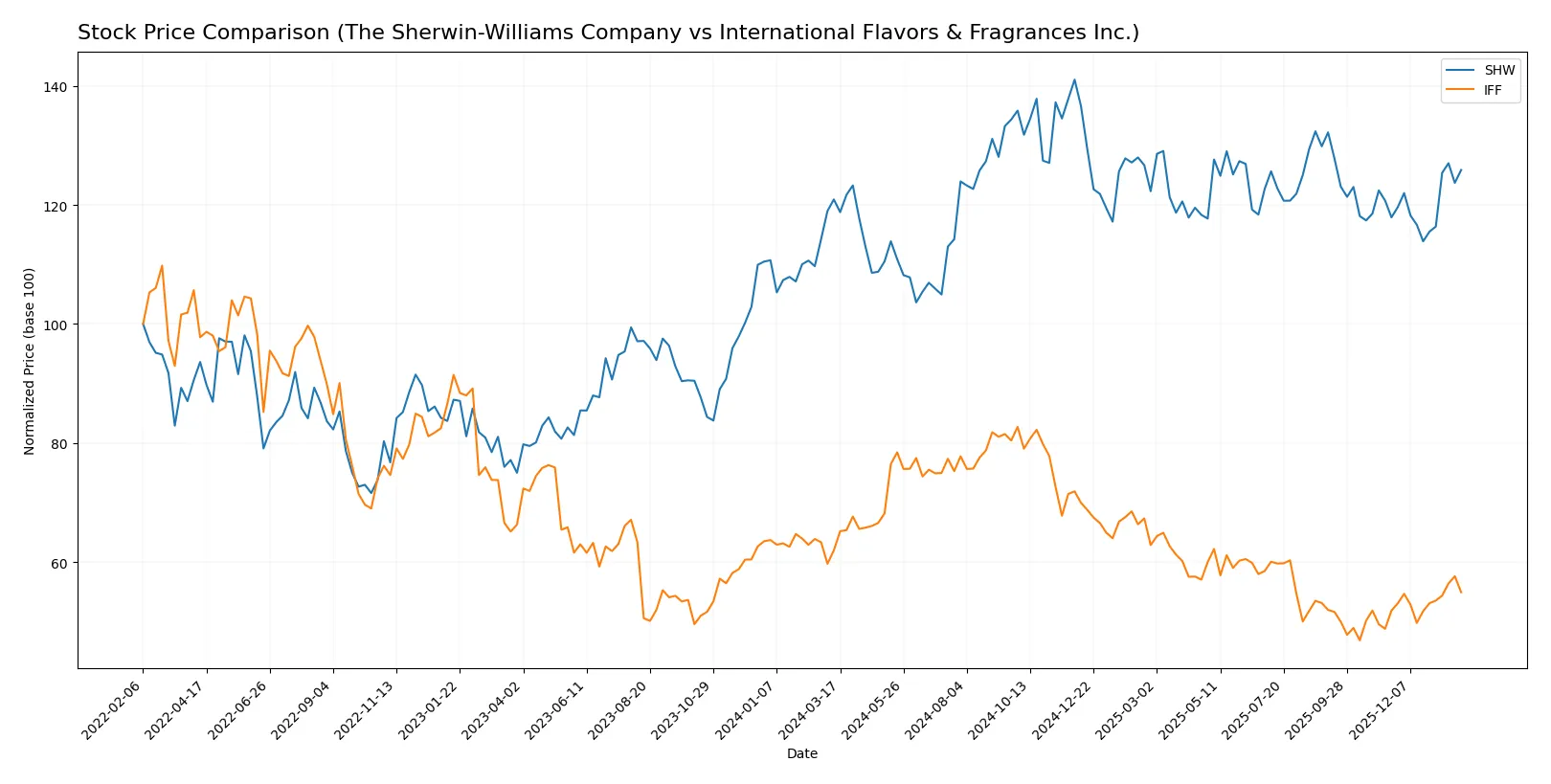
Trend Comparison
The Sherwin-Williams Company’s stock rose 4.09% over the past 12 months, signaling a bullish trend with accelerating momentum and a high volatility of 22.46. It reached a peak of 397.4 and a low near 292.
International Flavors & Fragrances Inc.’s stock declined 11.35% over the same period, marking a bearish trend with acceleration despite a recent 5.97% rebound and lower volatility at 12.8. The price ranged from 59.55 to 105.12.
Sherwin-Williams outperformed IFF over the year, delivering positive returns and stronger trend acceleration, while IFF’s overall performance remained negative despite recent gains.
Target Prices
Analysts present a cautiously optimistic consensus for these specialty chemicals leaders.
| Company | Target Low | Target High | Consensus |
|---|---|---|---|
| The Sherwin-Williams Company | 371 | 420 | 393.5 |
| International Flavors & Fragrances Inc. | 71 | 89 | 78.6 |
The Sherwin-Williams consensus target of 393.5 exceeds its current 354.64 price, suggesting upside potential. IFF’s 78.6 target also implies modest gains above its 69.81 share price, reflecting positive analyst expectations.

Don’t Let Luck Decide Your Entry Point
Optimize your entry points with our advanced ProRealTime indicators. You’ll get efficient buy signals with precise price targets for maximum performance. Start outperforming now!
How do institutions grade them?
The Sherwin-Williams Company Grades
The following table summarizes recent grades from reputable grading companies for Sherwin-Williams:
| Grading Company | Action | New Grade | Date |
|---|---|---|---|
| RBC Capital | maintain | Outperform | 2026-01-30 |
| UBS | maintain | Buy | 2026-01-12 |
| Mizuho | maintain | Outperform | 2025-12-18 |
| Citigroup | upgrade | Buy | 2025-12-18 |
| Citigroup | maintain | Neutral | 2025-10-30 |
| RBC Capital | maintain | Outperform | 2025-10-29 |
| Wells Fargo | maintain | Overweight | 2025-10-29 |
| JP Morgan | maintain | Overweight | 2025-10-29 |
| UBS | maintain | Buy | 2025-10-29 |
| B of A Securities | maintain | Neutral | 2025-10-14 |
International Flavors & Fragrances Inc. Grades
Below is the summary of recent grades from credible grading companies for International Flavors & Fragrances:
| Grading Company | Action | New Grade | Date |
|---|---|---|---|
| Argus Research | maintain | Buy | 2026-01-22 |
| Citigroup | maintain | Buy | 2026-01-21 |
| UBS | maintain | Neutral | 2026-01-12 |
| Barclays | maintain | Overweight | 2025-11-07 |
| UBS | maintain | Neutral | 2025-11-06 |
| B of A Securities | maintain | Buy | 2025-10-14 |
| Argus Research | maintain | Buy | 2025-10-07 |
| UBS | maintain | Neutral | 2025-10-06 |
| Citigroup | maintain | Buy | 2025-10-06 |
| Mizuho | maintain | Outperform | 2025-10-03 |
Which company has the best grades?
Sherwin-Williams consistently receives higher grades such as Outperform and Buy from multiple firms. IFF tends to have more Neutral and Overweight ratings. Sherwin-Williams’ stronger grades may signal greater institutional confidence, potentially influencing investor sentiment positively.
Risks specific to each company
The following categories identify the critical pressure points and systemic threats facing both firms in the 2026 market environment:
1. Market & Competition
The Sherwin-Williams Company
- Dominates specialty coatings with strong brand and distribution but faces pricing pressure from raw material inflation.
International Flavors & Fragrances Inc.
- Faces intense competition in natural ingredients and fragrances, pressured by innovation cycles and shifting consumer preferences.
2. Capital Structure & Debt
The Sherwin-Williams Company
- High debt-to-equity (2.81) signals elevated financial risk despite solid interest coverage (8.12x).
International Flavors & Fragrances Inc.
- Moderate leverage (0.69), but weak interest coverage (1.91x) raises concerns about debt servicing capacity.
3. Stock Volatility
The Sherwin-Williams Company
- Beta at 1.26 indicates above-market volatility, reflecting cyclical exposure in chemicals specialty.
International Flavors & Fragrances Inc.
- Beta at 1.056 shows moderate volatility, more stable but sensitive to consumer demand swings.
4. Regulatory & Legal
The Sherwin-Williams Company
- Subject to environmental regulations on chemical products and coatings, with compliance costs rising.
International Flavors & Fragrances Inc.
- Faces regulatory scrutiny on ingredient safety and labeling, especially in international markets.
5. Supply Chain & Operations
The Sherwin-Williams Company
- Relies on extensive company-operated stores; supply chain disruptions could impact inventory and delivery.
International Flavors & Fragrances Inc.
- Complex global sourcing for natural ingredients exposes it to supply disruptions and price volatility.
6. ESG & Climate Transition
The Sherwin-Williams Company
- Must reduce carbon footprint in manufacturing and solvent use amid tightening ESG standards.
International Flavors & Fragrances Inc.
- Faces pressure to source sustainably and reduce environmental impact of bio-based ingredients.
7. Geopolitical Exposure
The Sherwin-Williams Company
- Operations concentrated in Americas but growing in Europe and Asia exposes it to trade and tariff risks.
International Flavors & Fragrances Inc.
- Broad global footprint across emerging and developed markets increases exposure to geopolitical instability.
Which company shows a better risk-adjusted profile?
Sherwin-Williams’ greatest risk is its leveraged capital structure, increasing financial vulnerability despite strong profitability and operational scale. IFF’s most pressing risk lies in weak profitability and liquidity ratios, combined with a distress-level Altman Z-score. Sherwin-Williams shows a better risk-adjusted profile, supported by its safe-zone Z-score (3.84) and strong Piotroski score (7), while IFF remains in the distress zone with a weak Piotroski (5). Recent data revealing Sherwin-Williams’ high debt-to-equity (2.81) demands caution but still outperforms IFF’s financial fragility.
Final Verdict: Which stock to choose?
The Sherwin-Williams Company’s superpower lies in its durable competitive advantage, demonstrated by steadily rising ROIC well above its cost of capital. This efficiency translates into consistent value creation and strong profitability. A point of vigilance is its elevated debt levels and suboptimal liquidity ratios. It suits aggressive growth portfolios willing to accept leverage risk for quality.
International Flavors & Fragrances Inc. boasts a strategic moat rooted in its resilient recurring revenue streams and solid liquidity, offering a safer profile compared to Sherwin-Williams. However, its declining profitability and negative value creation trend signal operational challenges. It fits portfolios focused on growth at a reasonable price with a tolerance for turnaround stories.
If you prioritize durable profitability and proven value creation, Sherwin-Williams outshines with its robust moat and operating efficiency despite leverage concerns. However, if you seek relative safety and steady cash flow resilience in a turnaround candidate, IFF offers better stability, though it commands caution due to deteriorating returns.
Disclaimer: Investment carries a risk of loss of initial capital. The past performance is not a reliable indicator of future results. Be sure to understand risks before making an investment decision.
Go Further
I encourage you to read the complete analyses of The Sherwin-Williams Company and International Flavors & Fragrances Inc. to enhance your investment decisions: