Home > Comparison > Consumer Defensive > KMB vs IPAR
The strategic rivalry between Kimberly-Clark Corporation and Inter Parfums, Inc. shapes the competitive landscape of the consumer defensive sector. Kimberly-Clark operates as a capital-intensive manufacturer of personal care and tissue products, while Inter Parfums specializes in high-margin fragrance and cosmetic distribution. This analysis evaluates their contrasting operational models and market positions to identify which company offers a superior risk-adjusted return for a diversified portfolio.
Table of contents
Companies Overview
Kimberly-Clark and Inter Parfums hold significant stakes in the household and personal products market, shaping consumer preferences globally.
Kimberly-Clark Corporation: Consumer Products Powerhouse
Kimberly-Clark dominates the personal care and consumer tissue segments. Its core revenue stems from trusted brands like Huggies and Kleenex. In 2026, the company sharpens its focus on professional and consumer tissue markets, capitalizing on its broad retail and e-commerce distribution network to maintain leadership in essential household goods.
Inter Parfums, Inc.: Fragrance and Luxury Specialist
Inter Parfums thrives in the fragrance and cosmetic sector, generating revenue through prestigious brands including Coach and Jimmy Choo. The company emphasizes expanding its international presence and e-commerce channels in 2026, targeting premium department stores and specialty retailers worldwide to capture luxury consumer demand.
Strategic Collision: Similarities & Divergences
Both firms operate within the consumer defensive sector but diverge sharply in approach. Kimberly-Clark embraces a broad-product portfolio with mass-market reach, while Inter Parfums targets niche luxury fragrances. The battleground lies in consumer loyalty and distribution innovation. Their investment profiles differ: Kimberly-Clark offers stable income from staples; Inter Parfums presents growth potential tied to premium branding and international expansion.
Income Statement Comparison
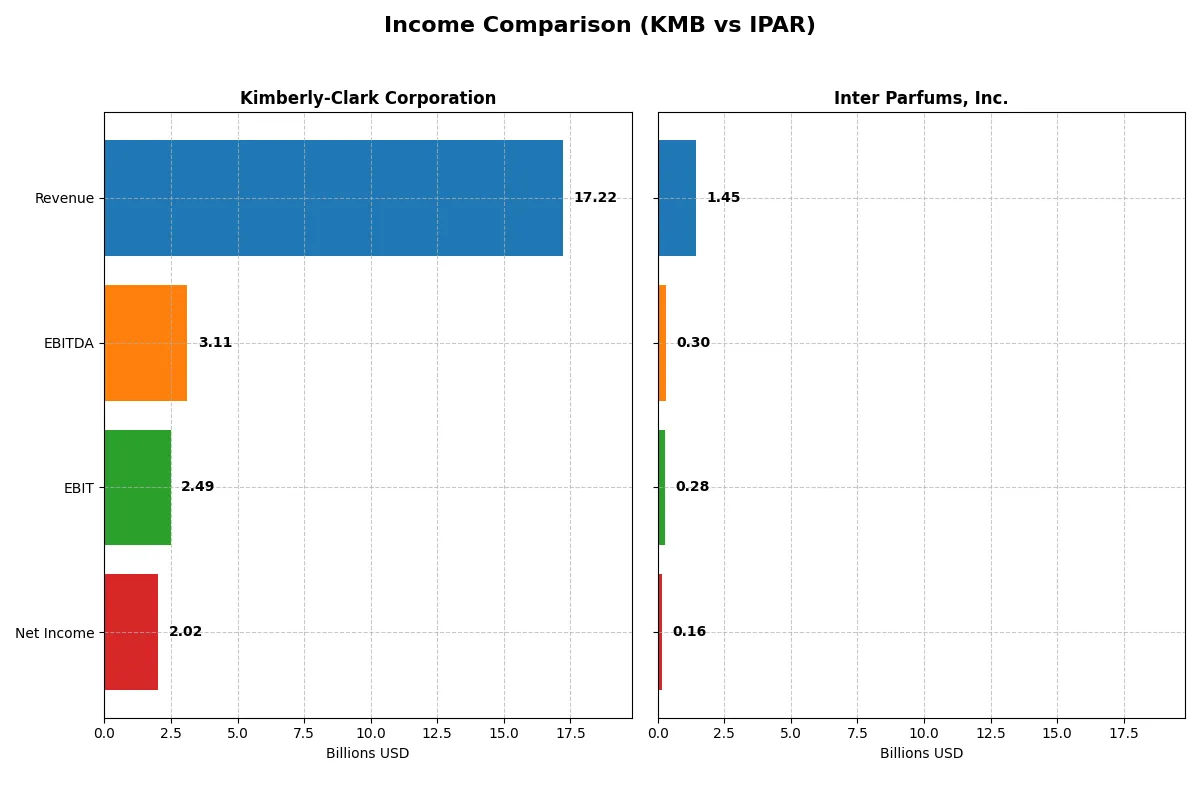
This data dissects the core profitability and scalability of both corporate engines to reveal who dominates the bottom line:
| Metric | Kimberly-Clark Corporation (KMB) | Inter Parfums, Inc. (IPAR) |
|---|---|---|
| Revenue | 17.2B | 1.45B |
| Cost of Revenue | 11.1B | 525M |
| Operating Expenses | 3.64B | 653M |
| Gross Profit | 6.13B | 927M |
| EBITDA | 3.11B | 305M |
| EBIT | 2.49B | 276M |
| Interest Expense | 256M | 7.83M |
| Net Income | 2.02B | 164M |
| EPS | 6.08 | 5.13 |
| Fiscal Year | 2025 | 2024 |
Income Statement Analysis: The Bottom-Line Duel
This income statement comparison reveals which company operates its business more efficiently and delivers superior profitability.
Kimberly-Clark Corporation Analysis
Kimberly-Clark’s revenue declined by over 14% from 2024 to 2025, falling to $17.2B. Despite this, net income remained robust at $2.02B, supported by a healthy net margin of 11.74%. Gross margin stayed favorable at 35.6%, though recent declines signal pressure on cost control and top-line momentum.
Inter Parfums, Inc. Analysis
Inter Parfums showed strong revenue growth of 10.2% in 2024 to $1.45B, with net income rising to $164M. Its gross margin impresses at 63.85%, nearly double Kimberly-Clark’s, reflecting high operational leverage. EBIT margin of 19.02% indicates superior profitability, despite a slight net margin contraction last year.
Margin Strength vs. Growth Trajectory
Kimberly-Clark delivers stable margins but suffers recent revenue declines, while Inter Parfums combines robust growth with superior profitability ratios. Inter Parfums’ impressive margin expansion and rapid earnings growth outpace Kimberly-Clark’s slower momentum. Investors seeking growth and margin expansion may find Inter Parfums’ profile more attractive.
Financial Ratios Comparison
These vital ratios act as a diagnostic tool to expose underlying fiscal health, valuation premiums, and capital efficiency for the companies compared below:
| Ratios | Kimberly-Clark Corporation (KMB) | Inter Parfums, Inc. (IPAR) |
|---|---|---|
| ROE | 3.03% (2024) | 22.07% (2024) |
| ROIC | 25.33% (2024) | 18.35% (2024) |
| P/E | 17.35 (2024) | 25.63 (2024) |
| P/B | 52.57 (2024) | 5.66 (2024) |
| Current Ratio | 0.80 (2024) | 2.75 (2024) |
| Quick Ratio | 0.54 (2024) | 1.63 (2024) |
| D/E (Debt-to-Equity) | 9.42 (2024) | 0.26 (2024) |
| Debt-to-Assets | 47.8% (2024) | 13.6% (2024) |
| Interest Coverage | 11.89 (2024) | 35.12 (2024) |
| Asset Turnover | 1.21 (2024) | 1.03 (2024) |
| Fixed Asset Turnover | 2.67 (2024) | 8.14 (2024) |
| Payout Ratio | 64.0% (2024) | 58.4% (2024) |
| Dividend Yield | 3.69% (2024) | 2.28% (2024) |
| Fiscal Year | 2024 | 2024 |
Efficiency & Valuation Duel: The Vital Signs
Financial ratios serve as a company’s DNA, revealing both hidden risks and operational excellence investors must understand.
Kimberly-Clark Corporation
Kimberly-Clark shows a solid net margin of 11.74%, signaling efficient core operations despite an unfavorable zero ROE and ROIC. Its P/E of 16.63 appears fairly valued, balancing shareholder returns with a strong 4.94% dividend yield. The firm’s moderate leverage and high interest coverage suggest prudent capital management amid mixed liquidity signals.
Inter Parfums, Inc.
Inter Parfums boasts robust profitability with a 22.07% ROE and 18.35% ROIC, highlighting strong capital efficiency. However, its valuation is stretched with a P/E of 25.63 and a high P/B of 5.66. The company sustains returns through moderate dividends (2.28%) and maintains a healthy liquidity profile with a 2.75 current ratio and low debt.
Premium Valuation vs. Operational Safety
Inter Parfums delivers superior returns and operational efficiency but trades at a premium that reflects higher risk. Kimberly-Clark offers steadier income and valuation discipline despite weaker profitability. Investors seeking growth may prefer Inter Parfums, while those prioritizing income and financial stability may lean toward Kimberly-Clark.
Which one offers the Superior Shareholder Reward?
I compare Kimberly-Clark (KMB) and Inter Parfums (IPAR) by their dividend yields, payout ratios, and buyback intensity. KMB yields 4.94% with a high payout ratio near 82%, supported by strong free cash flow coverage (1.67x). It pairs dividends with steady buybacks, signaling balanced distributions. IPAR pays a lower 2.28% yield and a 58% payout ratio, retaining cash for growth; its buyback activity is less pronounced. Historically, KMB’s model suits income-focused investors, while IPAR prioritizes reinvestment. I find KMB offers more sustainable, attractive total shareholder returns in 2026 due to its robust cash flow and disciplined capital allocation.
Comparative Score Analysis: The Strategic Profile
The radar chart reveals the fundamental DNA and trade-offs of Kimberly-Clark Corporation and Inter Parfums, Inc., highlighting their financial strengths and vulnerabilities:
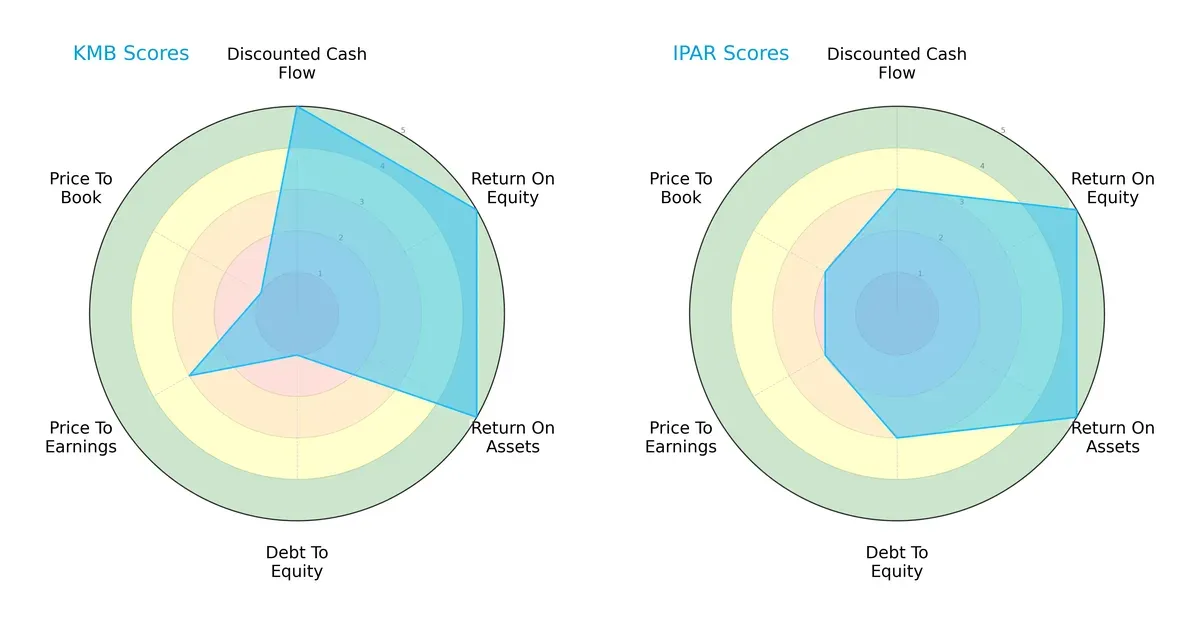
Kimberly-Clark excels in discounted cash flow (5 vs. 3), ROE (5 vs. 5), and ROA (5 vs. 5), signaling superior profitability and asset utilization. However, its debt-to-equity (1 vs. 3) and price-to-book (1 vs. 2) scores reveal heavy leverage and potential overvaluation risks. Inter Parfums offers a more balanced risk profile with moderate leverage and valuation but lags in cash flow strength. Kimberly-Clark relies on operational efficiency, while Inter Parfums leans on financial stability.
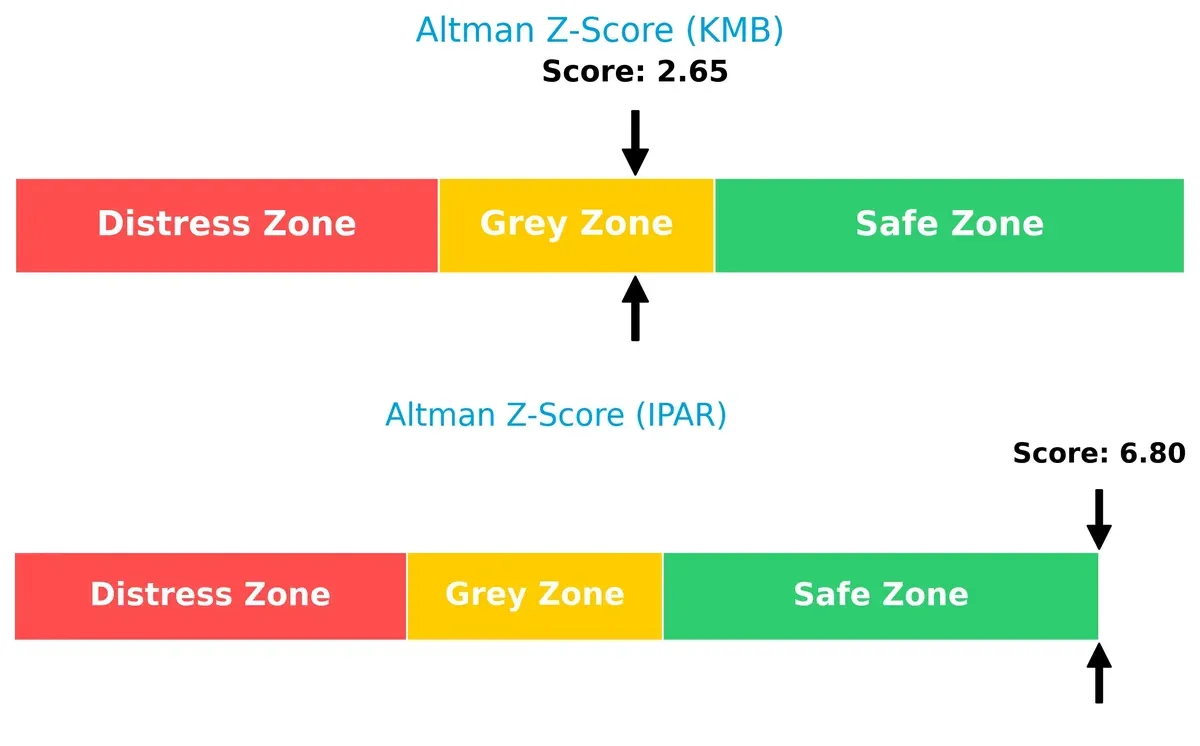
Bankruptcy Risk: Solvency Showdown
The Altman Z-Score gap shows Inter Parfums (6.8, safe zone) far surpasses Kimberly-Clark (2.65, grey zone), implying stronger long-term survival prospects for Inter Parfums in this cycle:
Financial Health: Quality of Operations
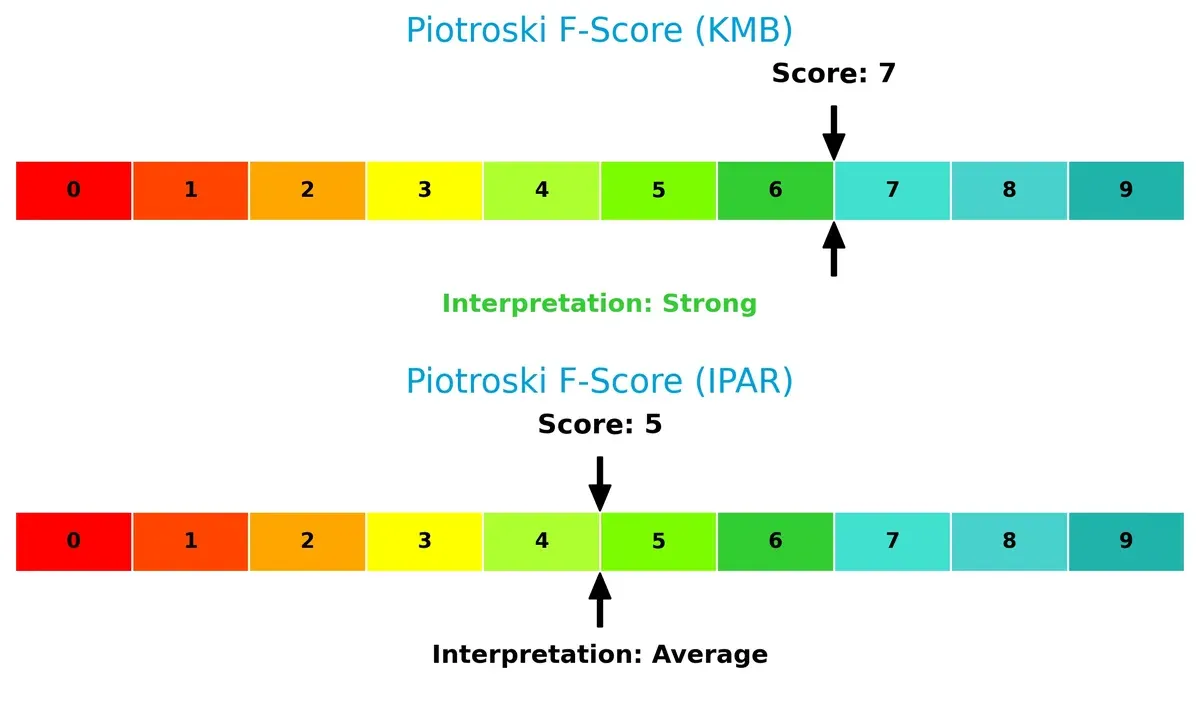
Kimberly-Clark’s Piotroski F-Score of 7 indicates robust financial health, outperforming Inter Parfums’ average score of 5. This suggests Kimberly-Clark maintains superior internal operations and fewer red flags:
How are the two companies positioned?
This section dissects the operational DNA of KMB and IPAR by comparing their revenue distribution and internal dynamics. The goal is to confront their economic moats and identify the more resilient, sustainable competitive advantage today.
Revenue Segmentation: The Strategic Mix
This visual comparison dissects how Kimberly-Clark Corporation and Inter Parfums, Inc. diversify their income streams and where their primary sector bets lie:
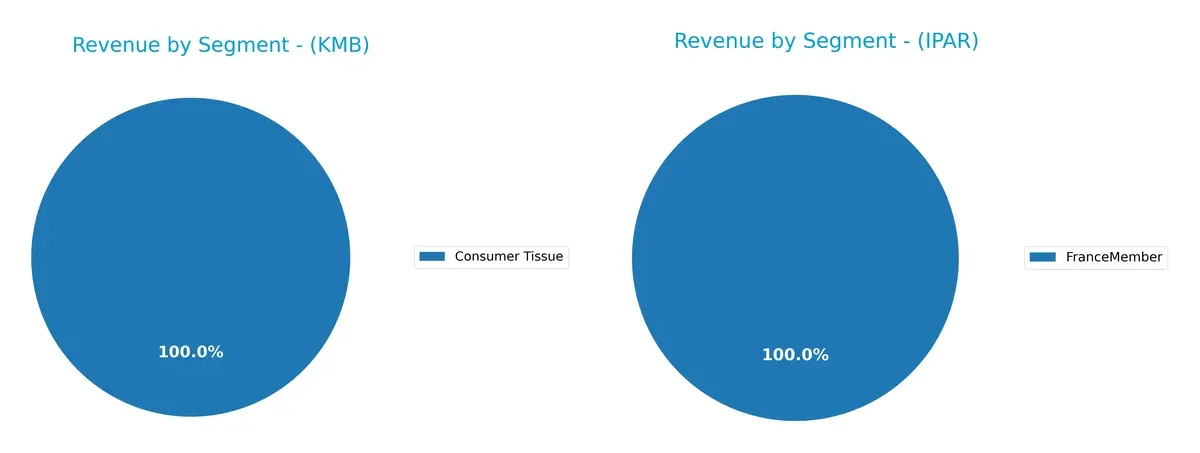
Kimberly-Clark pivots on a diversified mix, anchoring revenue in Personal Care ($10.7B), Consumer Tissue ($6.3B), and K-C Professional ($3.4B) for 2023. Inter Parfums, by contrast, relies solely on the FranceMember segment at $37.6M, revealing high concentration risk. Kimberly-Clark’s broad exposure creates ecosystem lock-in and resilience. Inter Parfums’ narrow focus signals vulnerability to market shifts but could reflect niche specialization.
Strengths and Weaknesses Comparison
This table compares the strengths and weaknesses of Kimberly-Clark Corporation (KMB) and Inter Parfums, Inc. (IPAR):
KMB Strengths
- Diverse product segments including Consumer Tissue, Professional, and Personal Care
- Favorable net margin at 11.74%
- Strong dividend yield at 4.94%
- Low debt-to-assets ratio and strong interest coverage
IPAR Strengths
- High ROE at 22.07% and ROIC at 18.35% indicating efficient capital use
- Favorable liquidity ratios (current 2.75, quick 1.63)
- Diversified geographic presence across multiple regions
- Favorable net margin at 11.32% and dividend yield at 2.28%
KMB Weaknesses
- Unfavorable ROE and ROIC at 0% indicating poor capital returns
- Unfavorable liquidity ratios (current and quick ratio at 0)
- Unavailable WACC data limits cost of capital analysis
- Neutral P/E ratio at 16.63
IPAR Weaknesses
- High P/E ratio at 25.63 and elevated PB ratio at 5.66 suggest overvaluation risk
- Lower dividend yield compared to KMB
- Neutral WACC at 9.24% may pressure returns
Kimberly-Clark shows strong diversification and stable profitability but struggles with capital efficiency and liquidity. Inter Parfums excels in profitability and liquidity while facing valuation concerns. These contrasts highlight different strategic priorities between the companies.
The Moat Duel: Analyzing Competitive Defensibility
A structural moat protects long-term profits from relentless competitive erosion. Without it, market share and margins shrink rapidly:
Kimberly-Clark Corporation: Intangible Assets and Brand Loyalty
Kimberly-Clark’s moat relies on strong brand recognition and trusted product lines. This delivers stable margins despite recent revenue declines. Innovation in personal care could deepen its moat, but margin pressure looms.
Inter Parfums, Inc.: High-Value Brand Portfolio and Efficient Capital Use
Inter Parfums leverages a luxury brand portfolio and rising ROIC well above WACC, signaling superior capital allocation. Its rapid revenue and profit growth highlight an expanding moat, fueled by global market penetration and product launches.
Brand Equity vs. Capital Efficiency: The Moat Showdown
Inter Parfums reveals a wider, more durable moat through growing ROIC and explosive earnings expansion. Kimberly-Clark’s brand loyalty supports stable profits but weaker growth and declining ROIC suggest vulnerability. Inter Parfums is better positioned to defend and grow market share in 2026.
Which stock offers better returns?
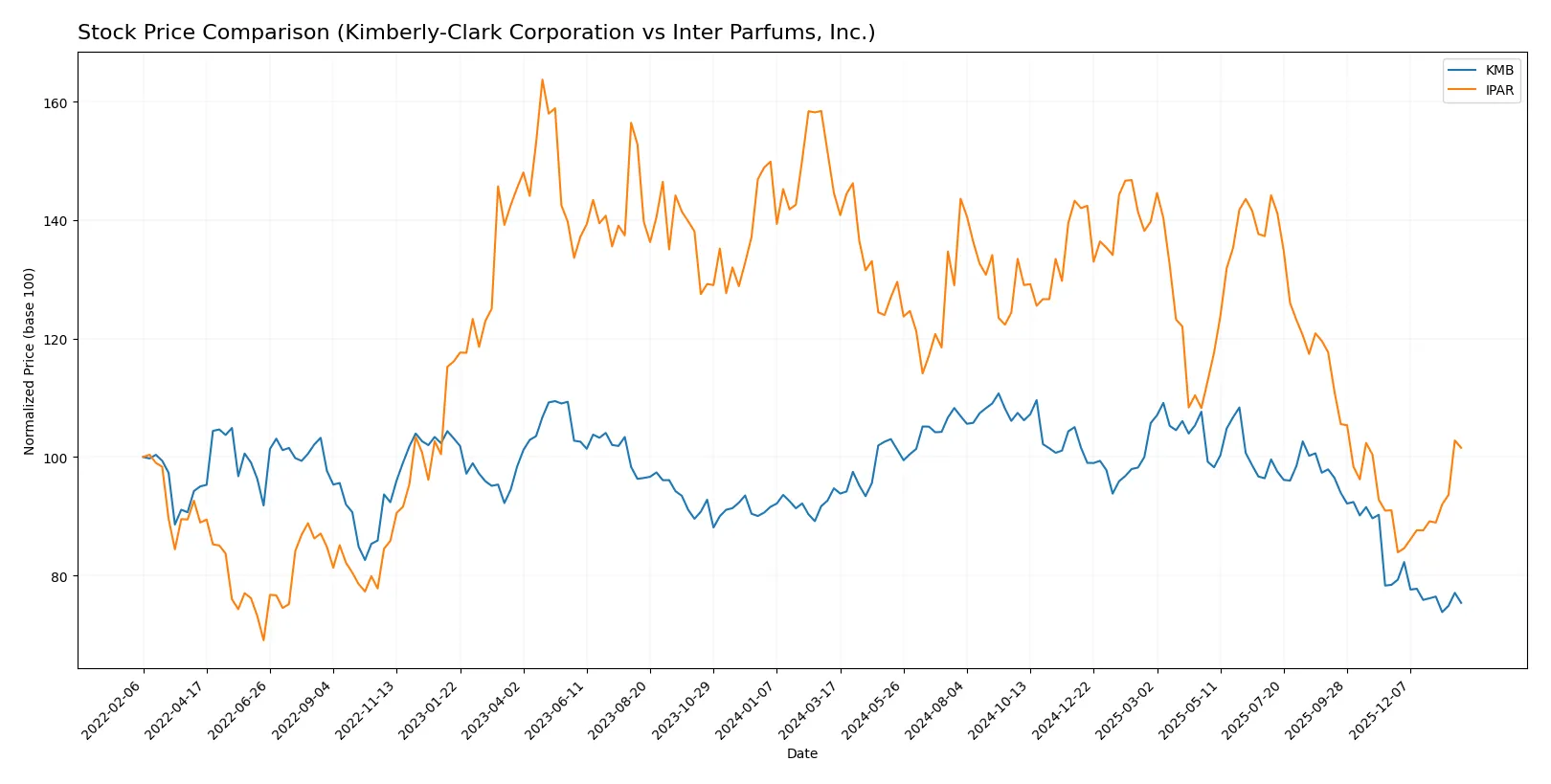
The past year shows contrasting price dynamics: Kimberly-Clark’s shares declined steadily, while Inter Parfums reversed earlier losses with notable recent gains.
Trend Comparison
Kimberly-Clark’s stock fell 20.42% over the past 12 months, reflecting a bearish trend with decelerating losses. The price ranged between 97.92 and 146.91, showing high volatility (12.48 std deviation).
Inter Parfums dropped 29.78% overall but accelerated its decline. Recently, it gained 11.6%, indicating a short-term bullish reversal. Price volatility remains elevated at 16.83 std deviation.
Comparing both, Kimberly-Clark’s less severe decline and steady volume contrast with Inter Parfums’ sharper drop but recent recovery, placing Kimberly-Clark as the stronger performer over the year.
Target Prices
Analysts show a moderate upside potential for Kimberly-Clark Corporation and Inter Parfums, Inc.
| Company | Target Low | Target High | Consensus |
|---|---|---|---|
| Kimberly-Clark Corporation | 102 | 162 | 122.38 |
| Inter Parfums, Inc. | 103 | 112 | 107.5 |
The consensus target prices imply a 22% upside for Kimberly-Clark from its current 99.99 price. Inter Parfums shows a smaller but positive 10% potential versus its 97.57 price.

Don’t Let Luck Decide Your Entry Point
Optimize your entry points with our advanced ProRealTime indicators. You’ll get efficient buy signals with precise price targets for maximum performance. Start outperforming now!
How do institutions grade them?
Kimberly-Clark Corporation Grades
The following table summarizes recent institutional grades for Kimberly-Clark Corporation:
| Grading Company | Action | New Grade | Date |
|---|---|---|---|
| UBS | Maintain | Neutral | 2026-01-28 |
| Citigroup | Maintain | Sell | 2026-01-14 |
| UBS | Maintain | Neutral | 2026-01-14 |
| TD Cowen | Maintain | Hold | 2026-01-08 |
| Wells Fargo | Maintain | Equal Weight | 2026-01-05 |
| Citigroup | Maintain | Sell | 2025-12-17 |
| BNP Paribas Exane | Maintain | Neutral | 2025-12-01 |
| Argus Research | Upgrade | Buy | 2025-11-13 |
| Wells Fargo | Maintain | Equal Weight | 2025-11-04 |
| Evercore ISI Group | Downgrade | In Line | 2025-11-04 |
Inter Parfums, Inc. Grades
Below is a summary of recent institutional grades for Inter Parfums, Inc.:
| Grading Company | Action | New Grade | Date |
|---|---|---|---|
| BWS Financial | Maintain | Neutral | 2026-01-29 |
| BWS Financial | Downgrade | Neutral | 2025-11-21 |
| Canaccord Genuity | Maintain | Buy | 2025-11-19 |
| Canaccord Genuity | Maintain | Buy | 2025-11-07 |
| Jefferies | Maintain | Buy | 2025-10-28 |
| BWS Financial | Maintain | Buy | 2025-10-22 |
| Canaccord Genuity | Maintain | Buy | 2025-10-21 |
| BWS Financial | Maintain | Buy | 2025-05-07 |
| Piper Sandler | Maintain | Overweight | 2025-04-24 |
| DA Davidson | Maintain | Buy | 2025-03-25 |
Which company has the best grades?
Inter Parfums, Inc. holds predominantly Buy and Overweight ratings, signaling stronger institutional confidence. Kimberly-Clark shows more Neutral and Sell grades, suggesting cautious sentiment. Investors might interpret this as differing risk-reward profiles.
Risks specific to each company
The following categories identify the critical pressure points and systemic threats facing both firms in the 2026 market environment:
1. Market & Competition
Kimberly-Clark Corporation
- Operates in mature consumer staples with steady demand but faces intense competition from global brands and private labels.
Inter Parfums, Inc.
- Faces fierce competition in luxury fragrances, highly sensitive to fashion trends and consumer preferences.
2. Capital Structure & Debt
Kimberly-Clark Corporation
- Strong interest coverage ratio (9.73) but lacks transparency on debt ratios; some liquidity concerns with unfavorable current and quick ratios.
Inter Parfums, Inc.
- Maintains a balanced capital structure with low debt (D/E 0.26), strong interest coverage (35.3), and healthy liquidity ratios.
3. Stock Volatility
Kimberly-Clark Corporation
- Very low beta (0.276) indicates defensive stock with low market volatility exposure.
Inter Parfums, Inc.
- Higher beta (1.243) reflects greater stock price volatility and sensitivity to market swings.
4. Regulatory & Legal
Kimberly-Clark Corporation
- Subject to stringent product safety and environmental regulations globally; potential litigation risks in personal care segment.
Inter Parfums, Inc.
- Faces regulatory scrutiny on product ingredients and international trade regulations affecting luxury goods distribution.
5. Supply Chain & Operations
Kimberly-Clark Corporation
- Large-scale global operations vulnerable to raw material cost inflation and supply disruptions.
Inter Parfums, Inc.
- Relies on specialized suppliers and international logistics, exposed to supply chain risks from geopolitical tensions.
6. ESG & Climate Transition
Kimberly-Clark Corporation
- Increasing ESG commitments with potential cost pressures but stronger brand reputation benefits.
Inter Parfums, Inc.
- Emerging ESG focus but less mature initiatives may pose transition risks.
7. Geopolitical Exposure
Kimberly-Clark Corporation
- Diversified global footprint but exposed to tariffs and trade uncertainties in key markets.
Inter Parfums, Inc.
- Concentrated luxury markets and reliance on international travel retail increase sensitivity to geopolitical instability.
Which company shows a better risk-adjusted profile?
Kimberly-Clark’s primary risk is liquidity concerns and operational complexity amid mature market competition. Inter Parfums faces higher volatility and fashion-driven demand risks but boasts stronger balance sheet metrics. Inter Parfums’ safe-zone Altman Z-score and favorable leverage profile suggest a superior risk-adjusted stance. However, Kimberly-Clark’s defensive stock nature and stable dividends provide downside protection. The recent strength in Inter Parfums’ interest coverage ratio (35.3) confirms its robust capacity to service debt, underscoring its resilience despite market volatility.
Final Verdict: Which stock to choose?
Kimberly-Clark’s superpower lies in its resilient cash flow generation and strong dividend yield, supporting steady income streams. However, its declining revenue growth and weakening balance sheet ratios warrant caution. It fits portfolios seeking stable income but can face headwinds in growth-focused strategies.
Inter Parfums benefits from a robust economic moat, demonstrated by a growing ROIC well above its cost of capital. Its superior liquidity and financial health offer a safety cushion compared to Kimberly-Clark. This makes it suitable for investors targeting growth at a reasonable price with moderate risk tolerance.
If you prioritize consistent income and defensive positioning, Kimberly-Clark is a compelling choice due to its reliable cash flow and dividend yield. However, if you seek growth backed by a durable competitive advantage and financial strength, Inter Parfums outshines with superior profitability and balance sheet resilience, despite its higher valuation.
Disclaimer: Investment carries a risk of loss of initial capital. The past performance is not a reliable indicator of future results. Be sure to understand risks before making an investment decision.
Go Further
I encourage you to read the complete analyses of Kimberly-Clark Corporation and Inter Parfums, Inc. to enhance your investment decisions: