Home > Comparison > Technology > INTC vs SKYT
The strategic rivalry between Intel Corporation and SkyWater Technology defines the semiconductor industry’s evolution. Intel, a capital-intensive technology giant, leads with broad platform products and high-performance compute solutions. SkyWater, a nimble semiconductor services provider, focuses on specialized analog and mixed-signal manufacturing. This analysis pits scale and diversification against agility and niche expertise to identify which trajectory offers superior risk-adjusted returns for a diversified portfolio in 2026.
Table of contents
Companies Overview
Intel and SkyWater Technology stand as influential players in the semiconductor sector, shaping industry innovation and supply chains.
Intel Corporation: Semiconductor Powerhouse
Intel dominates the semiconductor market with its diverse product portfolio spanning CPUs, chipsets, and high-performance compute solutions. Its revenue engine relies heavily on platform products and adjacent technologies serving cloud providers, OEMs, and verticals like healthcare and autonomous driving. In 2026, Intel focuses strategically on AI-enhanced drug discovery and workload-optimized platforms, reinforcing its competitive moat.
SkyWater Technology, Inc.: Specialized Semiconductor Manufacturer
SkyWater specializes in custom semiconductor development and manufacturing services for analog, mixed-signal, and rad-hard ICs. It generates revenue through engineering collaboration and process development tailored to aerospace, defense, automotive, and IoT sectors. In 2026, the company emphasizes co-creation with customers to advance silicon-based technologies, carving a niche in specialized, mission-critical applications.
Strategic Collision: Similarities & Divergences
Intel pursues a broad, integrated ecosystem with platform dominance, while SkyWater adopts a focused, collaborative approach in niche markets. Both compete on innovation and manufacturing capabilities, but Intel targets scale and AI-driven solutions, whereas SkyWater prioritizes customization and specialized offerings. Their investment profiles diverge sharply: Intel offers large-cap stability, SkyWater presents high beta growth potential with concentrated risk.
Income Statement Comparison
This data dissects the core profitability and scalability of both corporate engines to reveal who dominates the bottom line:
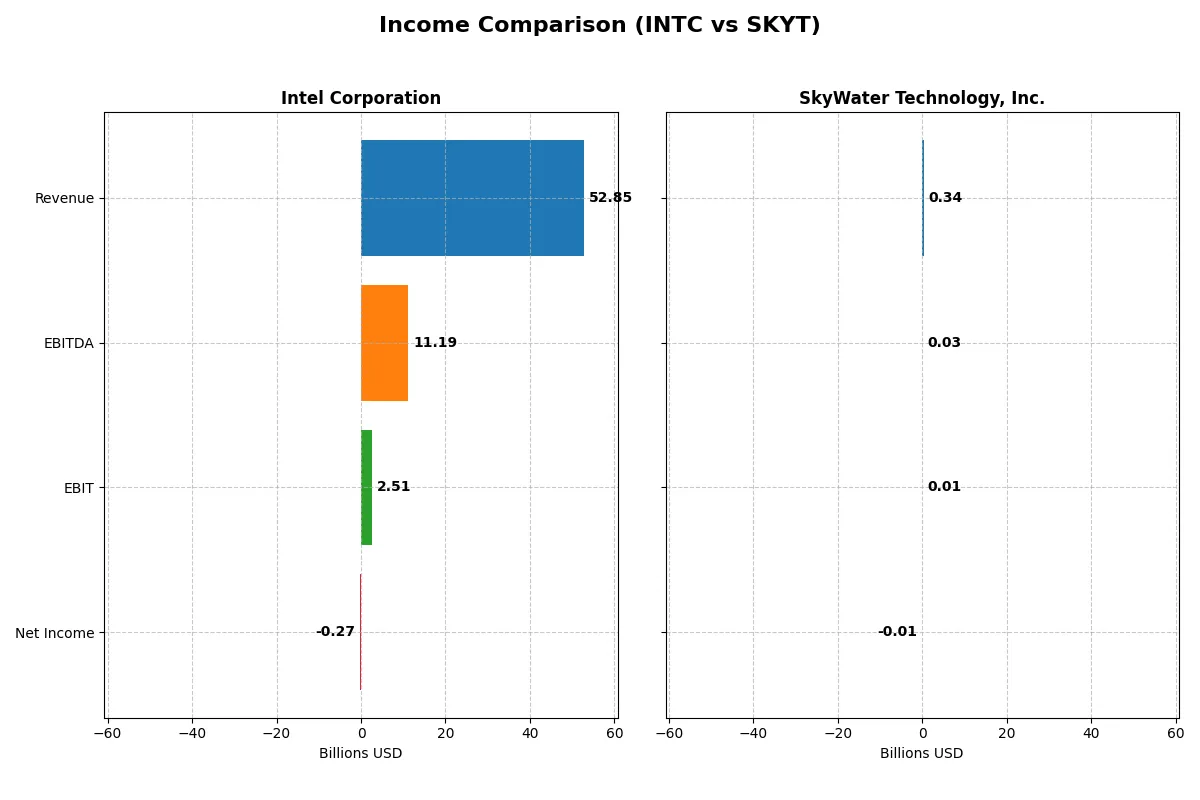
| Metric | Intel Corporation (INTC) | SkyWater Technology, Inc. (SKYT) |
|---|---|---|
| Revenue | 52.9B | 342M |
| Cost of Revenue | 34.4B | 273M |
| Operating Expenses | 20.6B | 63.1M |
| Gross Profit | 18.5B | 70M |
| EBITDA | 11.2B | 25.3M |
| EBIT | 2.5B | 6.6M |
| Interest Expense | 953M | 8.8M |
| Net Income | -267M | -6.8M |
| EPS | -0.08 | -0.14 |
| Fiscal Year | 2025 | 2024 |
Income Statement Analysis: The Bottom-Line Duel
This income statement comparison exposes the true operational efficiency and profitability trends of Intel Corporation and SkyWater Technology, Inc.
Intel Corporation Analysis
Intel’s revenue declined modestly from 79B in 2021 to 53B in 2025, with net income collapsing from 19.9B to a loss of 267M. Gross margins remain healthy near 35%, but net margins have turned negative, signaling cost pressures and operational challenges. The 2025 figures show a slight rebound in profitability momentum, with EBIT turning positive and net income loss narrowing significantly.
SkyWater Technology, Inc. Analysis
SkyWater’s revenue grew steadily from 140M in 2020 to 342M in 2024, while net losses shrank from 20.6M to 6.8M. The company maintains a lower gross margin of 20%, reflecting its smaller scale and industry position, but shows improving EBIT margins and consistent expense control. The 2024 results highlight accelerating growth and improved operational efficiency, reducing losses and bolstering cash flow potential.
Scale Dominance vs. Growth Efficiency
Intel commands vast revenue scale but struggles with declining net income and margin pressure. SkyWater, though smaller, posts solid growth with improving profitability metrics. For investors, Intel’s scale offers resilience, but SkyWater’s trajectory promises more efficient margin expansion and a clearer path to profitability.
Financial Ratios Comparison
These vital ratios act as a diagnostic tool to expose the underlying fiscal health, valuation premiums, and capital efficiency of the companies compared below:
| Ratios | Intel Corporation (INTC) | SkyWater Technology, Inc. (SKYT) |
|---|---|---|
| ROE | -0.23% | -11.79% |
| ROIC | -0.02% | 3.40% |
| P/E | -658.38 | -100.26 |
| P/B | 1.54 | 11.82 |
| Current Ratio | 2.02 | 0.86 |
| Quick Ratio | 1.65 | 0.76 |
| D/E (Debt-to-Equity) | 0.41 | 1.33 |
| Debt-to-Assets | 22.03% | 24.46% |
| Interest Coverage | -2.23 | 0.74 |
| Asset Turnover | 0.25 | 1.09 |
| Fixed Asset Turnover | 0.50 | 2.07 |
| Payout ratio | 0 | 0 |
| Dividend yield | 0 | 0 |
| Fiscal Year | 2025 | 2024 |
Efficiency & Valuation Duel: The Vital Signs
Financial ratios act as a company’s DNA, uncovering operational strengths and hidden risks that shape investor outcomes.
Intel Corporation
Intel’s core profitability falters with negative ROE and margins, signaling operational challenges. Despite this, the stock’s P/E ratio appears favorable, suggesting undervaluation. The company maintains a strong current ratio and manageable debt, yet offers no dividends, reinvesting heavily in R&D to fuel future growth and innovation.
SkyWater Technology, Inc.
SkyWater struggles with steep negative profitability metrics, including ROE and margins, marking operational inefficiency. Its valuation, reflected in a favorable P/E but high price-to-book ratio, feels stretched. SkyWater lacks dividends and shows weak liquidity, relying on growth investments amid high debt levels and limited interest coverage.
Operational Stability vs. Growth Gambit
Intel offers a better balance of risk and reward with stronger liquidity and prudent capital structure despite weak profitability. SkyWater’s profile suits investors seeking high-risk growth, given its stretched valuation and financial vulnerabilities. Choose Intel for stability; SkyWater for speculative growth potential.
Which one offers the Superior Shareholder Reward?
Intel Corporation (INTC) currently offers a more attractive shareholder reward than SkyWater Technology (SKYT). Intel pays no dividends in 2025, reflecting free cash flow challenges with a negative FCF per share (-1.02). Its payout ratio is zero, but it maintains a strong buyback capacity supported by solid operating cash flow per share (2.0). Conversely, SkyWater pays no dividends and shows modest positive free cash flow (0.15 per share) but suffers from weak operating cash flow coverage (0.12) and a high financial leverage ratio (5.4), limiting buyback potential. Intel’s distribution model is riskier short-term but grounded in deeper cash flow and capital management history, making it a superior long-term total return candidate in 2026.
Comparative Score Analysis: The Strategic Profile
The radar chart reveals the fundamental DNA and trade-offs of Intel Corporation and SkyWater Technology, Inc., highlighting their distinct financial strengths and vulnerabilities:
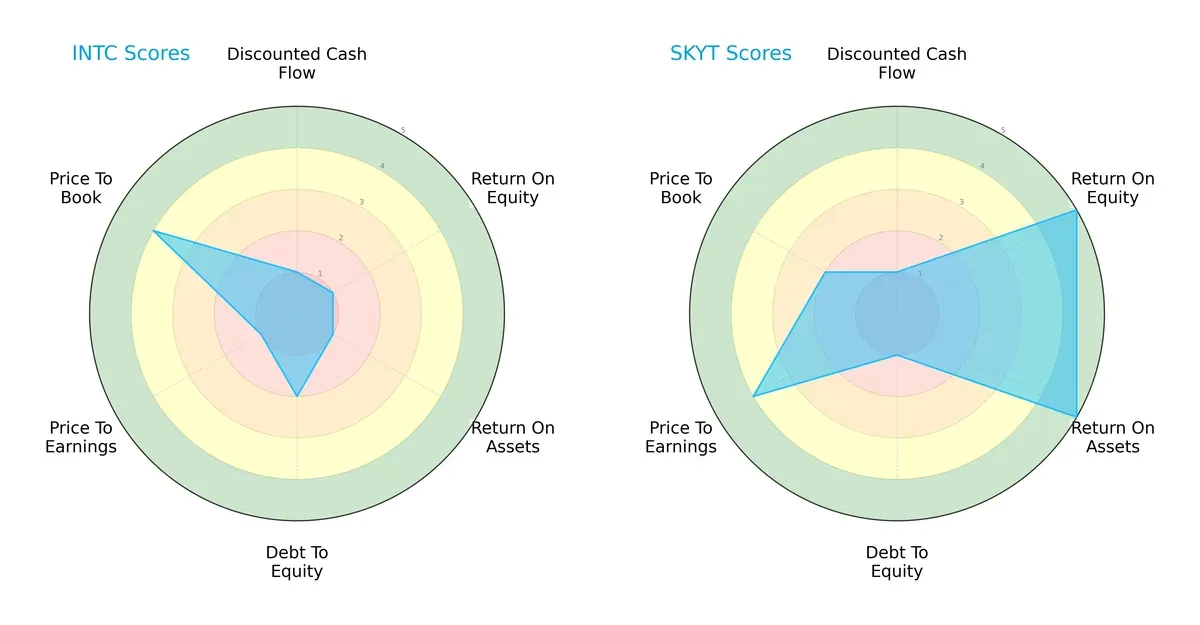
Intel shows weakness in profitability metrics (ROE and ROA at score 1), relying on valuation strength (P/B score 4). SkyWater excels in profitability (ROE and ROA scores 5) but carries higher financial risk with a poor debt-to-equity score (1). SkyWater’s profile is more balanced on returns but riskier, while Intel leans heavily on valuation appeal amid weaker operational returns.
Bankruptcy Risk: Solvency Showdown
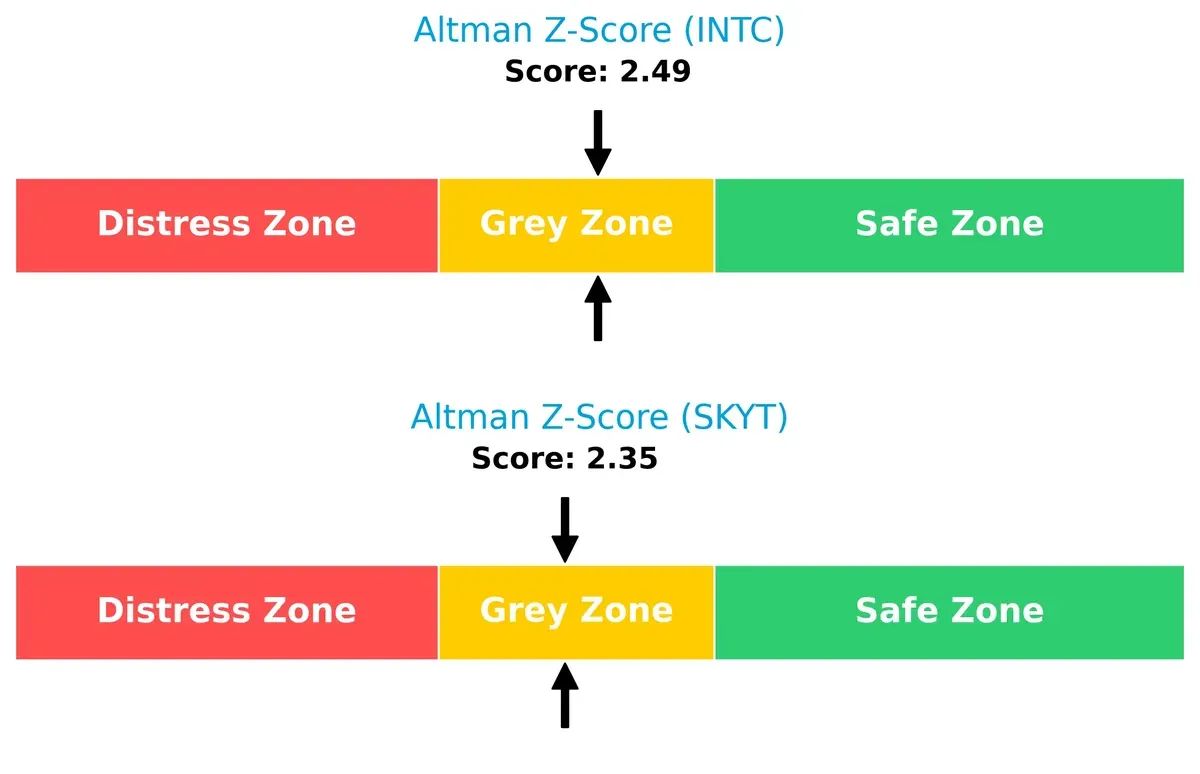
Intel’s Altman Z-Score of 2.49 slightly surpasses SkyWater’s 2.35, placing both firms in the grey zone with moderate bankruptcy risk in this cycle:
Financial Health: Quality of Operations
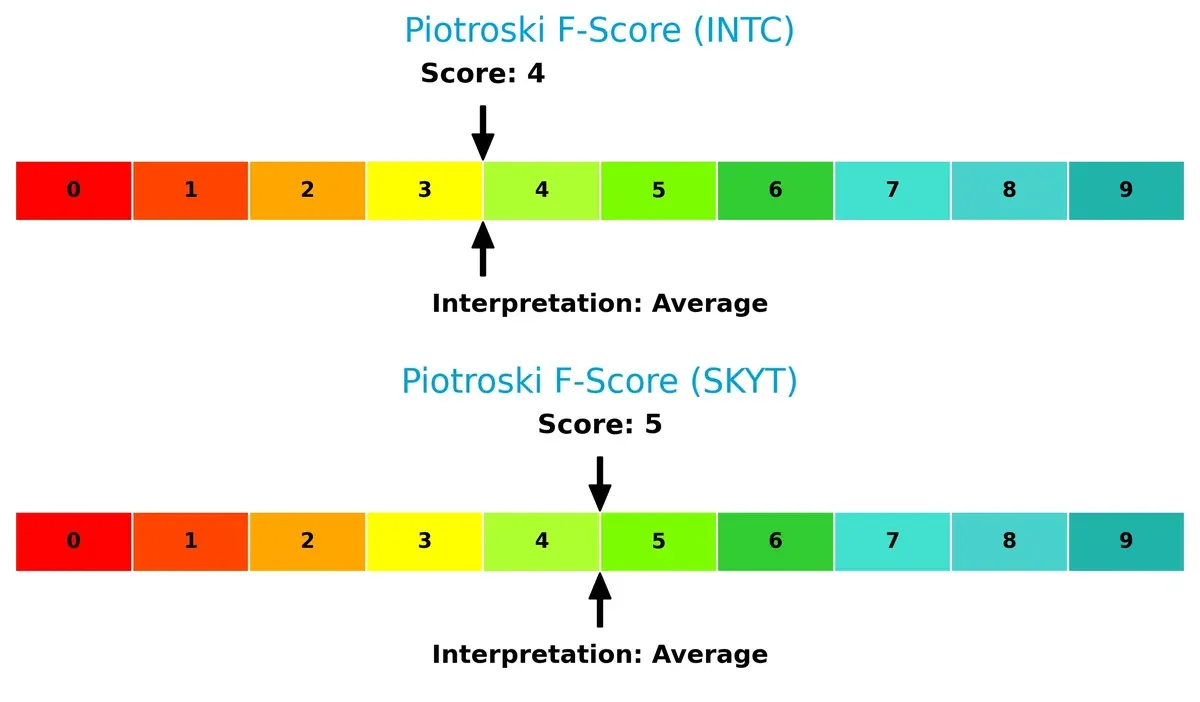
SkyWater’s Piotroski F-Score of 5 edges out Intel’s 4, suggesting marginally stronger internal financial health without clear red flags for either firm:
How are the two companies positioned?
This section dissects the operational DNA of Intel and SkyWater by comparing their revenue distribution and internal dynamics. The goal is to confront their economic moats to identify which model offers the most resilient, sustainable advantage today.
Revenue Segmentation: The Strategic Mix
This comparison dissects how Intel Corporation and SkyWater Technology diversify their income streams and reveals their primary sector bets for strategic positioning:
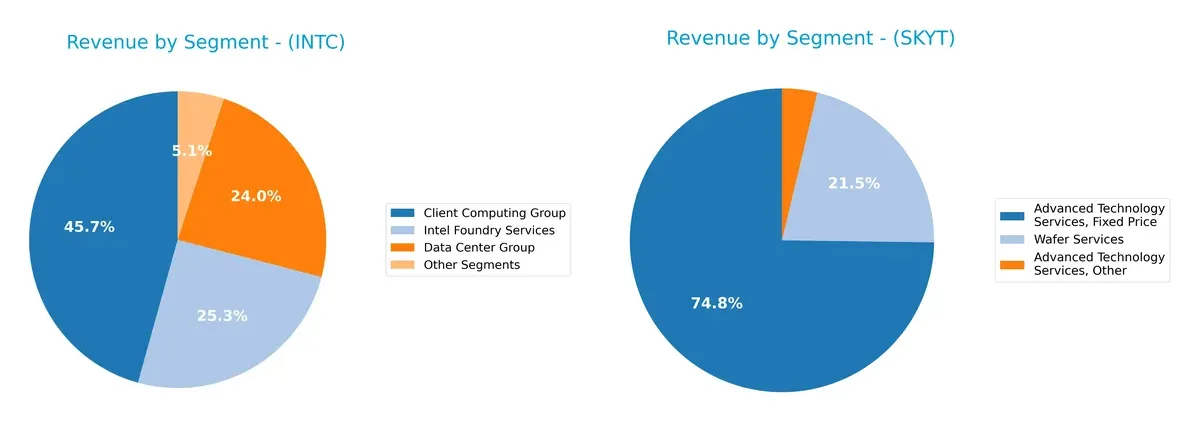
Intel leans heavily on its Client Computing Group, generating $32.2B, dwarfing other segments like Data Center ($16.9B) and Foundry Services ($17.8B). SkyWater’s revenue centers on Advanced Technology Services, split among fixed price ($93.5M) and time/materials ($122.3M), with wafer services ($61.1M) trailing. Intel’s concentration signals ecosystem lock-in risk, while SkyWater’s balanced service mix suggests nimble infrastructure dominance in a niche market.
Strengths and Weaknesses Comparison
This table compares the strengths and weaknesses of Intel Corporation and SkyWater Technology, Inc.:
Intel Corporation Strengths
- Diversified segments including Client Computing, Data Center, and Foundry Services
- Favorable current and quick ratios indicating liquidity
- Low debt-to-assets ratio supports financial stability
- Significant global presence with strong US and Asia-Pacific revenues
SkyWater Technology, Inc. Strengths
- Favorable asset turnover ratio shows efficient use of assets
- Favorable debt-to-assets ratio despite leverage
- Focused revenue streams in Advanced Technology and Wafer Services
- Presence in US and Canada markets
Intel Corporation Weaknesses
- Negative profitability metrics: net margin, ROE, ROIC
- Unfavorable asset turnover ratios limit operational efficiency
- Zero dividend yield may deter income-focused investors
- Slightly unfavorable global ratio evaluation
SkyWater Technology, Inc. Weaknesses
- Negative profitability metrics including net margin and ROE with higher WACC
- Unfavorable liquidity indicated by low current and quick ratios
- High debt-to-equity ratio signals higher leverage risk
- Unfavorable PB ratio and interest coverage ratio
- Overall unfavorable global ratio evaluation
Intel shows strength in diversification and liquidity but struggles with profitability and operational efficiency. SkyWater faces more pronounced profitability and liquidity challenges despite some operational efficiency and moderate geographic presence. These factors highlight contrasting strategic focuses and risk profiles.
The Moat Duel: Analyzing Competitive Defensibility
A structural moat is the sole barrier protecting long-term profits from relentless competitive pressures and market erosion:
Intel Corporation: Scale and Diversified Portfolio Moat
Intel’s moat stems from its scale and broad product portfolio, yielding stable gross margins near 35%. However, declining ROIC signals weakening capital efficiency by 2026, threatening moat durability.
SkyWater Technology, Inc.: Niche Engineering and Process Development Moat
SkyWater leverages specialized semiconductor manufacturing and engineering services, showing rising ROIC despite value destruction. Its focused niche contrasts Intel’s scale but offers potential moat expansion via innovation.
Scale Dominance vs. Niche Innovation: Who Defends Better?
Intel’s deep, diversified moat faces pressure from declining ROIC and shrinking margins. SkyWater’s smaller but improving moat shows promise with growing profitability. Intel’s scale remains wider, but SkyWater’s trajectory suggests stronger future defense potential.
Which stock offers better returns?
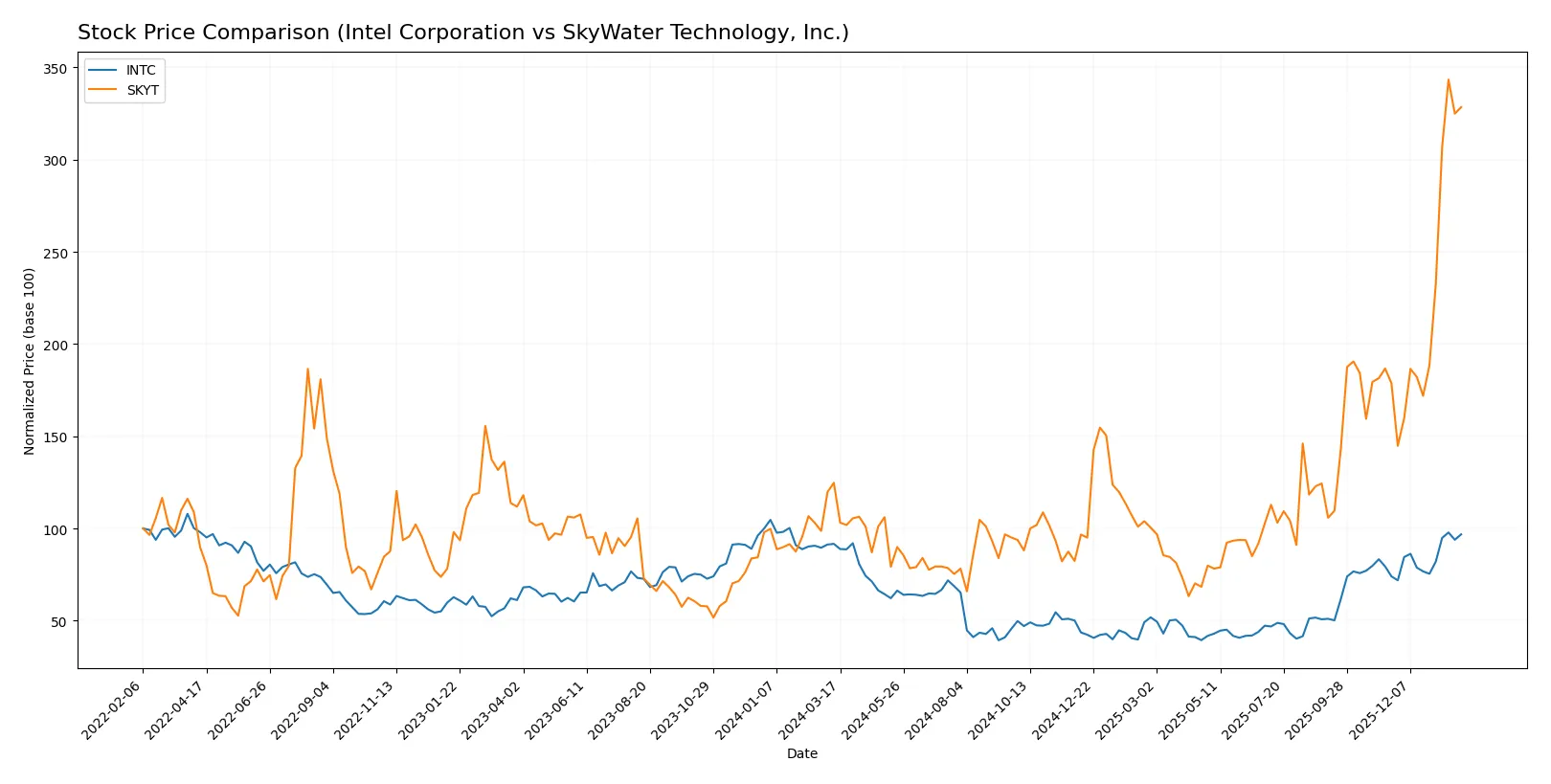
Over the past year, both Intel Corporation and SkyWater Technology, Inc. showed marked price appreciation, with SkyWater exhibiting a notably stronger surge and trading dynamics.
Trend Comparison
Intel Corporation’s stock rose 5.61% over the last 12 months, showing a bullish trend with price acceleration and moderate volatility (8.11 std deviation). The highest price reached 46.96, the lowest 18.89.
SkyWater Technology, Inc. surged 163.18% over the same period, also bullish with accelerating momentum and lower volatility (5.3 std deviation). It hit a high of 33.1 and a low of 6.1.
SkyWater’s performance far outpaced Intel’s, delivering the highest returns with stronger acceleration and more dominant buyer volume over the past year.
Target Prices
Analysts present a mixed but generally optimistic target consensus for Intel Corporation and SkyWater Technology.
| Company | Target Low | Target High | Consensus |
|---|---|---|---|
| Intel Corporation | 20 | 66 | 46.95 |
| SkyWater Technology, Inc. | 35 | 35 | 35 |
Intel’s target consensus of 46.95 closely matches its current 46.47 price, suggesting limited near-term upside. SkyWater’s fixed target at 35 implies a potential 10% gain from its 31.66 price.

Don’t Let Luck Decide Your Entry Point
Optimize your entry points with our advanced ProRealTime indicators. You’ll get efficient buy signals with precise price targets for maximum performance. Start outperforming now!
How do institutions grade them?
Intel Corporation Grades
The table below shows recent grades from reliable institutional graders for Intel Corporation.
| Grading Company | Action | New Grade | Date |
|---|---|---|---|
| RBC Capital | Maintain | Sector Perform | 2026-01-23 |
| Keybanc | Maintain | Overweight | 2026-01-23 |
| Evercore ISI Group | Maintain | In Line | 2026-01-23 |
| Needham | Maintain | Hold | 2026-01-23 |
| Benchmark | Maintain | Buy | 2026-01-23 |
| Rosenblatt | Maintain | Sell | 2026-01-23 |
| UBS | Maintain | Neutral | 2026-01-23 |
| Citigroup | Maintain | Neutral | 2026-01-23 |
| Stifel | Maintain | Hold | 2026-01-23 |
| Wedbush | Maintain | Neutral | 2026-01-23 |
SkyWater Technology, Inc. Grades
Below is a summary of institutional grades for SkyWater Technology, Inc. from reliable sources.
| Grading Company | Action | New Grade | Date |
|---|---|---|---|
| Needham | Downgrade | Hold | 2026-01-27 |
| Piper Sandler | Downgrade | Neutral | 2026-01-27 |
| TD Cowen | Downgrade | Hold | 2026-01-27 |
| Piper Sandler | Maintain | Overweight | 2025-11-06 |
| Needham | Maintain | Buy | 2025-11-06 |
| TD Cowen | Maintain | Buy | 2025-11-06 |
| Needham | Maintain | Buy | 2025-08-07 |
| Needham | Maintain | Buy | 2025-05-08 |
| Needham | Maintain | Buy | 2025-02-27 |
| Needham | Maintain | Buy | 2024-11-11 |
Which company has the best grades?
Intel holds a range of grades from Sell to Buy, with a concentration around Neutral and Hold. SkyWater recently faced downgrades but previously earned consistent Buy ratings. Intel’s grades show more mixed sentiment, while SkyWater’s recent downgrades may signal caution for investors.
Risks specific to each company
The following categories highlight critical pressure points and systemic threats facing Intel Corporation and SkyWater Technology, Inc. in the 2026 market environment:
1. Market & Competition
Intel Corporation
- Faces intense competition from global semiconductor giants, risking margin compression.
SkyWater Technology, Inc.
- Operates in a niche foundry segment but struggles against larger, better-capitalized rivals.
2. Capital Structure & Debt
Intel Corporation
- Maintains moderate leverage (D/E 0.41) with manageable interest coverage (2.63).
SkyWater Technology, Inc.
- High leverage (D/E 1.33) and weak interest coverage (0.74) raise financial distress concerns.
3. Stock Volatility
Intel Corporation
- Beta at 1.35 signals moderate sensitivity to market swings.
SkyWater Technology, Inc.
- Extremely volatile with beta of 3.49, exposing investors to sharp price movements.
4. Regulatory & Legal
Intel Corporation
- Subject to stringent US and international tech regulations; risks from antitrust scrutiny.
SkyWater Technology, Inc.
- Smaller scale reduces regulatory spotlight, but evolving semiconductor export controls pose risks.
5. Supply Chain & Operations
Intel Corporation
- Complex global supply chain vulnerable to geopolitical disruptions and component shortages.
SkyWater Technology, Inc.
- More agile but limited capacity and reliance on third-party suppliers constrain scalability.
6. ESG & Climate Transition
Intel Corporation
- Significant ESG initiatives underway, but high energy consumption remains a challenge.
SkyWater Technology, Inc.
- Early-stage ESG programs with limited impact; climate transition costs may weigh on margins.
7. Geopolitical Exposure
Intel Corporation
- Broad global footprint exposes it to US-China tensions and export restrictions.
SkyWater Technology, Inc.
- Primarily US-based, but sensitive to defense sector shifts and related policy changes.
Which company shows a better risk-adjusted profile?
Intel’s biggest risk is fierce market competition eroding profitability, reflected in its negative margins and average financial scores. SkyWater’s greatest threat is its precarious capital structure with high debt and poor interest coverage. Despite volatility, Intel’s robust balance sheet and scale offer a better risk-adjusted profile. SkyWater’s heightened leverage and weak liquidity create elevated bankruptcy risk, underscored by its Altman Z-Score in the “grey zone.” Recent data shows Intel’s stable current ratios contrast sharply with SkyWater’s liquidity shortfall, justifying my caution toward SkyWater’s financial resilience.
Final Verdict: Which stock to choose?
Intel Corporation’s superpower lies in its vast scale and established market presence, generating steady operating cash flow despite recent profitability challenges. Its point of vigilance is the persistent value destruction indicated by declining ROIC versus WACC. Intel fits portfolios aiming for long-term turnaround potential within a mature tech sector.
SkyWater Technology’s strategic moat is its growing ROIC trend coupled with accelerating revenue growth, signaling improving operational efficiency in a niche semiconductor space. Compared to Intel, SkyWater carries higher financial risk and less liquidity but offers a more dynamic growth profile. It suits investors with a higher risk appetite seeking emerging growth opportunities.
If you prioritize stable cash generation and scale, Intel appears the compelling choice due to its entrenched industry footprint, despite current value erosion. However, if you seek accelerated growth with improving profitability metrics, SkyWater offers better upside potential, albeit with elevated risk and volatility. Each reflects distinct investor profiles balancing stability and growth in the semiconductor domain.
Disclaimer: Investment carries a risk of loss of initial capital. The past performance is not a reliable indicator of future results. Be sure to understand risks before making an investment decision.
Go Further
I encourage you to read the complete analyses of Intel Corporation and SkyWater Technology, Inc. to enhance your investment decisions: