Home > Comparison > Industrials > IR vs PNR
The strategic rivalry between Ingersoll Rand Inc. and Pentair plc defines the current trajectory of the industrial machinery sector. Ingersoll Rand operates as a diversified industrial giant with a broad portfolio in air, fluid, and precision technologies. Pentair focuses on specialized water solutions, blending consumer and industrial applications. This analysis pits scale against specialization to identify which corporate model delivers superior risk-adjusted returns for a diversified portfolio in today’s capital-intensive environment.
Table of contents
Companies Overview
Ingersoll Rand Inc. and Pentair plc both command significant influence in the industrial machinery sector, shaping global infrastructure and water management.
Ingersoll Rand Inc.: Industrial Powerhouse in Mission-Critical Technologies
Ingersoll Rand Inc. dominates the industrial machinery market by manufacturing air, fluid, and energy technologies. Its core revenue comes from two segments: Industrial Technologies and Precision and Science Technologies, covering air compression and specialized pumps. In 2026, the company strategically focuses on expanding its after-market services and enhancing its precision fluid management solutions.
Pentair plc: Global Leader in Water Solutions
Pentair plc specializes in water treatment and fluid management systems, serving residential, commercial, and industrial markets. Its revenue stems from Consumer Solutions and Industrial & Flow Technologies, including pool equipment and advanced filtration products. The firm’s 2026 strategy centers on broadening its membrane filtration offerings and integrating smart water management technologies.
Strategic Collision: Similarities & Divergences
Both companies pursue robust engineering solutions but diverge in focus: Ingersoll Rand emphasizes diversified industrial technologies, while Pentair zeroes in on water-centric applications. Their primary battleground lies in fluid transfer and treatment systems, competing on innovation and service integration. These distinctions create unique risk and growth profiles for investors seeking exposure within industrial machinery.
Income Statement Comparison
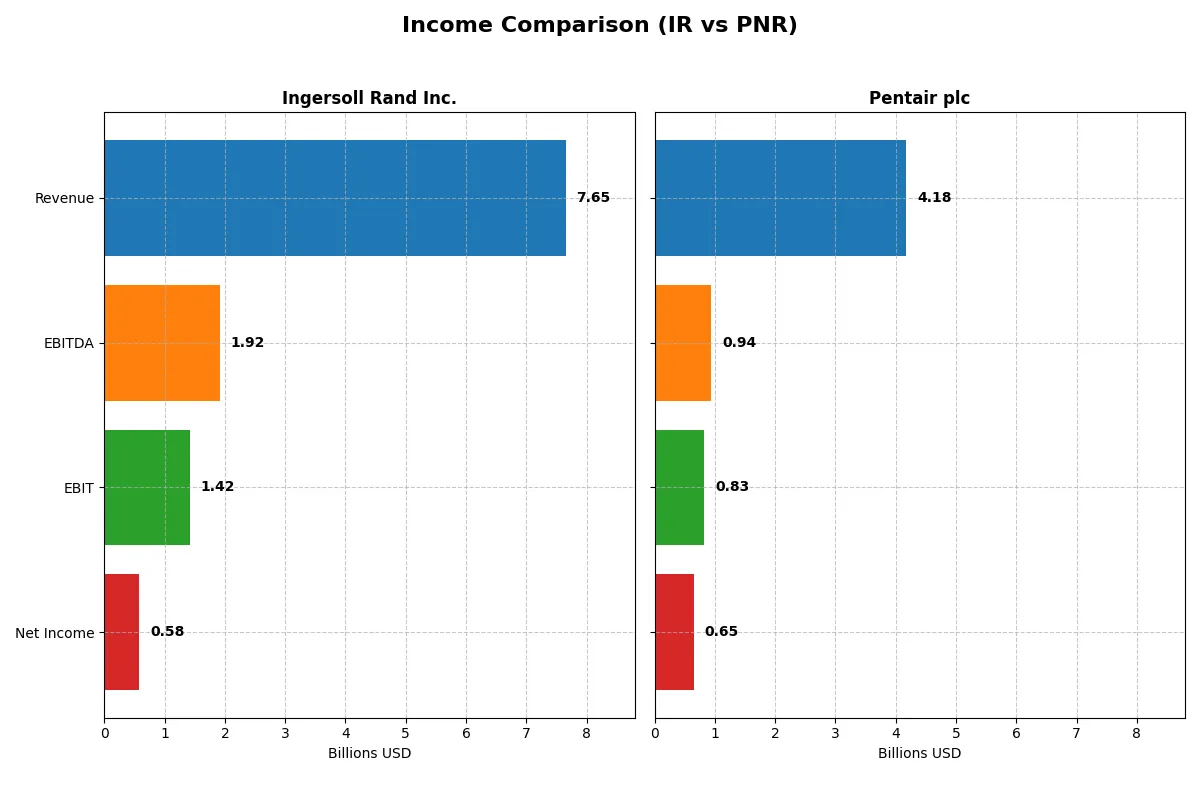
The following data dissects the core profitability and scalability of both corporate engines to reveal who dominates the bottom line:
| Metric | Ingersoll Rand Inc. (IR) | Pentair plc (PNR) |
|---|---|---|
| Revenue | 7.65B | 4.18B |
| Cost of Revenue | 4.70B | 2.49B |
| Operating Expenses | 1.53B | 833M |
| Gross Profit | 2.95B | 1.69B |
| EBITDA | 1.92B | 944M |
| EBIT | 1.42B | 826M |
| Interest Expense | 254M | 69M |
| Net Income | 581M | 654M |
| EPS | 1.46 | 3.99 |
| Fiscal Year | 2025 | 2025 |
Income Statement Analysis: The Bottom-Line Duel
This income statement comparison reveals the true operational efficiency and profitability momentum of two industrial powerhouses.
Ingersoll Rand Inc. Analysis
Ingersoll Rand’s revenue rose steadily from 5.15B in 2021 to 7.65B in 2025, showing a strong top-line trajectory. However, its gross profit dipped in 2025, reflecting margin pressure despite a healthy 38.5% gross margin. Net income declined sharply to 581M in 2025, compressing net margin to 7.6%. This signals rising costs and tightening bottom-line efficiency.
Pentair plc Analysis
Pentair’s revenue grew more modestly to 4.18B in 2025 but maintained a robust gross margin of 40.5%. Net income increased to 654M, lifting net margin to 15.7%. Pentair managed to expand earnings per share by nearly 6% year-over-year, indicating improving operational leverage and disciplined cost control despite slower revenue growth.
Verdict: Margin Power vs. Revenue Scale
Ingersoll Rand delivers impressive revenue growth but suffers margin erosion and net income declines. Pentair posts steadier revenue gains but boasts superior margin expansion and bottom-line growth. For investors prioritizing profitability and margin resilience, Pentair’s income statement profile appears more attractive than Ingersoll Rand’s scale-driven but margin-challenged performance.
Financial Ratios Comparison
These vital ratios act as a diagnostic tool to expose the underlying fiscal health, valuation premiums, and capital efficiency of these companies:
| Ratios | Ingersoll Rand Inc. (IR) | Pentair plc (PNR) |
|---|---|---|
| ROE | 5.8% | 17.0% |
| ROIC | 6.4% | 12.5% |
| P/E | 54.2 | 26.1 |
| P/B | 3.13 | 4.42 |
| Current Ratio | 2.06 | 1.61 |
| Quick Ratio | 1.49 | 0.95 |
| D/E | 0.47 | 0.42 |
| Debt-to-Assets | 26.1% | 23.9% |
| Interest Coverage | 5.58 | 12.36 |
| Asset Turnover | 0.42 | 0.61 |
| Fixed Asset Turnover | 8.22 | 11.08 |
| Payout Ratio | 5.5% | 25.1% |
| Dividend Yield | 0.10% | 0.96% |
| Fiscal Year | 2025 | 2025 |
Efficiency & Valuation Duel: The Vital Signs
Financial ratios act as the company’s DNA, exposing hidden risks and showcasing operational excellence through key performance signals.
Ingersoll Rand Inc.
Ingersoll Rand displays modest profitability with a 5.76% ROE and a neutral 7.6% net margin, suggesting limited shareholder returns. Its valuation appears stretched, marked by a high P/E of 54.24 and P/B of 3.13. The company offers minimal dividends (0.1%), favoring reinvestment in stable operations over aggressive payouts.
Pentair plc
Pentair outperforms with a robust 16.9% ROE and a strong 15.66% net margin, reflecting operational efficiency. Despite a relatively high P/E of 26.14 and P/B of 4.42, the stock’s valuation is more reasonable than Ingersoll Rand’s. Dividends yield 0.96%, signaling a balanced approach between shareholder returns and growth investment.
Operational Efficiency vs. Valuation Stretch
Pentair provides a healthier balance of profitability and valuation compared to Ingersoll Rand’s stretched multiples and weaker returns. Investors seeking stronger operational results with moderate risk may prefer Pentair, while those tolerant of valuation premiums might consider Ingersoll Rand’s stability.
Which one offers the Superior Shareholder Reward?
I see that Pentair (PNR) delivers a more robust shareholder reward than Ingersoll Rand (IR) in 2026. PNR pays a higher dividend yield near 0.96%, with a payout ratio around 25%, signaling a balanced distribution backed by strong free cash flow coverage of about 91%. IR’s dividend yield barely reaches 0.10%, with a very low payout ratio around 5%, reflecting minimal cash returned to investors. Buyback programs tilt the scales further: PNR’s active buybacks complement its dividends, enhancing total shareholder return sustainably. IR’s buyback intensity is less visible, suggesting retention for reinvestment or debt management. I find PNR’s model more sustainable, combining solid dividends, consistent buybacks, and strong cash flow metrics. For 2026 investors seeking total return, Pentair offers the superior reward profile.
Comparative Score Analysis: The Strategic Profile
The radar chart reveals the fundamental DNA and trade-offs of Ingersoll Rand Inc. and Pentair plc, highlighting their core financial strengths and weaknesses:
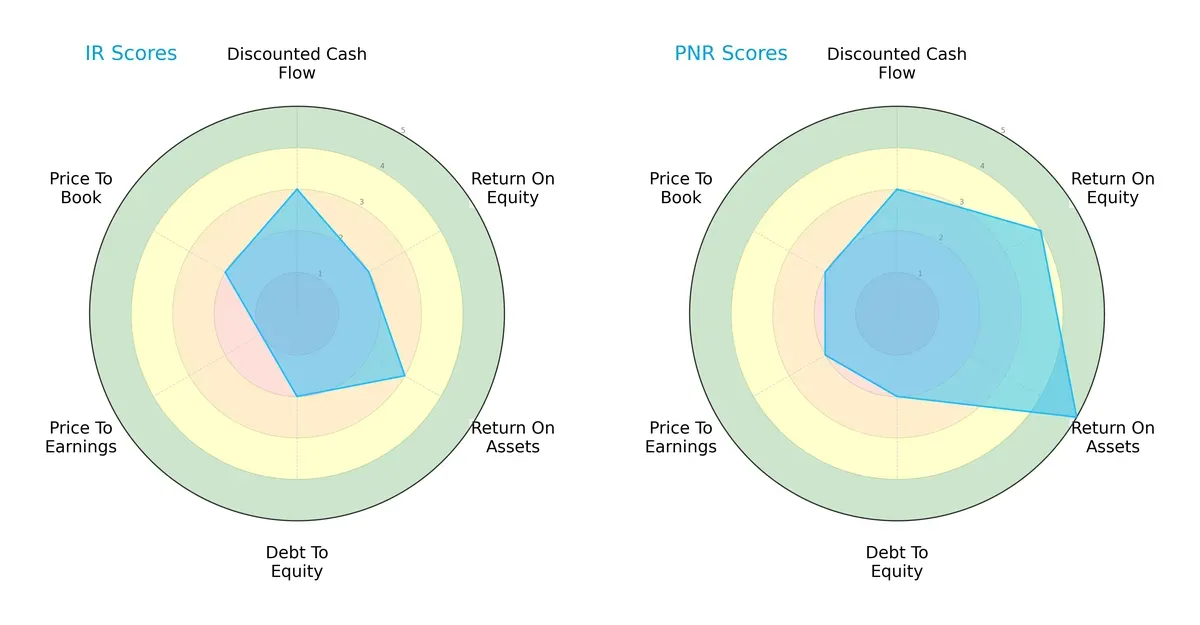
Pentair demonstrates a more balanced financial profile with strong ROE (4 vs. 2) and ROA (5 vs. 3) scores, reflecting superior asset utilization and profitability. Ingersoll Rand relies more on moderate DCF performance (3 vs. 3) but lags in valuation metrics (P/E 1 vs. 2) and leverage control (Debt/Equity 2 vs. 2), signaling potential risk. Overall, Pentair’s profile suggests greater operational efficiency and value stability.
Bankruptcy Risk: Solvency Showdown
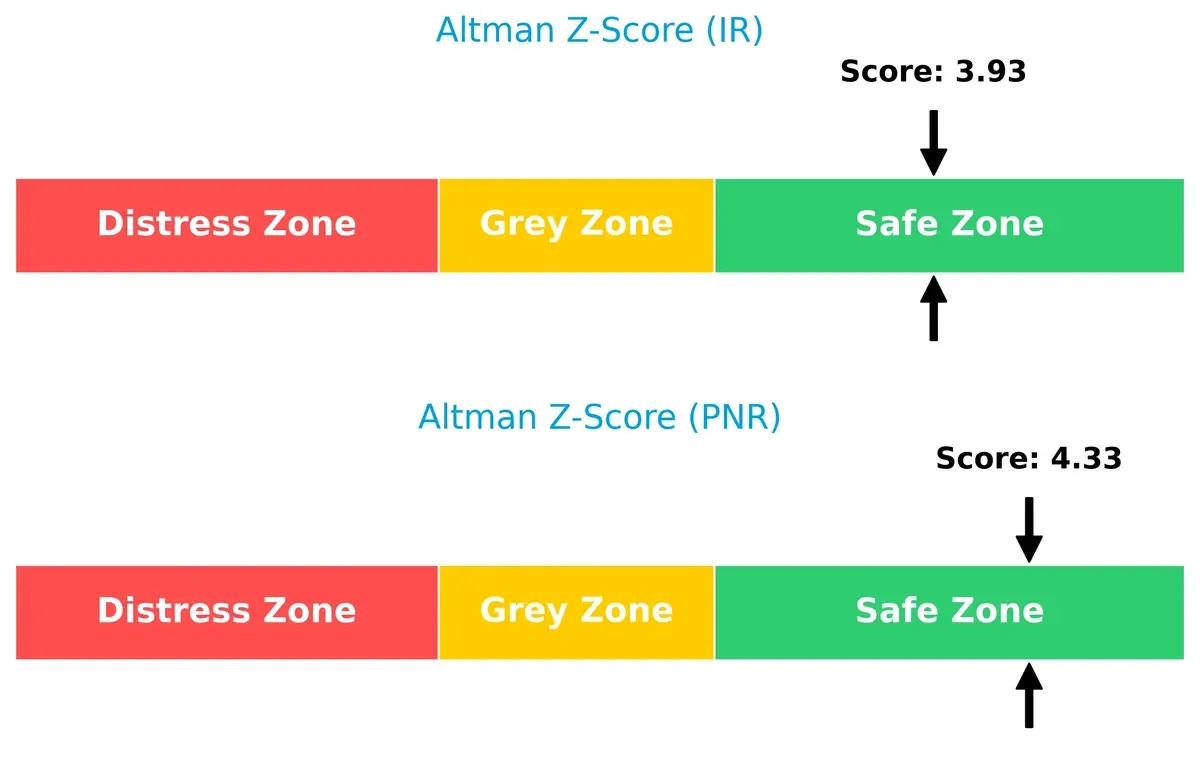
The Altman Z-Score comparison indicates both companies reside safely above 3, with Pentair at 4.33 and Ingersoll Rand at 3.93, signaling strong solvency and low bankruptcy risk in this cycle:
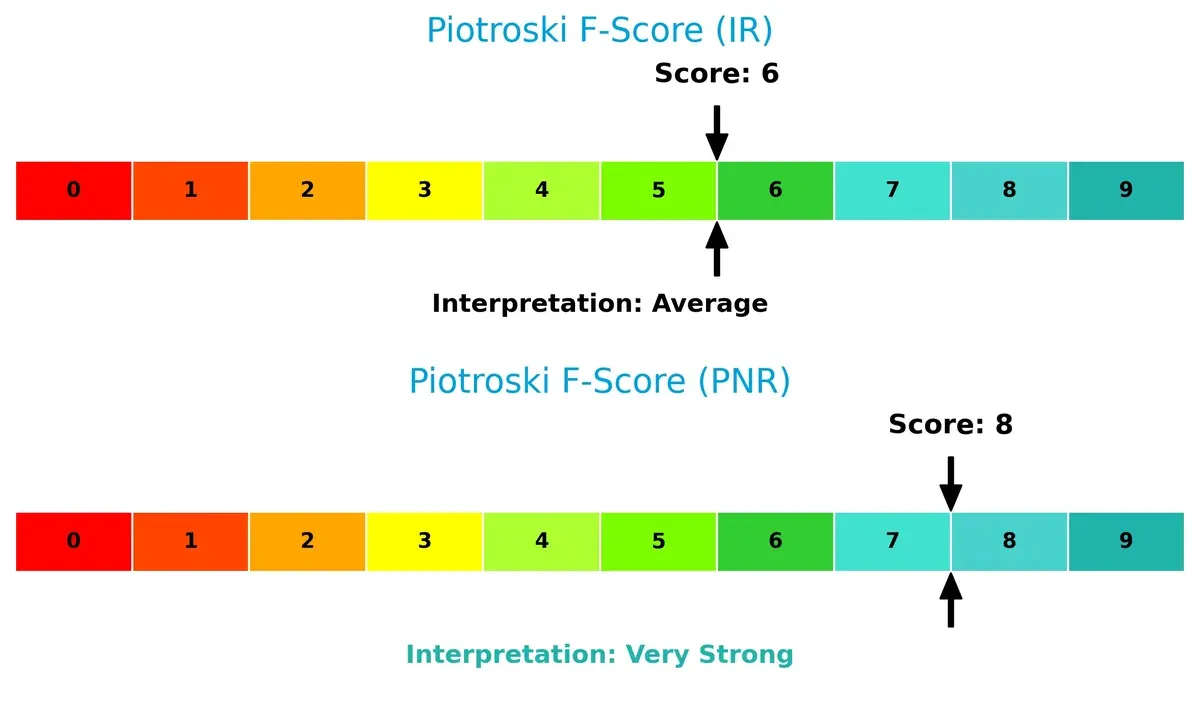
Financial Health: Quality of Operations
Pentair’s Piotroski F-Score of 8 versus Ingersoll Rand’s 6 reveals a marked difference in financial robustness. Pentair exhibits very strong internal metrics, while Ingersoll Rand’s average score suggests room for operational improvement:
How are the two companies positioned?
This section dissects the operational DNA of IR and PNR by comparing their revenue distribution and internal dynamics. The goal is to confront their economic moats to identify which model offers the most resilient competitive advantage today.
Revenue Segmentation: The Strategic Mix
This visual comparison dissects how Ingersoll Rand and Pentair diversify their income streams and where their primary sector bets lie:
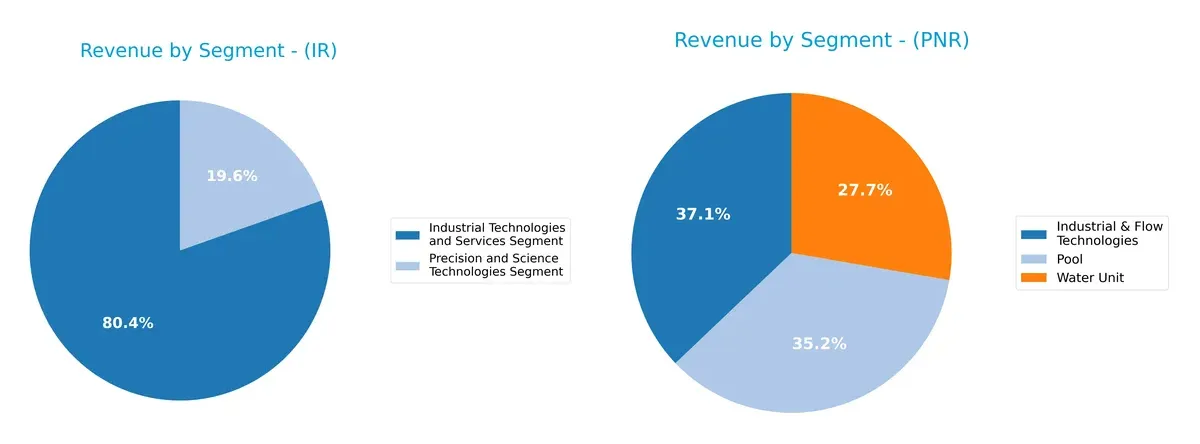
Ingersoll Rand heavily anchors revenue in its Industrial Technologies and Services Segment at $5.8B, with a smaller $1.4B from Precision and Science Technologies. Pentair shows a more diversified portfolio: Industrial & Flow Technologies at $1.5B, Pool at $1.4B, and Water Unit at $1.1B. IR’s concentration suggests strong industrial infrastructure dominance but elevated concentration risk. Pentair’s balanced segmentation supports resilience through multiple water and flow-related markets.
Strengths and Weaknesses Comparison
This table compares the Strengths and Weaknesses of Ingersoll Rand Inc. and Pentair plc:
Ingersoll Rand Inc. Strengths
- Diversified revenue streams from Industrial Technologies and Precision Science
- Strong current and quick ratios indicate good liquidity
- Favorable debt metrics show conservative leverage
- Global presence across Americas, EMEA, Asia Pacific
Pentair plc Strengths
- Higher profitability metrics: net margin, ROE, ROIC all favorable
- Strong fixed asset turnover and interest coverage ratios
- Diverse segments including Industrial & Flow, Pool, Water Units
- Solid presence in US, Developing Countries, and Western Europe
Ingersoll Rand Inc. Weaknesses
- Low ROE and high P/E ratio indicate valuation and efficiency concerns
- Unfavorable asset turnover suggests less efficient asset use
- Low dividend yield may deter income-focused investors
- Moderate net margin compared to peers
Pentair plc Weaknesses
- Unfavorable P/E and PB ratios suggest valuation risk
- Quick ratio is neutral, indicating borderline short-term liquidity
- Dividend yield also unfavorable, possibly limiting income appeal
- Concentrated revenue in US may limit geographic diversification
The comparison reveals Ingersoll Rand’s stable liquidity and conservative leverage but challenges in profitability and asset efficiency. Pentair shows stronger profitability and asset use but carries valuation and geographic concentration risks. These factors will shape each company’s strategic priorities going forward.
The Moat Duel: Analyzing Competitive Defensibility
A structural moat is the only reliable shield protecting long-term profits from relentless competition erosion. Let’s dissect the moats of two industrial machinery players:
Ingersoll Rand Inc.: Diverse Product Portfolio and Aftermarket Services Moat
Ingersoll Rand’s moat stems from its extensive product range and strong aftermarket services network, stabilizing margins and supporting a growing ROIC trend. The 2026 outlook hinges on innovation in precision technologies and expanded industrial applications, which could deepen its competitive edge or face disruption from specialized rivals.
Pentair plc: Water Solutions and Brand-Driven Cost Advantage
Pentair’s moat relies on brand strength and cost advantages in water filtration and industrial flow technologies, outperforming peers with superior margin profiles and consistent value creation. Unlike Ingersoll Rand, Pentair’s future growth depends on scaling residential and industrial water solutions globally amid tightening water regulations.
Aftermarket Services vs. Brand-Cost Leadership: The Moat Showdown
Ingersoll Rand shows improving profitability but currently destroys value, while Pentair creates value despite declining ROIC. Pentair’s wider moat, supported by stronger margins and value creation, better equips it to defend market share against competitive pressures in 2026.
Which stock offers better returns?
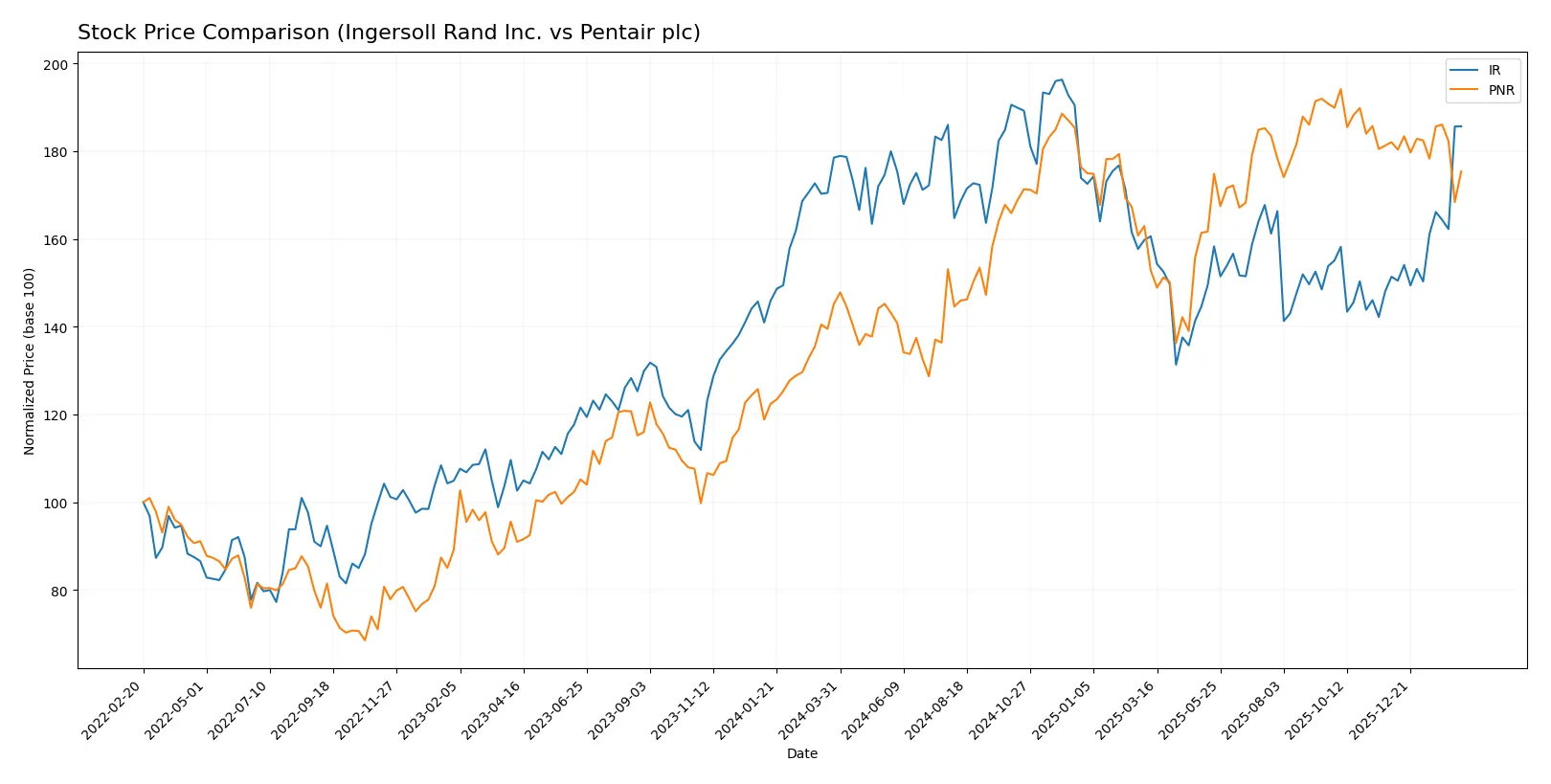
Over the past year, Ingersoll Rand Inc. showed steady price gains with accelerating momentum, while Pentair plc experienced strong gains overall but recent deceleration and a negative short-term move.
Trend Comparison
Ingersoll Rand Inc. recorded a 4.0% price increase over the past 12 months, signaling a bullish trend with accelerating momentum and a high volatility of 8.19%. The stock hit a low of 69.7 and a high of 104.17.
Pentair plc’s stock rose 20.8% over the past year, also bullish but with decelerating momentum. Volatility reached 10.6%. The recent 2.5-month period showed a 3.7% decline and a mild negative slope.
Pentair outperformed Ingersoll Rand in annual returns but showed recent weakness, while Ingersoll Rand’s gains accelerated recently, marking it as the stronger performer in the latest period.
Target Prices
Analysts present a bullish consensus for Ingersoll Rand Inc. and Pentair plc, with significant upside potential relative to current prices.
| Company | Target Low | Target High | Consensus |
|---|---|---|---|
| Ingersoll Rand Inc. | 87 | 100 | 93 |
| Pentair plc | 90 | 135 | 119 |
The consensus target for Ingersoll Rand sits slightly below its current price of 98.52, suggesting limited near-term upside. Pentair’s target consensus at 119 implies a robust 17% premium to the current 101.37, signaling stronger growth expectations.

Don’t Let Luck Decide Your Entry Point
Optimize your entry points with our advanced ProRealTime indicators. You’ll get efficient buy signals with precise price targets for maximum performance. Start outperforming now!
How do institutions grade them?
The following tables summarize recent institutional grades for Ingersoll Rand Inc. and Pentair plc:
Ingersoll Rand Inc. Grades
Below are the latest grades assigned by reputable financial institutions for Ingersoll Rand Inc.
| Grading Company | Action | New Grade | Date |
|---|---|---|---|
| Stifel | Maintain | Hold | 2026-01-23 |
| Citigroup | Maintain | Buy | 2026-01-12 |
| Wells Fargo | Maintain | Overweight | 2026-01-07 |
Pentair plc Grades
Here are the most recent grades from established grading firms for Pentair plc.
| Grading Company | Action | New Grade | Date |
|---|---|---|---|
| Citigroup | Maintain | Buy | 2026-02-04 |
| Oppenheimer | Maintain | Outperform | 2026-02-04 |
| JP Morgan | Maintain | Overweight | 2026-01-16 |
Which company has the best grades?
Pentair plc generally receives more positive grades, including multiple Outperform and Buy ratings. This suggests stronger institutional confidence compared to Ingersoll Rand’s more mixed Hold and Buy assessments. Investors may interpret this as Pentair having a comparatively more favorable outlook.
Risks specific to each company
The following categories identify the critical pressure points and systemic threats facing both firms in the 2026 market environment:
1. Market & Competition
Ingersoll Rand Inc.
- Faces intense competition in industrial machinery with moderate net margin and ROIC but high P/E, indicating valuation risk.
Pentair plc
- Operates in water solutions with stronger profitability and ROE but also elevated P/E and P/B ratios, signaling valuation concerns.
2. Capital Structure & Debt
Ingersoll Rand Inc.
- Maintains favorable debt ratios and interest coverage; debt-to-assets at 26.15% supports moderate leverage.
Pentair plc
- Shows slightly lower debt-to-assets at 23.86% and superior interest coverage, indicating a stronger balance sheet.
3. Stock Volatility
Ingersoll Rand Inc.
- Beta at 1.31 indicates above-market volatility, implying higher risk for equity investors.
Pentair plc
- Beta at 1.22 suggests moderately high volatility but less than Ingersoll Rand’s, offering slightly steadier returns.
4. Regulatory & Legal
Ingersoll Rand Inc.
- US-headquartered with exposure to complex industrial regulations and potential trade policy shifts.
Pentair plc
- UK-based, faces EU and global water regulation challenges, potentially more affected by climate-related compliance.
5. Supply Chain & Operations
Ingersoll Rand Inc.
- Broad global operations increase exposure to supply chain disruptions but diversified product lines mitigate risk.
Pentair plc
- Smaller global footprint and focus on water tech may reduce complexity but increases dependency on specialized suppliers.
6. ESG & Climate Transition
Ingersoll Rand Inc.
- Industrial sector faces pressure to decarbonize; moderate ESG risk due to energy-intensive products.
Pentair plc
- Water solutions benefit from positive ESG trends but must innovate rapidly to meet climate transition demands.
7. Geopolitical Exposure
Ingersoll Rand Inc.
- Significant US and Asia Pacific exposure; vulnerable to trade tensions and tariffs.
Pentair plc
- UK headquarters with diversified global sales; Brexit and regional instability pose risks.
Which company shows a better risk-adjusted profile?
Pentair’s strongest risk lies in valuation stretch despite robust profitability and a very strong Piotroski score. Ingersoll Rand wrestles with high stock volatility and weaker profitability metrics. Pentair’s superior Altman Z-score and stronger financial health offer a more balanced risk-reward profile. Recent data confirm Pentair’s resilience with higher interest coverage and better operational efficiency, reinforcing its defensive stance amid market uncertainties.
Final Verdict: Which stock to choose?
Ingersoll Rand Inc. (IR) boasts a superpower in operational efficiency and solid liquidity, reflected in its strong current ratio and improving profitability trend. Its main point of vigilance is a return on invested capital that still lags behind its cost of capital, indicating cautious capital allocation. IR fits well in an aggressive growth portfolio willing to tolerate some value erosion for future gains.
Pentair plc (PNR) commands a strategic moat through superior returns on invested capital consistently above its cost of capital, signaling value creation and efficient capital use. Its higher profitability and safety metrics relative to IR offer a more stable risk profile. PNR suits a GARP (Growth at a Reasonable Price) portfolio seeking balanced growth and financial resilience.
If you prioritize aggressive operational momentum and improving profitability underpinned by efficient asset use, Ingersoll Rand appears compelling despite its current value destruction. However, if you seek a more stable investment with clear value creation and stronger returns on equity, Pentair outshines IR by offering better stability and financial strength, albeit at a premium. Both choices require careful monitoring of their evolving profitability and capital efficiency.
Disclaimer: Investment carries a risk of loss of initial capital. The past performance is not a reliable indicator of future results. Be sure to understand risks before making an investment decision.
Go Further
I encourage you to read the complete analyses of Ingersoll Rand Inc. and Pentair plc to enhance your investment decisions: