Home > Comparison > Industrials > IR vs PSN
The strategic rivalry between Ingersoll Rand Inc. and Parsons Corporation shapes the current landscape of the industrial machinery sector. Ingersoll Rand operates as a capital-intensive manufacturer specializing in air and fluid technologies, while Parsons focuses on integrated defense and critical infrastructure solutions. This analysis pits manufacturing scale against specialized services, aiming to identify which business model offers superior risk-adjusted returns for diversified investors in 2026.
Table of contents
Companies Overview
Ingersoll Rand and Parsons Corporation hold significant industrial machinery roles, shaping critical infrastructure and technology markets.
Ingersoll Rand Inc.: Industrial Powerhouse in Machinery and Technologies
Ingersoll Rand stands as a leader in industrial machinery, generating revenue through air and gas compression, fluid transfer, and specialized medical technologies. It focuses on servicing diverse sectors from manufacturing to agriculture. The company’s 2026 strategy emphasizes expanding its precision and science technologies segment, enhancing critical applications in medical and energy industries.
Parsons Corporation: Critical Infrastructure Innovator
Parsons Corporation operates primarily in defense and critical infrastructure, delivering integrated solutions in cybersecurity, missile defense, and smart city technologies. Its core revenue derives from federal contracts and infrastructure engineering services. In 2026, Parsons centers on advancing defense cybersecurity and geospatial intelligence, reinforcing its role within U.S. government and international security sectors.
Strategic Collision: Similarities & Divergences
Both companies operate in the industrial sector but diverge sharply in philosophy: Ingersoll Rand drives growth through product innovation and manufacturing, while Parsons relies on service-heavy, government-driven contracts. Their market share contest unfolds across industrial machinery versus defense and infrastructure solutions. Investors encounter distinct risk profiles, with Ingersoll Rand’s broad industrial exposure contrasting Parsons’ specialized federal focus.
Income Statement Comparison
The following data dissects the core profitability and scalability of both corporate engines to reveal who dominates the bottom line:
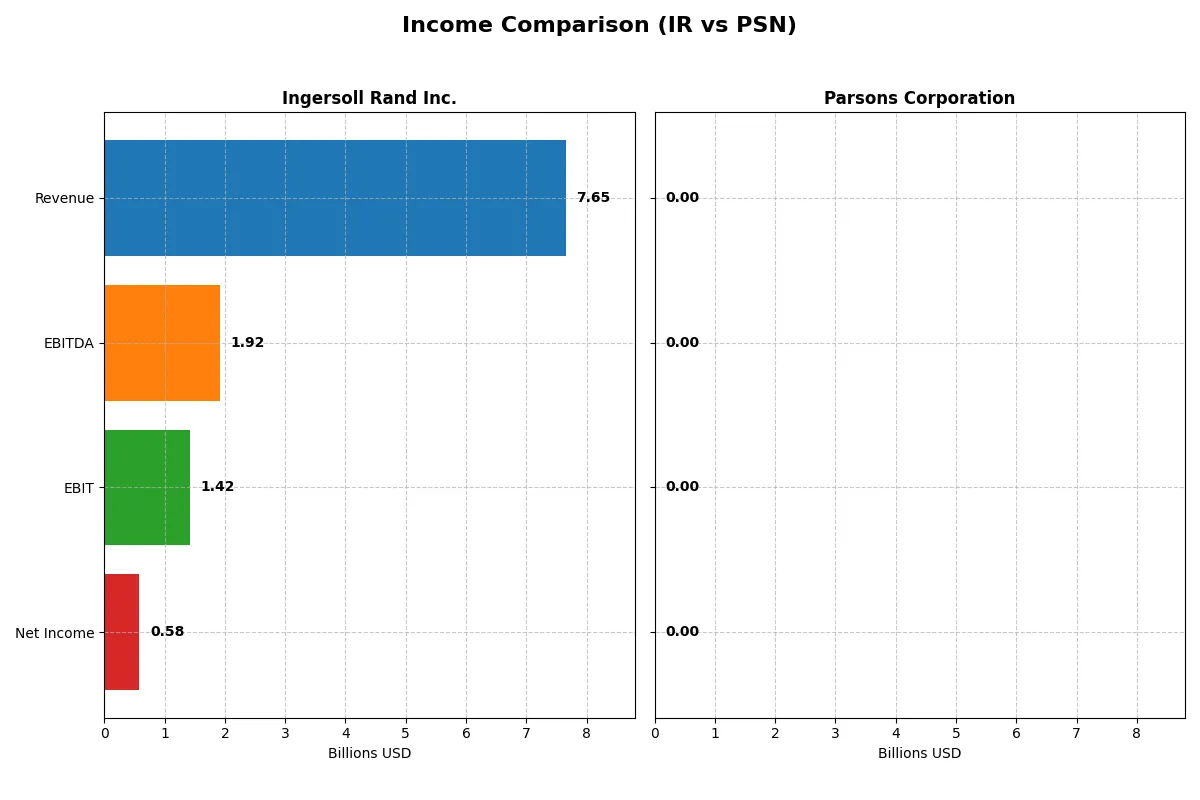
| Metric | Ingersoll Rand Inc. (IR) | Parsons Corporation (PSN) |
|---|---|---|
| Revenue | 7.65B | 100K |
| Cost of Revenue | 4.70B | 0 |
| Operating Expenses | 1.53B | 16K |
| Gross Profit | 2.95B | 0 |
| EBITDA | 1.92B | 6.6K |
| EBIT | 1.42B | 0 |
| Interest Expense | 254M | -800 |
| Net Income | 581M | 3.8K |
| EPS | 1.46 | 0 |
| Fiscal Year | 2025 | 2025 |
Income Statement Analysis: The Bottom-Line Duel
The income statement comparison uncovers which company turns revenue into profits with greater efficiency and sustainable momentum.
Ingersoll Rand Inc. Analysis
Ingersoll Rand’s revenue climbed steadily from $5.15B in 2021 to $7.65B in 2025, a 48.5% increase over five years. Despite a dip in gross profit growth last year, its gross margin remains healthy at 38.5%. Net income showed modest growth overall but fell 30% in margin and EPS last year, signaling margin pressures despite solid operating income.
Parsons Corporation Analysis
Parsons posted robust growth from $3.66B in 2021 to $6.75B in 2024 but collapsed to $100K in 2025, reflecting an extraordinary revenue drop. Gross and EBIT margins vanished in 2025, while net margin stayed low at 3.8%. The sharp revenue and profit decline last year overwhelms prior growth, raising concerns about business continuity and operational scale.
Revenue Resilience vs. Collapse in Profitability
Ingersoll Rand sustains consistent revenue growth with strong margins, despite recent margin erosion. Parsons exhibits volatile revenue with a catastrophic fall in 2025, erasing profitability. Ingersoll Rand’s profile offers more fundamental stability and margin strength, appealing to investors prioritizing durable earnings over unpredictable swings.
Financial Ratios Comparison
These vital ratios act as a diagnostic tool to expose the underlying fiscal health, valuation premiums, and capital efficiency of the companies compared below:
| Ratios | Ingersoll Rand Inc. (IR) | Parsons Corporation (PSN) |
|---|---|---|
| ROE | 5.76% | 0.00014% |
| ROIC | 6.36% | 0.00015% |
| P/E | 54.2x | N/A |
| P/B | 3.13x | N/A |
| Current Ratio | 2.06 | 1.75 |
| Quick Ratio | 1.49 | 1.75 |
| D/E | 0.47 | 0.52 |
| Debt-to-Assets | 26.1% | 23.9% |
| Interest Coverage | 5.58 | -8.25 |
| Asset Turnover | 0.42 | 0.000017 |
| Fixed Asset Turnover | 8.22 | 0.00036 |
| Payout Ratio | 5.47% | 0% |
| Dividend Yield | 0.10% | 0% |
| Fiscal Year | 2025 | 2025 |
Efficiency & Valuation Duel: The Vital Signs
Ratios act as the company’s DNA, revealing hidden risks and operational excellence that numbers alone cannot fully expose.
Ingersoll Rand Inc.
Ingersoll Rand shows moderate profitability with a 5.76% ROE and neutral net margin at 7.6%. The stock appears expensive, trading at a high P/E of 54.24 and P/B of 3.13. It delivers minimal dividends with a 0.1% yield, suggesting limited shareholder returns and possibly reinvesting earnings for growth.
Parsons Corporation
Parsons suffers from low profitability metrics; ROE and ROIC hover near zero, signaling operational challenges. Despite this, its valuation appears favorable with no reported P/E or P/B ratios. The company pays no dividends, indicating reinvestment in the business amid a slightly unfavorable ratio profile and weak earnings quality.
Premium Valuation vs. Operational Struggles
Ingersoll Rand’s premium valuation contrasts with Parsons’ operational weaknesses and undervalued status. IR’s higher profitability and capital structure stability offer a clearer risk-reward balance. Investors seeking growth with some operational safety might prefer IR, while those tolerant of uncertainty may consider Parsons’ turnaround potential.
Which one offers the Superior Shareholder Reward?
I observe Ingersoll Rand Inc. (IR) delivers a modest dividend yield near 0.1%, supported by a conservative payout ratio around 5%. IR complements dividends with steady buybacks, enhancing total shareholder return sustainably. Parsons Corporation (PSN) pays no dividends, reinvesting free cash flow aggressively into growth, but its weak cash flow coverage and interest coverage ratios pose risks. IR’s balanced distribution—dividends plus buybacks backed by strong free cash flow—offers a more reliable and attractive total return profile for investors in 2026.
Comparative Score Analysis: The Strategic Profile
The radar chart reveals the fundamental DNA and trade-offs of Ingersoll Rand Inc. and Parsons Corporation, highlighting their core financial strengths and weaknesses:
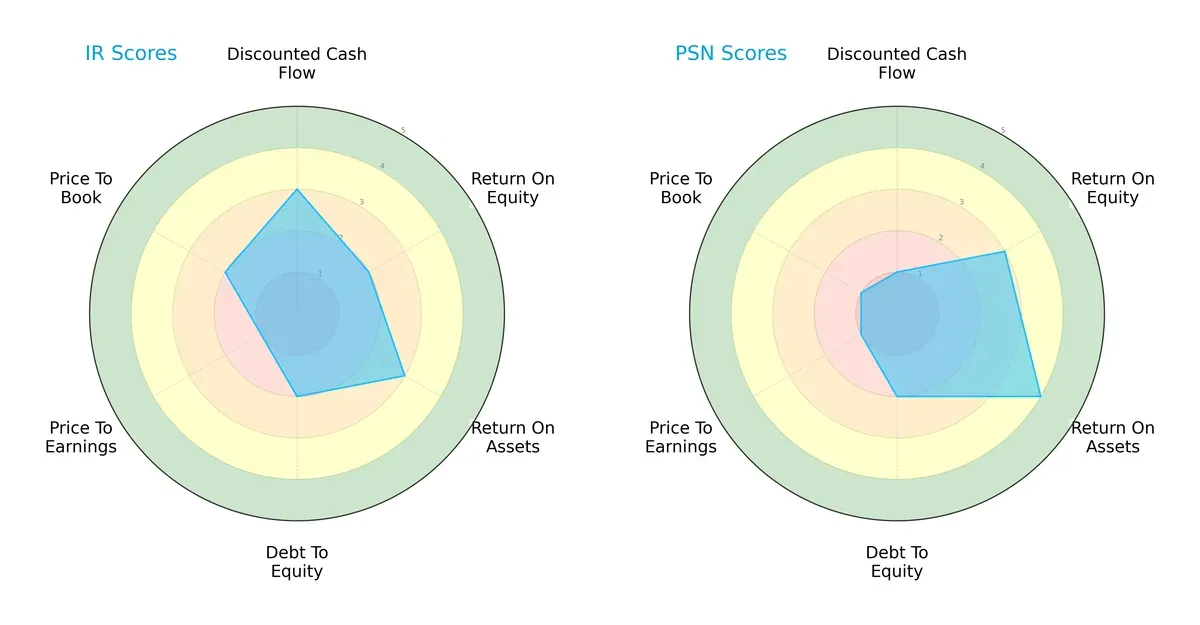
Ingersoll Rand shows moderate strength in discounted cash flow (3) and return on assets (3), but weaker return on equity (2) and valuation metrics (PE 1, PB 2). Parsons excels in return on equity (3) and assets (4) but scores poorly on discounted cash flow (1) and valuation (PE 1, PB 1). Parsons leans on operational efficiency, while Ingersoll Rand presents a more balanced but modest profile.
Bankruptcy Risk: Solvency Showdown
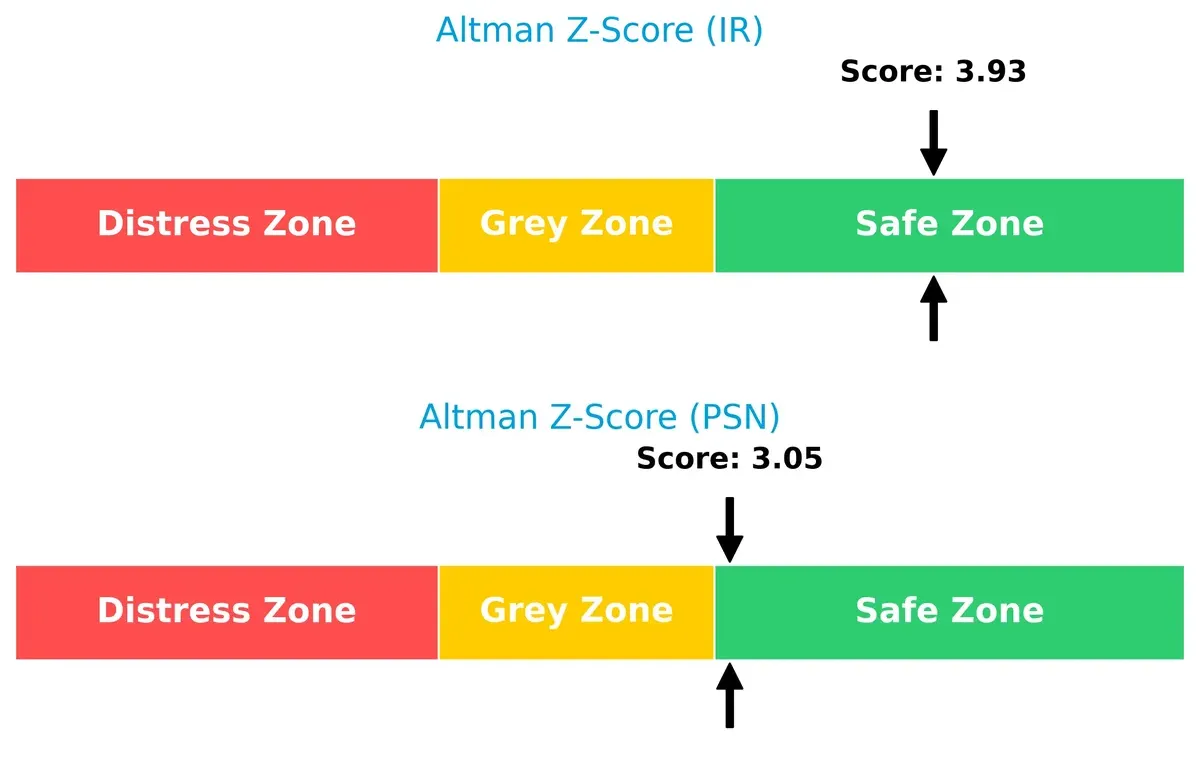
The Altman Z-Scores place both companies safely above distress thresholds, but Ingersoll Rand’s 3.93 versus Parsons’ 3.05 suggests a stronger buffer against financial distress in this late cycle:
Financial Health: Quality of Operations
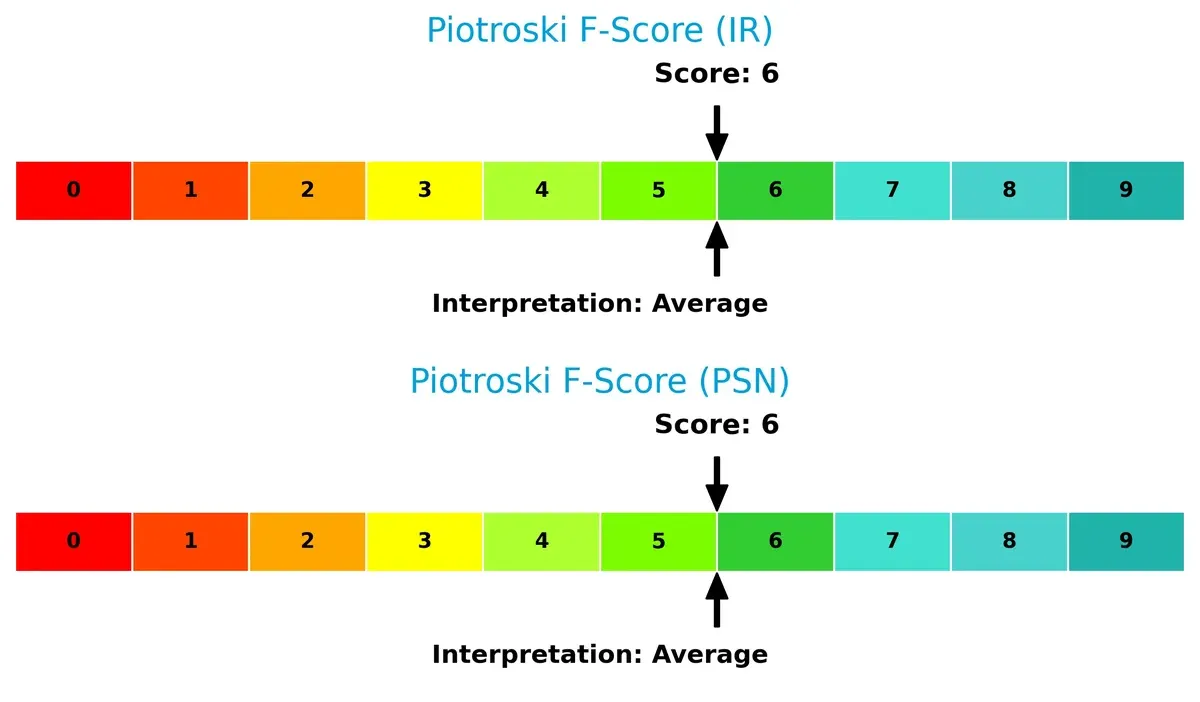
Both firms share an average Piotroski F-Score of 6, indicating moderately healthy financial operations without glaring internal weaknesses or red flags:
How are the two companies positioned?
This section dissects the operational DNA of IR and PSN by comparing their revenue distribution and analyzing their internal strengths and weaknesses. The objective is to confront their economic moats and determine which business model offers the most resilient competitive advantage today.
Revenue Segmentation: The Strategic Mix
This visual comparison dissects how Ingersoll Rand and Parsons diversify their income streams and where their primary sector bets lie:
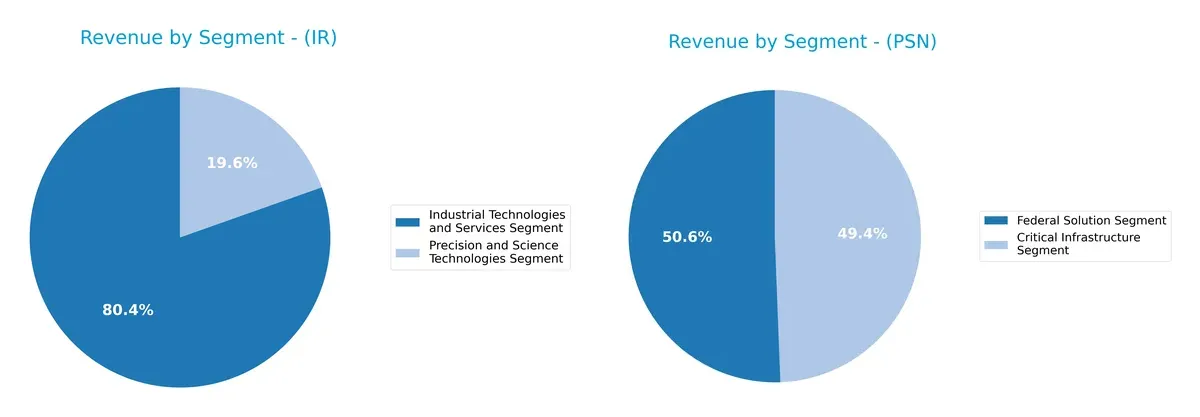
Ingersoll Rand anchors its revenue in the Industrial Technologies and Services Segment with $5.8B in 2024, complemented by a $1.4B Precision and Science Technologies segment. Parsons shows a tighter focus, with $4.0B in Federal Solutions and $2.7B in Critical Infrastructure in 2024. IR’s broader base reduces concentration risk, while Parsons pivots on government and infrastructure projects, exposing it to sector-specific cycles but benefiting from ecosystem lock-in.
Strengths and Weaknesses Comparison
This table compares the Strengths and Weaknesses of Ingersoll Rand Inc. and Parsons Corporation:
Ingersoll Rand Inc. Strengths
- Diversified revenue from Industrial Technologies and Precision segments
- Solid global presence across Americas, EMEA, Asia Pacific
- Favorable current and quick ratios indicate liquidity
- Low debt-to-assets and strong interest coverage support financial stability
Parsons Corporation Strengths
- Diversified revenue with Federal and Critical Infrastructure segments
- Strong North America presence with growing Middle East exposure
- Favorable current and quick ratios indicate adequate liquidity
- Low debt-to-assets ratio and very low WACC support capital efficiency
Ingersoll Rand Inc. Weaknesses
- Unfavorable ROE and high P/E and P/B ratios suggest valuation concerns
- Asset turnover is weak, limiting operational efficiency
- Very low dividend yield may deter income investors
Parsons Corporation Weaknesses
- Unfavorable net margin, ROE, ROIC, and interest coverage indicate profitability and solvency challenges
- Asset and fixed asset turnover at zero highlight operational inefficiency
- No dividend yield and zero P/E and P/B ratios may reflect limited market valuation
Ingersoll Rand benefits from solid liquidity and diversified global operations but faces valuation and efficiency headwinds. Parsons shows capital cost advantages and regional concentration but struggles with profitability and asset utilization. These contrasts suggest different strategic priorities and risk profiles for each company.
The Moat Duel: Analyzing Competitive Defensibility
A structural moat protects long-term profits from relentless competitive pressures and market erosion. Let’s dissect the moats guarding these industrial players:
Ingersoll Rand Inc.: Broad Industrial Integration and Brand Legacy
Ingersoll Rand’s moat stems from its diverse product lines and strong brand portfolio, yielding stable margins and rising ROIC despite current value erosion. Expansion into energy-efficient technologies promises moat reinforcement in 2026.
Parsons Corporation: Specialized Defense and Infrastructure Expertise
Parsons relies on government contracts and critical infrastructure projects, differentiating it from Ingersoll Rand’s broad industrial focus. Yet, its declining ROIC signals weakening moat durability amidst shifting defense budgets and market demands.
Integrated Solutions vs. Contractual Reliance: Who Fortifies Their Moat Better?
Ingersoll Rand holds a wider moat with improving profitability trends and diversified markets. Parsons, facing a shrinking ROIC, struggles to sustain its competitive edge. IR is better positioned to defend market share long term.
Which stock offers better returns?
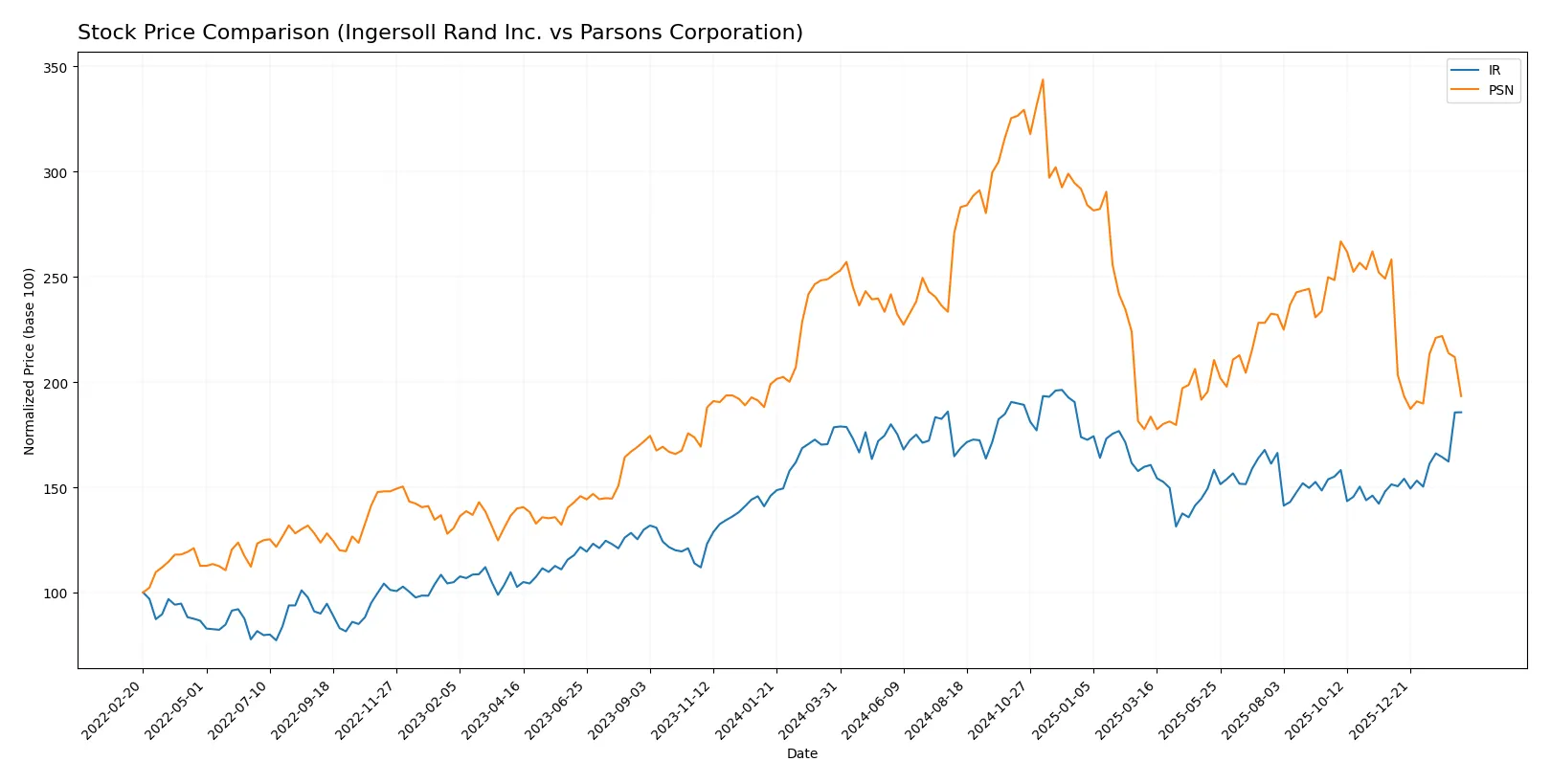
The past year shows contrasting price movements: Ingersoll Rand gains steadily with accelerating bullish momentum, while Parsons faces a notable bearish decline and decelerating trend.
Trend Comparison
Ingersoll Rand’s stock rose 4.0% over the past 12 months, marking a bullish trend with accelerating price gains and a high near 104.17, supported by increasing buyer dominance.
Parsons Corporation’s stock fell 23.0% over the same period, reflecting a bearish trend with deceleration and significant volatility, hitting a low of 58.22 amid seller dominance recently.
Ingersoll Rand outperformed Parsons substantially, delivering positive returns versus Parsons’ steep losses, making IR the stronger market performer over the last year.
Target Prices
Analysts present a cautiously optimistic consensus for Ingersoll Rand Inc. and Parsons Corporation.
| Company | Target Low | Target High | Consensus |
|---|---|---|---|
| Ingersoll Rand Inc. | 87 | 100 | 93 |
| Parsons Corporation | 78 | 104 | 86.8 |
Ingersoll Rand’s consensus target of 93 sits slightly below its current 98.52 price, signaling limited upside. Parsons shows a wider range and a consensus well above its 63.38 price, indicating more potential growth.

Don’t Let Luck Decide Your Entry Point
Optimize your entry points with our advanced ProRealTime indicators. You’ll get efficient buy signals with precise price targets for maximum performance. Start outperforming now!
How do institutions grade them?
Here is a comparison of recent institutional grades for Ingersoll Rand Inc. and Parsons Corporation:
Ingersoll Rand Inc. Grades
This table shows the latest grades from reputable financial institutions for Ingersoll Rand Inc.
| Grading Company | Action | New Grade | Date |
|---|---|---|---|
| Stifel | Maintain | Hold | 2026-01-23 |
| Citigroup | Maintain | Buy | 2026-01-12 |
| Wells Fargo | Maintain | Overweight | 2026-01-07 |
| Stifel | Maintain | Hold | 2025-12-16 |
| Citigroup | Maintain | Buy | 2025-12-08 |
| Citigroup | Maintain | Buy | 2025-11-03 |
| Baird | Maintain | Outperform | 2025-11-03 |
| Stifel | Maintain | Hold | 2025-10-20 |
| Wells Fargo | Maintain | Overweight | 2025-10-06 |
| Morgan Stanley | Maintain | Equal Weight | 2025-08-13 |
Parsons Corporation Grades
This table contains recent grades from established financial firms for Parsons Corporation.
| Grading Company | Action | New Grade | Date |
|---|---|---|---|
| UBS | Maintain | Buy | 2026-02-12 |
| Truist Securities | Maintain | Buy | 2026-02-12 |
| Keybanc | Maintain | Overweight | 2026-02-12 |
| Barclays | Maintain | Overweight | 2026-01-23 |
| Keybanc | Maintain | Overweight | 2026-01-20 |
| UBS | Maintain | Buy | 2026-01-15 |
| Citigroup | Maintain | Buy | 2026-01-13 |
| B of A Securities | Maintain | Buy | 2025-12-30 |
| Stifel | Maintain | Buy | 2025-12-23 |
| Jefferies | Maintain | Hold | 2025-12-11 |
Which company has the best grades?
Parsons Corporation consistently receives Buy and Overweight ratings from multiple top-tier firms. In contrast, Ingersoll Rand presents a mix of Hold, Buy, and Outperform grades. Investors may interpret Parsons’ stronger consensus grades as a signal of higher confidence from analysts.
Risks specific to each company
The following categories identify the critical pressure points and systemic threats facing both firms in the 2026 market environment:
1. Market & Competition
Ingersoll Rand Inc.
- Faces fierce competition in industrial machinery with a high P/E of 54.24 signaling market premium risk.
Parsons Corporation
- Operates in defense and infrastructure with lower market cap and less price pressure but must navigate government contracting cycles.
2. Capital Structure & Debt
Ingersoll Rand Inc.
- Maintains moderate debt-to-equity at 0.47 with solid interest coverage of 5.58, indicating manageable leverage.
Parsons Corporation
- Slightly higher debt-to-equity at 0.52 but poor interest coverage near zero raises concerns on debt servicing capability.
3. Stock Volatility
Ingersoll Rand Inc.
- Beta at 1.309 implies higher volatility than the market, increasing investment risk during downturns.
Parsons Corporation
- Lower beta of 0.665 suggests less stock price volatility and defensive characteristics.
4. Regulatory & Legal
Ingersoll Rand Inc.
- Subject to industrial and environmental regulations across multiple regions, requiring ongoing compliance investment.
Parsons Corporation
- Faces complex federal defense regulations and cybersecurity compliance, with risks linked to government policy shifts.
5. Supply Chain & Operations
Ingersoll Rand Inc.
- Global manufacturing exposes it to supply chain disruptions and raw material cost fluctuations.
Parsons Corporation
- Project-based operations are sensitive to delays and cost overruns, affecting profitability and client relationships.
6. ESG & Climate Transition
Ingersoll Rand Inc.
- Needs to align legacy industrial products with sustainability demands, a costly but necessary transition.
Parsons Corporation
- ESG risks stem from defense contracts and environmental impact of infrastructure projects, requiring transparent mitigation.
7. Geopolitical Exposure
Ingersoll Rand Inc.
- Operates worldwide, exposing it to trade tensions and currency risks, especially in Asia and Middle East.
Parsons Corporation
- Heavy reliance on U.S. government contracts limits geographic risk but ties revenue to political budgets and priorities.
Which company shows a better risk-adjusted profile?
Parsons faces significant risks from weak profitability and debt servicing but benefits from lower stock volatility and stable government contracts. Ingersoll Rand’s higher leverage and market premium elevate risk, yet its stronger interest coverage and global footprint offer resilience. Parsons’ interest coverage near zero and negative returns highlight its most critical vulnerability. Ingersoll Rand’s elevated P/E ratio signals potential overvaluation risk. Overall, Ingersoll Rand shows a better risk-adjusted profile, supported by a safer Altman Z-score of 3.93 versus Parsons’ 3.05, indicating stronger financial stability amid market pressures.
Final Verdict: Which stock to choose?
Ingersoll Rand Inc. stands out as a resilient cash machine with a solid balance sheet and a bullish price momentum. Its growing profitability despite a slight value destruction signals operational improvements. The main point of vigilance remains its high valuation multiples. It suits portfolios chasing aggressive growth with a tolerance for premium pricing.
Parsons Corporation’s strategic moat lies in its stable asset base and safer capital structure relative to Ingersoll Rand. However, its declining ROIC trend and bearish price action cast doubts on sustainable value creation. It fits investors prioritizing value preservation and steady income, leaning toward GARP strategies rather than high growth.
If you prioritize aggressive growth and can absorb valuation risk, Ingersoll Rand offers a compelling scenario due to improving profitability and market momentum. However, if you seek capital preservation with a more conservative profile, Parsons provides better stability despite its operational headwinds and weaker growth outlook. Both cases require careful monitoring of their respective risks.
Disclaimer: Investment carries a risk of loss of initial capital. The past performance is not a reliable indicator of future results. Be sure to understand risks before making an investment decision.
Go Further
I encourage you to read the complete analyses of Ingersoll Rand Inc. and Parsons Corporation to enhance your investment decisions: