In the evolving landscape of software infrastructure, VeriSign, Inc. (VRSN) and Informatica Inc. (INFA) stand out as pivotal players. VeriSign secures critical internet infrastructure, including domain name registry services, while Informatica leads in AI-powered data management across cloud environments. Both companies drive innovation in their overlapping technology sectors, making them compelling options for investors. This article will help you decide which company aligns best with your investment goals.
Table of contents
Companies Overview
I will begin the comparison between VeriSign and Informatica by providing an overview of these two companies and their main differences.
VeriSign Overview
VeriSign, Inc. operates as a domain name registry and internet infrastructure provider, ensuring the security and stability of key internet services globally. It manages the authoritative resolution for the .com and .net domains and operates root zone and root servers critical to internet navigation. Founded in 1995 and headquartered in Reston, Virginia, VeriSign plays a foundational role in supporting global e-commerce and internet integrity.
Informatica Overview
Informatica Inc. develops an AI-powered data management platform designed to connect, unify, and govern enterprise data across multi-cloud and hybrid environments. Its suite includes data integration, API management, data quality, master data management, and governance products, aimed at providing a comprehensive 360-degree view of business data. Founded in 1993 and based in Redwood City, California, Informatica focuses on enabling data accuracy, compliance, and analytics at scale.
Key similarities and differences
Both VeriSign and Informatica operate in the software infrastructure sector, providing essential services that support digital ecosystems. VeriSign specializes in internet infrastructure and domain registry services, focusing on security and stability of internet navigation. In contrast, Informatica concentrates on data management and integration solutions powered by AI to unify and govern enterprise data. While VeriSign’s services underpin internet functionality, Informatica’s platform targets enterprise data workflows and analytics.
Income Statement Comparison
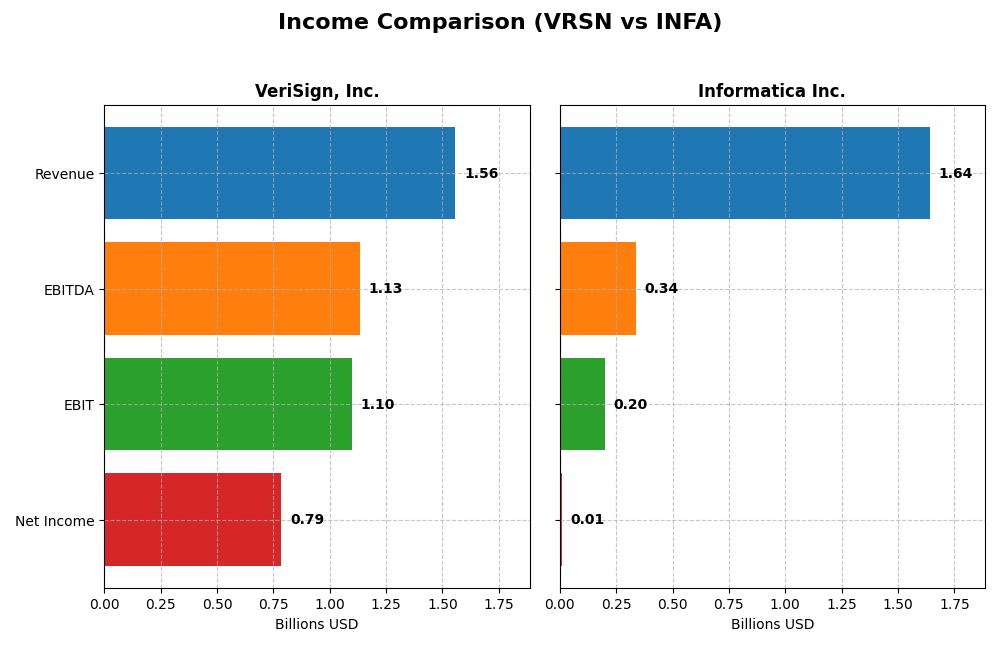
Below is the income statement comparison for VeriSign, Inc. and Informatica Inc. for the fiscal year 2024, highlighting key financial metrics.
| Metric | VeriSign, Inc. | Informatica Inc. |
|---|---|---|
| Market Cap | 23.1B | 7.54B |
| Revenue | 1.56B | 1.64B |
| EBITDA | 1.13B | 339M |
| EBIT | 1.10B | 199M |
| Net Income | 786M | 9.93M |
| EPS | 8.01 | 0.0329 |
| Fiscal Year | 2024 | 2024 |
Income Statement Interpretations
VeriSign, Inc.
VeriSign’s revenue showed steady growth from 2020 to 2024, increasing from $1.27B to $1.56B, a 23.11% rise overall. Net income fluctuated, slightly declining over the period with a 3.58% drop, and net margins decreased by 21.68%. In 2024, revenue growth slowed to 4.31%, gross profit margins improved, but net margin declined by 7.87%, signaling margin pressure despite stable operating efficiency.
Informatica Inc.
Informatica’s revenue grew consistently from $1.32B in 2020 to $1.64B in 2024, marking a 23.95% increase. The company turned around net income from a loss in earlier years to a positive $9.93M in 2024, with net margin rising to 0.61%. The most recent year saw modest revenue growth of 2.81%, but significant improvements in EBIT, net margin, and EPS growth, reflecting operational recovery and margin expansion.
Which one has the stronger fundamentals?
VeriSign exhibits stronger margins with a gross margin near 88% and net margin over 50%, although its net income slightly declined recently. Informatica shows impressive net income growth and margin recovery from losses, but its net margin remains modest. VeriSign’s consistent profitability contrasts with Informatica’s improving but still low margins, highlighting different risk-return profiles and fundamental strengths.
Financial Ratios Comparison
The table below presents a side-by-side comparison of key financial ratios for VeriSign, Inc. (VRSN) and Informatica Inc. (INFA) based on their most recent fiscal year data ending in 2024.
| Ratios | VeriSign, Inc. (VRSN) | Informatica Inc. (INFA) |
|---|---|---|
| ROE | -40.1% | 0.43% |
| ROIC | 4.51% | 0.56% |
| P/E | 25.8 | 787.9 |
| P/B | -10.4 | 3.39 |
| Current Ratio | 0.43 | 1.82 |
| Quick Ratio | 0.43 | 1.82 |
| D/E (Debt to Equity) | -0.92 | 0.81 |
| Debt-to-Assets | 128% | 35.2% |
| Interest Coverage | 14.1 | 0.87 |
| Asset Turnover | 1.11 | 0.31 |
| Fixed Asset Turnover | 6.66 | 8.75 |
| Payout ratio | 0% | 0.12% |
| Dividend yield | 0% | 0.00015% |
Interpretation of the Ratios
VeriSign, Inc.
VeriSign shows a mixed ratio profile with strengths in net margin (50.45%), return on invested capital (451.0%), and interest coverage (14.57), indicating solid profitability and solvency. However, concerns arise from unfavorable return on equity (-40.13%), low current ratio (0.43), and high debt to assets (128.08%), which suggest liquidity and leverage risks. VeriSign pays dividends, supported by stable free cash flow coverage, but investors should monitor payout sustainability due to some financial pressures.
Informatica Inc.
Informatica lacks publicly available ratio data for 2024, preventing detailed financial ratio evaluation. The company does not pay dividends, likely reflecting a reinvestment strategy or growth phase typical of technology firms. Without dividend returns, shareholder value may depend on capital appreciation, influenced by operational performance and cash flow, which remain unassessed due to missing data.
Which one has the best ratios?
Based on available data, VeriSign exhibits a generally favorable ratio profile with strong profitability and capital efficiency, despite some liquidity and leverage concerns. Informatica’s ratio analysis is unavailable, limiting comparison. Therefore, VeriSign currently offers the clearer view of financial health through its disclosed ratios.
Strategic Positioning
This section compares the strategic positioning of VeriSign and Informatica, including market position, key segments, and exposure to technological disruption:
VeriSign, Inc.
- Leader in domain name registry with control over .com and .net, facing limited direct competition.
- Core segments include domain registry and internet infrastructure services; business driven by global e-commerce support.
- Exposure to disruption is low due to critical role in internet infrastructure and root zone maintenance.
Informatica Inc.
- Focuses on AI-powered data management platform serving multi-cloud and hybrid enterprise data environments.
- Revenue primarily from subscription and professional services centered on data integration, quality, and governance.
- Faces moderate disruption risk from rapid AI and cloud technology evolution in data management and integration sectors.
VeriSign vs Informatica Positioning
VeriSign’s strategy is concentrated on secure internet infrastructure and domain registry, benefiting from a highly specialized market position. Informatica pursues diversification with a broad AI-driven data management suite, targeting various enterprise data needs but facing faster technological shifts.
Which has the best competitive advantage?
VeriSign demonstrates a very favorable moat with strong and growing ROIC well above WACC, indicating a durable competitive advantage. Informatica’s moat evaluation data is unavailable, preventing a definitive comparison of competitive advantages.
Stock Comparison
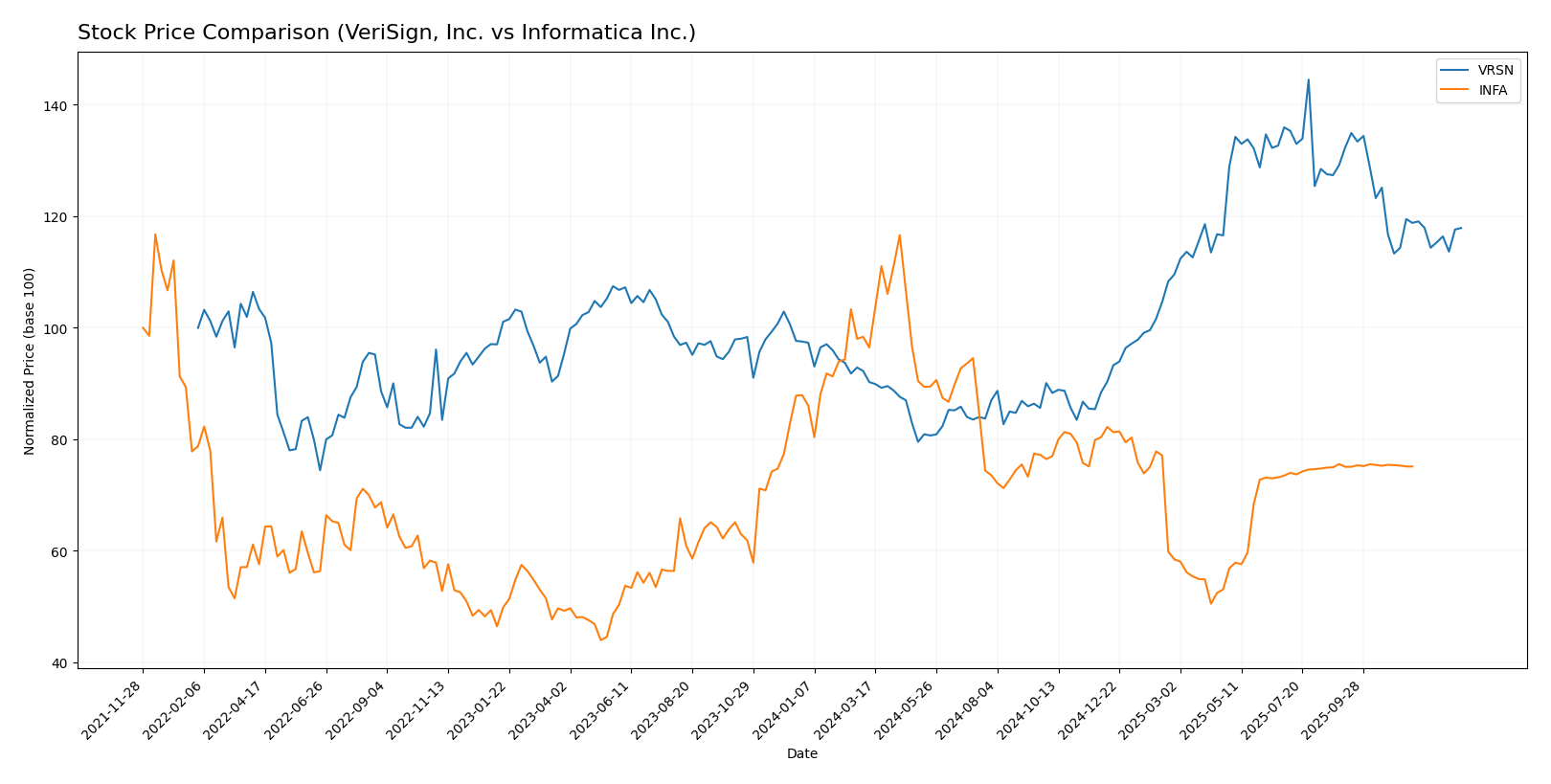
The stock price movements of VeriSign, Inc. (VRSN) and Informatica Inc. (INFA) over the past 12 months reveal contrasting trends, with VeriSign showing significant gains while Informatica experiences declines amid varying trading volumes and market dynamics.
Trend Analysis
VeriSign, Inc. posted a 26.92% price increase over the past year, indicating a bullish trend with deceleration in momentum. Its price ranged between 168.32 and 305.79, with notable volatility reflected by a 40.88 standard deviation.
Informatica Inc. saw a 12.68% price decrease over the same period, marking a bearish trend with accelerating decline. The stock fluctuated between 16.67 and 38.48, exhibiting low volatility with a standard deviation of 4.46.
Comparing these stocks, VeriSign delivered superior market performance with a strong positive price change, while Informatica lagged with a sustained negative trend.
Target Prices
Analysts present a clear and unanimous target consensus for both VeriSign, Inc. and Informatica Inc.
| Company | Target High | Target Low | Consensus |
|---|---|---|---|
| VeriSign, Inc. | 325 | 325 | 325 |
| Informatica Inc. | 27 | 27 | 27 |
The target consensus for VeriSign at $325 suggests upside potential from the current price of $249.47, while Informatica’s target at $27 indicates moderate growth compared to its current price of $24.79. Overall, analysts expect positive price appreciation for both stocks.
Analyst Opinions Comparison
This section compares analysts’ ratings and grades for VeriSign, Inc. and Informatica Inc.:
Rating Comparison
VeriSign, Inc. Rating
- Rating: B-, classified as Very Favorable by analysts.
- Discounted Cash Flow Score: 4, indicating a Favorable valuation based on future cash flows.
- ROE Score: 1, considered Very Unfavorable for shareholder equity profitability.
- ROA Score: 5, Very Favorable for asset utilization efficiency.
- Debt To Equity Score: 1, Very Unfavorable, indicating higher financial risk.
- Overall Score: 2, Moderate overall financial standing.
Informatica Inc. Rating
- No rating data available.
- No data provided.
- No data provided.
- No data provided.
- No data provided.
- No data provided.
Which one is the best rated?
VeriSign, Inc. holds a B- rating with detailed scores showing strengths in discounted cash flow and asset use but weaknesses in equity returns and debt management. Informatica Inc. lacks any analyst ratings or scores for comparison.
Scores Comparison
Here is a comparison of the Altman Z-Score and Piotroski Score for VeriSign, Inc. and Informatica Inc.:
VRSN Scores
- Altman Z-Score: -4.67, indicating financial distress and high bankruptcy risk.
- Piotroski Score: 8, very strong financial health and value potential.
INFA Scores
- Altman Z-Score: 1.94, in the grey zone, moderate bankruptcy risk.
- Piotroski Score: 6, average financial strength and investment quality.
Which company has the best scores?
VeriSign shows a much weaker Altman Z-Score, indicating distress, but a stronger Piotroski Score, reflecting robust financial health. Informatica has a moderate Altman Z-Score and an average Piotroski Score, suggesting balanced but less strong financial metrics overall.
Grades Comparison
Here is a detailed comparison of the most recent reliable grades for VeriSign, Inc. and Informatica Inc.:
VeriSign, Inc. Grades
This table shows the latest grades and analyst actions by reputable firms for VeriSign, Inc.
| Grading Company | Action | New Grade | Date |
|---|---|---|---|
| JP Morgan | Maintain | Neutral | 2026-01-06 |
| Baird | Maintain | Outperform | 2025-07-01 |
| Baird | Maintain | Outperform | 2025-04-25 |
| Baird | Maintain | Outperform | 2025-04-01 |
| Citigroup | Maintain | Buy | 2025-02-04 |
| Citigroup | Maintain | Buy | 2025-01-03 |
| Baird | Upgrade | Outperform | 2024-12-09 |
| Baird | Maintain | Neutral | 2024-06-27 |
| Baird | Maintain | Neutral | 2024-04-26 |
| Citigroup | Maintain | Buy | 2024-04-02 |
VeriSign has predominantly received “Buy” and “Outperform” grades, with stable or upgraded ratings indicating positive analyst sentiment over time.
Informatica Inc. Grades
This table presents the latest grades and analyst actions by reliable grading entities for Informatica Inc.
| Grading Company | Action | New Grade | Date |
|---|---|---|---|
| Guggenheim | Downgrade | Neutral | 2025-08-07 |
| UBS | Maintain | Neutral | 2025-08-07 |
| Baird | Maintain | Neutral | 2025-05-28 |
| JP Morgan | Downgrade | Neutral | 2025-05-28 |
| RBC Capital | Maintain | Sector Perform | 2025-05-28 |
| Wolfe Research | Downgrade | Peer Perform | 2025-05-28 |
| Wells Fargo | Maintain | Equal Weight | 2025-05-28 |
| Truist Securities | Downgrade | Hold | 2025-05-28 |
| RBC Capital | Maintain | Sector Perform | 2025-05-27 |
| UBS | Maintain | Neutral | 2025-05-16 |
Informatica’s grades mostly range from “Hold” to “Neutral,” with several downgrades reflecting a more cautious or less optimistic outlook.
Which company has the best grades?
VeriSign, Inc. has consistently received stronger grades such as “Buy” and “Outperform” compared to Informatica Inc.’s more conservative “Neutral” and “Hold” ratings. This difference may influence investor perception regarding growth potential and risk exposure.
Strengths and Weaknesses
Below is a comparative overview of key strengths and weaknesses for VeriSign, Inc. (VRSN) and Informatica Inc. (INFA) based on the most recent available data.
| Criterion | VeriSign, Inc. (VRSN) | Informatica Inc. (INFA) |
|---|---|---|
| Diversification | Moderate: Focused on domain name registry and related services, limiting diversification. | Moderate to High: Revenue streams from Subscription (1.1B in 2024) and Professional Services (78M in 2024), showing some diversification within software services. |
| Profitability | Very High: Net margin at 50.45%, ROIC extremely favorable at 451%, creating significant value. | Data unavailable for precise profitability ratios. Revenue growth visible but profitability metrics missing. |
| Innovation | Strong: Durable competitive advantage with growing ROIC indicating successful innovation and market leadership. | Presumed moderate: Subscription and cloud services growth suggest ongoing adaptation, but detailed innovation metrics unavailable. |
| Global presence | Strong: Well-established global footprint due to domain registry services. | Moderate: Global reach implied by cloud and subscription offerings but less clear without detailed data. |
| Market Share | Very strong: Leading position in domain name services with durable moat. | Moderate: Competitive in data integration and cloud services, but market share data unavailable. |
Key takeaways: VeriSign demonstrates a very favorable moat with outstanding profitability and a durable competitive advantage, though with limited diversification. Informatica shows promising revenue diversification and growth in subscription services, but lacks sufficient data to fully assess profitability and competitive strength. Investors should weigh VeriSign’s proven value creation against Informatica’s potential growth opportunities and data gaps.
Risk Analysis
Below is a comparative table outlining key risks for VeriSign, Inc. (VRSN) and Informatica Inc. (INFA) based on 2024-2026 data.
| Metric | VeriSign, Inc. (VRSN) | Informatica Inc. (INFA) |
|---|---|---|
| Market Risk | Moderate (Beta 0.77, stable niche) | Higher (Beta 1.135, more volatile) |
| Debt level | Low risk (negative debt-to-equity, but debt-to-assets high at 128%) | Data unavailable |
| Regulatory Risk | Moderate (domain registry regulations) | Moderate (data governance regulations) |
| Operational Risk | Low (stable infrastructure services) | Moderate (complex AI platform) |
| Environmental Risk | Low (technology sector, minimal impact) | Low (software sector) |
| Geopolitical Risk | Moderate (global internet services) | Moderate (enterprise data management) |
VeriSign faces its most impactful risks in regulatory and debt structure nuances, especially a debt-to-assets ratio above 100%, which is unusual and warrants caution. Informatica’s higher beta indicates greater market volatility, and operational complexity increases its risk exposure. Both companies encounter moderate regulatory and geopolitical risks given their global operations.
Which Stock to Choose?
VeriSign, Inc. (VRSN) shows favorable income evolution with a 23.11% revenue growth over 2020–2024 and strong profitability metrics, including a 50.45% net margin. Financial ratios are mostly favorable, despite a negative return on equity and low liquidity, supported by a very favorable moat and a B- rating.
Informatica Inc. (INFA) demonstrates slower revenue growth at 23.95%, with moderate profitability and a low net margin of 0.61%. Key financial ratios and ratings are unavailable, but scores suggest moderate financial health with an Altman Z-Score in the grey zone and average Piotroski Score.
Investors focused on durable competitive advantages and profitability might find VeriSign more aligned with their profile, while those valuing moderate growth with less available financial detail could interpret Informatica’s position differently. The choice might depend on the investor’s risk tolerance and strategy emphasis.
Disclaimer: Investment carries a risk of loss of initial capital. The past performance is not a reliable indicator of future results. Be sure to understand risks before making an investment decision.
Go Further
I encourage you to read the complete analyses of VeriSign, Inc. and Informatica Inc. to enhance your investment decisions: