In the dynamic world of financial technology, Fiserv, Inc. and Jack Henry & Associates, Inc. stand out as leading providers of innovative IT services tailored for the banking and payment sectors. Both companies compete in overlapping markets, offering critical solutions from payment processing to core banking systems. This comparison explores their strategic approaches and market positions to help you identify which company holds the most promise for your investment portfolio.

Table of contents
Companies Overview
I will begin the comparison between Fiserv and Jack Henry & Associates by providing an overview of these two companies and their main differences.
Fiserv Overview
Fiserv, Inc. is a global provider of payment and financial services technology, operating through Acceptance, Fintech, and Payments segments. Its offerings include point-of-sale solutions, mobile payments, digital banking, card transaction processing, and fraud protection products. Headquartered in Milwaukee, Wisconsin, Fiserv serves a diverse client base including businesses, banks, credit unions, and corporate clients, with a market cap of about 37B USD.
Jack Henry & Associates Overview
Jack Henry & Associates, Inc. specializes in technology solutions and payment processing mainly for U.S. financial services organizations. The company operates through Core, Payments, Complementary, and Corporate segments, providing core banking systems, credit union processing, risk management, and electronic payment solutions. Based in Monett, Missouri, Jack Henry has a market cap near 14B USD and focuses heavily on integrated applications for financial institutions.
Key similarities and differences
Both companies operate in the information technology services sector with a focus on financial technology and payment processing. Fiserv offers a broader global reach and a wider array of payment and banking services, while Jack Henry concentrates on U.S.-based financial institutions with specialized core banking and credit union systems. Fiserv’s workforce is significantly larger, reflecting its extensive product portfolio and client base compared to Jack Henry’s more focused market approach.
Income Statement Comparison
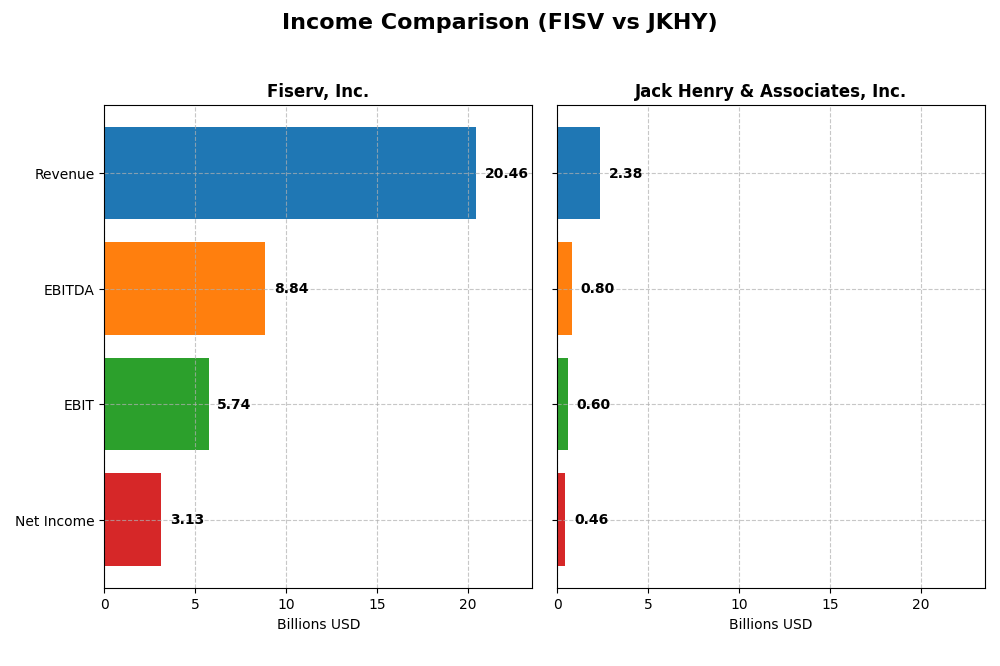
This table presents a side-by-side comparison of key income statement metrics for Fiserv, Inc. and Jack Henry & Associates, Inc., based on their most recent fiscal year data.
| Metric | Fiserv, Inc. (FISV) | Jack Henry & Associates, Inc. (JKHY) |
|---|---|---|
| Market Cap | 36.7B | 14.0B |
| Revenue | 20.5B | 2.38B |
| EBITDA | 8.84B | 801M |
| EBIT | 5.74B | 596M |
| Net Income | 3.13B | 456M |
| EPS | 5.41 | 6.24 |
| Fiscal Year | 2024 | 2025 |
Income Statement Interpretations
Fiserv, Inc.
Fiserv, Inc. showed consistent revenue growth from $14.9B in 2020 to $20.5B in 2024, with net income rising significantly from $958M to $3.13B over the same period. Margins remained broadly stable, with gross margin at 60.8% and EBIT margin around 28% in 2024. However, net margin slightly declined by 4.75% in the last year despite an 8% EPS growth, indicating some pressure on profitability.
Jack Henry & Associates, Inc.
Jack Henry & Associates experienced steady revenue growth from $1.76B in 2021 to $2.38B in mid-2025, with net income increasing from $311M to $456M. Margins improved moderately, with a gross margin of 42.7% and a net margin of 19.2% in the latest fiscal year. The company’s net margin rose by 11.3% year-on-year, alongside a strong 19.3% EPS growth, reflecting improving operational efficiency.
Which one has the stronger fundamentals?
Both companies present favorable income statements with solid revenue and earnings growth. Fiserv demonstrates higher absolute revenue and net income levels and stronger gross and EBIT margins, while Jack Henry shows more pronounced margin improvements and EPS growth recently. Fiserv’s net margin faced a slight decline last year, whereas Jack Henry maintained consistent margin gains, suggesting different dynamics in profitability trends.
Financial Ratios Comparison
This table presents the most recent key financial ratios for Fiserv, Inc. (FISV) and Jack Henry & Associates, Inc. (JKHY), reflecting their financial health and operational efficiency as of their latest fiscal years.
| Ratios | Fiserv, Inc. (2024) | Jack Henry & Associates, Inc. (2025) |
|---|---|---|
| ROE | 11.57% | 21.39% |
| ROIC | 8.70% | 17.63% |
| P/E | 37.97 | 28.88 |
| P/B | 4.39 | 6.18 |
| Current Ratio | 1.06 | 1.27 |
| Quick Ratio | 1.06 | 1.27 |
| D/E (Debt-to-Equity) | 0.92 | 0 |
| Debt-to-Assets | 32.34% | 0 |
| Interest Coverage | 4.75 | 54.49 |
| Asset Turnover | 0.27 | 0.78 |
| Fixed Asset Turnover | 8.62 | 10.75 |
| Payout ratio | 0% | 36.13% |
| Dividend yield | 0% | 1.25% |
Interpretation of the Ratios
Fiserv, Inc.
Fiserv shows a mixed ratio profile with favorable net margin (15.31%) and weighted average cost of capital (6.11%), but unfavorable price-to-earnings (37.97) and price-to-book (4.39) ratios. The current and quick ratios near 1.06 indicate moderate liquidity. The company does not pay dividends, reflecting a possible reinvestment strategy or other priorities.
Jack Henry & Associates, Inc.
Jack Henry exhibits strong financial ratios, including a favorable net margin of 19.19%, return on equity of 21.39%, and return on invested capital of 17.63%. Its liquidity ratios are solid, with a current ratio of 1.27 and no debt, while interest coverage is very high at 57.14. The company pays dividends, yielding 1.25% annually, with a stable payout.
Which one has the best ratios?
Jack Henry & Associates demonstrates a more favorable ratio set, with a higher proportion of positive metrics, strong profitability, and robust liquidity, alongside a modest dividend yield. Fiserv presents a neutral overall picture with both favorable and unfavorable ratios, and no dividend payments, resulting in a less compelling financial profile by comparison.
Strategic Positioning
This section compares the strategic positioning of Fiserv, Inc. and Jack Henry & Associates, Inc. on market position, key segments, and exposure to technological disruption:
Fiserv, Inc.
- Large market cap (~37B USD), broad competitive pressure in global payment tech sector
- Diverse segments: Acceptance, Fintech, Payments; broad client base including banks
- Exposure through digital payments, fraud protection, and cloud POS platforms
Jack Henry & Associates, Inc.
- Smaller market cap (~14B USD), focused competitive pressure in US financial services
- Concentrated on core, payments, complementary services mainly for US financial firms
- Exposure via integrated banking systems, core processing, and digital payment solutions
Fiserv vs Jack Henry Positioning
Fiserv pursues a diversified strategy across global payment and fintech segments, leveraging scale and technology breadth. Jack Henry focuses on US financial institutions with specialized core banking and credit union systems, providing a more concentrated but integrated offering.
Which has the best competitive advantage?
Both companies show a very favorable moat with growing ROIC versus WACC. Jack Henry’s higher ROIC spread and stable growth indicate a durable competitive advantage, while Fiserv’s scale and diversified segments also support strong value creation.
Stock Comparison
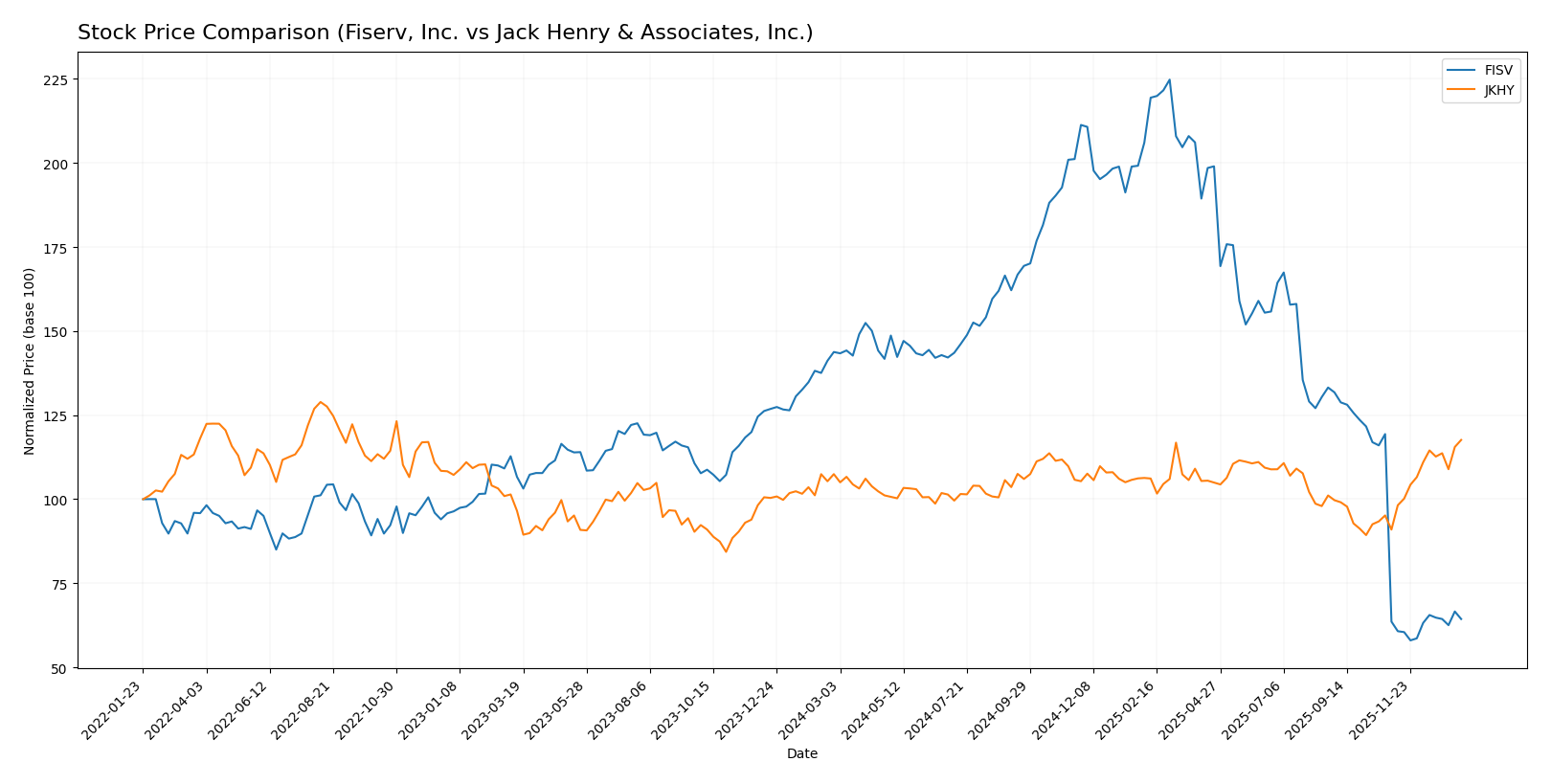
The stock price movements over the past year show contrasting dynamics between Fiserv, Inc. and Jack Henry & Associates, Inc., with Fiserv facing significant declines while Jack Henry demonstrates consistent upward momentum.
Trend Analysis
Fiserv, Inc. experienced a bearish trend over the past 12 months with a -55.23% price change and accelerating decline. The stock ranged between 60.84 and 235.69, with high volatility indicated by a 44.96 standard deviation.
Jack Henry & Associates, Inc. showed a bullish trend with a 9.46% increase over the same period and accelerating momentum. Its price fluctuated between 146.26 and 192.6, supported by moderate volatility at 9.15 standard deviation.
Comparing both, Jack Henry outperformed Fiserv with positive growth and stronger buyer dominance, while Fiserv’s stock declined significantly despite recent minor gains.
Target Prices
Analysts provide a clear target price consensus for both Fiserv, Inc. and Jack Henry & Associates, Inc.
| Company | Target High | Target Low | Consensus |
|---|---|---|---|
| Fiserv, Inc. | 180 | 62 | 111.39 |
| Jack Henry & Associates, Inc. | 220 | 161 | 196 |
The consensus target for Fiserv, Inc. at 111.39 suggests upside potential from its current price of 67.5 USD. Jack Henry & Associates, Inc. shows a strong target consensus of 196, slightly above its current price of 192.6 USD, indicating moderate growth expectations.
Analyst Opinions Comparison
This section compares analysts’ ratings and grades for Fiserv, Inc. and Jack Henry & Associates, Inc.:
Rating Comparison
FISV Rating
- Rating: B+ with a very favorable overall evaluation.
- Discounted Cash Flow Score: 5, indicating very favorable valuation prospects.
- ROE Score: 4, reflecting favorable profit generation efficiency.
- ROA Score: 3, indicating moderate asset utilization efficiency.
- Debt To Equity Score: 1, signaling very unfavorable financial risk profile.
- Overall Score: 3, a moderate summary of financial standing.
JKHY Rating
- Rating: A- with a very favorable overall evaluation.
- Discounted Cash Flow Score: 4, showing favorable valuation prospects.
- ROE Score: 4, reflecting favorable profit generation efficiency.
- ROA Score: 5, indicating very favorable asset utilization efficiency.
- Debt To Equity Score: 4, signaling a favorable financial risk profile.
- Overall Score: 4, a favorable summary of financial standing.
Which one is the best rated?
Based strictly on the provided data, JKHY is better rated overall with an A- rating and higher scores in ROA, debt-to-equity, and overall assessment compared to FISV’s B+ and mixed scores.
Scores Comparison
Here is the comparison of the Altman Z-Score and Piotroski Score for both companies:
Fiserv, Inc. Scores
- Altman Z-Score: 1.41, in distress zone, high risk.
- Piotroski Score: 7, strong financial health.
Jack Henry & Associates, Inc. Scores
- Altman Z-Score: 12.58, in safe zone, very low risk.
- Piotroski Score: 8, very strong financial health.
Which company has the best scores?
Jack Henry & Associates shows significantly better scores, with a very high Altman Z-Score indicating low bankruptcy risk and a very strong Piotroski Score. Fiserv is in distress zone with a lower, though still strong, Piotroski Score.
Grades Comparison
Here is the grades comparison of Fiserv, Inc. and Jack Henry & Associates, Inc.:
Fiserv, Inc. Grades
This table summarizes recent grades and rating actions from established financial institutions for Fiserv, Inc.
| Grading Company | Action | New Grade | Date |
|---|---|---|---|
| Tigress Financial | Maintain | Buy | 2025-12-31 |
| Mizuho | Maintain | Outperform | 2025-12-22 |
| Goldman Sachs | Downgrade | Neutral | 2025-10-30 |
| Bernstein | Downgrade | Market Perform | 2025-10-30 |
| Argus Research | Downgrade | Hold | 2025-10-30 |
| Morgan Stanley | Downgrade | Equal Weight | 2025-10-30 |
| Truist Securities | Downgrade | Hold | 2025-10-30 |
| JP Morgan | Maintain | Overweight | 2025-10-30 |
| Citigroup | Maintain | Neutral | 2025-10-30 |
| RBC Capital | Maintain | Outperform | 2025-10-30 |
Fiserv’s grades show a mixed trend with several downgrades from Buy/Outperform to Hold/Neutral and some maintained Outperform ratings, indicating cautious sentiment.
Jack Henry & Associates, Inc. Grades
Below are the recent grades and rating changes from reputable firms for Jack Henry & Associates, Inc.
| Grading Company | Action | New Grade | Date |
|---|---|---|---|
| Wolfe Research | Upgrade | Outperform | 2026-01-08 |
| UBS | Maintain | Neutral | 2026-01-08 |
| RBC Capital | Upgrade | Outperform | 2025-12-16 |
| Baird | Maintain | Neutral | 2025-12-15 |
| Keefe, Bruyette & Woods | Upgrade | Outperform | 2025-12-08 |
| Goldman Sachs | Maintain | Neutral | 2025-11-07 |
| Wells Fargo | Maintain | Equal Weight | 2025-11-06 |
| Compass Point | Upgrade | Buy | 2025-11-06 |
| DA Davidson | Maintain | Buy | 2025-10-29 |
| Goldman Sachs | Maintain | Neutral | 2025-10-13 |
Jack Henry & Associates shows an improving trend with multiple upgrades to Outperform and Buy ratings alongside several Neutral holds, reflecting positive analyst sentiment.
Which company has the best grades?
Jack Henry & Associates, Inc. generally has stronger and improving grades with several recent upgrades to Outperform and Buy, whereas Fiserv, Inc. exhibits a more cautious stance with multiple downgrades. This divergence may influence investor confidence and risk perception differently for each company.
Strengths and Weaknesses
The table below summarizes the key strengths and weaknesses of Fiserv, Inc. (FISV) and Jack Henry & Associates, Inc. (JKHY) based on their recent financial and operational data.
| Criterion | Fiserv, Inc. (FISV) | Jack Henry & Associates, Inc. (JKHY) |
|---|---|---|
| Diversification | High, with strong processing and services segment contributing $16.6B in 2024 | Moderate, focused on core and payments segments with steady growth |
| Profitability | Net margin 15.31%, ROIC 8.7% (neutral), consistent value creation | Net margin 19.19%, ROIC 17.63% (favorable), strong value creation |
| Innovation | Moderate, steady investment in fintech and product offerings | Strong, with growing ROIC and significant investments in payments and complementary services |
| Global presence | Extensive global footprint through processing services | Primarily US-focused but with robust sector specialization |
| Market Share | Large market share in financial processing and services | Solid market share in banking systems and payment solutions |
Key takeaways: Jack Henry & Associates exhibits stronger profitability and financial health with a notably higher ROIC and lower debt levels. Fiserv shows greater diversification and global reach but faces mixed ratio signals. Both companies maintain durable competitive moats with growth prospects, though JKHY’s financial metrics suggest a more favorable risk-reward profile.
Risk Analysis
Below is a comparison of key risks for Fiserv, Inc. (FISV) and Jack Henry & Associates, Inc. (JKHY) based on the most recent data available:
| Metric | Fiserv, Inc. (FISV) | Jack Henry & Associates, Inc. (JKHY) |
|---|---|---|
| Market Risk | Moderate (Beta 0.80) | Moderate (Beta 0.73) |
| Debt level | Moderate (Debt-to-Equity ~0.92) | Low (Debt-to-Equity 0) |
| Regulatory Risk | Moderate (Financial tech sector regulations) | Moderate (Highly regulated US financial tech market) |
| Operational Risk | Medium (Complex global operations, 38K employees) | Low (Smaller scale, 7K employees) |
| Environmental Risk | Low (Technology sector, limited direct impact) | Low (Technology sector, limited direct impact) |
| Geopolitical Risk | Moderate (Global operations) | Low to Moderate (Primarily US-focused) |
Fiserv’s moderate debt and global exposure increase its financial and geopolitical risk, highlighted by a low Altman Z-score indicating financial distress. Jack Henry, with no debt and a very strong financial position, faces fewer financial risks but remains exposed to regulatory changes in the US market. Market risk is moderate for both due to their technology service focus.
Which Stock to Choose?
Fiserv, Inc. (FISV) shows a favorable income statement with strong growth in net income and EPS over 2020–2024, though recent net margin declined slightly. Its financial ratios present a neutral overall profile, with favorable profitability but some valuation and asset turnover concerns. The company carries moderate debt, reflected in a neutral debt-to-equity ratio, and holds a very favorable rating of B+. Its economic moat is very favorable, indicating durable competitive advantage and growing ROIC above WACC.
Jack Henry & Associates, Inc. (JKHY) exhibits a favorable income statement with steady growth in revenue, net income, and margins from 2021–2025. Its financial ratios are largely favorable, highlighting strong profitability, low debt, and solid liquidity. JKHY holds a very favorable rating of A- supported by strong Altman Z-Score and Piotroski Score, and demonstrates a very favorable moat with a positive ROIC trend well above its WACC.
Investors focused on higher profitability and financial strength might find JKHY more favorable due to its stronger ratios and ratings, while those valuing significant income growth and a solid moat could consider FISV’s profile. The choice could thus depend on the investor’s risk tolerance and preference for growth versus financial stability.
Disclaimer: Investment carries a risk of loss of initial capital. The past performance is not a reliable indicator of future results. Be sure to understand risks before making an investment decision.
Go Further
I encourage you to read the complete analyses of Fiserv, Inc. and Jack Henry & Associates, Inc. to enhance your investment decisions: