Home > Comparison > Real Estate > INVH vs ESS
The strategic rivalry between Invitation Homes Inc. and Essex Property Trust, Inc. shapes the residential real estate sector’s evolution. Invitation Homes focuses on single-family home leasing nationwide, offering updated homes with community-oriented features. In contrast, Essex Property Trust operates as a fully integrated REIT specializing in multifamily residential properties on the West Coast. This analysis will evaluate which business model delivers superior risk-adjusted returns for diversified real estate portfolios.

Table of contents
Companies Overview
Invitation Homes and Essex Property Trust dominate the US residential REIT sector with distinct portfolio focuses and strategies.
Invitation Homes Inc.: Premier Single-Family Home Leasing Leader
Invitation Homes operates as the nation’s leading single-family home leasing company, generating revenue by leasing high-quality, updated homes. Its 2026 strategy emphasizes providing homes close to jobs and good schools, enhancing resident experiences through high-touch service and tailored living solutions.
Essex Property Trust, Inc.: West Coast Multifamily REIT Powerhouse
Essex Property Trust focuses on acquiring, developing, and managing multifamily residential properties across key West Coast markets. Its revenue comes from rent and property operations. In 2026, it concentrates on expanding its portfolio of 246 communities and progressing developments to meet growing urban housing demand.
Strategic Collision: Similarities & Divergences
Both REITs excel in residential real estate, yet Invitation Homes targets single-family rentals nationwide while Essex specializes in West Coast multifamily apartments. Their primary battleground is residential rental market share with distinct asset classes. Investment profiles diverge sharply: Invitation Homes offers scale in single-family leasing, Essex delivers concentrated multifamily expertise with integrated development.
Income Statement Comparison
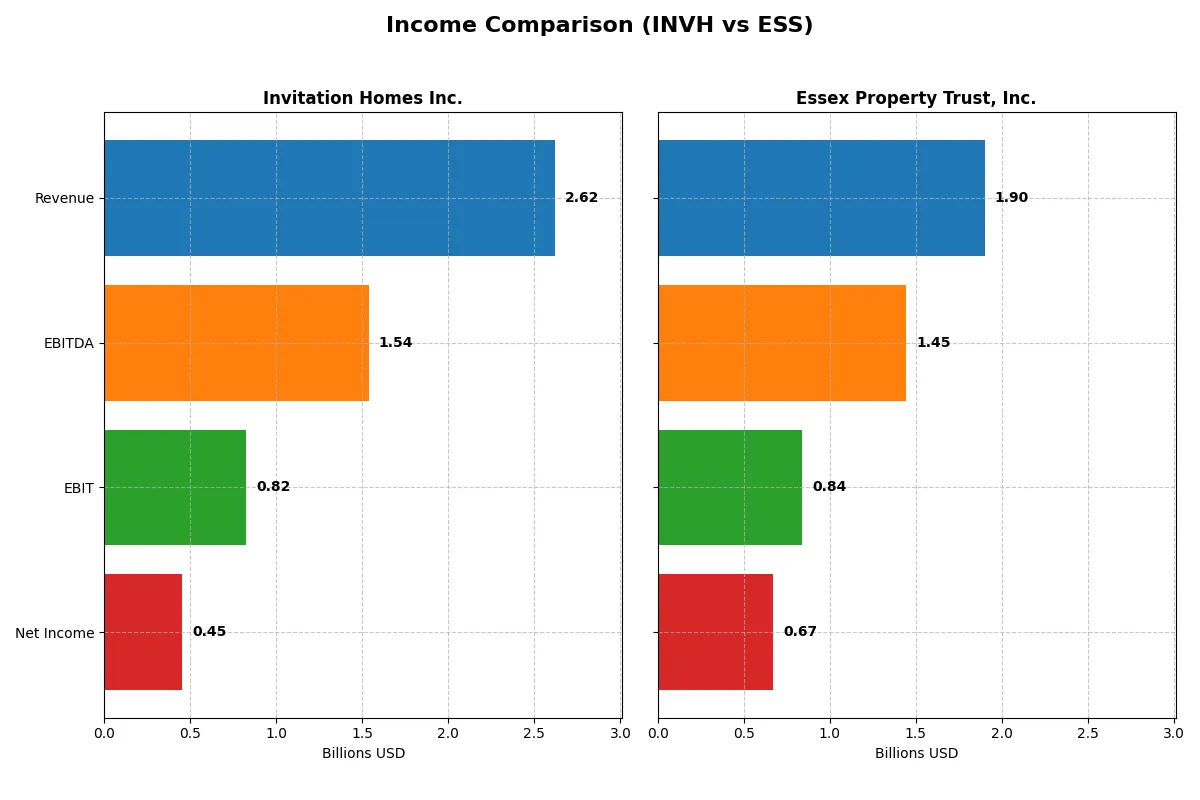
This data dissects the core profitability and scalability of both corporate engines to reveal who dominates the bottom line:
| Metric | Invitation Homes Inc. (INVH) | Essex Property Trust, Inc. (ESS) |
|---|---|---|
| Revenue | 2.62B | 1.77B |
| Cost of Revenue | 1.07B | 567M |
| Operating Expenses | 805M | 505M |
| Gross Profit | 1.55B | 1.21B |
| EBITDA | 1.54B | 1.63B |
| EBIT | 821M | 1.05B |
| Interest Expense | 366M | 236M |
| Net Income | 454M | 742M |
| EPS | 0.74 | 11.54 |
| Fiscal Year | 2024 | 2024 |
Income Statement Analysis: The Bottom-Line Duel
The following income statement comparison reveals the true efficiency and momentum behind each company’s revenue and profit engines over recent years.
Invitation Homes Inc. (INVH) Analysis
INVH steadily grows revenue from $1.82B in 2020 to $2.62B in 2024, with net income jumping from $196M to $453M. Its gross margin holds firm around 59%, reflecting solid cost control, though net margin dips slightly to 17.3%. Despite a 7.7% revenue rise in 2024, EBIT and net margin experience declines, signaling recent pressure on profitability.
Essex Property Trust, Inc. (ESS) Analysis
ESS expands revenue from $1.44B in 2021 to $1.90B in 2025, with net income rising from $489M to $672M. Its gross margin outperforms at nearly 69%, and net margin reaches a strong 35.4%. While 2025 shows a 7.1% revenue increase, EBIT and net margin fall, yet margins remain robust, highlighting operational efficiency and premium pricing power.
Margin Strength vs. Growth Resilience
ESS delivers superior margins, with a 44% EBIT margin and 35% net margin versus INVH’s 31% and 17%. INVH, however, shows stronger net income growth over five years (131% vs. 38%). ESS’s profile suits investors prioritizing profitability and margin quality, while INVH appeals to those focused on rapid earnings expansion.
Financial Ratios Comparison
These vital ratios act as a diagnostic tool to expose the underlying fiscal health, valuation premiums, and capital efficiency of the companies compared below:
| Ratios | Invitation Homes Inc. (INVH) | Essex Property Trust, Inc. (ESS) |
|---|---|---|
| ROE | 4.65% | 13.39% |
| ROIC | 4.02% | 5.61% |
| P/E | 43.14 | 24.72 |
| P/B | 2.01 | 3.31 |
| Current Ratio | 0.82 | 0.66 |
| Quick Ratio | 0.82 | 0.66 |
| D/E | 0.84 | 1.20 |
| Debt-to-Assets | 43.86% | 51.47% |
| Interest Coverage | 2.02 | 2.99 |
| Asset Turnover | 0.14 | 0.14 |
| Fixed Asset Turnover | 36.61 | 34.42 |
| Payout ratio | 152% | 84% |
| Dividend yield | 3.52% | 3.38% |
| Fiscal Year | 2024 | 2024 |
Efficiency & Valuation Duel: The Vital Signs
Financial ratios serve as a company’s DNA, uncovering hidden risks and operational strengths that numbers alone cannot reveal.
Invitation Homes Inc.
Invitation Homes posts a modest 4.65% ROE, signaling subdued profitability versus its 43.14 P/E, which suggests an expensive valuation. Its net margin of 17.33% is favorable. The stock offers a 3.52% dividend yield, rewarding shareholders despite weaker returns on invested capital. Efficiency ratios like asset turnover appear stretched, highlighting operational challenges.
Essex Property Trust, Inc.
Essex shows a strong net margin of 35.38%, but lacks reported ROE and ROIC data, clouding profitability assessment. Its P/E of 25.08 is lower than Invitation Homes, hinting at a more reasonable valuation. Dividend yield stands at 3.88%, reflecting shareholder returns amid limited liquidity data. The company’s capital structure appears conservative with favorable debt metrics.
Valuation Stretch vs. Profitability Strength
Invitation Homes carries higher valuation multiples but weaker profitability and operational efficiency, offset partially by dividends. Essex offers superior margins and disciplined leverage but suffers from incomplete profitability metrics. Investors prioritizing yield and margin strength may favor Essex, while those tolerant of valuation risk might consider Invitation Homes.
Which one offers the Superior Shareholder Reward?
Invitation Homes Inc. (INVH) pays a 3.5% dividend yield with a payout ratio above 150%, signaling aggressive distributions that may pressure free cash flow. Its buyback activity is modest but consistent, supporting returns. Essex Property Trust, Inc. (ESS) yields 3.8%, with a more conservative payout near 100%, balancing dividends and reinvestment. ESS boasted higher operating margins and stronger free cash flow per share (~$14.5 vs. INVH’s ~$1.4B total FCF), underpinning sustainable distributions. ESS also maintains a robust buyback program, enhancing total shareholder return. I conclude ESS offers a more attractive, sustainable reward for 2026 investors, combining healthy dividends with disciplined capital allocation.
Comparative Score Analysis: The Strategic Profile
The radar chart reveals the fundamental DNA and trade-offs of Invitation Homes Inc. and Essex Property Trust, Inc.:
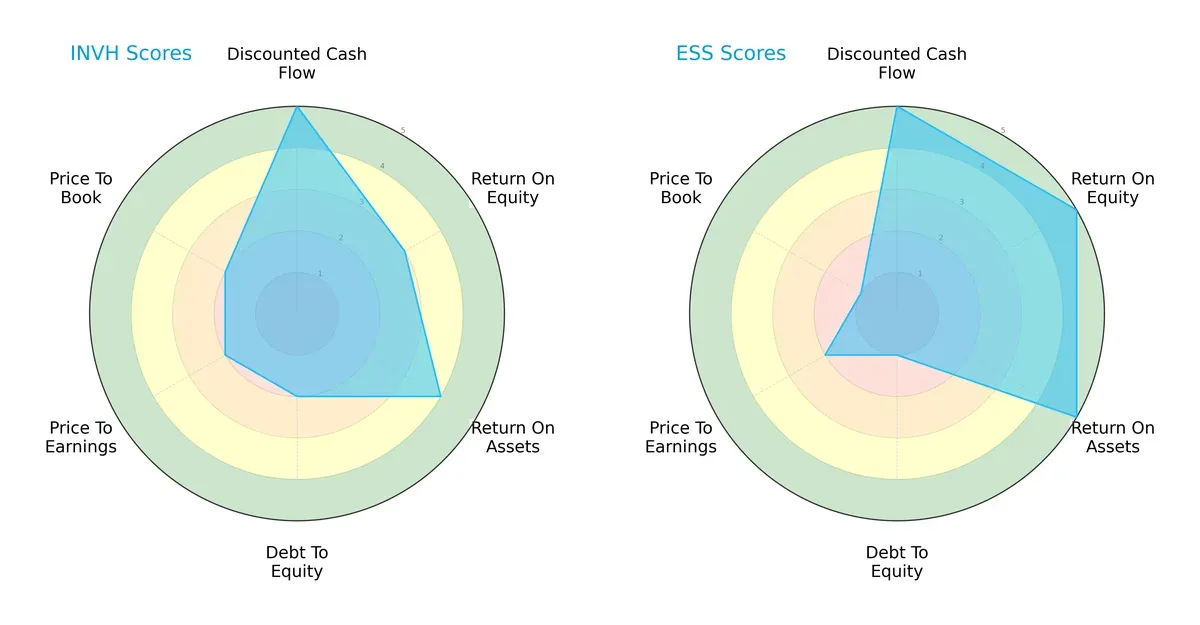
Invitation Homes (INVH) shows a balanced strength in discounted cash flow (DCF) and return on assets (ROA), but weaker debt-to-equity and valuation scores. Essex Property Trust (ESS) excels in return on equity (ROE) and ROA, yet suffers from poor debt-to-equity and price-to-book (P/B) scores. ESS relies heavily on operational efficiency, while INVH presents a more diversified risk profile.
Bankruptcy Risk: Solvency Showdown
The Altman Z-Scores place both firms in the distress zone, signaling elevated bankruptcy risk amid current market pressures:
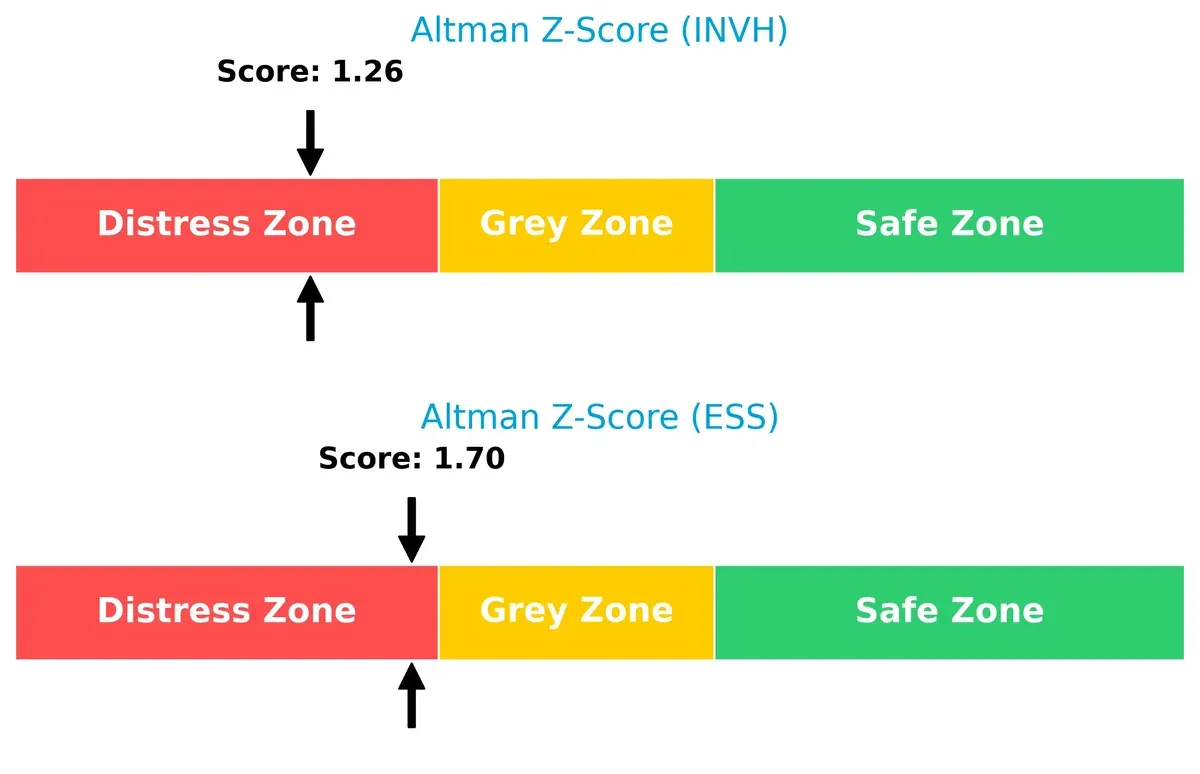
Invitation Homes has a lower Z-Score (1.26) than Essex (1.70), indicating a comparatively higher risk of financial distress. Both companies face solvency challenges, demanding cautious capital allocation from investors.
Financial Health: Quality of Operations
Invitation Homes scores an 8 on the Piotroski F-Score, signaling very strong financial health compared to Essex’s 7, which is strong but less robust:
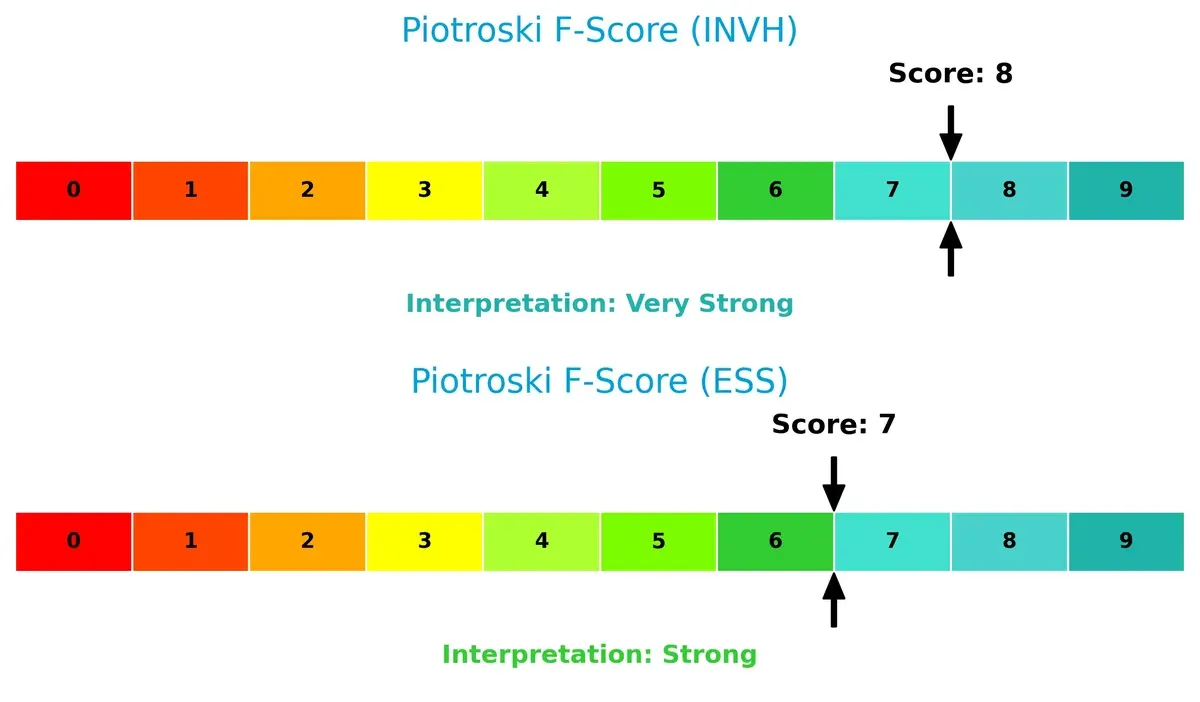
INVH’s higher score reflects superior internal metrics in profitability, leverage, and efficiency. Essex shows minor red flags in operational consistency, warranting close monitoring despite its strong overall position.
How are the two companies positioned?
This section dissects the operational DNA of INVH and ESS by comparing their revenue distribution and internal strengths and weaknesses. The goal is to confront their economic moats to reveal which model delivers the most resilient, sustainable competitive advantage today.
Revenue Segmentation: The Strategic Mix
This visual comparison dissects how Invitation Homes Inc. and Essex Property Trust, Inc. diversify their income streams and reveals their primary sector bets:
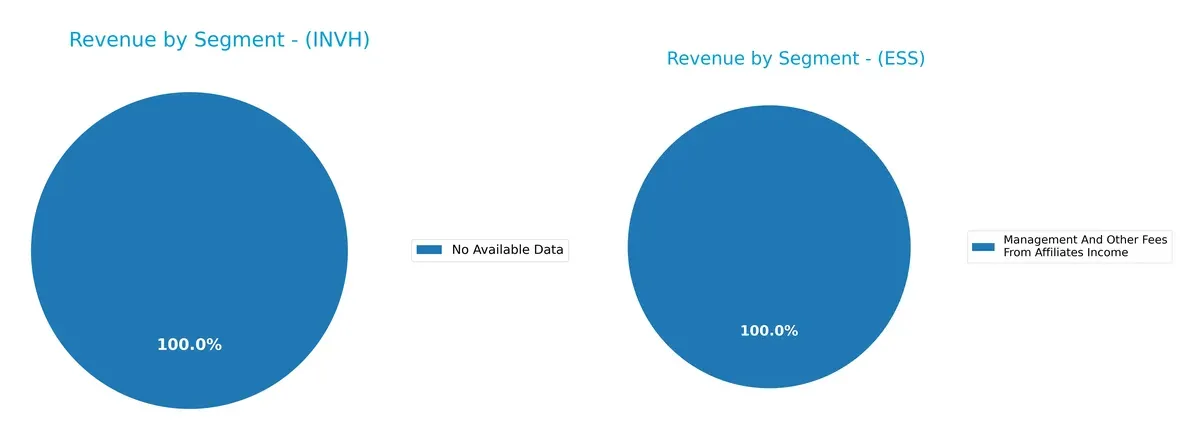
Invitation Homes Inc. lacks available segment data, preventing revenue mix analysis. Essex Property Trust anchors revenue in Rental and Other Property Revenues, with $1.28B in 2018, dwarfing its $9.18M management fees. Essex’s concentrated rental income suggests infrastructure dominance but exposes it to sector-specific risks. Without diversification data for Invitation Homes, Essex’s focused strategy contrasts with an unknown competitive mix.
Strengths and Weaknesses Comparison
This table compares the strengths and weaknesses of Invitation Homes Inc. and Essex Property Trust, Inc.:
Invitation Homes Inc. Strengths
- Favorable net margin at 17.33%
- Low debt-equity ratio at 0.84
- Strong fixed asset turnover at 36.61
- Dividend yield at 3.52% favorable
- WACC lower than ROIC supports capital efficiency
Essex Property Trust, Inc. Strengths
- High net margin at 35.38%
- Favorable price-to-book ratio
- Low debt-to-assets ratio
- Dividend yield at 3.88%
- Stable management fee revenues indicate consistent cash flow
Invitation Homes Inc. Weaknesses
- Unfavorable ROE and ROIC below WACC
- Current ratio under 1 indicates liquidity risk
- High P/E ratio at 43.14
- Asset turnover low at 0.14
- Slightly unfavorable overall financial ratios
Essex Property Trust, Inc. Weaknesses
- Zero ROE and ROIC raise profitability concerns
- Missing WACC data limits cost of capital analysis
- Unfavorable current and quick ratios suggest liquidity issues
- Unfavorable asset turnover and fixed asset turnover
- Higher proportion of unfavorable ratios overall
Invitation Homes shows strength in asset utilization and moderate profitability but faces liquidity and return challenges. Essex excels in margin and conservative leverage but has notable profitability and liquidity gaps, affecting its capital allocation clarity.
The Moat Duel: Analyzing Competitive Defensibility
A structural moat is the only reliable shield protecting long-term profits from relentless competitive erosion. Let’s dissect the moats of Invitation Homes and Essex Property Trust:
Invitation Homes Inc.: Scale-Driven Single-Family Leasing Moat
Invitation Homes leverages scale and operational efficiency in single-family home leasing. Its slightly unfavorable ROIC versus WACC signals value destruction, yet rising profitability hints at moat strengthening through cost control and market expansion.
Essex Property Trust, Inc.: Premium West Coast Multifamily Focus
Essex’s moat rests on its prime West Coast multifamily assets and integrated management. Despite unavailable ROIC data and declining ROIC trend, its high margins and stable growth underpin a defensible niche distinct from Invitation’s segment.
Scale Efficiency vs. Market Specialization: Which Moat Holds Stronger?
Invitation Homes’ scale moat is deepening with improving returns, while Essex’s premium location moat faces pressure amid falling ROIC. I see Invitation Homes better positioned to defend market share through operational leverage and growth.
Which stock offers better returns?
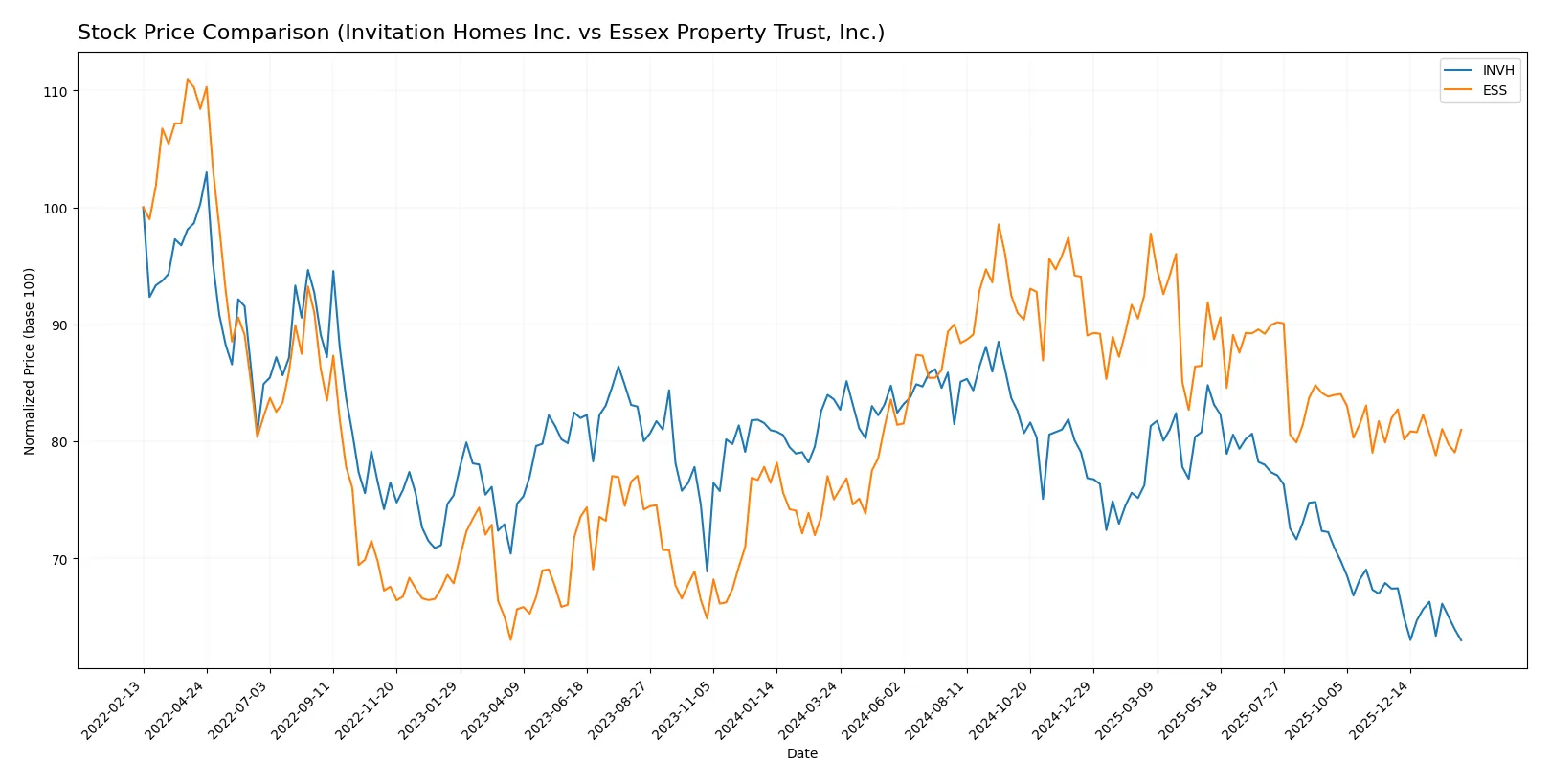
Invitation Homes Inc. and Essex Property Trust, Inc. displayed contrasting price movements over the past year, with Invitation Homes showing a steady decline and Essex Property Trust maintaining moderate gains despite recent softness.
Trend Comparison
Invitation Homes Inc. shows a bearish trend over the past 12 months with a -24.66% price change, decelerating further recently with a -6.56% drop and moderate volatility (2.87 std dev). The stock hit a high of 37.02 and a low of 26.34.
Essex Property Trust, Inc. exhibits a bullish trend over the same period, gaining 7.94% despite deceleration. Recent performance is slightly negative (-1.2%), with higher volatility (18.8 std dev). The price ranged between 235.17 and 314.05.
Essex Property Trust outperformed Invitation Homes with positive annual returns, while Invitation Homes faced significant declines and seller dominance in recent trading sessions.
Target Prices
Analysts show a positive target consensus for Invitation Homes Inc. and Essex Property Trust, Inc.
| Company | Target Low | Target High | Consensus |
|---|---|---|---|
| Invitation Homes Inc. | 27 | 40 | 33.29 |
| Essex Property Trust, Inc. | 271 | 292 | 280.4 |
The consensus targets exceed current prices, suggesting upside potential. Invitation Homes trades below its consensus by 26%, while Essex Property Trust is 8.5% below its target consensus.

Don’t Let Luck Decide Your Entry Point
Optimize your entry points with our advanced ProRealTime indicators. You’ll get efficient buy signals with precise price targets for maximum performance. Start outperforming now!
How do institutions grade them?
Invitation Homes Inc. Grades
The following table summarizes recent institutional grades for Invitation Homes Inc.:
| Grading Company | Action | New Grade | Date |
|---|---|---|---|
| Scotiabank | maintain | Sector Perform | 2026-01-14 |
| Mizuho | downgrade | Neutral | 2026-01-08 |
| UBS | maintain | Buy | 2026-01-08 |
| Barclays | maintain | Overweight | 2025-11-25 |
| JP Morgan | maintain | Overweight | 2025-11-18 |
| Morgan Stanley | maintain | Equal Weight | 2025-11-13 |
| B of A Securities | maintain | Neutral | 2025-11-12 |
| Scotiabank | maintain | Sector Perform | 2025-11-10 |
| Keefe, Bruyette & Woods | maintain | Market Perform | 2025-11-05 |
| RBC Capital | maintain | Sector Perform | 2025-10-31 |
Essex Property Trust, Inc. Grades
Below is a summary of recent institutional grades for Essex Property Trust, Inc.:
| Grading Company | Action | New Grade | Date |
|---|---|---|---|
| BMO Capital | downgrade | Market Perform | 2026-01-09 |
| UBS | maintain | Neutral | 2026-01-08 |
| Jefferies | downgrade | Hold | 2025-12-16 |
| Truist Securities | maintain | Hold | 2025-12-16 |
| Barclays | maintain | Equal Weight | 2025-11-25 |
| Mizuho | maintain | Outperform | 2025-11-24 |
| UBS | maintain | Neutral | 2025-11-10 |
| Wells Fargo | maintain | Equal Weight | 2025-11-10 |
| Scotiabank | maintain | Sector Outperform | 2025-11-04 |
| Evercore ISI Group | maintain | In Line | 2025-11-03 |
Which company has the best grades?
Invitation Homes Inc. holds more overweight and buy ratings, reflecting stronger institutional confidence. Essex Property Trust, Inc. shows more hold and market perform grades, indicating a cautious outlook. These differences may influence investor sentiment and portfolio positioning.
Risks specific to each company
The following categories identify the critical pressure points and systemic threats facing both firms in the 2026 market environment:
1. Market & Competition
Invitation Homes Inc.
- Operates in single-family home leasing, facing competition from new housing supply and rental market shifts.
Essex Property Trust, Inc.
- Focused on West Coast multifamily properties, exposed to intense regional competition and development risks.
2. Capital Structure & Debt
Invitation Homes Inc.
- Debt-to-equity ratio neutral at 0.84; interest coverage moderate at 2.24x, signaling manageable but notable leverage.
Essex Property Trust, Inc.
- Debt metrics unavailable or zero; debt-to-equity score very unfavorable, implying potential financial risk or reporting gaps.
3. Stock Volatility
Invitation Homes Inc.
- Beta of 0.83 indicates moderate sensitivity to market swings, underperforming slightly in volume.
Essex Property Trust, Inc.
- Lower beta at 0.74 suggests less volatility, supported by solid trading volume and recent price gains.
4. Regulatory & Legal
Invitation Homes Inc.
- Subject to residential leasing regulations nationally; potential risks from evolving tenant protection laws.
Essex Property Trust, Inc.
- Faces stringent West Coast housing regulations and zoning laws impacting development and operations.
5. Supply Chain & Operations
Invitation Homes Inc.
- Dependent on home renovations and maintenance supply chains; operational efficiency challenged by asset turnover of 0.14.
Essex Property Trust, Inc.
- Operational metrics incomplete; likely exposed to construction delays and cost pressures in active development projects.
6. ESG & Climate Transition
Invitation Homes Inc.
- Increasing pressure to improve sustainability in single-family housing amid growing tenant demand for green features.
Essex Property Trust, Inc.
- High ESG scrutiny in California markets; climate transition risks affect property valuations and development costs.
7. Geopolitical Exposure
Invitation Homes Inc.
- Primarily US-focused, with limited international risk; sensitive to national housing policy shifts.
Essex Property Trust, Inc.
- Concentrated in West Coast US, vulnerable to regional economic and geopolitical fluctuations, including state-specific policies.
Which company shows a better risk-adjusted profile?
Invitation Homes faces significant leverage and liquidity risks, reflected in a distress-level Altman Z-score of 1.26 despite a strong Piotroski score of 8. Essex Property Trust also resides in the distress zone (Z-score 1.70) with a slightly lower Piotroski at 7, but shows weaker debt management and operational metrics. Invitation Homes’ diversified single-family model and stronger operational control offer a comparatively better risk-adjusted profile, although both companies require close monitoring of leverage and market conditions. The most impactful risk for Invitation Homes is its liquidity shortfall (current ratio 0.82), while Essex’s concentrated geographic exposure and weak debt metrics present the greatest threat. Recent market volatility underscores these vulnerabilities, demanding prudent caution from investors.
Final Verdict: Which stock to choose?
Invitation Homes Inc. (INVH) demonstrates a superpower in steadily growing profitability despite a challenging capital efficiency backdrop. Its rising ROIC trend suggests improving operational discipline, but the low current ratio signals liquidity risk—a point of vigilance for cautious investors. INVH suits portfolios targeting aggressive growth with tolerance for balance sheet nuances.
Essex Property Trust, Inc. (ESS) commands a strategic moat through its impressive net margin and robust recurring income profile, offering relative safety versus INVH’s leverage concerns. However, its declining ROIC trend and stretched valuation require scrutiny. ESS fits well in Growth at a Reasonable Price (GARP) portfolios seeking stable returns with moderate risk.
If you prioritize capital efficiency and improving profitability amid financial leverage, INVH is the compelling choice due to its upward ROIC trajectory. However, if you seek margin strength paired with a safer balance sheet, ESS offers better stability and a durable income stream despite a softer growth outlook. Each appeals to distinct investor profiles balancing growth potential and risk tolerance.
Disclaimer: Investment carries a risk of loss of initial capital. The past performance is not a reliable indicator of future results. Be sure to understand risks before making an investment decision.
Go Further
I encourage you to read the complete analyses of Invitation Homes Inc. and Essex Property Trust, Inc. to enhance your investment decisions: