In the competitive world of household and personal care products, The Estée Lauder Companies Inc. (EL) and Edgewell Personal Care Company (EPC) stand out as significant players. Both operate in overlapping markets, focusing on innovation and diverse product lines that cater to evolving consumer needs. This comparison will explore their strengths and strategies to help you, the investor, identify which company offers the most promising opportunity for your portfolio.

Table of contents
Companies Overview
I will begin the comparison between The Estée Lauder Companies Inc. and Edgewell Personal Care Company by providing an overview of these two companies and their main differences.
The Estée Lauder Companies Inc. Overview
The Estée Lauder Companies Inc. is a global manufacturer and marketer of prestige skin care, makeup, fragrance, and hair care products. Founded in 1946 and headquartered in New York City, the company operates under a wide array of brands, including Estée Lauder, Clinique, and MAC, targeting upscale consumers worldwide. It distributes through department stores, specialty retailers, standalone stores, and online channels, maintaining a strong presence in the household and personal products industry.
Edgewell Personal Care Company Overview
Edgewell Personal Care Company, established in 1772 and based in Shelton, Connecticut, produces and markets personal care products globally. It operates through three segments: Wet shave, Sun and Skin care, and Feminine care, with brands such as Schick, Banana Boat, and Playtex. The company serves a broad consumer base with mass-market products primarily distributed via retail outlets, focusing on functional personal care solutions in the household and personal products sector.
Key similarities and differences
Both companies operate in the household and personal products industry, manufacturing and marketing personal care items internationally. Estée Lauder emphasizes prestige and luxury brands with a diverse product portfolio in cosmetics and fragrance, whereas Edgewell focuses on mass-market personal care categories like razors, sun care, and feminine products. Estée Lauder’s distribution includes upscale retail and e-commerce, while Edgewell targets broader retail channels, highlighting differences in market positioning and consumer segments.
Income Statement Comparison
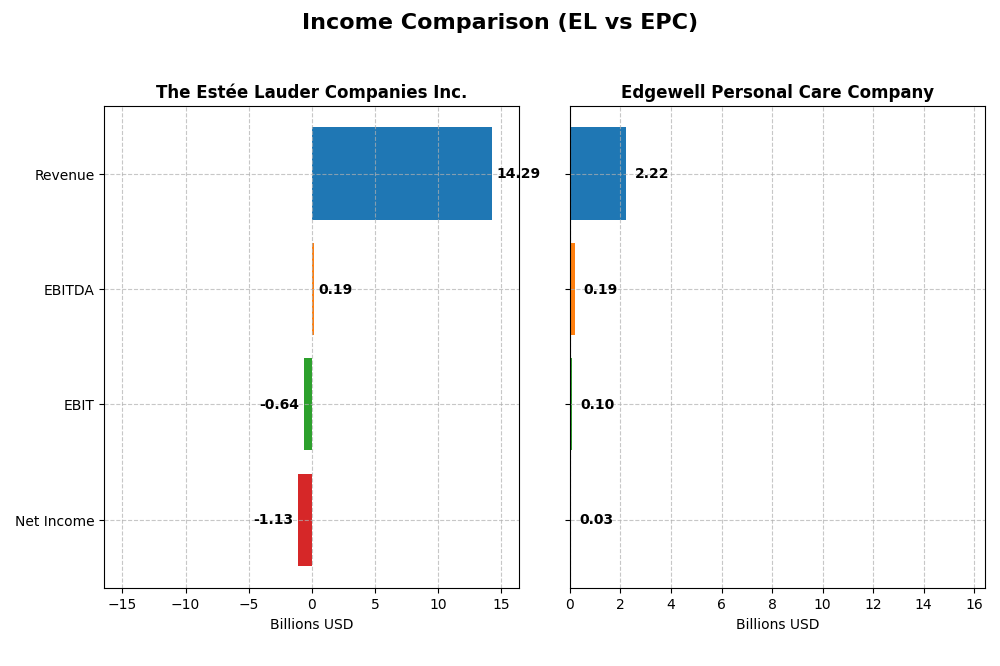
This table presents a side-by-side comparison of key income statement metrics for The Estée Lauder Companies Inc. and Edgewell Personal Care Company based on their most recent fiscal year data.
| Metric | The Estée Lauder Companies Inc. | Edgewell Personal Care Company |
|---|---|---|
| Market Cap | 40.7B | 847M |
| Revenue | 14.3B | 2.22B |
| EBITDA | 193M | 186M |
| EBIT | -636M | 97M |
| Net Income | -1.13B | 25.4M |
| EPS | -3.15 | 0.53 |
| Fiscal Year | 2025 | 2025 |
Income Statement Interpretations
The Estée Lauder Companies Inc.
From 2021 to 2025, The Estée Lauder Companies experienced declining revenue, falling from $16.2B to $14.3B, with net income turning negative at -$1.13B in 2025 after peaking at $2.87B in 2021. Gross margins remained strong around 74%, but EBIT and net margins deteriorated sharply. The latest year showed a significant contraction in profit and margin, signaling operational challenges.
Edgewell Personal Care Company
Edgewell’s revenue was relatively stable near $2.2B from 2021 to 2025, with a slight overall increase of 6.5%. Net income, however, decreased substantially from $118M in 2021 to $25M in 2025. Gross margin hovered at 41.6%, EBIT margin was modestly positive, and net margin near 1%. The most recent fiscal year reflected margin compression and lower profitability despite stable sales.
Which one has the stronger fundamentals?
Both companies face profitability declines, but Estée Lauder’s larger scale and higher gross margins contrast with its recent losses and negative earnings growth. Edgewell shows more stable revenue and modest positive margins but suffers from significant net income declines. Overall, both have unfavorable income statement trends, with neither demonstrating distinctly stronger fundamentals at this time.
Financial Ratios Comparison
This table presents a side-by-side comparison of key financial ratios for The Estée Lauder Companies Inc. (EL) and Edgewell Personal Care Company (EPC) based on their most recent fiscal year data.
| Ratios | The Estée Lauder Companies Inc. (EL) | Edgewell Personal Care Company (EPC) |
|---|---|---|
| ROE | -29.31% (2025) | 1.64% (2025) |
| ROIC | 6.44% (2025) | 3.00% (2025) |
| P/E | -25.68 (2025) | 38.07 (2025) |
| P/B | 7.53 (2025) | 0.62 (2025) |
| Current Ratio | 1.30 (2025) | 1.76 (2025) |
| Quick Ratio | 0.92 (2025) | 0.90 (2025) |
| D/E | 2.44 (2025) | 0.91 (2025) |
| Debt-to-Assets | 47.45% (2025) | 37.61% (2025) |
| Interest Coverage | 2.37 (2025) | 1.32 (2025) |
| Asset Turnover | 0.72 (2025) | 0.59 (2025) |
| Fixed Asset Turnover | 2.79 (2025) | 6.02 (2025) |
| Payout ratio | -54.55% (2025) | 115.35% (2025) |
| Dividend yield | 2.12% (2025) | 3.03% (2025) |
Interpretation of the Ratios
The Estée Lauder Companies Inc.
The Estée Lauder shows several unfavorable ratios, including negative net margin (-7.93%) and return on equity (-29.31%), indicating profitability and efficiency challenges. Neutral metrics include return on invested capital (6.44%) and liquidity ratios. Its dividend yield is favorable at 2.12%, but caution arises from high debt-to-equity (2.44) and negative interest coverage. The company pays dividends, supported by a stable yield but with risks from operational weaknesses.
Edgewell Personal Care Company
Edgewell displays a mixed ratio profile with unfavorable net margin (1.14%) and return on equity (1.64%), reflecting modest profitability. Favorable indicators include a strong current ratio (1.76), low price-to-book (0.62), and dividend yield at 3.03%. Its weighted average cost of capital at 5.23% is favorable. The company pays dividends, supported by decent liquidity and coverage, though interest coverage remains unfavorable at 1.32.
Which one has the best ratios?
Edgewell Personal Care presents a more balanced and slightly favorable ratio set with better liquidity, lower valuation multiples, and a higher dividend yield. The Estée Lauder Companies face more pronounced profitability and leverage concerns, reflected in multiple unfavorable ratios. Overall, Edgewell’s ratios are assessed as neutral, while Estée Lauder’s are slightly unfavorable.
Strategic Positioning
This section compares the strategic positioning of The Estée Lauder Companies Inc. (EL) and Edgewell Personal Care Company (EPC), covering Market position, Key segments, and Exposure to technological disruption:
The Estée Lauder Companies Inc.
- Large market cap of 40.7B with strong presence in luxury cosmetics; faces intense competition in beauty industry.
- Diverse product portfolio including skin care, makeup, fragrance, and hair care driving revenues across multiple segments.
- Limited explicit data on technological disruption exposure; traditional beauty products dominate with incremental innovation.
Edgewell Personal Care Company
- Smaller market cap of 847M, focused on personal care with niche brands; competitive pressure from established consumer goods firms.
- Concentrated in wet shave, sun and skin care, and feminine care segments with key revenue from razors and sun care.
- No direct information on technological disruption; personal care products focus on established categories with stable innovation.
EL vs EPC Positioning
EL has a diversified portfolio across luxury beauty segments, providing multiple revenue streams but facing high competition. EPC concentrates on personal care niches like razors and sun care, which may limit diversification but allows focused market presence.
Which has the best competitive advantage?
Both EL and EPC show declining ROIC trends below WACC from 2021 to 2025, indicating value destruction and very unfavorable moat status without competitive advantage based on the provided MOAT evaluation data.
Stock Comparison
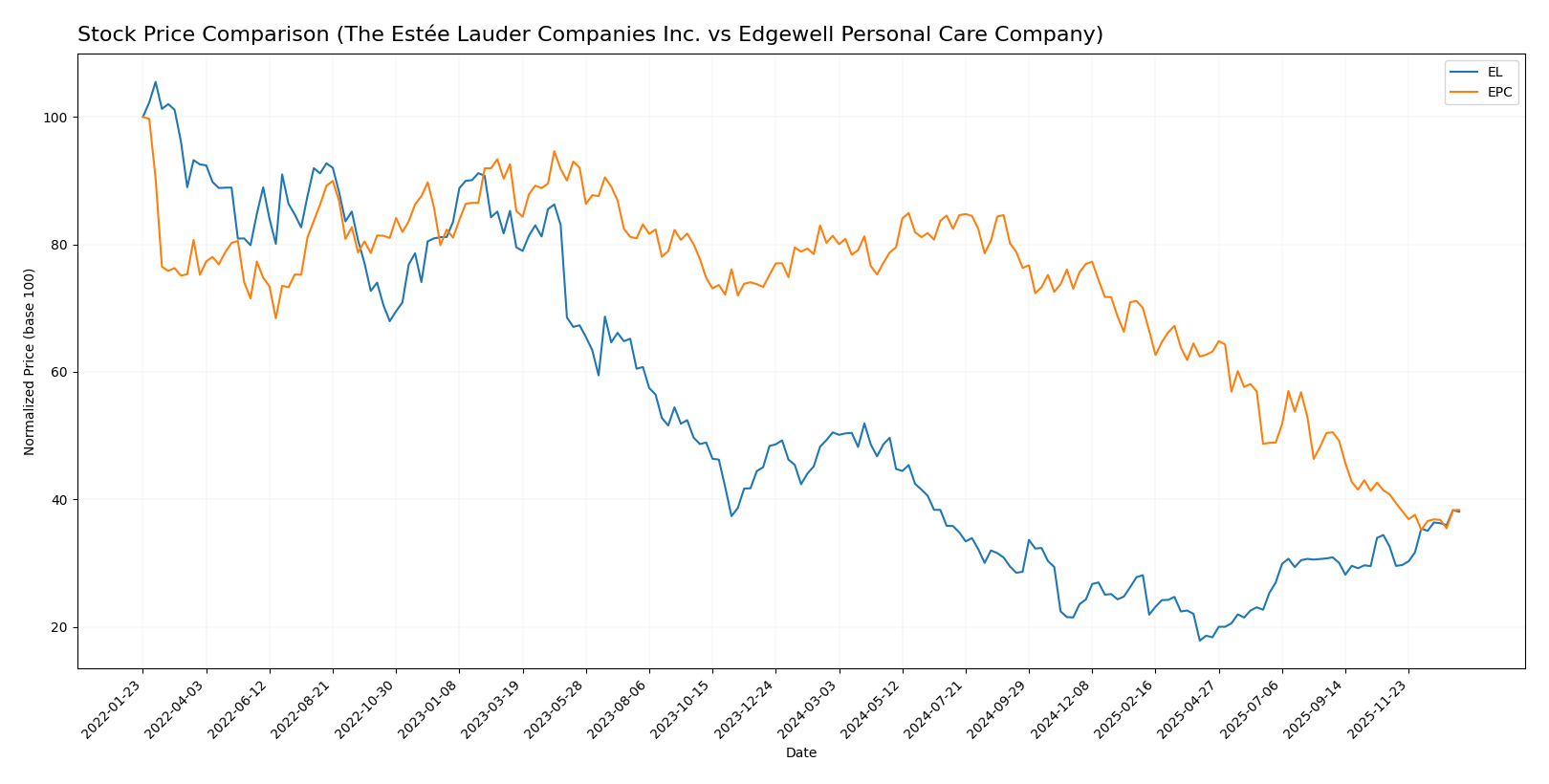
The stock price performance of The Estée Lauder Companies Inc. (EL) and Edgewell Personal Care Company (EPC) over the past 12 months reveals contrasting bearish trends with differing acceleration patterns and recent momentum shifts.
Trend Analysis
The Estée Lauder Companies Inc. (EL) experienced a bearish trend with a -24.65% price change over the past year, showing acceleration and high volatility (25.16 std deviation). Recently, EL reversed with a 16.89% gain, indicating a short-term bullish recovery.
Edgewell Personal Care Company (EPC) showed a more pronounced bearish trend, declining -52.87% over the same period with accelerating momentum and moderate volatility (7.54 std deviation). Its recent trend remains negative, down -5.98%, with continued deceleration.
Comparing both, EL outperformed EPC over the past year by delivering a smaller loss and a recent positive rebound, making EL the stronger market performer in this period.
Target Prices
The current analyst consensus presents a balanced outlook with distinct target ranges for The Estée Lauder Companies Inc. and Edgewell Personal Care Company.
| Company | Target High | Target Low | Consensus |
|---|---|---|---|
| The Estée Lauder Companies Inc. | 130 | 70 | 106.67 |
| Edgewell Personal Care Company | 23 | 20 | 21.5 |
Analysts expect The Estée Lauder stock to trade slightly below its current price of 113.02 USD, while Edgewell’s consensus target of 21.5 USD suggests a moderate upside from its current 18.23 USD level.
Analyst Opinions Comparison
This section compares analysts’ ratings and grades for The Estée Lauder Companies Inc. and Edgewell Personal Care Company:
Rating Comparison
EL Rating
- Rating: D+ indicating a very favorable overall rating despite weak financial scores.
- Discounted Cash Flow Score: 2, reflecting a moderate valuation based on future cash flows.
- ROE Score: 1, indicating very unfavorable efficiency in generating profit from equity.
- ROA Score: 1, showing very unfavorable asset utilization in generating earnings.
- Debt To Equity Score: 1, reflecting very unfavorable financial risk due to higher leverage.
- Overall Score: 1, classified as very unfavorable financial health overall.
EPC Rating
- Rating: B with a very favorable overall rating supported by stronger financial scores.
- Discounted Cash Flow Score: 5, showing a very favorable valuation outlook.
- ROE Score: 2, representing moderate efficiency in profit generation from equity.
- ROA Score: 2, indicating moderate asset utilization effectiveness.
- Debt To Equity Score: 2, showing moderate financial stability with lower leverage.
- Overall Score: 3, considered moderate overall financial standing.
Which one is the best rated?
Based strictly on the provided data, Edgewell Personal Care Company (EPC) is better rated than The Estée Lauder Companies Inc. (EL), showing higher scores across all financial metrics and an overall moderate rating versus EL’s very unfavorable standing.
Scores Comparison
Here is a comparison of the Altman Z-Score and Piotroski Score for The Estée Lauder Companies Inc. and Edgewell Personal Care Company:
EL Scores
- Altman Z-Score: 3.11, in the safe zone
- Piotroski Score: 5, classified as average
EPC Scores
- Altman Z-Score: 1.44, in the distress zone
- Piotroski Score: 6, classified as average
Which company has the best scores?
Based on the provided data, EL has a stronger Altman Z-Score indicating better financial stability, while EPC has a slightly higher Piotroski Score. Overall, EL shows better bankruptcy risk metrics, whereas EPC shows marginally better financial strength.
Grades Comparison
Here is the comparison of recent grades assigned to The Estée Lauder Companies Inc. and Edgewell Personal Care Company by several reputable grading firms:
The Estée Lauder Companies Inc. Grades
The table below shows the latest grades from recognized financial institutions for The Estée Lauder Companies Inc.:
| Grading Company | Action | New Grade | Date |
|---|---|---|---|
| Wells Fargo | Maintain | Equal Weight | 2026-01-05 |
| Raymond James | Upgrade | Strong Buy | 2026-01-05 |
| Citigroup | Maintain | Neutral | 2025-12-17 |
| Evercore ISI Group | Maintain | Outperform | 2025-12-16 |
| Rothschild & Co | Downgrade | Sell | 2025-11-25 |
| Argus Research | Upgrade | Buy | 2025-11-11 |
| JP Morgan | Maintain | Overweight | 2025-10-31 |
| Telsey Advisory Group | Maintain | Market Perform | 2025-10-31 |
| UBS | Maintain | Neutral | 2025-10-31 |
| RBC Capital | Maintain | Outperform | 2025-10-31 |
The Estée Lauder Companies Inc. exhibits a mixed but generally positive grading trend with several upgrades and multiple maintain ratings at neutral to outperform levels.
Edgewell Personal Care Company Grades
The table below summarizes the recent grades assigned to Edgewell Personal Care Company by established grading firms:
| Grading Company | Action | New Grade | Date |
|---|---|---|---|
| Wells Fargo | Maintain | Overweight | 2026-01-05 |
| Morgan Stanley | Maintain | Equal Weight | 2025-11-18 |
| Barclays | Maintain | Equal Weight | 2025-11-14 |
| RBC Capital | Maintain | Outperform | 2025-11-14 |
| Wells Fargo | Maintain | Overweight | 2025-11-14 |
| Wells Fargo | Maintain | Overweight | 2025-09-25 |
| Morgan Stanley | Upgrade | Equal Weight | 2025-08-06 |
| UBS | Maintain | Neutral | 2025-08-06 |
| Barclays | Maintain | Equal Weight | 2025-08-06 |
| Canaccord Genuity | Maintain | Buy | 2025-08-06 |
Edgewell Personal Care Company’s grades predominantly reflect stable assessments with several maintain ratings around overweight and equal weight, and a few upgrades over the last year.
Which company has the best grades?
The Estée Lauder Companies Inc. has received a broader spectrum of grades, including a strong buy and several outperform ratings, while Edgewell Personal Care Company’s grades are more concentrated around equal weight and overweight with fewer upgrades. This variety in Estée Lauder’s grades indicates a wider range of analyst views, potentially implying more diverse investor sentiment and risk considerations.
Strengths and Weaknesses
Below is a comparison table of key strengths and weaknesses for The Estée Lauder Companies Inc. (EL) and Edgewell Personal Care Company (EPC) based on the most recent financial and operational data.
| Criterion | The Estée Lauder Companies Inc. (EL) | Edgewell Personal Care Company (EPC) |
|---|---|---|
| Diversification | Strong product diversification across Skin Care (6.96B), Makeup (4.21B), Fragrance (2.49B), and Hair Care (565M) | Moderate diversification with focus on Razors & Blades (1.10B), Sun Care (459M), and Feminine Care segments |
| Profitability | Negative net margin (-7.93%) and ROE (-29.31%), indicating current profitability challenges | Slightly positive net margin (1.14%) and ROE (1.64%), but overall low profitability |
| Innovation | Historically strong brand innovation; however, recent declining ROIC trend (-51.3%) signals weakening competitive advantage | Lower innovation impact with declining ROIC (-50.4%) and less differentiation evident |
| Global presence | Extensive global footprint supporting large revenue base | More regional focus with smaller scale compared to EL |
| Market Share | Large market share in premium beauty segments | Leading in niche categories like razors and personal care, but smaller overall share |
Key takeaways: Both companies face declining profitability and weakening ROIC trends, signaling value destruction. Estée Lauder’s strong diversification and brand presence offer resilience but current financials are unfavorable. Edgewell shows moderate profitability with a focused product portfolio, yet also struggles to create value. Caution and risk management are advised when considering these stocks for investment.
Risk Analysis
Below is a comparative table highlighting key risks for The Estée Lauder Companies Inc. (EL) and Edgewell Personal Care Company (EPC) based on the most recent 2025 financial and operational data.
| Metric | The Estée Lauder Companies Inc. (EL) | Edgewell Personal Care Company (EPC) |
|---|---|---|
| Market Risk | Beta 1.15 indicates moderate volatility; luxury goods demand sensitive to economic cycles. | Beta 0.62 suggests lower volatility; more defensive personal care market exposure. |
| Debt Level | High leverage: Debt-to-Equity 2.44 (unfavorable), Interest coverage negative (-1.57). | Moderate leverage: Debt-to-Equity 0.91 (neutral), Interest coverage low (1.32, unfavorable). |
| Regulatory Risk | Exposure to global cosmetics regulations; recalls or compliance issues could impact. | Personal care product regulations, including FDA scrutiny on skincare and feminine products. |
| Operational Risk | Large global supply chain with 44K employees; potential disruptions could impact production. | Smaller workforce (6.7K) but diversified segments may mitigate operational risks. |
| Environmental Risk | Sustainability demands rising; pressure to reduce environmental footprint in packaging and ingredients. | Similar environmental concerns in product sourcing and packaging; moderate impact. |
| Geopolitical Risk | Global footprint exposes EL to trade tensions and currency fluctuations. | Primarily US-focused but exposed to international supply chains and tariffs. |
The most significant risks for EL stem from its high debt and negative interest coverage, which increase financial vulnerability despite a stable Altman Z-score in the safe zone. EPC shows financial distress according to its Altman Z-score and moderate interest coverage, signaling potential liquidity concerns. Market-wise, EL’s luxury positioning brings moderate market risk, while EPC’s lower volatility reflects a more stable defensive niche. Investors should weigh financial stability and market exposure carefully in their portfolio decisions.
Which Stock to Choose?
The Estée Lauder Companies Inc. has experienced a declining income trend with unfavorable net and ROE margins, a slightly unfavorable global ratio profile, and very unfavorable ratings despite a safe Altman Z-Score. Its ROIC is below WACC with a declining trend, indicating value destruction and deteriorating profitability.
Edgewell Personal Care Company shows a more stable income with neutral net margin and mixed growth, a neutral global ratio evaluation, and a very favorable rating overall. However, it has a distress-level Altman Z-Score and also exhibits a declining ROIC below WACC, signaling value loss and weakening returns.
Considering ratings and financial evaluations, investors seeking potentially stronger financial ratings and moderate risk might find Edgewell more appealing, while risk-tolerant investors focusing on companies with safer bankruptcy risk but declining profitability could interpret Estée Lauder differently. Both companies reflect challenges in sustained profitability and value creation.
Disclaimer: Investment carries a risk of loss of initial capital. The past performance is not a reliable indicator of future results. Be sure to understand risks before making an investment decision.
Go Further
I encourage you to read the complete analyses of The Estée Lauder Companies Inc. and Edgewell Personal Care Company to enhance your investment decisions: