In the evolving landscape of regulated electric utilities, DTE Energy Company and FirstEnergy Corp. stand out as key players with significant market overlap and shared commitments to innovation in energy generation and distribution. Both companies serve millions of customers across different U.S. regions, blending traditional and renewable energy sources. This article will analyze their strategies, financial health, and growth potential to help you decide which utility stock deserves a place in your investment portfolio.

Table of contents
Companies Overview
I will begin the comparison between DTE Energy Company and FirstEnergy Corp. by providing an overview of these two companies and their main differences.
DTE Energy Company Overview
DTE Energy Company is a utility firm focused on regulated electric and gas operations in Michigan. It serves approximately 2.3M electricity customers and 1.3M natural gas customers. DTE generates power using fossil fuel, nuclear, hydroelectric, and renewable sources, and operates infrastructure including substations, transformers, pipelines, and meters. Founded in 1903, the company engages in energy trading and industrial projects, positioning itself as a diversified energy provider.
FirstEnergy Corp. Overview
FirstEnergy Corp. operates in the regulated electric utility sector, serving about 6M customers across six states in the US. The company owns and manages coal, nuclear, hydroelectric, natural gas, wind, and solar power plants, along with extensive transmission and distribution networks. Incorporated in 1996, FirstEnergy’s business model integrates generation, transmission, and distribution, emphasizing a broad geographic footprint and varied energy sources.
Key similarities and differences
Both companies operate in the regulated electric utility industry with diversified power generation portfolios including fossil, nuclear, and renewables. DTE’s operations concentrate in Michigan with significant gas distribution, while FirstEnergy covers multiple states with a larger customer base focused on electric transmission and distribution. DTE also includes energy trading and industrial services, whereas FirstEnergy emphasizes extensive transmission infrastructure and a wider regional presence.
Income Statement Comparison
The table below compares key income statement metrics for DTE Energy Company and FirstEnergy Corp. based on their most recent fiscal year results.
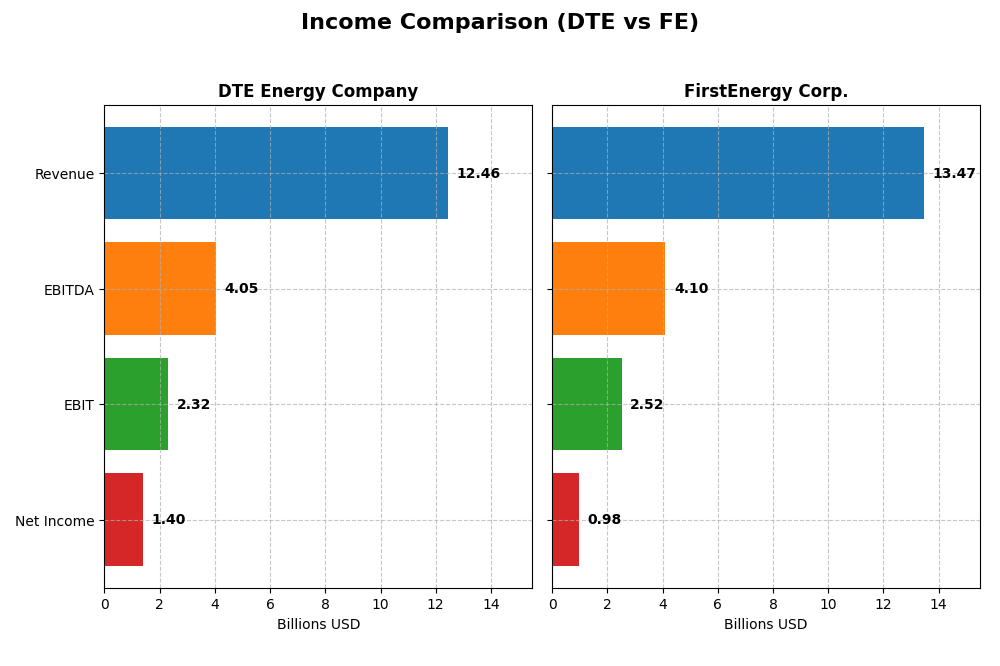
| Metric | DTE Energy Company | FirstEnergy Corp. |
|---|---|---|
| Market Cap | 27B | 26B |
| Revenue | 12.46B | 13.47B |
| EBITDA | 4.05B | 4.10B |
| EBIT | 2.32B | 2.52B |
| Net Income | 1.40B | 978M |
| EPS | 6.78 | 1.70 |
| Fiscal Year | 2024 | 2024 |
Income Statement Interpretations
DTE Energy Company
DTE Energy’s revenue showed a moderate overall growth of 9.05% from 2020 to 2024 but declined by 2.26% in the latest year. Net income experienced a slight overall increase of 2.41%, with net margins stable but slightly decreasing over time. For 2024, gross and net margins were favorable, though revenue and EBIT growth slowed, indicating some pressure on profitability.
FirstEnergy Corp.
FirstEnergy’s revenue increased by 24.86% over the five-year period, with a 4.68% rise in the latest year. However, net income declined by 9.36% overall, and net margin dropped by 27.4%, reflecting weakening profitability. While gross margin improved significantly last year, net margin and EPS deteriorated, signaling challenges in controlling costs relative to revenue growth.
Which one has the stronger fundamentals?
Both companies face unfavorable overall income statement evaluations, with DTE showing moderate revenue growth and stable margins but some recent declines in profitability. FirstEnergy presents stronger revenue expansion but suffers from significant net income and margin contractions. Thus, DTE appears to maintain more consistent profitability, whereas FirstEnergy’s fundamentals are more strained despite higher sales growth.
Financial Ratios Comparison
The table below presents a side-by-side comparison of key financial ratios for DTE Energy Company and FirstEnergy Corp. based on their latest fiscal year data from 2024.
| Ratios | DTE Energy Company | FirstEnergy Corp. |
|---|---|---|
| ROE | 12.00% | 7.85% |
| ROIC | 4.65% | 3.66% |
| P/E | 17.80 | 23.39 |
| P/B | 2.14 | 1.84 |
| Current Ratio | 0.71 | 0.56 |
| Quick Ratio | 0.46 | 0.45 |
| D/E (Debt to Equity) | 1.99 | 1.95 |
| Debt-to-Assets | 47.6% | 46.6% |
| Interest Coverage | 2.20 | 2.35 |
| Asset Turnover | 0.26 | 0.26 |
| Fixed Asset Turnover | 0.40 | 0.33 |
| Payout ratio | 57.7% | 99.2% |
| Dividend yield | 3.24% | 4.24% |
Interpretation of the Ratios
DTE Energy Company
DTE Energy presents a mixed ratio profile with 21.43% favorable and 42.86% unfavorable ratios, leading to a slightly unfavorable overall view. While net margin (11.27%) and dividend yield (3.24%) are favorable, concerns arise from weak liquidity (current ratio 0.71) and asset turnover (0.26). The company maintains a stable dividend payout with a reasonable yield, supported by free cash flow coverage, but investors should monitor its high debt levels and operational efficiency.
FirstEnergy Corp.
FirstEnergy’s ratios show a slightly unfavorable trend as well, with 14.29% favorable and 50% unfavorable metrics. Its dividend yield is attractive at 4.24%, but return on equity (7.85%) and return on invested capital (3.66%) are weak, suggesting limited profitability. Liquidity ratios are also low (current ratio 0.56), and asset turnover remains subdued at 0.26. The company pays dividends, but risks include sustaining distributions amid modest earnings and high leverage.
Which one has the best ratios?
Both companies exhibit slightly unfavorable ratio profiles with more unfavorable than favorable indicators. DTE Energy shows stronger profitability margins and a more balanced dividend yield, whereas FirstEnergy struggles with lower returns and similar liquidity challenges. Neither stands out decisively, but DTE’s relatively better profitability and dividend metrics provide a marginally stronger ratio picture.
Strategic Positioning
This section compares the strategic positioning of DTE Energy Company and FirstEnergy Corp. regarding Market position, Key segments, and Exposure to technological disruption:
DTE Energy Company
- Serves 2.3M electricity and 1.3M gas customers in southeastern Michigan, facing regulated market pressure.
- Diverse segments: Electric, Gas, Energy Trading, DTE Vantage, Power and Industrial Projects driving revenue.
- Operates fossil fuel, nuclear, hydro, wind, and renewable assets with limited explicit tech disruption mention.
FirstEnergy Corp.
- Serves 6M customers across six states with regulated electric transmission and distribution segments.
- Focused on Regulated Distribution and Transmission, with some competitive energy services historically.
- Owns diverse power plants including coal, nuclear, hydro, wind, solar, with no direct disruption details.
DTE Energy Company vs FirstEnergy Corp. Positioning
DTE exhibits a diversified business model including trading and industrial projects, while FirstEnergy concentrates on regulated transmission and distribution. DTE’s broader segment mix may offer varied revenue streams; FirstEnergy’s larger customer base spans multiple states but focuses on core regulated utilities.
Which has the best competitive advantage?
Both companies are currently shedding value relative to their capital costs; however, DTE shows a growing profitability trend, while FirstEnergy faces declining returns, indicating a weaker competitive advantage for the latter based on MOAT evaluation.
Stock Comparison
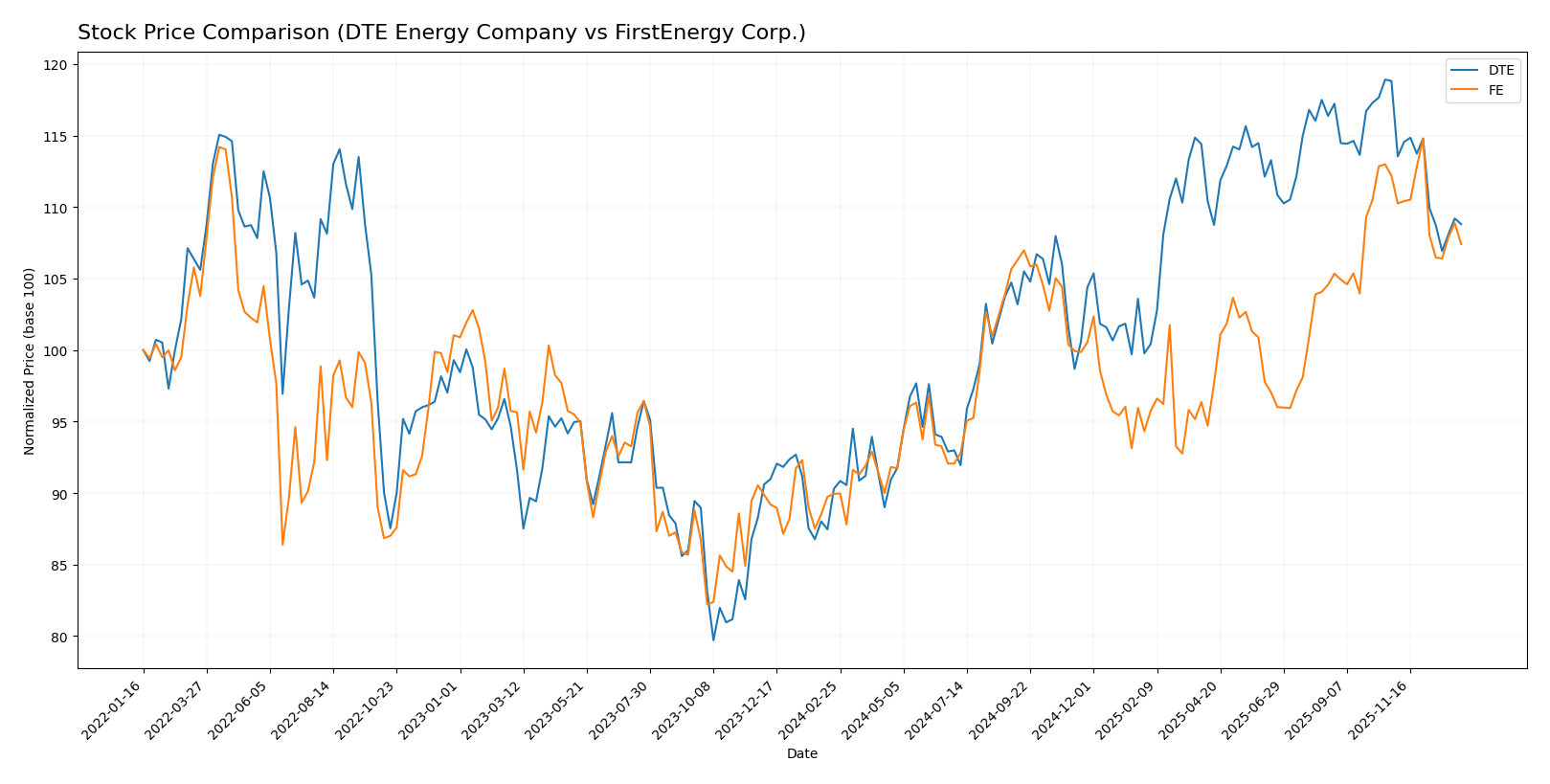
The stock price movements of DTE Energy Company and FirstEnergy Corp. over the past 12 months reveal significant bullish trends with signs of deceleration and recent short-term declines, highlighting dynamic trading patterns in both names.
Trend Analysis
DTE Energy Company’s stock rose 20.49% over the past year, confirming a bullish trend with decelerating momentum. The price ranged between 106.25 and 141.95, with recent months showing an 8.42% pullback and increased volatility.
FirstEnergy Corp. experienced a 19.42% gain in the same period, also bullish with deceleration. Its price fluctuated from 36.5 to 47.72, followed by a 4.27% drop recently, accompanied by lower volatility compared to DTE.
Comparing the two, DTE Energy Company delivered a slightly higher market performance over 12 months, though both stocks showed retreating trends in the most recent quarter.
Target Prices
Analysts provide a clear target price consensus for both DTE Energy Company and FirstEnergy Corp.
| Company | Target High | Target Low | Consensus |
|---|---|---|---|
| DTE Energy Company | 157 | 138 | 148.29 |
| FirstEnergy Corp. | 54 | 46 | 49.29 |
The consensus target prices suggest upside potential for both stocks compared to their current prices: DTE trades at 129.89 USD and FirstEnergy at 44.65 USD. Analysts expect moderate gains within the regulated electric utilities sector.
Analyst Opinions Comparison
This section compares analysts’ ratings and grades for DTE Energy Company and FirstEnergy Corp.:
Rating Comparison
DTE Rating
- Rated C, considered Very Favorable overall.
- Discounted Cash Flow Score: 1, Very Unfavorable, indicating possible overvaluation.
- Return on Equity Score: 3, Moderate efficiency in generating profit from equity.
- Return on Assets Score: 2, Moderate asset utilization.
- Debt To Equity Score: 1, Very Unfavorable, indicating high financial risk.
- Overall Score: 2, Moderate financial standing.
FE Rating
- Rated B, considered Very Favorable overall.
- Discounted Cash Flow Score: 4, Favorable, suggesting undervaluation potential.
- Return on Equity Score: 4, Favorable, showing better profit generation from equity.
- Return on Assets Score: 3, Moderate, slightly better asset utilization.
- Debt To Equity Score: 1, Very Unfavorable, similarly high financial risk.
- Overall Score: 3, Moderate financial standing but higher than DTE.
Which one is the best rated?
Based strictly on provided data, FE holds a higher overall rating (B vs. C) and better scores in discounted cash flow and return on equity, indicating it is rated better than DTE despite both sharing high financial risk.
Scores Comparison
The comparison of scores between DTE and FE provides insight into their financial stability and strength:
DTE Scores
- Altman Z-Score: 1.03, indicating financial distress with high bankruptcy risk.
- Piotroski Score: 7, reflecting strong financial health and value potential.
FE Scores
- Altman Z-Score: 0.78, indicating financial distress with high bankruptcy risk.
- Piotroski Score: 6, reflecting average financial health and moderate value.
Which company has the best scores?
DTE shows a higher Piotroski Score (7 vs. 6), suggesting stronger financial health compared to FE. Both companies fall into the distress zone for Altman Z-Score, with FE scoring lower, indicating higher bankruptcy risk.
Grades Comparison
Here is a detailed comparison of the latest grades and rating actions for DTE Energy Company and FirstEnergy Corp.:
DTE Energy Company Grades
The following table summarizes recent grades and rating changes from reputable grading companies for DTE Energy Company:
| Grading Company | Action | New Grade | Date |
|---|---|---|---|
| BMO Capital | Maintain | Market Perform | 2025-12-24 |
| UBS | Maintain | Buy | 2025-12-17 |
| JP Morgan | Maintain | Neutral | 2025-12-11 |
| Jefferies | Upgrade | Buy | 2025-12-11 |
| B of A Securities | Maintain | Buy | 2025-11-05 |
| Scotiabank | Maintain | Sector Perform | 2025-10-31 |
| Morgan Stanley | Maintain | Overweight | 2025-10-22 |
| Barclays | Maintain | Equal Weight | 2025-10-14 |
| UBS | Maintain | Buy | 2025-10-10 |
| Scotiabank | Downgrade | Sector Perform | 2025-10-03 |
Overall, DTE Energy shows a stable to slightly positive trend, with multiple buy/overweight ratings and one recent upgrade.
FirstEnergy Corp. Grades
The table below presents recent grades and rating decisions for FirstEnergy Corp.:
| Grading Company | Action | New Grade | Date |
|---|---|---|---|
| UBS | Maintain | Neutral | 2025-12-17 |
| Mizuho | Maintain | Neutral | 2025-10-24 |
| Scotiabank | Maintain | Sector Outperform | 2025-10-24 |
| UBS | Maintain | Neutral | 2025-10-24 |
| Morgan Stanley | Maintain | Overweight | 2025-10-21 |
| Jefferies | Maintain | Hold | 2025-10-21 |
| Keybanc | Downgrade | Sector Weight | 2025-10-15 |
| Scotiabank | Maintain | Sector Outperform | 2025-10-06 |
| Morgan Stanley | Maintain | Overweight | 2025-09-25 |
| Barclays | Upgrade | Overweight | 2025-08-25 |
FirstEnergy’s grades reflect a generally neutral to positive stance, with several overweight and sector outperform ratings, balanced by some hold and downgrade actions.
Which company has the best grades?
DTE Energy Company has received more consistent buy and overweight ratings, including a recent upgrade, compared to FirstEnergy Corp., which has a mix of neutral and overweight grades. This suggests DTE may be viewed with slightly more confidence by analysts, potentially influencing investor sentiment towards stable or positive prospects.
Strengths and Weaknesses
Below is a comparative overview of key strengths and weaknesses for DTE Energy Company and FirstEnergy Corp., based on the most recent financial and operational data.
| Criterion | DTE Energy Company | FirstEnergy Corp. |
|---|---|---|
| Diversification | Strong in Electric (5.8B) and Energy Trading (4.6B) with Gas and DTE Vantage segments | Primarily focused on Regulated Distribution (6.9B) and Transmission (1.8B); less diversified |
| Profitability | Net margin 11.27% (favorable); ROIC 4.65% (unfavorable but growing) | Net margin 7.26% (neutral); ROIC 3.66% (unfavorable and declining) |
| Innovation | Moderate innovation through DTE Vantage (0.8B revenue) | Limited innovation focus; mainly regulated services |
| Global presence | Mainly U.S. market with some energy trading exposure | Primarily U.S. regulated utilities market |
| Market Share | Strong in electric utilities with consistent revenue streams | Large regulated distribution network but challenged by profitability trends |
Key takeaways: DTE Energy shows better diversification and improving profitability despite current value destruction, while FirstEnergy struggles with declining returns and less diversification. Both face liquidity and operational efficiency challenges, advising cautious investment consideration.
Risk Analysis
Below is a comparative table summarizing key risks for DTE Energy Company and FirstEnergy Corp. based on the most recent 2024 data:
| Metric | DTE Energy Company | FirstEnergy Corp. |
|---|---|---|
| Market Risk | Beta 0.48 (low volatility) | Beta 0.63 (moderate volatility) |
| Debt level | D/E ratio 1.99 (high) | D/E ratio 1.95 (high) |
| Regulatory Risk | Moderate (regulated electric sector) | Moderate (regulated electric sector) |
| Operational Risk | Asset turnover 0.26 (low efficiency) | Asset turnover 0.26 (low efficiency) |
| Environmental Risk | Exposure to fossil fuels and nuclear plants | Similar exposure with coal and nuclear assets |
| Geopolitical Risk | Low (domestic US operations) | Low (domestic US operations) |
The most impactful and likely risks for both companies stem from their high leverage, placing financial stability under pressure despite solid market positions. Both operate in a heavily regulated environment and rely on fossil fuels and nuclear energy, which increases environmental and regulatory risks amid tightening policies. Their low asset turnover signals operational efficiency challenges, while their low beta values suggest limited market volatility exposure.
Which Stock to Choose?
DTE Energy Company shows a mixed income evolution with a 9.05% revenue growth overall but recent declines, favorable net margin of 11.25%, and moderate profitability. Its financial ratios reveal slight weaknesses in liquidity and leverage, with a very favorable overall rating. However, it is shedding value despite an improving ROIC trend.
FirstEnergy Corp. displays a stronger overall revenue growth of 24.86% but suffers from declining profitability and negative net income growth over the period. Its financial ratios are slightly less favorable, with higher debt concerns and a very unfavorable moat rating, although it holds a very favorable rating score overall.
Investors focused on growth might find FirstEnergy’s revenue expansion appealing despite profitability challenges, while those prioritizing financial stability and improving profitability trends may view DTE Energy as more favorable given its moderate rating and improving ROIC, though both companies show signs of value erosion.
Disclaimer: Investment carries a risk of loss of initial capital. The past performance is not a reliable indicator of future results. Be sure to understand risks before making an investment decision.
Go Further
I encourage you to read the complete analyses of DTE Energy Company and FirstEnergy Corp. to enhance your investment decisions: