Walmart Inc. and Dollar Tree, Inc. are two prominent players in the discount retail industry, each pursuing unique strategies to capture market share. Walmart’s expansive global footprint contrasts with Dollar Tree’s focused variety store model, creating an intriguing dynamic for investors. By comparing their market presence, innovation approaches, and growth potential, this article aims to help you identify which company offers the more compelling investment opportunity in 2026.

Table of contents
Companies Overview
I will begin the comparison between Walmart Inc. and Dollar Tree, Inc. by providing an overview of these two companies and their main differences.
Walmart Overview
Walmart Inc. is a global leader in retail, operating through Walmart U.S., Walmart International, and Sam’s Club segments. The company offers a vast range of products, from groceries and consumables to electronics, apparel, and financial services. Founded in 1945 and headquartered in Bentonville, Arkansas, Walmart emphasizes scale and diversity in its physical stores and eCommerce platforms, serving millions worldwide with a market cap of around 940B USD.
Dollar Tree Overview
Dollar Tree, Inc. operates discount variety retail stores under two main segments: Dollar Tree and Family Dollar. It offers fixed-price merchandise, including consumables, household goods, apparel, and seasonal items. Founded in 1986 and based in Chesapeake, Virginia, Dollar Tree focuses on value retailing with approximately 16,000 stores across the U.S. and Canada. The company’s market cap stands near 29B USD, reflecting its smaller scale compared to Walmart.
Key similarities and differences
Both Walmart and Dollar Tree operate in the discount store industry, targeting cost-conscious consumers with a broad range of products. Walmart’s business model is diversified across multiple store formats and international markets, offering a wide product assortment and additional services like digital payments. In contrast, Dollar Tree emphasizes fixed-price retailing with a focus on smaller stores and primarily North American locations. Walmart’s scale and product variety significantly exceed Dollar Tree’s more niche, value-oriented approach.
Income Statement Comparison
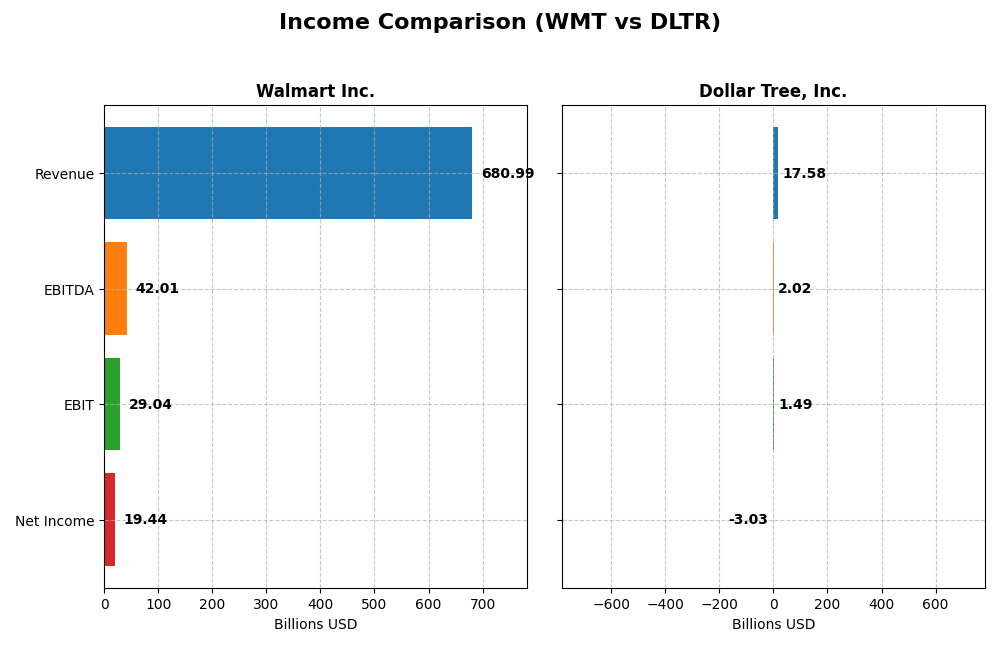
This table compares the key income statement metrics for Walmart Inc. and Dollar Tree, Inc. for their most recent fiscal years, providing a straightforward financial snapshot.
| Metric | Walmart Inc. (WMT) | Dollar Tree, Inc. (DLTR) |
|---|---|---|
| Market Cap | 940.6B | 28.8B |
| Revenue | 681B | 17.6B |
| EBITDA | 42B | 2.0B |
| EBIT | 29.0B | 1.5B |
| Net Income | 19.4B | -3.0B |
| EPS | 2.42 | -14.05 |
| Fiscal Year | 2025 | 2024 |
Income Statement Interpretations
Walmart Inc.
Walmart Inc. has exhibited steady revenue growth from $559B in 2021 to $681B in 2025, with net income rising from $13.5B to $19.4B over the same period. Gross margin remains favorable at 24.85%, while EBIT and net margins show neutral status. The 2025 fiscal year saw revenue growth at 5.07% and net margin growth of 19.26%, reflecting improved profitability despite a slight rise in operating expenses.
Dollar Tree, Inc.
Dollar Tree’s revenue peaked near $26.3B in 2021 but declined to $17.6B by 2024, with net income turning negative at -$3.0B in 2024 after positive earnings in prior years. While gross margin is strong at 35.81%, net margin is unfavorable at -17.24%. The latest year’s performance includes a 4.75% revenue increase but a 189.73% decline in net margin, indicating significant profitability challenges.
Which one has the stronger fundamentals?
Walmart shows stronger fundamentals with sustained revenue and net income growth, favorable gross margin, and improved profitability metrics in 2025. Conversely, Dollar Tree faces declining revenues, negative net income, and sharply deteriorating margins. The overall income statement evaluations favor Walmart’s stable and improving financial health compared to Dollar Tree’s unfavorable trends.
Financial Ratios Comparison
The table below presents a side-by-side comparison of key financial ratios for Walmart Inc. and Dollar Tree, Inc. based on their most recent fiscal year data.
| Ratios | Walmart Inc. (WMT) FY 2025 | Dollar Tree, Inc. (DLTR) FY 2024 |
|---|---|---|
| ROE | 21.4% | -76.2% |
| ROIC | 13.1% | 9.2% |
| P/E | 40.6 | -5.2 |
| P/B | 8.67 | 3.98 |
| Current Ratio | 0.82 | 1.06 |
| Quick Ratio | 0.24 | 0.75 |
| D/E (Debt-to-Equity) | 0.66 | 1.97 |
| Debt-to-Assets | 23.0% | 42.0% |
| Interest Coverage | 10.8 | 13.6 |
| Asset Turnover | 2.61 | 0.94 |
| Fixed Asset Turnover | 4.87 | 2.03 |
| Payout ratio | 34.4% | 0% |
| Dividend yield | 0.85% | 0% |
Interpretation of the Ratios
Walmart Inc.
Walmart’s ratios show a mixed profile with strong returns on equity (21.36%) and invested capital (13.06%), alongside favorable debt management and asset turnover metrics. However, concerns include a low net margin (2.85%), high price-to-book (8.67), and weak liquidity ratios with a current ratio of 0.82. Walmart pays dividends, but the yield is modest at 0.85%, indicating cautious shareholder returns supported by stable free cash flow coverage.
Dollar Tree, Inc.
Dollar Tree exhibits unfavorable profitability ratios, including a negative net margin (-17.24%) and return on equity (-76.18%), reflecting recent losses or restructuring. Its balance sheet shows higher leverage with a debt-to-equity ratio of 1.97 and neutral debt-to-assets at 42%. The company does not pay dividends, likely due to negative net income and reinvestment priorities, focusing on operational improvements and cash flow generation.
Which one has the best ratios?
Walmart presents a more balanced set of financial ratios with favorable profitability, leverage, and asset efficiency metrics, despite some liquidity and valuation concerns. Dollar Tree’s ratios reflect operational challenges and financial strain, with significant losses and higher leverage. Consequently, Walmart’s ratios are generally stronger, while Dollar Tree’s profile remains less favorable based on the available data.
Strategic Positioning
This section compares the strategic positioning of Walmart Inc. and Dollar Tree, Inc., including market position, key segments, and exposure to disruption:
Walmart Inc.
- Largest discount retailer with significant scale; faces moderate competitive pressure.
- Operates Walmart U.S., Walmart International, and Sam’s Club segments driving diverse revenue streams.
- Moderate exposure through eCommerce and digital payment platforms; adapts via multiple retail formats.
Dollar Tree, Inc.
- Smaller market cap; operates discount variety stores with niche competitive dynamics.
- Focuses on Dollar Tree fixed-price and Family Dollar segments, emphasizing variety discount retail.
- Limited technological disruption exposure; primarily traditional discount retail model.
Walmart Inc. vs Dollar Tree, Inc. Positioning
Walmart displays a diversified global retail presence balancing grocery, memberships, and eCommerce. Dollar Tree concentrates on fixed-price and value variety retail segments. Walmart’s breadth offers scale benefits; Dollar Tree’s focus targets specific consumer needs but with narrower scope.
Which has the best competitive advantage?
Both companies create value with growing ROICs, but Walmart’s larger scale and diversified segments provide a more durable competitive advantage, supported by a very favorable moat evaluation and stronger ROIC growth compared to Dollar Tree.
Stock Comparison
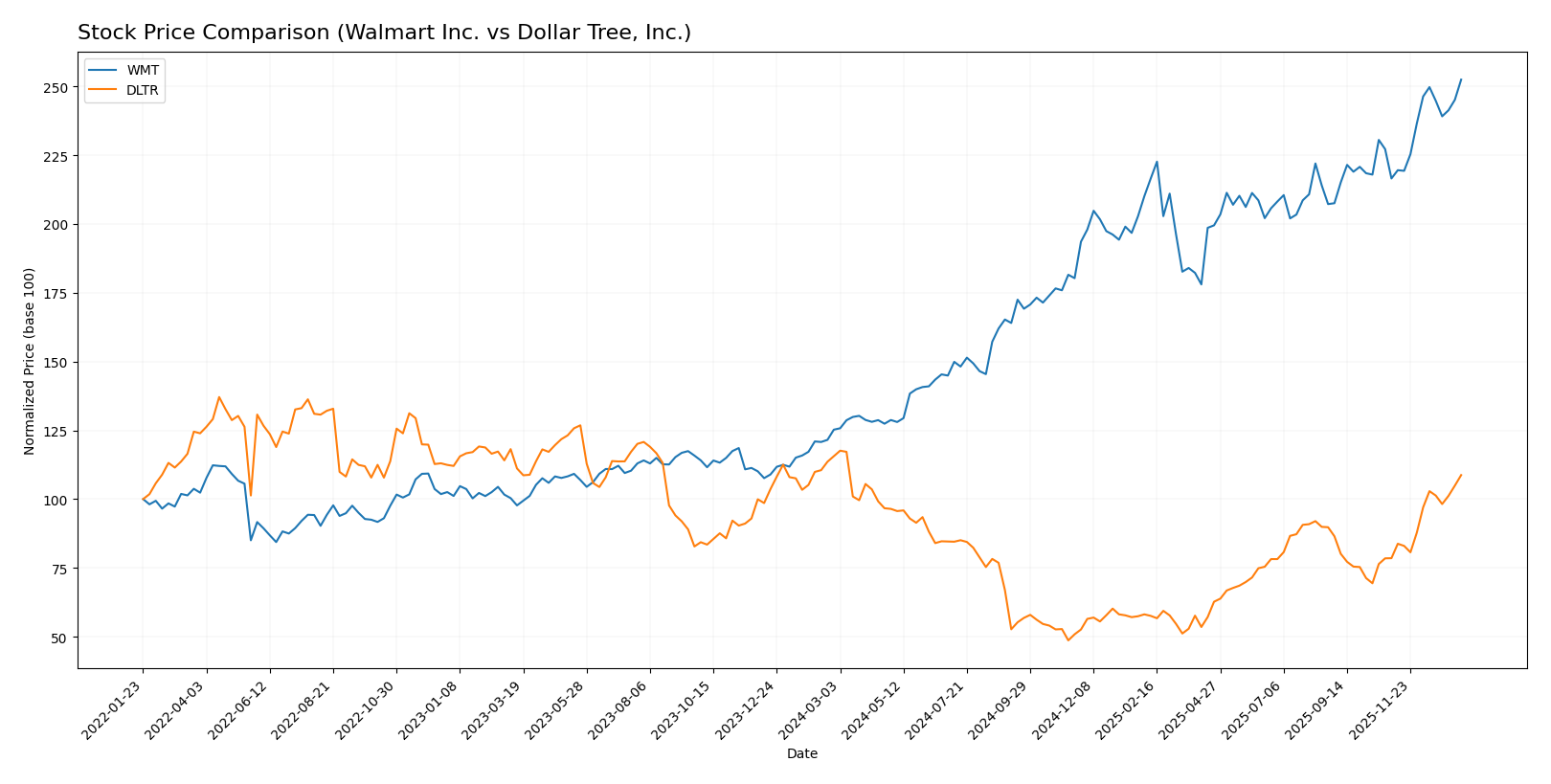
The stock prices of Walmart Inc. (WMT) and Dollar Tree, Inc. (DLTR) have shown contrasting trajectories over the past year, with Walmart exhibiting strong growth and Dollar Tree facing a decline despite recent upward momentum.
Trend Analysis
Walmart Inc. (WMT) recorded a 101.59% price increase over the past 12 months, indicating a bullish trend with acceleration. The stock experienced a high of 117.97 and a low of 58.52, supported by a standard deviation of 16.45.
Dollar Tree, Inc. (DLTR) showed a -5.92% price change over the same period, marking a bearish trend with acceleration. The highest price reached 148.44 and the lowest was 61.41, with a higher volatility measured by a standard deviation of 22.69.
Comparing both stocks, Walmart delivered the highest market performance with a substantial positive price change, while Dollar Tree remained in a negative trend despite recent gains.
Target Prices
Analysts provide a clear consensus on target prices for Walmart Inc. and Dollar Tree, Inc.
| Company | Target High | Target Low | Consensus |
|---|---|---|---|
| Walmart Inc. | 135 | 119 | 125.67 |
| Dollar Tree, Inc. | 150 | 75 | 125.33 |
The consensus targets suggest moderate upside potential for Walmart from its current price of $117.97 and a mixed outlook for Dollar Tree, whose current price of $137.24 is near the upper bound of analyst expectations.
Analyst Opinions Comparison
This section compares analysts’ ratings and financial scores for Walmart Inc. and Dollar Tree, Inc.:
Rating Comparison
Walmart Inc. Rating
- Rating: B-, considered very favorable by analysts.
- Discounted Cash Flow Score: 2, indicating moderate valuation.
- ROE Score: 5, a very favorable measure of equity profit efficiency.
- ROA Score: 4, favorable asset utilization.
- Debt To Equity Score: 2, moderate financial risk.
- Overall Score: 3, moderate overall financial standing.
Dollar Tree, Inc. Rating
- Rating: D+, also marked very favorable by analysts.
- Discounted Cash Flow Score: 2, indicating moderate valuation.
- ROE Score: 1, very unfavorable, showing low equity profitability.
- ROA Score: 1, very unfavorable asset efficiency.
- Debt To Equity Score: 1, very unfavorable financial risk.
- Overall Score: 1, very unfavorable overall financial standing.
Which one is the best rated?
Walmart Inc. holds a stronger position with a higher rating of B- and better scores in ROE, ROA, and overall financial standing. Dollar Tree, while rated D+, shows significant weaknesses in most financial metrics, resulting in a lower overall score.
Scores Comparison
Here is a comparison of Walmart Inc. and Dollar Tree, Inc. scores:
WMT Scores
- Altman Z-Score: 6.03, indicating a safe zone financial status
- Piotroski Score: 6, classified as average financial strength
DLTR Scores
- Altman Z-Score: 3.49, also in the safe zone but lower than WMT
- Piotroski Score: 4, also average but weaker than WMT
Which company has the best scores?
Walmart shows a higher Altman Z-Score and Piotroski Score compared to Dollar Tree, indicating stronger financial stability and relatively better financial strength based on these metrics.
Grades Comparison
Here is a comparative overview of the recent grades assigned to Walmart Inc. and Dollar Tree, Inc.:
Walmart Inc. Grades
The following table summarizes recent grades from leading financial institutions for Walmart Inc.:
| Grading Company | Action | New Grade | Date |
|---|---|---|---|
| Barclays | Maintain | Overweight | 2026-01-08 |
| Oppenheimer | Maintain | Outperform | 2026-01-08 |
| Mizuho | Maintain | Outperform | 2026-01-05 |
| Bernstein | Maintain | Outperform | 2026-01-05 |
| Wells Fargo | Maintain | Overweight | 2025-12-19 |
| Evercore ISI Group | Maintain | Outperform | 2025-12-16 |
| Evercore ISI Group | Maintain | Outperform | 2025-12-09 |
| Tigress Financial | Maintain | Buy | 2025-12-03 |
| BTIG | Maintain | Buy | 2025-11-21 |
| Morgan Stanley | Maintain | Overweight | 2025-11-21 |
The grades for Walmart show a consistent “Outperform” or “Overweight” consensus with no downgrades, indicating stable positive analyst sentiment.
Dollar Tree, Inc. Grades
Below is a summary of recent grades from reputable grading companies for Dollar Tree, Inc.:
| Grading Company | Action | New Grade | Date |
|---|---|---|---|
| Barclays | Maintain | Overweight | 2026-01-08 |
| Bernstein | Maintain | Market Perform | 2026-01-05 |
| Wells Fargo | Maintain | Overweight | 2025-12-19 |
| Barclays | Maintain | Overweight | 2025-12-09 |
| Morgan Stanley | Maintain | Equal Weight | 2025-12-08 |
| Evercore ISI Group | Maintain | In Line | 2025-12-04 |
| Telsey Advisory Group | Maintain | Outperform | 2025-12-04 |
| B of A Securities | Maintain | Underperform | 2025-12-04 |
| Guggenheim | Maintain | Buy | 2025-12-04 |
| Wells Fargo | Maintain | Overweight | 2025-12-04 |
Dollar Tree’s grades exhibit more variability, ranging from “Underperform” to “Outperform,” reflecting a mixed analyst view.
Which company has the best grades?
Walmart Inc. has received more consistently positive grades, mainly “Outperform” and “Overweight,” compared to Dollar Tree’s wider range including “Underperform.” This consistency may signal stronger confidence from analysts, potentially impacting investor perception of stability and growth prospects.
Strengths and Weaknesses
Below is a comparison table highlighting the key strengths and weaknesses of Walmart Inc. (WMT) and Dollar Tree, Inc. (DLTR) based on the most recent data available.
| Criterion | Walmart Inc. (WMT) | Dollar Tree, Inc. (DLTR) |
|---|---|---|
| Diversification | Highly diversified revenue streams: Walmart U.S. $462B, International $122B, Sam’s Club $90B (2025) | Less diversified: mainly Dollar Tree stores with some Family Dollar exposure (2024 revenue approx. $31B combined) |
| Profitability | Favorable ROIC (13.06%) and ROE (21.36%), but lower net margin (2.85%, unfavorable) | Negative net margin (-17.24%) and ROE (-76.18%), ROIC neutral (9.17%), indicating profitability challenges |
| Innovation | Strong focus on efficient asset turnover (2.61) and fixed asset turnover (4.87), supporting operational innovation | Moderate asset turnover (0.94) and fixed asset turnover (2.03), innovation impact limited |
| Global presence | Strong international footprint with $122B in international revenue | Primarily focused on the U.S. market, limited global presence |
| Market Share | Large market share in retail with durable competitive advantage and growing ROIC | Smaller market share with a stable but less dominant position and slightly unfavorable financial ratios |
Walmart demonstrates a robust, diversified business model with strong profitability and global reach, supported by a durable competitive advantage. Dollar Tree shows growth potential but faces profitability and diversification challenges, suggesting higher investment risk.
Risk Analysis
Below is a comparative risk assessment table for Walmart Inc. (WMT) and Dollar Tree, Inc. (DLTR) based on the most recent financial and operational data for 2025 and 2024 respectively:
| Metric | Walmart Inc. (WMT) | Dollar Tree, Inc. (DLTR) |
|---|---|---|
| Market Risk | Moderate (Beta 0.66) | Moderate (Beta 0.75) |
| Debt level | Moderate (Debt/Equity 0.66, Debt/Assets 23%) | High (Debt/Equity 1.97, Debt/Assets 42%) |
| Regulatory Risk | Moderate (US retail focus, global exposure) | Moderate (US and Canada retail operations) |
| Operational Risk | Low (2.1M employees, diversified operations) | Moderate (64K employees, two segments) |
| Environmental Risk | Moderate (Large supply chain impact) | Moderate (Retail packaging and logistics) |
| Geopolitical Risk | Moderate (International operations) | Low to Moderate (Primarily North America) |
Walmart shows a solid financial position with a safe Altman Z-score (6.03) indicating low bankruptcy risk, but carries some market and operational risks due to its scale and global footprint. Dollar Tree exhibits higher financial risk with weaker profitability, elevated debt levels, and a lower Altman Z-score (3.49), suggesting a narrower margin of safety. The most impactful risks are financial leverage for Dollar Tree and operational complexity for Walmart. Investors should weigh Walmart’s stable but lower net margin against Dollar Tree’s volatile performance and higher indebtedness.
Which Stock to Choose?
Walmart Inc. (WMT) shows a favorable income evolution with 21.79% revenue growth over five years and improving profitability, reflected in a 21.36% ROE and 13.06% ROIC. Its debt level is moderate with a debt-to-assets ratio of 23.05%, and its overall rating is very favorable (B-).
Dollar Tree, Inc. (DLTR) exhibits an unfavorable income trend, with negative net margin (-17.24%) and declining net income over the period. Key ratios like ROE and debt-to-equity are unfavorable, though it maintains a very favorable rating (D+) mainly due to other factors. Debt levels are higher, with a debt-to-assets ratio of 42%.
For investors, Walmart’s slightly favorable global ratios and favorable income statement may appeal more to those prioritizing quality and stability, while Dollar Tree’s profile might be more relevant to risk-tolerant investors seeking potential turnaround opportunities despite current weaknesses. Both companies show a durable competitive advantage with a very favorable moat status.
Disclaimer: Investment carries a risk of loss of initial capital. The past performance is not a reliable indicator of future results. Be sure to understand risks before making an investment decision.
Go Further
I encourage you to read the complete analyses of Walmart Inc. and Dollar Tree, Inc. to enhance your investment decisions: