In the dynamic software application sector, DocuSign, Inc. and Domo, Inc. stand out for their innovative approaches to digital business solutions. DocuSign leads in electronic signature and contract management, while Domo excels in cloud-based business intelligence platforms. Their shared focus on streamlining enterprise operations makes them compelling candidates for comparison. This article will help you identify which company offers the most promising investment opportunity in 2026.
Table of contents
Companies Overview
I will begin the comparison between DocuSign and Domo by providing an overview of these two companies and their main differences.
DocuSign Overview
DocuSign, Inc. offers electronic signature software and related solutions to digitally prepare, sign, and manage agreements globally. Positioned as a leader in e-signature and contract lifecycle management, DocuSign serves enterprises of all sizes with AI-driven tools and industry-specific cloud offerings. Founded in 2003 and headquartered in San Francisco, it operates in the software application industry with a market cap of approximately 11.4B USD.
Domo Overview
Domo, Inc. operates a cloud-based business intelligence platform designed to connect all organizational levels with real-time data and insights. The platform supports mobile business management and serves clients internationally, including Japan. Founded in 2010 and based in American Fork, Utah, Domo competes in the software application sector with a market cap near 257M USD and a focus on data-driven decision-making.
Key similarities and differences
Both DocuSign and Domo operate within the software application industry, providing cloud-based solutions that enhance business workflows. DocuSign specializes in digital agreement management and contract automation, while Domo focuses on business intelligence and real-time data connectivity. They differ significantly in scale, with DocuSign having a much larger market capitalization and workforce compared to Domo’s smaller, more specialized platform.
Income Statement Comparison
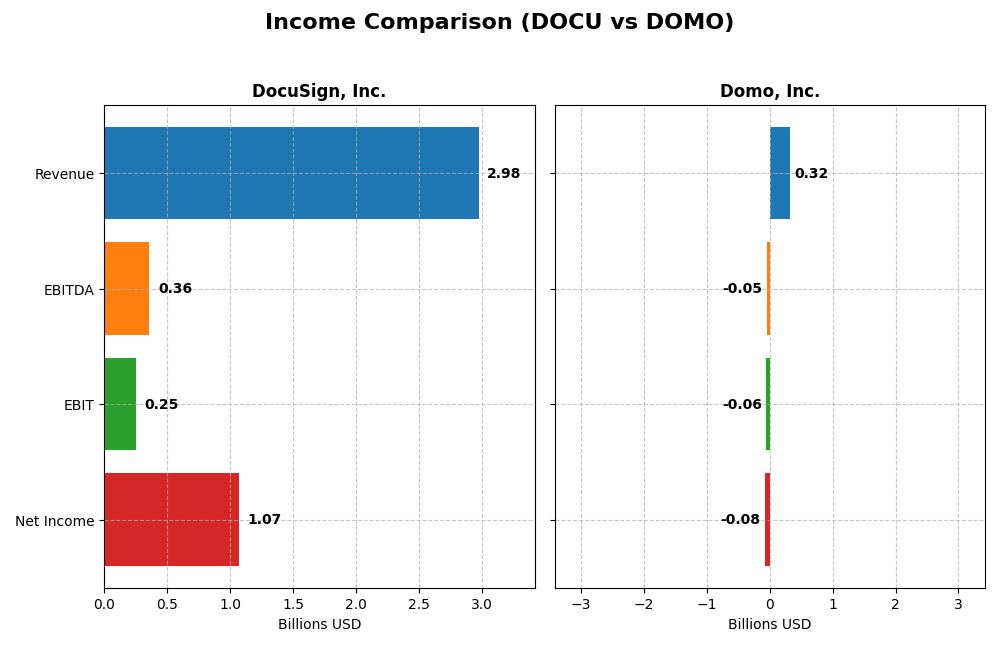
This table presents a side-by-side comparison of key income statement metrics for DocuSign, Inc. and Domo, Inc. based on their most recent fiscal year results.
| Metric | DocuSign, Inc. (DOCU) | Domo, Inc. (DOMO) |
|---|---|---|
| Market Cap | 11.4B | 257M |
| Revenue | 2.98B | 317M |
| EBITDA | 357M | -50M |
| EBIT | 249M | -59M |
| Net Income | 1.07B | -82M |
| EPS | 5.23 | -2.13 |
| Fiscal Year | 2025 | 2025 |
Income Statement Interpretations
DocuSign, Inc.
DocuSign experienced strong revenue growth from 2021 to 2025, doubling its top line with a 104.86% increase. Net income surged dramatically from losses to a positive $1.07B in 2025, while gross margin remained robust at 79.12%. The latest fiscal year showed a solid 7.78% revenue increase and a significant improvement in net margin to 35.87%, signaling enhanced profitability and operational leverage.
Domo, Inc.
Domo’s revenue grew moderately by 50.84% over the five years but declined slightly by 0.61% in the most recent year. Despite favorable gross margins at 74.45%, the company suffered persistent net losses, with a net margin of -25.84% in 2025. EBIT margin remained negative at -18.7%, and recent declines in earnings and margins indicate continuing challenges in achieving profitability.
Which one has the stronger fundamentals?
DocuSign displays stronger fundamentals with consistent revenue expansion and a sharp turnaround to profitability, supported by favorable gross and net margins. Conversely, Domo shows weaker fundamentals marked by negative earnings, declining recent revenue, and unfavorable net margin trends. Overall, DocuSign’s income statement reflects a more favorable and improving financial position relative to Domo.
Financial Ratios Comparison
The table below presents a side-by-side comparison of the key financial ratios for DocuSign, Inc. and Domo, Inc. based on their most recent full fiscal year data (2025).
| Ratios | DocuSign, Inc. (DOCU) | Domo, Inc. (DOMO) |
|---|---|---|
| ROE | 53.3% | 46.2% |
| ROIC | 9.1% | 195% |
| P/E | 18.5 | -3.98 |
| P/B | 9.87 | -1.84 |
| Current Ratio | 0.81 | 0.56 |
| Quick Ratio | 0.81 | 0.56 |
| D/E | 0.062 | -0.76 |
| Debt-to-Assets | 3.1% | 63.2% |
| Interest Coverage | 129 | -2.99 |
| Asset Turnover | 0.74 | 1.48 |
| Fixed Asset Turnover | 7.28 | 8.17 |
| Payout ratio | 0 | 0 |
| Dividend yield | 0 | 0 |
Interpretation of the Ratios
DocuSign, Inc.
DocuSign displays a slightly favorable overall ratio profile with strong net margin at 35.87% and an impressive return on equity of 53.32%, indicating efficient profitability. However, concerns exist around its low current ratio of 0.81 and a high price-to-book ratio of 9.87, suggesting liquidity constraints and potential overvaluation. The company does not pay dividends, consistent with reinvestment in growth and R&D, maintaining a zero dividend yield.
Domo, Inc.
Domo presents a mixed picture with favorable returns on equity (46.23%) and invested capital (194.73%), but a negative net margin of -25.84% and poor liquidity ratios (current ratio 0.56), highlighting operational and financial challenges. Debt-to-assets ratio is high at 63.23%, signaling leverage risk. Like DocuSign, Domo pays no dividends, likely reflecting its reinvestment strategy amid losses and high growth ambitions.
Which one has the best ratios?
DocuSign’s ratios lean more favorably due to solid profitability metrics and manageable debt levels, despite some liquidity concerns. Domo shows strong capital returns but is hampered by negative margins, weak liquidity, and high leverage. Overall, DocuSign exhibits a more balanced ratio profile, while Domo’s ratios indicate higher risk and operational challenges.
Strategic Positioning
This section compares the strategic positioning of DocuSign, Inc. and Domo, Inc. including market position, key segments, and exposure to technological disruption:
DocuSign, Inc.
- Leading e-signature software provider with strong market cap and moderate competitive pressure
- Revenue primarily from subscription services focused on digital agreements and contract management
- Invests in AI-driven contract lifecycle management and digital identity verification reducing disruption risk
Domo, Inc.
- Smaller market cap, operates in cloud-based business intelligence with higher beta risk
- Revenue mainly from subscription services providing real-time data insights and business management
- Cloud platform connecting employees to data and systems, facing high technology evolution risks
DocuSign, Inc. vs Domo, Inc. Positioning
DocuSign shows a concentrated focus on e-signature and contract management with strong subscription revenue, while Domo offers a diversified cloud BI platform emphasizing real-time data connectivity. DocuSign benefits from scale, Domo faces higher market volatility and technological exposure.
Which has the best competitive advantage?
Domo demonstrates a very favorable moat with high ROIC exceeding WACC and growing profitability, indicating durable competitive advantage. DocuSign’s moat is slightly favorable, showing growing ROIC but currently shedding value relative to cost of capital.
Stock Comparison
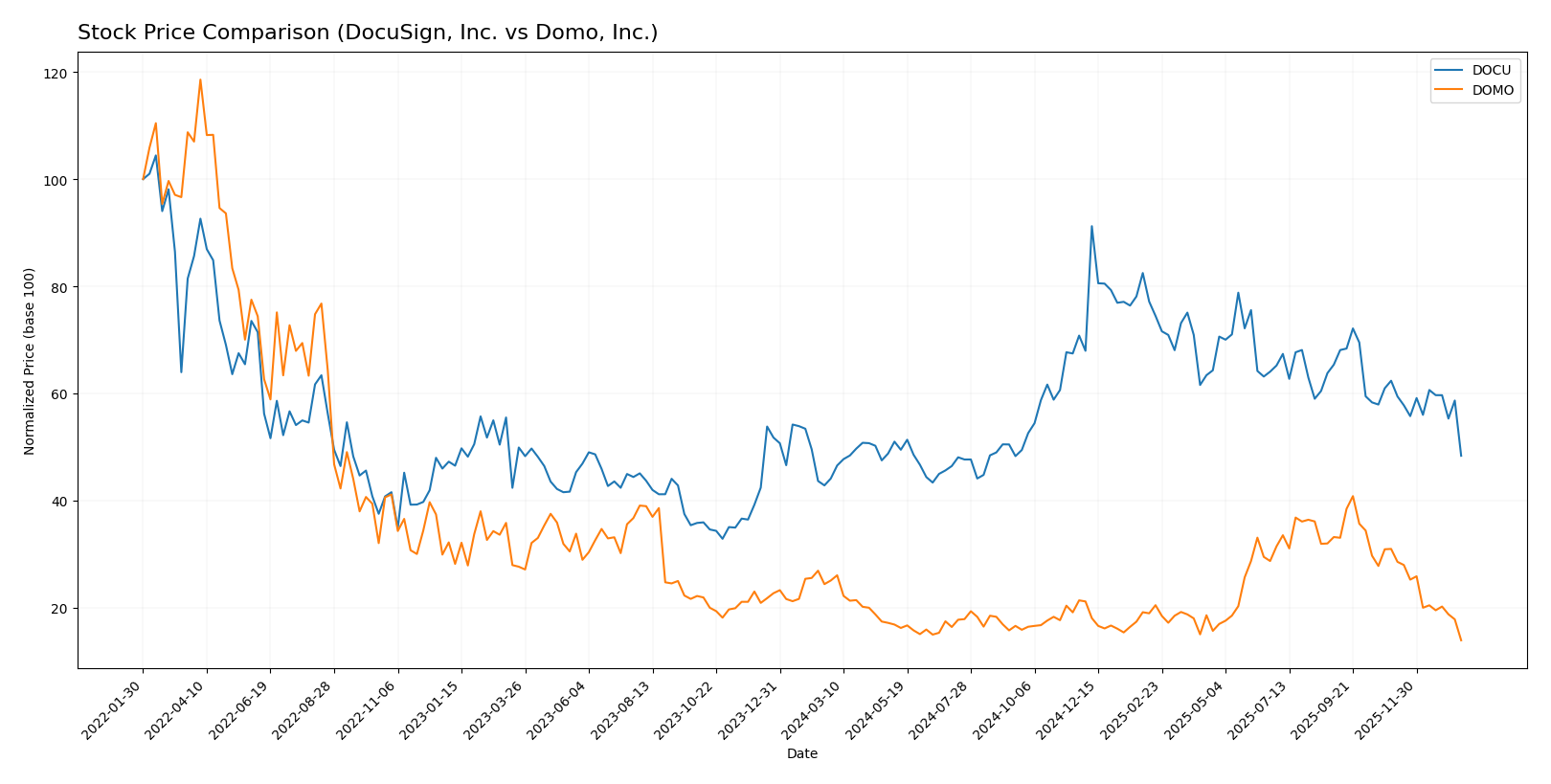
The past year revealed contrasting trading dynamics between DocuSign, Inc. and Domo, Inc., with DocuSign exhibiting a moderate bullish trend despite recent declines, while Domo faced a pronounced bearish trajectory marked by accelerating losses.
Trend Analysis
DocuSign, Inc. recorded a 9.63% price increase over the past 12 months, indicating a bullish trend with decelerating momentum and a volatility of 12.98. The stock peaked at 106.99 and bottomed at 50.84.
Domo, Inc. experienced a 44.54% decline over the same period, confirming a bearish trend with decelerating losses and lower volatility at 3.01. The highest price reached 18.06 and the lowest was 6.15.
Comparing the two, DocuSign outperformed Domo with a positive market return, while Domo’s stock showed significantly weaker performance throughout the analyzed year.
Target Prices
The current analyst consensus presents a clear outlook for DocuSign, Inc. and Domo, Inc.
| Company | Target High | Target Low | Consensus |
|---|---|---|---|
| DocuSign, Inc. | 88 | 70 | 76.86 |
| Domo, Inc. | 13 | 10 | 11.5 |
For DocuSign, the consensus target price of 76.86 USD is significantly above its current price of 56.71 USD, indicating expected upside potential. Domo’s consensus target of 11.5 USD also suggests considerable room for growth compared to its current price of 6.15 USD.
Analyst Opinions Comparison
This section compares analysts’ ratings and grades for DocuSign, Inc. (DOCU) and Domo, Inc. (DOMO):
Rating Comparison
DOCU Rating
- Rating: B+, considered Very Favorable by analysts.
- Discounted Cash Flow Score: 5, rated Very Favorable, indicating strong valuation.
- ROE Score: 4, Favorable, showing efficient profit generation from equity.
- ROA Score: 4, Favorable, showing effective asset utilization.
- Debt To Equity Score: 3, Moderate, suggesting balanced financial risk.
- Overall Score: 3, Moderate overall financial standing.
DOMO Rating
- Rating: C, also considered Very Favorable by analysts.
- Discounted Cash Flow Score: 1, rated Very Unfavorable, reflecting weak valuation.
- ROE Score: 5, Very Favorable, indicating excellent profitability from equity.
- ROA Score: 1, Very Unfavorable, indicating poor asset utilization.
- Debt To Equity Score: 1, Very Unfavorable, indicating higher financial risk.
- Overall Score: 2, Moderate but lower overall financial standing.
Which one is the best rated?
Based strictly on the provided data, DOCU holds a higher overall rating (B+) and stronger scores in discounted cash flow, ROA, and debt-to-equity measures. DOMO scores higher only in ROE but has weaker valuations and financial risk metrics, making DOCU the better rated company overall.
Scores Comparison
Here is a comparison of the financial health scores for DocuSign and Domo:
DocuSign Scores
- Altman Z-Score of 4.43, indicating a safe zone.
- Piotroski Score of 5, reflecting average financial strength.
Domo Scores
- Altman Z-Score of -10.10, indicating distress zone.
- Piotroski Score of 3, reflecting very weak financial strength.
Which company has the best scores?
DocuSign holds a significantly stronger financial position with a safe-zone Altman Z-Score and an average Piotroski score. Domo shows signs of financial distress and very weak financial health based on the provided scores.
Grades Comparison
Here is a detailed comparison of the latest grades assigned to DocuSign, Inc. and Domo, Inc.:
DocuSign, Inc. Grades
The following table summarizes recent grades from reputable financial institutions for DocuSign, Inc.:
| Grading Company | Action | New Grade | Date |
|---|---|---|---|
| RBC Capital | Maintain | Sector Perform | 2026-01-05 |
| Evercore ISI Group | Maintain | In Line | 2025-12-05 |
| UBS | Maintain | Neutral | 2025-12-05 |
| Wells Fargo | Maintain | Equal Weight | 2025-12-05 |
| Piper Sandler | Maintain | Neutral | 2025-12-05 |
| JP Morgan | Maintain | Neutral | 2025-12-05 |
| B of A Securities | Maintain | Neutral | 2025-12-05 |
| Needham | Maintain | Hold | 2025-12-05 |
| Baird | Maintain | Neutral | 2025-12-05 |
The overall rating trend for DocuSign is neutral to hold, reflecting a cautious stance with no upgrades or downgrades recently.
Domo, Inc. Grades
Below is a summary table for Domo, Inc.’s recent grades from recognized grading companies:
| Grading Company | Action | New Grade | Date |
|---|---|---|---|
| DA Davidson | Maintain | Neutral | 2025-12-05 |
| TD Cowen | Maintain | Buy | 2025-12-05 |
| Lake Street | Maintain | Hold | 2025-12-05 |
| JMP Securities | Maintain | Market Outperform | 2025-09-10 |
| Cantor Fitzgerald | Maintain | Overweight | 2025-08-28 |
Domo’s grades show a generally more positive trend, including upgrades to buy and market outperform, indicating stronger analyst confidence.
Which company has the best grades?
Domo, Inc. has received generally better grades than DocuSign, Inc., with multiple buy and outperform ratings versus DocuSign’s consistent hold and neutral consensus. This difference may influence investors seeking growth potential versus stability.
Strengths and Weaknesses
Below is a comparative table that highlights the key strengths and weaknesses of DocuSign, Inc. (DOCU) and Domo, Inc. (DOMO) based on their recent financial performance, market position, and operational metrics.
| Criterion | DocuSign, Inc. (DOCU) | Domo, Inc. (DOMO) |
|---|---|---|
| Diversification | Focused primarily on subscription-based e-signature services with moderate professional services revenue; limited product diversification. | Concentrated on subscription analytics and professional services; narrower product range but consistent revenue growth. |
| Profitability | Net margin at 35.87%, strong ROE at 53.32%, but neutral ROIC; slightly favorable overall profitability. | Negative net margin (-25.84%) despite high ROE (46.23%) and exceptional ROIC; profitability challenged by high costs. |
| Innovation | Moderate innovation reflected in steady revenue growth and growing ROIC trend; slightly favorable competitive moat. | High innovation capacity indicated by very favorable moat and rapidly growing ROIC; strong value creation. |
| Global presence | Well-established global footprint with strong subscription revenue of ~2.9B USD in 2025. | Smaller global presence with total subscription revenue of ~286M USD in 2025; growing but less expansive. |
| Market Share | Leading position in e-signature and agreement cloud market segments; strong recurring revenue base. | Emerging player in business intelligence and analytics with growing but limited market share. |
Key takeaways: DocuSign demonstrates stable profitability and market leadership with a slightly favorable moat, though diversification is limited. Domo shows strong innovation and value creation but struggles with profitability and scale, resulting in a more balanced risk profile for investors.
Risk Analysis
Below is a comparison table of key risks for DocuSign, Inc. (DOCU) and Domo, Inc. (DOMO) based on the latest available data for 2025:
| Metric | DocuSign, Inc. (DOCU) | Domo, Inc. (DOMO) |
|---|---|---|
| Market Risk | Moderate (Beta 0.99) | High (Beta 1.65) |
| Debt Level | Low (Debt-to-Assets 3.1%) | High (Debt-to-Assets 63.23%) |
| Regulatory Risk | Moderate (Tech sector, global compliance) | Moderate (Tech sector, global compliance) |
| Operational Risk | Moderate (Scale with 6.8K employees) | Moderate-High (Smaller scale, 888 employees) |
| Environmental Risk | Low (Software industry, minimal footprint) | Low (Software industry, minimal footprint) |
| Geopolitical Risk | Moderate (US-based, international exposure) | Moderate (US-based, international exposure) |
DocuSign presents a lower market and financial risk profile with low debt and a stable beta near 1. Its operational scale adds complexity but is well managed. Domo shows elevated market and financial risks due to higher beta and very high debt levels, with distress signals from its negative Altman Z-Score and weak Piotroski score. The most impactful risks for investors are Domo’s financial distress and high leverage, contrasting with DocuSign’s stronger balance sheet and moderate operational risks.
Which Stock to Choose?
DocuSign, Inc. (DOCU) shows a favorable income evolution with strong net margin growth of 314% over 2021-2025 and a slightly favorable global ratios opinion. Its profitability is high, with ROE at 53.32%, low debt levels, and a very favorable rating of B+. The company’s MOAT status is slightly favorable, reflecting growing ROIC but still shedding value relative to WACC.
Domo, Inc. (DOMO) exhibits an unfavorable income statement with negative net margin and declining revenue in the last year, despite a very favorable MOAT indicating value creation and strong ROIC growth. Financial ratios present a mixed picture with half favorable but also significant unfavorable scores, and a moderate rating of C. Debt levels are high with poor liquidity ratios, signaling financial risk.
Investors focused on growth and value creation might find Domo’s strong MOAT and ROIC trend appealing despite short-term earnings weakness, while those prioritizing profitability, stability, and a favorable rating may lean towards DocuSign’s consistent income growth and solid financial metrics. The choice could thus depend on the investor’s risk tolerance and preference for either improving profitability or potential value creation.
Disclaimer: Investment carries a risk of loss of initial capital. The past performance is not a reliable indicator of future results. Be sure to understand risks before making an investment decision.
Go Further
I encourage you to read the complete analyses of DocuSign, Inc. and Domo, Inc. to enhance your investment decisions: