Home > Comparison > Industrials > CSX vs WAB
The strategic rivalry between CSX Corporation and Westinghouse Air Brake Technologies Corporation shapes the landscape of the Industrials sector. CSX operates as a capital-intensive rail-based freight transportation provider, leveraging an extensive route network. In contrast, Westinghouse Air Brake focuses on high-tech equipment manufacturing and services for freight and passenger rail systems. This analysis evaluates which business model offers superior risk-adjusted returns amid evolving transportation demands and sector dynamics.
Table of contents
Companies Overview
CSX Corporation and Westinghouse Air Brake Technologies Corporation dominate distinct niches within the rail industry, shaping freight and transit dynamics.
CSX Corporation: Freight Rail Powerhouse
CSX operates a vast rail-based freight transportation network across 23 states and parts of Canada. Its core revenue comes from moving chemicals, agricultural products, automotive, and coal via a 19,500-route mile network. In 2026, CSX sharpens its focus on expanding intermodal services and enhancing rail-to-truck transfer efficiencies to capture diverse logistics demand.
Westinghouse Air Brake Technologies Corporation: Rail Technology Innovator
Westinghouse Air Brake Technologies leads in technology-driven rail equipment and service solutions for freight and passenger transit worldwide. It generates revenue by manufacturing components, locomotives, and providing overhaul services. The 2026 strategy emphasizes advancing positive train control and transit vehicle modernization to meet evolving safety and efficiency standards.
Strategic Collision: Similarities & Divergences
CSX prioritizes network scale and freight logistics, while Westinghouse invests in cutting-edge rail technology and equipment servicing. Their competition centers on freight rail modernization and transit system upgrades. CSX offers a capital-intensive transport platform; Westinghouse delivers innovation and equipment lifecycle value, defining distinct investment profiles in the rail sector.
Income Statement Comparison
This data dissects the core profitability and scalability of both corporate engines to reveal who dominates the bottom line:
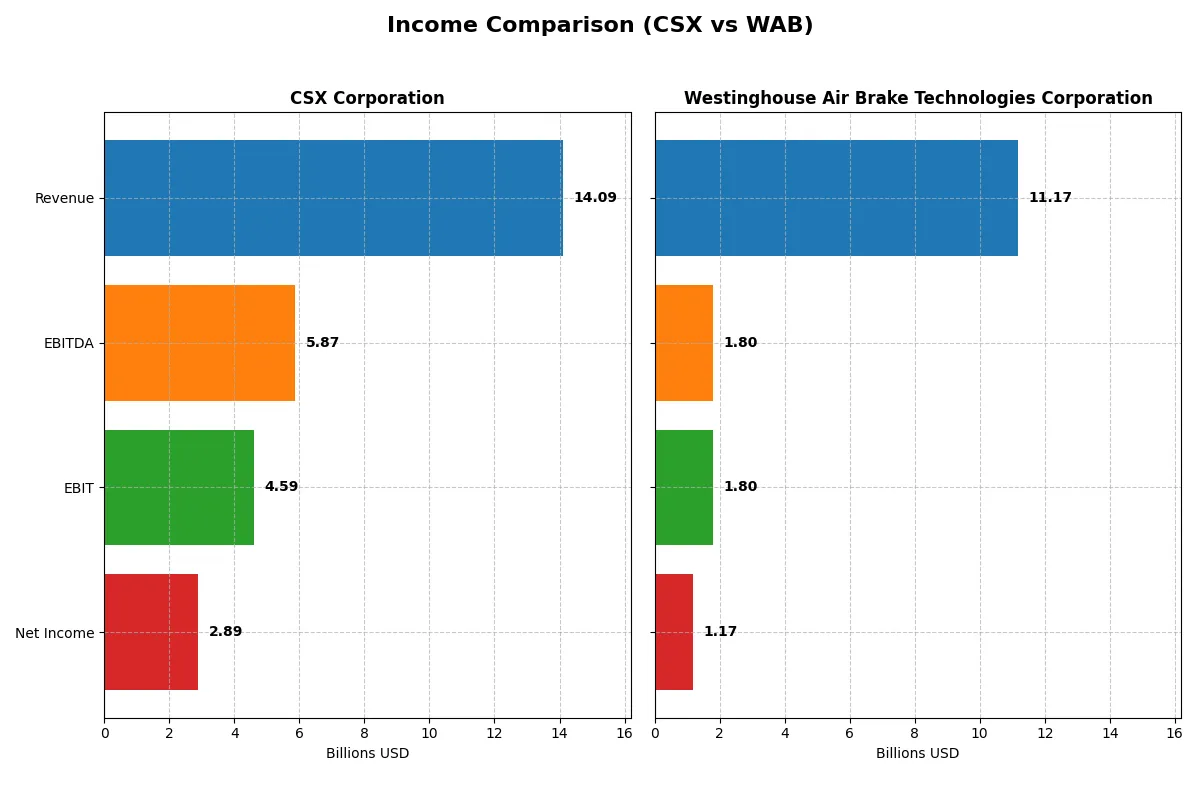
| Metric | CSX Corporation (CSX) | Westinghouse Air Brake Technologies Corporation (WAB) |
|---|---|---|
| Revenue | 14.1B | 11.2B |
| Cost of Revenue | 9.41B | 7.36B |
| Operating Expenses | 164M | 1.49B |
| Gross Profit | 4.69B | 3.81B |
| EBITDA | 5.87B | 1.81B |
| EBIT | 4.59B | 1.81B |
| Interest Expense | 844M | 225M |
| Net Income | 2.89B | 1.17B |
| EPS | 1.54 | 6.86 |
| Fiscal Year | 2025 | 2025 |
Income Statement Analysis: The Bottom-Line Duel
This income statement comparison reveals the operational efficiency and profitability momentum powering each company’s financial engine.
CSX Corporation Analysis
CSX’s revenue rose 12.5% from 2021 to 2025 but fell 3.1% in 2025 alone. Net income declined 23.6% over five years and dropped 14.1% last year. Despite this, CSX maintains a strong gross margin of 33.3% and a net margin of 20.5%, reflecting healthy profitability but recent erosion in margin momentum.
Westinghouse Air Brake Technologies Corporation Analysis
WAB’s revenue surged 42.8% over five years, growing 7.5% in 2025. Net income more than doubled, climbing 109.7% overall and rising 3.1% last year. Gross margin stands at a solid 34.1%, with a net margin of 10.5%. WAB’s consistent margin expansion and double-digit EBIT growth underscore improving operational leverage.
Margin Resilience vs. Growth Trajectory
CSX delivers superior net margins but suffers recent declines in revenue and earnings growth, signaling margin pressure. WAB shows robust revenue and net income expansion with favorable margin trends, albeit at lower absolute profitability levels. For investors, CSX offers margin strength; WAB presents compelling growth momentum and margin improvement.
Financial Ratios Comparison
These vital ratios act as a diagnostic tool to expose the underlying fiscal health, valuation premiums, and capital efficiency of the companies compared below:
| Ratios | CSX Corporation (CSX) | Westinghouse Air Brake Technologies Corporation (WAB) |
|---|---|---|
| ROE | 21.95% | 10.50% |
| ROIC | 3.92 | 7.38% |
| P/E | 23.39 | 31.11 |
| P/B | 5.13 | 3.27 |
| Current Ratio | 0.22 | 1.11 |
| Quick Ratio | 0.22 | 0.57 |
| D/E | 1.43 | 0.50 |
| Debt-to-Assets | 43.2% | 25.1% |
| Interest Coverage | 5.36 | 8.02 |
| Asset Turnover | 0.32 | 0.51 |
| Fixed Asset Turnover | 0 | 6.91 |
| Payout Ratio | 33.6% | 14.6% |
| Dividend Yield | 1.44% | 0.47% |
| Fiscal Year | 2025 | 2025 |
Efficiency & Valuation Duel: The Vital Signs
Financial ratios serve as a company’s DNA, exposing hidden risks and operational efficiency critical for investment decisions.
CSX Corporation
CSX delivers strong profitability with a 21.95% ROE and a robust 20.5% net margin, signaling operational excellence. Its P/E of 23.39 appears fairly valued, though a high P/B ratio of 5.13 and a weak current ratio of 0.22 highlight liquidity concerns. The 1.44% dividend yield offers modest shareholder returns amid limited reinvestment in R&D.
Westinghouse Air Brake Technologies Corporation
WAB shows moderate profitability with a 10.5% ROE and a 10.48% net margin, reflecting steady but less efficient operations. Its P/E of 31.11 suggests a stretched valuation. Favorable debt metrics and a solid interest coverage ratio support balance sheet strength. WAB’s low 0.47% dividend yield signals limited direct returns, with growth likely driven by capital investments.
Premium Valuation vs. Operational Safety
CSX balances superior profitability with moderate valuation but carries liquidity risks. WAB offers healthier liquidity and debt management but trades at a premium with weaker profitability. CSX suits investors prioritizing earnings efficiency; WAB fits those favoring balance sheet resilience and growth potential.
Which one offers the Superior Shareholder Reward?
I compare CSX Corporation and Westinghouse Air Brake Technologies (WAB) on dividends, buybacks, and sustainability. CSX yields ~1.4%, with a 27–34% payout ratio, supported by solid free cash flow coverage (~37–65%). WAB pays a lower yield (~0.4–0.5%) but maintains a conservative payout ratio (~13–16%) and covers dividends well with free cash flow. CSX’s payout is more generous and sustainable, paired with steady buyback activity enhancing total returns. WAB’s buybacks are less intense but it reinvests heavily in growth. I conclude CSX offers a superior total shareholder reward in 2026, balancing yield, buybacks, and long-term value creation more effectively.
Comparative Score Analysis: The Strategic Profile
The radar chart reveals the fundamental DNA and trade-offs of CSX Corporation and Westinghouse Air Brake Technologies Corporation:
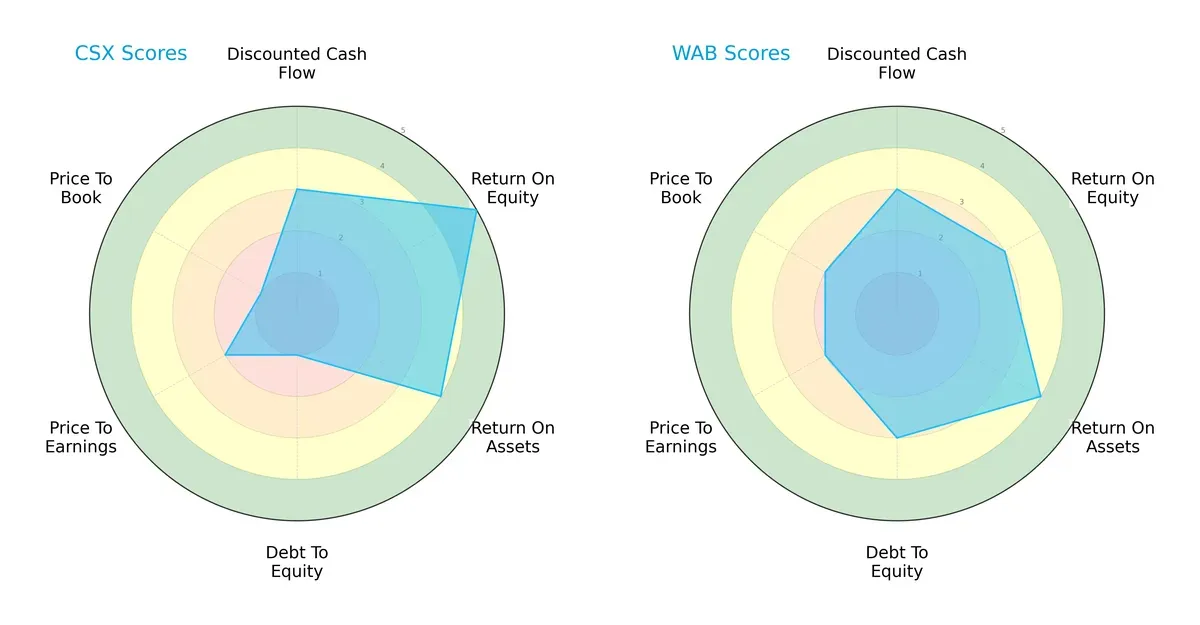
CSX leads with a stronger Return on Equity (5 vs. 3) and Return on Assets (4 vs. 4 tie), indicating superior profitability and asset utilization. However, CSX carries higher financial risk with a weak Debt-to-Equity score (1 vs. 3). Both firms share moderate DCF scores (3), but CSX’s valuation metrics lag behind WAB’s modest advantage in P/B (1 vs. 2). WAB shows a more balanced profile, relying less on leverage but lacking CSX’s profitability edge.
Bankruptcy Risk: Solvency Showdown
CSX’s Altman Z-Score of 2.10 places it in the grey zone, signaling moderate bankruptcy risk. WAB scores 3.47, comfortably in the safe zone. This gap implies WAB maintains stronger financial stability for long-term survival in this market cycle:

Financial Health: Quality of Operations
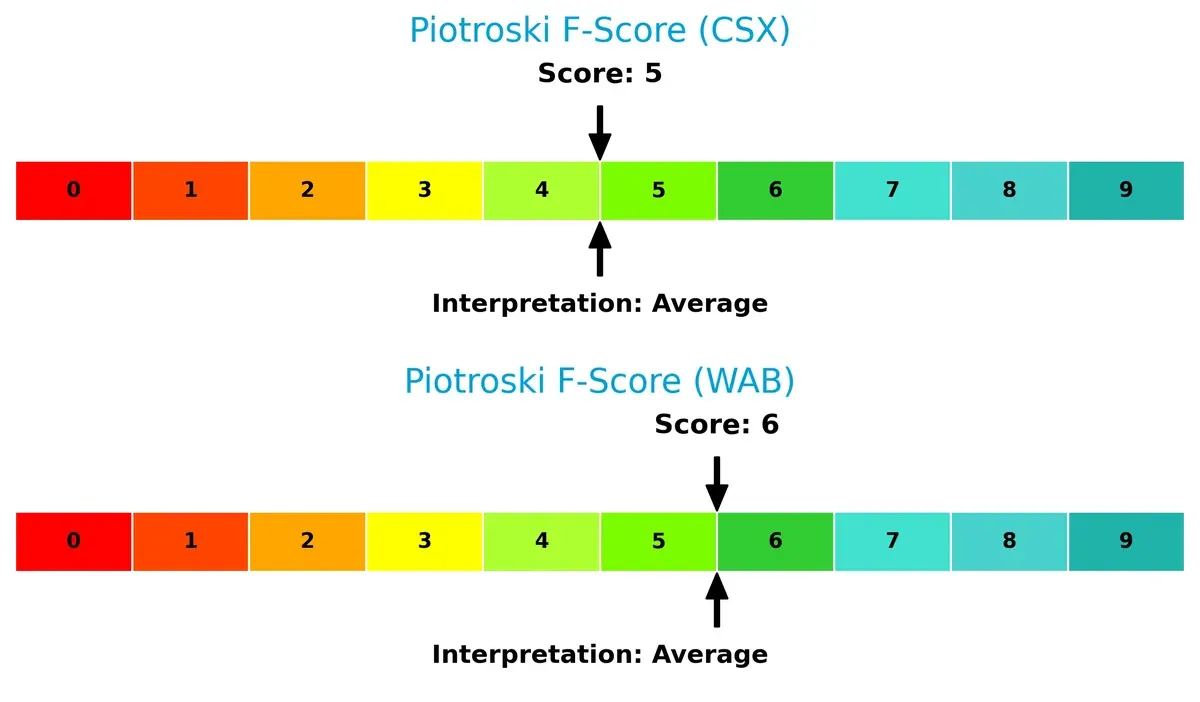
Both companies exhibit average Piotroski F-Scores, with WAB slightly ahead at 6 versus CSX’s 5. Neither shows alarming red flags, but WAB’s marginally better score suggests a modestly stronger internal financial condition:
How are the two companies positioned?
This section dissects the operational DNA of CSX and WAB by comparing their revenue distribution and internal dynamics. The goal is to confront their economic moats and identify which model offers the most resilient competitive advantage today.
Revenue Segmentation: The Strategic Mix
This visual comparison dissects how CSX Corporation and Westinghouse Air Brake Technologies diversify income streams and where their primary sector bets lie:
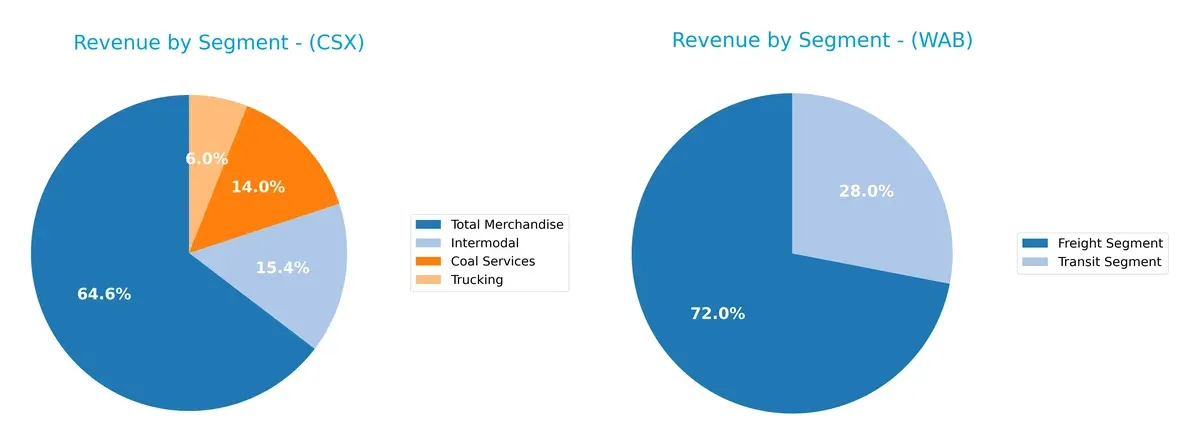
CSX relies heavily on a broad merchandise base anchored by chemicals ($2.6B), coal services ($1.9B), and intermodal ($2.1B). Its diversified segments reduce concentration risk and support ecosystem lock-in. WAB, by contrast, pivots mainly on freight ($8.0B) and transit ($3.1B) segments, showing less diversification but strong infrastructure dominance within its niche. CSX’s varied portfolio contrasts with WAB’s focused, dual-segment strategy, each reflecting distinct market moats.
Strengths and Weaknesses Comparison
This table compares the Strengths and Weaknesses of CSX Corporation and Westinghouse Air Brake Technologies Corporation:
CSX Strengths
- Diversified merchandise segments including coal, chemicals, and intermodal
- High profitability with 20.5% net margin
- Strong ROE at 21.95%
- Very high ROIC at 392% indicating efficient capital use
WAB Strengths
- Balanced revenue from freight and transit segments
- Favorable WACC at 7.8% supports lower capital costs
- Strong interest coverage of 8.02
- Low debt-to-equity ratio of 0.5 suggests conservative leverage
- Solid fixed asset turnover at 6.91
CSX Weaknesses
- Low liquidity with current ratio at 0.22, a red flag
- High debt-to-equity at 1.43 indicates elevated leverage risk
- Unfavorable asset and fixed asset turnover suggest operational inefficiency
- High price-to-book ratio at 5.13 could imply overvaluation
WAB Weaknesses
- Lower profitability with net margin at 10.48% and neutral ROE
- Unfavorable quick ratio at 0.57 hints at liquidity concerns
- Higher P/E at 31.11 may reflect stretched valuation
- Dividend yield low at 0.47%
CSX shows strong profitability and capital efficiency but faces liquidity and leverage concerns. WAB manages financial risk through lower debt and capital costs but has weaker profitability and some valuation risks. Each company’s strengths and weaknesses have clear implications for balancing growth and financial stability in their strategies.
The Moat Duel: Analyzing Competitive Defensibility
A structural moat is the only thing protecting long-term profits from the erosion of competition. Let’s dissect the moats of two industry players:
CSX Corporation: Network Effects and Scale Economies
CSX leverages an extensive rail network and scale economies that generate high ROIC, well above WACC, reflecting efficient capital use. However, recent revenue declines challenge margin stability in 2026.
Westinghouse Air Brake Technologies Corporation: Intangible Assets and Innovation
WAB’s moat centers on proprietary technology and diversified rail solutions. Despite a lower ROIC than WACC, growing profitability signals improving competitive positioning and expansion potential in global markets.
Verdict: Network Scale vs. Technological Innovation
CSX’s wider moat stems from its dominant network effects and superior capital returns. WAB shows promising innovation-driven growth but must overcome value destruction. CSX is better equipped to defend market share long term.
Which stock offers better returns?
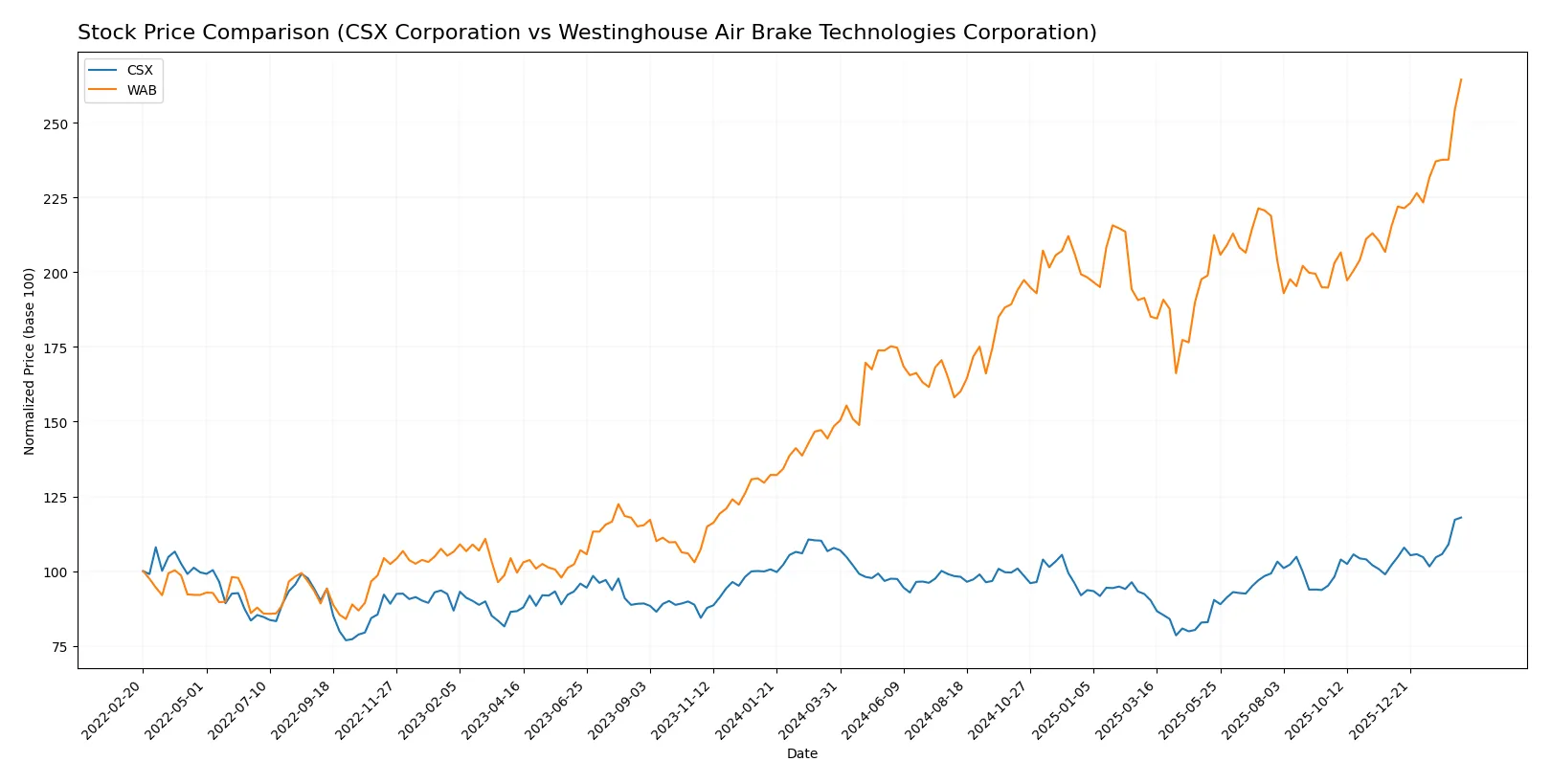
The past year shows distinct bullish momentum in both stocks, with CSX displaying steady acceleration and WAB experiencing a sharper rise amid higher volatility.
Trend Comparison
CSX Corporation’s stock price increased 9.42% over the past year, exhibiting a bullish trend with accelerating momentum and a standard deviation of 2.44, ranging between 27.21 and 40.87.
Westinghouse Air Brake Technologies Corporation’s stock surged 78.09% over the last 12 months, showing a strong bullish trend with acceleration and higher volatility at a 22.53 standard deviation, hitting a low of 143.78 and a high of 256.06.
WAB outperformed CSX significantly in market returns, delivering the highest price appreciation and stronger recent momentum despite elevated volatility.
Target Prices
Analysts present a solid consensus on target prices for CSX Corporation and Westinghouse Air Brake Technologies Corporation.
| Company | Target Low | Target High | Consensus |
|---|---|---|---|
| CSX Corporation | 30 | 45 | 39.11 |
| Westinghouse Air Brake Technologies Corporation | 221 | 308 | 267.6 |
The consensus targets for CSX suggest modest upside potential compared to the current price of $40.87. Westinghouse Air Brake’s targets indicate a potential 5% upside from the current $256.06, reflecting cautious optimism.

Don’t Let Luck Decide Your Entry Point
Optimize your entry points with our advanced ProRealTime indicators. You’ll get efficient buy signals with precise price targets for maximum performance. Start outperforming now!
How do institutions grade them?
The following tables summarize recent grades assigned to CSX Corporation and Westinghouse Air Brake Technologies Corporation by major financial institutions:
CSX Corporation Grades
This table lists CSX’s latest analyst ratings from reputable financial firms.
| Grading Company | Action | New Grade | Date |
|---|---|---|---|
| Citigroup | Maintain | Buy | 2026-01-23 |
| Bernstein | Maintain | Market Perform | 2026-01-23 |
| Evercore ISI Group | Maintain | Outperform | 2026-01-23 |
| JP Morgan | Maintain | Overweight | 2026-01-12 |
| Morgan Stanley | Maintain | Equal Weight | 2025-12-08 |
| JP Morgan | Maintain | Overweight | 2025-10-20 |
| Barclays | Maintain | Overweight | 2025-10-20 |
| Baird | Maintain | Outperform | 2025-10-20 |
| TD Cowen | Maintain | Buy | 2025-10-17 |
| UBS | Maintain | Buy | 2025-10-17 |
Westinghouse Air Brake Technologies Corporation Grades
This table shows recent analyst ratings for Westinghouse Air Brake Technologies from established firms.
| Grading Company | Action | New Grade | Date |
|---|---|---|---|
| Wells Fargo | Maintain | Equal Weight | 2026-02-13 |
| Stephens & Co. | Maintain | Overweight | 2026-02-12 |
| Keybanc | Maintain | Overweight | 2026-02-12 |
| Citigroup | Maintain | Buy | 2026-02-12 |
| Susquehanna | Maintain | Positive | 2026-01-26 |
| JP Morgan | Maintain | Neutral | 2026-01-14 |
| Morgan Stanley | Maintain | Overweight | 2026-01-12 |
| Citigroup | Maintain | Buy | 2026-01-09 |
| Wolfe Research | Upgrade | Outperform | 2026-01-08 |
| Wells Fargo | Maintain | Equal Weight | 2025-12-17 |
Which company has the best grades?
CSX Corporation holds consistently positive grades, including multiple Buy, Outperform, and Overweight ratings. Westinghouse Air Brake also receives favorable marks but has a wider range from Neutral to Outperform. Investors may view CSX’s more uniform strong ratings as a sign of broader analyst confidence.
Risks specific to each company
The following categories identify the critical pressure points and systemic threats facing both firms in the 2026 market environment:
1. Market & Competition
CSX Corporation
- Operates in a mature rail freight market with significant competition from trucking and logistics firms.
Westinghouse Air Brake Technologies Corporation
- Faces strong competition in rail equipment manufacturing and transit solutions globally, with technological innovation pressure.
2. Capital Structure & Debt
CSX Corporation
- High debt-to-equity ratio (1.43) signals elevated financial leverage and higher risk exposure.
Westinghouse Air Brake Technologies Corporation
- Maintains conservative debt-to-equity (0.5), indicating stronger balance sheet stability and lower financial risk.
3. Stock Volatility
CSX Corporation
- Beta of 1.29 shows higher stock volatility than the market, increasing risk in turbulent times.
Westinghouse Air Brake Technologies Corporation
- Beta near 1.015 suggests stock moves close to market average, reflecting moderate volatility.
4. Regulatory & Legal
CSX Corporation
- Subject to stringent transportation safety and environmental regulations in North America.
Westinghouse Air Brake Technologies Corporation
- Faces complex regulatory standards in global operations spanning safety, emissions, and transit infrastructure.
5. Supply Chain & Operations
CSX Corporation
- Operations depend on extensive rail network maintenance; vulnerable to infrastructure disruptions.
Westinghouse Air Brake Technologies Corporation
- Relies on global manufacturing supply chains with exposure to component shortages and logistics delays.
6. ESG & Climate Transition
CSX Corporation
- Increasing pressure to reduce carbon footprint in freight transport; transition risks present.
Westinghouse Air Brake Technologies Corporation
- Must innovate in eco-friendly transit technologies to meet climate goals and regulatory demands.
7. Geopolitical Exposure
CSX Corporation
- Primarily North American operations limit international geopolitical risks.
Westinghouse Air Brake Technologies Corporation
- Global footprint exposes WAB to geopolitical tensions affecting supply chains and market access.
Which company shows a better risk-adjusted profile?
CSX’s most critical risk lies in its stretched capital structure with high leverage, raising financial vulnerability. WAB faces significant market competition and global regulatory complexity but benefits from a stronger balance sheet and lower volatility. I observe that WAB’s safer debt levels and Altman Z-Score in the safe zone provide a more stable risk-adjusted profile compared to CSX’s higher leverage and grey zone distress score. WAB’s moderate stock volatility and better interest coverage further underline its relative resilience.
Final Verdict: Which stock to choose?
CSX Corporation’s superpower lies in its robust value creation, evidenced by a very favorable moat with a growing ROIC well above its cost of capital. This efficiency in capital allocation fuels long-term profitability. Its point of vigilance is a weak liquidity position, which may pressure short-term operations. CSX fits aggressive growth portfolios willing to embrace operational risks for steady value creation.
Westinghouse Air Brake Technologies commands a strategic moat through its niche in industrial technology and improving profitability. Its stronger liquidity and lower leverage offer a safer profile relative to CSX. The company’s steady revenue and earnings growth position it well for GARP (Growth at a Reasonable Price) investors who prioritize stability alongside growth potential.
If you prioritize durable competitive advantage and efficient capital returns, CSX outshines with its superior value creation despite liquidity risks. However, if you seek better financial stability and consistent earnings growth with moderate risk, WAB offers a more balanced profile. Both present analytical scenarios suitable for distinct investor strategies, emphasizing the importance of aligning stock selection with individual risk tolerance and portfolio goals.
Disclaimer: Investment carries a risk of loss of initial capital. The past performance is not a reliable indicator of future results. Be sure to understand risks before making an investment decision.
Go Further
I encourage you to read the complete analyses of CSX Corporation and Westinghouse Air Brake Technologies Corporation to enhance your investment decisions: