In the dynamic world of consumer goods, The Clorox Company (CLX) and Coty Inc. (COTY) stand out as influential players within the household and personal products industry. Both companies compete in overlapping markets, leveraging innovation to capture consumer preferences from cleaning essentials to beauty products. This comparison will highlight their strategic strengths and risks, guiding you to the most compelling investment choice in 2026. Let’s explore which company deserves a spot in your portfolio.
Table of contents
Companies Overview
I will begin the comparison between The Clorox Company and Coty Inc. by providing an overview of these two companies and their main differences.
The Clorox Company Overview
The Clorox Company operates globally in the Household & Personal Products industry, focusing on manufacturing and marketing consumer and professional products. It segments its business into Health and Wellness, Household, Lifestyle, and International, offering well-known brands such as Clorox, Glad, Brita, and Burt’s Bees. Founded in 1913 and headquartered in Oakland, California, Clorox leverages diverse distribution channels including retail, e-commerce, and direct sales.
Coty Inc. Overview
Coty Inc., based in New York City and founded in 1904, specializes in beauty products including prestige fragrances, skin care, and color cosmetics. It markets its portfolio through prestige retailers and mass-market outlets, with brands like Calvin Klein, Gucci, CoverGirl, and Max Factor. Coty distributes products across approximately 150 countries and operates as a subsidiary of Cottage Holdco B.V., focusing on both direct-to-consumer and third-party channels.
Key similarities and differences
Both companies operate within the consumer defensive sector, focusing on personal and household products with global reach. Clorox emphasizes cleaning, health, and lifestyle products across multiple segments, while Coty concentrates on beauty and cosmetics with a blend of prestige and mass-market brands. Distribution strategies overlap, yet Clorox has a broader product category scope, whereas Coty is more specialized in beauty and fragrance markets.
Income Statement Comparison
The table below compares key income statement metrics for The Clorox Company (CLX) and Coty Inc. (COTY) for their most recent fiscal year, 2025.
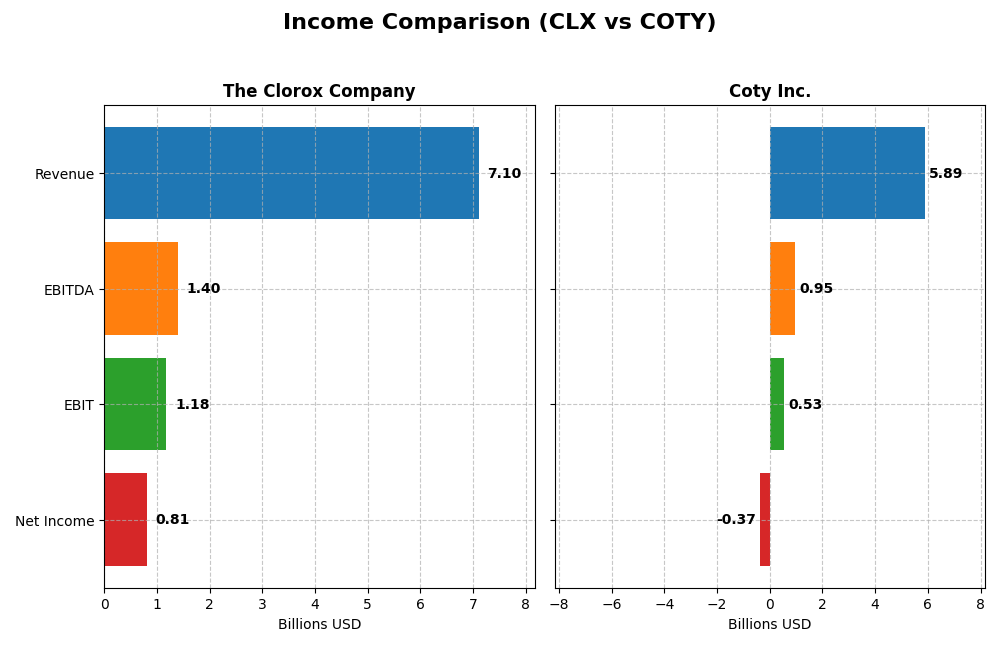
| Metric | The Clorox Company (CLX) | Coty Inc. (COTY) |
|---|---|---|
| Market Cap | 13.0B | 2.8B |
| Revenue | 7.10B | 5.89B |
| EBITDA | 1.40B | 950M |
| EBIT | 1.18B | 530M |
| Net Income | 810M | -368M |
| EPS | 6.56 | -0.44 |
| Fiscal Year | 2025 | 2025 |
Income Statement Interpretations
The Clorox Company
The Clorox Company experienced relatively stable revenue around 7.1B over 2021-2025, with a slight decline overall but a marginal increase in the latest year. Net income showed a positive trend, rising significantly to 810M in 2025. Margins improved notably, with gross margin at 44.96% and net margin at 11.4% in 2025, reflecting enhanced profitability and operational efficiency despite modest revenue growth.
Coty Inc.
Coty Inc. demonstrated overall revenue growth of 27.3% from 2021 to 2025 but faced a decline in the latest year to 5.89B. Net income deteriorated sharply, posting a loss of 368M in 2025 after prior positive results. While gross margin remained favorable at 64.84%, net margin was negative at -6.24%, indicating profitability challenges and increased expenses impacting the bottom line in the most recent fiscal year.
Which one has the stronger fundamentals?
The Clorox Company shows stronger fundamentals with consistent profitability gains, favorable margin improvements, and positive net income growth over the period. Conversely, Coty faces unfavorable income statement trends, including declining net income and negative net margins despite revenue growth. Clorox’s stable margins and earnings growth position it with a more favorable income statement profile relative to Coty.
Financial Ratios Comparison
The table below compares key financial ratios for The Clorox Company (CLX) and Coty Inc. (COTY) based on their most recent fiscal year data ending June 30, 2025.
| Ratios | The Clorox Company (CLX) | Coty Inc. (COTY) |
|---|---|---|
| ROE | 2.52% | -9.98% |
| ROIC | 24.14% | 2.55% |
| P/E | 18.31 | -11.02 |
| P/B | 46.20 | 1.10 |
| Current Ratio | 0.84 | 0.77 |
| Quick Ratio | 0.57 | 0.46 |
| D/E | 8.97 | 1.15 |
| Debt-to-Assets | 51.79% | 35.65% |
| Interest Coverage | 11.67 | 1.06 |
| Asset Turnover | 1.28 | 0.49 |
| Fixed Asset Turnover | 4.44 | 6.04 |
| Payout Ratio | 74.32% | -3.62% |
| Dividend Yield | 4.06% | 0.33% |
Interpretation of the Ratios
The Clorox Company
The Clorox Company shows predominantly favorable financial ratios, including a strong net margin of 11.4%, an impressive return on equity of 252.34%, and a robust return on invested capital at 24.14%. However, liquidity ratios like the current ratio (0.84) and quick ratio (0.57) are weak, and the high debt-to-equity ratio of 8.97 raises concerns about leverage. Dividend yield is attractive at 4.06%, supported by a stable payout, but high leverage calls for caution in sustainability.
Coty Inc.
Coty Inc. displays several unfavorable ratios, including a negative net margin of -6.24% and a negative return on equity of -9.98%, reflecting profitability challenges. Liquidity ratios are weak, with a current ratio of 0.77 and quick ratio of 0.46, while debt levels remain moderately high with a debt-to-equity ratio of 1.15. Coty does not pay dividends, likely due to persistent losses and a focus on restructuring and growth, which affects shareholder returns.
Which one has the best ratios?
The Clorox Company clearly exhibits stronger financial health with a majority of favorable ratios, particularly in profitability and returns, despite some liquidity and leverage weaknesses. Coty Inc. struggles with negative profitability metrics and weaker liquidity, reflecting a less favorable financial position. Overall, Clorox’s ratios suggest better operational performance and shareholder value stability compared to Coty.
Strategic Positioning
This section compares the strategic positioning of The Clorox Company and Coty Inc., focusing on Market position, Key segments, and Exposure to technological disruption:
The Clorox Company
- Leading in household and personal products with lower beta and larger market cap of 13B USD.
- Diverse segments: Health and Wellness, Household, Lifestyle, and International drive revenues.
- Limited explicit exposure to technological disruption mentioned in product categories or operations.
Coty Inc.
- Smaller market cap of 2.8B USD with higher beta; operates in beauty segment facing intense competition.
- Concentrated in two segments: Prestige and Consumer Beauty products globally distributed.
- No explicit indication of technological disruption exposure in provided data.
The Clorox Company vs Coty Inc. Positioning
Clorox employs a diversified strategy across multiple consumer product segments with stable market positioning, while Coty focuses on beauty and prestige segments. Clorox’s broader product base contrasts with Coty’s concentrated segment specialization, each presenting distinct scale and risk profiles.
Which has the best competitive advantage?
Clorox demonstrates a very favorable moat with a durable competitive advantage and value creation, while Coty shows a slightly unfavorable moat, indicating value destruction despite growing profitability. This suggests Clorox currently holds a stronger competitive advantage.
Stock Comparison
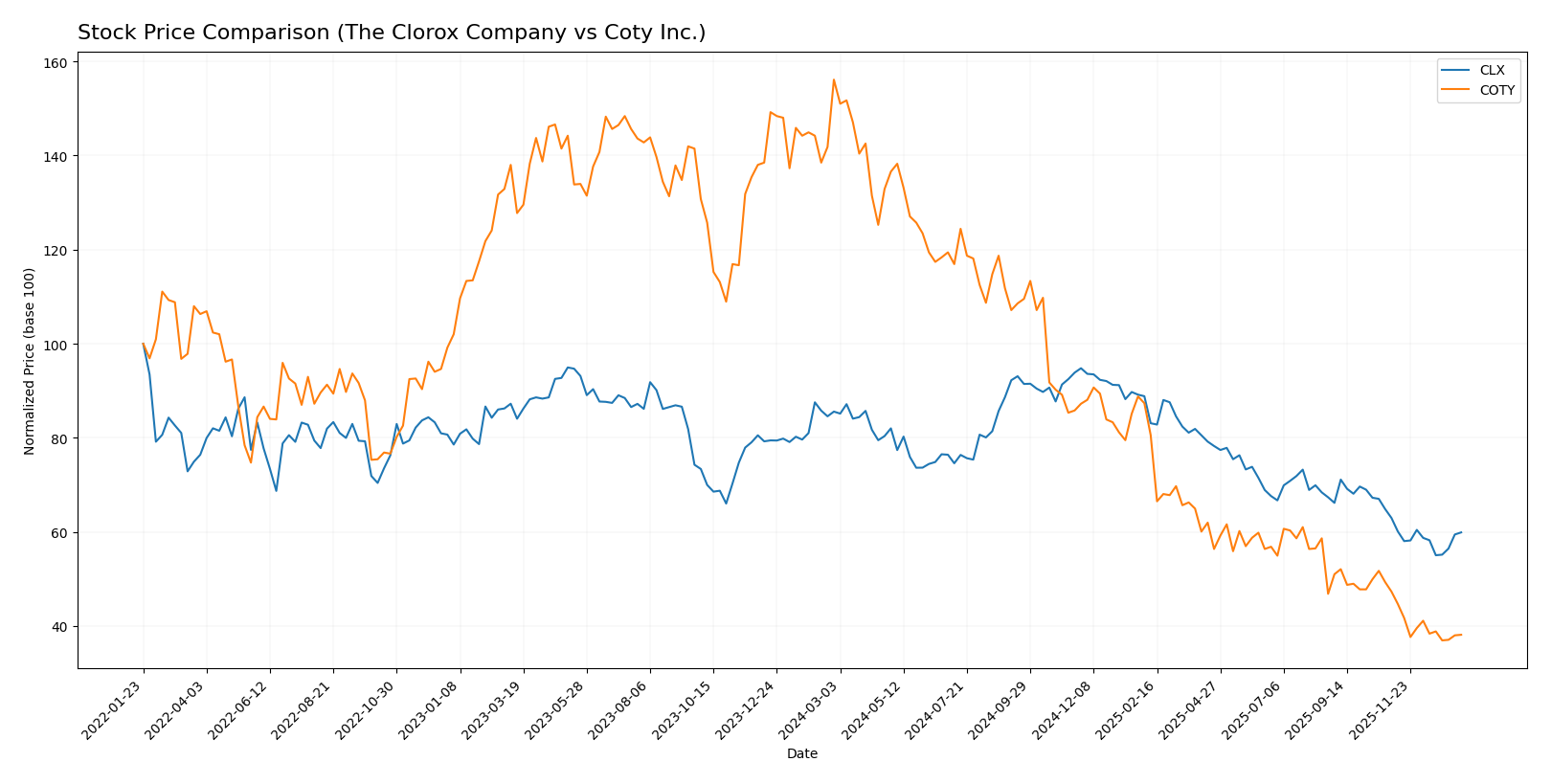
The stock price chart highlights significant bearish trends for both The Clorox Company and Coty Inc. over the past 12 months, with marked declines and distinct trading volume patterns shaping their market trajectories.
Trend Analysis
The Clorox Company (CLX) experienced a 30.01% price decline over the past year, indicating a bearish trend with deceleration. The stock showed high volatility with a standard deviation of 19.09, peaking at 169.3 and bottoming at 98.31.
Coty Inc. (COTY) posted a sharper 75.57% price drop over the same period, confirming a bearish trend with acceleration. Volatility was lower at 2.82, with a high of 13.1 and a low of 3.1, showing a sustained downward momentum.
Comparing both stocks, The Clorox Company demonstrated a less severe decline and higher volatility, delivering the stronger market performance relative to Coty Inc. during the analyzed period.
Target Prices
The current analyst consensus presents a mixed outlook for The Clorox Company and Coty Inc.
| Company | Target High | Target Low | Consensus |
|---|---|---|---|
| The Clorox Company | 152 | 94 | 118.33 |
| Coty Inc. | 10 | 3.5 | 4.95 |
For The Clorox Company, the consensus target price of 118.33 suggests a moderate upside from the current price of 106.98. Coty’s consensus target of 4.95 indicates a potential increase compared to its current price of 3.2, reflecting cautious optimism among analysts.
Analyst Opinions Comparison
This section compares analysts’ ratings and grades for The Clorox Company and Coty Inc.:
Rating Comparison
The Clorox Company Rating
- Rating: B-, classified as Very Favorable
- Discounted Cash Flow Score: 5, indicating Very Favorable valuation
- ROE Score: 1, signaling Very Unfavorable profitability from equity
- ROA Score: 5, reflecting Very Favorable asset efficiency
- Debt To Equity Score: 1, indicating Very Unfavorable financial risk
- Overall Score: 3, considered Moderate
Coty Inc. Rating
- Rating: C+, also classified as Very Favorable
- Discounted Cash Flow Score: 5, also Very Favorable valuation
- ROE Score: 1, equally Very Unfavorable
- ROA Score: 1, marked as Very Unfavorable
- Debt To Equity Score: 1, equally Very Unfavorable
- Overall Score: 2, also Moderate
Which one is the best rated?
The Clorox Company holds a higher overall score of 3 against Coty’s 2, showing a marginally better analyst rating. Both share very favorable DCF scores, but Clorox outperforms Coty notably in ROA, indicating more efficient asset use.
Scores Comparison
Here is the comparison of The Clorox Company (CLX) and Coty Inc. (COTY) based on their financial scores:
CLX Scores
- Altman Z-Score: 3.27, indicating a safe zone with low bankruptcy risk.
- Piotroski Score: 5, reflecting average financial strength.
COTY Scores
- Altman Z-Score: 0.01, indicating distress zone with high bankruptcy risk.
- Piotroski Score: 4, reflecting average financial strength.
Which company has the best scores?
CLX shows a significantly stronger Altman Z-Score, placing it in a safe zone, unlike COTY in distress. Both have average Piotroski scores, but CLX’s safer financial position stands out based on these metrics.
Grades Comparison
Here is the comparison of recent grades and ratings for The Clorox Company and Coty Inc.:
The Clorox Company Grades
This table displays grades and rating actions from verified grading companies for The Clorox Company.
| Grading Company | Action | New Grade | Date |
|---|---|---|---|
| TD Cowen | Maintain | Hold | 2026-01-08 |
| Goldman Sachs | Maintain | Sell | 2026-01-07 |
| Wells Fargo | Maintain | Equal Weight | 2026-01-05 |
| Citigroup | Maintain | Neutral | 2025-12-17 |
| Morgan Stanley | Maintain | Equal Weight | 2025-11-04 |
| JP Morgan | Maintain | Neutral | 2025-11-04 |
| Wells Fargo | Maintain | Equal Weight | 2025-11-04 |
| Citigroup | Maintain | Neutral | 2025-11-04 |
| JP Morgan | Maintain | Neutral | 2025-10-10 |
| Citigroup | Maintain | Neutral | 2025-10-09 |
The Clorox Company’s grades predominantly show maintenance of neutral to hold ratings, indicating a stable outlook without upgrades or downgrades.
Coty Inc. Grades
This table presents recent verified grading data for Coty Inc. from established financial firms.
| Grading Company | Action | New Grade | Date |
|---|---|---|---|
| Evercore ISI Group | Downgrade | In Line | 2025-12-23 |
| Citigroup | Maintain | Neutral | 2025-12-17 |
| TD Cowen | Maintain | Hold | 2025-12-12 |
| Berenberg | Downgrade | Hold | 2025-09-10 |
| Morgan Stanley | Maintain | Equal Weight | 2025-08-25 |
| RBC Capital | Maintain | Outperform | 2025-08-22 |
| Wells Fargo | Maintain | Equal Weight | 2025-08-22 |
| Goldman Sachs | Maintain | Neutral | 2025-08-22 |
| Barclays | Maintain | Underweight | 2025-08-22 |
| B of A Securities | Maintain | Underperform | 2025-08-22 |
Coty Inc. exhibits a mixed pattern with a recent downgrade and several hold and neutral ratings, alongside some outperform and underperform assessments, reflecting varied analyst perspectives.
Which company has the best grades?
Both companies hold a consensus rating of “Hold,” but The Clorox Company’s grades are more consistently neutral or hold without downgrades, whereas Coty Inc. shows recent downgrades and a wider range of opinions. This consistency could imply a steadier market perception for The Clorox Company, affecting investor confidence and risk assessment accordingly.
Strengths and Weaknesses
Below is a comparison of The Clorox Company (CLX) and Coty Inc. (COTY) based on their current diversification, profitability, innovation, global presence, and market share.
| Criterion | The Clorox Company (CLX) | Coty Inc. (COTY) |
|---|---|---|
| Diversification | Strong product range across Health & Wellness, Household, International, and Lifestyle segments totaling over $7.7B in revenue | Concentrated in Consumer Beauty and Prestige segments, around $5.9B total revenue |
| Profitability | High profitability with 11.4% net margin, 24.14% ROIC, and strong ROE at 252.34% | Negative net margin (-6.24%), low ROIC (2.55%), and negative ROE (-9.98%) |
| Innovation | Demonstrates durable competitive advantage with increasing ROIC trend (+13.7%) | Improving profitability trend but still value-destructive overall |
| Global presence | Significant international revenue (~$1.07B), supporting global footprint | Global presence mainly through prestige and beauty brands but less diversified internationally |
| Market Share | Strong market position in cleaning and household products with steady revenue growth | Market share challenged by profitability issues despite revenue in beauty segments |
The Clorox Company shows robust diversification and consistent profitability with a durable competitive advantage, making it a favorable investment. In contrast, Coty Inc. faces profitability challenges despite improving ROIC, suggesting higher risk but potential for turnaround.
Risk Analysis
Below is a comparative table summarizing key risks for The Clorox Company (CLX) and Coty Inc. (COTY) based on their latest financial and operational data from 2025.
| Metric | The Clorox Company (CLX) | Coty Inc. (COTY) |
|---|---|---|
| Market Risk | Moderate beta (0.575); stable demand in consumer products sector | Higher beta (0.958); volatile beauty market exposure |
| Debt level | High debt-to-assets ratio (51.79%); unfavorable debt/equity (8.97) | Moderate debt-to-assets (35.65%); debt/equity at 1.15, still concerning |
| Regulatory Risk | Moderate; operates globally with standard compliance | Moderate; global footprint with cosmetic regulations |
| Operational Risk | Low; diversified product portfolio and stable operations | Higher; weaker margins and operational efficiency |
| Environmental Risk | Moderate; consumer goods industry with sustainability pressures | Moderate; beauty industry increasingly scrutinized for sustainability |
| Geopolitical Risk | Moderate exposure via international segment | Moderate exposure via global distribution network |
In synthesis, Coty faces more pronounced financial and operational risks, indicated by its negative net margin (-6.24%) and low interest coverage (2.33), increasing vulnerability. Clorox’s higher leverage is a caution point but is offset by solid profitability and strong cash flow metrics. Investors should weigh Coty’s bankruptcy risk (Altman Z-score in distress zone at 0.01) against Clorox’s safer financial position (Altman Z-score 3.27 in safe zone). Market and geopolitical risks remain moderate for both, tied to their international operations.
Which Stock to Choose?
The Clorox Company (CLX) shows a generally favorable income evolution with improving profitability, reflected in a strong net margin of 11.4% and a 1-year net margin growth of 188.84%. Its financial ratios are mostly favorable, including a high ROE of 252.34%, though some liquidity and debt metrics appear unfavorable. The company’s debt level is significant, but its rating remains very favorable with a B- grade and a safe Altman Z-score of 3.27. CLX demonstrates a very favorable moat, indicating durable competitive advantage and value creation.
Coty Inc. (COTY) presents an unfavorable income evolution marked by a negative net margin of -6.24% and declining profitability, with net income growth over the period at -82.76%. Financial ratios are mostly unfavorable, including negative ROE and low asset turnover, while debt metrics are mixed with moderate debt-to-assets but unfavorable debt-to-equity. Despite a very favorable rating status with a C+ grade, the company is in financial distress per its Altman Z-score of 0.01 and shows a slightly unfavorable moat due to value destruction despite improving ROIC.
For investors, CLX might appear more favorable given its very favorable rating, positive income statement trends, and strong moat, suggesting quality and stability. Conversely, COTY’s improving ROIC but weaker financials and income may appeal to risk-tolerant investors seeking potential turnaround opportunities. Thus, choice could depend on whether an investor prioritizes durability and value creation or is willing to accept higher risk for possible recovery.
Disclaimer: Investment carries a risk of loss of initial capital. The past performance is not a reliable indicator of future results. Be sure to understand risks before making an investment decision.
Go Further
I encourage you to read the complete analyses of The Clorox Company and Coty Inc. to enhance your investment decisions: