In the competitive landscape of household and personal products, Coty Inc. and Helen of Troy Limited stand out as influential players. Both companies share a commitment to innovation and cater to diverse consumer needs across beauty, health, and home segments. This comparison dives into their market positions, product strategies, and growth potential to help you identify the most compelling investment opportunity in this dynamic sector. Let’s uncover which company deserves a spot in your portfolio.
Table of contents
Companies Overview
I will begin the comparison between Coty Inc. and Helen of Troy Limited by providing an overview of these two companies and their main differences.
Coty Inc. Overview
Coty Inc. is a US-based company engaged in the manufacture, marketing, distribution, and sale of beauty products worldwide. It offers prestige fragrances, skin care, and color cosmetics via various retail channels, including department stores and e-commerce, under well-known brands such as Calvin Klein, Gucci, and CoverGirl. Founded in 1904 and headquartered in New York City, Coty operates in the Household & Personal Products industry with a market cap of approximately 2.79B USD.
Helen of Troy Limited Overview
Helen of Troy Limited, headquartered in El Paso, Texas, is a consumer products company operating across Home & Outdoor, Health & Wellness, and Beauty segments. It offers a wide range of products including kitchen gadgets, health monitors, and beauty appliances, marketed under brands like OXO, Hydro Flask, and Braun. Incorporated in 1968, the company serves global markets with a market cap near 431M USD and is listed on NASDAQ.
Key similarities and differences
Both companies operate within the Household & Personal Products sector and focus on consumer goods distributed through diverse retail channels. Coty specializes primarily in prestige and mass-market beauty products, while Helen of Troy has a broader portfolio spanning home goods, health devices, and beauty appliances. Coty’s market cap is significantly larger than Helen of Troy’s, reflecting different scale and market positioning, with Coty emphasizing brand licensing and global fragrance distribution.
Income Statement Comparison
The table below presents a side-by-side comparison of key income statement metrics for Coty Inc. and Helen of Troy Limited for their most recent fiscal years.

| Metric | Coty Inc. (2025) | Helen of Troy Limited (2025) |
|---|---|---|
| Market Cap | 2.79B | 431M |
| Revenue | 5.89B | 1.91B |
| EBITDA | 950M | 269M |
| EBIT | 530M | 214M |
| Net Income | -368M | 124M |
| EPS | -0.44 | 5.38 |
| Fiscal Year | 2025 | 2025 |
Income Statement Interpretations
Coty Inc.
Coty’s revenue rose 27.3% from 2021 to 2025 but declined 3.7% in the latest year to $5.9B. Net income sharply dropped overall, with a loss of $367.9M in 2025 versus a $508.2M profit in 2023. Gross margin remained favorable at 64.8%, while EBIT margin held neutral at 9.0%. The recent year showed weakening profitability and deteriorating net margin to -6.2%.
Helen of Troy Limited
Helen of Troy’s revenue declined 9.1% over 2021-2025, reaching $1.9B in 2025, down 4.9% from 2024. Net income similarly decreased 51.3% over the period, settling at $123.8M. Despite this, gross margin stayed favorable at 47.9%, with EBIT and net margins improving favorably to 11.2% and 6.5%, respectively. The latest year reflected slower growth but stable margin levels.
Which one has the stronger fundamentals?
Both companies face unfavorable income growth trends and margin contractions over the long term and recent year, with Coty showing a larger net loss in 2025. Coty exhibits a higher gross margin but weaker net margin and profitability deterioration. Helen of Troy maintains consistently favorable EBIT and net margins despite revenue shrinkage. Overall, each displays challenges, with Helen of Troy showing slightly better margin stability.
Financial Ratios Comparison
The table below presents a side-by-side comparison of key financial ratios for Coty Inc. and Helen of Troy Limited, reflecting their most recent fiscal year data to help investors assess their financial health and performance.
| Ratios | Coty Inc. (2025) | Helen of Troy Limited (2025) |
|---|---|---|
| ROE | -9.98% | 7.35% |
| ROIC | 2.55% | 5.32% |
| P/E | -11.0 | 10.25 |
| P/B | 1.10 | 0.75 |
| Current Ratio | 0.77 | 2.00 |
| Quick Ratio | 0.46 | 1.03 |
| D/E (Debt-to-Equity) | 1.15 | 0.57 |
| Debt-to-Assets | 35.7% | 30.7% |
| Interest Coverage | 1.06 | 2.75 |
| Asset Turnover | 0.49 | 0.61 |
| Fixed Asset Turnover | 6.04 | 5.23 |
| Payout ratio | -3.62% | 0.0% |
| Dividend yield | 0.33% | 0.0% |
Interpretation of the Ratios
Coty Inc.
Coty’s financial ratios mostly appear weak, with unfavorable net margin (-6.24%) and return on equity (-9.98%), signaling profitability challenges. Its current and quick ratios below 1 suggest liquidity concerns, and a debt-to-equity ratio above 1 indicates elevated leverage. The company does not pay dividends, likely due to negative net income and a focus on managing leverage and operations.
Helen of Troy Limited
Helen of Troy shows a more balanced ratio profile, with neutral net margin (6.49%) and return on invested capital (5.32%), but an unfavorable return on equity (7.35%). Its liquidity ratios are strong, with a current ratio of 2.0 and a quick ratio above 1. The company pays no dividends, possibly prioritizing reinvestment or growth initiatives over shareholder distributions.
Which one has the best ratios?
Helen of Troy presents a slightly favorable ratio profile due to stronger liquidity, lower leverage, and a better overall balance of profitability metrics. Coty displays more unfavorable ratios with profitability and liquidity weaknesses, leading to a less favorable overall assessment in comparison.
Strategic Positioning
This section compares the strategic positioning of Coty Inc. and Helen of Troy Limited, including Market position, Key segments, and Exposure to technological disruption:
Coty Inc.
- Established player in beauty products with global presence, facing competitive pressure in prestige and consumer beauty markets.
- Key segments include Prestige fragrances and Consumer Beauty products, driving revenue through multiple global channels.
- Exposure to disruption is limited to beauty product innovation, with traditional retail and e-commerce distribution channels.
Helen of Troy Limited
- Operates in diverse consumer products with moderate market cap, competing in home, wellness, and beauty sectors.
- Operates through Home & Outdoor, Health & Wellness, and Beauty segments, focusing on diversified consumer goods.
- Faces technological disruption in health and wellness products, plus home environment innovations and consumer electronics.
Coty Inc. vs Helen of Troy Limited Positioning
Coty focuses on a concentrated approach in beauty products with a strong global footprint, while Helen of Troy pursues diversification across home, health, and beauty segments. Coty’s advantage lies in brand prestige; Helen of Troy benefits from segment variety and innovation exposure.
Which has the best competitive advantage?
Based on MOAT evaluation, Coty shows slightly unfavorable value destruction but improving profitability, whereas Helen of Troy faces very unfavorable value destruction with declining returns, indicating Coty has a relatively stronger competitive advantage.
Stock Comparison
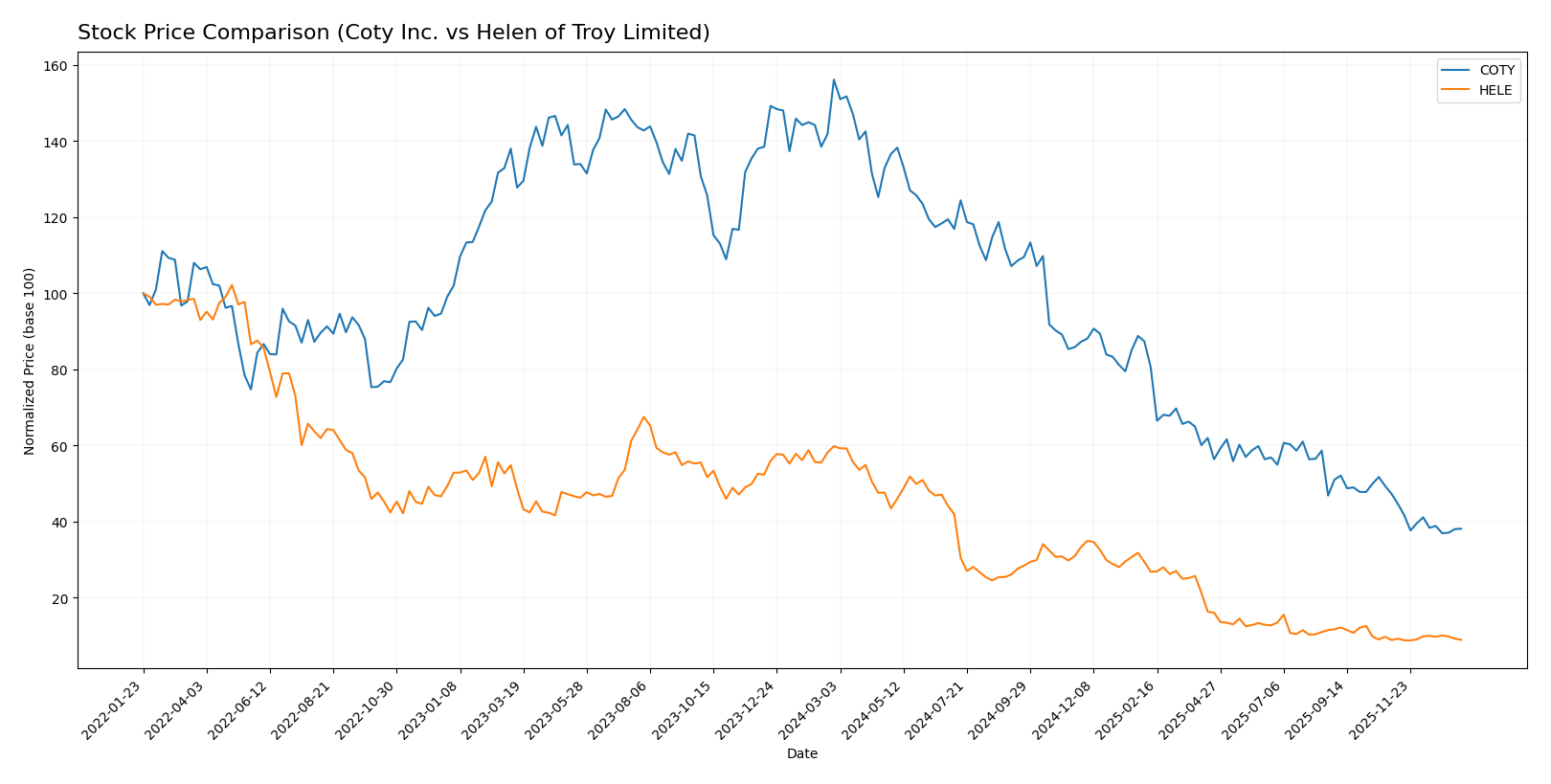
The stock prices of Coty Inc. and Helen of Troy Limited have both experienced significant declines over the past 12 months, with notable acceleration in bearish trends and varying recent price movements.
Trend Analysis
Coty Inc. shows a strong bearish trend over the past year with a price decline of -75.57% and accelerating downward momentum, hitting a low of 3.1 after a high of 13.1, supported by moderate volatility (std deviation 2.82).
Helen of Troy Limited also exhibits a bearish trend with an even steeper 12-month drop of -85.04%, accelerated decline, a wide price range from 125.57 to 18.45, and significantly higher volatility (std deviation 31.1).
Comparing both, Coty Inc. has delivered a relatively better market performance despite the bearish trend, with a smaller percentage loss than Helen of Troy Limited over the analyzed period.
Target Prices
Analysts provide a clear target price consensus for Coty Inc. and Helen of Troy Limited, indicating expected price ranges.
| Company | Target High | Target Low | Consensus |
|---|---|---|---|
| Coty Inc. | 10 | 3.5 | 4.95 |
| Helen of Troy Limited | 22 | 22 | 22 |
The consensus target for Coty Inc. at $4.95 suggests upside potential versus the current price of $3.2, while Helen of Troy’s target at $22 also indicates room for growth from its $18.78 market price.
Analyst Opinions Comparison
This section compares analysts’ ratings and grades for Coty Inc. and Helen of Troy Limited:
Rating Comparison
COTY Rating
- Rating: C+, rated as Very Favorable
- Discounted Cash Flow Score: 5, indicating Very Favorable
- ROE Score: 1, considered Very Unfavorable
- ROA Score: 1, considered Very Unfavorable
- Debt To Equity Score: 1, classified as Very Unfavorable
- Overall Score: 2, rated Moderate
HELE Rating
- Rating: B, rated as Very Favorable
- Discounted Cash Flow Score: 5, indicating Very Favorable
- ROE Score: 1, considered Very Unfavorable
- ROA Score: 1, considered Very Unfavorable
- Debt To Equity Score: 4, classified as Favorable
- Overall Score: 3, rated Moderate
Which one is the best rated?
Helen of Troy Limited is better rated overall with a higher rating grade (B vs. C+) and a stronger debt-to-equity score (4 vs. 1), despite both companies sharing very unfavorable ROE and ROA scores.
Scores Comparison
Here is a comparison of the Altman Z-Score and Piotroski Score for Coty Inc. and Helen of Troy Limited:
COTY Scores
- Altman Z-Score: 0.01, indicating financial distress and a high bankruptcy risk.
- Piotroski Score: 4, reflecting average financial strength.
HELE Scores
- Altman Z-Score: 1.10, also in financial distress zone with high bankruptcy risk.
- Piotroski Score: 3, indicating very weak financial strength.
Which company has the best scores?
Based on the provided scores, Coty has a slightly lower Altman Z-Score but a higher Piotroski Score than Helen of Troy. Coty shows average financial strength, while Helen of Troy’s scores indicate weaker financial health overall.
Grades Comparison
The following presents a comparison of recent grades and ratings from established grading companies for Coty Inc. and Helen of Troy Limited:
Coty Inc. Grades
This table summarizes recent grades given to Coty Inc. by reputable grading companies.
| Grading Company | Action | New Grade | Date |
|---|---|---|---|
| Evercore ISI Group | Downgrade | In Line | 2025-12-23 |
| Citigroup | Maintain | Neutral | 2025-12-17 |
| TD Cowen | Maintain | Hold | 2025-12-12 |
| Berenberg | Downgrade | Hold | 2025-09-10 |
| Morgan Stanley | Maintain | Equal Weight | 2025-08-25 |
| RBC Capital | Maintain | Outperform | 2025-08-22 |
| Wells Fargo | Maintain | Equal Weight | 2025-08-22 |
| Goldman Sachs | Maintain | Neutral | 2025-08-22 |
| Barclays | Maintain | Underweight | 2025-08-22 |
| B of A Securities | Maintain | Underperform | 2025-08-22 |
Overall, Coty Inc.’s grades show a predominance of Hold and Neutral ratings with some downgrades and a few Outperform ratings, indicating a cautious market sentiment.
Helen of Troy Limited Grades
The following table lists recent grades assigned to Helen of Troy Limited by recognized grading firms.
| Grading Company | Action | New Grade | Date |
|---|---|---|---|
| UBS | Maintain | Neutral | 2026-01-09 |
| Canaccord Genuity | Maintain | Hold | 2026-01-09 |
| Canaccord Genuity | Maintain | Hold | 2026-01-06 |
| UBS | Maintain | Neutral | 2025-10-10 |
| Canaccord Genuity | Maintain | Hold | 2025-10-10 |
| UBS | Maintain | Neutral | 2025-10-02 |
| Canaccord Genuity | Downgrade | Hold | 2025-07-11 |
| UBS | Maintain | Neutral | 2025-07-11 |
| Canaccord Genuity | Maintain | Buy | 2025-07-07 |
| Canaccord Genuity | Maintain | Buy | 2025-04-25 |
Helen of Troy Limited’s ratings mainly consist of Hold and Neutral grades with some Buy ratings maintained, reflecting a generally stable but cautious stance.
Which company has the best grades?
Both Coty Inc. and Helen of Troy Limited have predominantly Hold and Neutral grades, but Coty shows more downgrades and lower ratings such as Underweight and Underperform. Helen of Troy has maintained some Buy ratings, suggesting slightly more positive analyst sentiment that may influence investor confidence differently.
Strengths and Weaknesses
Below is a comparison of key strengths and weaknesses for Coty Inc. and Helen of Troy Limited based on recent financial and strategic data.
| Criterion | Coty Inc. | Helen of Troy Limited |
|---|---|---|
| Diversification | Focused on beauty with Consumer Beauty & Prestige segments; Prestige leads with $3.82B in 2025 | Balanced between Beauty & Wellness ($1B) and Home & Outdoor ($906M) segments |
| Profitability | Negative net margin (-6.24%), ROIC 2.55% below WACC (5.62%) – value destroying | Moderate net margin (6.49%), ROIC 5.32% close to WACC (5.64%) – slightly favorable |
| Innovation | ROIC trend strongly positive (+2220%), showing improving efficiency | ROIC trend declining (-67%), signaling potential innovation or operational challenges |
| Global presence | Strong global brand portfolio, but liquidity ratios weak (current ratio 0.77) | Good liquidity (current ratio 2.0) and moderate debt levels support global operations |
| Market Share | Leading in prestige beauty but declining consumer beauty segment revenues since 2018 | Growing presence in beauty and wellness, stable in home/outdoor markets |
Coty shows promising profitability improvement but still struggles with value creation and liquidity. Helen of Troy is more balanced financially with a slightly favorable outlook, though its declining ROIC trend suggests caution. Investors should weigh Coty’s turnaround potential against Helen of Troy’s steadier but less dynamic profile.
Risk Analysis
Below is a summary table comparing key risks for Coty Inc. (COTY) and Helen of Troy Limited (HELE) as of 2025:
| Metric | Coty Inc. (COTY) | Helen of Troy Limited (HELE) |
|---|---|---|
| Market Risk | Moderate (Beta 0.96, volatile price range $2.94-$7.71) | Moderate (Beta 0.78, wide price range $17.01-$69.05) |
| Debt level | High (Debt-to-Equity 1.15, interest coverage 2.33) | Moderate (Debt-to-Equity 0.57, interest coverage 4.11) |
| Regulatory Risk | Moderate (Global sales, diverse brands, subject to international regulations) | Moderate (Global presence, multiple product lines subject to regulations) |
| Operational Risk | Elevated (Unfavorable net margin -6.24%, weak liquidity ratios) | Moderate (Net margin 6.49%, healthy liquidity ratios) |
| Environmental Risk | Moderate (Consumer products sector with packaging and sourcing impacts) | Moderate (Household and health products with environmental considerations) |
| Geopolitical Risk | Moderate (Exposure to ~150 countries, potential supply chain disruptions) | Moderate (Global markets including volatile regions) |
The most significant risks lie in Coty’s financial health, with high leverage and weak profitability raising concerns about solvency, as reflected by its Altman Z-score in the distress zone (0.01). Helen of Troy, while also in the distress zone by Altman Z-score (1.10), shows better liquidity and lower debt burden, making its financial risk somewhat less severe. Operational risks tied to profitability and market volatility are more pronounced for Coty, while both companies face moderate exposure to regulatory and geopolitical uncertainties given their global footprint. Investors should monitor debt management and operational efficiency closely, especially for Coty.
Which Stock to Choose?
Coty Inc. shows a declining income trend with a 3.68% revenue drop over one year and a negative net margin of -6.24%. Its financial ratios are mostly unfavorable, including a low current ratio of 0.77 and negative returns on equity (-9.98%) and invested capital (2.55%). The company carries significant debt and has a moderate rating of C+ with a very favorable discounted cash flow score but weak profitability scores.
Helen of Troy Limited’s income also declined, with a 4.86% revenue decrease and a positive net margin of 6.49%. Its financial ratios are slightly more favorable, with a strong current ratio near 2.0 and moderate returns on equity (7.35%) and invested capital (5.32%). Debt levels are moderate, supported by a B rating, very favorable discounted cash flow, and mixed profitability scores.
The choice between these stocks might appear to depend on the investor’s profile: those seeking potentially higher growth despite weaker profitability might consider Coty, which shows improving ROIC despite value destruction. Conversely, investors favoring a slightly more stable financial structure and better liquidity could lean toward Helen of Troy, despite its declining profitability trend and very unfavorable moat status.
Disclaimer: Investment carries a risk of loss of initial capital. The past performance is not a reliable indicator of future results. Be sure to understand risks before making an investment decision.
Go Further
I encourage you to read the complete analyses of Coty Inc. and Helen of Troy Limited to enhance your investment decisions: