Duke Energy Corporation and Consolidated Edison, Inc. are two leading players in the regulated electric utility sector, serving millions of customers across key U.S. regions. Their overlapping markets and commitment to integrating renewable energy highlight their innovative approaches in a traditionally stable industry. For investors seeking clarity in utility stocks, this article will reveal which company offers the most compelling investment opportunity in 2026.
Table of contents
Companies Overview
I will begin the comparison between Duke Energy Corporation and Consolidated Edison by providing an overview of these two companies and their main differences.
Duke Energy Corporation Overview
Duke Energy Corporation operates as a major energy company in the US, serving approximately 8.2M customers across six states in the Southeast and Midwest. It focuses on electric utilities, gas utilities, and commercial renewables, with a generation capacity of roughly 50,259 MW. Duke’s energy mix includes coal, natural gas, nuclear, hydroelectric, and renewables, reflecting its diversified approach to power generation and infrastructure management.
Consolidated Edison, Inc. Overview
Consolidated Edison, Inc. delivers regulated electric, gas, and steam services primarily in New York City and Westchester County, serving around 3.5M electric customers and 1.1M gas customers. Its infrastructure includes extensive transmission and distribution networks, and it also develops renewable energy and transmission projects. The company focuses on urban utility services, supplying electricity, gas, and steam to residential, commercial, and government sectors.
Key similarities and differences
Both companies operate in the regulated electric utility sector with significant gas distribution segments and investments in renewable energy. Duke Energy serves a broader geographic area with a larger customer base and greater generation capacity, while Consolidated Edison concentrates on a dense urban market with diversified utility services including steam. Duke’s business spans multiple fuel sources, whereas Consolidated Edison emphasizes infrastructure within a highly urbanized region.
Income Statement Comparison
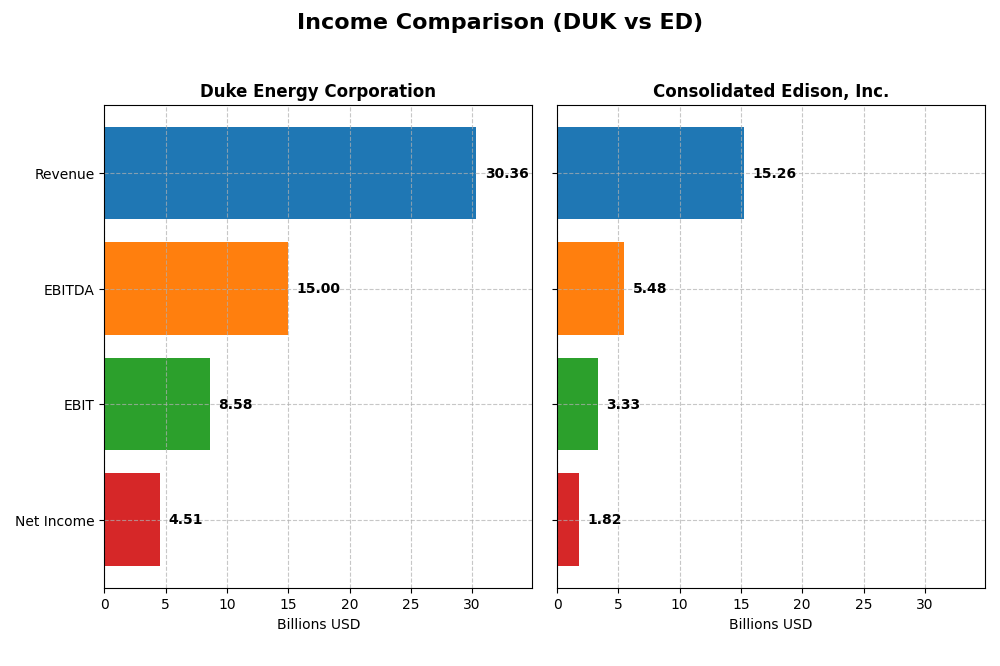
The table below summarizes the key income statement metrics for Duke Energy Corporation and Consolidated Edison, Inc. for the fiscal year 2024, providing a clear side-by-side comparison of their financial performance.
| Metric | Duke Energy Corporation | Consolidated Edison, Inc. |
|---|---|---|
| Market Cap | 90.8B | 35.8B |
| Revenue | 30.36B | 15.26B |
| EBITDA | 15.00B | 5.48B |
| EBIT | 8.58B | 3.33B |
| Net Income | 4.51B | 1.82B |
| EPS | 5.71 | 5.26 |
| Fiscal Year | 2024 | 2024 |
Income Statement Interpretations
Duke Energy Corporation
Duke Energy’s revenue rose steadily from $23.4B in 2020 to $30.4B in 2024, with net income surging from $1.38B to $4.51B. Gross and EBIT margins remained favorable, around 50% and 28% respectively. In 2024, revenue growth slowed slightly to 4.46%, yet gross profit and EBIT improved by over 10%, reflecting enhanced operational efficiency.
Consolidated Edison, Inc.
Consolidated Edison’s revenue increased from $12.2B in 2020 to $15.3B in 2024, with net income growing from $1.1B to $1.82B. Margins showed stability, with a gross margin near 64% and an EBIT margin of 21.8%. However, 2024 saw a decline in EBIT by 17.5% and net margin by 30.6%, indicating pressure on profitability despite revenue growth.
Which one has the stronger fundamentals?
Duke Energy demonstrates stronger fundamentals with consistently growing revenue and net income, favorable margin expansions, and positive EPS growth. Consolidated Edison shows good long-term revenue and net income growth, but recent declines in EBIT and net margin highlight short-term profitability challenges. Overall, Duke Energy’s income statement metrics reflect a more robust financial position.
Financial Ratios Comparison
The table below compares key financial ratios for Duke Energy Corporation (DUK) and Consolidated Edison, Inc. (ED) based on their most recent fiscal year data for 2024.
| Ratios | Duke Energy Corporation (DUK) | Consolidated Edison, Inc. (ED) |
|---|---|---|
| ROE | 8.99% | 8.29% |
| ROIC | 4.02% | 3.48% |
| P/E | 18.44 | 16.96 |
| P/B | 1.66 | 1.41 |
| Current Ratio | 0.67 | 1.04 |
| Quick Ratio | 0.44 | 0.96 |
| D/E (Debt-to-Equity) | 1.70 | 1.27 |
| Debt-to-Assets | 45.7% | 39.4% |
| Interest Coverage | 2.34 | 2.30 |
| Asset Turnover | 0.16 | 0.22 |
| Fixed Asset Turnover | 0.24 | 0.29 |
| Payout Ratio | 71.2% | 60.4% |
| Dividend Yield | 3.86% | 3.56% |
Interpretation of the Ratios
Duke Energy Corporation
Duke Energy shows a mix of ratio strengths and weaknesses with a net margin of 14.86% marked favorable, but return on equity (9.0%) and return on invested capital (4.02%) considered unfavorable. Liquidity ratios like current ratio (0.67) and quick ratio (0.44) are weak, indicating potential short-term liquidity concerns. The company offers a dividend yield of 3.86%, supported by consistent payouts, but the high debt level and low asset turnover caution on sustainability.
Consolidated Edison, Inc.
Consolidated Edison displays favorable net margin (11.93%) and price-to-book ratio (1.41), yet exhibits weaker returns on equity (8.29%) and invested capital (3.48%). Its liquidity ratios are neutral with a current ratio of 1.04. The dividend yield stands at a solid 3.56%, reflecting steady shareholder returns. Despite moderate debt levels, asset turnover ratios remain below ideal, suggesting efficiency challenges.
Which one has the best ratios?
Both companies are assessed as slightly unfavorable overall, but Consolidated Edison has a higher proportion of favorable ratios (28.57% vs. 21.43%) and better liquidity metrics. Duke Energy’s higher dividend yield contrasts with its weaker liquidity and returns. Neither company shows clear superiority across all key financial metrics, indicating balanced trade-offs for investors to consider.
Strategic Positioning
This section compares the strategic positioning of Duke Energy Corporation and Consolidated Edison, Inc., including market position, key segments, and exposure to technological disruption:
Duke Energy Corporation
- Large market cap of 90.8B with presence in Southeast and Midwest; faces regulated utility competition.
- Key segments: Electric Utilities and Infrastructure (26.8B), Gas Utilities (2.3B), Commercial Renewables (3.5 GW capacity).
- Exposure via renewables and energy storage projects; diverse fuel mix including nuclear, coal, gas, hydro, and renewables.
Consolidated Edison, Inc.
- Smaller market cap of 35.8B serving New York City metro; operates in regulated electric, gas, and steam markets.
- Key segments: Electricity (10.8B), Oil and Gas Purchased (3.1B), Steam (569M), Non-Utility Products and Services.
- Exposure through renewable and energy infrastructure projects; operates extensive transmission and distribution networks.
Duke Energy Corporation vs Consolidated Edison, Inc. Positioning
Duke Energy maintains a diversified business model with multiple segments across regions and energy types, including renewables, while Consolidated Edison focuses on a concentrated regional market with regulated electric, gas, and steam services. Duke’s scale supports varied energy sources; Con Edison’s strength lies in dense urban infrastructure.
Which has the best competitive advantage?
Neither company currently creates value above its cost of capital. Duke Energy shows a slightly unfavorable moat with improving profitability, whereas Consolidated Edison has a very unfavorable moat with declining profitability, indicating weaker competitive advantage for Con Edison.
Stock Comparison
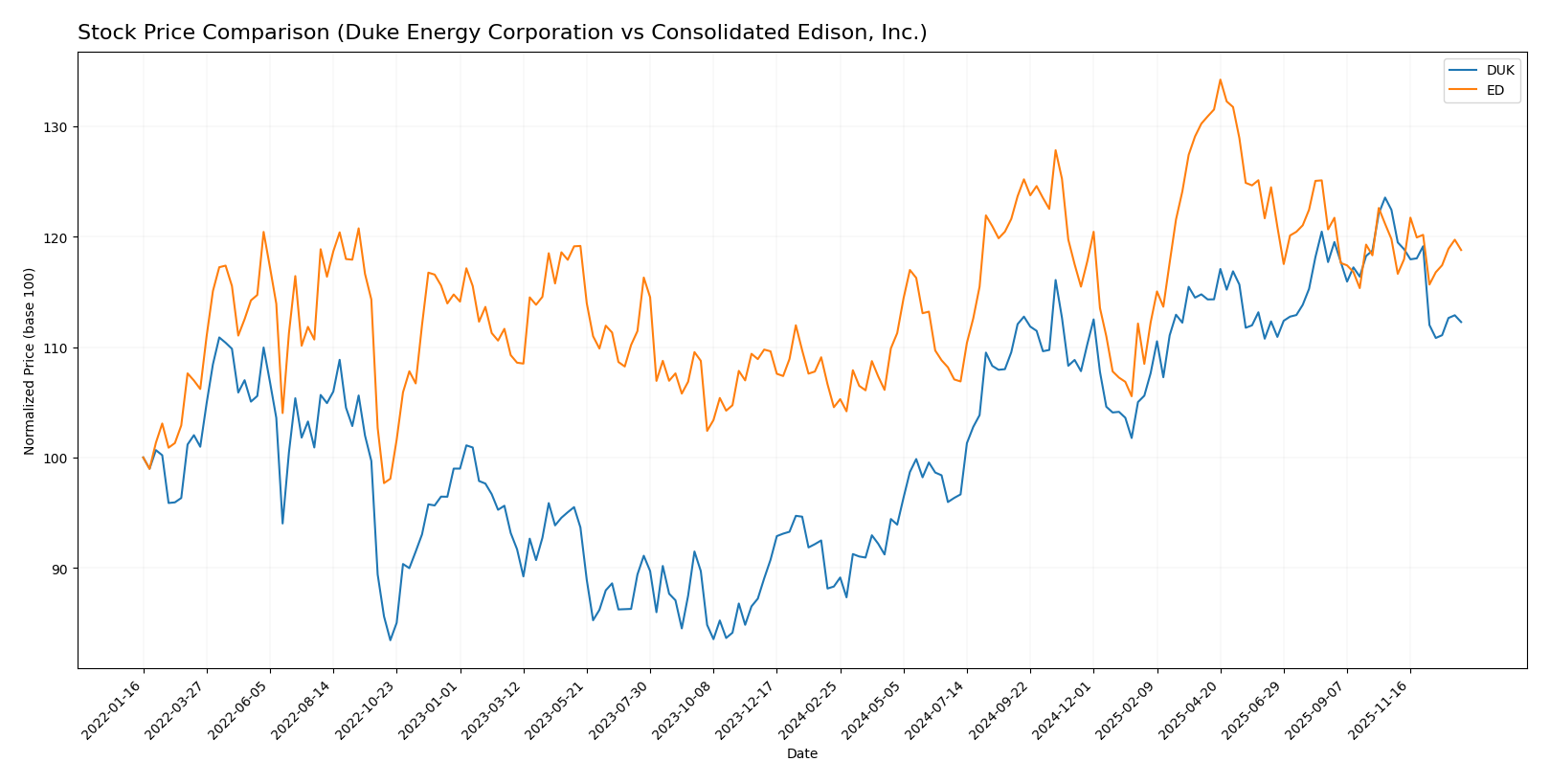
The stock prices of Duke Energy Corporation and Consolidated Edison, Inc. have shown significant movements over the past year, with Duke Energy exhibiting a stronger overall gain despite a recent downturn, while Consolidated Edison’s growth has been more moderate with near-neutral recent performance.
Trend Analysis
Duke Energy Corporation’s stock showed a bullish trend over the past 12 months with a 27.12% price increase, though the trend decelerated and recent weeks indicate an 8.3% decline, reflecting a short-term bearish phase.
Consolidated Edison, Inc. experienced a bullish trend with a 13.62% price increase over the past year, also experiencing deceleration; recent performance is nearly neutral with a slight 0.83% decrease, indicating stability.
Comparing both stocks, Duke Energy delivered the highest market performance over the past year, outperforming Consolidated Edison by a significant margin despite recent volatility.
Target Prices
The consensus target prices for Duke Energy Corporation and Consolidated Edison, Inc. indicate moderate upside potential based on current valuations.
| Company | Target High | Target Low | Consensus |
|---|---|---|---|
| Duke Energy Corporation | 150 | 126 | 135.91 |
| Consolidated Edison, Inc. | 106 | 86 | 99.86 |
Analysts expect Duke Energy’s stock to appreciate from its current price of 116.8 USD to around 136 USD on average, while Consolidated Edison’s price is close to its consensus target near 100 USD. This suggests modest growth potential with some margin of safety.
Analyst Opinions Comparison
This section compares analysts’ ratings and grades for Duke Energy Corporation and Consolidated Edison, Inc.:
Rating Comparison
DUK Rating
- Rating: C+ reflecting a very favorable rating status.
- Discounted Cash Flow Score: 1, indicating a very unfavorable valuation outlook.
- ROE Score: 3, a moderate indicator of profit generation efficiency.
- ROA Score: 3, showing moderate effectiveness in asset utilization.
- Debt To Equity Score: 2, indicating moderate financial risk.
- Overall Score: 2, representing a moderate overall financial standing.
ED Rating
- Rating: B- reflecting a very favorable rating status.
- Discounted Cash Flow Score: 1, indicating a very unfavorable valuation outlook.
- ROE Score: 3, a moderate indicator of profit generation efficiency.
- ROA Score: 3, showing moderate effectiveness in asset utilization.
- Debt To Equity Score: 2, indicating moderate financial risk.
- Overall Score: 2, representing a moderate overall financial standing.
Which one is the best rated?
Based strictly on the data, ED holds a higher letter rating of B- compared to DUK’s C+, although both share the same moderate overall score of 2 and identical sub-scores for cash flow, ROE, ROA, and debt-to-equity.
Scores Comparison
Here is a comparison of the Altman Z-Score and Piotroski Score for Duke Energy Corporation and Consolidated Edison, Inc.:
Duke Energy Corporation Scores
- Altman Z-Score: 0.71, indicating financial distress zone risk.
- Piotroski Score: 6, showing average financial strength.
Consolidated Edison, Inc. Scores
- Altman Z-Score: 1.19, also in financial distress zone.
- Piotroski Score: 7, indicating strong financial health.
Which company has the best scores?
Consolidated Edison has a higher Altman Z-Score and Piotroski Score than Duke Energy, suggesting relatively stronger financial health based on these metrics. Both remain in the distress zone for bankruptcy risk.
Grades Comparison
Here is a comparison of the recent grades assigned to Duke Energy Corporation and Consolidated Edison, Inc.:
Duke Energy Corporation Grades
The table below shows recent grade updates from reputable grading companies for Duke Energy Corporation:
| Grading Company | Action | New Grade | Date |
|---|---|---|---|
| UBS | Maintain | Neutral | 2025-12-17 |
| JP Morgan | Maintain | Neutral | 2025-12-11 |
| Mizuho | Maintain | Outperform | 2025-10-27 |
| Morgan Stanley | Maintain | Equal Weight | 2025-10-22 |
| Barclays | Maintain | Overweight | 2025-10-14 |
| UBS | Maintain | Neutral | 2025-10-10 |
| BMO Capital | Maintain | Outperform | 2025-10-10 |
| Scotiabank | Upgrade | Sector Outperform | 2025-10-03 |
| Jefferies | Downgrade | Hold | 2025-09-26 |
| Morgan Stanley | Maintain | Equal Weight | 2025-09-25 |
Duke Energy’s grades mostly cluster around Neutral to Outperform, with few downgrades and some recent upgrades, indicating a stable to moderately positive outlook from analysts.
Consolidated Edison, Inc. Grades
The table below presents the recent grades from reliable grading firms for Consolidated Edison, Inc.:
| Grading Company | Action | New Grade | Date |
|---|---|---|---|
| UBS | Maintain | Neutral | 2026-01-07 |
| UBS | Maintain | Neutral | 2025-12-17 |
| Keybanc | Maintain | Underweight | 2025-12-12 |
| JP Morgan | Maintain | Underweight | 2025-12-12 |
| Barclays | Maintain | Underweight | 2025-11-10 |
| Barclays | Maintain | Underweight | 2025-10-22 |
| Morgan Stanley | Maintain | Underweight | 2025-10-22 |
| Barclays | Maintain | Underweight | 2025-10-21 |
| Keybanc | Maintain | Underweight | 2025-10-15 |
| Morgan Stanley | Maintain | Underweight | 2025-09-25 |
Consolidated Edison consistently receives Underweight or Neutral grades, reflecting a cautious to negative stance by analysts without recent upgrades.
Which company has the best grades?
Duke Energy holds a stronger grade profile with multiple Outperform and Overweight ratings, while Consolidated Edison predominantly receives Underweight grades. This suggests Duke Energy is viewed more favorably by analysts, potentially impacting investor confidence and perceived growth prospects.
Strengths and Weaknesses
Below is a comparative overview of key strengths and weaknesses for Duke Energy Corporation (DUK) and Consolidated Edison, Inc. (ED) based on recent financial and operational data.
| Criterion | Duke Energy Corporation (DUK) | Consolidated Edison, Inc. (ED) |
|---|---|---|
| Diversification | Strong focus on Electric Utilities and Gas Infrastructure with emerging Commercial Renewables segment. | Diversified revenue streams including Electricity, Oil & Gas Purchased, Steam, and Non-Utility Products. |
| Profitability | Moderate net margin at 14.9%, but ROIC below WACC indicating value destruction despite improving trend. | Solid net margin at 11.9%, but declining ROIC below WACC signals value destruction with worsening profitability. |
| Innovation | Growing ROIC trend suggests improving operational efficiency and potential innovation benefits. | Declining ROIC trend points to challenges in innovation or operational improvements. |
| Global presence | Primarily US-focused with regulated utilities and infrastructure. | US-centric with diversified utility services but less emphasis on renewables. |
| Market Share | Large market share in electric utilities with substantial infrastructure assets. | Significant regional market presence in electricity and gas distribution. |
Key takeaways: Duke Energy shows signs of improving profitability but still destroys value overall, while Consolidated Edison faces more pronounced profitability declines. Both companies have slightly unfavorable financial ratios, with Duke leaning on infrastructure and renewables growth, and Consolidated Edison relying on diversified utility services. Investors should weigh growth potential against current value challenges.
Risk Analysis
Below is a comparative table highlighting key risks for Duke Energy Corporation (DUK) and Consolidated Edison, Inc. (ED) as of 2024 financial data:
| Metric | Duke Energy Corporation (DUK) | Consolidated Edison, Inc. (ED) |
|---|---|---|
| Market Risk | Low beta (0.49), less volatile | Very low beta (0.379), stable |
| Debt Level | High debt/equity ratio (1.7), moderate interest coverage (2.53) | Moderate debt/equity (1.27), interest coverage (2.8) |
| Regulatory Risk | High – operates in multiple regulated states with evolving policies | High – serves NYC area with stringent regulations |
| Operational Risk | Complex infrastructure, coal and nuclear exposure | Dense urban infrastructure, aging assets |
| Environmental Risk | Transitioning to renewables but still coal/nuclear reliant | Focus on renewables but urban pollution concerns |
| Geopolitical Risk | Low – primarily US operations | Low – primarily US operations |
The most impactful risks for both are regulatory and operational challenges inherent in the heavily regulated utility sector. Duke Energy’s higher leverage and reliance on traditional energy sources elevate its financial and environmental risks. Both companies’ Altman Z-Scores place them in the distress zone, signaling caution due to potential financial vulnerability. Investors should weigh these risks against stable dividends and essential service demand.
Which Stock to Choose?
Duke Energy Corporation (DUK) shows a favorable income statement with strong revenue and net income growth over 2020-2024. Its financial ratios are slightly unfavorable, impacted by low current and quick ratios and a high debt level. Profitability is moderate with an ROE near 9%. The company carries significant debt, reflected in a net debt to EBITDA of 5.66. Its overall rating is very favorable at C+, despite a distress zone Altman Z-score and average Piotroski score.
Consolidated Edison, Inc. (ED) presents a favorable income statement with solid gross margins but weaker recent earnings growth and net margin declines. Financial ratios appear slightly better balanced with more neutral liquidity ratios and a lower debt to equity ratio. Profitability is somewhat lower than DUK’s, with an ROE around 8.3%. Debt remains elevated but lower than DUK’s, with net debt to EBITDA near 4.84. ED holds a very favorable rating at B- and a distress zone Altman Z-score but a stronger Piotroski score.
Investors focused on growth might find Duke Energy’s improving income metrics and rising profitability suggestive of potential value creation, despite its higher leverage and liquidity challenges. Conversely, those prioritizing financial stability and stronger operational health may see Consolidated Edison’s steadier debt profile and more balanced ratios as preferable, notwithstanding its recent earnings softness and declining ROIC trend.
Disclaimer: Investment carries a risk of loss of initial capital. The past performance is not a reliable indicator of future results. Be sure to understand risks before making an investment decision.
Go Further
I encourage you to read the complete analyses of Duke Energy Corporation and Consolidated Edison, Inc. to enhance your investment decisions: