Home > Comparison > Energy > COP vs EXE
The strategic rivalry between ConocoPhillips and Expand Energy Corporation shapes the future of the U.S. oil and gas sector. ConocoPhillips operates as a global, capital-intensive energy giant with diversified assets across conventional and unconventional fields. In contrast, Expand Energy focuses on U.S.-based unconventional natural gas plays, emphasizing nimble exploration and production. This analysis will determine which operational model offers a superior risk-adjusted return for a diversified portfolio amid evolving energy market dynamics.
Table of contents
Companies Overview
ConocoPhillips and Expand Energy Corporation stand as pivotal players in the U.S. oil and gas sector, each commanding significant market presence.
ConocoPhillips: Global Energy Giant
ConocoPhillips dominates as a global oil and gas explorer and producer with a diversified portfolio spanning conventional and unconventional assets worldwide. Its core revenue stems from extracting and marketing crude oil, natural gas, and LNG. In 2026, the company strategically emphasizes expanding LNG developments and enhancing tight oil production efficiency to capitalize on evolving energy demands.
Expand Energy Corporation: Focused U.S. Producer
Expand Energy Corporation operates as an independent U.S. exploration and production firm specializing in unconventional natural gas assets. It generates revenue primarily through acquiring and developing shale gas properties, notably in the Marcellus and Haynesville/Bossier plays. In 2026, its strategic focus targets optimizing shale gas production and expanding its onshore well portfolio to strengthen its domestic market foothold.
Strategic Collision: Similarities & Divergences
Both companies prioritize oil and gas exploration and production but diverge in scale and asset diversity. ConocoPhillips pursues a broad international footprint with a mix of conventional and unconventional resources, while Expand Energy concentrates on U.S. shale gas plays. Their primary battleground lies in natural gas market share growth amid shifting energy consumption trends. These distinctions shape contrasting investment profiles: ConocoPhillips offers global scale and asset diversity, whereas Expand Energy emphasizes niche specialization and domestic growth.
Income Statement Comparison
This data dissects the core profitability and scalability of both corporate engines to reveal who dominates the bottom line:
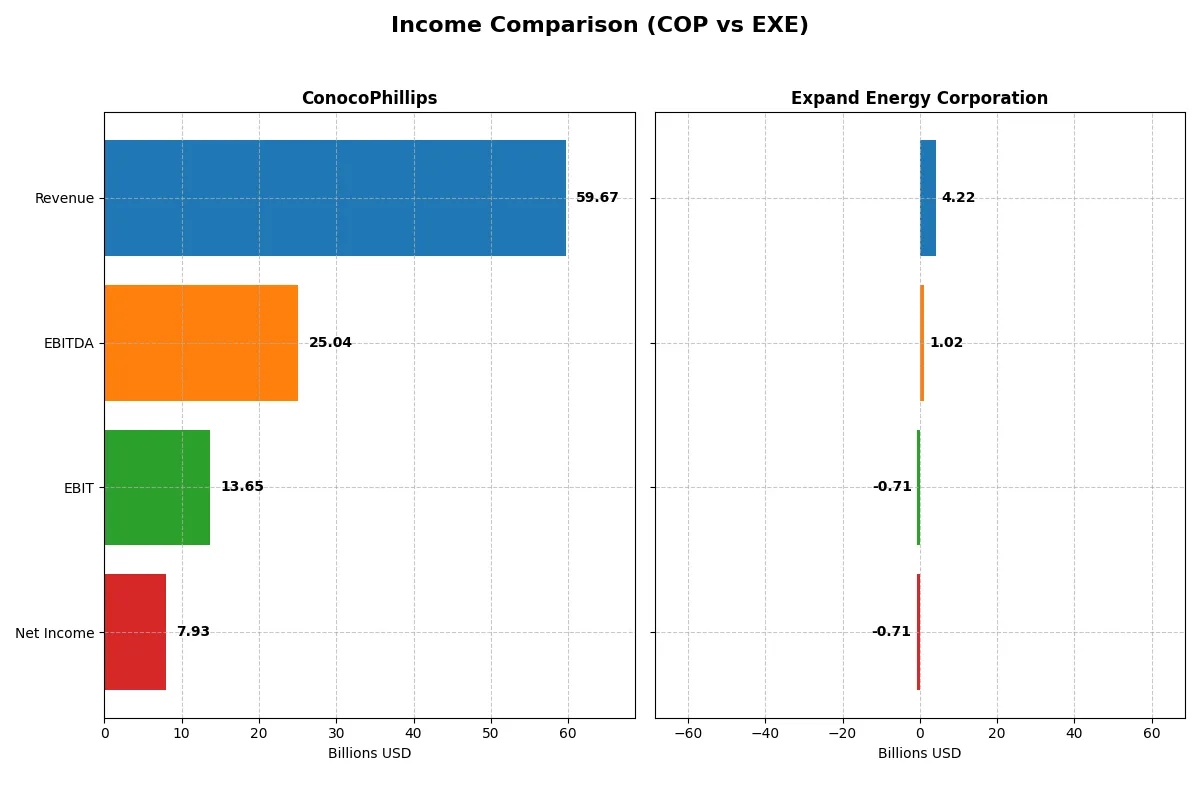
| Metric | ConocoPhillips (COP) | Expand Energy Corporation (EXE) |
|---|---|---|
| Revenue | 59.7B | 4.22B |
| Cost of Revenue | 38.7B | 3.08B |
| Operating Expenses | 9.13B | 1.94B |
| Gross Profit | 21.0B | 1.14B |
| EBITDA | 25.0B | 1.02B |
| EBIT | 13.7B | -711M |
| Interest Expense | 1.14B | 123M |
| Net Income | 7.93B | -714M |
| EPS | 6.34 | -4.55 |
| Fiscal Year | 2025 | 2024 |
Income Statement Analysis: The Bottom-Line Duel
This income statement comparison reveals which company runs a more efficient and profitable corporate engine through recent performance and margin trends.
ConocoPhillips Analysis
ConocoPhillips shows a strong revenue growth of 9.3% in 2025, reaching $59.7B, but net income fell 14% to $7.9B. The firm maintains healthy gross (35.2%) and net margins (13.3%), though net margin declined year-over-year. Despite a 7.6% EBIT drop, the company sustains solid profitability and operational efficiency amid volatile market conditions.
Expand Energy Corporation Analysis
Expand Energy’s revenue sharply declined 45.7% to $4.2B in 2024, dragging net income into a $714M loss. Its gross margin remained respectable at 27%, but EBIT and net margins turned deeply negative (-16.8% and -16.9%). The steep margin deterioration and revenue contraction signal severe operational challenges and a lack of current profitability momentum.
Margin Strength vs. Revenue Scale
ConocoPhillips outperforms Expand Energy with a consistent revenue scale and positive margins, despite recent profit softness. Expand Energy’s volatile revenue and persistent losses highlight fundamental struggles. For investors, ConocoPhillips’ profile offers more reliable income generation and operational resilience, whereas Expand Energy presents higher risk with uncertain near-term recovery.
Financial Ratios Comparison
These vital ratios act as a diagnostic tool to expose the underlying fiscal health, valuation premiums, and capital efficiency of the companies analyzed:
| Ratios | ConocoPhillips (COP) | Expand Energy Corporation (EXE) |
|---|---|---|
| ROE | 12.3% | -4.1% |
| ROIC | 6.9% | -2.7% |
| P/E | 14.1 | -21.9 |
| P/B | 1.74 | 0.89 |
| Current Ratio | 1.30 | 0.64 |
| Quick Ratio | 1.14 | 0.64 |
| D/E | 0.36 | 0.33 |
| Debt-to-Assets | 19.2% | 20.9% |
| Interest Coverage | 10.4 | -6.5 |
| Asset Turnover | 0.49 | 0.15 |
| Fixed Asset Turnover | 0.64 | 0.17 |
| Payout ratio | 50.4% | -54.3% |
| Dividend yield | 3.57% | 2.48% |
| Fiscal Year | 2025 | 2024 |
Efficiency & Valuation Duel: The Vital Signs
Financial ratios act as a company’s DNA, uncovering hidden risks and revealing operational effectiveness behind the numbers.
ConocoPhillips
ConocoPhillips shows moderate profitability with a 12.3% ROE and favorable 13.29% net margin. Its P/E of 14.13 signals a reasonable valuation, supported by a 3.57% dividend yield. The company balances shareholder returns with steady dividends rather than aggressive buybacks or high R&D reinvestment, reflecting operational stability.
Expand Energy Corporation
Expand Energy struggles with negative returns: ROE at -4.06% and net margin at -16.92%. Despite a low P/B of 0.89 and a seemingly attractive P/E, its operational metrics are weak. The firm yields a 2.48% dividend but faces liquidity challenges, indicated by a low current ratio of 0.64, increasing financial risk.
Valuation Discipline Meets Operational Resilience
ConocoPhillips offers a more balanced risk-reward profile with solid profitability and prudent valuation. Expand Energy’s ratios expose operational weakness and liquidity concerns despite cheaper multiples. Investors prioritizing financial health and consistent returns may find ConocoPhillips aligns better with their risk tolerance.
Which one offers the Superior Shareholder Reward?
I compare ConocoPhillips (COP) and Expand Energy Corporation (EXE) on dividends and buybacks. COP delivers a steady 3.57% yield with a 50% payout ratio, well-covered by robust FCF (85%). Its share buybacks remain consistent, supporting shareholder returns. EXE’s dividend yield varies around 2.5–4.8%, but its payout is unstable and coverage weak, reflecting operational volatility. EXE prioritizes reinvestment over buybacks, focusing on growth, but with low FCF conversion and negative margins recently. Historically, COP’s disciplined capital allocation and sustainable distributions outperform EXE’s riskier, growth-driven model. In 2026, COP offers the more attractive and reliable total return profile.
Comparative Score Analysis: The Strategic Profile
The radar chart reveals the fundamental DNA and trade-offs of ConocoPhillips and Expand Energy Corporation, highlighting their financial strengths and valuation differences:
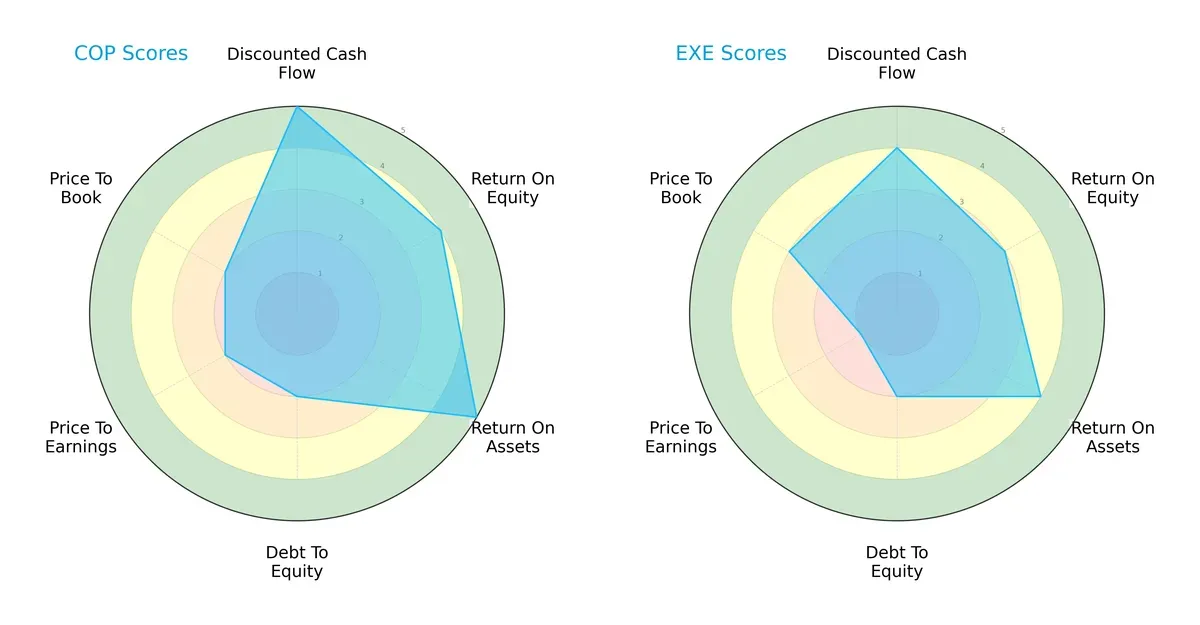
ConocoPhillips shows a more balanced profile with strong DCF (5), ROE (4), and ROA (5) scores, though its valuation scores (PE/PB) lag at 2. Expand Energy leans on moderate operational efficiency (DCF 4, ROA 4) but suffers from weak valuation metrics, especially P/E at 1, indicating potential overvaluation risks. Both share a weak debt-to-equity score of 2, signaling leverage concerns. Overall, ConocoPhillips dominates in financial robustness while Expand Energy relies on selective operational strengths.
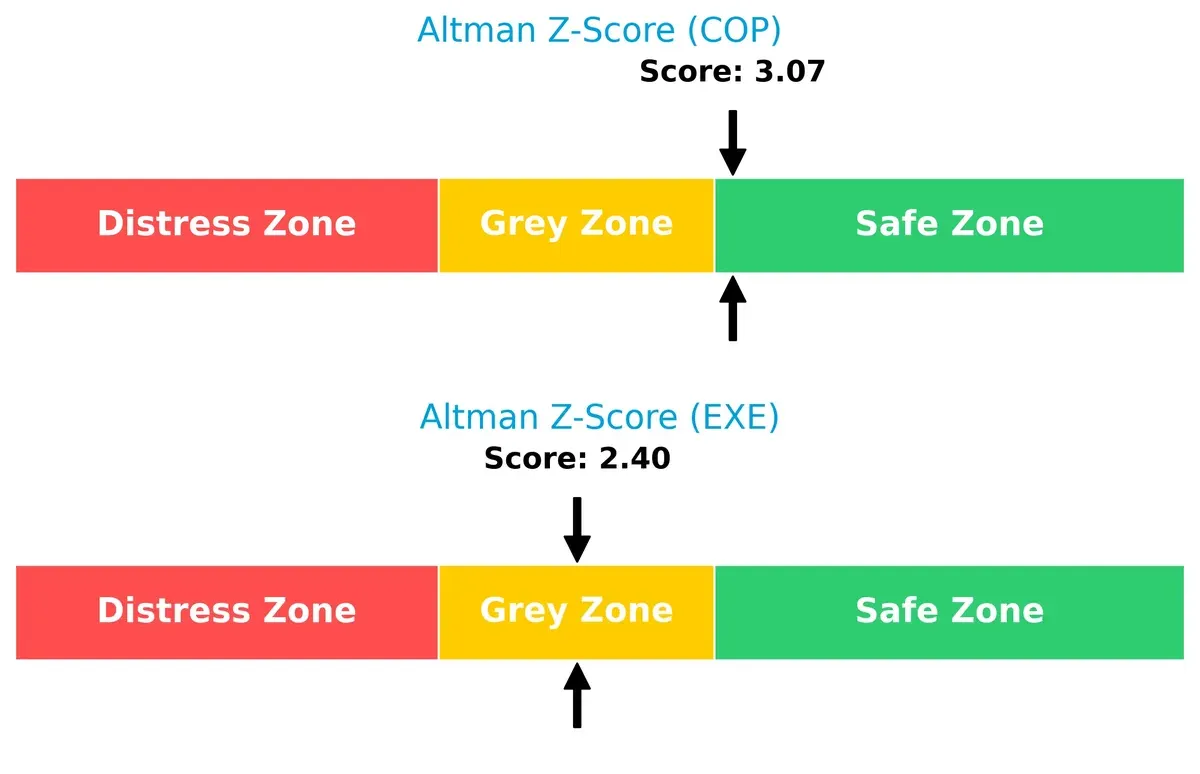
Bankruptcy Risk: Solvency Showdown
ConocoPhillips’ Altman Z-Score at 3.07 places it securely in the safe zone, while Expand Energy’s 2.40 suggests moderate bankruptcy risk amid current market volatility:
Financial Health: Quality of Operations
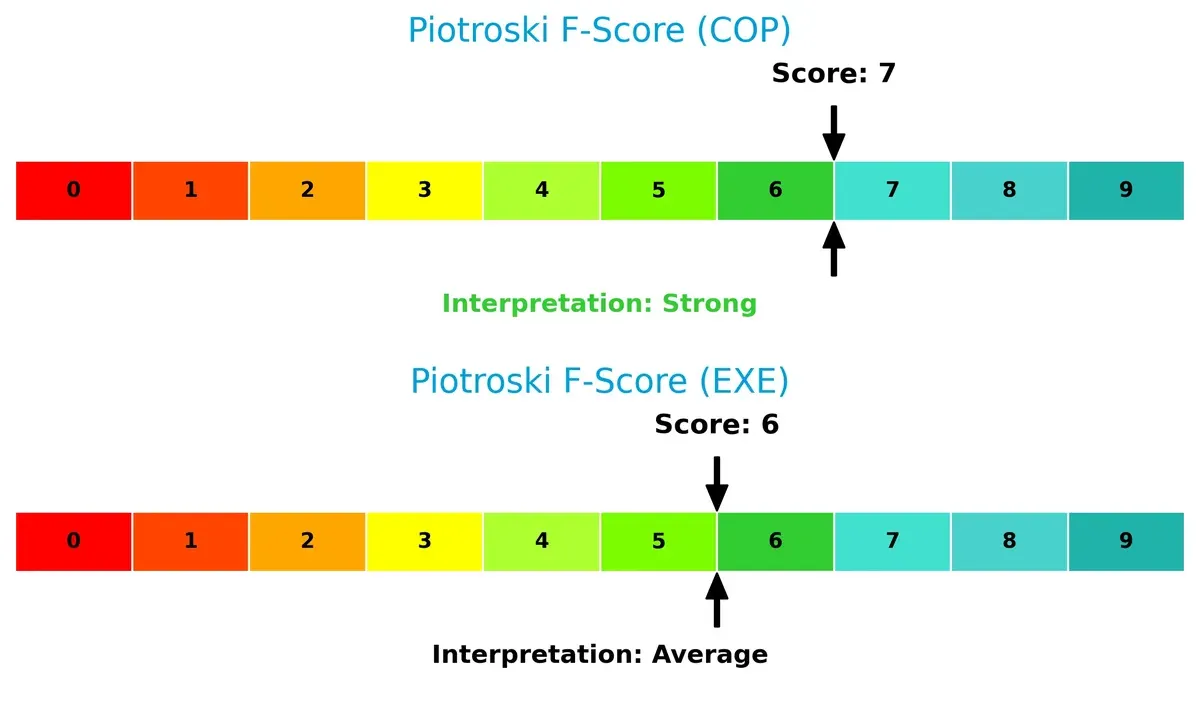
ConocoPhillips scores a strong 7 on the Piotroski F-Score, indicating solid operational quality, whereas Expand Energy’s 6 signals average financial health with some internal red flags:
How are the two companies positioned?
This section dissects the operational DNA of COP and EXE by comparing their revenue distribution and internal dynamics, including strengths and weaknesses. The final objective confronts their economic moats to determine which model offers the most resilient, sustainable competitive advantage today.
Revenue Segmentation: The Strategic Mix
The following visual comparison dissects how ConocoPhillips and Expand Energy Corporation diversify their income streams and where their primary sector bets lie:
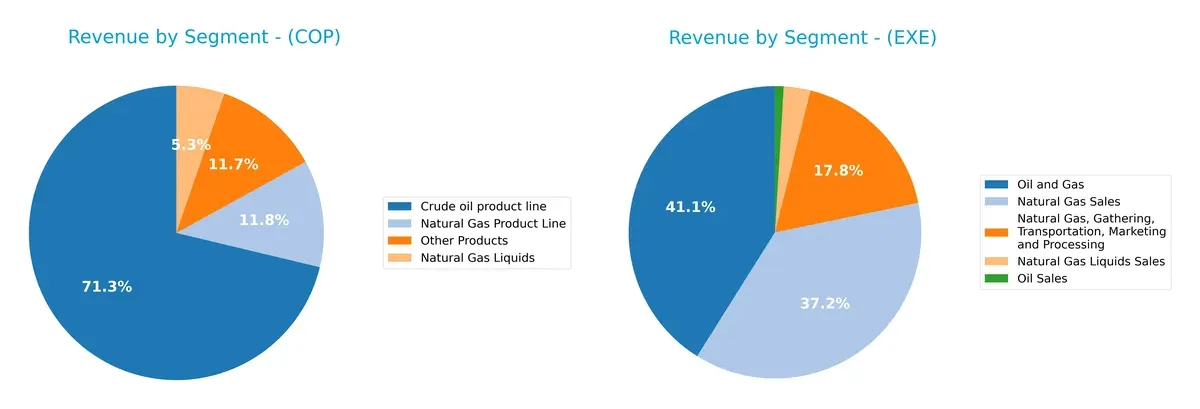
ConocoPhillips anchors its revenue heavily on its crude oil product line with $39B, complemented by natural gas segments totaling $9.3B. This mix shows moderate diversification but a clear dominance in oil. Expand Energy leans more evenly on natural gas sales ($2.7B) and related gathering and processing ($1.3B), with smaller oil sales ($69M). Expand’s broader gas infrastructure revenue suggests ecosystem lock-in, while ConocoPhillips faces concentration risk tied to oil prices.
Strengths and Weaknesses Comparison
This table compares the Strengths and Weaknesses of ConocoPhillips and Expand Energy Corporation:
ConocoPhillips Strengths
- Favorable net margin at 13.29%
- WACC below ROIC at 4.83%
- Strong interest coverage at 11.99
- Diverse product lines including crude oil and natural gas
- Global presence with significant revenue in Lower 48 and multiple countries
- Dividend yield at 3.57%
Expand Energy Corporation Strengths
- Favorable WACC at 5.27%
- Positive valuation metrics (PE and PB) despite negative earnings
- Favorable debt ratios (debt-to-assets 20.88%, debt equity 0.33)
- Dividend yield at 2.48%
- Presence in natural gas and oil sales segments
ConocoPhillips Weaknesses
- Unfavorable asset turnover ratios (0.49 total, 0.64 fixed assets)
- Neutral ROIC at 6.86% only slightly above WACC
- Current ratio at 1.3 limits liquidity cushion
- ROE neutral at 12.3%
- Exposure to commodity price volatility
Expand Energy Corporation Weaknesses
- Negative profitability ratios: net margin -16.92%, ROE -4.06%, ROIC -2.7%
- Unfavorable current and quick ratios at 0.64
- Negative interest coverage at -5.78 indicating financial distress
- Low asset turnover ratios (0.15 total, 0.17 fixed assets)
- Lack of disclosed global revenue diversification
ConocoPhillips benefits from diversified products and global operations supporting stable profitability and credit metrics. Expand Energy struggles with profitability and liquidity, despite favorable debt management and some dividend yield. These conditions frame their strategic challenges and opportunities moving forward.
The Moat Duel: Analyzing Competitive Defensibility
A structural moat is the only barrier protecting long-term profits from relentless competition erosion. Let’s dissect how two energy firms defend their turf:
ConocoPhillips: Diversified Asset Base and Scale Advantage
ConocoPhillips leverages a broad geographic portfolio and scale, driving a slightly favorable moat with ROIC exceeding WACC by 2%. Despite declining ROIC trends, its stable margins reflect strong capital allocation. Expansion into LNG and unconventional plays could deepen its moat in 2026.
Expand Energy Corporation: Emerging Efficiency and Growth Potential
Expand Energy’s moat stems from operational improvements in shale gas plays and a rising ROIC trend. Unlike ConocoPhillips, it currently destroys value with ROIC below WACC but shows promising margin recovery and growth potential in U.S. unconventional gas markets.
Legacy Scale vs. Growth Momentum: The Moat Face-off
ConocoPhillips holds the deeper moat with consistent value creation despite margin pressures. Expand Energy’s rising ROIC hints at future strength but lacks ConocoPhillips’ established scale to defend market share today.
Which stock offers better returns?
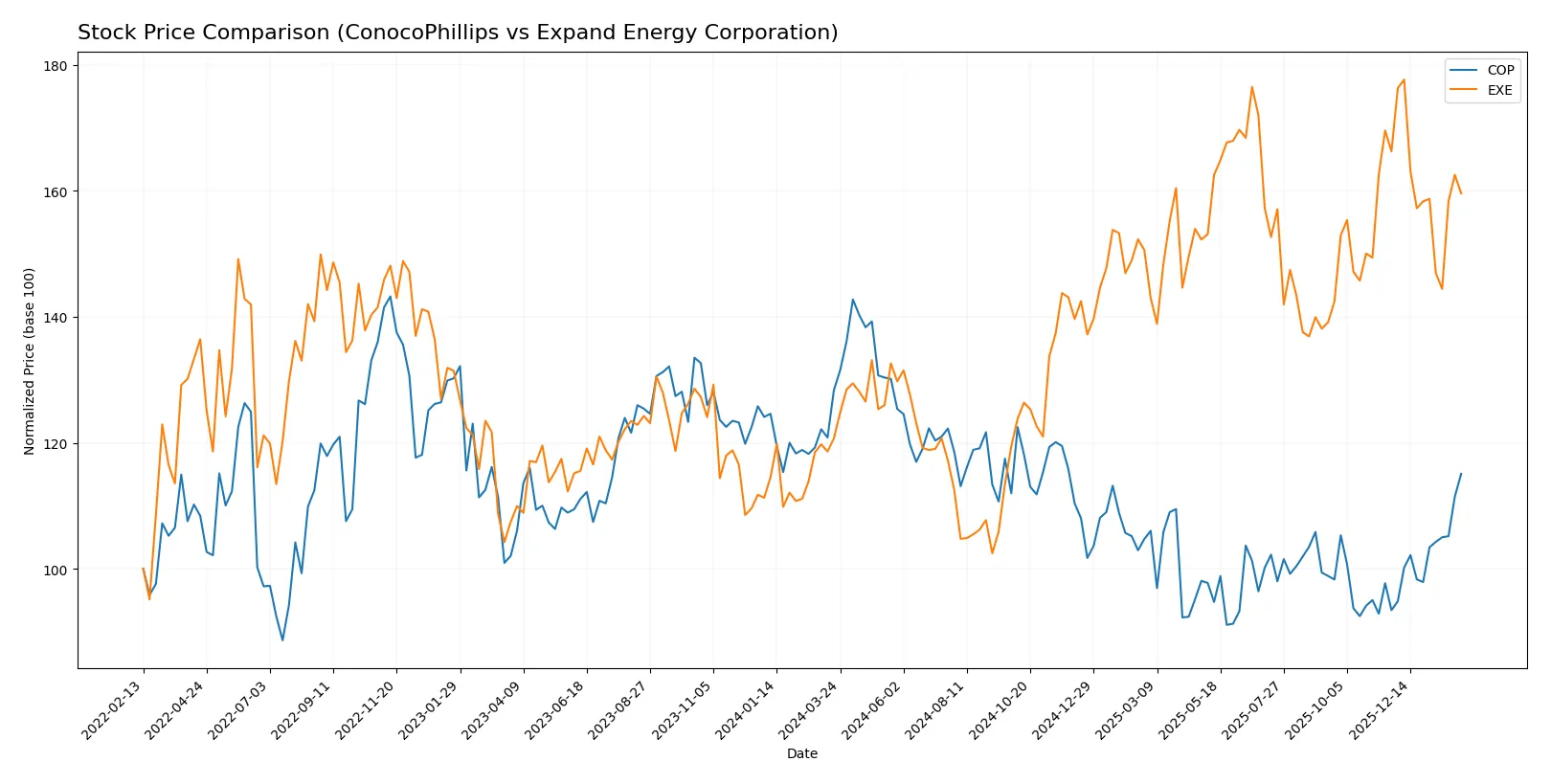
The past year reveals contrasting dynamics: ConocoPhillips declined sharply but accelerated upward recently, while Expand Energy rose overall but shows recent deceleration and slight seller dominance.
Trend Comparison
ConocoPhillips’ stock fell 10.35% over the past year, signaling a bearish trend with accelerating momentum and a high volatility of 11.69%. It hit a high of 133.52 and a low of 85.19.
Expand Energy’s stock gained 32.23% over the last year, marking a bullish trend with decelerating price increases and volatility at 12.77%. Its price ranged between 70.84 and 122.86.
Expand Energy outperformed ConocoPhillips, delivering the highest market returns, despite recent bearish signals in the last quarter.
Target Prices
Analysts maintain optimistic target price consensus for both ConocoPhillips and Expand Energy Corporation.
| Company | Target Low | Target High | Consensus |
|---|---|---|---|
| ConocoPhillips | 98 | 133 | 116.07 |
| Expand Energy Corporation | 126 | 150 | 140.78 |
The targets suggest upside potential from current prices: ConocoPhillips trades near 108 versus a 116 consensus, while Expand Energy stands at 110 against a 141 consensus. Analysts expect meaningful appreciation in both stocks.

Don’t Let Luck Decide Your Entry Point
Optimize your entry points with our advanced ProRealTime indicators. You’ll get efficient buy signals with precise price targets for maximum performance. Start outperforming now!
How do institutions grade them?
ConocoPhillips Grades
The following table summarizes recent institutional grades for ConocoPhillips:
| Grading Company | Action | New Grade | Date |
|---|---|---|---|
| Wells Fargo | Maintain | Overweight | 2026-02-06 |
| BMO Capital | Maintain | Outperform | 2026-02-06 |
| Piper Sandler | Maintain | Overweight | 2026-02-06 |
| Susquehanna | Maintain | Positive | 2026-01-26 |
| Morgan Stanley | Maintain | Overweight | 2026-01-23 |
| JP Morgan | Downgrade | Neutral | 2026-01-20 |
| B of A Securities | Downgrade | Underperform | 2026-01-16 |
| JP Morgan | Maintain | Overweight | 2026-01-13 |
| Wells Fargo | Upgrade | Overweight | 2026-01-12 |
| Piper Sandler | Maintain | Overweight | 2026-01-08 |
Expand Energy Corporation Grades
The following table summarizes recent institutional grades for Expand Energy Corporation:
| Grading Company | Action | New Grade | Date |
|---|---|---|---|
| Piper Sandler | Maintain | Overweight | 2026-01-28 |
| Barclays | Maintain | Overweight | 2026-01-21 |
| Stephens & Co. | Maintain | Overweight | 2026-01-20 |
| UBS | Maintain | Buy | 2026-01-08 |
| Jefferies | Maintain | Buy | 2026-01-08 |
| Bernstein | Maintain | Outperform | 2026-01-05 |
| Citigroup | Maintain | Buy | 2025-12-19 |
| UBS | Maintain | Buy | 2025-12-12 |
| Mizuho | Maintain | Outperform | 2025-12-12 |
| Piper Sandler | Maintain | Overweight | 2025-11-18 |
Which company has the best grades?
Expand Energy Corporation has consistently received higher ratings such as Buy and Outperform across multiple firms. ConocoPhillips shows a wider range, including downgrades to Neutral and Underperform. This divergence may affect investor confidence and portfolio positioning.
Risks specific to each company
The following categories pinpoint critical pressure points and systemic threats facing ConocoPhillips and Expand Energy Corporation in the 2026 market environment:
1. Market & Competition
ConocoPhillips
- Diversified global portfolio reduces market risk but faces stiff competition in conventional and unconventional oil and gas sectors.
Expand Energy Corporation
- Focused on U.S. unconventional natural gas assets, limiting diversification and increasing exposure to regional market fluctuations.
2. Capital Structure & Debt
ConocoPhillips
- Maintains a conservative debt-to-equity ratio (0.36), with strong interest coverage (11.99), indicating manageable leverage.
Expand Energy Corporation
- Similar debt level (0.33) but negative interest coverage (-5.78) signals distress in servicing debt and financial instability.
3. Stock Volatility
ConocoPhillips
- Low beta (0.29) suggests stock is less volatile than the market, providing stability to investors.
Expand Energy Corporation
- Higher beta (0.45) implies greater stock price swings, increasing risk for shareholders.
4. Regulatory & Legal
ConocoPhillips
- Operates globally, facing complex regulations across multiple jurisdictions, increasing compliance costs and legal risks.
Expand Energy Corporation
- Concentrated in U.S. markets, regulatory risk is more localized but affected by evolving environmental policies.
5. Supply Chain & Operations
ConocoPhillips
- Large-scale, diversified operations offer resilience, though lower asset turnover ratios indicate operational inefficiencies.
Expand Energy Corporation
- Smaller scale with low asset turnover, exposing the company to operational bottlenecks and scaling challenges.
6. ESG & Climate Transition
ConocoPhillips
- Faces pressure to reduce carbon footprint globally; diversified energy mix can facilitate transition but requires heavy capital allocation.
Expand Energy Corporation
- Focus on natural gas may ease transition risks but still exposed to tightening emissions regulations in the U.S.
7. Geopolitical Exposure
ConocoPhillips
- Global footprint exposes it to geopolitical risks including trade disputes and regional conflicts.
Expand Energy Corporation
- U.S.-focused assets limit geopolitical exposure but increase vulnerability to domestic policy shifts.
Which company shows a better risk-adjusted profile?
ConocoPhillips exhibits a superior risk-adjusted profile. Its strong interest coverage and low beta denote financial stability and lower volatility. Expand Energy struggles with negative interest coverage and weaker operational metrics, heightening financial and operational risk. The Altman Z-score confirms COP is in the safe zone, while EXE lingers in the grey zone, underscoring COP’s stronger balance sheet resilience.
Final Verdict: Which stock to choose?
ConocoPhillips (COP) stands out as a cash-generating powerhouse with a solid economic moat, consistently creating value above its cost of capital. Its efficiency in capital allocation and strong balance sheet reinforce confidence. A point of vigilance remains its declining profitability trend. COP suits portfolios focused on stable income and moderate growth.
Expand Energy Corporation (EXE) impresses with a growing profitability trajectory, signaling operational improvements. Its strategic moat lies in potential turnaround and growth momentum. However, current financial instability and weaker liquidity present higher risk compared to COP. EXE fits growth-oriented investors willing to tolerate volatility for future upside.
If you prioritize resilient cash flow and value preservation, ConocoPhillips is the compelling choice due to its proven capital efficiency and safer financial profile. However, if you seek high growth potential and can accept elevated risk, Expand Energy offers superior prospects with improving profitability but less stability.
Disclaimer: Investment carries a risk of loss of initial capital. The past performance is not a reliable indicator of future results. Be sure to understand risks before making an investment decision.
Go Further
I encourage you to read the complete analyses of ConocoPhillips and Expand Energy Corporation to enhance your investment decisions: