Deere & Company and Columbus McKinnon Corporation are two prominent players in the industrial sector, both specializing in machinery and motion solutions. Deere focuses on agricultural, construction, and forestry equipment, while Columbus McKinnon excels in intelligent material handling and lifting systems. Their shared commitment to innovation and industrial applications makes this comparison compelling. Join me as we explore which company presents the more attractive investment opportunity in today’s market.
Table of contents
Companies Overview
I will begin the comparison between Deere & Company and Columbus McKinnon Corporation by providing an overview of these two companies and their main differences.
Deere & Company Overview
Deere & Company, founded in 1837 and headquartered in Moline, Illinois, is a leading manufacturer and distributor of agricultural, construction, and forestry equipment worldwide. The company operates through four segments, including Production and Precision Agriculture, Small Agriculture and Turf, Construction and Forestry, and Financial Services. Deere serves various customers such as crop producers, dairy and livestock producers, and turf and utility users, with a market capitalization of 135B USD.
Columbus McKinnon Corporation Overview
Columbus McKinnon Corporation, established in 1875 and based in Buffalo, New York, designs and manufactures intelligent motion solutions for material handling across multiple industries. It offers hoists, crane systems, rigging equipment, power and motion technology products, and conveyor systems. The company serves diverse sectors including industrial automation, construction, energy, and supply chain, with a market capitalization of 554M USD.
Key similarities and differences
Both Deere & Company and Columbus McKinnon operate within the industrial sector with a focus on equipment and machinery. Deere specializes primarily in agricultural and construction machinery with additional financial services, while Columbus McKinnon centers on material handling and motion control solutions across varied industries. Deere is significantly larger by market cap and workforce, reflecting broader product offerings and global reach compared to Columbus McKinnon’s more specialized niche.
Income Statement Comparison
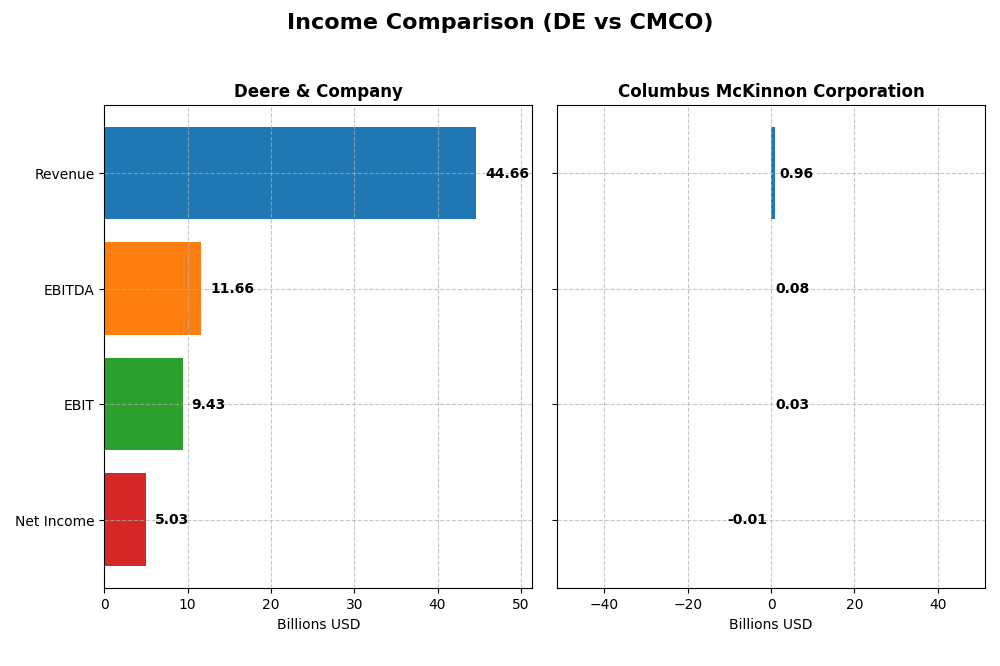
The table below compares key income statement metrics for Deere & Company and Columbus McKinnon Corporation for their most recent fiscal years, providing a snapshot of their financial performance.
| Metric | Deere & Company | Columbus McKinnon Corporation |
|---|---|---|
| Market Cap | 135.4B | 554M |
| Revenue | 44.7B | 963M |
| EBITDA | 11.7B | 75M |
| EBIT | 9.4B | 27M |
| Net Income | 5.0B | -5.1M |
| EPS | 18.56 | -0.18 |
| Fiscal Year | 2025 | 2024 |
Income Statement Interpretations
Deere & Company
Deere & Company’s revenue showed a modest overall growth of 3.8% from 2021 to 2025 but declined by 11.6% in the latest year. Net income decreased by 15.7% over the period and dropped 29% in the last year, reflecting weakening profitability. Margins remain generally favorable, with a stable gross margin at 36.5% and a strong EBIT margin of 21.1% in 2025, though net margin fell to 11.3%. The recent year saw a significant slowdown in growth and margin contraction.
Columbus McKinnon Corporation
Columbus McKinnon experienced a 48.2% revenue increase over 2020-2024 but faced a 5% decline in the last year. Despite revenue gains, net income fell sharply by 156.4% over the period and turned negative in 2024, indicating losses. Gross margin stayed favorable at 33.8%, but EBIT margin was only 2.8%, and the net margin was negative at -0.5%. The latest year showed a substantial drop in profitability and weaker operating performance.
Which one has the stronger fundamentals?
Both companies display unfavorable overall income statement trends, but Deere’s higher and more stable margins, along with positive net income, suggest relatively stronger fundamentals. Columbus McKinnon’s profitability weakness, especially its negative net margin and net losses in the latest year, indicate greater financial challenges. However, Deere’s recent revenue and profit declines also warrant caution when assessing its income strength.
Financial Ratios Comparison
Below is a comparison of key financial ratios for Deere & Company and Columbus McKinnon Corporation based on the most recent fiscal year data available.
| Ratios | Deere & Company (DE) 2025 | Columbus McKinnon Corp (CMCO) 2024 |
|---|---|---|
| ROE | 19.37% | -0.58% |
| ROIC | 7.13% | 3.30% |
| P/E | 24.89 | -94.69 |
| P/B | 4.82 | 0.55 |
| Current Ratio | 2.31 | 1.81 |
| Quick Ratio | 2.08 | 1.04 |
| D/E (Debt-to-Equity) | 2.46 | 0.61 |
| Debt-to-Assets | 60.32% | 31.09% |
| Interest Coverage | 2.65 | 1.68 |
| Asset Turnover | 0.42 | 0.55 |
| Fixed Asset Turnover | 2.77 | 9.07 |
| Payout Ratio | 34.22% | -156.52% |
| Dividend Yield | 1.37% | 1.65% |
Interpretation of the Ratios
Deere & Company
Deere & Company shows a mixed ratio profile with strong net margin at 11.25% and a favorable 19.37% return on equity, while its return on invested capital is neutral at 7.13%. Concerns arise from a high debt-to-equity ratio of 2.46 and debt-to-assets at 60.32%, both unfavorable. The company maintains a 1.37% dividend yield with a neutral payout outlook, supported by stable free cash flow coverage and moderate risk from leverage.
Columbus McKinnon Corporation
Columbus McKinnon Corporation exhibits several weak profitability ratios, including a negative net margin of -0.53% and return on equity of -0.58%, signaling operational challenges. Its debt levels appear moderate with a debt-to-equity of 0.61 and debt-to-assets at 31.09%, both neutral. The 1.65% dividend yield is neutral, but the company’s negative earnings suggest dividends reflect a reinvestment or recovery strategy amid financial strain.
Which one has the best ratios?
Both companies are assessed as slightly favorable overall. Deere & Company benefits from stronger profitability and liquidity ratios but carries significant leverage risks. Columbus McKinnon shows weaker profitability and coverage metrics but has lower leverage and a more conservative asset base. The decision on which has better ratios depends on the investor’s risk tolerance regarding leverage versus profitability.
Strategic Positioning
This section compares the strategic positioning of Deere & Company and Columbus McKinnon Corporation regarding market position, key segments, and exposure to technological disruption:
Deere & Company
- Leading market position in agricultural machinery under competitive pressure from diversified sectors.
- Diverse segments: Production & Precision Ag, Small Ag & Turf, Construction & Forestry, Financial Services.
- Moderate exposure to technological disruption through precision ag and automation in machinery.
Columbus McKinnon Corporation
- Smaller market cap, niche position in intelligent motion and material handling solutions.
- Focused on hoists, cranes, actuators, conveyors across multiple industrial verticals.
- Exposure to innovation in digital power control and automation in material handling.
Deere & Company vs Columbus McKinnon Corporation Positioning
Deere exhibits a diversified strategic approach spanning agriculture, construction, forestry, and financial services, providing broad market coverage. Columbus McKinnon concentrates on motion solutions and material handling, focusing on industrial automation and niche products, which limits its scope but allows specialization.
Which has the best competitive advantage?
Both companies are currently shedding value relative to their cost of capital, with Deere showing a declining ROIC trend and Columbus McKinnon a growing ROIC trend. Neither demonstrates a strong economic moat, indicating slightly unfavorable competitive advantages.
Stock Comparison
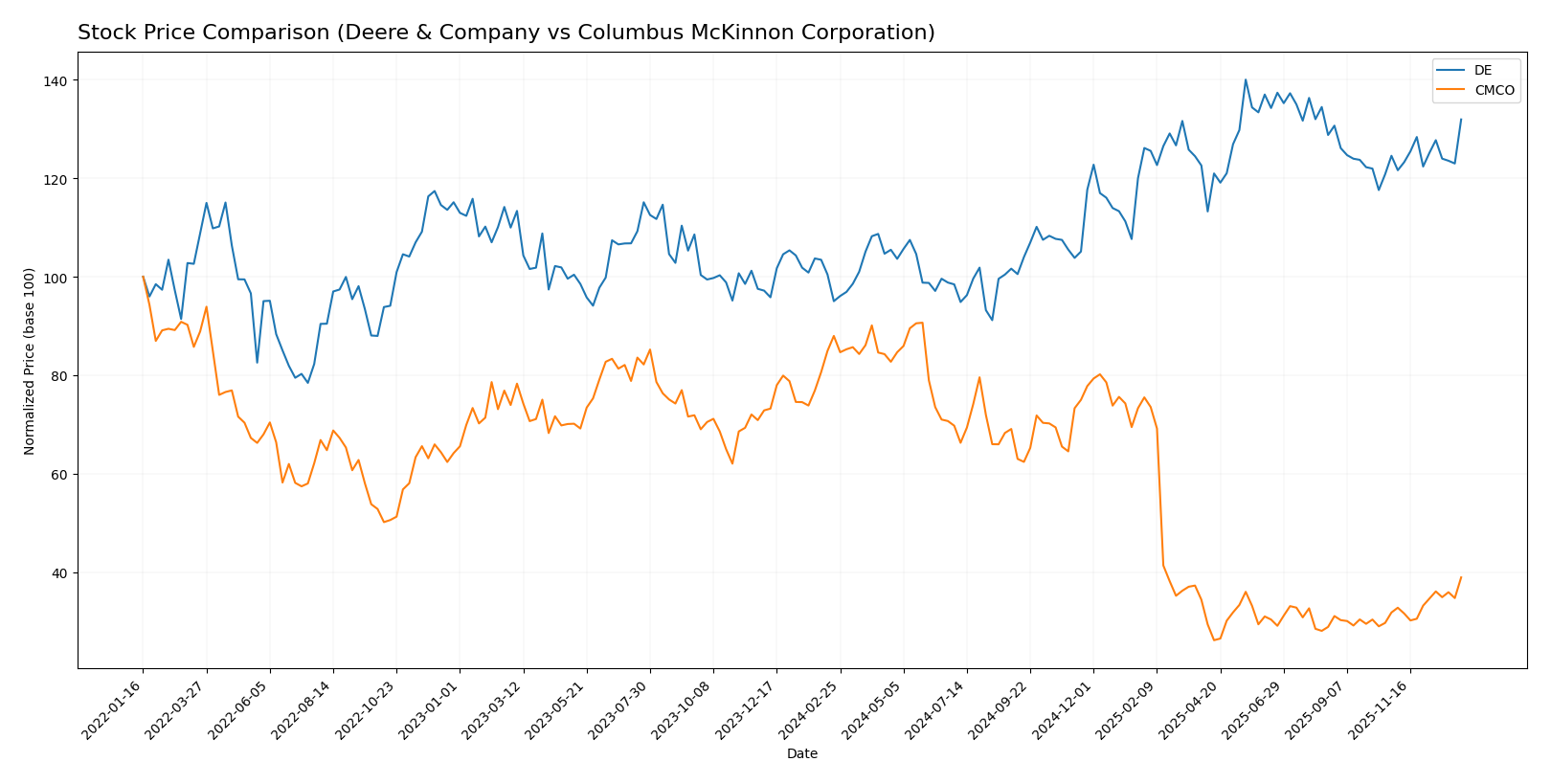
The stock price movements of Deere & Company and Columbus McKinnon Corporation over the past year reveal contrasting trends, with Deere showing significant gains amid decelerating growth and Columbus McKinnon experiencing a sharp overall decline despite recent recovery.
Trend Analysis
Deere & Company’s stock exhibited a strong bullish trend over the past 12 months, rising by 38.85%, though the pace of increase has slowed recently. The stock’s price fluctuated between 346.03 and 531.48, with a high volatility level reflected in a standard deviation of 49.76.
Columbus McKinnon Corporation’s stock showed a pronounced bearish trend over the same period, declining by 55.75%. Despite this, recent months indicate a partial rebound with a 22.41% gain, yet the overall trend remains negative with accelerating downward momentum and lower volatility at 11.22 standard deviation.
Comparing both, Deere & Company delivered the highest market performance with a substantial positive price change, contrasting with Columbus McKinnon’s significant overall loss despite recent improvement.
Target Prices
The consensus target prices from verified analysts indicate a positive outlook for both Deere & Company and Columbus McKinnon Corporation.
| Company | Target High | Target Low | Consensus |
|---|---|---|---|
| Deere & Company | 612 | 458 | 529.5 |
| Columbus McKinnon Corporation | 50 | 48 | 49 |
Analysts expect Deere & Company’s stock to rise above its current price of 500.8 USD, suggesting potential upside. Columbus McKinnon’s consensus target price is significantly above the current 19.28 USD, indicating strong expected growth.
Analyst Opinions Comparison
This section compares analysts’ ratings and grades for Deere & Company and Columbus McKinnon Corporation:
Rating Comparison
Deere & Company Rating
- Rating: B- indicating a very favorable overall evaluation
- Discounted Cash Flow Score: 2, moderate valuation signal
- ROE Score: 5, very favorable profit generation from equity
- ROA Score: 3, moderate asset utilization
- Debt To Equity Score: 1, very unfavorable balance sheet
- Overall Score: 2, moderate overall financial standing
Columbus McKinnon Corporation Rating
- Rating: B indicating a very favorable overall evaluation
- Discounted Cash Flow Score: 5, very favorable valuation
- ROE Score: 1, very unfavorable profit generation from equity
- ROA Score: 2, moderate asset utilization
- Debt To Equity Score: 2, moderate financial risk
- Overall Score: 3, moderate overall financial standing
Which one is the best rated?
Based strictly on the provided data, Columbus McKinnon holds a higher overall score and a superior DCF score, while Deere excels in ROE but suffers from a weaker debt-to-equity rating. Columbus McKinnon is slightly better rated overall.
Scores Comparison
Here is a comparison of the scores for Deere & Company and Columbus McKinnon Corporation:
Deere & Company Scores
- Altman Z-Score: 2.94, indicating moderate bankruptcy risk in the grey zone.
- Piotroski Score: 6, reflecting average financial strength.
Columbus McKinnon Scores
- Altman Z-Score: 1.40, indicating high bankruptcy risk in the distress zone.
- Piotroski Score: 8, reflecting very strong financial strength.
Which company has the best scores?
Columbus McKinnon shows stronger financial health with a higher Piotroski Score of 8 versus Deere’s 6, but Deere has a better Altman Z-Score indicating lower bankruptcy risk. Each score highlights different aspects of financial stability.
Grades Comparison
Here is a comparison of the latest reliable grades for Deere & Company and Columbus McKinnon Corporation:
Deere & Company Grades
This table summarizes recent grades and rating actions from reputable grading companies for Deere & Company.
| Grading Company | Action | New Grade | Date |
|---|---|---|---|
| Jefferies | Maintain | Hold | 2025-12-09 |
| DA Davidson | Maintain | Buy | 2025-12-01 |
| Truist Securities | Maintain | Buy | 2025-11-28 |
| RBC Capital | Maintain | Outperform | 2025-11-28 |
| Oppenheimer | Maintain | Outperform | 2025-11-28 |
| Evercore ISI Group | Maintain | In Line | 2025-11-28 |
| UBS | Upgrade | Buy | 2025-10-17 |
| JP Morgan | Maintain | Neutral | 2025-10-14 |
| Truist Securities | Maintain | Buy | 2025-10-08 |
| Oppenheimer | Maintain | Outperform | 2025-09-18 |
The overall grading trend for Deere & Company shows a predominance of “Buy” and “Outperform” ratings with some “Hold” and “Neutral” grades, indicating generally positive analyst sentiment.
Columbus McKinnon Corporation Grades
This table provides recent grades and rating changes from recognized grading firms for Columbus McKinnon Corporation.
| Grading Company | Action | New Grade | Date |
|---|---|---|---|
| DA Davidson | Downgrade | Neutral | 2025-02-11 |
| DA Davidson | Maintain | Buy | 2024-02-05 |
| DA Davidson | Maintain | Buy | 2022-10-04 |
| DA Davidson | Maintain | Buy | 2022-10-03 |
| Barrington Research | Maintain | Outperform | 2022-07-29 |
| Barrington Research | Maintain | Outperform | 2022-07-28 |
| JP Morgan | Downgrade | Neutral | 2022-05-26 |
| Barrington Research | Maintain | Outperform | 2022-05-26 |
| Barrington Research | Maintain | Outperform | 2022-05-25 |
| JP Morgan | Downgrade | Neutral | 2022-05-25 |
The grading trend for Columbus McKinnon Corporation shows a shift from “Buy” and “Outperform” ratings toward more recent “Neutral” grades, reflecting a cautious stance by analysts.
Which company has the best grades?
Deere & Company holds predominantly “Buy” and “Outperform” grades recently, while Columbus McKinnon has seen downgrades to “Neutral.” Deere’s stronger consensus may suggest better perceived growth or stability, potentially impacting investor confidence positively compared to Columbus McKinnon.
Strengths and Weaknesses
The following table compares key strengths and weaknesses of Deere & Company (DE) and Columbus McKinnon Corporation (CMCO) based on recent financial data and market positioning.
| Criterion | Deere & Company (DE) | Columbus McKinnon Corporation (CMCO) |
|---|---|---|
| Diversification | Highly diversified with strong agri, construction, and forestry segments generating $20.6B, $8.0B, and $1.1B respectively in 2024 | More focused product lines, with Hoists ($480M) and High Precision Conveyors ($155M) as major contributors |
| Profitability | Net margin 11.25%, ROE 19.37%, ROIC 7.13% (neutral), indicating solid profitability but declining value creation | Negative net margin (-0.53%) and ROE (-0.58%), ROIC 3.3% (unfavorable), suggesting current profitability challenges |
| Innovation | Strong in precision agriculture and construction equipment, supported by ongoing investments | Moderate innovation focus in digital power controls and conveyor systems, with steady growth in ROIC |
| Global presence | Extensive global footprint with large-scale agriculture and construction markets | More niche industrial focus, less global scale but steady market presence in hoists and conveyors |
| Market Share | Leading market share in agricultural and construction equipment | Smaller market share in industrial hoists and conveyor products |
Key takeaways: Deere & Company offers broad diversification and strong profitability metrics despite a slightly declining ROIC trend, while Columbus McKinnon faces profitability challenges but shows improving ROIC and focused industrial specialization. Investors should weigh Deere’s scale and stable margins against CMCO’s growth potential amid current financial headwinds.
Risk Analysis
Below is a comparative risk table for Deere & Company (DE) and Columbus McKinnon Corporation (CMCO) based on the most recent data from 2025 and 2024 respectively.
| Metric | Deere & Company (DE) | Columbus McKinnon Corporation (CMCO) |
|---|---|---|
| Market Risk | Beta 1.01, moderate volatility | Beta 1.29, higher volatility |
| Debt level | High leverage: D/E 2.46 (unfavorable), Debt/Assets 60.3% | Moderate leverage: D/E 0.61 (neutral), Debt/Assets 31.1% |
| Regulatory Risk | Moderate, industrial/agriculture sector subject to environmental and trade regulations | Moderate, industrial automation with compliance requirements |
| Operational Risk | Complex global operations, supply chain sensitivity | Smaller scale, but exposed to manufacturing disruptions |
| Environmental Risk | Exposure due to heavy machinery production and agriculture equipment | Lower, but still exposed in manufacturing processes |
| Geopolitical Risk | Global sales subject to trade tensions and tariffs | Moderate, with some international exposure |
Synthesis: Deere & Company faces significant debt-related risk with a high debt-to-equity ratio and a grey zone Altman Z-score of 2.94, indicating moderate financial distress risk. Columbus McKinnon shows financial vulnerability with an Altman Z-score of 1.40 in the distress zone, despite a stronger Piotroski score, signaling operational risk and weaker profitability. Market volatility is higher for CMCO, but DE’s size and leverage pose greater financial risk. Investors should monitor debt levels and sector-specific regulatory changes closely.
Which Stock to Choose?
Deere & Company (DE) shows a slightly unfavorable income statement trend with declining profitability and income growth over 2021-2025. Its financial ratios are slightly favorable overall, but high debt levels and a moderate rating with a B- score suggest caution, despite strong ROE and liquidity.
Columbus McKinnon Corporation (CMCO) exhibits an unfavorable income statement with negative margins and shrinking net income despite revenue growth. Its financial ratios are slightly favorable, supported by low valuation multiples and moderate debt, but a distress-zone Altman Z-Score and mixed rating with a B score indicate financial challenges.
Investors prioritizing stability and strong profitability might find DE’s profile more appealing due to its solid ROE and liquidity, whereas those tolerant of risk and seeking potential turnaround opportunities could view CMCO’s improving ROIC trend and low valuation ratios as positive signals.
Disclaimer: Investment carries a risk of loss of initial capital. The past performance is not a reliable indicator of future results. Be sure to understand risks before making an investment decision.
Go Further
I encourage you to read the complete analyses of Deere & Company and Columbus McKinnon Corporation to enhance your investment decisions: