Home > Comparison > Financial Services > CINF vs L
The strategic rivalry between Cincinnati Financial Corporation and Loews Corporation defines the trajectory of the U.S. property & casualty insurance sector. Cincinnati Financial operates as a focused insurer with diversified insurance segments, emphasizing risk underwriting and investments. Loews Corporation combines insurance with diversified industrial and energy operations, leveraging scale and asset integration. This analysis aims to identify which model delivers superior risk-adjusted returns for investors seeking balanced exposure in financial services.

Table of contents
Companies Overview
Cincinnati Financial Corporation and Loews Corporation stand as key players in the U.S. property and casualty insurance market.
Cincinnati Financial Corporation: Specialty Insurer with Diversified Segments
Cincinnati Financial Corporation focuses on property and casualty insurance, generating revenue through commercial lines, personal lines, excess and surplus lines, life insurance, and investments. In 2026, it strategically emphasizes broadening commercial and personal insurance products while maintaining a strong investment portfolio. Its diversified segment approach supports steady premium growth and risk mitigation.
Loews Corporation: Diversified Conglomerate with Insurance Core
Loews Corporation operates primarily in commercial property and casualty insurance but also extends into natural gas transportation, plastics manufacturing, and hospitality. Its revenue engine combines specialty insurance products with diverse industrial operations. In 2026, Loews concentrates on expanding its insurance products while leveraging its energy and manufacturing subsidiaries to stabilize cash flow and enhance shareholder value.
Strategic Collision: Similarities & Divergences
Both companies prioritize property and casualty insurance, but Cincinnati emphasizes insurance diversification, while Loews blends insurance with energy and manufacturing. Their primary battleground lies in specialty commercial insurance markets. Investors face distinct profiles: Cincinnati offers focused insurance growth with stable investments, whereas Loews presents a conglomerate model balancing cyclical industrial segments with insurance stability.
Income Statement Comparison
The following data dissects the core profitability and scalability of both corporate engines to reveal who dominates the bottom line:
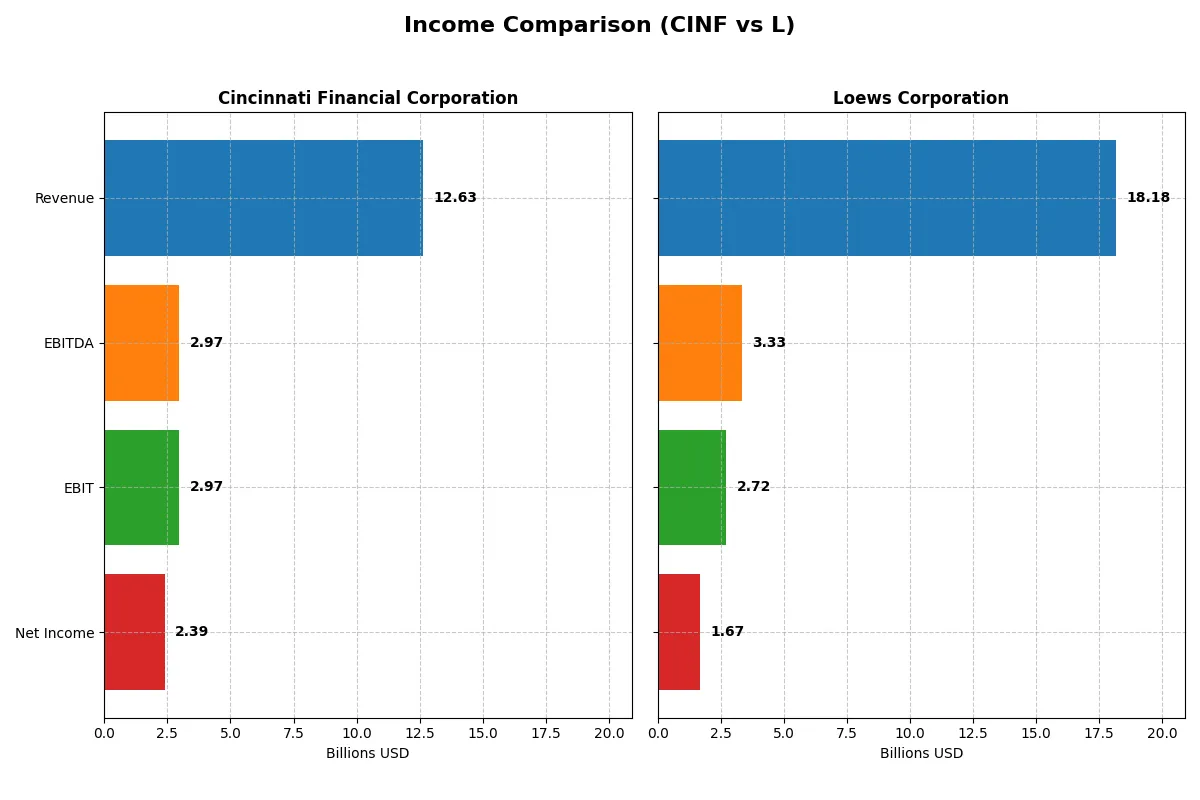
| Metric | Cincinnati Financial Corporation (CINF) | Loews Corporation (L) |
|---|---|---|
| Revenue | 12.6B | 18.2B |
| Cost of Revenue | 6.3B | 10.2B |
| Operating Expenses | 3.4B | 5.7B |
| Gross Profit | 6.3B | 8.0B |
| EBITDA | 3.0B | 3.3B |
| EBIT | 3.0B | 2.7B |
| Interest Expense | 5.3M | 437M |
| Net Income | 2.4B | 1.7B |
| EPS | 15.17 | 7.97 |
| Fiscal Year | 2025 | 2025 |
Income Statement Analysis: The Bottom-Line Duel
This income statement comparison reveals which company operates more efficiently and sustains stronger profitability in a competitive environment.
Cincinnati Financial Corporation Analysis
Cincinnati Financial grew revenue steadily from 9.6B in 2021 to 12.6B in 2025. Net income fluctuated, peaking at 3B in 2021 before settling near 2.4B in 2025. It maintains robust gross and net margins around 50% and 19%, signaling strong cost control. However, net margin declined slightly last year despite revenue growth, reflecting margin pressure.
Loews Corporation Analysis
Loews expanded revenue from 13.7B in 2021 to 18.2B in 2025, showing consistent growth. Net income rose moderately to 1.7B in 2025, supported by improving EBIT margins near 15%. Gross margin held steady around 44%. Loews improved net margin and EPS significantly last year, indicating accelerating profit momentum and operational efficiency.
Margin Strength vs. Growth Trajectory
Cincinnati Financial delivers higher margins and absolute net income, showcasing superior profitability and cost discipline. Loews, meanwhile, achieves faster earnings growth and expanding margins, reflecting rising operational leverage. Investors seeking solid margin power may favor Cincinnati’s profile, while those prioritizing growth momentum might find Loews more compelling.
Financial Ratios Comparison
These vital ratios act as a diagnostic tool to expose the underlying fiscal health, valuation premiums, and capital efficiency of the companies compared below:
| Ratios | Cincinnati Financial Corporation (CINF) | Loews Corporation (L) |
|---|---|---|
| ROE | 15.04% | 8.92% |
| ROIC | 56.09% | 1.68% |
| P/E | 10.77 | 13.21 |
| P/B | 1.62 | 1.18 |
| Current Ratio | 5.93 | N/A |
| Quick Ratio | 5.93 | N/A |
| D/E | 0.054 | 0.508 |
| Debt-to-Assets | 2.10% | 10.99% |
| Interest Coverage | 559.62 | 5.22 |
| Asset Turnover | 0.31 | 0.21 |
| Fixed Asset Turnover | 57.68 | 1.70 |
| Payout ratio | 22.94% | 3.12% |
| Dividend yield | 2.13% | 0.24% |
| Fiscal Year | 2025 | 2025 |
Efficiency & Valuation Duel: The Vital Signs
Financial ratios serve as a company’s DNA, unveiling hidden risks and operational strengths critical for investment decisions.
Cincinnati Financial Corporation
Cincinnati Financial boasts a strong 15% ROE and a robust 18.95% net margin, signaling efficient profitability. Its P/E ratio of 10.77 suggests the stock trades at a reasonable valuation. The company rewards shareholders with a 2.13% dividend yield, reflecting steady income over speculative growth.
Loews Corporation
Loews shows a lower 8.92% ROE and a moderate 9.17% net margin, indicating less operational efficiency. Despite a higher P/E of 13.21, the valuation remains attractive relative to its peers. Dividend yield stands weak at 0.24%, hinting at limited direct shareholder returns and reliance on internal capital deployment.
Operational Strength vs. Valuation Discipline
Cincinnati Financial delivers superior profitability and a balanced valuation, offering a safer risk-reward profile. Loews, while cheaper in some respects, struggles with weaker returns and minimal dividends. Investors prioritizing steady income and operational consistency may favor Cincinnati’s profile.
Which one offers the Superior Shareholder Reward?
I observe Cincinnati Financial (CINF) offers a 2.13% dividend yield with a prudent 23% payout ratio, supported by strong free cash flow coverage near 100%. Cincinnati pairs this with modest buybacks, balancing income and capital return sustainably. Loews (L) pays a minimal 0.24% yield, with a sparse 3% payout ratio, favoring reinvestment over dividends. Its buyback activity is limited, reflecting a more conservative shareholder return approach amid higher leverage (debt-to-equity ~0.51). Historically, Cincinnati’s balanced dividend and buyback strategy delivers superior total returns and sustainability. I favor Cincinnati Financial for a more attractive 2026 total shareholder reward.
Comparative Score Analysis: The Strategic Profile
The radar chart reveals the fundamental DNA and trade-offs of Cincinnati Financial Corporation and Loews Corporation, highlighting their core financial strengths and weaknesses:
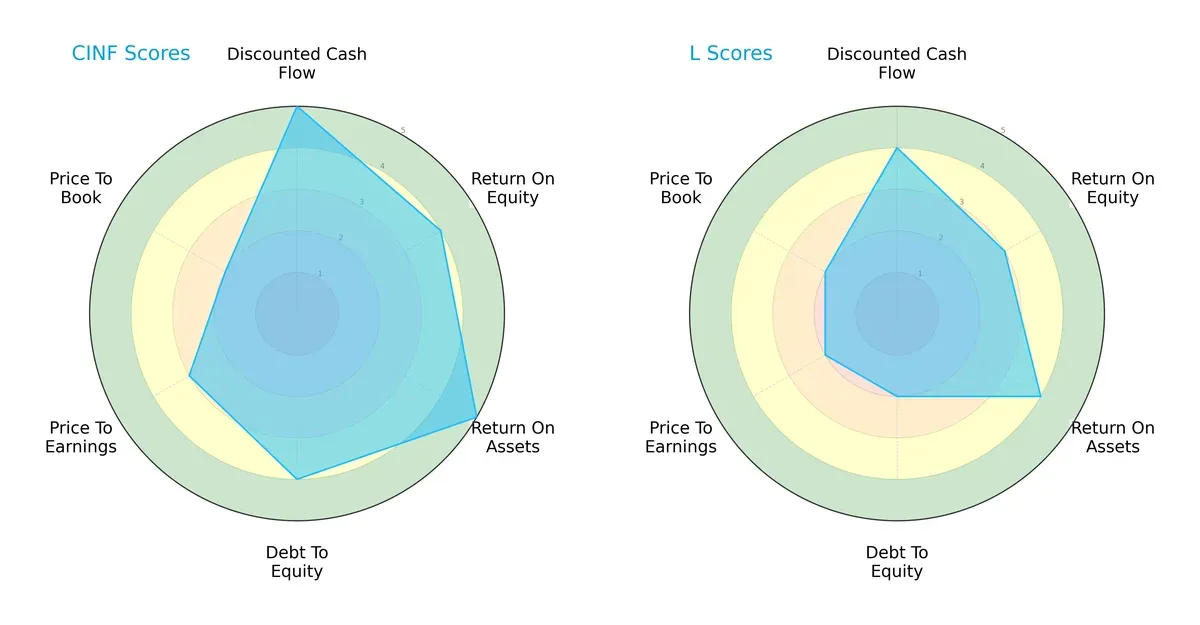
Cincinnati Financial exhibits a more balanced profile with very favorable scores in discounted cash flow (5), return on assets (5), and debt-to-equity (4). It maintains strong operational efficiency and financial stability. Loews leans on moderate returns and weaker leverage control, with a debt-to-equity score of 2 signaling higher financial risk. Cincinnati’s valuation scores show some moderate to unfavorable marks, indicating potential overvaluation compared to Loews, which scores lower but consistently unfavorable in valuation metrics.
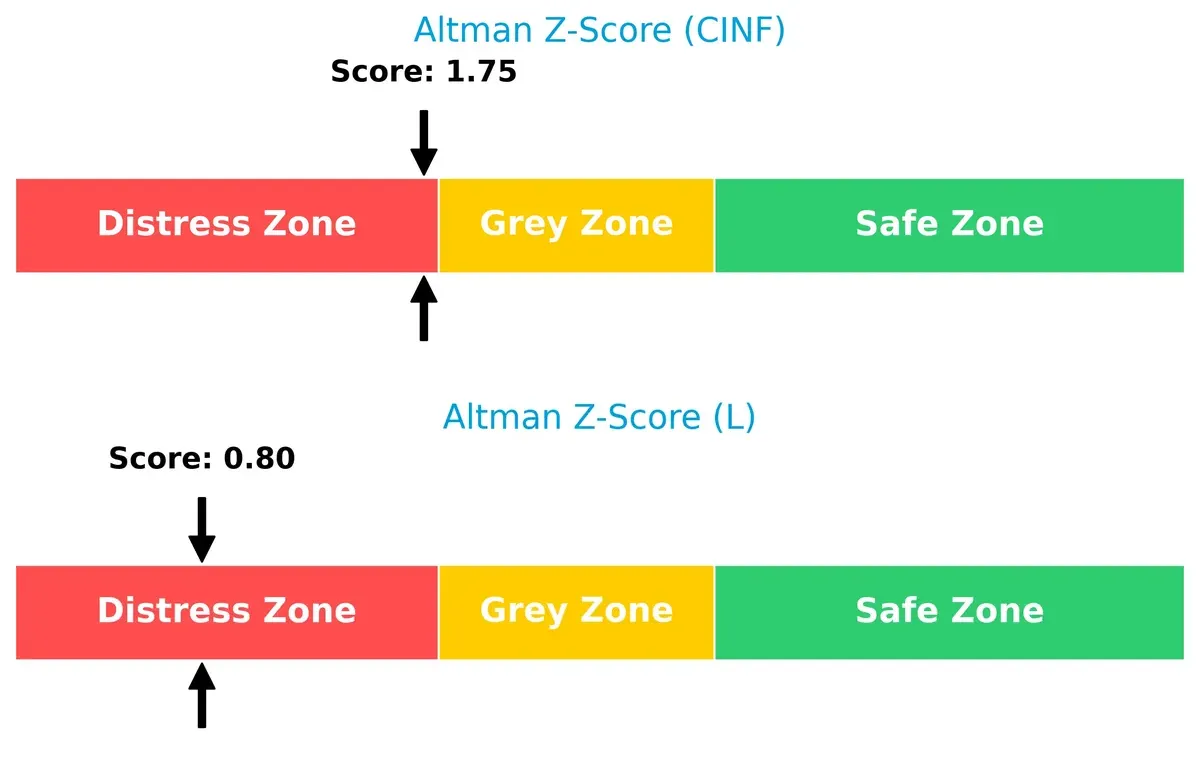
Bankruptcy Risk: Solvency Showdown
Cincinnati’s Altman Z-Score of 1.75 versus Loews’s 0.80 places both firms in the distress zone, but Cincinnati is closer to the grey area, suggesting a relatively lower bankruptcy risk in this cycle:
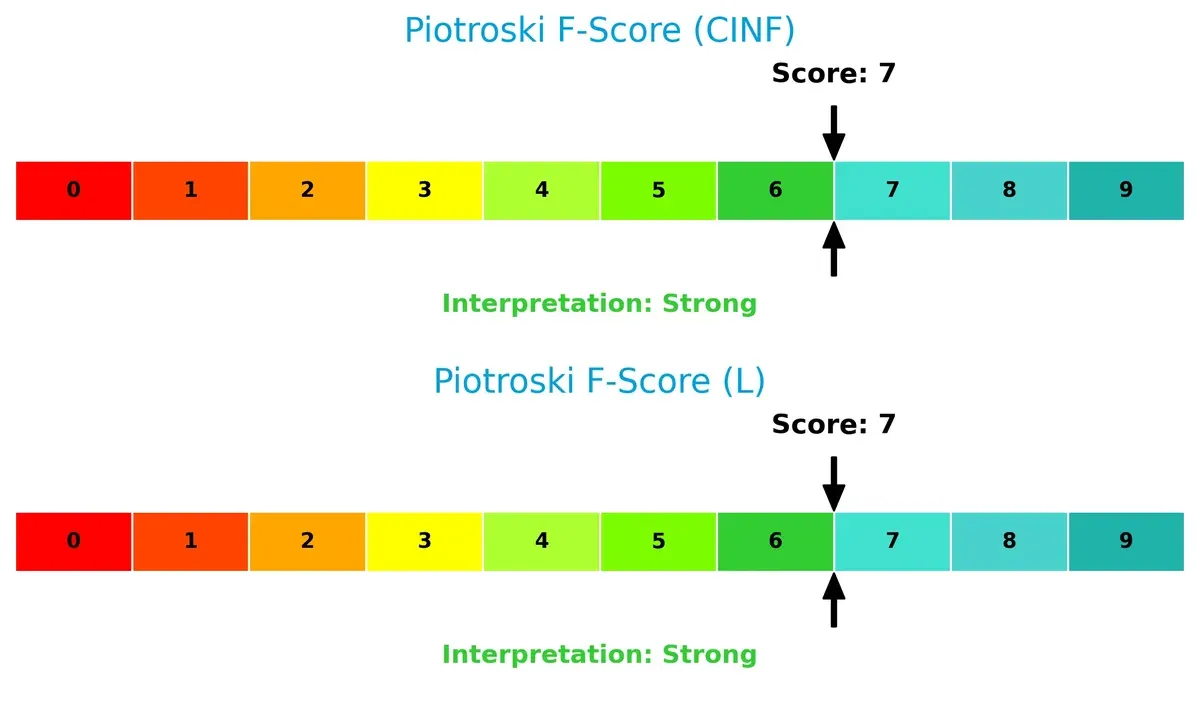
Financial Health: Quality of Operations
Both Cincinnati and Loews score a solid 7 on the Piotroski F-Score, reflecting strong internal financial health. Neither shows immediate red flags, but this parity emphasizes the importance of monitoring other risk factors closely:
How are the two companies positioned?
This section dissects CINF and L’s operational DNA by comparing their revenue distribution and internal dynamics, including strengths and weaknesses. The goal is to confront their economic moats and identify which model offers the most resilient competitive advantage today.
Revenue Segmentation: The Strategic Mix
The following visual comparison dissects how Cincinnati Financial Corporation and Loews Corporation diversify their income streams and where their primary sector bets lie:
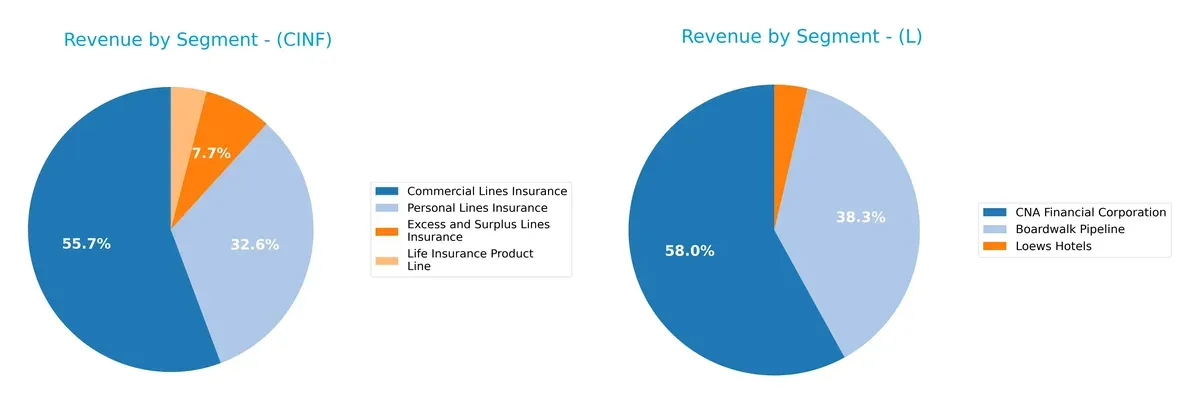
Cincinnati Financial leans heavily on Commercial Lines Insurance, generating $4.49B in 2024, supplemented by Personal Lines at $2.63B. Loews pivots around CNA Financial, which dwarfs other segments at $14.99B, while Boardwalk Pipeline and Loews Hotels provide smaller, yet steady, diversification. Cincinnati’s mix spreads risk across insurance products, while Loews concentrates revenue in financial services, exposing it to sector-specific cyclicality but benefiting from ecosystem dominance.
Strengths and Weaknesses Comparison
This table compares the Strengths and Weaknesses of Cincinnati Financial Corporation (CINF) and Loews Corporation (L):
CINF Strengths
- Strong profitability with 18.95% net margin and 15.04% ROE
- Very favorable ROIC at 56.09% well above WACC
- Low debt levels with 0.05 D/E ratio and 2.1% debt-to-assets
- High interest coverage at 559.62
- Diverse insurance product lines with stable revenue growth
- Dividend yield at 2.13% supports shareholder returns
L Strengths
- Exceptional ROIC of 168.44% exceeding WACC of 5.56%
- Favorable P/E and P/B ratios indicate value attractiveness
- Significant revenue from diversified businesses: insurance, pipeline, hotels
- Positive interest coverage ratio at 6.22
- Stable revenue growth in CNA Financial segment
- Moderate debt-to-assets ratio at 10.99%
CINF Weaknesses
- Unfavorable current ratio at 5.93 may indicate liquidity risk
- Asset turnover low at 0.31 suggests less efficient asset use
- Neutral P/B ratio at 1.62 limits valuation upside
- Limited global geographic presence
- Market share concentrated in insurance sector
L Weaknesses
- Neutral to unfavorable profitability with 9.17% net margin and 8.92% ROE
- Zero current and quick ratios reflect liquidity concerns
- Higher debt-to-equity at 0.51 may increase financial risk
- Low dividend yield at 0.24%
- Asset turnover low at 0.21 and fixed asset turnover neutral at 1.7
- Revenue more concentrated in fewer business lines
CINF’s strengths lie in robust profitability, strong capital structure, and diversified insurance offerings, yet liquidity and asset efficiency require attention. L shows exceptional ROIC and diversified revenue streams but faces challenges in profitability metrics and liquidity ratios. These contrasts suggest differing strategic priorities and risk profiles.
The Moat Duel: Analyzing Competitive Defensibility
A structural moat is the sole shield preserving long-term profits from relentless competition erosion. Let’s examine these moats in action:
Cincinnati Financial Corporation (CINF): Durable Intangible Assets Moat
CINF’s moat stems from its trusted brand and underwriting expertise. Its ROIC outpaces WACC by nearly 50%, signaling efficient capital use and stable margins. New insurance products and digital underwriting in 2026 could deepen its moat.
Loews Corporation (L): Diversified Asset Base Moat
Loews leverages its broad industrial and insurance holdings to spread risk. Its ROIC exceeds WACC by 160%, but declining ROIC warns of weakening efficiency. Expansion into specialty insurance and energy could disrupt its moat in 2026.
Capital Efficiency vs. Diversification: The Moat Showdown
CINF boasts a deeper, growing moat driven by underwriting strength and intangibles. Loews holds a wider but eroding moat reliant on diversification. Cincinnati Financial is better positioned to sustain market leadership amid competitive pressures.
Which stock offers better returns?
Over the past year, both Cincinnati Financial Corporation and Loews Corporation showed strong price gains with decelerating momentum, reflecting significant but slowing bullish trends.
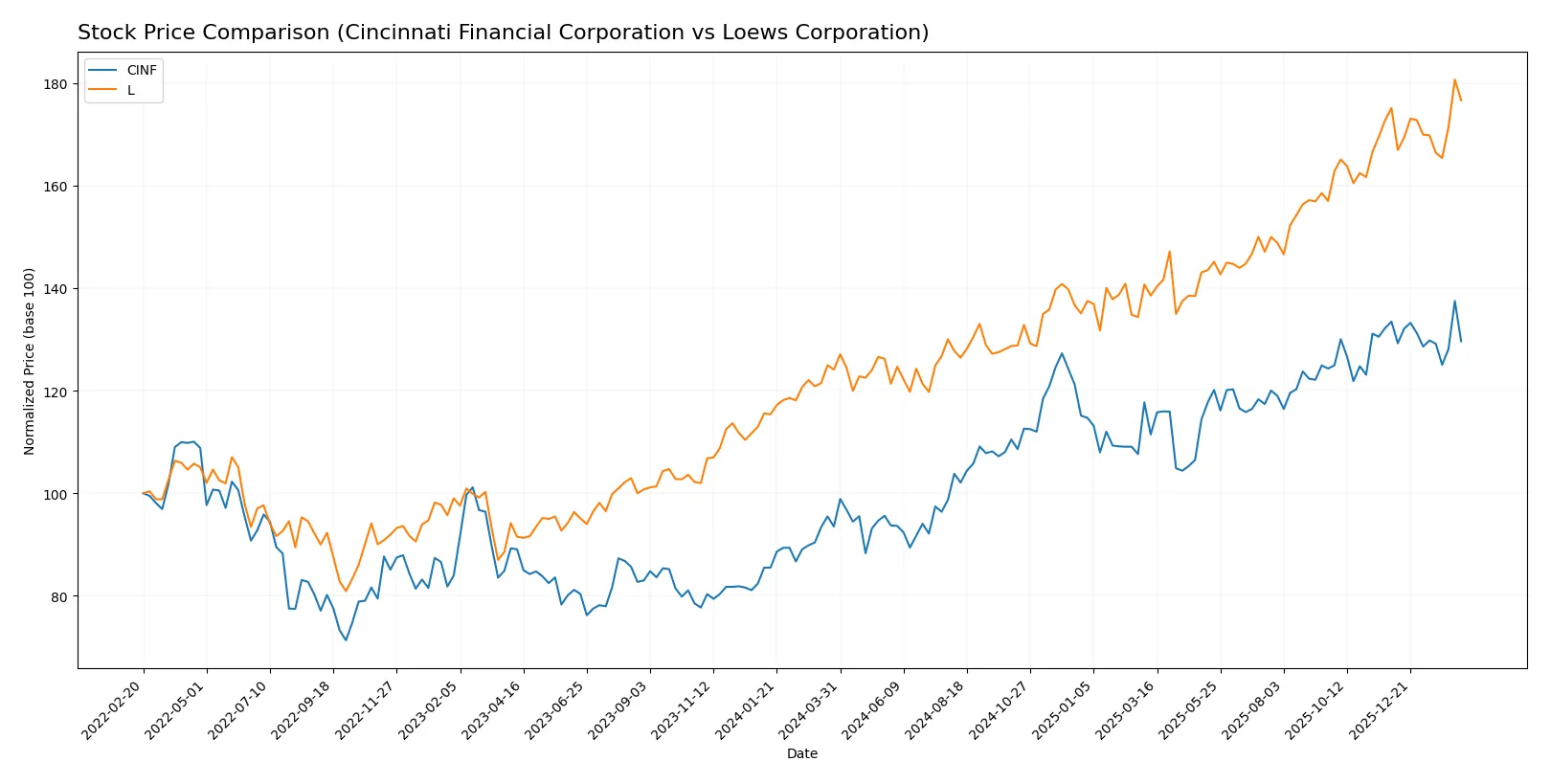
Trend Comparison
Cincinnati Financial’s stock rose 38.62% over the last 12 months, marking a bullish trend with decelerating momentum. It reached a high of 172.65 and a low of 110.88, showing notable price range expansion.
Loews Corporation’s stock gained 42.29% over the same period, also bullish with deceleration. Its price fluctuated between 73.76 and 111.27, presenting a slightly lower volatility than Cincinnati Financial.
Comparing both, Loews Corporation delivered the highest market performance with a 42.29% gain versus Cincinnati Financial’s 38.62% over the past year.
Target Prices
Analysts set a solid target consensus for Cincinnati Financial Corporation, reflecting cautious optimism.
| Company | Target Low | Target High | Consensus |
|---|---|---|---|
| Cincinnati Financial Corporation | 157 | 175 | 166 |
The consensus target of 166 sits modestly above the current price of 162.77, indicating moderate upside. No verified target price data is available for Loews Corporation.

Don’t Let Luck Decide Your Entry Point
Optimize your entry points with our advanced ProRealTime indicators. You’ll get efficient buy signals with precise price targets for maximum performance. Start outperforming now!
How do institutions grade them?
Cincinnati Financial Corporation Grades
The following table summarizes recent institutional grades for Cincinnati Financial Corporation:
| Grading Company | Action | New Grade | Date |
|---|---|---|---|
| Keefe, Bruyette & Woods | Maintain | Outperform | 2026-01-06 |
| Piper Sandler | Maintain | Neutral | 2025-12-22 |
| Keefe, Bruyette & Woods | Maintain | Outperform | 2025-11-04 |
| B of A Securities | Maintain | Buy | 2025-10-28 |
| B of A Securities | Maintain | Buy | 2025-10-13 |
| Keefe, Bruyette & Woods | Maintain | Outperform | 2025-10-06 |
| Keefe, Bruyette & Woods | Maintain | Outperform | 2025-08-05 |
| Roth Capital | Maintain | Buy | 2025-07-29 |
| Keefe, Bruyette & Woods | Maintain | Outperform | 2025-07-09 |
| Keefe, Bruyette & Woods | Maintain | Outperform | 2025-04-09 |
Loews Corporation Grades
The following table summarizes recent institutional grades for Loews Corporation:
| Grading Company | Action | New Grade | Date |
|---|---|---|---|
| RBC Capital | Maintain | Outperform | 2025-05-27 |
| Deutsche Bank | Maintain | Hold | 2018-08-01 |
| Deutsche Bank | Maintain | Hold | 2018-07-31 |
| Deutsche Bank | Maintain | Hold | 2015-11-06 |
| Deutsche Bank | Maintain | Hold | 2015-11-05 |
| JP Morgan | Maintain | Hold | 2014-08-08 |
| JP Morgan | Maintain | Hold | 2014-08-07 |
| Deutsche Bank | Downgrade | Hold | 2014-03-24 |
| Deutsche Bank | Downgrade | Hold | 2014-03-23 |
| Deutsche Bank | Maintain | Buy | 2013-09-04 |
Which company has the best grades?
Cincinnati Financial consistently receives Outperform and Buy grades from multiple firms, indicating strong confidence. Loews has fewer recent grades, mostly Hold, with one Outperform from 2025. This suggests Cincinnati Financial holds a stronger institutional endorsement, potentially influencing investor sentiment more positively.
Risks specific to each company
The following categories identify critical pressure points and systemic threats facing Cincinnati Financial Corporation and Loews Corporation in the 2026 market environment:
1. Market & Competition
Cincinnati Financial Corporation
- Faces intense competition in property & casualty insurance with evolving customer needs.
Loews Corporation
- Operates in diverse sectors including insurance and energy, facing multi-industry competitive pressures.
2. Capital Structure & Debt
Cincinnati Financial Corporation
- Maintains a very low debt-to-equity ratio (0.05), signaling strong balance sheet discipline.
Loews Corporation
- Higher debt-to-equity (0.51) creates moderate leverage risk despite manageable interest coverage.
3. Stock Volatility
Cincinnati Financial Corporation
- Exhibits lower beta (0.646), indicating less sensitivity to market swings.
Loews Corporation
- Slightly lower beta (0.605) reflects moderate volatility but broader business exposure.
4. Regulatory & Legal
Cincinnati Financial Corporation
- Subject to insurance regulatory frameworks impacting underwriting and capital requirements.
Loews Corporation
- Faces regulatory complexity across insurance, energy, and manufacturing sectors.
5. Supply Chain & Operations
Cincinnati Financial Corporation
- Operations centered on insurance underwriting with limited supply chain risk.
Loews Corporation
- Supply chain complexity from pipeline operations and manufacturing increases operational risk.
6. ESG & Climate Transition
Cincinnati Financial Corporation
- Insurance business exposed to climate risk via underwriting property damages.
Loews Corporation
- Energy and manufacturing segments face transition risks tied to climate policies.
7. Geopolitical Exposure
Cincinnati Financial Corporation
- Primarily US-focused, limiting geopolitical risk.
Loews Corporation
- International insurance and energy operations expose it to geopolitical uncertainties.
Which company shows a better risk-adjusted profile?
Cincinnati Financial’s most impactful risk is its very low current ratio, which signals potential liquidity concerns despite strong profitability. Loews faces its greatest risk from elevated leverage across diverse industries, increasing financial and operational complexity. Cincinnati Financial demonstrates a better risk-adjusted profile, supported by superior profitability ratios and lower financial leverage, despite a distressed Altman Z-score. This suggests that while liquidity is a caution point, its overall financial stability and focused market position provide a more resilient investment stance in 2026.
Final Verdict: Which stock to choose?
Cincinnati Financial Corporation’s superpower lies in its robust capital efficiency and sustainable competitive advantage, reflected in its soaring ROIC well above WACC. This translates to value creation and disciplined capital allocation. A point of vigilance remains its stretched current ratio, hinting at potential liquidity concerns. It fits best in an Aggressive Growth portfolio seeking resilience and efficiency.
Loews Corporation’s strategic moat is its ability to create value despite a declining ROIC trend, supported by steady income quality and strong free cash flow yield. Its balance sheet shows higher leverage but also solid interest coverage, offering a more defensive profile than Cincinnati. It appeals to GARP investors who prioritize stability with growth at a reasonable price.
If you prioritize durable capital efficiency and a company with a proven moat, Cincinnati Financial outshines due to its superior ROIC and value creation. However, if you seek a more balanced approach with steady cash flow and moderate risk, Loews offers better stability despite its weaker ROIC trend and higher leverage. Both present analytical scenarios tailored to distinct investor profiles.
Disclaimer: Investment carries a risk of loss of initial capital. The past performance is not a reliable indicator of future results. Be sure to understand risks before making an investment decision.
Go Further
I encourage you to read the complete analyses of Cincinnati Financial Corporation and Loews Corporation to enhance your investment decisions: