Home > Comparison > Consumer Cyclical > CMG vs YUM
The strategic rivalry between Chipotle Mexican Grill, Inc. and Yum! Brands, Inc. defines the current trajectory of the consumer cyclical restaurant sector. Chipotle operates a focused, fast-casual model emphasizing quality and innovation, while Yum! Brands commands a diversified, franchise-heavy portfolio spanning global quick-service giants. This face-off pits concentrated growth against expansive scale. This analysis will reveal which trajectory offers superior risk-adjusted returns for a diversified portfolio in today’s competitive landscape.

Table of contents
Companies Overview
Chipotle Mexican Grill and Yum! Brands dominate the global quick-service restaurant market with distinct operational models.
Chipotle Mexican Grill, Inc.: Pioneer of Fast-Casual Mexican Dining
Chipotle Mexican Grill dominates the fast-casual Mexican segment with approximately 3,000 restaurants across North America and Europe. Its core revenue engine hinges on owning and operating locations that emphasize fresh, customizable meals. In 2026, Chipotle’s strategic focus remains on expanding its footprint while enhancing digital ordering and delivery capabilities to capture evolving consumer preferences.
Yum! Brands, Inc.: Global Franchise Powerhouse
Yum! Brands leads with a diversified portfolio, operating and franchising over 53,000 restaurants worldwide across KFC, Pizza Hut, Taco Bell, and The Habit Burger Grill. Its competitive advantage lies in franchising scale and brand diversity, generating revenue through franchise fees and company-operated units. In 2026, Yum! concentrates on international growth and menu innovation to sustain its global leadership.
Strategic Collision: Similarities & Divergences
Chipotle pursues a company-owned model focusing on quality control and brand consistency, contrasting Yum!’s franchise-heavy approach emphasizing rapid global expansion. Both vie for market share in fast, casual dining but differ sharply: Chipotle bets on controlled growth and digital investment, while Yum! leverages franchising to scale. Their investment profiles reflect this split—Chipotle offers growth potential with operational complexity, whereas Yum! provides stability through diversified, recurring franchise fees.
Income Statement Comparison
This data dissects the core profitability and scalability of both corporate engines to reveal who dominates the bottom line:
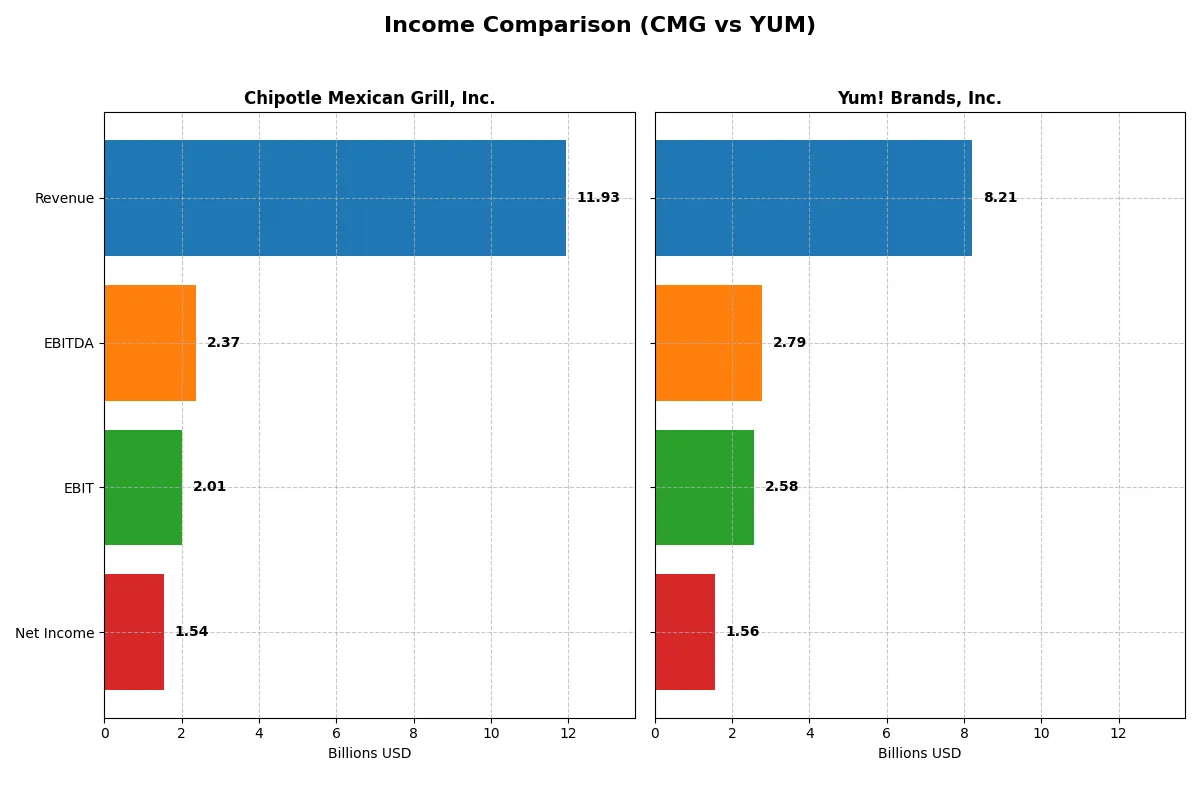
| Metric | Chipotle Mexican Grill, Inc. (CMG) | Yum! Brands, Inc. (YUM) |
|---|---|---|
| Revenue | 11.93B | 8.21B |
| Cost of Revenue | 9.26B | 4.42B |
| Operating Expenses | 656M | 1.26B |
| Gross Profit | 2.66B | 3.79B |
| EBITDA | 2.37B | 2.79B |
| EBIT | 2.01B | 2.58B |
| Interest Expense | 0 | 500M |
| Net Income | 1.54B | 1.56B |
| EPS | 1.15 | 5.59 |
| Fiscal Year | 2025 | 2025 |
Income Statement Analysis: The Bottom-Line Duel
This income statement comparison will expose which company runs a more efficient and profitable business engine in 2025.
Chipotle Mexican Grill, Inc. Analysis
Chipotle’s revenue climbed steadily, reaching $11.9B in 2025, with net income up 135% over five years to $1.54B. Gross margin softened to 22.35%, reflecting cost pressures, yet the net margin held strong at 12.88%. Despite a slight dip in gross profit, Chipotle maintained operational discipline, with EBIT margin steady near 17%, signaling resilient momentum.
Yum! Brands, Inc. Analysis
Yum! reported $8.2B in revenue for 2025, growing 8.8% year-over-year, and a solid $1.56B net income. Its gross margin at 46.17% and EBIT margin at 31.4% outpace Chipotle, showcasing superior cost control. However, net margin slightly declined by 3.6%. While revenue and profitability grew, net income dropped marginally over five years, hinting at margin pressures despite operational efficiency.
Margin Strength vs. Growth Resilience
Yum! leads in margin dominance, delivering stronger profitability ratios and cost efficiency. Chipotle impresses with rapid revenue and net income growth, reflecting robust expansion and margin recovery. For investors prioritizing growth momentum, Chipotle’s trajectory appears more attractive, while Yum! suits those valuing consistent high margins and operational leverage.
Financial Ratios Comparison
These vital ratios act as a diagnostic tool to expose the underlying fiscal health, valuation premiums, and capital efficiency of these companies:
| Ratios | Chipotle Mexican Grill, Inc. (CMG) | Yum! Brands, Inc. (YUM) |
|---|---|---|
| ROE | 54.3% | -21.3% |
| ROIC | 18.9% | 28.3% |
| P/E | 32.2 | 27.0 |
| P/B | 17.5 | -5.7 |
| Current Ratio | 1.23 | 1.35 |
| Quick Ratio | 1.19 | 1.35 |
| D/E | 3.48 | -1.63 |
| Debt-to-Assets | 109.5% | 145.3% |
| Interest Coverage | 0 | 5.06 |
| Asset Turnover | 1.33 | 1.00 |
| Fixed Asset Turnover | 1.67 | 5.12 |
| Payout ratio | 0 | 50.6% |
| Dividend yield | 0 | 1.88% |
| Fiscal Year | 2025 | 2025 |
Efficiency & Valuation Duel: The Vital Signs
Financial ratios act as a company’s DNA, uncovering hidden risks and operational strengths critical for investment insight.
Chipotle Mexican Grill, Inc.
Chipotle posts a robust 54.3% ROE and solid 12.9% net margin, signaling strong profitability. Its 32.2 P/E ratio appears stretched versus typical sector norms. The absence of dividends highlights reinvestment in growth. However, a high debt-to-equity ratio at 3.48 flags leverage risk despite favorable returns on invested capital.
Yum! Brands, Inc.
Yum! delivers a superior 19.0% net margin and a strong 28.3% ROIC, reflecting operational efficiency. The 27.0 P/E ratio is high but less stretched than Chipotle’s. Negative ROE contrasts with its profitable core, hinting at balance sheet challenges. Yum! offers a modest 1.9% dividend yield, balancing shareholder returns with steady cash flow.
Premium Valuation vs. Operational Safety
Yum! Brands exhibits a better balance of operational efficiency and shareholder returns with fewer financial red flags. Chipotle’s high leverage and premium valuation increase risk despite strong profitability. Investors seeking growth may prefer Chipotle’s reinvestment, while risk-averse profiles might favor Yum!’s steadier payout and efficiency.
Which one offers the Superior Shareholder Reward?
I observe Yum! Brands (YUM) pays a consistent dividend with a 1.9% yield and a 50.6% payout ratio in 2025. Chipotle (CMG) pays no dividends, instead reinvesting FCF (~1.08/share) to fuel growth. Both run buybacks, but YUM’s payout plus buybacks deliver steadier returns. Yum!’s dividend sustainability aligns with solid free cash flow coverage despite heavy debt leverage. Chipotle’s zero payout boosts growth potential but increases risk without immediate shareholder returns. For 2026, I favor Yum! Brands for a balanced, sustainable total return profile.
Comparative Score Analysis: The Strategic Profile
The radar chart reveals the fundamental DNA and trade-offs of Chipotle Mexican Grill, Inc. and Yum! Brands, Inc., highlighting their distinct financial strengths and weaknesses:
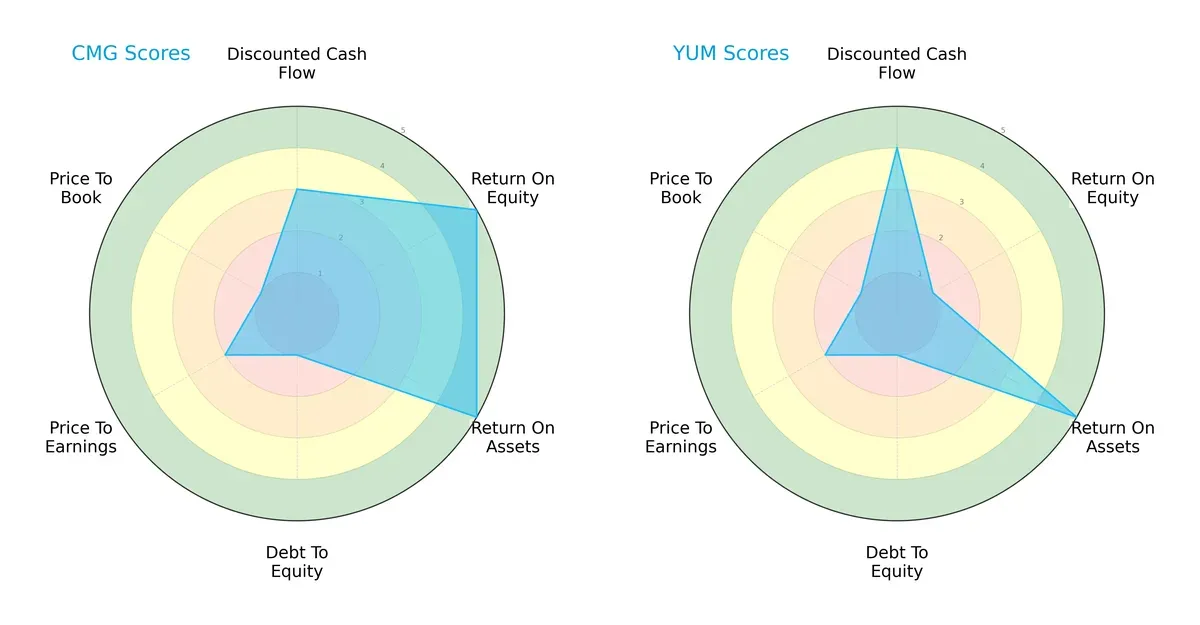
Chipotle excels in profitability metrics with top scores in ROE (5) and ROA (5), signaling efficient capital and asset use. Yum! Brands scores higher in discounted cash flow (4), indicating better valuation based on future cash flows. Both firms share weak debt-to-equity and valuation scores, reflecting cautious capital structures and questionable market pricing. Chipotle presents a more balanced profile driven by operational efficiency, while Yum! relies on its valuation edge.
Bankruptcy Risk: Solvency Showdown
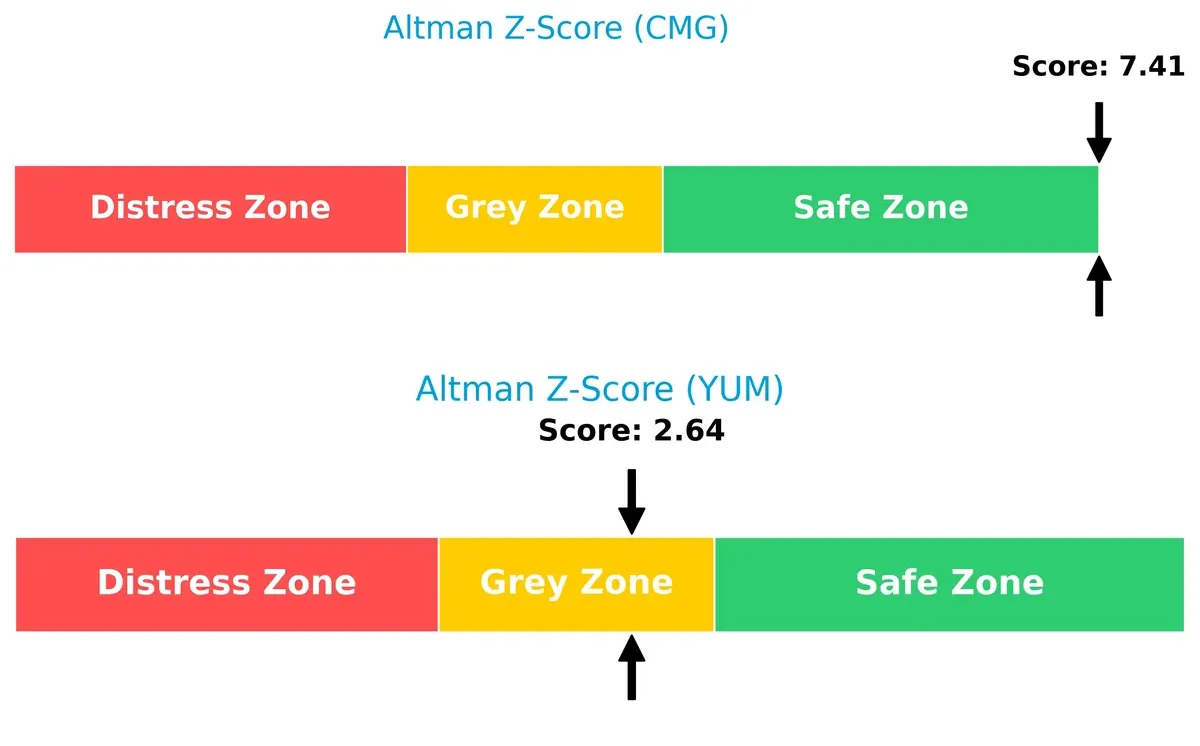
Chipotle’s Altman Z-Score of 7.41 firmly places it in the safe zone, while Yum!’s 2.64 situates it in the grey zone, signaling higher bankruptcy risk in this cycle:
Financial Health: Quality of Operations
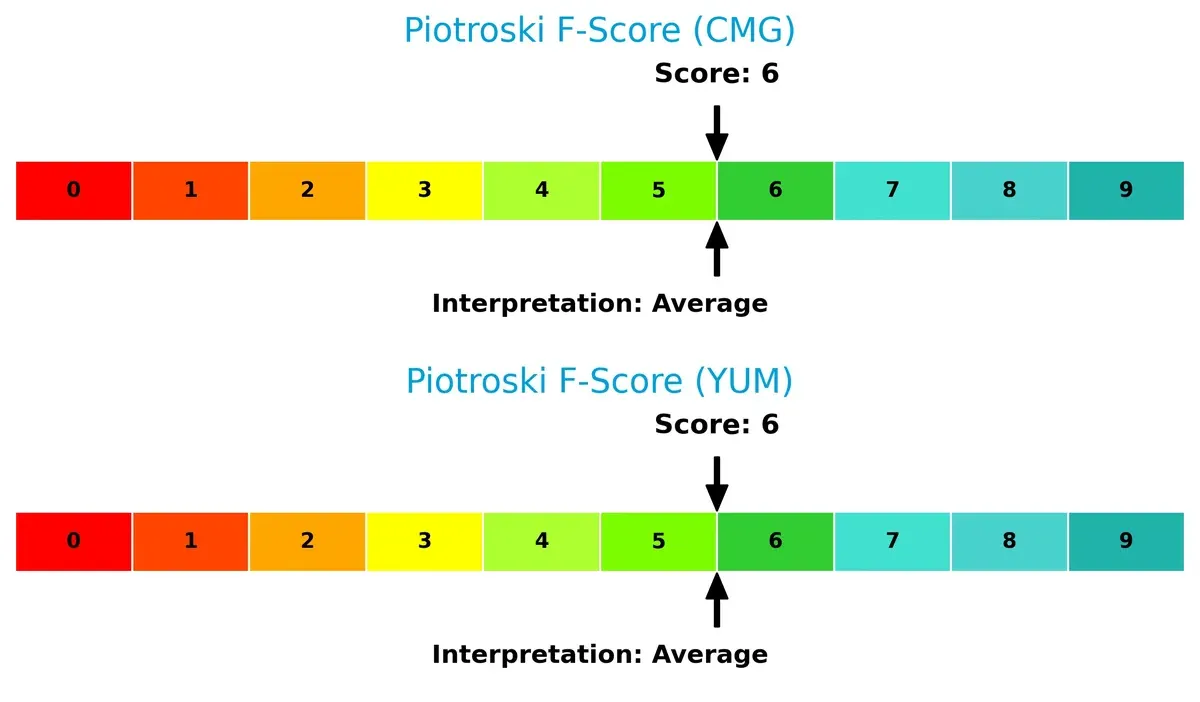
Both companies share an identical Piotroski F-Score of 6, reflecting average financial health without glaring red flags in profitability, leverage, or liquidity metrics:
How are the two companies positioned?
This section dissects the operational DNA of Chipotle Mexican Grill and Yum! Brands by comparing revenue distribution and internal dynamics. The goal is to confront their economic moats, revealing which model offers the most resilient competitive advantage today.
Revenue Segmentation: The Strategic Mix
This visual comparison dissects how Chipotle Mexican Grill and Yum! Brands diversify their income streams and where their primary sector bets lie:
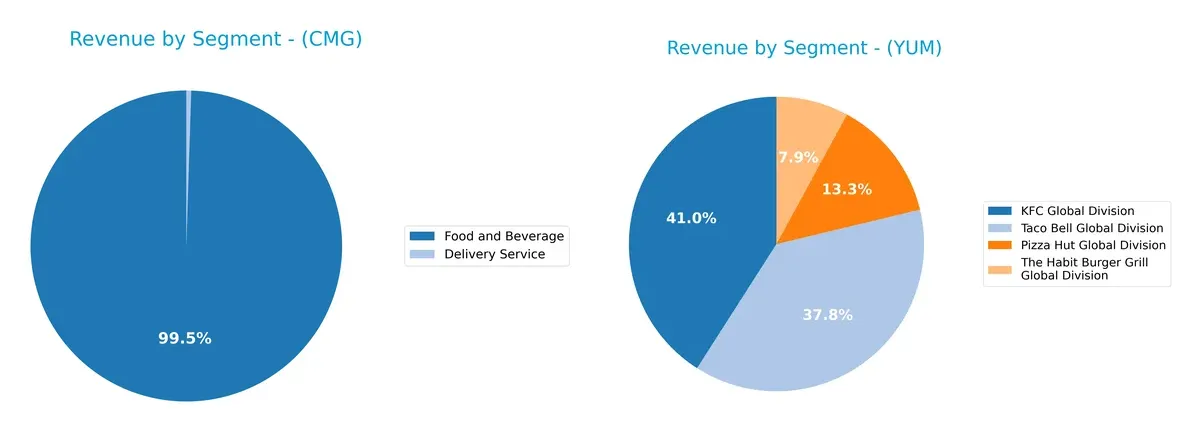
Chipotle Mexican Grill anchors its revenue heavily in Food and Beverage, generating $11.87B in 2025, with Delivery Service contributing a modest $60M. Yum! Brands exhibits a more balanced mix, with KFC ($3.1B), Taco Bell ($2.86B), Pizza Hut ($1.01B), and The Habit Burger Grill ($600M) all materially supporting revenue. Yum!’s diversification reduces concentration risk, while Chipotle’s reliance on a single segment signals vulnerability to sector shifts despite strong core brand dominance.
Strengths and Weaknesses Comparison
This table compares the Strengths and Weaknesses of Chipotle Mexican Grill, Inc. (CMG) and Yum! Brands, Inc. (YUM):
CMG Strengths
- Strong profitability with 12.88% net margin
- High ROE at 54.26% and ROIC at 18.93%
- Favorable quick ratio at 1.19
- Consistent asset turnover at 1.33
- Large U.S. market presence with $11.68B revenue
- Focus on food and beverage segment
YUM Strengths
- Higher net margin at 18.98%
- Superior ROIC at 28.26%
- Favorable debt-to-equity and interest coverage ratios
- Greater fixed asset turnover at 5.12
- Diversified global revenue streams across multiple brands
- Favorable price-to-book ratio
CMG Weaknesses
- Elevated debt-to-assets at 109.5% signals financial leverage risk
- Unfavorable PE at 32.22 and PB at 17.48
- Debt-to-equity ratio very high at 3.48
- No dividend yield
- Limited geographic diversification beyond U.S.
- Slightly unfavorable global ratios overall
YUM Weaknesses
- Negative ROE at -21.28% raises profitability concerns
- High debt-to-assets at 145.3%
- PE still unfavorable at 26.98
- No dividend yield advantage, only neutral
- Heavy reliance on international markets without U.S. segment data
Both companies demonstrate strong profitability and operational efficiency but face leverage concerns. CMG’s strengths lie in U.S. market dominance, while YUM benefits from global diversification. Each must manage debt prudently to sustain growth.
The Moat Duel: Analyzing Competitive Defensibility
A structural moat is the critical shield protecting long-term profits from relentless competitive erosion. Here’s how these two giants defend their turf:
Chipotle Mexican Grill, Inc.: Premium Brand & Operational Excellence
Chipotle’s moat stems from strong brand loyalty and operational efficiency. Its ROIC outpaces WACC by 11.3%, signaling value creation. Expanding menu innovation and digital sales deepen its competitive edge in 2026.
Yum! Brands, Inc.: Franchise Scale & Global Reach
Yum! leverages a vast franchise network across multiple cuisines, creating cost advantages different from Chipotle’s brand focus. Despite a high ROIC premium of 22.1%, declining ROIC signals pressure. Expansion in emerging markets offers growth potential amid margin challenges.
Brand Loyalty vs. Franchise Scale: The Moat Showdown
Chipotle’s growing ROIC and operational focus build a deeper moat than Yum!’s scale, which faces margin erosion. I see Chipotle better positioned to defend and expand market share long term.
Which stock offers better returns?
Over the past year, Chipotle Mexican Grill experienced a sharp decline followed by a recent strong rebound, while Yum! Brands showed steady gains with accelerating momentum.
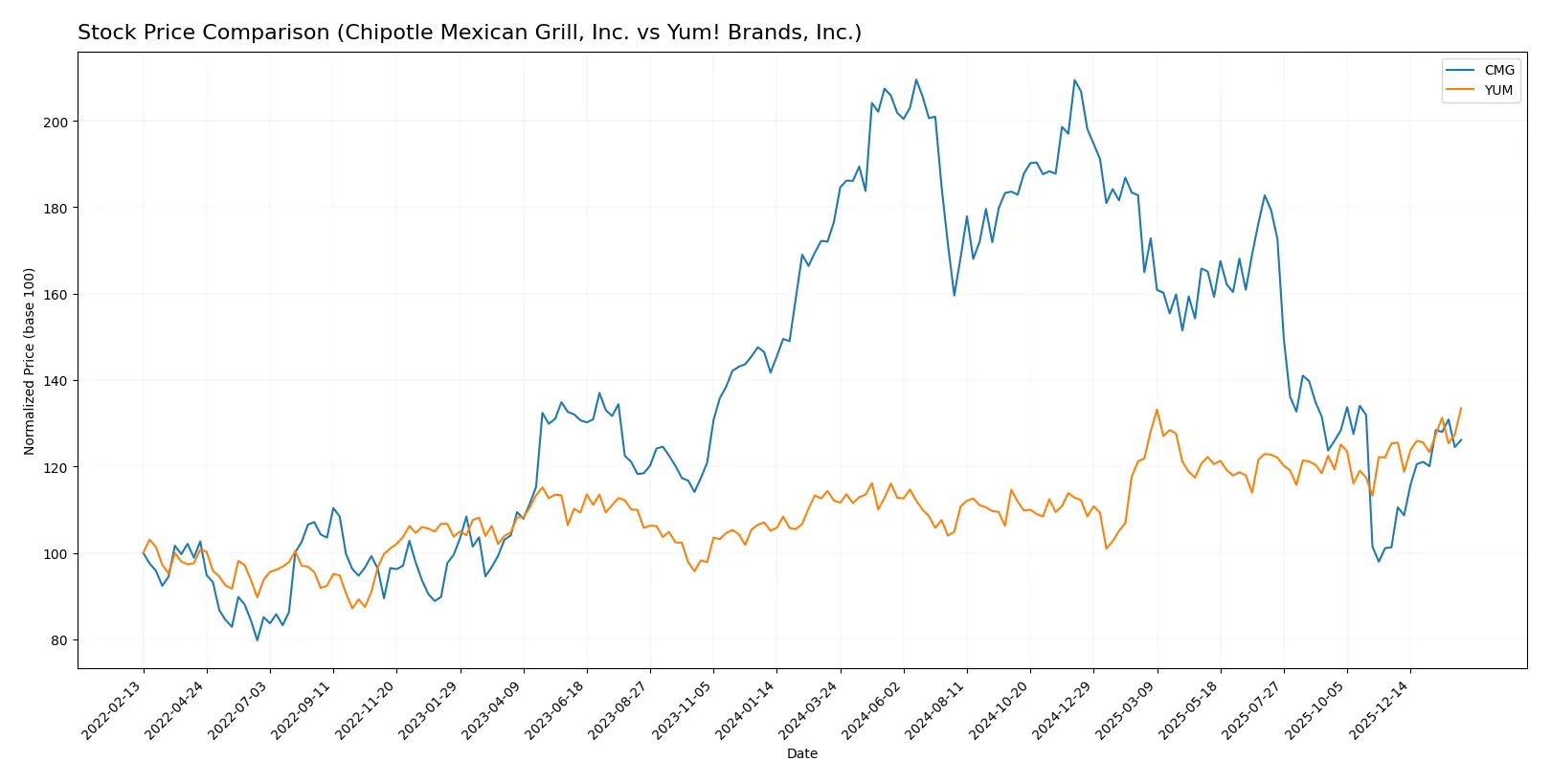
Trend Comparison
Chipotle Mexican Grill’s stock fell 28.55% over the past 12 months, marking a bearish trend with accelerating decline and a high volatility of 9.32%. The price ranged from $65.43 to $30.59, with a recent rebound of 24.53% over the last two and a half months.
Yum! Brands’ stock rose 19.07% over the past year, confirming a bullish trend with accelerating gains and volatility of 8.64%. The price fluctuated between $123.25 and $162.93, with a 6.5% increase in the recent period.
Yum! Brands outperformed Chipotle Mexican Grill over the past year with a positive total return, despite Chipotle’s recent recovery phase showing strong buyer dominance.
Target Prices
Analysts present a clear target price consensus for both Chipotle Mexican Grill and Yum! Brands.
| Company | Target Low | Target High | Consensus |
|---|---|---|---|
| Chipotle Mexican Grill, Inc. | 35 | 52 | 44.35 |
| Yum! Brands, Inc. | 158 | 185 | 170.85 |
The target consensus for Chipotle exceeds its current price of 39.39, signaling modest upside. Yum! Brands’ consensus target also suggests room for appreciation above its 162.93 price.

Don’t Let Luck Decide Your Entry Point
Optimize your entry points with our advanced ProRealTime indicators. You’ll get efficient buy signals with precise price targets for maximum performance. Start outperforming now!
How do institutions grade them?
Chipotle Mexican Grill, Inc. Grades
The following table summarizes recent institutional grades for Chipotle Mexican Grill, Inc.:
| Grading Company | Action | New Grade | Date |
|---|---|---|---|
| Argus Research | maintain | Hold | 2026-02-05 |
| TD Cowen | maintain | Buy | 2026-02-04 |
| Morgan Stanley | maintain | Overweight | 2026-02-04 |
| Keybanc | maintain | Overweight | 2026-02-04 |
| Piper Sandler | maintain | Overweight | 2026-02-04 |
| Mizuho | maintain | Neutral | 2026-02-04 |
| BTIG | maintain | Buy | 2026-02-04 |
| Citigroup | maintain | Buy | 2026-02-04 |
| Stifel | maintain | Buy | 2026-02-04 |
| Barclays | maintain | Equal Weight | 2026-02-04 |
Yum! Brands, Inc. Grades
The following table summarizes recent institutional grades for Yum! Brands, Inc.:
| Grading Company | Action | New Grade | Date |
|---|---|---|---|
| TD Cowen | maintain | Buy | 2026-02-05 |
| Wells Fargo | maintain | Equal Weight | 2026-02-05 |
| Citigroup | maintain | Neutral | 2026-02-05 |
| Citigroup | maintain | Neutral | 2026-01-22 |
| Morgan Stanley | maintain | Equal Weight | 2026-01-20 |
| Gordon Haskett | upgrade | Buy | 2026-01-08 |
| Barclays | maintain | Overweight | 2026-01-07 |
| Oppenheimer | downgrade | Perform | 2026-01-07 |
| TD Cowen | upgrade | Buy | 2025-11-17 |
| Evercore ISI Group | upgrade | Outperform | 2025-11-05 |
Which company has the best grades?
Chipotle Mexican Grill, Inc. holds generally more bullish grades with multiple Buy and Overweight ratings. Yum! Brands, Inc. shows a mix of Buy and Neutral grades with some recent upgrades but also a downgrade. Investors may view Chipotle’s broader Buy consensus as a stronger signal in current market conditions.
Risks specific to each company
The following categories identify the critical pressure points and systemic threats facing both firms in the 2026 market environment:
1. Market & Competition
Chipotle Mexican Grill, Inc. (CMG)
- Faces intense competition in fast-casual dining with price sensitivity impacting margins.
Yum! Brands, Inc. (YUM)
- Operates diverse segments globally, facing competitive pressure in multiple quick-service markets.
2. Capital Structure & Debt
Chipotle Mexican Grill, Inc. (CMG)
- High debt-to-assets ratio (109.5%) and debt/equity of 3.48 signal elevated leverage risk.
Yum! Brands, Inc. (YUM)
- Even higher debt-to-assets ratio (145.3%) but negative debt-to-equity suggests off-balance sheet liabilities.
3. Stock Volatility
Chipotle Mexican Grill, Inc. (CMG)
- Beta near 1 (0.996) indicates stock moves roughly with the market, moderate volatility.
Yum! Brands, Inc. (YUM)
- Lower beta (0.657) shows less sensitivity to market swings, potentially more stable.
4. Regulatory & Legal
Chipotle Mexican Grill, Inc. (CMG)
- Exposure to food safety regulations with global operations increasing compliance complexity.
Yum! Brands, Inc. (YUM)
- Faces regulatory scrutiny across 157 countries, increasing legal and compliance risks.
5. Supply Chain & Operations
Chipotle Mexican Grill, Inc. (CMG)
- Supply chain disruptions can impact fresh ingredient sourcing critical to brand promise.
Yum! Brands, Inc. (YUM)
- Complex global supply chain across multiple brands increases operational risks.
6. ESG & Climate Transition
Chipotle Mexican Grill, Inc. (CMG)
- Growing pressure to improve sustainability in sourcing and reduce environmental footprint.
Yum! Brands, Inc. (YUM)
- Faces heightened ESG scrutiny due to scale and diversity of operations worldwide.
7. Geopolitical Exposure
Chipotle Mexican Grill, Inc. (CMG)
- Moderate exposure concentrated in North America and Europe.
Yum! Brands, Inc. (YUM)
- Significant geopolitical risks from extensive operations in emerging markets.
Which company shows a better risk-adjusted profile?
Chipotle’s greatest risk lies in its elevated leverage, which could amplify shocks despite solid profitability. Yum! suffers from complex geopolitical exposure and regulatory burdens but enjoys broader diversification and lower market volatility. Yum!’s Altman Z-score in the grey zone signals moderate financial distress risk, while Chipotle’s safe zone score reflects stronger financial health. Overall, Yum! presents a more balanced risk-adjusted profile due to diversification and stability, despite its debt concerns.
Final Verdict: Which stock to choose?
Chipotle Mexican Grill’s superpower lies in its exceptional capital efficiency and robust return on invested capital, signaling a strong economic moat. Its heavy leverage, however, demands vigilance amid rising interest rate environments. It suits investors aiming for aggressive growth with a tolerance for financial risk.
Yum! Brands offers a strategic moat through its diversified franchise model and recurring revenue streams, delivering better cash flow stability. While its profitability metrics show some volatility, it generally presents a safer profile than Chipotle. It fits well within GARP portfolios seeking steady growth with moderate risk.
If you prioritize aggressive growth driven by operational excellence and expanding margins, Chipotle outshines with its superior efficiency and profitability. However, if you seek better stability and recurring cash flows with a more conservative risk stance, Yum! Brands offers a compelling scenario despite its current profitability challenges. Both require careful monitoring of leverage and market conditions.
Disclaimer: Investment carries a risk of loss of initial capital. The past performance is not a reliable indicator of future results. Be sure to understand risks before making an investment decision.
Go Further
I encourage you to read the complete analyses of Chipotle Mexican Grill, Inc. and Yum! Brands, Inc. to enhance your investment decisions: