Taiwan Semiconductor Manufacturing Company Limited (TSM) and CEVA, Inc. both operate in the semiconductor industry but occupy distinct niches: TSM is a global leader in chip manufacturing, while CEVA specializes in licensing advanced wireless connectivity and AI processor technologies. Their innovation strategies and market focus overlap in enabling next-generation technologies. This article will help you determine which company presents the most compelling investment opportunity in 2026.
Table of contents
Companies Overview
I will begin the comparison between Taiwan Semiconductor Manufacturing Company Limited and CEVA, Inc. by providing an overview of these two companies and their main differences.
Taiwan Semiconductor Manufacturing Company Limited Overview
Taiwan Semiconductor Manufacturing Company Limited (TSM) is a leading global semiconductor manufacturer established in 1987 and headquartered in Hsinchu City, Taiwan. It specializes in manufacturing, packaging, testing, and selling integrated circuits and semiconductor devices worldwide. TSMC offers diverse wafer fabrication processes and supports sectors such as high-performance computing, smartphones, IoT, automotive, and digital consumer electronics.
CEVA, Inc. Overview
CEVA, Inc. is a US-based technology licensor founded in 1999 and headquartered in Rockville, Maryland. It licenses digital signal processors, AI processors, wireless connectivity, and smart sensing technologies to semiconductor and OEM companies globally. CEVA’s solutions cover 5G, imaging, voice, AI, sensor fusion, and IoT applications, targeting mobile, consumer, automotive, robotics, and industrial markets with software development kits and system design tools.
Key similarities and differences
Both companies operate in the semiconductor industry but have distinct business models. TSMC focuses on manufacturing and testing semiconductor chips at scale, serving a broad range of electronic device sectors. Conversely, CEVA primarily licenses intellectual property and software platforms for signal processing and wireless technologies, enabling clients to integrate these into their own products. While TSMC is a manufacturing heavyweight with a market cap exceeding 1.6T USD, CEVA operates on a smaller scale with a market cap around 544M USD.
Income Statement Comparison
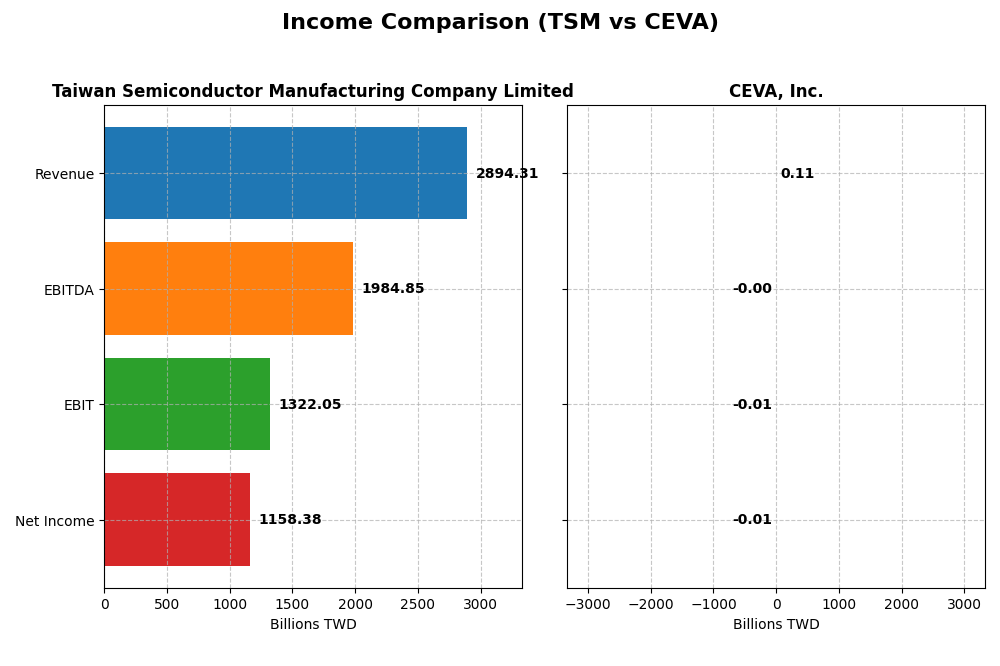
The table below presents a side-by-side comparison of key income statement metrics for Taiwan Semiconductor Manufacturing Company Limited (TSM) and CEVA, Inc. for the fiscal year 2024.
| Metric | Taiwan Semiconductor Manufacturing Company Limited | CEVA, Inc. |
|---|---|---|
| Market Cap | 1.70T TWD | 544M USD |
| Revenue | 2.89T TWD | 107M USD |
| EBITDA | 1.98T TWD | -3.41M USD |
| EBIT | 1.32T TWD | -7.55M USD |
| Net Income | 1.16T TWD | -8.79M USD |
| EPS | 223.4 TWD | -0.37 USD |
| Fiscal Year | 2024 | 2024 |
Income Statement Interpretations
Taiwan Semiconductor Manufacturing Company Limited
Taiwan Semiconductor Manufacturing Company Limited (TSM) exhibited strong revenue growth from 2020 to 2024, increasing from TWD 1.34T to TWD 2.89T, while net income rose significantly from TWD 510B to TWD 1.16T. Margins remained robust, with a gross margin of 56.12% and a net margin around 40%. The firm’s 2024 performance showed continued revenue acceleration and stable margin expansion.
CEVA, Inc.
CEVA, Inc. showed moderate revenue growth from USD 100M in 2020 to USD 107M in 2024, but net income remained negative, with a loss of USD 8.8M in 2024 despite some improvement from previous years. While gross margin was high at 88.06%, EBIT and net margins were negative at -7.06% and -8.22%, respectively. The 2024 year saw positive growth in EBIT and net margin but ongoing net losses persisted.
Which one has the stronger fundamentals?
TSM demonstrates stronger fundamentals with consistent double-digit revenue and net income growth, favorable margins, and positive earnings per share momentum. CEVA, while maintaining a high gross margin, struggles with profitability and net losses over the period. Overall, TSM’s income statement reflects greater stability and scalability compared to CEVA’s more volatile financial results.
Financial Ratios Comparison
The table below compares key financial ratios for Taiwan Semiconductor Manufacturing Company Limited (TSM) and CEVA, Inc. based on their most recent fiscal year data from 2024.
| Ratios | Taiwan Semiconductor Manufacturing Company Limited (TSM) | CEVA, Inc. |
|---|---|---|
| ROE | 27.29% | -3.30% |
| ROIC | 20.00% | -2.68% |
| P/E | 29.04 | -84.79 |
| P/B | 7.92 | 2.79 |
| Current Ratio | 2.36 | 7.09 |
| Quick Ratio | 2.14 | 7.09 |
| D/E (Debt-to-Equity) | 0.25 | 0.02 |
| Debt-to-Assets | 15.65% | 1.80% |
| Interest Coverage | 126.0 | 0 (not covered) |
| Asset Turnover | 0.43 | 0.35 |
| Fixed Asset Turnover | 0.88 | 8.43 |
| Payout ratio | 31.34% | 0 |
| Dividend yield | 1.08% | 0 |
Interpretation of the Ratios
Taiwan Semiconductor Manufacturing Company Limited
Taiwan Semiconductor Manufacturing Company shows mostly strong financial ratios with favorable net margin at 40.02%, ROE of 27.29%, and ROIC of 20.0%. However, the company faces some concerns with relatively high P/E at 29.04 and P/B at 7.92, indicating a potentially expensive valuation. The dividend yield is moderate at 1.08%, supported by consistent dividend payments and shareholder returns.
CEVA, Inc.
CEVA presents weak financial ratios, with negative net margin (-8.22%), ROE (-3.3%), and ROIC (-2.68%), reflecting operational challenges. The company does not pay dividends, likely due to ongoing losses and a focus on reinvestment and R&D, which consumes a significant portion of revenue. Despite a low debt-to-equity ratio and strong quick ratio, several metrics remain unfavorable, signaling caution.
Which one has the best ratios?
Taiwan Semiconductor Manufacturing Company holds the advantage with a majority of favorable ratios, solid profitability, and a balanced capital structure. In contrast, CEVA’s ratios are predominantly unfavorable, with losses and no dividend payout. Therefore, based strictly on the presented ratios, Taiwan Semiconductor Manufacturing Company exhibits stronger financial health.
Strategic Positioning
This section compares the strategic positioning of Taiwan Semiconductor Manufacturing Company Limited (TSM) and CEVA, Inc. regarding market position, key segments, and exposure to technological disruption:
Taiwan Semiconductor Manufacturing Company Limited
- Leading global semiconductor manufacturer with high competitive pressure in wafer fabrication.
- Focus on wafer fabrication, integrated circuits, and semiconductor devices for computing, smartphones, IoT, automotive, and consumer electronics.
- Invests in advanced wafer fabrication technologies, but exposure to rapid semiconductor manufacturing innovation risks remains.
CEVA, Inc.
- Licensor of wireless connectivity and smart sensing IP, facing competitive pressures in DSP and AI processor licensing.
- Specializes in licensing DSP cores, AI processors, and wireless platforms for mobile, IoT, automotive, and industrial applications.
- Exposure to disruption through evolving AI processors and wireless standards; relies heavily on IP licensing model adaptability.
Taiwan Semiconductor Manufacturing Company Limited vs CEVA, Inc. Positioning
TSM operates a diversified business with large-scale wafer manufacturing and integrated support services, while CEVA has a concentrated focus on IP licensing for wireless and sensing technologies. TSM’s scale offers broad market reach, whereas CEVA’s niche approach depends on technology adoption and licensing success.
Which has the best competitive advantage?
TSM demonstrates a slightly favorable moat by creating value despite a declining ROIC trend, indicating sustainable competitive advantage. CEVA’s very unfavorable moat reflects value destruction and declining profitability, suggesting weaker competitive positioning.
Stock Comparison
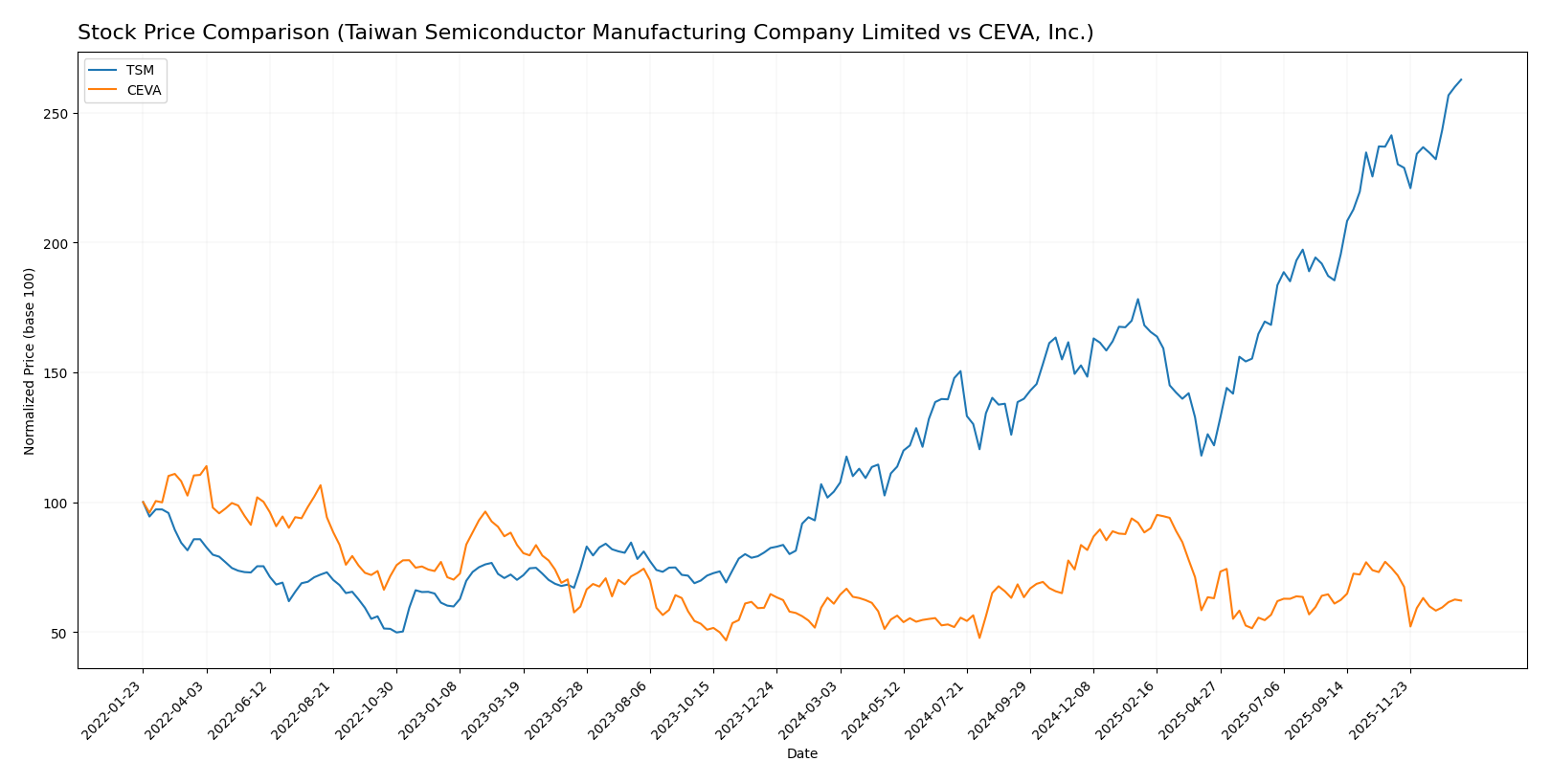
The stock price chart highlights significant movements and contrasting trading dynamics between Taiwan Semiconductor Manufacturing Company Limited and CEVA, Inc. over the past 12 months, reflecting divergent market sentiments and momentum.
Trend Analysis
Taiwan Semiconductor Manufacturing Company Limited exhibited a strong bullish trend over the past year with a 152.54% price increase, accelerating momentum, and a high volatility indicated by a 51.25 standard deviation. The stock ranged between 127.7 and 327.11.
CEVA, Inc. showed a near-neutral trend with a modest 1.98% price increase over the year, accompanied by deceleration and lower volatility at 4.4 standard deviation. The recent period indicates a downward trend with a -16.8% change.
Comparing the two, Taiwan Semiconductor Manufacturing Company Limited delivered the highest market performance with a substantial bullish trend and acceleration, while CEVA’s stock remained largely flat with recent negative momentum.
Target Prices
Analysts present a clear target price consensus for Taiwan Semiconductor Manufacturing Company Limited and CEVA, Inc.
| Company | Target High | Target Low | Consensus |
|---|---|---|---|
| Taiwan Semiconductor Manufacturing Company Limited | 400 | 330 | 361.25 |
| CEVA, Inc. | 28 | 28 | 28 |
The target consensus for TSM suggests a potential upside from the current price of 327.11 USD, indicating moderate bullish expectations. CEVA’s consensus target price of 28 USD also implies upside from its current price of 22.64 USD, reflecting positive analyst sentiment.
Analyst Opinions Comparison
This section compares analysts’ ratings and grades for Taiwan Semiconductor Manufacturing Company Limited (TSM) and CEVA, Inc. (CEVA):
Rating Comparison
TSM Rating
- Rating: A-, considered very favorable by analysts.
- Discounted Cash Flow Score: 5, indicating very favorable valuation based on future cash flows.
- ROE Score: 5, very favorable efficiency in generating profit from shareholders’ equity.
- ROA Score: 5, very favorable use of assets to generate earnings.
- Debt To Equity Score: 3, moderate financial risk with some reliance on debt.
- Overall Score: 4, a favorable overall financial standing.
CEVA Rating
- Rating: C+, reflecting a very unfavorable analyst view.
- Discounted Cash Flow Score: 3, a moderate valuation outlook.
- ROE Score: 1, very unfavorable in generating profit from equity.
- ROA Score: 1, very unfavorable asset utilization.
- Debt To Equity Score: 4, favorable financial stability with lower reliance on debt.
- Overall Score: 2, a moderate overall financial standing.
Which one is the best rated?
Based strictly on the provided data, TSM is better rated overall with higher scores in discounted cash flow, ROE, and ROA, reflecting stronger profitability and valuation metrics. CEVA shows moderate to unfavorable ratings except for a better debt-to-equity score.
Scores Comparison
Here is a comparison of the Altman Z-Score and Piotroski Score for both companies:
TSM Scores
- Altman Z-Score: 2.94, positioned in the grey zone, moderate bankruptcy risk.
- Piotroski Score: 8, indicating very strong financial health.
CEVA Scores
- Altman Z-Score: 9.99, positioned in the safe zone, very low bankruptcy risk.
- Piotroski Score: 4, indicating average financial health.
Which company has the best scores?
CEVA has a significantly higher Altman Z-Score, indicating stronger bankruptcy protection, while TSM shows a much stronger Piotroski Score, reflecting better overall financial strength. Each company leads in different score categories.
Grades Comparison
Here is a comparison of the latest grades assigned to Taiwan Semiconductor Manufacturing Company Limited and CEVA, Inc.:
Taiwan Semiconductor Manufacturing Company Limited Grades
The table below shows recent grades from reputable financial institutions for TSM:
| Grading Company | Action | New Grade | Date |
|---|---|---|---|
| Bernstein | Maintain | Outperform | 2025-12-08 |
| Needham | Maintain | Buy | 2025-10-27 |
| Barclays | Maintain | Overweight | 2025-10-17 |
| Needham | Maintain | Buy | 2025-10-16 |
| Susquehanna | Maintain | Positive | 2025-10-10 |
| Barclays | Maintain | Overweight | 2025-10-09 |
| Barclays | Maintain | Overweight | 2025-09-16 |
| Needham | Maintain | Buy | 2025-07-17 |
| Susquehanna | Maintain | Positive | 2025-07-14 |
| Needham | Maintain | Buy | 2025-07-01 |
The overall trend for TSM shows consistent positive ratings, mainly “Buy,” “Outperform,” and “Overweight,” indicating broad analyst confidence.
CEVA, Inc. Grades
The following table lists recent grades for CEVA:
| Grading Company | Action | New Grade | Date |
|---|---|---|---|
| Barclays | Maintain | Overweight | 2025-11-12 |
| Rosenblatt | Maintain | Buy | 2025-11-11 |
| Rosenblatt | Maintain | Buy | 2025-08-14 |
| Oppenheimer | Maintain | Outperform | 2025-05-09 |
| Rosenblatt | Maintain | Buy | 2025-05-08 |
| Barclays | Maintain | Overweight | 2025-05-08 |
| Rosenblatt | Maintain | Buy | 2025-04-23 |
| Barclays | Maintain | Overweight | 2025-02-14 |
| Rosenblatt | Maintain | Buy | 2025-02-14 |
| Rosenblatt | Maintain | Buy | 2025-02-11 |
CEVA’s grades also consistently reflect positive analyst sentiment, with repeated “Buy,” “Overweight,” and “Outperform” ratings.
Which company has the best grades?
Both Taiwan Semiconductor Manufacturing Company Limited and CEVA, Inc. have received predominantly positive grades from reputable firms, mostly “Buy” or equivalent. CEVA shows a slightly higher number of “Buy” ratings, while TSM combines “Buy” with strong “Overweight” and “Outperform” ratings. This consistency suggests solid analyst confidence in both companies, which can influence investor perception and portfolio decisions.
Strengths and Weaknesses
Below is a comparative overview of key strengths and weaknesses for Taiwan Semiconductor Manufacturing Company Limited (TSM) and CEVA, Inc. based on the most recent financial and operational data available in 2026.
| Criterion | Taiwan Semiconductor Manufacturing Company Limited (TSM) | CEVA, Inc. |
|---|---|---|
| Diversification | High: Dominates wafer fabrication with additional product lines; revenue >2.3T TWD in 2024 | Moderate: Licensing and royalty business model; revenue around 107M USD in 2024 |
| Profitability | Strong: Net margin 40%, ROIC 20%, favorable overall ratios | Weak: Negative net margin (-8.22%), negative ROIC (-2.68%), unfavorable ratios overall |
| Innovation | Solid R&D in advanced semiconductor manufacturing | Focus on DSP and connectivity IP, but declining profitability raises concerns |
| Global presence | Very strong: Global leader in semiconductor foundry services | Moderate: Niche market in IP licensing, less global scale |
| Market Share | Leading market share in semiconductor foundry | Small market share in IP licensing within DSP and connectivity sectors |
Key takeaways: TSM stands out with robust profitability, strong global presence, and diversified product offerings, though its ROIC has shown a slight decline. CEVA faces challenges with negative profitability and value destruction, despite a focused niche in technology licensing. Investors should weigh TSM’s stability against CEVA’s higher risk profile.
Risk Analysis
Below is a comparative table outlining key risks for Taiwan Semiconductor Manufacturing Company Limited (TSM) and CEVA, Inc. in 2026:
| Metric | Taiwan Semiconductor Manufacturing Company Limited (TSM) | CEVA, Inc. |
|---|---|---|
| Market Risk | Moderate (Beta 1.27; semiconductor cyclical exposure) | Higher (Beta 1.44; smaller market cap, volatile) |
| Debt level | Low (Debt-to-Equity 0.25; favorable leverage) | Very Low (Debt-to-Equity 0.02; minimal leverage) |
| Regulatory Risk | Moderate (Geopolitical tensions in Taiwan and export controls) | Moderate (US tech regulations, IP licensing scrutiny) |
| Operational Risk | Moderate (Complex global supply chain and fab operations) | Moderate (Dependency on licensing success and tech adoption) |
| Environmental Risk | Moderate (Energy-intensive fabs; increasing ESG pressures) | Low (Software/IP focused; lower direct environmental impact) |
| Geopolitical Risk | High (Taiwan Strait tensions impacting supply chain) | Low to Moderate (US-based but less exposed globally) |
Synthesis: TSM faces the most impactful risks from geopolitical instability around Taiwan, potentially disrupting its critical semiconductor manufacturing operations. CEVA’s risks lie more in market volatility and operational dependence on technology licensing success. Both maintain low debt, but TSM’s market size and exposure to export regulations add complexity. Investors should weigh geopolitical and market factors carefully.
Which Stock to Choose?
Taiwan Semiconductor Manufacturing Company Limited (TSM) shows strong income growth with a 33.89% revenue increase in 2024 and a 40.02% net margin. Its financial ratios are largely favorable, featuring a 27.29% ROE and low debt levels, supported by a very favorable A- rating. The company is creating value with a slightly favorable moat despite a declining ROIC trend.
CEVA, Inc. (CEVA) displays mixed income results, with a favorable 88.06% gross margin but an unfavorable -8.22% net margin. Financial ratios are mostly unfavorable, including negative ROE and ROIC, though it maintains low debt and an improving current ratio. Its rating stands at C+ with a very unfavorable moat due to value destruction and declining profitability.
From a rating and financial health perspective, TSM could appear more favorable for investors seeking stable profitability and value creation, while CEVA might attract those with higher risk tolerance focused on potential turnaround or growth opportunities despite current challenges. The choice might depend on the investor’s risk profile and strategy emphasis.
Disclaimer: Investment carries a risk of loss of initial capital. The past performance is not a reliable indicator of future results. Be sure to understand risks before making an investment decision.
Go Further
I encourage you to read the complete analyses of Taiwan Semiconductor Manufacturing Company Limited and CEVA, Inc. to enhance your investment decisions: