In the fast-evolving technology sector, CDW Corporation and Palo Alto Networks, Inc. stand out as key players shaping IT solutions and cybersecurity landscapes. CDW excels in delivering comprehensive IT services and hardware integration, while Palo Alto Networks leads with innovative cybersecurity software and cloud security. Both companies overlap in serving enterprise clients with cutting-edge technology, making their comparison vital for investors seeking growth and stability. Let’s explore which offers the most compelling investment opportunity.

Table of contents
Companies Overview
I will begin the comparison between CDW Corporation and Palo Alto Networks, Inc. by providing an overview of these two companies and their main differences.
CDW Corporation Overview
CDW Corporation operates in the Information Technology Services industry, providing IT solutions across the US, UK, and Canada. Founded in 1984 and headquartered in Vernon Hills, Illinois, it serves government, education, healthcare, and business clients through hardware, software, and integrated IT services including cloud and security. CDW segments its operations into Corporate, Small Business, and Public sectors.
Palo Alto Networks, Inc. Overview
Palo Alto Networks, founded in 2005 and based in Santa Clara, California, specializes in cybersecurity solutions globally. It offers firewall appliances, security management, cloud security, and threat intelligence services. The company targets medium to large enterprises, government, and service providers, emphasizing subscription-based security services and professional consulting in various industries including finance, healthcare, and telecommunications.
Key similarities and differences
Both companies operate within the technology sector, focusing on IT and security solutions, but their business models differ. CDW provides a broad range of IT hardware and software products with integrated services, serving diverse markets including small and large businesses. In contrast, Palo Alto Networks concentrates on cybersecurity software and services with a subscription model, targeting medium to large enterprises and government entities. Their geographic footprints overlap primarily in the US.
Income Statement Comparison
This table presents a side-by-side comparison of key income statement metrics for CDW Corporation and Palo Alto Networks, Inc. for their most recent fiscal years.
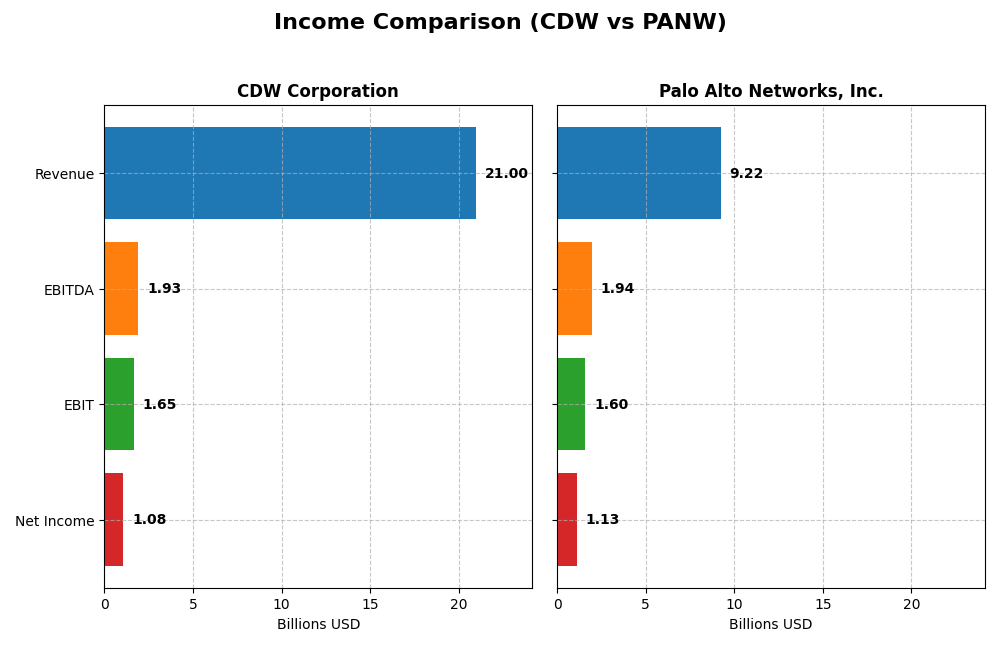
| Metric | CDW Corporation | Palo Alto Networks, Inc. |
|---|---|---|
| Market Cap | 17.3B | 120.0B |
| Revenue | 21.0B | 9.2B |
| EBITDA | 1.93B | 1.94B |
| EBIT | 1.65B | 1.60B |
| Net Income | 1.08B | 1.13B |
| EPS | 8.06 | 1.71 |
| Fiscal Year | 2024 | 2025 |
Income Statement Interpretations
CDW Corporation
CDW Corporation’s revenue showed a moderate overall growth of 13.7% from 2020 to 2024, with net income increasing by 36.7% over the same period. Margins remained relatively stable, with a gross margin of 21.9% and a net margin of 5.1% in 2024. However, the most recent year saw a slight decline in revenue and net income, indicating a slowdown in growth and marginal contraction.
Palo Alto Networks, Inc.
Palo Alto Networks experienced robust revenue growth of 116.7% and a substantial net income increase of 327.3% from 2021 to 2025. Its margins are strong, with a gross margin of 73.4% and a net margin of 12.3% in 2025. The latest fiscal year reported significant revenue and EBIT growth, though net margin and EPS declined sharply, signaling some margin pressure despite top-line gains.
Which one has the stronger fundamentals?
Palo Alto Networks exhibits stronger fundamentals with higher growth rates and superior margins, reflecting robust operational performance. CDW shows steady but slower growth and stable margins, with recent earnings softening. While both companies have favorable income statement evaluations, Palo Alto Networks’ scale and margin improvements outweigh CDW’s more modest but consistent profile.
Financial Ratios Comparison
The table below presents key financial ratios for CDW Corporation and Palo Alto Networks, Inc. based on their most recent fiscal year data, facilitating a direct comparison.
| Ratios | CDW Corporation (2024) | Palo Alto Networks, Inc. (2025) |
|---|---|---|
| ROE | 45.8% | 14.5% |
| ROIC | 13.1% | 5.7% |
| P/E | 21.6 | 101.4 |
| P/B | 9.9 | 14.7 |
| Current Ratio | 1.35 | 0.89 |
| Quick Ratio | 1.24 | 0.89 |
| D/E | 2.55 | 0.04 |
| Debt-to-Assets | 40.8% | 1.4% |
| Interest Coverage | 7.7 | 414.3 |
| Asset Turnover | 1.43 | 0.39 |
| Fixed Asset Turnover | 67.3 | 12.6 |
| Payout Ratio | 30.8% | 0% |
| Dividend Yield | 1.43% | 0% |
Interpretation of the Ratios
CDW Corporation
CDW shows a balanced financial profile with favorable returns on equity (45.81%) and invested capital (13.13%), alongside a neutral net margin of 5.13%. However, its price-to-book ratio is high at 9.9, indicating a potential overvaluation risk. The company maintains a 1.43% dividend yield with a neutral payout ratio, supported by stable free cash flow coverage.
Palo Alto Networks, Inc.
Palo Alto Networks displays a strong net margin of 12.3% but only neutral returns on equity (14.49%) and invested capital (5.67%). Its valuation metrics, including a high P/E of 101.43 and price-to-book of 14.7, are unfavorable. The company does not pay dividends, reflecting a reinvestment strategy in a high-growth phase, with solid interest coverage and low debt levels.
Which one has the best ratios?
Both companies have slightly favorable global ratio opinions, but CDW’s higher return on equity and better dividend yield contrast with Palo Alto Networks’ stronger net margin yet unfavorable valuation and liquidity ratios. CDW’s leverage and valuation metrics are less attractive, while Palo Alto Networks’ growth focus impacts its current ratio and dividend policy.
Strategic Positioning
This section compares the strategic positioning of CDW Corporation and Palo Alto Networks, Inc., focusing on market position, key segments, and exposure to technological disruption:
CDW Corporation
- Market leader in IT solutions with moderate competitive pressure across US, UK, and Canada.
- Diverse segments: Corporate, Small Business, Public; drives revenue from hardware, software, and services.
- Moderate exposure with integrated IT hardware and software; adapts to hybrid and cloud environments.
Palo Alto Networks, Inc.
- Major cybersecurity provider facing competitive pressure in software infrastructure globally.
- Focused on cybersecurity with product, subscription, and support segments driving growth.
- High exposure to technological disruption in cybersecurity innovations and cloud security solutions.
CDW Corporation vs Palo Alto Networks, Inc. Positioning
CDW pursues a diversified strategy across IT hardware, software, and services targeting multiple customer segments. Palo Alto Networks concentrates on cybersecurity software and subscriptions, emphasizing innovation in threat prevention and cloud security. CDW’s breadth contrasts with PANW’s focused specialization.
Which has the best competitive advantage?
CDW shows a slightly favorable moat with value creation despite declining profitability, while Palo Alto Networks has a slightly unfavorable moat due to value destruction despite improving profitability. CDW currently demonstrates a stronger competitive advantage based on ROIC versus WACC evaluation.
Stock Comparison
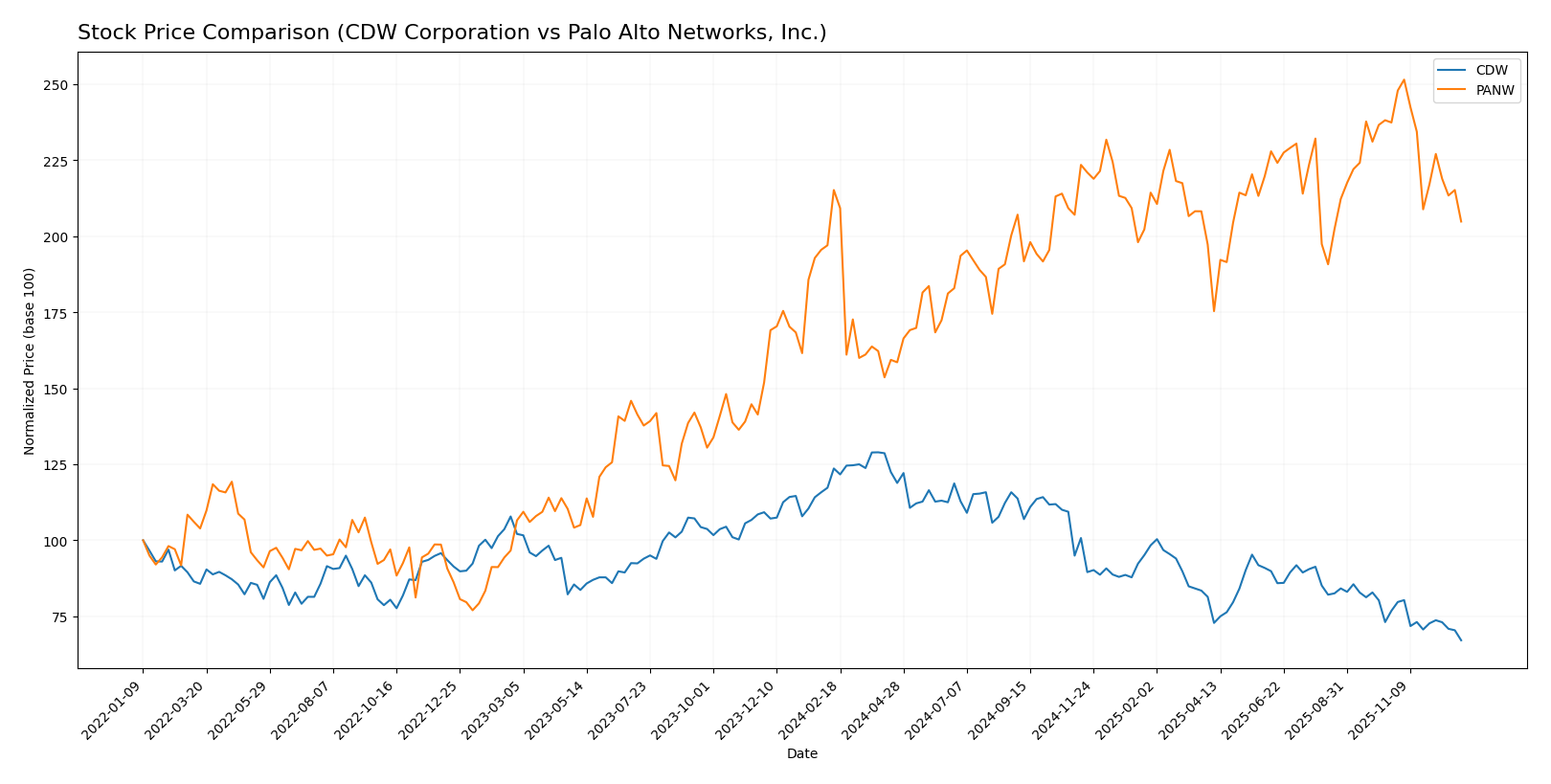
The stock price movements over the past year highlight significant declines for both CDW Corporation and Palo Alto Networks, Inc., with notable price drops and shifting trading volumes reflecting bearish momentum and decelerating trends.
Trend Analysis
CDW Corporation experienced a sharp bearish trend over the past 12 months, with a -45.7% price decline and deceleration in momentum. The stock saw high volatility, with a standard deviation of 33.71, ranging from a high of 255.78 to a low of 133.16.
Palo Alto Networks, Inc. also showed a bearish trend over the past year, with a -4.82% price decline and deceleration. Its volatility was lower than CDW’s, with a standard deviation of 19.94, fluctuating between 220.24 and 134.51.
Comparing both stocks, CDW Corporation delivered the largest negative market performance, with a much steeper price decline than Palo Alto Networks over the past 12 months.
Target Prices
The current analyst consensus suggests promising upside potential for both CDW Corporation and Palo Alto Networks, Inc.
| Company | Target High | Target Low | Consensus |
|---|---|---|---|
| CDW Corporation | 190 | 148 | 175 |
| Palo Alto Networks, Inc. | 250 | 157 | 231.07 |
Analysts expect CDW’s stock to rise well above its current price of 133.16, while Palo Alto Networks shows a notably higher consensus target of 231.07 versus its present price of 179.37, indicating strong growth expectations.
Analyst Opinions Comparison
This section compares analysts’ ratings and grades for CDW Corporation and Palo Alto Networks, Inc.:
Rating Comparison
CDW Rating
- Rating: B, considered Very Favorable by analysts.
- Discounted Cash Flow Score: 4, indicating a Favorable valuation outlook.
- ROE Score: 5, Very Favorable, showing strong profit generation efficiency.
- ROA Score: 4, Favorable, reflecting effective asset utilization.
- Debt To Equity Score: 1, Very Unfavorable, indicating higher financial risk.
- Overall Score: 3, Moderate overall financial standing.
PANW Rating
- Rating: B, also considered Very Favorable.
- Discounted Cash Flow Score: 4, also Favorable for valuation assessment.
- ROE Score: 4, Favorable, indicating good profitability from equity.
- ROA Score: 3, Moderate, somewhat less efficient use of assets.
- Debt To Equity Score: 4, Favorable, showing lower financial leverage risk.
- Overall Score: 3, Moderate overall rating as well.
Which one is the best rated?
Both CDW and PANW share the same overall rating and discounted cash flow scores. CDW excels in profitability metrics with higher ROE and ROA scores, while PANW shows stronger financial stability through a better debt-to-equity score. Overall, their ratings balance different strengths.
Scores Comparison
The comparison of scores for CDW and PANW provides insights into their financial stability and strength:
CDW Scores
- Altman Z-Score: 2.74, indicating moderate bankruptcy risk in the grey zone.
- Piotroski Score: 6, reflecting average financial strength.
PANW Scores
- Altman Z-Score: 5.77, indicating low bankruptcy risk in the safe zone.
- Piotroski Score: 6, reflecting average financial strength.
Which company has the best scores?
PANW shows a stronger financial position with an Altman Z-Score in the safe zone, while CDW remains in the grey zone. Both companies have the same average Piotroski Score of 6, indicating comparable financial strength on that metric.
Grades Comparison
The following is a summary of the recent grades assigned to CDW Corporation and Palo Alto Networks, Inc.:
CDW Corporation Grades
This table shows recent grades and rating actions from notable financial institutions for CDW Corporation:
| Grading Company | Action | New Grade | Date |
|---|---|---|---|
| Morgan Stanley | Maintain | Overweight | 2025-12-17 |
| Raymond James | Upgrade | Strong Buy | 2025-11-25 |
| Barclays | Maintain | Equal Weight | 2025-11-05 |
| UBS | Maintain | Buy | 2025-11-05 |
| Evercore ISI Group | Maintain | Outperform | 2025-10-20 |
| UBS | Maintain | Buy | 2025-08-07 |
| Barclays | Maintain | Equal Weight | 2025-08-07 |
| JP Morgan | Maintain | Neutral | 2025-07-17 |
| Citigroup | Maintain | Neutral | 2025-07-11 |
| Barclays | Maintain | Equal Weight | 2025-05-08 |
The grades for CDW Corporation show a generally favorable outlook with multiple “Buy,” “Outperform,” and “Strong Buy” ratings, alongside some neutral and equal weight assessments.
Palo Alto Networks, Inc. Grades
This table shows recent grades and rating actions from notable financial institutions for Palo Alto Networks, Inc.:
| Grading Company | Action | New Grade | Date |
|---|---|---|---|
| Morgan Stanley | Maintain | Overweight | 2025-12-18 |
| HSBC | Downgrade | Reduce | 2025-11-21 |
| Goldman Sachs | Maintain | Buy | 2025-11-21 |
| Rosenblatt | Maintain | Buy | 2025-11-20 |
| Piper Sandler | Maintain | Overweight | 2025-11-20 |
| Bernstein | Maintain | Outperform | 2025-11-20 |
| WestPark Capital | Maintain | Hold | 2025-11-20 |
| Wedbush | Maintain | Outperform | 2025-11-20 |
| BTIG | Maintain | Buy | 2025-11-20 |
| Oppenheimer | Maintain | Outperform | 2025-11-20 |
Grades for Palo Alto Networks show a mixed but mostly positive trend with several “Buy,” “Outperform,” and “Overweight” ratings, though HSBC’s downgrade to “Reduce” introduces some caution.
Which company has the best grades?
CDW Corporation has received a slightly stronger consensus with upgrades to “Strong Buy” and multiple “Buy” and “Outperform” ratings, compared to Palo Alto Networks, which shows a wider range of opinions including a downgrade. This suggests CDW currently enjoys a more uniformly optimistic evaluation, potentially implying steadier investor confidence.
Strengths and Weaknesses
Below is a comparative overview of key strengths and weaknesses for CDW Corporation and Palo Alto Networks, Inc. based on recent financial and operational data.
| Criterion | CDW Corporation | Palo Alto Networks, Inc. |
|---|---|---|
| Diversification | Strong product mix: Hardware (15.2B), Software (3.8B), Services (1.9B) | Focused on cybersecurity: Subscriptions (5.0B), Support (2.4B), Products (1.8B) |
| Profitability | Favorable ROIC (13.1%) and ROE (45.8%); net margin moderate (5.1%) | Moderate ROIC (5.7%), strong net margin (12.3%), but high valuation ratios (PE 101.4) |
| Innovation | Stable software revenue growth, but declining ROIC trend (-15%) signals caution | Rapid ROIC growth (+225%), strong investment in subscriptions and support services |
| Global presence | Established global hardware and software distribution | Expanding global footprint in cybersecurity subscriptions and services |
| Market Share | Leading IT solutions distributor with diversified customer base | Strong presence in cybersecurity market, but faces intense competition |
Key takeaways: CDW Corporation shows a diversified business model with solid profitability but faces a declining return on invested capital, signaling the need for strategic focus. Palo Alto Networks is growing rapidly with improving profitability and innovative offerings, yet high valuation and mixed liquidity ratios suggest cautious optimism for investors.
Risk Analysis
Below is a table summarizing key risks for CDW Corporation and Palo Alto Networks, Inc. based on their latest available data for 2024 and 2025 respectively.
| Metric | CDW Corporation | Palo Alto Networks, Inc. |
|---|---|---|
| Market Risk | Beta 1.06, moderate market sensitivity | Beta 0.79, lower market volatility exposure |
| Debt level | Debt-to-Equity 2.55 (unfavorable), Debt-to-Assets 40.8% (neutral) | Debt-to-Equity 0.04 (favorable), Debt-to-Assets 1.43% (favorable) |
| Regulatory Risk | Medium, operates in IT services with some government contracts | Medium to high, cybersecurity sector faces evolving regulations |
| Operational Risk | Moderate, diversified segments but reliant on third-party providers | Moderate, complexity of cybersecurity solutions and ongoing innovation required |
| Environmental Risk | Low, limited direct environmental impact | Low, primarily software-based operations |
| Geopolitical Risk | Moderate, presence in US, UK, Canada | Moderate, global client base but US-based headquarters |
In synthesis, CDW faces higher financial leverage risk with its elevated debt levels, which could impact stability in volatile markets. Palo Alto Networks, while financially stronger in debt terms, carries significant regulatory and operational risks due to the fast-evolving cybersecurity landscape. Market and geopolitical risks remain moderate for both companies given their US-centric operations but global exposure. Investors should weigh these factors carefully in risk management strategies.
Which Stock to Choose?
CDW Corporation shows a favorable income statement with a 36.69% net income growth over five years, though recent annual revenue declined by 1.77%. Its financial ratios reveal strong profitability with 45.81% ROE, a slightly high debt-to-equity ratio, and a very favorable rating of B, indicating solid but moderately leveraged financial health.
Palo Alto Networks, Inc. exhibits robust income growth with a 327.28% net income increase over five years and a 14.87% revenue rise last year. Its financial ratios indicate moderate profitability with a 14.49% ROE, low debt levels, but high valuation multiples and a very favorable rating of B, reflecting growth potential amid valuation challenges.
For investors prioritizing stability and strong profitability, CDW’s favorable ROE and consistent value creation could be more appealing, whereas those focused on high growth might find Palo Alto Networks’ accelerating income and improving profitability attractive despite its higher valuation and debt profile. The choice may depend on the investor’s risk tolerance and investment horizon.
Disclaimer: Investment carries a risk of loss of initial capital. The past performance is not a reliable indicator of future results. Be sure to understand risks before making an investment decision.
Go Further
I encourage you to read the complete analyses of CDW Corporation and Palo Alto Networks, Inc. to enhance your investment decisions: