Cardinal Health, Inc. (CAH) and Henry Schein, Inc. (HSIC) are two prominent players in the medical distribution industry, each with a distinct approach to healthcare solutions. Cardinal Health focuses on integrated pharmaceutical and medical product distribution, while Henry Schein emphasizes dental and medical product distribution coupled with technology-driven value-added services. Their overlapping markets and innovation strategies make them compelling candidates for comparison. In this article, I will help you determine which company presents the more attractive investment opportunity.

Table of contents
Companies Overview
I will begin the comparison between Cardinal Health and Henry Schein by providing an overview of these two companies and their main differences.
Cardinal Health Overview
Cardinal Health, Inc. is an integrated healthcare services and products company operating internationally, including the US, Canada, Europe, and Asia. It focuses on providing customized solutions for hospitals, pharmacies, and healthcare providers through its Pharmaceutical and Medical segments. The company distributes pharmaceutical products, offers specialty pharmacy services, and manufactures medical and surgical supplies. Cardinal Health is headquartered in Dublin, Ohio, with a market cap of approximately 47.8B USD.
Henry Schein Overview
Henry Schein, Inc. supplies healthcare products and services primarily to dental and medical practitioners worldwide. It operates through Health Care Distribution and Technology and Value-Added Services segments. The company offers dental products, medical supplies, and practice management software, alongside financial and consulting services. Founded in 1932 and headquartered in Melville, New York, Henry Schein has a market cap near 9.5B USD and employs about 25,000 people.
Key similarities and differences
Both companies operate in the medical distribution industry, serving healthcare providers with a broad range of products. Cardinal Health has a larger scale and a stronger focus on pharmaceutical distribution and manufacturing, whereas Henry Schein emphasizes dental products and value-added technology services. While Cardinal Health’s segments include extensive pharmaceutical and medical device manufacturing, Henry Schein integrates software and financial services into its offering, reflecting a more technology-driven approach.
Income Statement Comparison
The table below presents a clear comparison of key income statement metrics for Cardinal Health, Inc. and Henry Schein, Inc. for their most recent fiscal years.
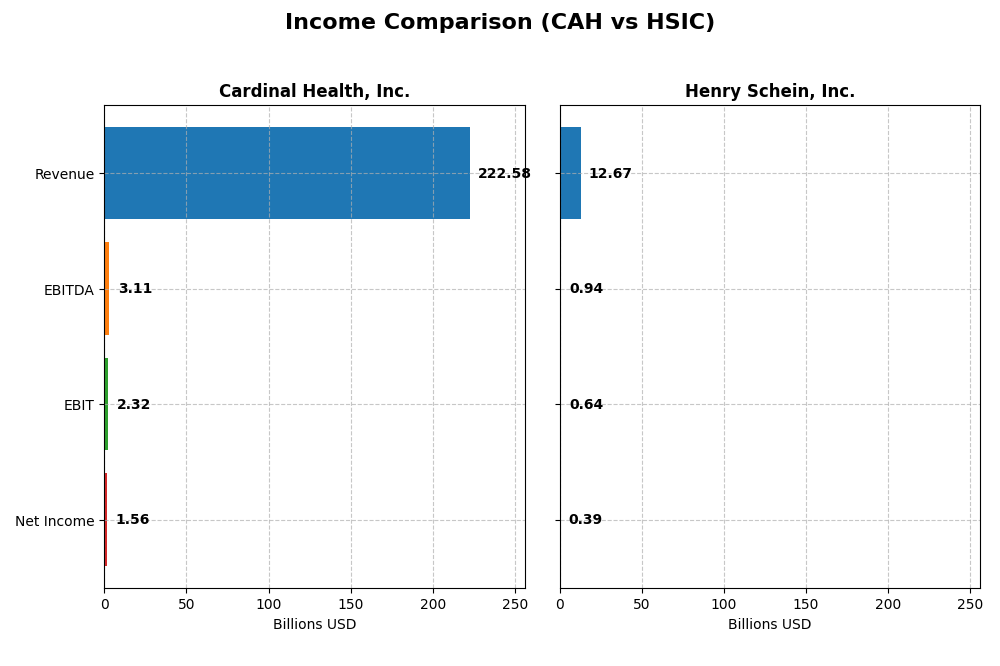
| Metric | Cardinal Health, Inc. (2025) | Henry Schein, Inc. (2024) |
|---|---|---|
| Market Cap | 47.8B | 9.5B |
| Revenue | 223B | 12.7B |
| EBITDA | 3.11B | 941M |
| EBIT | 2.32B | 644M |
| Net Income | 1.56B | 390M |
| EPS | 6.48 | 3.07 |
| Fiscal Year | 2025 | 2024 |
Income Statement Interpretations
Cardinal Health, Inc.
Cardinal Health’s revenue grew by 37% from 2021 to 2025, with net income surging 155%, reflecting strong profitability improvements. Margins showed stability, with a gross margin of 3.67% and net margin of 0.7% in 2025. The latest year saw a slight 1.87% revenue decline but an 87% rise in net margin and EPS, indicating improved operational efficiency.
Henry Schein, Inc.
Henry Schein experienced a 25.24% revenue increase over 2020-2024, but net income declined by 3.04%, and net margin dropped 22.58%. Gross margin remained favorable at nearly 30%, while EBIT margin was stable at 5.08%. The most recent year showed modest 2.7% revenue growth, yet net margin and EPS fell by 8.7% and 3.5%, respectively, signaling margin pressure despite sales gains.
Which one has the stronger fundamentals?
Cardinal Health demonstrates stronger fundamentals with significant net income and EPS growth, alongside stable margins and favorable interest expense trends. Conversely, Henry Schein, despite solid gross margins and revenue growth, faces declining profitability and margin contraction. Overall, Cardinal Health’s income statement performance is assessed as favorable, while Henry Schein’s is unfavorable.
Financial Ratios Comparison
The table below presents a side-by-side comparison of key financial ratios for Cardinal Health, Inc. (CAH) and Henry Schein, Inc. (HSIC) based on their most recent fiscal year data.
| Ratios | Cardinal Health, Inc. (2025) | Henry Schein, Inc. (2024) |
|---|---|---|
| ROE | -56.1% | 11.5% |
| ROIC | 11.4% | 6.7% |
| P/E | 25.9 | 22.9 |
| P/B | -14.6 | 2.63 |
| Current Ratio | 0.94 | 1.42 |
| Quick Ratio | 0.50 | 0.78 |
| D/E (Debt-to-Equity) | -3.36 | 0.85 |
| Debt-to-Assets | 17.6% | 28.1% |
| Interest Coverage | 10.6 | 5.56 |
| Asset Turnover | 4.19 | 1.24 |
| Fixed Asset Turnover | 77.9 | 15.4 |
| Payout Ratio | 31.6% | 0% |
| Dividend Yield | 1.22% | 0% |
Interpretation of the Ratios
Cardinal Health, Inc.
Cardinal Health shows a mixed ratio profile with favorable indicators in return on invested capital (11.37%), weighted average cost of capital (6.21%), and asset turnover (4.19), among others. However, negative return on equity (-56.13%), low net margin (0.7%), and weak liquidity ratios (current ratio 0.94, quick ratio 0.5) raise concerns. Dividend yield is moderate at 1.22%, with no apparent risk of unsustainable payouts.
Henry Schein, Inc.
Henry Schein’s ratios are generally slightly favorable, with strengths in asset turnover (1.24), fixed asset turnover (15.38), and a solid weighted average cost of capital (6.91%). The company posts a low net margin (3.08%) and an unimpressive quick ratio (0.78). It does not pay dividends, consistent with reinvestment strategy and focus on growth, which aligns with its slightly favorable overall ratio evaluation.
Which one has the best ratios?
Cardinal Health’s ratios present a more favorable overall evaluation at 57.14%, outperforming Henry Schein’s 28.57%. Despite some liquidity and profitability concerns, Cardinal Health exhibits stronger capital efficiency and coverage metrics. Henry Schein’s neutrality and lack of dividends reflect a different financial strategy but show less ratio strength comparatively.
Strategic Positioning
This section compares the strategic positioning of Cardinal Health, Inc. and Henry Schein, Inc. regarding Market position, Key segments, and Exposure to technological disruption:
Cardinal Health, Inc.
- Large market cap at $47.8B with broad competitive presence in healthcare distribution.
- Operates in Pharmaceutical and Medical segments, serving hospitals, pharmacies, and clinical providers.
- Limited explicit details on technological disruption exposure provided.
Henry Schein, Inc.
- Smaller market cap of $9.5B, serving niche healthcare distribution segments.
- Focuses on Health Care Distribution and Technology segments for dental and medical practitioners.
- Includes technology and value-added services segment, indicating some tech exposure.
Cardinal Health, Inc. vs Henry Schein, Inc. Positioning
Cardinal Health has a diversified model across pharmaceuticals and medical products with a broad customer base, while Henry Schein concentrates on dental and medical distribution plus technology services. This specialization offers focused expertise but less diversification.
Which has the best competitive advantage?
Cardinal Health shows a very favorable moat with growing ROIC and value creation, indicating a durable competitive advantage. Henry Schein faces a very unfavorable moat, with declining ROIC and value destruction, signaling weaker competitive positioning.
Stock Comparison
The stock price performance of Cardinal Health, Inc. (CAH) and Henry Schein, Inc. (HSIC) over the past 12 months reveals significant upward momentum, with CAH showing a notably stronger appreciation and trading activity compared to HSIC.

Trend Analysis
Cardinal Health, Inc. (CAH) experienced a strong bullish trend with a 92.54% price increase over the past year, marked by acceleration and high volatility (31.63 std deviation). The stock reached a high of 212.26 and a low of 94.1.
Henry Schein, Inc. (HSIC) posted a modest bullish trend with a 2.63% price increase over the same period, also showing acceleration but with lower volatility (3.92 std deviation). Its price fluctuated between 62.98 and 80.0.
Comparing both, CAH delivered the highest market performance with a substantial price gain, while HSIC showed limited appreciation, indicating stronger investor interest and momentum in CAH’s stock.
Target Prices
The current analyst consensus presents promising target prices for these healthcare distribution companies.
| Company | Target High | Target Low | Consensus |
|---|---|---|---|
| Cardinal Health, Inc. | 243 | 186 | 215 |
| Henry Schein, Inc. | 90 | 75 | 82.5 |
Analysts expect Cardinal Health’s stock to appreciate beyond its current price of 201.11 USD, while Henry Schein’s consensus target of 82.5 USD is slightly above its current price of 77.64 USD, indicating moderate upside potential.
Analyst Opinions Comparison
This section compares analysts’ ratings and grades for Cardinal Health, Inc. (CAH) and Henry Schein, Inc. (HSIC):
Rating Comparison
CAH Rating
- Rating: C+, classified as Very Favorable
- Discounted Cash Flow Score: 5, indicating a Very Favorable valuation outlook
- ROE Score: 1, considered Very Unfavorable for profitability efficiency
- ROA Score: 3, Moderate effectiveness in asset utilization
- Debt To Equity Score: 1, Very Unfavorable financial risk due to high leverage
- Overall Score: 2, Moderate overall financial standing
HSIC Rating
- Rating: B, classified as Very Favorable
- Discounted Cash Flow Score: 4, rated as Favorable valuation outlook
- ROE Score: 4, rated Favorable for generating profit from shareholders’ equity
- ROA Score: 3, also Moderate in asset utilization efficiency
- Debt To Equity Score: 1, also Very Unfavorable for financial risk
- Overall Score: 3, Moderate but higher than CAH’s overall score
Which one is the best rated?
Based on the provided data, HSIC holds a better overall rating (B vs. C+) and outperforms CAH in key metrics like ROE and discounted cash flow scores, despite both sharing a very unfavorable debt-to-equity score.
Scores Comparison
Here is a comparison of the Altman Z-Score and Piotroski Score for Cardinal Health, Inc. and Henry Schein, Inc.:
CAH Scores
- Altman Z-Score: 4.89, indicating a safe financial zone with low bankruptcy risk.
- Piotroski Score: 6, reflecting average financial strength and investment potential.
HSIC Scores
- Altman Z-Score: 2.82, placing the company in a grey zone with moderate bankruptcy risk.
- Piotroski Score: 6, reflecting average financial strength and investment potential.
Which company has the best scores?
Based on the provided data, CAH has a stronger Altman Z-Score, indicating better financial stability, while both companies share the same average Piotroski Score. Thus, CAH shows a more secure financial position overall.
Grades Comparison
The following presents the latest official grades assigned to Cardinal Health, Inc. and Henry Schein, Inc.:
Cardinal Health, Inc. Grades
This table summarizes recent analyst grades and recommendations for Cardinal Health, Inc.:
| Grading Company | Action | New Grade | Date |
|---|---|---|---|
| Citigroup | Buy | Buy | 2026-01-09 |
| Wells Fargo | Maintain | Overweight | 2025-11-05 |
| Mizuho | Maintain | Outperform | 2025-11-04 |
| TD Cowen | Maintain | Buy | 2025-11-03 |
| Evercore ISI Group | Maintain | Outperform | 2025-10-31 |
| Citigroup | Maintain | Neutral | 2025-10-31 |
| UBS | Maintain | Buy | 2025-10-31 |
| Wells Fargo | Maintain | Overweight | 2025-08-13 |
| Baird | Maintain | Outperform | 2025-08-13 |
| Evercore ISI Group | Maintain | Outperform | 2025-08-13 |
Cardinal Health exhibits a consistent pattern of buy and outperform ratings from major analysts, with no sell recommendations and a recent upgrade by Citigroup.
Henry Schein, Inc. Grades
This table summarizes recent analyst grades and recommendations for Henry Schein, Inc.:
| Grading Company | Action | New Grade | Date |
|---|---|---|---|
| Morgan Stanley | Maintain | Underweight | 2025-11-05 |
| Barrington Research | Maintain | Outperform | 2025-11-05 |
| JP Morgan | Maintain | Overweight | 2025-11-05 |
| Evercore ISI Group | Maintain | Outperform | 2025-11-05 |
| Wells Fargo | Maintain | Equal Weight | 2025-11-05 |
| Barrington Research | Maintain | Outperform | 2025-10-22 |
| Barrington Research | Maintain | Outperform | 2025-09-23 |
| Evercore ISI Group | Upgrade | Outperform | 2025-08-26 |
| JP Morgan | Maintain | Overweight | 2025-08-07 |
| UBS | Maintain | Neutral | 2025-08-06 |
Henry Schein’s grades show a mix of outperform and overweight ratings but also include an underweight from Morgan Stanley and a few hold-level ratings, indicating a more varied analyst outlook.
Which company has the best grades?
Cardinal Health, Inc. has received predominantly buy and outperform ratings, whereas Henry Schein, Inc. presents a broader range including underweight and hold ratings. This suggests Cardinal Health may currently be viewed more favorably by analysts, which could influence investor sentiment toward stronger confidence in its outlook.
Strengths and Weaknesses
Below is a comparative overview of strengths and weaknesses for Cardinal Health, Inc. (CAH) and Henry Schein, Inc. (HSIC) based on their most recent data.
| Criterion | Cardinal Health, Inc. (CAH) | Henry Schein, Inc. (HSIC) |
|---|---|---|
| Diversification | Highly diversified with strong pharmaceutical and medical segments | Moderate diversification, focused on healthcare distribution and technology |
| Profitability | Favorable ROIC at 11.37%, but weak net margin at 0.7% and negative ROE (-56.13%) | Modest profitability with neutral ROIC (6.73%) and ROE (11.49%), net margin at 3.08% |
| Innovation | Strong asset turnover metrics indicate operational efficiency | Moderate innovation with technology segment present but smaller scale |
| Global presence | Extensive global operations, large pharmaceutical member revenue (~204B USD) | Established global healthcare distribution network, smaller scale revenue (~12.7B USD) |
| Market Share | Leading position in pharmaceutical distribution | Strong position in healthcare products, but less dominant than CAH |
Cardinal Health shows a durable competitive advantage with growing ROIC and a favorable moat, supported by its vast pharmaceutical segment. Henry Schein, however, faces challenges with declining ROIC and value destruction, though it maintains a respectable presence in healthcare distribution. Investors should weigh CAH’s operational efficiency against HSIC’s more moderate profitability and footprint.
Risk Analysis
Below is a risk comparison table for Cardinal Health, Inc. (CAH) and Henry Schein, Inc. (HSIC) based on their most recent financial and operational data.
| Metric | Cardinal Health, Inc. (CAH) | Henry Schein, Inc. (HSIC) |
|---|---|---|
| Market Risk | Moderate (Beta 0.65) | Moderate-High (Beta 0.88) |
| Debt Level | Low (Debt-to-Assets 17.6%) | Moderate (Debt-to-Assets 28.1%) |
| Regulatory Risk | Moderate (Healthcare sector regulatory exposure) | Moderate (Healthcare & dental regulation) |
| Operational Risk | Moderate (Large global supply chain) | Moderate (Diverse healthcare services & tech) |
| Environmental Risk | Moderate (Healthcare product manufacturing impact) | Moderate (Product distribution and tech services) |
| Geopolitical Risk | Moderate (Global operations exposure) | Moderate (International healthcare markets) |
The most likely and impactful risks for both companies revolve around regulatory changes in healthcare and supply chain disruptions. Cardinal Health’s lower debt level and stronger financial stability reduce its risk profile compared to Henry Schein, which faces higher leverage and slightly greater market volatility. Both companies must manage operational risks inherent in global distribution and evolving healthcare regulations.
Which Stock to Choose?
Cardinal Health, Inc. (CAH) shows a generally favorable financial profile with a strong income growth of 155% over five years and mostly positive profitability metrics despite a slight revenue decline recently. Its financial ratios indicate solid value creation and manageable debt levels, supported by a very favorable overall rating and a robust economic moat with growing ROIC.
Henry Schein, Inc. (HSIC) presents mixed financial signals, with modest revenue growth but an overall unfavorable income statement trend marked by declining net income and margins. Its financial ratios are slightly favorable but less convincing than CAH’s, with a moderate rating and a very unfavorable moat due to declining ROIC and value destruction concerns.
Investors focused on durable competitive advantages and strong income growth might find CAH’s profile more appealing, while those preferring companies with moderate financial stability but exposed to some profitability challenges may view HSIC as a potentially suitable option depending on risk tolerance and investment strategy.
Disclaimer: Investment carries a risk of loss of initial capital. The past performance is not a reliable indicator of future results. Be sure to understand risks before making an investment decision.
Go Further
I encourage you to read the complete analyses of Cardinal Health, Inc. and Henry Schein, Inc. to enhance your investment decisions: