Home > Comparison > Industrials > FDX vs CHRW
The strategic rivalry between FedEx Corporation and C.H. Robinson Worldwide, Inc. shapes the dynamics of the integrated freight and logistics sector. FedEx operates as a capital-intensive industrial powerhouse with vast transportation assets and global reach. In contrast, C.H. Robinson leverages a high-margin, asset-light model focused on freight brokerage and logistics solutions. This analysis will determine which business model offers superior risk-adjusted returns for a diversified portfolio in an evolving market landscape.
Table of contents
Companies Overview
FedEx Corporation and C.H. Robinson Worldwide, Inc. command substantial influence in the integrated freight and logistics market.
FedEx Corporation: Global Logistics Powerhouse
FedEx dominates the integrated freight and logistics sector with a diversified service portfolio including express transportation, small-package ground delivery, and freight transport. Its revenue engine centers on time-critical and cross-border e-commerce solutions. In 2026, FedEx sharpens its focus on expanding technology-driven supply chain and last-mile delivery capabilities to maintain its competitive edge.
C.H. Robinson Worldwide, Inc.: Logistics & Freight Brokerage Leader
C.H. Robinson stands out as a leading freight transportation and logistics solutions provider, specializing in brokerage services for truckload, less-than-truckload, intermodal, and global forwarding. Its core revenue relies on managing complex transportation networks and fresh produce logistics. The company’s 2026 strategy emphasizes strengthening contractual relationships and enhancing managed transportation services through its advanced TMS platform.
Strategic Collision: Similarities & Divergences
Both firms excel in integrated logistics but diverge strategically: FedEx invests heavily in asset-heavy, end-to-end delivery networks, while C.H. Robinson leverages a capital-light brokerage model with a broad carrier base. Their primary battleground lies in optimizing supply chain efficiency for global customers. Investors will find FedEx’s asset scale and tech investment contrast sharply with C.H. Robinson’s agility and asset-light operational model.
Income Statement Comparison
The following data dissects the core profitability and scalability of both corporate engines to reveal who dominates the bottom line:
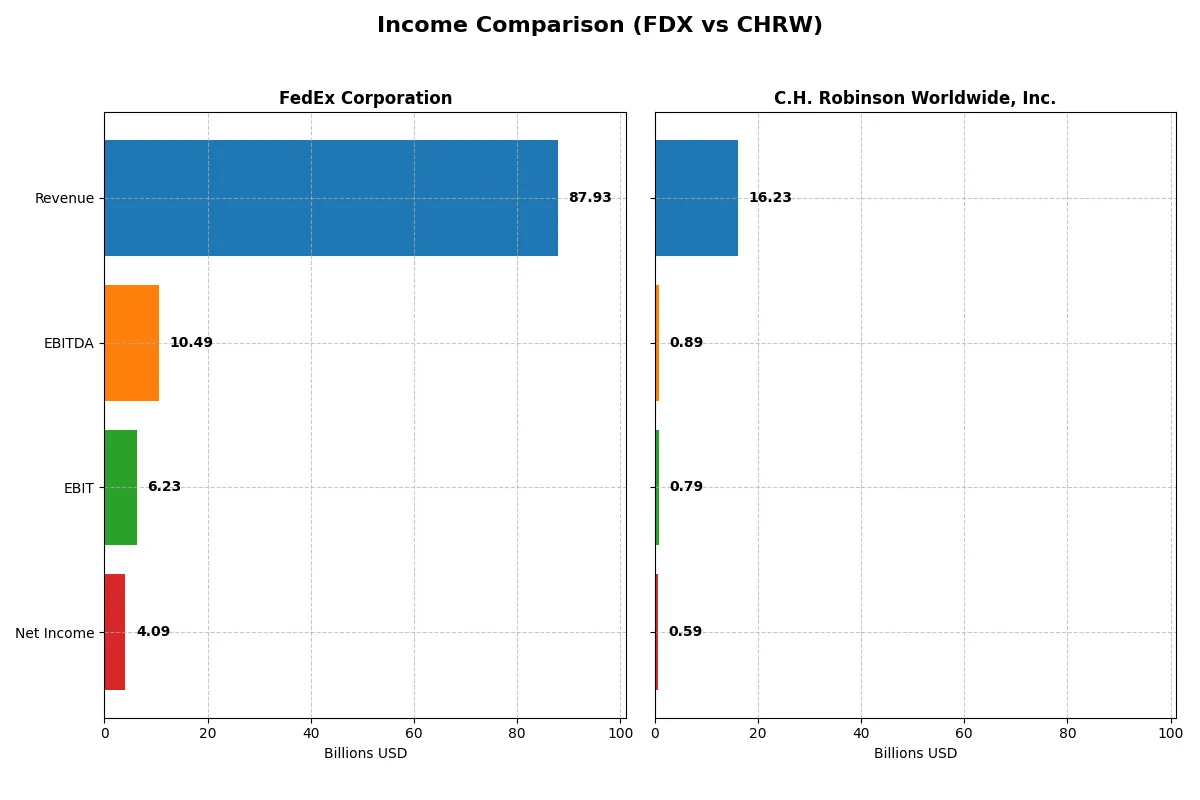
| Metric | FedEx Corporation (FDX) | C.H. Robinson Worldwide, Inc. (CHRW) |
|---|---|---|
| Revenue | 87.9B | 16.2B |
| Cost of Revenue | 68.9B | 14.9B |
| Operating Expenses | 12.9B | 564M |
| Gross Profit | 19.0B | 1.4B |
| EBITDA | 10.5B | 888M |
| EBIT | 6.2B | 786M |
| Interest Expense | 789M | 63M |
| Net Income | 4.1B | 587M |
| EPS | 16.96 | 4.88 |
| Fiscal Year | 2025 | 2025 |
Income Statement Analysis: The Bottom-Line Duel
This income statement comparison reveals which company drives superior profitability and operational efficiency in their respective markets.
FedEx Corporation Analysis
FedEx’s revenue held steady near 88B in 2025, but net income declined to 4.1B, reflecting margin pressures. Its gross margin remains healthy at 21.6%, yet net margin softened to 4.65%, signaling rising costs and weaker bottom-line momentum. Despite solid scale, the one-year net and EPS declines highlight efficiency challenges in 2025.
C.H. Robinson Worldwide, Inc. Analysis
C.H. Robinson’s revenue fell sharply by 8.4% to 16.2B in 2025, but net income surged 26% to 587M. Gross margin sits lower at 8.4%, yet net margin improved to 3.62%, reflecting tighter cost controls. EBIT and net margin growth in 2025 indicate operational gains despite volume contraction, demonstrating effective expense management.
Scale vs. Efficiency: The Profitability Contrast
FedEx dominates in revenue scale with nearly 5.5x higher sales but faces shrinking net income and margin erosion. C.H. Robinson shows stronger margin momentum and bottom-line growth despite revenue decline. For investors, FedEx offers size with profitability headwinds, while C.H. Robinson presents an efficiency-driven turnaround profile worth monitoring.
Financial Ratios Comparison
These vital ratios act as a diagnostic tool to expose the underlying fiscal health, valuation premiums, and capital efficiency of the following companies:
| Ratios | FedEx Corporation (FDX) | C.H. Robinson Worldwide, Inc. (CHRW) |
|---|---|---|
| ROE | 14.6% | 27.0% |
| ROIC | 6.0% | 15.4% |
| P/E | 13.0 | 26.6 |
| P/B | 1.89 | 7.19 |
| Current Ratio | 1.19 | 1.28 |
| Quick Ratio | 1.15 | 1.28 |
| D/E (Debt-to-Equity) | 1.33 | 1.01 |
| Debt-to-Assets | 42.7% | 32.9% |
| Interest Coverage | 7.71 | 7.44 |
| Asset Turnover | 1.00 | 3.35 |
| Fixed Asset Turnover | 1.51 | 38.37 |
| Payout Ratio | 32.7% | 63.3% |
| Dividend Yield | 2.53% | 2.38% |
| Fiscal Year | 2025 | 2024 |
Efficiency & Valuation Duel: The Vital Signs
Ratios act as a company’s DNA, exposing hidden risks and signaling operational strength or weakness beneath the surface.
FedEx Corporation
FedEx presents a neutral ROE of 14.58% with a modest 4.65% net margin, indicating average profitability. Its P/E of 12.95 is favorable, suggesting the stock is fairly valued, not expensive. The dividend yield of 2.53% supports shareholder returns, balancing moderate efficiency with stable income.
C.H. Robinson Worldwide, Inc.
C.H. Robinson boasts a robust 27.04% ROE and 2.63% net margin, showing strong profitability but thinner margins. However, its P/E of 26.58 and P/B of 7.19 mark the stock as stretched in valuation. The 2.38% dividend yield reflects a shareholder-friendly policy amid aggressive growth strategies.
Balanced Profitability Meets Valuation Discipline
FedEx offers a more reasonable valuation with steady profitability and consistent dividends. C.H. Robinson excels in returns but trades at a premium, exposing investors to higher valuation risk. Investors seeking value and income may prefer FedEx; growth-oriented investors might lean toward C.H. Robinson despite its stretched multiples.
Which one offers the Superior Shareholder Reward?
I compare FedEx and C.H. Robinson’s shareholder reward through dividends, payout ratios, and buybacks. FedEx yields 2.53% with a 33% payout, supported by strong free cash flow (12.3/share). It maintains consistent buybacks enhancing total return. C.H. Robinson offers a slightly higher yield of 2.38%, but with a 63% payout ratio, signaling less free cash for reinvestment or buybacks. Their buybacks are modest relative to FedEx’s scale. FedEx’s balanced distribution and buyback strategy appear more sustainable, delivering superior long-term value. I conclude FedEx offers the more attractive total return profile in 2026.
Comparative Score Analysis: The Strategic Profile
The radar chart reveals the fundamental DNA and trade-offs of FedEx Corporation and C.H. Robinson Worldwide, Inc., highlighting their operational and financial contrasts:
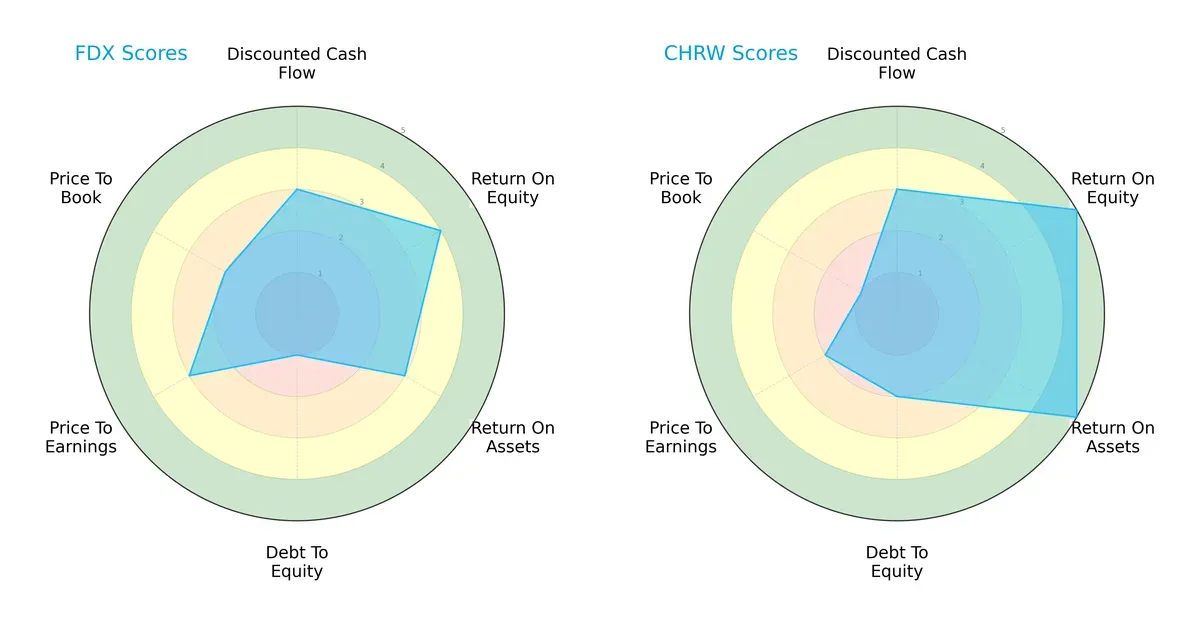
FedEx shows moderate DCF and ROA scores but struggles with debt, scoring very unfavorable on debt-to-equity. C.H. Robinson excels in ROE and ROA, reflecting superior asset efficiency and profitability. However, it trades at less attractive valuation metrics. C.H. Robinson presents a more balanced financial profile, while FedEx relies heavily on specific profitability metrics despite higher leverage.
Bankruptcy Risk: Solvency Showdown
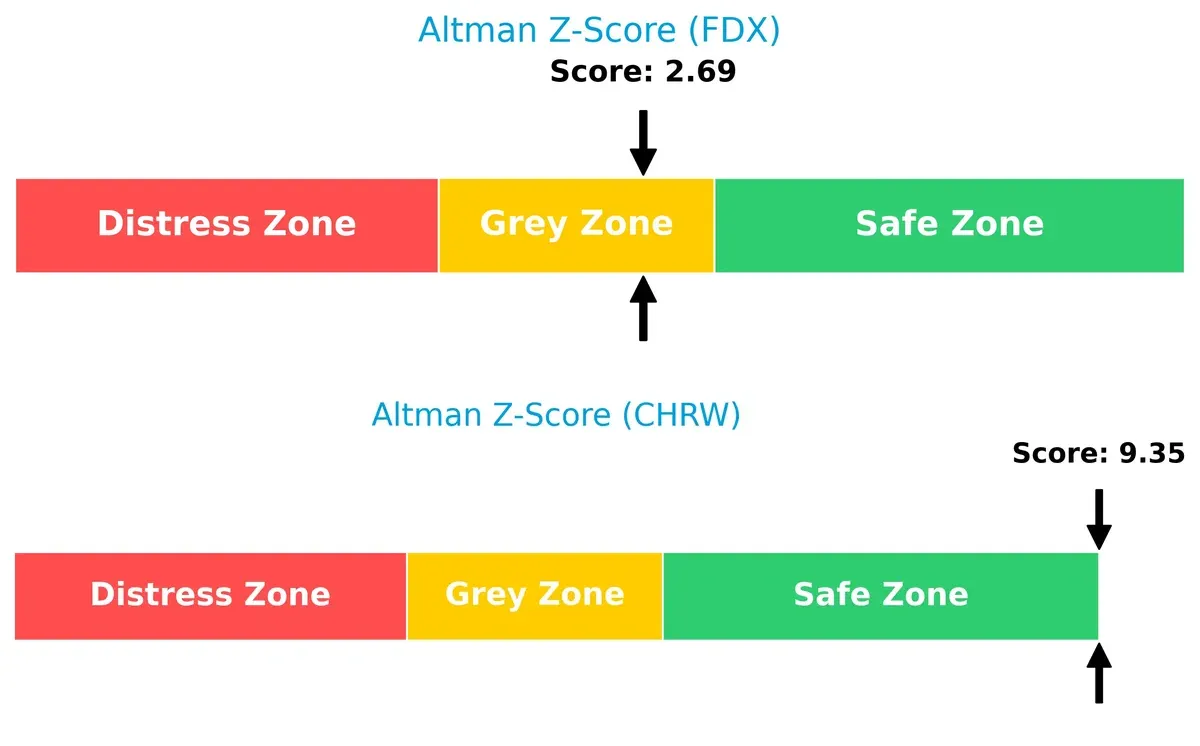
C.H. Robinson’s Altman Z-Score of 9.35 places it firmly in the safe zone, signaling strong solvency. FedEx’s 2.69 score sits in the grey zone, indicating moderate bankruptcy risk and caution in long-term survival:
Financial Health: Quality of Operations
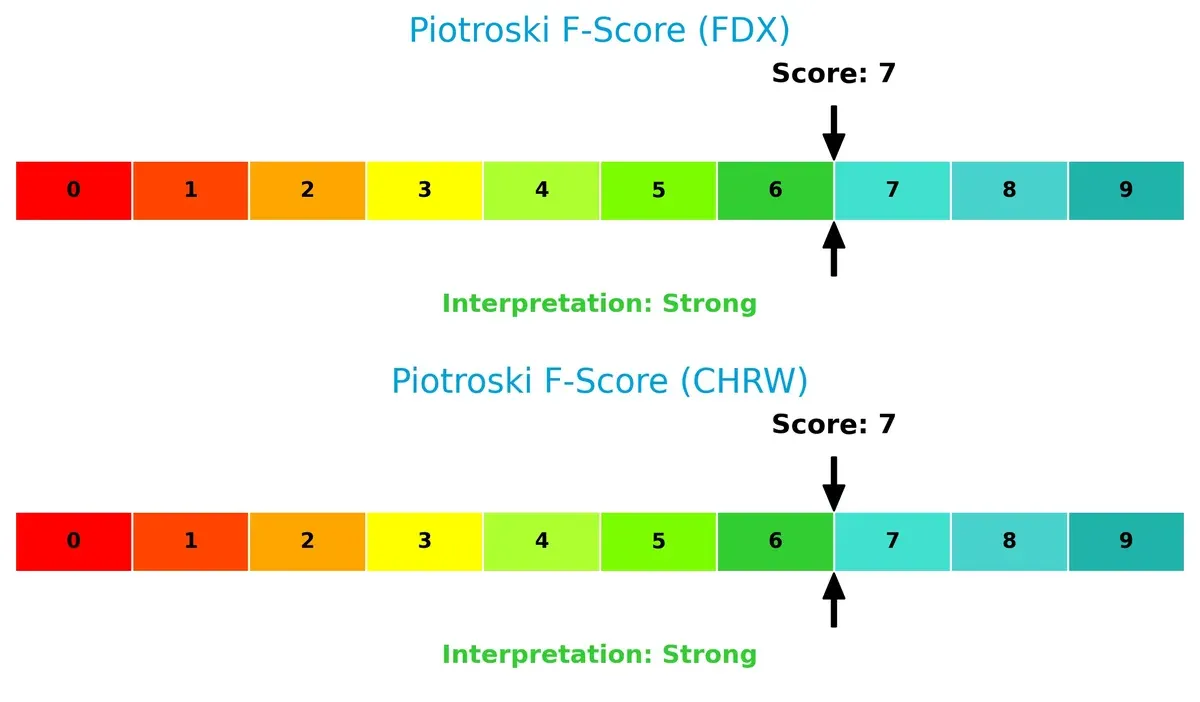
Both companies share a strong Piotroski F-Score of 7, indicating healthy internal financial metrics. Neither shows immediate red flags, but this parity suggests investors should weigh other factors like leverage and profitability in their decisions:
How are the two companies positioned?
This section dissects the operational DNA of FedEx and C.H. Robinson by comparing their revenue distribution and internal dynamics. The goal is to confront their economic moats and identify which business model offers the most resilient, sustainable competitive advantage today.
Revenue Segmentation: The Strategic Mix
The following visual comparison dissects how FedEx Corporation and C.H. Robinson Worldwide diversify their income streams and where their primary sector bets lie:
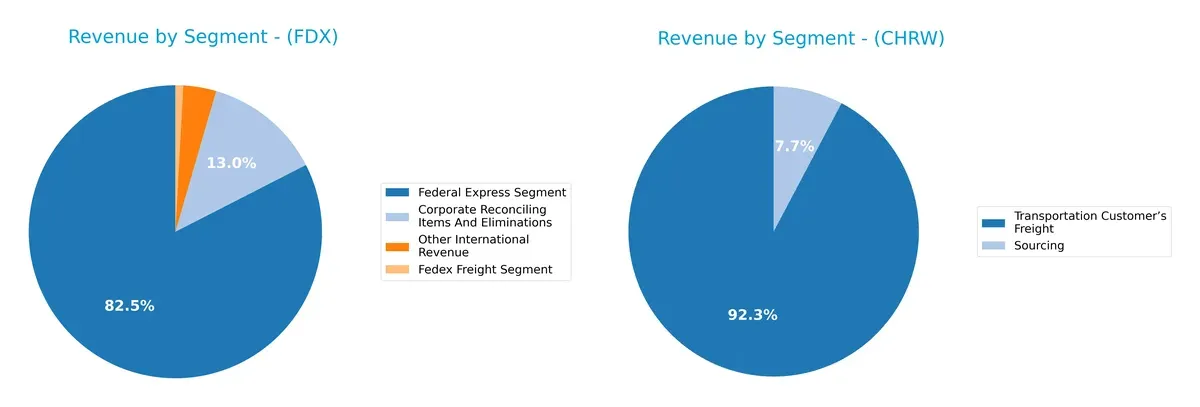
FedEx anchors its revenue heavily in the Fedex Express Segment at $23.7B for 2025, with smaller contributions from Freight and International operations. This concentration reflects a strong infrastructure dominance in express delivery. In contrast, C.H. Robinson leans on Transportation Customer’s Freight at $16.4B, but also diversifies with notable Sourcing and Global Forwarding segments. FedEx faces more concentration risk, while C.H. Robinson pivots towards a more balanced and flexible logistics ecosystem.
Strengths and Weaknesses Comparison
This table compares the Strengths and Weaknesses of FedEx Corporation and C.H. Robinson Worldwide, Inc.:
FedEx Strengths
- Diverse revenue streams across express, freight, ground, and international segments
- Strong U.S. and Non-U.S. global presence with $63B U.S. and $25B Non-U.S. revenues
- Favorable cost of capital (WACC 7.83%) and valuation metrics (PE 12.95)
- Solid liquidity ratios (quick ratio 1.15) and interest coverage (7.9)
- Consistent dividend yield at 2.53%
C.H. Robinson Strengths
- High profitability with ROE 27.04% and ROIC 15.36% above cost of capital (7.78%)
- Excellent asset utilization with asset turnover 3.35 and fixed asset turnover 38.37
- Strong liquidity (quick ratio 1.28) and interest coverage (12.45)
- Favorable dividend yield near 2.38%
- Significant U.S. revenue ($14.9B) with growing Non-U.S. presence ($2.85B)
FedEx Weaknesses
- Low net margin at 4.65% flagged as unfavorable
- High debt-to-equity ratio (1.33) indicates leverage risk
- ROIC (6.0%) slightly below WACC (7.83%)
- Moderate market valuation with neutral PB (1.89)
- Net margin under pressure despite scale
C.H. Robinson Weaknesses
- Low net margin at 2.63% and unfavorable valuation ratios (PE 26.58, PB 7.19)
- Debt-to-equity at 1.01 still flagged unfavorable
- Higher proportion of unfavorable ratios (28.57%)
- Smaller absolute scale in revenues compared to FedEx, limiting market share
Both companies show strengths in liquidity and dividend yields, but FedEx benefits from scale and diversification. C.H. Robinson excels in profitability and asset efficiency but faces valuation and margin challenges. These factors shape their strategic priorities differently.
The Moat Duel: Analyzing Competitive Defensibility
Structural moats protect long-term profits from competition erosion. Only a durable moat sustains superior returns over market cycles:
FedEx Corporation: Scale and Infrastructure Moat
FedEx leverages vast logistics infrastructure and brand scale to maintain operational efficiency and margin stability. However, declining ROIC signals weakening value creation in 2026.
C.H. Robinson Worldwide, Inc.: Brokerage Network Moat
C.H. Robinson’s extensive carrier network and technology-driven brokerage create cost advantages. Despite a slightly declining ROIC, it sustains positive value creation and margin improvements, unlike FedEx.
Scale Infrastructure vs. Brokerage Network: Who Defends Better?
FedEx’s scale is massive but currently loses value with a shrinking ROIC. C.H. Robinson’s leaner model maintains a wider moat through efficient capital use. I see C.H. Robinson better equipped to defend market share amid industry pressures.
Which stock offers better returns?
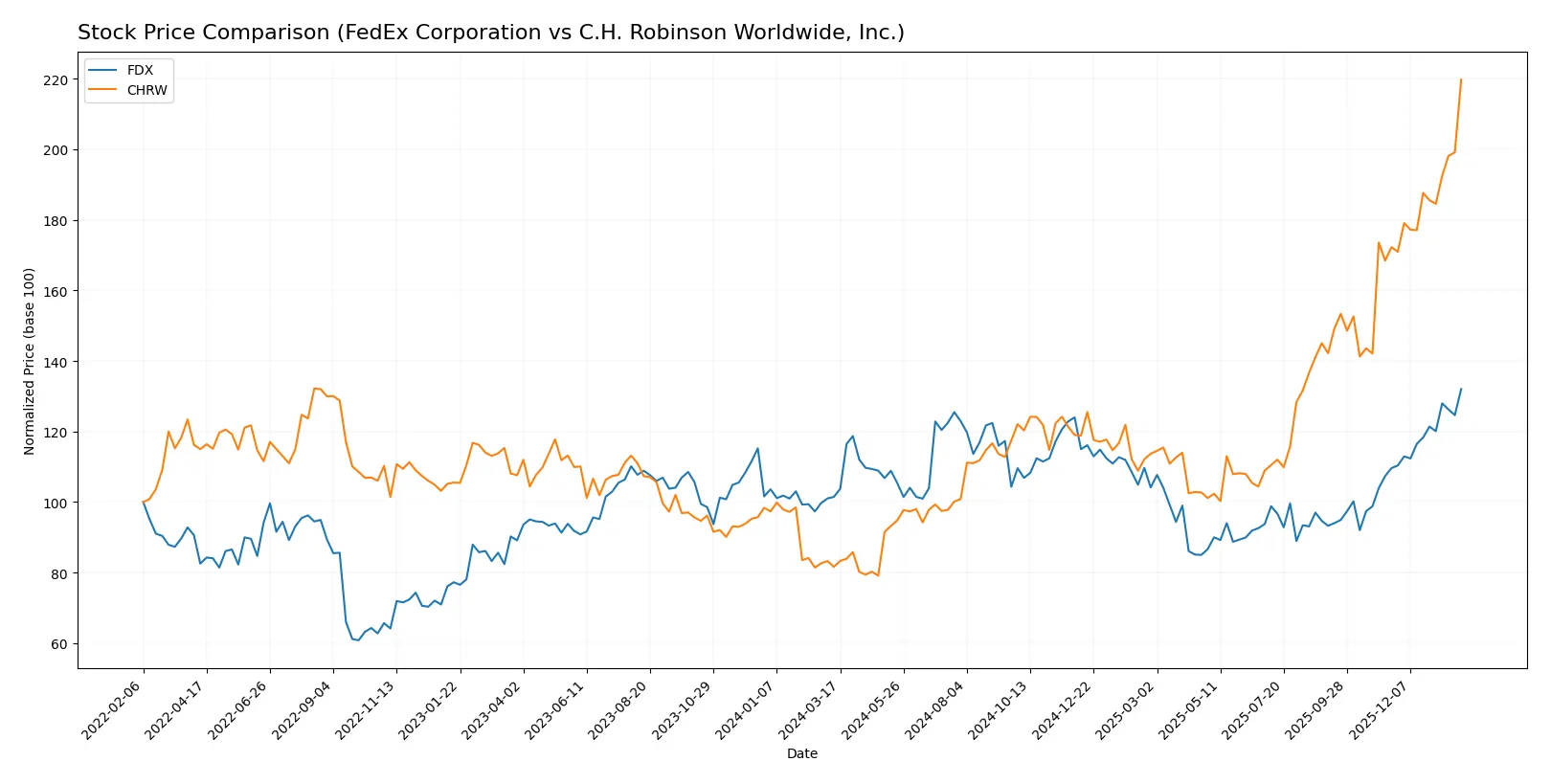
Both FedEx Corporation and C.H. Robinson Worldwide, Inc. show strong bullish momentum, with significant price gains and accelerating trends over the past year, reflecting dynamic trading activity and notable upward moves.
Trend Comparison
FedEx Corporation’s stock rose 30.11% over the past 12 months, showing acceleration and a high volatility level with prices ranging from 207.55 to 322.25.
C.H. Robinson Worldwide’s shares surged 169.08% over the same period, also accelerating but with slightly lower volatility, hitting a low of 70.22 and a high near 195.
C.H. Robinson delivered a substantially higher market return than FedEx, maintaining a strong upward trend and greater overall price appreciation.
Target Prices
Analysts present mixed but generally optimistic target prices for FedEx and C.H. Robinson.
| Company | Target Low | Target High | Consensus |
|---|---|---|---|
| FedEx Corporation | 210 | 355 | 294.07 |
| C.H. Robinson Worldwide, Inc. | 90 | 220 | 184.19 |
FedEx’s consensus target of 294.07 sits below its current 322.25 price, signaling potential downside risk. C.H. Robinson’s consensus at 184.19 also trails its current 194.95, suggesting cautious investor sentiment despite strong operational fundamentals.

Don’t Let Luck Decide Your Entry Point
Optimize your entry points with our advanced ProRealTime indicators. You’ll get efficient buy signals with precise price targets for maximum performance. Start outperforming now!
How do institutions grade them?
The following tables summarize recent institutional grades for FedEx Corporation and C.H. Robinson Worldwide, Inc.:
FedEx Corporation Grades
The latest grades from reputable firms for FedEx Corporation are as follows:
| Grading Company | Action | New Grade | Date |
|---|---|---|---|
| Rothschild & Co | Downgrade | Neutral | 2026-01-21 |
| Bernstein | Maintain | Market Perform | 2026-01-09 |
| Jefferies | Maintain | Buy | 2025-12-19 |
| Morgan Stanley | Maintain | Underweight | 2025-12-19 |
| JP Morgan | Maintain | Neutral | 2025-12-19 |
| BMO Capital | Maintain | Market Perform | 2025-12-19 |
| Truist Securities | Maintain | Buy | 2025-12-19 |
| Wells Fargo | Maintain | Equal Weight | 2025-12-19 |
| Stephens & Co. | Maintain | Overweight | 2025-12-19 |
| B of A Securities | Maintain | Neutral | 2025-12-19 |
C.H. Robinson Worldwide, Inc. Grades
The latest grades from credible institutions for C.H. Robinson Worldwide, Inc. are as follows:
| Grading Company | Action | New Grade | Date |
|---|---|---|---|
| Citigroup | Maintain | Neutral | 2026-01-30 |
| Benchmark | Maintain | Buy | 2026-01-30 |
| Stifel | Maintain | Buy | 2026-01-29 |
| Evercore ISI Group | Maintain | Outperform | 2026-01-29 |
| Morgan Stanley | Maintain | Underweight | 2026-01-29 |
| Truist Securities | Maintain | Buy | 2026-01-29 |
| Wells Fargo | Maintain | Overweight | 2026-01-29 |
| Susquehanna | Maintain | Positive | 2026-01-29 |
| UBS | Maintain | Buy | 2026-01-23 |
| Truist Securities | Maintain | Buy | 2026-01-15 |
Which company has the best grades?
C.H. Robinson Worldwide, Inc. consistently receives stronger ratings, including multiple Buy and Outperform grades. FedEx shows a mix of Neutral, Market Perform, and Buy ratings, with some downgrades. This contrast can influence investor sentiment and portfolio positioning.
Risks specific to each company
The following categories identify critical pressure points and systemic threats facing FedEx Corporation and C.H. Robinson Worldwide, Inc. in the 2026 market environment:
1. Market & Competition
FedEx Corporation
- Faces intense competition in express and ground delivery; market saturation pressures margins.
C.H. Robinson Worldwide, Inc.
- Operates in a highly fragmented brokerage market; competitive pricing limits margin expansion.
2. Capital Structure & Debt
FedEx Corporation
- Elevated debt-to-equity ratio (1.33) signals higher financial leverage risk.
C.H. Robinson Worldwide, Inc.
- Moderate debt levels with a lower debt-to-assets ratio, reflecting more conservative leverage.
3. Stock Volatility
FedEx Corporation
- Higher beta (1.357) indicates greater sensitivity to market swings and higher volatility risk.
C.H. Robinson Worldwide, Inc.
- Lower beta (0.913) suggests more stable stock price movements relative to the market.
4. Regulatory & Legal
FedEx Corporation
- Subject to stringent transportation and cross-border regulations globally; compliance costs rising.
C.H. Robinson Worldwide, Inc.
- Faces regulatory scrutiny mainly in brokerage and customs brokerage services; less exposure to transport regulation.
5. Supply Chain & Operations
FedEx Corporation
- Complex global logistics network vulnerable to disruptions and rising operational costs.
C.H. Robinson Worldwide, Inc.
- Relies heavily on third-party carriers; operational efficiency depends on partner reliability.
6. ESG & Climate Transition
FedEx Corporation
- Pressured to reduce carbon footprint amid large vehicle fleet; capital-intensive green investments required.
C.H. Robinson Worldwide, Inc.
- ESG risks lower but must manage sustainability in sourcing and transportation partners.
7. Geopolitical Exposure
FedEx Corporation
- High exposure to global trade tensions and cross-border restrictions affecting freight flows.
C.H. Robinson Worldwide, Inc.
- Also impacted by geopolitical risks but with more diversified contract base and less asset intensity.
Which company shows a better risk-adjusted profile?
FedEx’s most impactful risk is its high financial leverage, which elevates bankruptcy risk despite operational scale. C.H. Robinson’s key risk lies in its market valuation and competitive pressures despite stronger profitability metrics. Given its safer Altman Z-score and stronger ROIC, C.H. Robinson presents a better risk-adjusted profile. The disparity in debt-to-equity ratios and Altman Z-scores justifies my concern about FedEx’s balance sheet vulnerability in a volatile economy.
Final Verdict: Which stock to choose?
FedEx Corporation’s superpower lies in its established scale and operational efficiency that supports steady cash flow generation. Its declining profitability and value destruction, however, remain points of vigilance. It suits portfolios seeking stable income with moderate growth exposure, often found in core or dividend-focused allocations.
C.H. Robinson Worldwide’s strategic moat is its superior capital efficiency and strong returns on invested capital, supported by a lean asset base and recurring logistics contracts. Compared to FedEx, it offers better profitability and financial health, fitting well within GARP (Growth at a Reasonable Price) portfolios focused on quality growth with risk awareness.
If you prioritize cash flow reliability and market presence, FedEx is the compelling choice due to its operational scale and dividend yield. However, if you seek superior capital efficiency and growth potential with better financial stability, C.H. Robinson outshines as a more attractive candidate. Both require careful risk management given their industry cyclicality and recent performance trends.
Disclaimer: Investment carries a risk of loss of initial capital. The past performance is not a reliable indicator of future results. Be sure to understand risks before making an investment decision.
Go Further
I encourage you to read the complete analyses of FedEx Corporation and C.H. Robinson Worldwide, Inc. to enhance your investment decisions: