Home > Comparison > Financial Services > BLK vs BEN
The strategic rivalry between BlackRock, Inc. and Franklin Resources, Inc. shapes the financial services sector’s competitive landscape. BlackRock operates as a global, diversified asset manager with a broad, multi-asset portfolio approach. In contrast, Franklin Resources focuses on traditional mutual fund management with a leaner operational footprint. This analysis compares their growth trajectories and capital allocation strategies to identify which offers superior risk-adjusted returns for a diversified portfolio in today’s evolving market environment.
Table of contents
Companies Overview
BlackRock and Franklin Resources both wield significant influence in asset management, shaping investment landscapes globally.
BlackRock, Inc.: The Global Investment Manager
BlackRock dominates as a public investment manager catering to diverse institutional and individual clients. Its revenue stems from managing equity, fixed income, balanced portfolios, and alternative investments worldwide. In 2026, BlackRock sharpens its focus on global risk management and advisory services, leveraging quantitative and fundamental analysis to stay ahead.
Franklin Resources, Inc.: The Asset Management Holding Company
Franklin Resources operates as a holding company providing asset management via subsidiaries. It generates revenue by launching mutual funds across equity, fixed income, and multi-asset classes. In 2026, Franklin emphasizes expanding its equity and alternative market investments, targeting both individual and institutional clients with a streamlined fund offering.
Strategic Collision: Similarities & Divergences
Both firms compete in asset management but diverge in structure: BlackRock offers a direct, integrated investment platform, while Franklin relies on a subsidiary model. Their battle centers on capturing institutional and mutual fund market share. BlackRock’s scale and global reach contrast with Franklin’s focused fund strategy, defining distinct investment profiles shaped by breadth versus specialization.
Income Statement Comparison
The following data dissects the core profitability and scalability of both corporate engines to reveal who dominates the bottom line:
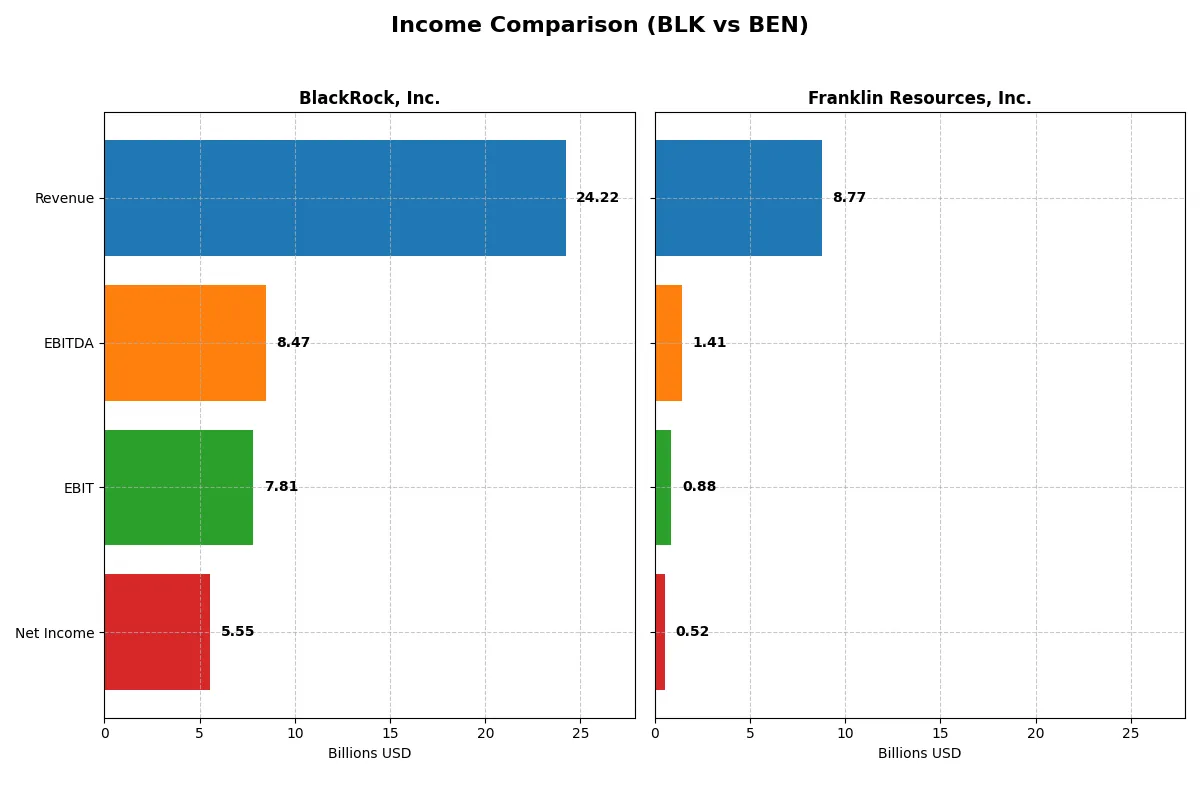
| Metric | BlackRock, Inc. (BLK) | Franklin Resources, Inc. (BEN) |
|---|---|---|
| Revenue | 24.2B | 8.8B |
| Cost of Revenue | 10.8B | 1.7B |
| Operating Expenses | 6.4B | 6.4B |
| Gross Profit | 13.4B | 7.0B |
| EBITDA | 8.5B | 1.4B |
| EBIT | 7.8B | 882M |
| Interest Expense | 706M | 95M |
| Net Income | 5.6B | 525M |
| EPS | 35.84 | 0.91 |
| Fiscal Year | 2025 | 2025 |
Income Statement Analysis: The Bottom-Line Duel
This income statement comparison reveals which company runs a more efficient and profitable business engine through recent financial performance.
BlackRock, Inc. Analysis
BlackRock’s revenue climbed from $17.9B in 2023 to $24.2B in 2025, showing strong growth momentum. Its gross margin remains healthy at 55.5%, while net margin near 23% indicates robust profitability. Despite a 15.7% EPS decline in 2025, BlackRock sustains solid operating efficiency with an EBIT margin of 32.3%.
Franklin Resources, Inc. Analysis
Franklin’s revenue modestly increased from $7.8B in 2023 to $8.8B in 2025, reflecting stable but slower growth. The company boasts a higher gross margin at 80.3%, yet net margin lags at 6%, signaling tighter bottom-line performance. EPS grew 7% in 2025, but a 4.2% EBIT drop suggests pressure on operational income.
Margin Strength vs. Growth Velocity
BlackRock outpaces Franklin in revenue scale and operating margins, delivering greater absolute profits despite recent EPS softness. Franklin’s superior gross margin does not translate into higher net income, reflecting cost structure challenges. Investors seeking dominant margin power and growth may favor BlackRock’s profile over Franklin’s steadier, lower-margin approach.
Financial Ratios Comparison
These vital ratios act as a diagnostic tool to expose underlying fiscal health, valuation premiums, and capital efficiency for informed analysis:
| Ratios | BlackRock (BLK) | Franklin Resources (BEN) |
|---|---|---|
| ROE | 13.4% (2024) | 4.3% (2025) |
| ROIC | 4.3% (2024) | 1.4% (2025) |
| P/E | 24.1 (2024) | 22.7 (2025) |
| P/B | 3.2 (2024) | 1.0 (2025) |
| Current Ratio | 16.4 (2024) | 2.7 (2025) |
| Quick Ratio | 16.4 (2024) | 2.7 (2025) |
| D/E | 0.30 (2024) | 1.10 (2025) |
| Debt-to-Assets | 10.3% (2024) | 41.1% (2025) |
| Interest Coverage | 14.1 (2024) | 6.4 (2025) |
| Asset Turnover | 0.15 (2024) | 0.27 (2025) |
| Fixed Asset Turnover | 7.8 (2024) | 5.1 (2025) |
| Payout Ratio | 48.7% (2024) | 130.3% (2025) |
| Dividend Yield | 2.0% (2024) | 5.7% (2025) |
| Fiscal Year | 2024 | 2025 |
Efficiency & Valuation Duel: The Vital Signs
Financial ratios act as a company’s DNA, exposing hidden risks and operational strengths that shape investor confidence and valuation.
BlackRock, Inc.
BlackRock reports a strong net margin of 22.93%, signaling operational efficiency, but its ROE is zero, which is unfavorable. The stock trades at a high P/E of 29.9, suggesting it is expensive relative to earnings. Dividend yield is modest at 1.95%, balancing shareholder returns with reinvestment in growth.
Franklin Resources, Inc.
Franklin Resources shows a moderate net margin of 5.98% and a low ROE of 4.35%, indicating weaker profitability. Its P/E ratio of 22.67 is more reasonable, reflecting a fair valuation. The company delivers a higher dividend yield of 5.75%, offering steady income despite its slower growth profile.
Premium Valuation vs. Income Stability
BlackRock presents a stretched valuation with superior operational margins but lacks equity returns, while Franklin Resources offers a more balanced valuation and stronger dividend income. Investors seeking growth may prefer BlackRock’s efficiency, whereas income-focused investors might favor Franklin’s stable payouts.
Which one offers the Superior Shareholder Reward?
I compare BlackRock, Inc. (BLK) and Franklin Resources, Inc. (BEN) on dividends, payout ratios, and buyback intensity. BLK yields ~2.0%, with a payout ratio near 50-58%, supported by strong free cash flow and consistent buybacks driving capital return. BEN offers a higher dividend yield around 5-6% but pays out over 100% of earnings recently, signaling unsustainable payouts. BEN’s buyback program is less aggressive, focusing more on dividends. BLK’s balanced approach, combining moderate dividends with robust buybacks and superior operating margins, offers a more sustainable and attractive total return in 2026 than BEN’s high-yield but riskier model.
Comparative Score Analysis: The Strategic Profile
The radar chart reveals the fundamental DNA and trade-offs of both firms, highlighting their core financial strengths and weaknesses:
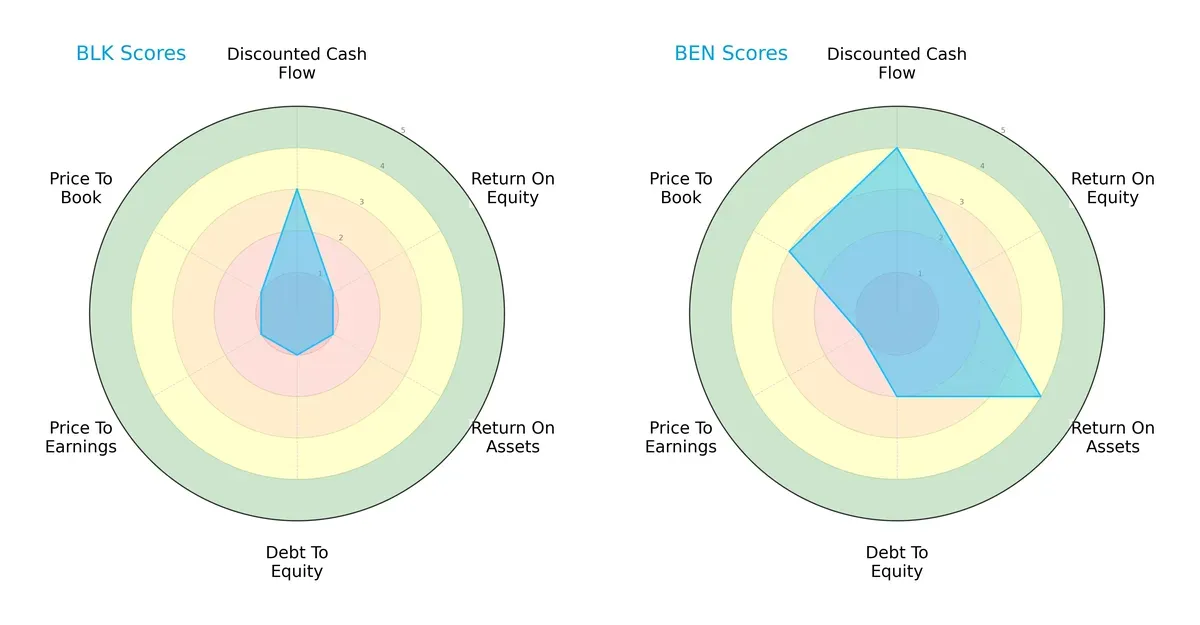
Franklin Resources, Inc. (BEN) shows a more balanced profile with favorable scores in DCF (4), ROA (4), and moderate debt-to-equity (2). BlackRock, Inc. (BLK) relies heavily on a moderate DCF score (3) but suffers from very unfavorable scores across ROE, ROA, and leverage metrics (all 1). BEN demonstrates a stronger operational and valuation discipline, while BLK’s profile signals strategic vulnerabilities.
Bankruptcy Risk: Solvency Showdown
The Altman Z-Score difference signals contrasting survivability prospects in this cycle:
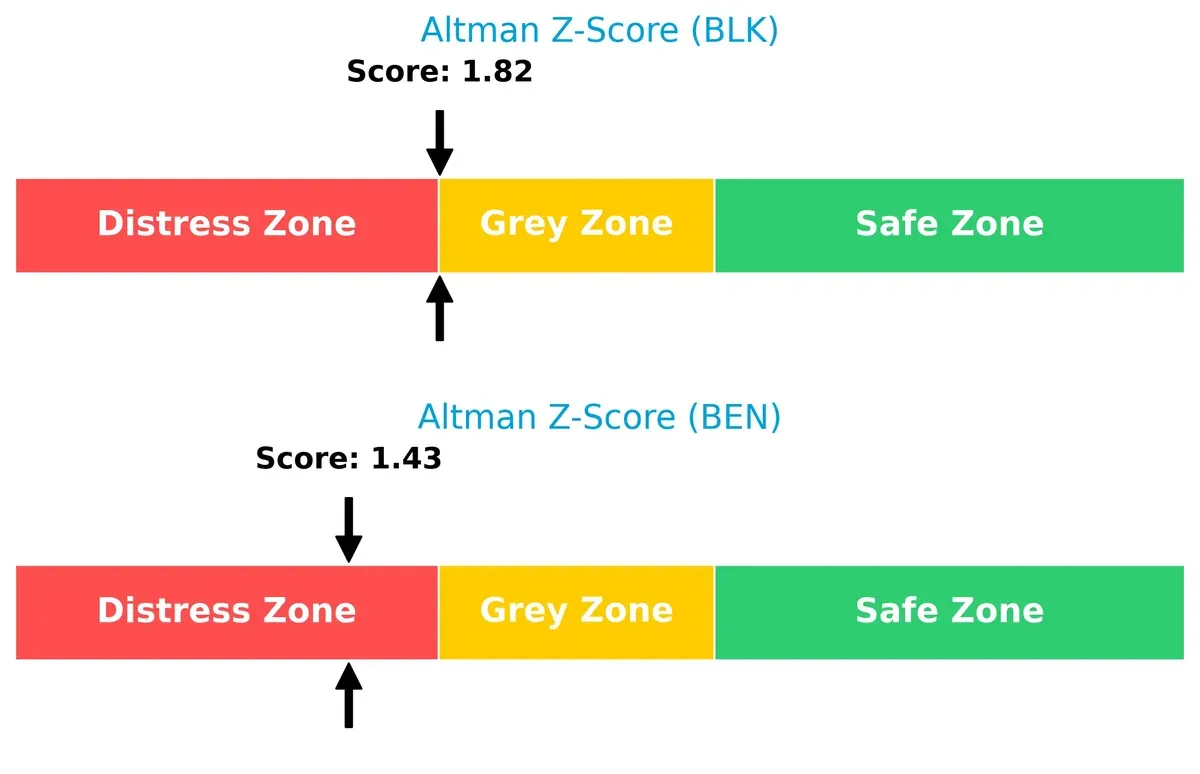
BlackRock’s score (1.82) places it in the grey zone, indicating moderate bankruptcy risk. Franklin’s score (1.43) lands in the distress zone, reflecting higher financial distress and increased default risk despite BEN’s operational strengths.
Financial Health: Quality of Operations
Piotroski F-Scores reveal internal financial quality and operational robustness:
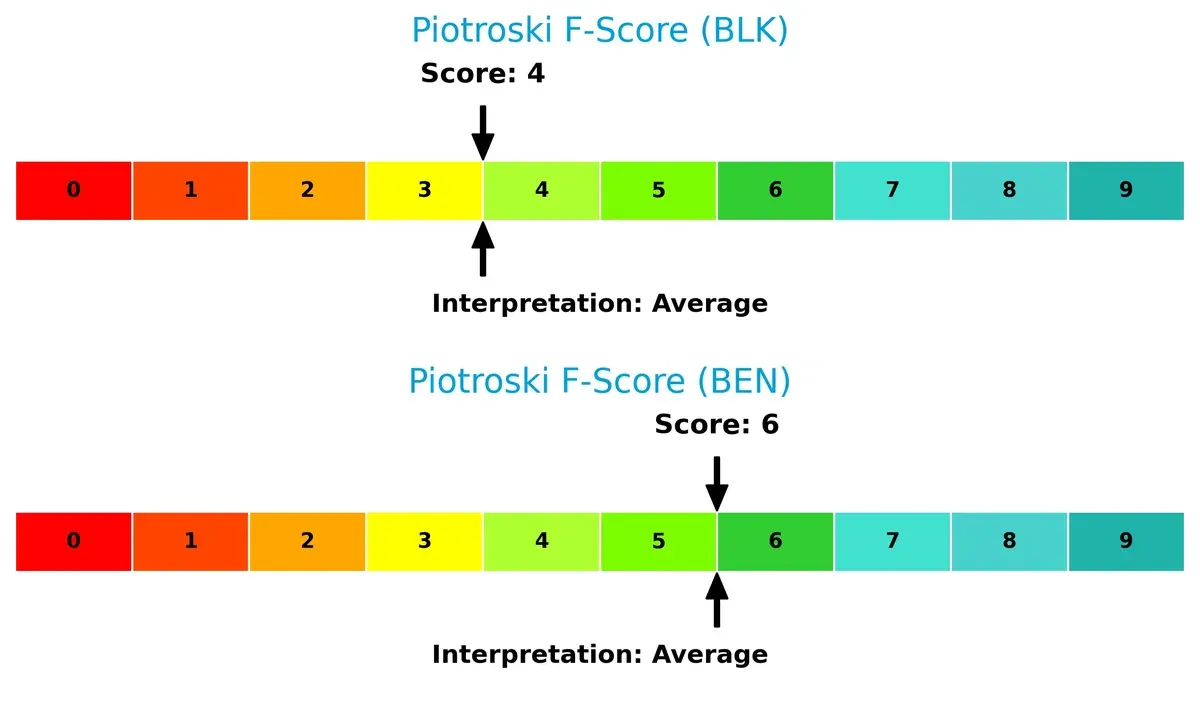
Franklin Resources leads with a score of 6, indicating average financial health and no glaring red flags. BlackRock scores 4, suggesting weaker internal metrics and potential operational inefficiencies relative to BEN. Both companies are in the average range, but BEN’s higher score reflects more reliable fundamentals.
How are the two companies positioned?
This section dissects BLK and BEN’s operational DNA by comparing revenue distribution and internal dynamics, including strengths and weaknesses. The goal is to confront their economic moats and identify which model offers the most resilient, sustainable advantage today.
Revenue Segmentation: The Strategic Mix
This visual comparison dissects how BlackRock, Inc. and Franklin Resources, Inc. diversify their income streams and where their primary sector bets lie:
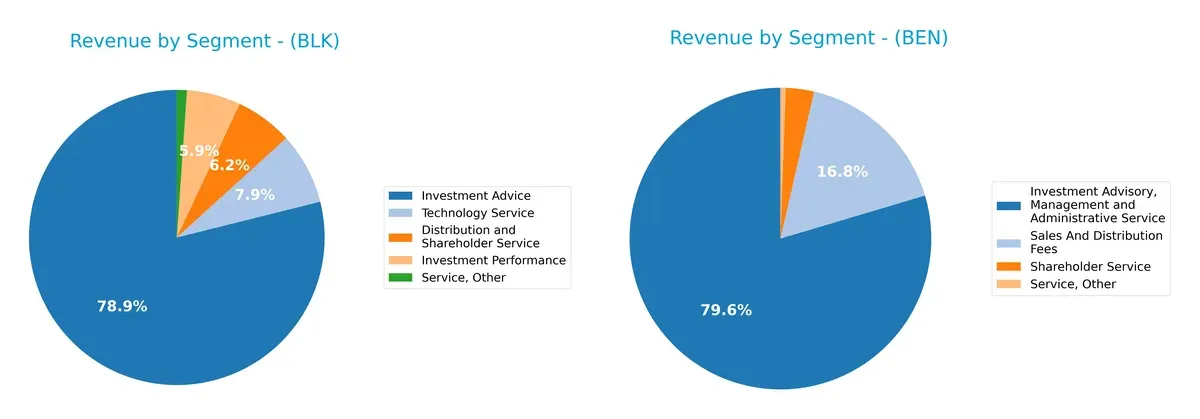
BlackRock anchors its revenue with $16.1B from Investment Advice, dwarfing other segments like Technology Service at $1.6B. Franklin Resources leans heavily on Investment Advisory, Management, and Administrative Service, generating $6.8B, with Sales and Distribution Fees contributing $1.4B. BlackRock’s mix shows a dominant core with niche services, signaling ecosystem lock-in. Franklin’s more balanced spread reduces concentration risk but lacks BlackRock’s infrastructure dominance.
Strengths and Weaknesses Comparison
This table compares the Strengths and Weaknesses of BlackRock, Inc. and Franklin Resources, Inc.:
BlackRock Strengths
- Strong net margin at 22.93%
- Favorable debt-to-assets ratio at 0%
- High interest coverage at 11.06
- Diversified revenue streams including technology and investment advice
- Significant global presence across Americas, Europe, Asia Pacific
Franklin Resources Strengths
- Favorable WACC at 6.7%
- Solid current and quick ratios at 2.71 each
- Favorable fixed asset turnover at 5.12
- Diversified geographic revenue with strong US and Luxembourg presence
- Neutral net margin at 5.98%
BlackRock Weaknesses
- Unfavorable ROE and ROIC at 0%
- Unavailable WACC data
- Unfavorable liquidity ratios (current and quick ratio at 0)
- Unfavorable asset and fixed asset turnover
- PE ratio considered unfavorable at 29.9
Franklin Resources Weaknesses
- Unfavorable debt-to-equity at 1.1
- Unfavorable ROE and ROIC below WACC
- Moderate net margin at 5.98% neutral
- Unfavorable asset turnover at 0.27
- Moderate dividend yield neutral at 5.75%
Both companies show diversification and global reach but differ in financial health. BlackRock excels in profitability and leverage but suffers liquidity and efficiency weaknesses. Franklin has better liquidity and capital efficiency but faces challenges in profitability and leverage. This contrast informs their strategic financial positioning.
The Moat Duel: Analyzing Competitive Defensibility
A structural moat is the only true barrier protecting long-term profits from relentless competitive erosion. Let’s examine these firms’ moats:
BlackRock, Inc.: Scale and Brand Intangibles
BlackRock’s moat stems from intangible assets like brand reputation and scale. Its stable margins and 23% net margin reflect pricing power. Expansion in global markets could deepen this moat despite margin pressure in 2026.
Franklin Resources, Inc.: Niche Cost Advantage
Franklin relies on selective cost advantages and focused client relationships. Its high gross margin (80%) contrasts with lower net margins (6%), signaling operational leverage limits. Growth opportunities hinge on product innovation to offset shrinking profitability.
Verdict: Scale and Brand Intangibles vs. Niche Cost Control
BlackRock’s wider moat benefits from scale and diversified global reach, enabling stronger margin resilience. Franklin’s smaller, cost-focused moat faces tougher sustainability challenges. BlackRock is better positioned to defend market share in 2026.
Which stock offers better returns?
Over the past 12 months, BlackRock, Inc. (BLK) surged 33.83%, showing accelerating growth and wide price swings. Franklin Resources, Inc. (BEN) declined 5.1%, despite recent gains and low volatility.
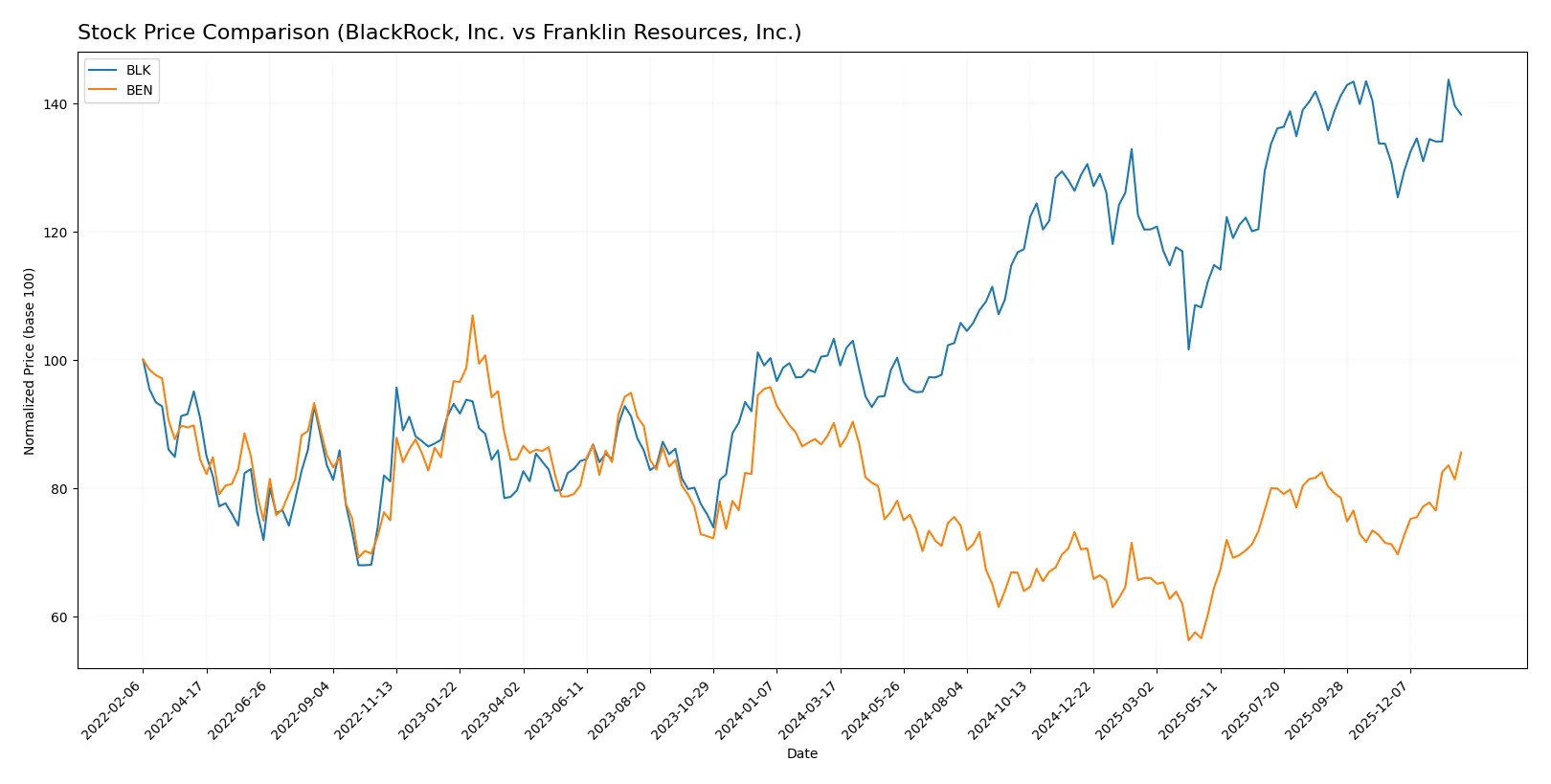
Trend Comparison
BlackRock’s stock climbed 33.83% over the past year, marking a bullish trend with accelerating momentum and a high price range between 750 and 1163.
Franklin Resources fell 5.1% overall, a bearish trend with acceleration. Recent months show a 20.07% rise but remain volatile at a lower price scale.
BlackRock outperformed Franklin over the full year, delivering a stronger market return despite higher volatility.
Target Prices
Analysts present a clear target range reflecting optimism for BlackRock and a steady outlook for Franklin Resources.
| Company | Target Low | Target High | Consensus |
|---|---|---|---|
| BlackRock, Inc. | 1200 | 1514 | 1333.7 |
| Franklin Resources, Inc. | 25 | 25 | 25 |
BlackRock’s consensus target of 1333.7 suggests a significant upside from its current 1118.94 price. Franklin Resources trades slightly above its fixed consensus target of 25, indicating limited near-term price expansion expected.

Don’t Let Luck Decide Your Entry Point
Optimize your entry points with our advanced ProRealTime indicators. You’ll get efficient buy signals with precise price targets for maximum performance. Start outperforming now!
How do institutions grade them?
The following shows the latest institutional grades for BlackRock, Inc. and Franklin Resources, Inc.:
BlackRock, Inc. Grades
Below is a summary of recent grades from major financial institutions on BlackRock:
| Grading Company | Action | New Grade | Date |
|---|---|---|---|
| UBS | Maintain | Neutral | 2026-01-16 |
| Keefe, Bruyette & Woods | Maintain | Outperform | 2026-01-16 |
| Barclays | Maintain | Overweight | 2026-01-16 |
| TD Cowen | Downgrade | Hold | 2026-01-14 |
| UBS | Maintain | Neutral | 2026-01-12 |
| Barclays | Maintain | Overweight | 2026-01-08 |
| Keefe, Bruyette & Woods | Maintain | Outperform | 2026-01-08 |
| Keefe, Bruyette & Woods | Maintain | Outperform | 2025-12-17 |
| Morgan Stanley | Maintain | Overweight | 2025-12-17 |
| Barclays | Maintain | Overweight | 2025-12-12 |
Franklin Resources, Inc. Grades
Here are recent institutional grades for Franklin Resources from key analysts:
| Grading Company | Action | New Grade | Date |
|---|---|---|---|
| Barclays | Maintain | Underweight | 2026-01-15 |
| TD Cowen | Maintain | Buy | 2026-01-14 |
| Barclays | Maintain | Underweight | 2025-12-12 |
| JP Morgan | Maintain | Neutral | 2025-11-10 |
| Barclays | Maintain | Underweight | 2025-10-21 |
| Evercore ISI Group | Maintain | Underperform | 2025-10-09 |
| B of A Securities | Maintain | Underperform | 2025-10-02 |
| Morgan Stanley | Maintain | Underweight | 2025-08-12 |
| JP Morgan | Maintain | Neutral | 2025-08-04 |
| Barclays | Maintain | Underweight | 2025-08-04 |
Which company has the best grades?
BlackRock consistently earns positive grades such as Outperform and Overweight, reflecting stronger institutional confidence. Franklin Resources faces mostly Underweight and Underperform ratings, indicating weaker market sentiment. Investors may interpret these disparities as differing risk-return profiles.
Risks specific to each company
The following categories identify the critical pressure points and systemic threats facing both firms in the 2026 market environment:
1. Market & Competition
BlackRock, Inc.
- Dominates asset management with $174B market cap but faces intense competition from fintech disruptors.
Franklin Resources, Inc.
- Smaller $14B market cap limits scale; competes heavily on niche and legacy strategies.
2. Capital Structure & Debt
BlackRock, Inc.
- Strong debt metrics with favorable debt-to-equity and interest coverage ratios.
Franklin Resources, Inc.
- Higher debt-to-equity ratio (1.1) raises financial risk despite adequate interest coverage.
3. Stock Volatility
BlackRock, Inc.
- Beta of 1.48 signals above-market volatility but consistent trading volume supports liquidity.
Franklin Resources, Inc.
- Similar beta at 1.47 with significantly higher trading volume, indicating more active but volatile trading.
4. Regulatory & Legal
BlackRock, Inc.
- Faces complex global regulations given its broad international footprint.
Franklin Resources, Inc.
- Regulatory risk is more concentrated in U.S. and limited international presence reduces exposure.
5. Supply Chain & Operations
BlackRock, Inc.
- Operational complexity due to wide geographic spread and diverse product lines.
Franklin Resources, Inc.
- Less operational complexity but potential vulnerability to technology infrastructure gaps.
6. ESG & Climate Transition
BlackRock, Inc.
- Leading ESG integration expected; pressure to maintain leadership amid rising investor demands.
Franklin Resources, Inc.
- ESG initiatives less visible, risking investor preference shifts toward sustainability leaders.
7. Geopolitical Exposure
BlackRock, Inc.
- Exposure to multiple global markets increases geopolitical risk but also diversifies revenue.
Franklin Resources, Inc.
- Focused mostly in U.S. and India, limiting geopolitical risk but also growth opportunities.
Which company shows a better risk-adjusted profile?
Franklin Resources’ moderate debt and focused operations present a more balanced risk profile. BlackRock’s dominant market position comes with scale benefits but elevated volatility and regulatory complexity. BlackRock’s Altman Z-score near the grey zone, paired with weak profitability metrics, flags financial caution. Franklin’s distress zone Altman score and higher leverage raise red flags but its more favorable overall financial ratios and moderate Piotroski score suggest steadier risk management. The key risk for BlackRock is regulatory and market competition pressure. For Franklin, debt levels and financial distress risk dominate. I judge Franklin Resources to offer a slightly better risk-adjusted profile in 2026, given its relatively stronger liquidity and capital structure despite smaller scale.
Final Verdict: Which stock to choose?
BlackRock’s superpower lies in its unmatched scale and operational efficiency, driving strong revenue growth and robust cash flow generation. However, its declining profitability metrics and elevated valuation multiples warrant vigilance. It suits aggressive growth portfolios that can tolerate near-term margin pressure for long-term market dominance.
Franklin Resources offers a strategic moat through its historically stable asset management franchise and favorable balance sheet metrics. Its lower growth profile comes with better financial stability compared to BlackRock. It aligns well with GARP investors seeking moderate growth with a margin of safety in valuation.
If you prioritize high-growth potential and can absorb some margin volatility, BlackRock is the compelling choice due to its market leadership and cash generation capacity. However, if you seek a more conservative profile with steadier financial footing, Franklin Resources offers better stability and valuation discipline despite slower growth. Both present distinct risk-return trade-offs aligned with different investor avatars.
Disclaimer: Investment carries a risk of loss of initial capital. The past performance is not a reliable indicator of future results. Be sure to understand risks before making an investment decision.
Go Further
I encourage you to read the complete analyses of BlackRock, Inc. and Franklin Resources, Inc. to enhance your investment decisions: