In the dynamic world of communication services, Baidu, Inc. and Twilio Inc. stand out as influential players shaping the future of digital interaction. Baidu, a Chinese tech giant, excels in online marketing and AI-driven cloud services, while Twilio, based in the U.S., specializes in cloud communications platforms empowering developers worldwide. This comparison explores their market positions and innovation strategies to help you identify the most promising investment opportunity. Let’s discover which company truly deserves a place in your portfolio.
Table of contents
Companies Overview
I will begin the comparison between Baidu and Twilio by providing an overview of these two companies and their main differences.
Baidu Overview
Baidu, Inc. operates primarily in the People’s Republic of China, providing online marketing and cloud services through its internet platform. Its business is divided between Baidu Core, which includes search-based and AI-driven marketing services, and iQIYI, an online entertainment video platform. Founded in 2000 and headquartered in Beijing, Baidu is a major player in internet content and information with a workforce of 35,900 employees.
Twilio Overview
Twilio Inc. is a U.S.-based company offering a cloud communications platform that enables developers to integrate voice, messaging, video, and email capabilities into applications. Founded in 2008 and headquartered in San Francisco, Twilio focuses on customer engagement through APIs that simplify communication management. The company operates in the communication services sector with 5,502 full-time employees and serves a global market.
Key similarities and differences
Both Baidu and Twilio operate in the communication services sector and deliver cloud-based platforms focused on digital interaction. However, Baidu’s business model combines online marketing and entertainment platforms primarily in China, while Twilio centers on developer tools for embedding communication functions globally. Baidu is significantly larger by market cap and employee count, reflecting its broader service scope and regional dominance compared to Twilio’s specialized API offerings.
Income Statement Comparison
The table below compares key income statement metrics for Baidu, Inc. and Twilio Inc. for the fiscal year 2024, providing a snapshot of their financial performance.
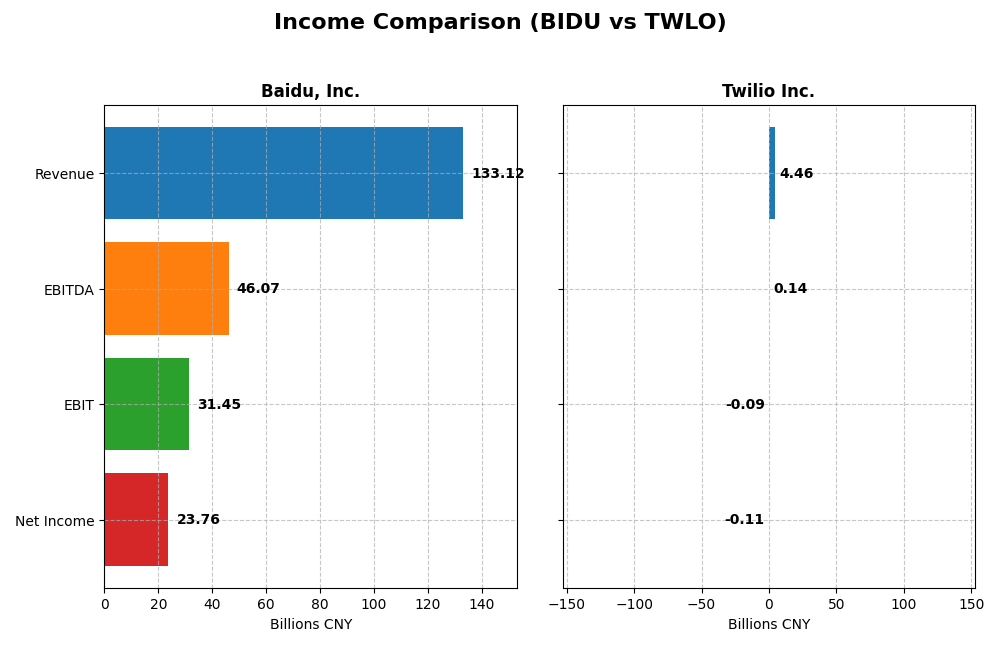
| Metric | Baidu, Inc. (BIDU) | Twilio Inc. (TWLO) |
|---|---|---|
| Market Cap | 51.6B CNY | 20.2B USD |
| Revenue | 133.1B CNY | 4.46B USD |
| EBITDA | 46.1B CNY | 136M USD |
| EBIT | 31.4B CNY | -88.6M USD |
| Net Income | 23.8B CNY | -109M USD |
| EPS | 66.48 CNY | -0.66 USD |
| Fiscal Year | 2024 | 2024 |
Income Statement Interpretations
Baidu, Inc.
Baidu’s revenue grew by 24.33% over the 2020-2024 period, though it slightly declined by 1.09% in the latest year. Net income increased moderately overall by 5.73%, with a strong 18.25% margin growth in the last year. Margins remain solid, with a gross margin of 50.35% and an EBIT margin of 23.62%, reflecting stable profitability and improved EPS growth of 19.59% recently.
Twilio Inc.
Twilio showed a significant revenue increase of 153.04% over five years, with a 7.32% rise in the most recent year. Despite this growth, EBIT and net margins remain negative at -1.99% and -2.45%, respectively, though improving. The company’s net income and EPS have grown impressively by 77.72% and 80.3% over the period, with a favorable margin expansion of 91.19%, signaling operational improvements despite ongoing losses.
Which one has the stronger fundamentals?
Baidu demonstrates stronger fundamentals with consistently positive net income, solid profitability margins, and stable growth, despite a slight revenue dip recently. Twilio’s rapid revenue and earnings growth are notable but come from a loss-making position with negative margins. Baidu’s margin stability contrasts with Twilio’s ongoing operating losses, suggesting Baidu currently has a more favorable income statement profile.
Financial Ratios Comparison
This table presents a side-by-side comparison of key financial ratios for Baidu, Inc. and Twilio Inc. based on their most recent fiscal year data for 2024.
| Ratios | Baidu, Inc. (BIDU) | Twilio Inc. (TWLO) |
|---|---|---|
| ROE | 9.01% | -1.38% |
| ROIC | 4.87% | -0.45% |
| P/E | 9.03 | -163.92 |
| P/B | 0.81 | 2.25 |
| Current Ratio | 2.09 | 4.20 |
| Quick Ratio | 2.01 | 4.20 |
| D/E | 0.30 | 0.14 |
| Debt-to-Assets | 18.54% | 11.25% |
| Interest Coverage | 7.53 | 0 |
| Asset Turnover | 0.31 | 0.45 |
| Fixed Asset Turnover | 3.25 | 18.24 |
| Payout Ratio | 0 | 0 |
| Dividend Yield | 0 | 0 |
Interpretation of the Ratios
Baidu, Inc.
Baidu shows mostly favorable financial ratios, including a strong net margin of 17.85% and a low price-to-book ratio of 0.81, indicating undervaluation. However, its return on equity (9.01%) and return on invested capital (4.87%) appear weak, raising concerns about efficiency in generating shareholder returns. The company does not pay dividends, likely focusing on reinvestment and growth.
Twilio Inc.
Twilio’s ratios reveal challenges, with negative net margin (-2.45%) and returns on equity (-1.38%) and invested capital (-0.45%) signaling unprofitability and operational inefficiencies. Its current ratio is high but marked as unfavorable, possibly due to excessive liquidity or asset management issues. Twilio also does not pay dividends, consistent with its negative earnings and growth-oriented strategy.
Which one has the best ratios?
Baidu’s ratios are predominantly favorable, reflecting better profitability and financial stability compared to Twilio’s mostly unfavorable and negative returns. While Baidu faces some efficiency issues, it maintains a stronger overall financial position. Twilio’s negative margins and returns highlight greater risks, making its ratios less attractive in this comparison.
Strategic Positioning
This section compares the strategic positioning of Baidu, Inc. and Twilio Inc., including market position, key segments, and exposure to technological disruption:
Baidu, Inc.
- Leading internet content provider in China facing moderate competitive pressure in key markets.
- Operates Baidu Core (online marketing, cloud, AI products) and iQIYI (online entertainment).
- Exposure through AI initiatives and evolving digital entertainment consumption trends in China.
Twilio Inc.
- Cloud communications platform competing in a highly dynamic software market.
- Focuses on a communications platform enabling voice, messaging, video, and email APIs.
- Technology-driven platform exposed to rapid innovation cycles in cloud communications APIs.
Baidu, Inc. vs Twilio Inc. Positioning
Baidu has a diversified business model balancing online marketing, cloud, AI, and entertainment segments, while Twilio concentrates on cloud communication APIs. Baidu benefits from scale in China, whereas Twilio focuses on developer-centric engagement platforms internationally.
Which has the best competitive advantage?
Baidu shows a slightly favorable moat with growing profitability despite shedding value, indicating potential for competitive advantage. Twilio is slightly unfavorable with value destruction but improving profitability, reflecting higher risk in capital efficiency.
Stock Comparison
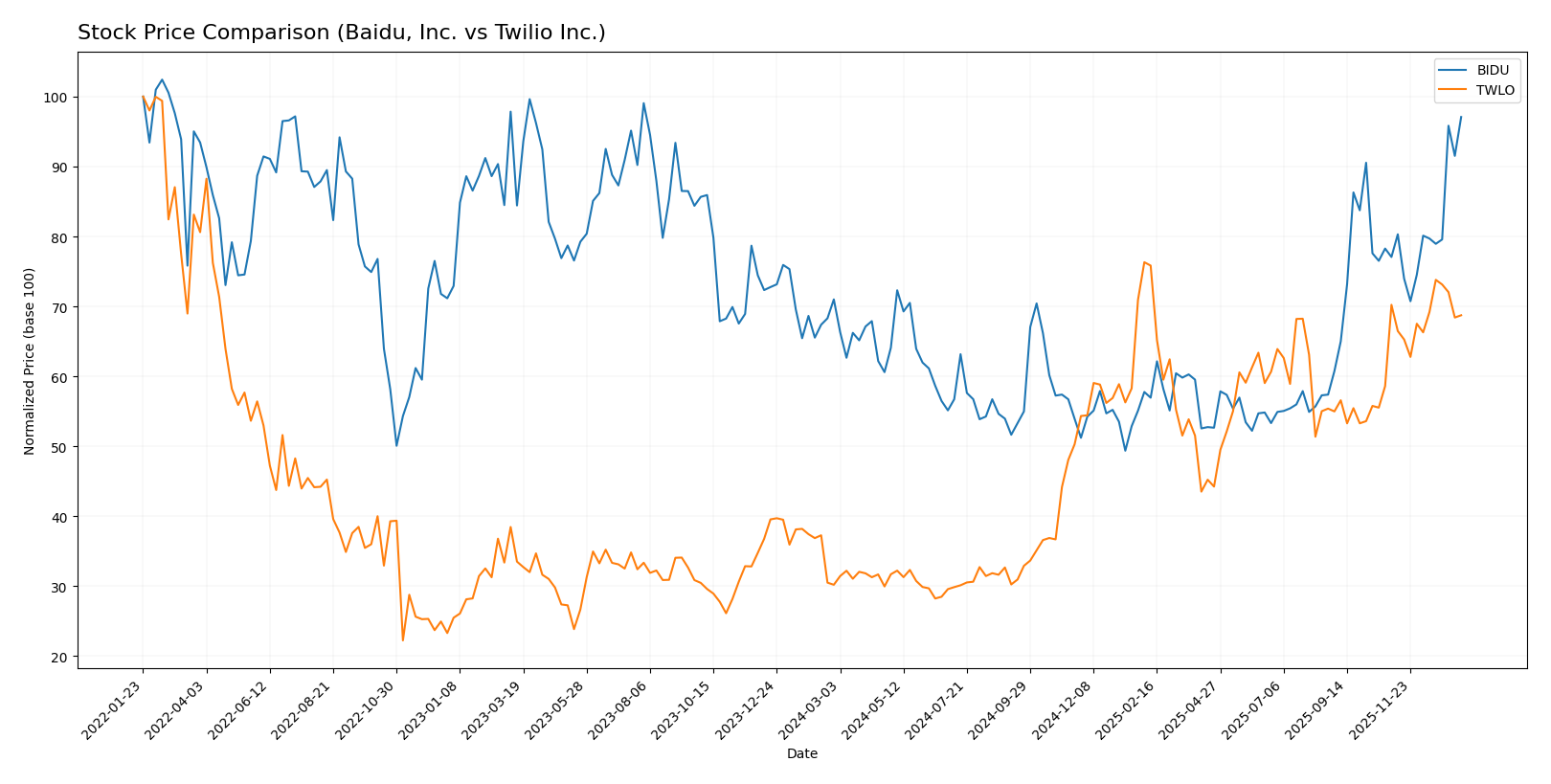
The stock prices of Baidu, Inc. and Twilio Inc. have shown marked bullish trends over the past 12 months, with Baidu accelerating steadily while Twilio experienced strong gains but with recent deceleration in momentum.
Trend Analysis
Baidu, Inc. (BIDU) exhibited a 36.73% price increase over the past year, indicating a bullish trend with accelerating momentum and a standard deviation of 16.69, reaching a high of 152.26 and a low of 77.43.
Twilio Inc. (TWLO) showed a 127.56% price increase over the same period, also bullish but with decelerating momentum and higher volatility at a 28.32 standard deviation, with prices ranging from 54.24 to 146.58.
Comparing both, Twilio delivered the highest market performance with a significantly larger percentage gain, despite recent slight price decline, while Baidu maintained steadier acceleration.
Target Prices
The current analyst target consensus indicates promising upside potential for these stocks.
| Company | Target High | Target Low | Consensus |
|---|---|---|---|
| Baidu, Inc. | 215 | 110 | 162.13 |
| Twilio Inc. | 170 | 100 | 145.91 |
Analysts expect Baidu’s stock to appreciate moderately above its current price of 152.26 USD, while Twilio’s consensus target price suggests a notable upside from the current 132.01 USD level.
Analyst Opinions Comparison
This section compares analysts’ ratings and financial grades for Baidu, Inc. and Twilio Inc.:
Rating Comparison
BIDU Rating
- Rating: B-, considered very favorable overall.
- Discounted Cash Flow Score: 3, moderate valuation based on future cash flows.
- ROE Score: 2, moderate efficiency in generating profit from equity.
- ROA Score: 3, moderate effectiveness using assets to generate earnings.
- Debt To Equity Score: 2, moderate financial risk with somewhat higher debt.
- Overall Score: 2, moderate financial standing.
TWLO Rating
- Rating: B-, considered very favorable overall.
- Discounted Cash Flow Score: 3, moderate valuation based on future cash flows.
- ROE Score: 2, moderate efficiency in generating profit from equity.
- ROA Score: 3, moderate effectiveness using assets to generate earnings.
- Debt To Equity Score: 3, moderate financial risk with lower debt levels.
- Overall Score: 2, moderate financial standing.
Which one is the best rated?
Both Baidu and Twilio share the same overall rating of B- and moderate scores in most financial metrics. Twilio shows a slightly stronger debt-to-equity score, indicating potentially lower financial risk compared to Baidu.
Scores Comparison
Here is a comparison of the Altman Z-Score and Piotroski Score for Baidu and Twilio:
BIDU Scores
- Altman Z-Score: 0.89, in distress zone signaling high bankruptcy risk.
- Piotroski Score: 3, classified as very weak financial health.
TWLO Scores
- Altman Z-Score: 6.62, in safe zone indicating low bankruptcy risk.
- Piotroski Score: 6, considered average financial strength.
Which company has the best scores?
Twilio has significantly better scores, with a safe zone Altman Z-Score and an average Piotroski Score, while Baidu shows distress and very weak financial health based on these metrics.
Grades Comparison
Here is a comparison of the latest reliable grades assigned to Baidu, Inc. and Twilio Inc.:
Baidu, Inc. Grades
The table below lists recent grades and actions from reputable grading companies for Baidu, Inc.:
| Grading Company | Action | New Grade | Date |
|---|---|---|---|
| Freedom Capital Markets | Maintain | Buy | 2026-01-07 |
| Jefferies | Maintain | Buy | 2026-01-02 |
| JP Morgan | Upgrade | Overweight | 2025-11-24 |
| Benchmark | Maintain | Buy | 2025-11-19 |
| B of A Securities | Maintain | Buy | 2025-11-19 |
| Morgan Stanley | Maintain | Equal Weight | 2025-11-19 |
| Barclays | Maintain | Equal Weight | 2025-11-19 |
| Goldman Sachs | Maintain | Buy | 2025-11-19 |
| Macquarie | Upgrade | Outperform | 2025-10-10 |
| DBS Bank | Upgrade | Buy | 2025-09-25 |
Overall, Baidu’s grades show a strong buy consensus with several upgrades, indicating positive analyst sentiment and stable outlook.
Twilio Inc. Grades
The table below lists recent grades and actions from reputable grading companies for Twilio Inc.:
| Grading Company | Action | New Grade | Date |
|---|---|---|---|
| Rosenblatt | Maintain | Buy | 2026-01-07 |
| RBC Capital | Maintain | Underperform | 2026-01-05 |
| Piper Sandler | Downgrade | Neutral | 2026-01-05 |
| Citizens | Maintain | Market Outperform | 2025-12-30 |
| Wells Fargo | Maintain | Overweight | 2025-10-31 |
| Piper Sandler | Maintain | Overweight | 2025-10-31 |
| Needham | Maintain | Buy | 2025-10-31 |
| B of A Securities | Maintain | Underperform | 2025-10-31 |
| Mizuho | Maintain | Outperform | 2025-10-31 |
| TD Cowen | Maintain | Hold | 2025-10-31 |
Twilio’s grades present a mixed trend with both buy and underperform ratings, reflecting a more cautious or uncertain analyst consensus.
Which company has the best grades?
Baidu, Inc. has received more consistent and predominantly positive grades, including multiple buy and outperform ratings, signaling stronger analyst confidence. Twilio Inc. shows a varied grading pattern with some downgrades and underperform ratings, suggesting higher uncertainty for investors. This disparity may impact investor perception of risk and potential return.
Strengths and Weaknesses
Below is a comparison table highlighting the key strengths and weaknesses of Baidu, Inc. (BIDU) and Twilio Inc. (TWLO) based on the most recent financial and operational data.
| Criterion | Baidu, Inc. (BIDU) | Twilio Inc. (TWLO) |
|---|---|---|
| Diversification | Moderate: Strong in online marketing services and other products, but mainly focused on China market | Limited: Primarily focused on communications segment globally |
| Profitability | Favorable net margin (17.85%) but moderate ROE (9.01%) and ROIC (4.87%) | Negative net margin (-2.45%), ROE (-1.38%), and ROIC (-0.45%) |
| Innovation | Growing ROIC trend indicates improving efficiency and potential for innovation | High ROIC growth trend but still negative profitability, indicating potential but current challenges |
| Global presence | Strong presence in China with growing international efforts | Global presence in cloud communications but higher operational risks |
| Market Share | Leading position in Chinese online marketing and search services | Significant in cloud communications but facing strong competition |
Key takeaways: Baidu shows solid profitability with a slightly favorable economic moat and a strong foothold in its core market, though diversification is moderate. Twilio, despite negative profitability, demonstrates high ROIC growth, reflecting potential innovation and market expansion but carries higher risk. Investors should weigh Baidu’s steady value creation against Twilio’s growth potential and current value destruction.
Risk Analysis
Below is a comparison of key risk factors for Baidu, Inc. and Twilio Inc. based on their latest financial and market data in 2026.
| Metric | Baidu, Inc. (BIDU) | Twilio Inc. (TWLO) |
|---|---|---|
| Market Risk | Low beta (0.29) indicates lower volatility. | Higher beta (1.31) suggests greater market sensitivity. |
| Debt level | Moderate debt-to-assets (18.54%), low debt/equity (0.3). | Low debt-to-assets (11.25%), very low debt/equity (0.14). |
| Regulatory Risk | High, due to operating primarily in China with strict internet and AI regulations. | Moderate, mainly US and international regulations on data privacy. |
| Operational Risk | Large workforce (35.9K), complexity in AI and content platforms. | Smaller scale (5.5K employees), reliant on cloud infrastructure stability. |
| Environmental Risk | Moderate, with growing pressure on tech companies in China for sustainability. | Moderate, with increasing scrutiny on data centers’ energy use. |
| Geopolitical Risk | High, exposed to US-China tensions impacting tech sector. | Moderate, US-based but with international exposure. |
The most impactful risks include Baidu’s geopolitical and regulatory exposure in China, which could affect its operations and valuation significantly. Twilio presents higher market volatility risk but benefits from a safer financial structure. Baidu’s Altman Z-score signals financial distress, indicating caution, whereas Twilio remains in a safe zone. Investors should weigh regulatory and geopolitical risks carefully when considering Baidu.
Which Stock to Choose?
Baidu, Inc. (BIDU) shows a favorable income statement with a net margin of 17.85% and a bullish stock trend. Its financial ratios are globally favorable at 71.43%, supported by low debt levels and strong interest coverage, though ROE and ROIC remain slightly unfavorable. The company’s moat evaluation is slightly favorable, reflecting growing ROIC but still shedding value. Its Altman Z-score signals distress, and Piotroski score is very weak.
Twilio Inc. (TWLO) has a favorable income trend overall, with strong revenue and net income growth but a negative net margin of -2.45%. Financial ratios are slightly unfavorable at 35.71% favorable, with low debt but weak profitability and interest coverage. The company’s moat rating is slightly unfavorable due to value destruction despite improving ROIC. TWLO’s Altman Z-score is in the safe zone and Piotroski score is average. The stock trend is bullish but with recent deceleration.
For investors prioritizing stability and a stronger financial foundation, Baidu’s favorable income and financial ratios with improving profitability might appear more suitable. Conversely, those focused on growth potential could see Twilio’s rapid revenue and net income expansion, despite weaker profitability, as signaling future opportunities. The choice could depend on the investor’s risk tolerance and strategic focus.
Disclaimer: Investment carries a risk of loss of initial capital. The past performance is not a reliable indicator of future results. Be sure to understand risks before making an investment decision.
Go Further
I encourage you to read the complete analyses of Baidu, Inc. and Twilio Inc. to enhance your investment decisions: