Home > Comparison > Real Estate > AVB vs CPT
The strategic rivalry between AvalonBay Communities, Inc. and Camden Property Trust shapes the competitive landscape of the residential REIT sector. AvalonBay operates a vast, capital-intensive portfolio across leading metropolitan markets, while Camden focuses on a more concentrated yet highly managed multifamily property base. This head-to-head reflects a contest between scale-driven growth and operational efficiency. This analysis will identify which model delivers superior risk-adjusted returns for diversified real estate investors.

Table of contents
Companies Overview
AvalonBay Communities and Camden Property Trust stand as key players in the residential REIT market, shaping urban living across the US.
AvalonBay Communities, Inc.: Leading Metropolitan Apartment REIT
AvalonBay Communities dominates the residential REIT sector with a portfolio of 291 apartment communities totaling 86K homes. Its core revenue engine stems from developing, acquiring, and managing properties in premium metro areas like New England and California. In 2026, AvalonBay focuses on expanding in Southeast Florida and Denver, targeting high-growth urban markets.
Camden Property Trust: Multifamily Specialist with Growth Focus
Camden Property Trust operates 167 multifamily apartment communities comprising 57K homes. Its revenue derives from ownership, development, and management of these properties nationwide. Camden’s 2026 strategy centers on completing 7 projects under development, growing its portfolio to 174 properties, while maintaining a strong emphasis on workplace culture and tenant satisfaction.
Strategic Collision: Similarities & Divergences
Both companies pursue growth through property development and management in residential real estate, but AvalonBay targets established metros while Camden emphasizes portfolio expansion nationwide. Their competitive battleground lies in attracting tenants in high-demand urban and suburban areas. AvalonBay’s scale and metro focus contrast with Camden’s development-driven growth, creating distinct risk and return profiles for investors.
Income Statement Comparison
This data dissects the core profitability and scalability of both corporate engines to reveal who dominates the bottom line:
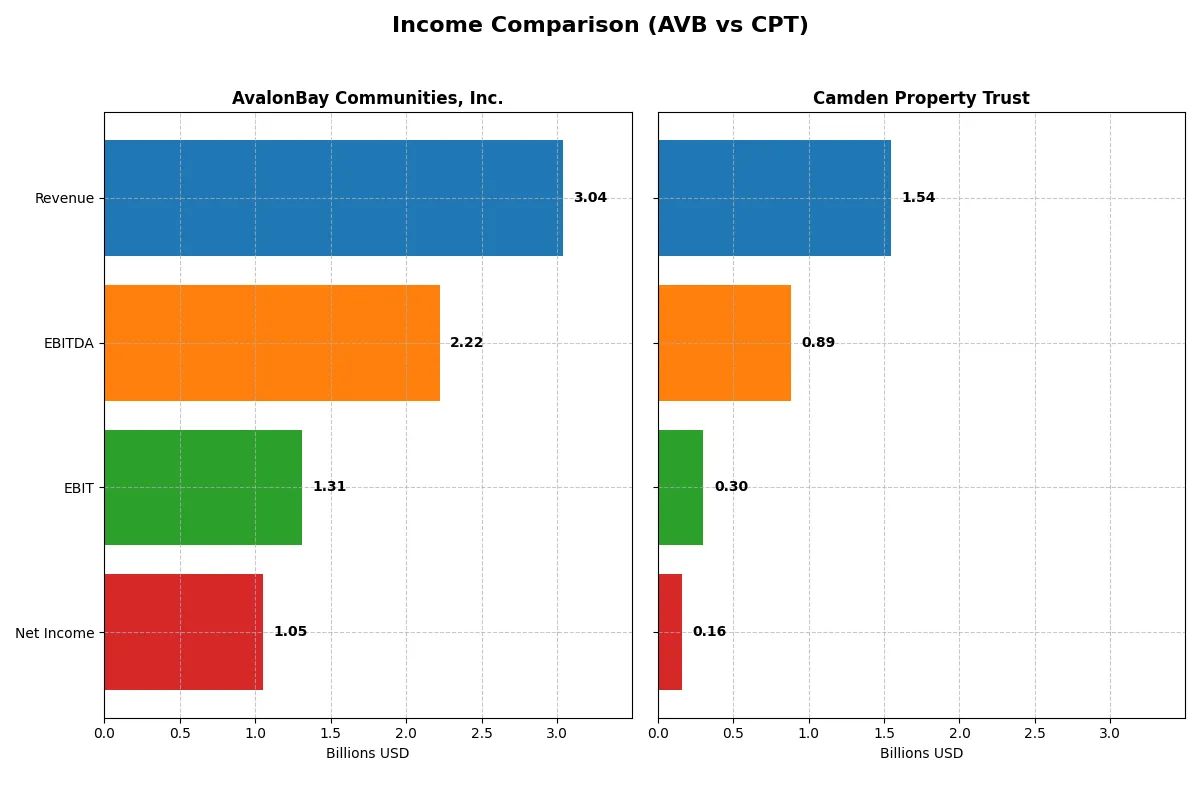
| Metric | AvalonBay Communities, Inc. (AVB) | Camden Property Trust (CPT) |
|---|---|---|
| Revenue | 3.04B | 1.54B |
| Cost of Revenue | 1.00B | 599M |
| Operating Expenses | 889M | 647M |
| Gross Profit | 2.04B | 945M |
| EBITDA | 2.22B | 886M |
| EBIT | 1.31B | 304M |
| Interest Expense | 259M | 130M |
| Net Income | 1.05B | 163M |
| EPS | 7.4 | 1.5 |
| Fiscal Year | 2025 | 2024 |
Income Statement Analysis: The Bottom-Line Duel
This income statement comparison exposes which company runs its financial engine with superior efficiency and sustainable profitability.
AvalonBay Communities, Inc. Analysis
AvalonBay’s revenue climbed steadily, reaching $3.04B in 2025, with net income of $1.05B. Its gross margin holds strong at 67%, reflecting tight cost controls. Despite a slight dip in EBIT and net margin growth last year, the company maintains a favorable 34.6% net margin, signifying robust operational momentum and efficient expense management.
Camden Property Trust Analysis
Camden’s revenue showed marginal growth, hitting $1.54B in 2024, with net income at $163M. The gross margin remains solid at 61%, but EBIT and net margin contracted sharply last year. Despite a favorable long-term revenue and net income growth, recent margin declines highlight efficiency challenges and shrinking profitability that temper its overall financial health.
Margin Strength vs. Growth Trajectory
AvalonBay outperforms with superior margins and consistent profitability, demonstrating its ability to convert revenue into earnings efficiently. Camden shows stronger revenue growth over several years but struggles with margin compression and earnings volatility. For investors prioritizing robust margin profiles and stable profits, AvalonBay’s financial discipline presents a more attractive profile.
Financial Ratios Comparison
These vital ratios act as a diagnostic tool to expose the underlying fiscal health, valuation premiums, and capital efficiency of the companies compared below:
| Ratios | AvalonBay Communities, Inc. (AVB) | Camden Property Trust (CPT) |
|---|---|---|
| ROE | 9.1% | 3.5% |
| ROIC | 4.5% | 3.5% |
| P/E | 28.9 | 77.1 |
| P/B | 2.62 | 2.69 |
| Current Ratio | 0.36 | 0.10 |
| Quick Ratio | 0.36 | 0.10 |
| D/E | 0.69 | 0.75 |
| Debt-to-Assets | 39.3% | 39.4% |
| Interest Coverage | 4.04 | 2.29 |
| Asset Turnover | 0.14 | 0.17 |
| Fixed Asset Turnover | 18.8 | 0.00 |
| Payout ratio | 89% | 276% |
| Dividend yield | 3.1% | 3.6% |
| Fiscal Year | 2024 | 2024 |
Efficiency & Valuation Duel: The Vital Signs
Financial ratios act as a company’s DNA, revealing hidden risks, operational strengths, and valuation accuracy critical to investment decisions.
AvalonBay Communities, Inc.
AvalonBay posts a moderate ROE of 9.06%, reflecting modest profitability, but its net margin is strong at 37.13%. The stock trades at a stretched P/E of 28.87, signaling premium valuation. Dividend yield at 3.08% supports steady shareholder returns, balancing reinvestment with income distribution.
Camden Property Trust
Camden Property shows weaker profitability with a 3.49% ROE and a slim 10.58% net margin. Its P/E of 77.1 marks the stock as highly expensive. Despite unfavorable returns, the firm maintains a slightly higher dividend yield of 3.58%, offering modest income amid growth challenges.
Premium Valuation vs. Operational Safety
AvalonBay balances elevated valuation with stronger margins and a solid dividend, suggesting operational resilience despite premium pricing. Camden trades at a much higher P/E, reflecting growth expectations but with weaker profitability. Investors seeking income and relative safety may prefer AvalonBay’s profile, while risk-tolerant investors might consider Camden’s growth gamble.
Which one offers the Superior Shareholder Reward?
AvalonBay Communities (AVB) delivers a 3.08% dividend yield with a high payout ratio near 89%, supported by strong free cash flow coverage (~88%). Its steady buyback program enhances shareholder returns sustainably. Camden Property Trust (CPT) yields slightly higher at 3.58%, but with payout ratios exceeding 100% and free cash flow coverage below 50%, signaling riskier dividends. CPT’s buybacks are modest and less consistent. I see AVB’s disciplined distribution and robust cash flow as the more sustainable model, offering superior total return potential in 2026.
Comparative Score Analysis: The Strategic Profile
The radar chart reveals the fundamental DNA and trade-offs of AvalonBay Communities, Inc. and Camden Property Trust, highlighting their financial strengths and valuation challenges:
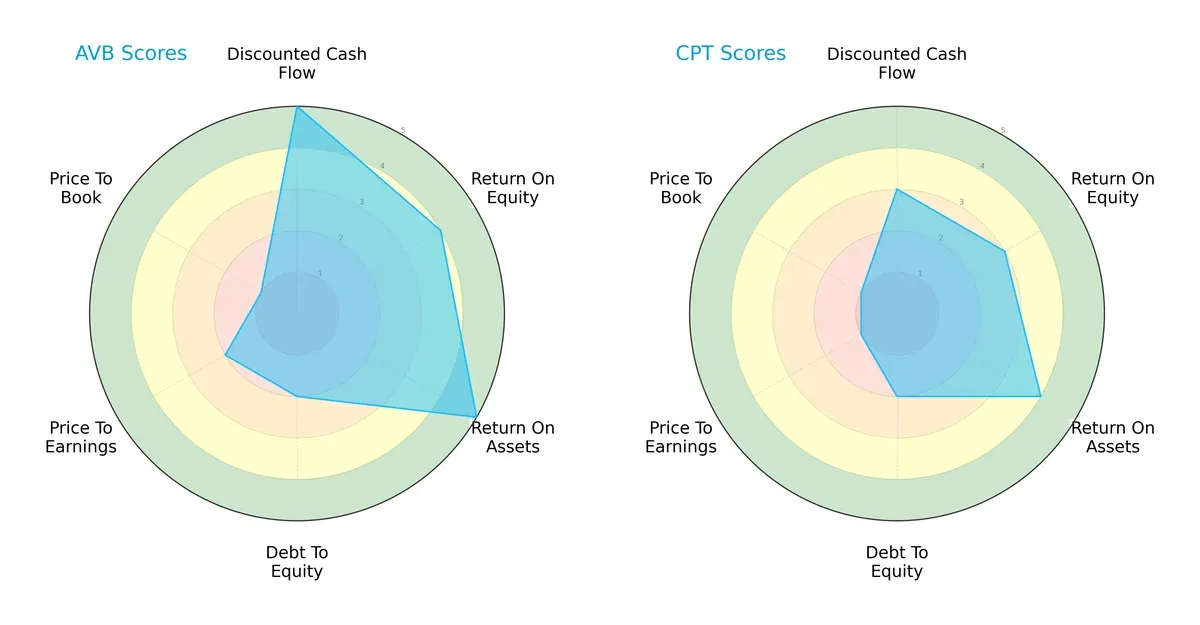
AvalonBay shows a more balanced profile with strong DCF (5) and ROA (5) scores, indicating efficient asset use and cash flow generation. Camden lags with moderate DCF (3) and ROE (3) but edges in ROA (4). Both face valuation headwinds with low P/E and P/B scores, but AvalonBay’s slightly better debt management and equity returns give it a clearer strategic advantage.
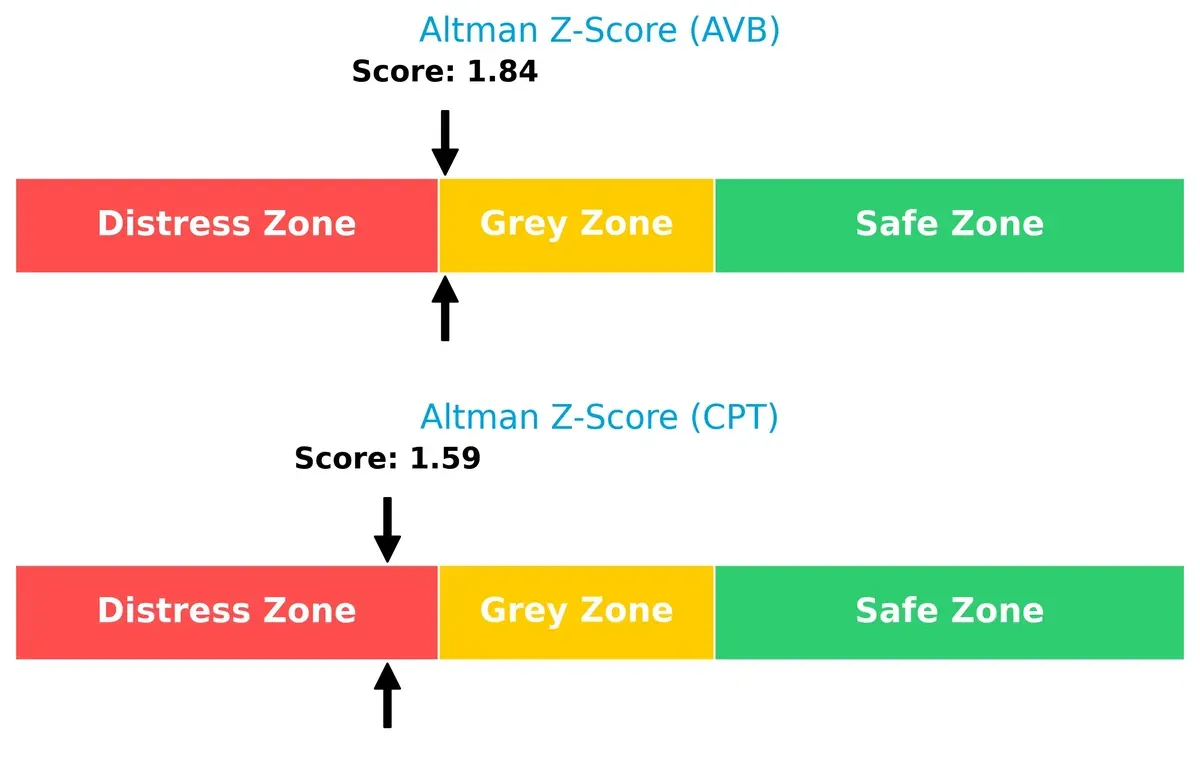
Bankruptcy Risk: Solvency Showdown
AvalonBay’s Altman Z-Score of 1.84 places it in the grey zone, signaling moderate bankruptcy risk, while Camden’s 1.59 falls into the distress zone, suggesting higher vulnerability. This gap warns that AvalonBay currently holds a comparatively safer financial position:
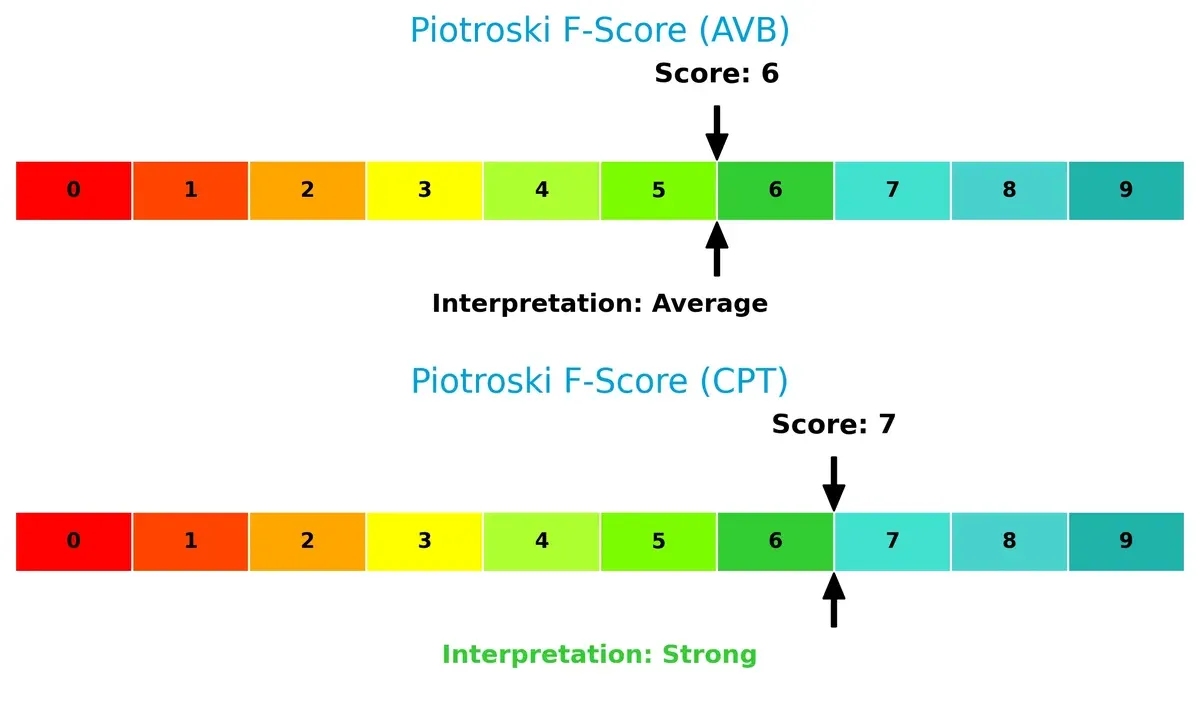
Financial Health: Quality of Operations
Camden’s Piotroski F-Score of 7 reflects stronger internal financial health than AvalonBay’s 6, indicating Camden’s operational metrics and profitability factors are currently more robust. AvalonBay’s slightly lower score flags caution in its internal financial strength:
How are the two companies positioned?
This section dissects AVB and CPT’s operational DNA through revenue segmentation and internal strengths and weaknesses. The goal is to confront their economic moats to determine which model delivers a more resilient, sustainable advantage today.
Revenue Segmentation: The Strategic Mix
This visual comparison dissects how AvalonBay Communities, Inc. and Camden Property Trust diversify their income streams and where their primary sector bets lie:
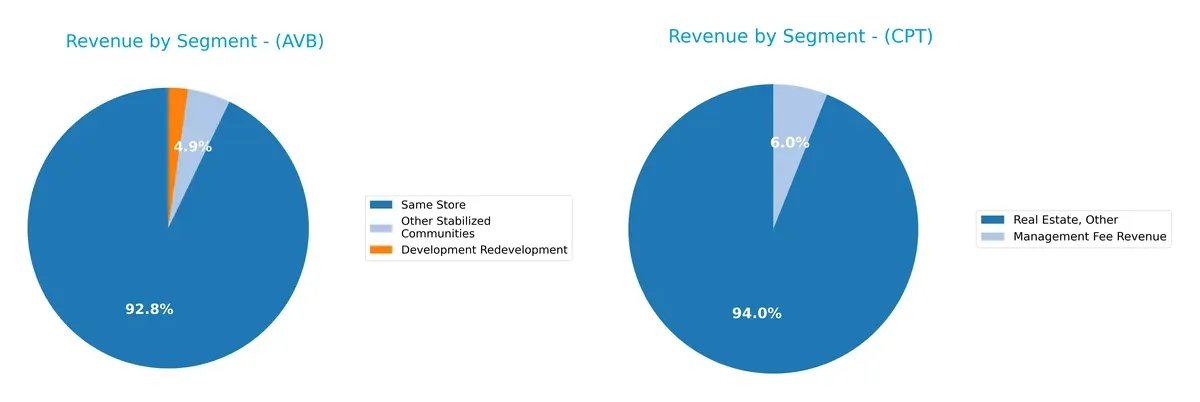
AvalonBay anchors revenue in “Same Store” properties with $2.54B in 2023, dwarfing its smaller “Development Redevelopment” ($62M) and “Other Stabilized Communities” ($135M). Camden Property Trust, by contrast, shows a narrow focus with $112M in “Real Estate, Other” and $7M from “Management Fee Revenue.” AvalonBay’s diversified mix mitigates concentration risk, while Camden’s reliance signals potential vulnerability to shifts in its limited segment.
Strengths and Weaknesses Comparison
This table compares the Strengths and Weaknesses of AvalonBay Communities, Inc. (AVB) and Camden Property Trust (CPT):
AVB Strengths
- Strong net margin at 37.13%
- Favorable WACC at 6.4%
- High interest coverage of 5.05
- Favorable fixed asset turnover of 18.84
- Dividend yield of 3.08% supports income focus
CPT Strengths
- Positive net margin of 10.58%
- Favorable WACC at 6.8%
- Dividend yield of 3.58%
- Neutral debt to assets at 39.38%
- Asset turnover slightly higher than AVB at 0.17
AVB Weaknesses
- Low current and quick ratios at 0.36 indicate liquidity concerns
- Unfavorable ROE (9.06%) and ROIC (4.52%) below WACC
- High P/E ratio of 28.87 signals valuation risk
- Low asset turnover at 0.14 limits efficiency
CPT Weaknesses
- Very low current and quick ratios at 0.1 raise short-term risk
- ROE (3.49%) and ROIC (3.46%) below cost of capital
- High P/E ratio of 77.1 suggests overvaluation
- Interest coverage of 2.34 is less comfortable
- Fixed asset turnover is zero, indicating inefficiency
Both companies show slightly unfavorable overall financial ratios with liquidity and return on capital as common weaknesses. AVB’s higher profitability and asset efficiency contrast with CPT’s more challenged operational metrics. These factors likely shape each company’s strategic emphasis on capital allocation and risk management.
The Moat Duel: Analyzing Competitive Defensibility
A structural moat is the only reliable shield protecting long-term profits from relentless competitive pressures in any industry:
AvalonBay Communities, Inc.: Location and Scale Moat
AvalonBay’s advantage lies in prime urban locations and scale economies. Its steady gross margins near 67% reflect pricing power. Expansion into Southeast Florida and Denver may deepen its foothold in 2026.
Camden Property Trust: Talent and Operational Efficiency Moat
Camden’s moat stems from operational excellence and a strong employer brand, driving tenant retention. Despite lower margins, its disciplined cost management supports growth opportunities in multifamily developments nationwide.
Location Dominance vs. Operational Excellence
AvalonBay’s scale and location offer a wider moat than Camden’s operational edge. AvalonBay better defends market share through superior pricing power and geographic reach, positioning it more favorably for future competition.
Which stock offers better returns?
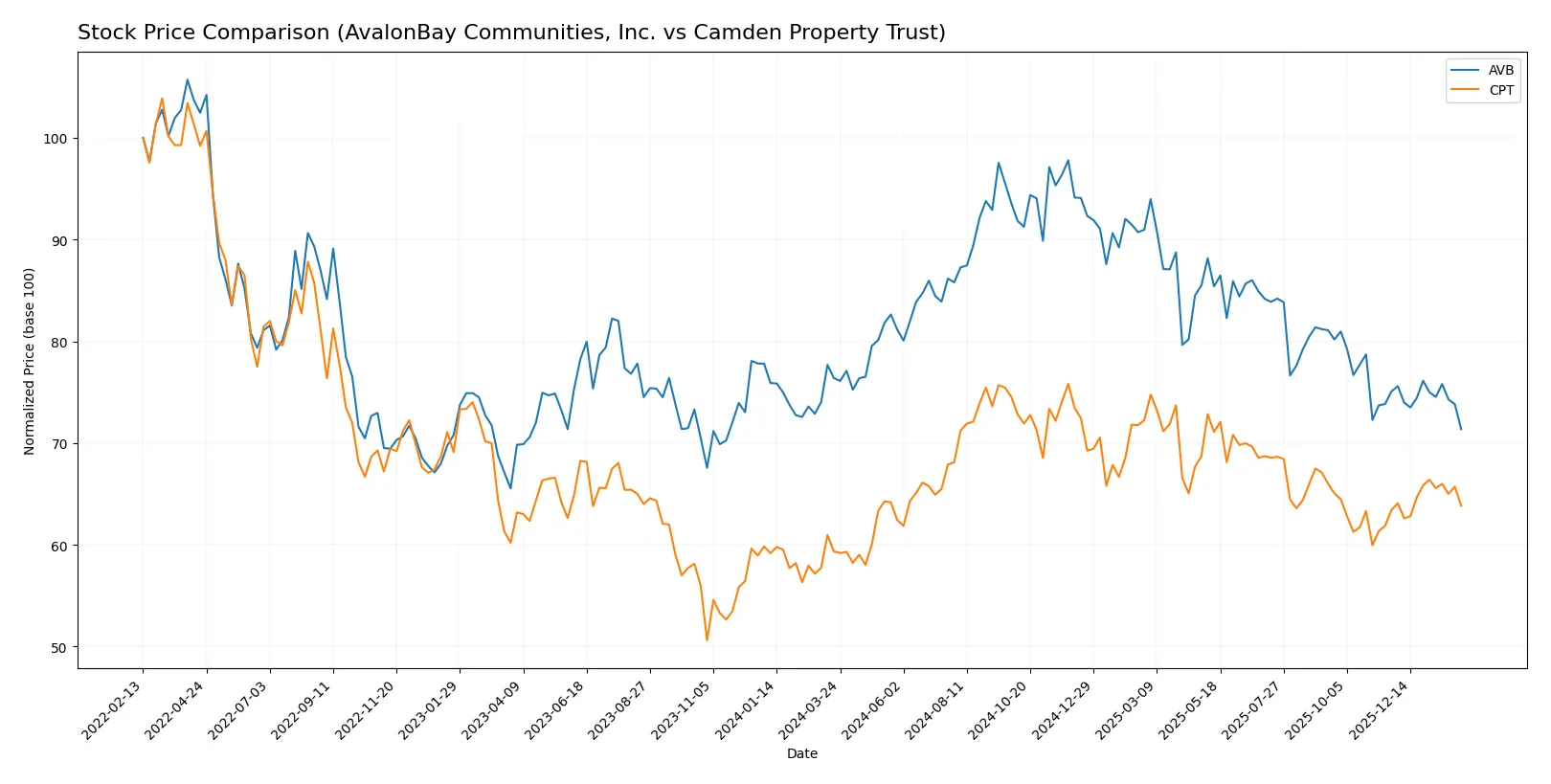
The past year reveals contrasting stock price dynamics: AvalonBay Communities, Inc. declined steadily, while Camden Property Trust gained momentum with accelerating upward trends.
Trend Comparison
AvalonBay Communities, Inc. experienced a 6.57% price decline over the past 12 months, signaling a bearish trend with deceleration. The stock ranged between 171.75 and 235.35, showing high volatility (16.79% std deviation).
Camden Property Trust delivered a 7.55% price increase over the same period, reflecting a bullish trend with acceleration. The price fluctuated from 96.29 to 125.8, with moderate volatility (7.57% std deviation).
Camden Property Trust outperformed AvalonBay Communities, Inc., posting a positive return while AvalonBay declined, indicating stronger market performance in the last year.
Target Prices
Analysts present a cautiously optimistic consensus on AvalonBay Communities, Inc. and Camden Property Trust.
| Company | Target Low | Target High | Consensus |
|---|---|---|---|
| AvalonBay Communities, Inc. | 172 | 217 | 193.9 |
| Camden Property Trust | 105 | 133 | 114.34 |
AvalonBay’s consensus target of $193.9 exceeds its current $171.58 share price, signaling upside potential. Camden’s $114.34 target also surpasses its $105.62 price, reflecting moderate growth expectations.

Don’t Let Luck Decide Your Entry Point
Optimize your entry points with our advanced ProRealTime indicators. You’ll get efficient buy signals with precise price targets for maximum performance. Start outperforming now!
How do institutions grade them?
AvalonBay Communities, Inc. Grades
The following table summarizes recent grades from reputable financial institutions for AvalonBay Communities, Inc.:
| Grading Company | Action | New Grade | Date |
|---|---|---|---|
| Truist Securities | Maintain | Buy | 2026-01-20 |
| Barclays | Maintain | Overweight | 2026-01-13 |
| UBS | Maintain | Neutral | 2026-01-08 |
| Colliers Securities | Downgrade | Neutral | 2025-12-04 |
| Truist Securities | Maintain | Buy | 2025-12-02 |
| Barclays | Upgrade | Overweight | 2025-11-25 |
| Mizuho | Maintain | Neutral | 2025-11-24 |
| Morgan Stanley | Maintain | Overweight | 2025-11-13 |
| UBS | Maintain | Neutral | 2025-11-10 |
| Wells Fargo | Maintain | Overweight | 2025-11-10 |
Camden Property Trust Grades
The following table summarizes recent grades from reputable financial institutions for Camden Property Trust:
| Grading Company | Action | New Grade | Date |
|---|---|---|---|
| Truist Securities | Maintain | Buy | 2026-01-20 |
| Barclays | Maintain | Equal Weight | 2026-01-13 |
| Mizuho | Maintain | Outperform | 2026-01-12 |
| UBS | Maintain | Neutral | 2026-01-08 |
| JP Morgan | Upgrade | Neutral | 2025-12-18 |
| Truist Securities | Maintain | Buy | 2025-12-15 |
| Wells Fargo | Maintain | Equal Weight | 2025-11-25 |
| Barclays | Downgrade | Equal Weight | 2025-11-25 |
| Mizuho | Maintain | Outperform | 2025-11-24 |
| Morgan Stanley | Maintain | Equal Weight | 2025-11-13 |
Which company has the best grades?
AvalonBay Communities, Inc. holds generally stronger grades, frequently rated as Buy or Overweight. Camden Property Trust mostly receives Neutral to Equal Weight ratings, with occasional Outperform. Investors may view AvalonBay’s higher grades as a sign of greater confidence from institutions.
Risks specific to each company
The following categories identify the critical pressure points and systemic threats facing both firms in the 2026 market environment:
1. Market & Competition
AvalonBay Communities, Inc.
- Larger portfolio with 86K homes supports scale advantages in competitive metro areas.
Camden Property Trust
- Smaller footprint with 57K homes limits market reach but allows focused management.
2. Capital Structure & Debt
AvalonBay Communities, Inc.
- Debt-to-assets at 39%, interest coverage solid at 5.05x, signaling manageable leverage.
Camden Property Trust
- Similar debt level but weaker interest coverage of 2.34x raises refinancing and servicing risks.
3. Stock Volatility
AvalonBay Communities, Inc.
- Beta of 0.75 indicates lower volatility, appealing for risk-averse investors.
Camden Property Trust
- Beta of 0.83 suggests moderately higher price swings, increasing risk exposure.
4. Regulatory & Legal
AvalonBay Communities, Inc.
- Exposure to strict metropolitan housing regulations, especially in California and Northeast.
Camden Property Trust
- Faces regulatory risks mainly in Texas and southeastern U.S., with some variation in local policies.
5. Supply Chain & Operations
AvalonBay Communities, Inc.
- Larger scale with 18 developments under way may strain construction supply chains.
Camden Property Trust
- Smaller development pipeline reduces scale but may ease operational bottlenecks.
6. ESG & Climate Transition
AvalonBay Communities, Inc.
- Active in coastal markets vulnerable to climate risks, requiring costly adaptation.
Camden Property Trust
- Less exposure to climate-prone regions but faces increasing ESG compliance costs.
7. Geopolitical Exposure
AvalonBay Communities, Inc.
- Primarily U.S.-based with no significant international geopolitical risks.
Camden Property Trust
- Similar domestic focus with limited direct geopolitical impact.
Which company shows a better risk-adjusted profile?
AvalonBay’s strongest risk is operational strain from its large development pipeline and coastal climate exposure. Camden’s primary risk is weaker interest coverage raising financial vulnerability. AvalonBay’s lower stock volatility and stronger debt servicing provide a better risk-adjusted profile. Its Altman Z-score in the grey zone contrasts with Camden’s distress zone, underscoring relatively higher financial stability.
Final Verdict: Which stock to choose?
AvalonBay Communities, Inc. (AVB) excels through its operational efficiency and steady cash generation, which have supported a growing return on capital despite value erosion. Its low liquidity ratios represent a point of vigilance, signaling potential short-term funding constraints. AVB suits investors targeting aggressive growth with a tolerance for cyclical risks.
Camden Property Trust (CPT) benefits from a strategic moat rooted in its resilient recurring revenue streams and disciplined asset management. Compared to AVB, CPT offers a safer profile with a stronger Piotroski score but faces challenges in profitability margins and near-term valuation pressures. It fits portfolios focused on growth at a reasonable price (GARP) with moderate risk appetite.
If you prioritize operational efficiency and cash flow growth, AVB is the compelling choice due to its improving profitability and robust free cash flow generation. However, if you seek better stability and a stronger financial health signal, CPT offers superior defensive qualities and a bullish price trajectory despite margin headwinds. Both stocks carry risks linked to capital structure and market volatility, demanding cautious position sizing.
Disclaimer: Investment carries a risk of loss of initial capital. The past performance is not a reliable indicator of future results. Be sure to understand risks before making an investment decision.
Go Further
I encourage you to read the complete analyses of AvalonBay Communities, Inc. and Camden Property Trust to enhance your investment decisions: