Home > Comparison > Industrials > ADP vs WDAY
The strategic rivalry between Automatic Data Processing, Inc. (ADP) and Workday, Inc. (WDAY) shapes the future of human capital management technology. ADP operates as a capital-intensive industrial leader in staffing and employment services, while Workday excels as a high-margin software application provider in enterprise cloud solutions. This head-to-head reflects a battle between established scale and innovative agility. This analysis identifies which company offers a superior risk-adjusted return for diversified portfolios.
Table of contents
Companies Overview
Automatic Data Processing, Inc. and Workday, Inc. are pivotal players in the evolving human capital management landscape.
Automatic Data Processing, Inc.: Veteran in Human Capital Management Solutions
Automatic Data Processing, Inc. dominates the staffing and employment services sector with cloud-based HR solutions. Its core revenue derives from Employer Services and Professional Employer Organization segments. In 2026, it focuses on expanding comprehensive outsourcing and compliance services, leveraging a proven co-employment model that serves small and mid-sized businesses globally.
Workday, Inc.: Innovator in Enterprise Cloud Applications
Workday, Inc. stands out in the software application industry by offering integrated cloud suites for financial and human capital management. Its revenue engine hinges on delivering advanced analytics, machine learning, and planning tools across industries. In 2026, Workday prioritizes enhancing augmented analytics and cloud spend management to deepen operational insights and automate business processes.
Strategic Collision: Similarities & Divergences
Both companies emphasize cloud-based human capital management but diverge in approach: ADP relies on a service-heavy outsourcing model, while Workday pushes a technology-driven, analytics-first platform. They compete primarily in HR management solutions targeting mid-to-large enterprises. ADP’s scale and legacy contrast with Workday’s innovation and agility, creating distinct investment profiles rooted in stability versus growth potential.
Income Statement Comparison
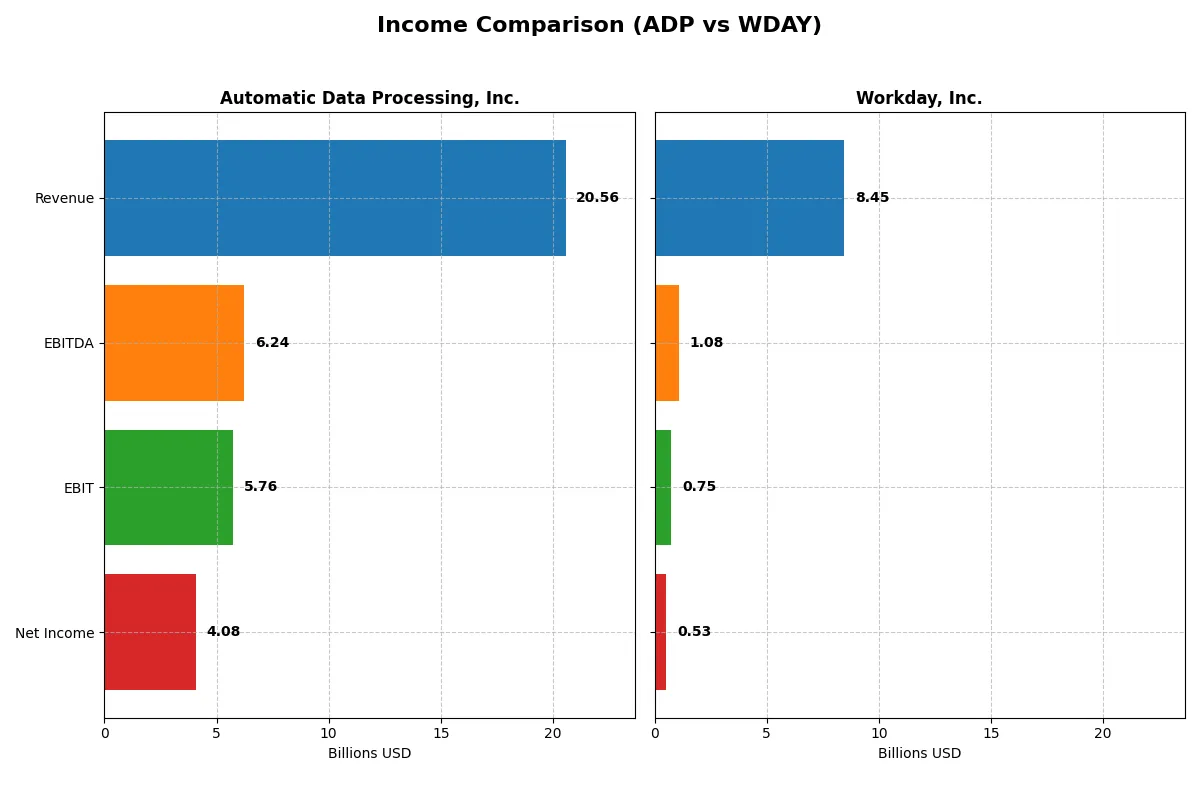
This data dissects the core profitability and scalability of both corporate engines to reveal who dominates the bottom line:
| Metric | Automatic Data Processing, Inc. (ADP) | Workday, Inc. (WDAY) |
|---|---|---|
| Revenue | 20.6B | 8.4B |
| Cost of Revenue | 10.1B | 2.1B |
| Operating Expenses | 5.0B | 6.0B |
| Gross Profit | 10.5B | 6.4B |
| EBITDA | 6.2B | 1.1B |
| EBIT | 5.8B | 752M |
| Interest Expense | 456M | 114M |
| Net Income | 4.1B | 526M |
| EPS | 10.02 | 1.98 |
| Fiscal Year | 2025 | 2025 |
Income Statement Analysis: The Bottom-Line Duel
This income statement comparison uncovers which company runs its business engine with superior efficiency and sustainable profit growth.
Automatic Data Processing, Inc. Analysis
ADP’s revenue climbs steadily from 15B in 2021 to 20.6B in 2025, with net income rising from 2.6B to 4.1B. Its gross margin stays robust near 51%, while the net margin approaches 20%, signaling solid profitability. In 2025, ADP maintains strong operating leverage, growing EBIT by nearly 10%, showing consistent momentum and disciplined cost control.
Workday, Inc. Analysis
Workday’s revenue nearly doubles from 4.3B in 2021 to 8.4B in 2025, reflecting rapid expansion. Gross margin impresses at 75.5%, but net margin remains slim at 6.2%, highlighting high operating expenses. Despite a 60% EBIT surge in 2025, net income and EPS decline sharply, pointing to volatility and challenges in converting growth into sustainable bottom-line profits.
Margin Strength vs. Growth Velocity
ADP delivers consistent margin strength and steady profit improvements, while Workday exhibits explosive top-line growth but struggles with profitability. ADP’s mature model offers reliable earnings expansion, making it a fundamentally stronger performer. Investors focused on stable profitability may find ADP’s profile more attractive than Workday’s high-growth, high-risk approach.
Financial Ratios Comparison
These vital ratios act as a diagnostic tool to expose the underlying fiscal health, valuation premiums, and capital efficiency of the companies compared below:
| Ratios | Automatic Data Processing, Inc. (ADP) | Workday, Inc. (WDAY) |
|---|---|---|
| ROE | 66.0% | 5.8% |
| ROIC | 24.7% | 2.7% |
| P/E | 30.8 | 132.2 |
| P/B | 20.3 | 7.7 |
| Current Ratio | 1.05 | 1.85 |
| Quick Ratio | 1.05 | 1.85 |
| D/E (Debt-to-Equity) | 1.46 | 0.37 |
| Debt-to-Assets | 17.0% | 18.7% |
| Interest Coverage | 11.9 | 3.6 |
| Asset Turnover | 0.39 | 0.47 |
| Fixed Asset Turnover | 20.0 | 5.4 |
| Payout ratio | 58.8% | 0% |
| Dividend yield | 1.91% | 0% |
| Fiscal Year | 2025 | 2025 |
Efficiency & Valuation Duel: The Vital Signs
Financial ratios act as a company’s DNA, uncovering hidden operational strengths and risks that raw numbers alone cannot reveal.
Automatic Data Processing, Inc.
ADP exhibits strong profitability with a 65.93% ROE and a solid 19.84% net margin, signaling operational excellence. The stock trades at a stretched P/E of 30.77, above sector averages, indicating high valuation. Shareholders benefit from a 1.91% dividend yield, reflecting consistent returns amid disciplined reinvestment in R&D and growth.
Workday, Inc.
Workday shows modest profitability with a 5.82% ROE and a 6.23% net margin, pointing to operational challenges. Its valuation is expensive, with a P/E soaring to 132.15, pushing risk higher. The company pays no dividend, instead heavily reinvesting in R&D, underscored by high SG&A and stock-based compensation ratios, aiming for long-term growth.
Premium Valuation vs. Operational Safety
ADP offers a favorable ratio profile with superior profitability and balanced shareholder returns, despite a stretched valuation. Workday’s expensive multiples and weaker returns highlight higher risk. Investors seeking stability and operational strength may prefer ADP, while those targeting growth at a premium must weigh Workday’s risks carefully.
Which one offers the Superior Shareholder Reward?
I see ADP balances dividends and buybacks well, offering a 2.26% dividend yield with a 58% payout ratio, sustainably covered by free cash flow. ADP’s steady buyback programs add total return. Workday pays no dividends but reinvests heavily in growth, indicated by zero payout and robust free cash flow reinvestment. However, WDAY’s buybacks are minimal, and its sky-high P/E of 132 signals rich valuation risk. For 2026, I favor ADP’s disciplined distribution and buybacks, which promise a more reliable total return than Workday’s growth-heavy, dividend-free model.
Comparative Score Analysis: The Strategic Profile
The radar chart reveals the fundamental DNA and trade-offs of both firms, highlighting their core financial strengths and valuation challenges:
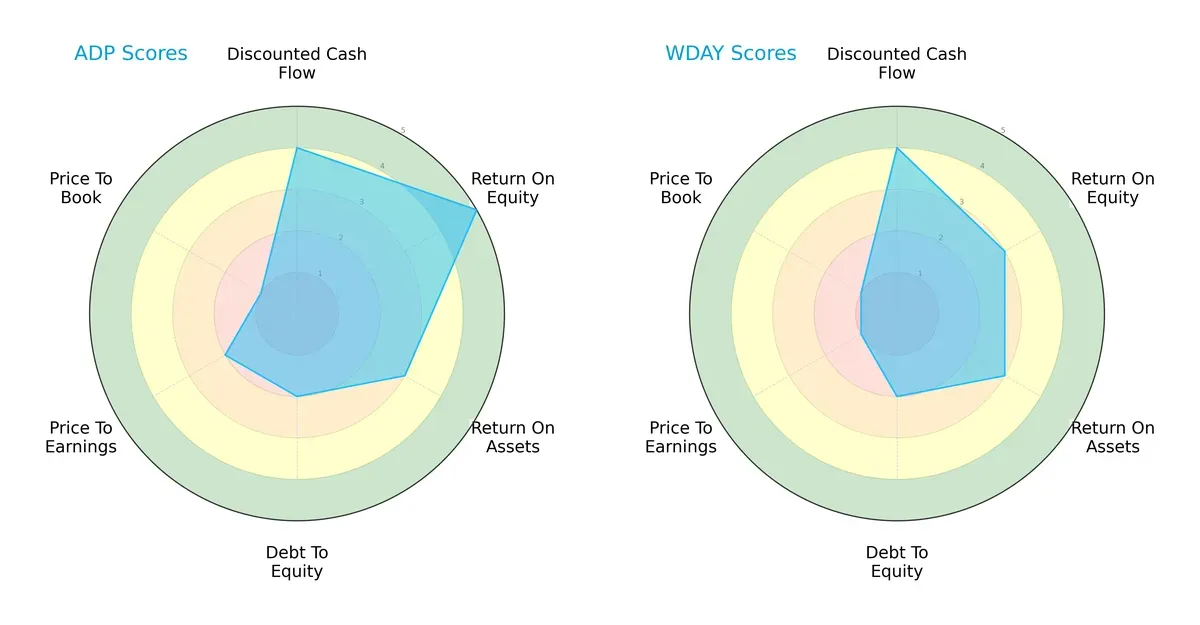
Automatic Data Processing, Inc. (ADP) shows a more balanced profile with strong ROE (5) and favorable DCF (4), but weaker valuation scores (P/E 2, P/B 1). Workday, Inc. (WDAY) matches ADP in DCF (4) but lags in ROE (3) and suffers from very unfavorable valuation scores (P/E 1, P/B 1). ADP leverages profitability efficiently, while WDAY relies more heavily on growth potential despite valuation headwinds.
Bankruptcy Risk: Solvency Showdown
ADP’s Altman Z-Score of 1.7 places it in the distress zone, indicating elevated bankruptcy risk in this cycle. WDAY’s 4.1 score lands safely in the safe zone, signaling stronger long-term solvency:

Financial Health: Quality of Operations
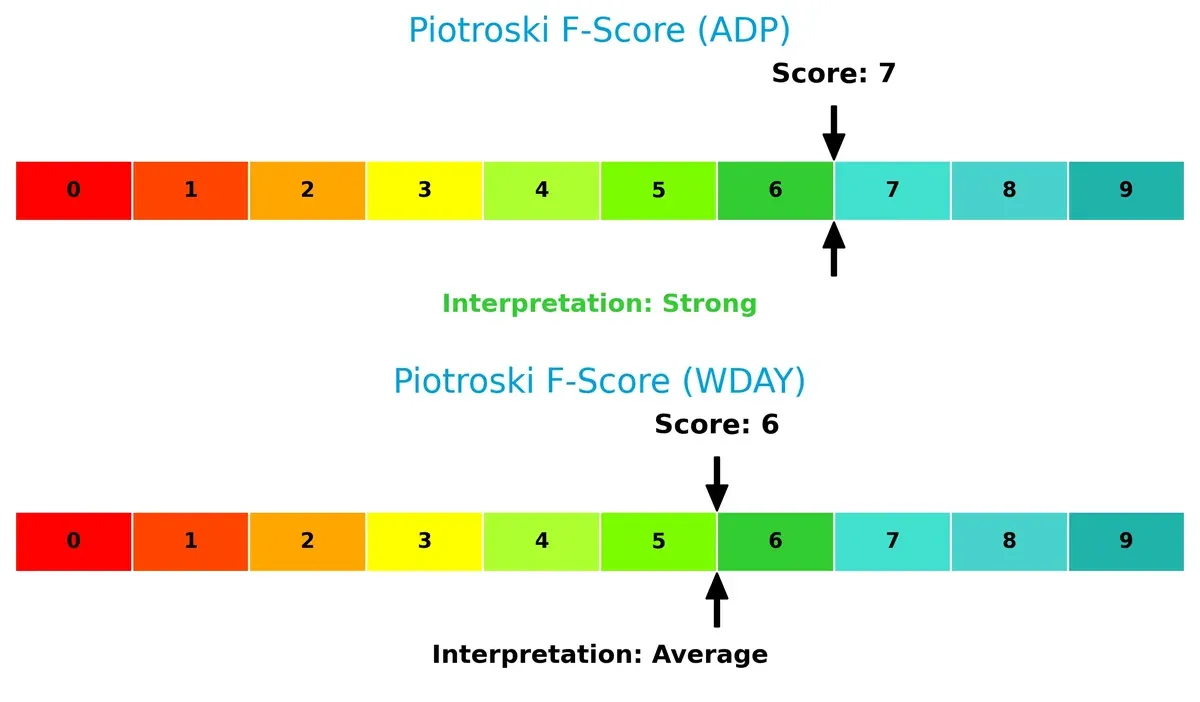
ADP’s Piotroski F-Score of 7 signals strong financial health and operational quality. WDAY’s 6 is average, suggesting some red flags in internal metrics relative to ADP:
How are the two companies positioned?
This section dissects the operational DNA of ADP and WDAY by comparing their revenue distribution and internal dynamics, including strengths and weaknesses. The goal is to confront their economic moats and identify which business model delivers the most resilient competitive advantage today.
Revenue Segmentation: The Strategic Mix
This visual comparison dissects how Automatic Data Processing, Inc. and Workday, Inc. diversify their income streams and where their primary sector bets lie:

Automatic Data Processing, Inc. anchors its revenue in HCM at $8.67B, supported by strong contributions from Professional Employee Organization Services at $4.29B and HRO at $3.78B. In contrast, Workday, Inc. pivots heavily on Subscription Services, generating $7.72B, dwarfing its $728M Professional Services segment. ADP’s diversified mix reduces concentration risk and leverages ecosystem lock-in, while Workday’s reliance on subscription revenues highlights scalability but exposes it to subscription churn risks.
Strengths and Weaknesses Comparison
This table compares the Strengths and Weaknesses of Automatic Data Processing, Inc. (ADP) and Workday, Inc. (WDAY):
ADP Strengths
- High profitability with 19.8% net margin
- Strong ROE of 65.9% and ROIC of 24.7%
- Diverse revenue streams across HCM, HRO, and Global segments
- Solid global presence, notably in the US, Europe, and Canada
- Favorable interest coverage and manageable debt-to-assets ratio
WDAY Strengths
- Favorable liquidity ratios with current and quick ratios at 1.85
- Low debt-to-equity ratio of 0.37 indicates conservative leverage
- Growing subscription services revenue signals innovation focus
- Global expansion with significant Non-US revenue
- Positive interest coverage despite lower profitability
ADP Weaknesses
- High price-to-book ratio of 20.3 signals expensive valuation
- Elevated debt-to-equity ratio at 1.46 indicates higher leverage risk
- Asset turnover is low at 0.39, limiting operational efficiency
- PE ratio of 30.8 considered unfavorable relative to earnings
- Dividend yield is modest at 1.9%, limiting income appeal
WDAY Weaknesses
- Low profitability with 6.2% net margin and weak ROE at 5.8%
- ROIC at 2.7% below cost of capital at 8.8%, indicating poor capital returns
- High PE ratio of 132.2 reflects expensive valuation
- No dividend yield, reducing income investor attraction
- Asset turnover remains low at 0.47, limiting efficiency gains
ADP demonstrates robust profitability and diversified revenue with some valuation and leverage concerns. WDAY shows strong liquidity and growth in subscription services but faces challenges with profitability and high valuation. Both companies reflect distinct strategic profiles shaped by their financial strengths and weaknesses.
The Moat Duel: Analyzing Competitive Defensibility
A structural moat alone shields long-term profits from relentless competitive pressure and market disruption by securing economic value:
Automatic Data Processing, Inc. (ADP): Durable Switching Costs Moat
ADP’s moat stems from high switching costs embedded in its integrated HCM platforms. This creates margin stability with a 28% EBIT margin and sustained 17% ROIC above WACC. Expansion into international markets in 2026 could further fortify this moat.
Workday, Inc. (WDAY): Innovation-Driven Network Effects Moat
Workday leverages network effects from its cloud-based financial and HCM applications. Despite a lower 9% EBIT margin and negative ROIC vs. WACC, rapid revenue growth and improving ROIC trend signal potential moat deepening through product innovation and global expansion in 2026.
Legacy Integration vs. Agile Innovation: The Moat Showdown
ADP’s wider moat relies on entrenched client relationships and consistent value creation. Workday’s deeper moat remains nascent but promises disruption via technology. ADP is better positioned today to defend its market share, while Workday’s rising profitability warrants close monitoring.
Which stock offers better returns?
Over the past 12 months, Automatic Data Processing, Inc. (ADP) showed a mild bullish trend with a 1.82% gain, while Workday, Inc. (WDAY) experienced a pronounced bearish trend, losing 33.55%.

Trend Comparison
ADP’s stock price rose 1.82% over the past year, indicating a bullish trend with decelerating momentum. The price ranged between 235.56 and 326.81, showing moderate volatility (std dev 25.11).
WDAY’s stock price fell 33.55% during the same period, reflecting a strong bearish trend with decelerating decline. Price fluctuated between 175.63 and 277.5, with volatility at 20.24.
Comparing both, ADP outperformed WDAY in market returns over the last year, delivering a positive trend versus WDAY’s significant losses.
Target Prices
Analysts show a moderately bullish consensus for both Automatic Data Processing, Inc. and Workday, Inc.
| Company | Target Low | Target High | Consensus |
|---|---|---|---|
| Automatic Data Processing, Inc. | 230 | 306 | 274.71 |
| Workday, Inc. | 235 | 320 | 274.47 |
The consensus target prices for ADP and WDAY exceed their current prices, indicating expected appreciation. This signals analysts’ confidence despite market volatility.

Don’t Let Luck Decide Your Entry Point
Optimize your entry points with our advanced ProRealTime indicators. You’ll get efficient buy signals with precise price targets for maximum performance. Start outperforming now!
How do institutions grade them?
The following tables summarize recent institutional grades for Automatic Data Processing, Inc. and Workday, Inc.:
Automatic Data Processing, Inc. Grades
The table below shows institutional ratings and grade changes for ADP as of early 2026.
| Grading Company | Action | New Grade | Date |
|---|---|---|---|
| Citigroup | maintain | Neutral | 2026-01-29 |
| Morgan Stanley | maintain | Equal Weight | 2026-01-29 |
| Stifel | maintain | Hold | 2026-01-29 |
| Wells Fargo | maintain | Underweight | 2026-01-29 |
| JP Morgan | maintain | Underweight | 2026-01-29 |
| Jefferies | downgrade | Underperform | 2025-12-16 |
| JP Morgan | maintain | Underweight | 2025-10-30 |
| Wells Fargo | maintain | Underweight | 2025-10-30 |
| UBS | maintain | Neutral | 2025-09-17 |
| Morgan Stanley | maintain | Equal Weight | 2025-07-31 |
Workday, Inc. Grades
The table below presents recent institutional ratings and grade updates for Workday, Inc.
| Grading Company | Action | New Grade | Date |
|---|---|---|---|
| Barclays | maintain | Overweight | 2026-01-12 |
| RBC Capital | maintain | Outperform | 2026-01-05 |
| Guggenheim | maintain | Buy | 2025-11-26 |
| Keybanc | maintain | Overweight | 2025-11-26 |
| Morgan Stanley | maintain | Equal Weight | 2025-11-26 |
| Needham | maintain | Buy | 2025-11-26 |
| UBS | maintain | Neutral | 2025-11-26 |
| Wells Fargo | maintain | Overweight | 2025-11-26 |
| Citigroup | maintain | Neutral | 2025-11-26 |
| DA Davidson | maintain | Neutral | 2025-11-26 |
Which company has the best grades?
Workday, Inc. holds stronger institutional support with multiple Buy and Overweight ratings. ADP’s grades skew more cautious, including Hold and Underweight calls. Investors may view Workday’s ratings as signaling higher growth expectations relative to ADP’s more conservative outlook.
Risks specific to each company
The following categories identify the critical pressure points and systemic threats facing both firms in the 2026 market environment:
1. Market & Competition
Automatic Data Processing, Inc.
- Faces intense competition in staffing and HR services but benefits from scale and long-standing client relationships.
Workday, Inc.
- Operates in highly competitive enterprise software space with rapid innovation cycles and strong tech rivals.
2. Capital Structure & Debt
Automatic Data Processing, Inc.
- Higher debt-to-equity ratio of 1.46 signals leverage risk despite strong interest coverage of 12.63x.
Workday, Inc.
- Lower debt-to-equity at 0.37 reduces financial risk, but interest coverage at 6.6x is less comfortable.
3. Stock Volatility
Automatic Data Processing, Inc.
- Beta of 0.864 indicates below-market volatility, offering relative stability.
Workday, Inc.
- Beta of 1.142 suggests above-market volatility, exposing investors to higher price swings.
4. Regulatory & Legal
Automatic Data Processing, Inc.
- Exposed to complex labor laws and compliance risks in multiple jurisdictions.
Workday, Inc.
- Faces data privacy regulations and software compliance challenges globally.
5. Supply Chain & Operations
Automatic Data Processing, Inc.
- Relies on robust operational infrastructure but may face disruptions in service delivery.
Workday, Inc.
- Dependent on cloud infrastructure stability and technology partners for seamless service.
6. ESG & Climate Transition
Automatic Data Processing, Inc.
- Under pressure to improve sustainability reporting and reduce carbon footprint in operations.
Workday, Inc.
- Faces investor scrutiny on ESG practices and climate risk mitigation in tech sector.
7. Geopolitical Exposure
Automatic Data Processing, Inc.
- Limited geographic risk, primarily US-focused with some international exposure.
Workday, Inc.
- More diversified global footprint, increasing exposure to geopolitical tensions and trade policies.
Which company shows a better risk-adjusted profile?
Automatic Data Processing’s highest risk is its elevated leverage amid strong operational cash flows, while Workday’s primary concern is its high stock volatility combined with modest profitability. ADP’s lower beta and favorable profitability metrics signal a better risk-adjusted profile despite debt concerns. Notably, ADP’s Altman Z-score in the distress zone warns of financial stress, contrasting with Workday’s safe zone score, though WDAY’s valuation multiples remain stretched. This mix justifies caution, but ADP’s stronger earnings stability and market position offer a more balanced risk-return tradeoff in 2026.
Final Verdict: Which stock to choose?
Automatic Data Processing, Inc. (ADP) stands out as a cash-generating powerhouse with a durable competitive moat. Its ability to create value well above its cost of capital signals operational excellence and disciplined capital allocation. The point of vigilance is its relatively high valuation multiples, which could temper near-term upside. ADP fits well in portfolios seeking steady growth with a margin of safety.
Workday, Inc. (WDAY) leverages a strategic moat rooted in cloud innovation and recurring revenue streams. Its strong liquidity and conservative leverage offer a safer financial profile compared to ADP, despite weaker profitability metrics. WDAY suits investors inclined towards growth at a reasonable price, willing to trade immediate earnings for longer-term expansion potential.
If you prioritize reliable value creation and consistent profitability, ADP is the compelling choice due to its superior ROIC and strong income quality. However, if you seek exposure to disruptive cloud growth with a more conservative balance sheet, WDAY offers better stability amid growth uncertainty. Both represent distinct analytical scenarios aligned with different investor risk appetites.
Disclaimer: Investment carries a risk of loss of initial capital. The past performance is not a reliable indicator of future results. Be sure to understand risks before making an investment decision.
Go Further
I encourage you to read the complete analyses of Automatic Data Processing, Inc. and Workday, Inc. to enhance your investment decisions: