Home > Comparison > Technology > ALAB vs ON
The strategic rivalry between Astera Labs, Inc. and ON Semiconductor Corporation shapes the semiconductor sector’s innovation curve. Astera Labs is a nimble, software-driven connectivity solutions provider for cloud and AI infrastructure. ON Semiconductor operates as a diversified, capital-intensive leader in intelligent sensing and power solutions across automotive and industrial markets. This analysis aims to identify which firm’s growth trajectory offers a superior risk-adjusted return for a diversified portfolio in this dynamic technology landscape.
Table of contents
Companies Overview
Astera Labs and ON Semiconductor stand as pivotal players shaping the semiconductor landscape in 2026.
Astera Labs, Inc. Common Stock: Intelligent Connectivity Pioneer
Astera Labs specializes in semiconductor-based connectivity solutions tailored for cloud and AI infrastructure. Its core revenue derives from its Intelligent Connectivity Platform, which integrates data, network, and memory connectivity products under a software-defined architecture. In 2026, the company focuses strategically on scaling high-performance infrastructure deployments for cloud and AI applications.
ON Semiconductor Corporation: Power and Sensing Leader
ON Semiconductor dominates intelligent sensing and power solutions worldwide. Its revenue engine spans analog, discrete, and integrated semiconductors that enable automotive electrification, industrial power, and sustainable energy systems. The company’s 2026 strategy prioritizes advancing electrification technologies and expanding intelligent sensing capabilities across diverse end-markets.
Strategic Collision: Similarities & Divergences
Astera Labs and ON Semiconductor both operate in semiconductors but diverge in focus—connectivity solutions versus power and sensing technologies. They compete primarily in enabling next-gen infrastructure, with Astera Labs targeting cloud AI while ON semi powers electric vehicles and sustainable energy. Their investment profiles differ sharply: one bets on niche intelligent connectivity; the other on broad power and sensing applications.
Income Statement Comparison
The following data dissects the core profitability and scalability of both corporate engines to reveal who dominates the bottom line:
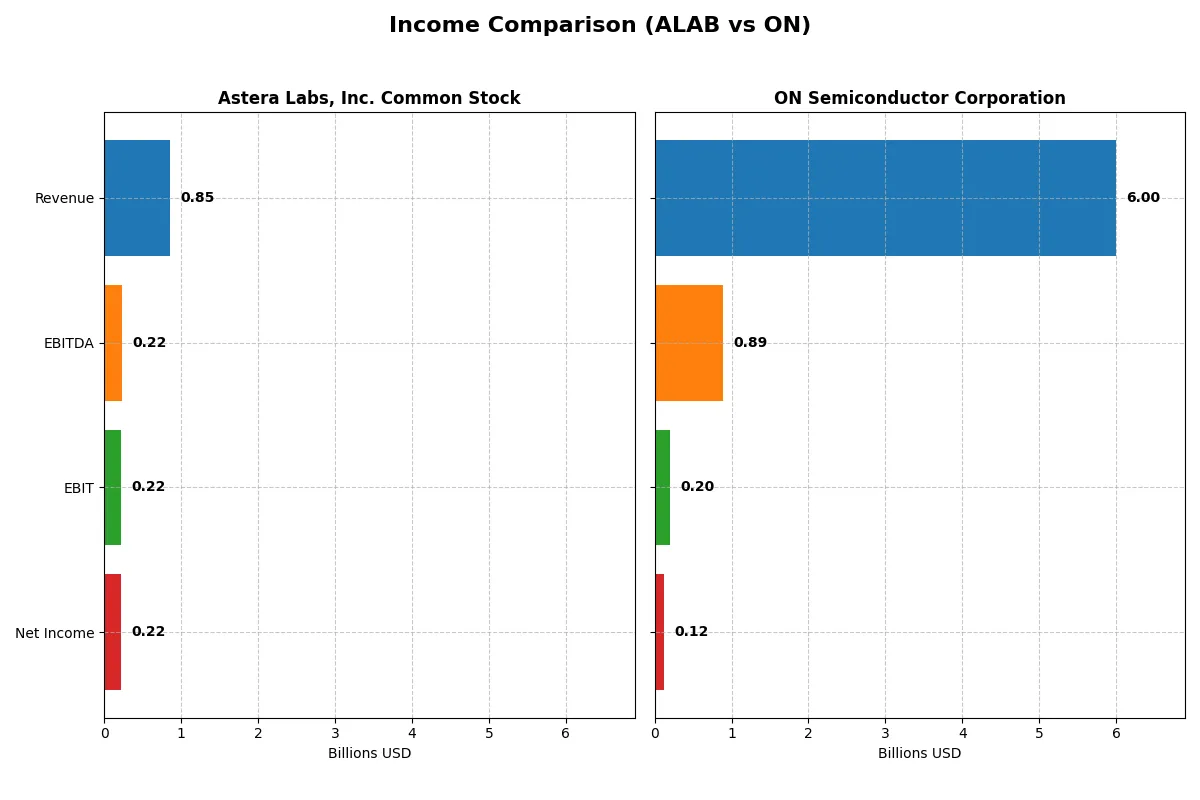
| Metric | Astera Labs, Inc. Common Stock (ALAB) | ON Semiconductor Corporation (ON) |
|---|---|---|
| Revenue | 853M | 6.00B |
| Cost of Revenue | 207M | 4.06B |
| Operating Expenses | 472M | 1.19B |
| Gross Profit | 645M | 1.94B |
| EBITDA | 225M | 888M |
| EBIT | 218M | 202M |
| Interest Expense | 0 | 71M |
| Net Income | 219M | 121M |
| EPS | 1.32 | 0.29 |
| Fiscal Year | 2025 | 2025 |
Income Statement Analysis: The Bottom-Line Duel
This income statement comparison reveals which company runs a more efficient and profitable corporate engine in the competitive semiconductor sector.
Astera Labs, Inc. Common Stock Analysis
Astera Labs impresses with a revenue surge from $80M in 2022 to $853M in 2025, showing robust growth momentum. Its gross margin holds a healthy 75.7%, while net margin expanded sharply to 25.7%, reflecting strong cost control and operational leverage. The 2025 net income of $219M confirms accelerating profitability and efficient capital allocation.
ON Semiconductor Corporation Analysis
ON Semiconductor’s revenue declined from $8.3B in 2022 to $6.0B in 2025, marking a challenging top-line environment. Gross margin at 32.3% remains respectable but net margin shrank to just 2%, signaling margin pressure and diminished earnings power. The 2025 net income of $121M pales against prior years, evidencing deteriorating profitability and operational headwinds.
Margin Strength vs. Revenue Scale
Astera Labs clearly outpaces ON Semiconductor in margin expansion and bottom-line growth despite its smaller scale. While ON grapples with declining revenue and compressed profits, Astera Labs leverages high margins and rapid growth. Investors seeking a leaner, high-efficiency profile might favor Astera’s dynamic earnings momentum over ON’s fading scale advantage.
Financial Ratios Comparison
These vital ratios act as a diagnostic tool to expose the underlying fiscal health, valuation premiums, and capital efficiency of these companies:
| Ratios | Astera Labs, Inc. (ALAB) | ON Semiconductor Corporation (ON) |
|---|---|---|
| ROE | 16.1% | 1.6% |
| ROIC | 12.4% | 6.2% |
| P/E | 126.3 | 183.9 |
| P/B | 20.3 | 2.9 |
| Current Ratio | 10.2 | 4.5 |
| Quick Ratio | 9.8 | 3.0 |
| D/E | 0 | 0.45 |
| Debt-to-Assets | 0 | 0.28 |
| Interest Coverage | 0 | 10.5 |
| Asset Turnover | 0.56 | 0.48 |
| Fixed Asset Turnover | 9.3 | 1.8 |
| Payout Ratio | 0 | 0 |
| Dividend Yield | 0 | 0 |
| Fiscal Year | 2025 | 2025 |
Efficiency & Valuation Duel: The Vital Signs
Financial ratios act as the company’s DNA, revealing hidden risks and operational strengths that guide investors through complex market landscapes.
Astera Labs, Inc. Common Stock
Astera Labs shows strong profitability with a 16.07% ROE and a robust 25.7% net margin, signaling operational excellence. However, its valuation is stretched, with a P/E of 126.33 and P/B of 20.3, reflecting high growth expectations. The company reinvests heavily in R&D (36%) and maintains zero debt, supporting long-term innovation but offering no dividends.
ON Semiconductor Corporation
ON Semiconductor posts weaker profitability, with a 1.58% ROE and a thin 2.02% net margin, indicating operational challenges. Its valuation appears highly expensive, with a P/E of 183.93, though the P/B of 2.9 is more moderate. The firm holds moderate debt (D/E 0.45) and does not pay dividends, focusing capital on growth rather than shareholder returns.
Premium Valuation vs. Operational Safety
Astera Labs balances solid profitability and zero debt against a highly stretched valuation, suggesting risk but potential reward for growth investors. ON Semiconductor’s weaker returns and elevated valuation imply greater risk without clear operational leverage. Investors seeking growth with operational safety may prefer Astera’s profile, while those tolerating risk might consider ON’s speculative appeal.
Which one offers the Superior Shareholder Reward?
Astera Labs (ALAB) pays no dividends and has no buyback program, reinvesting heavily in growth with a pristine balance sheet and high free cash flow per share of 1.69. ON Semiconductor (ON) also pays no dividends but supports shareholder returns through moderate buybacks, evident in free cash flow per share of 3.45 and a more mature payout capacity. I see ON’s buyback activity coupled with positive net margins and sustainable cash flow as a superior reward model in 2026, balancing shareholder returns with growth. ALAB’s zero distribution and sky-high valuation pose risks for patient investors.
Comparative Score Analysis: The Strategic Profile
The radar chart reveals the fundamental DNA and trade-offs of Astera Labs and ON Semiconductor Corporation, highlighting their financial strengths and weaknesses:
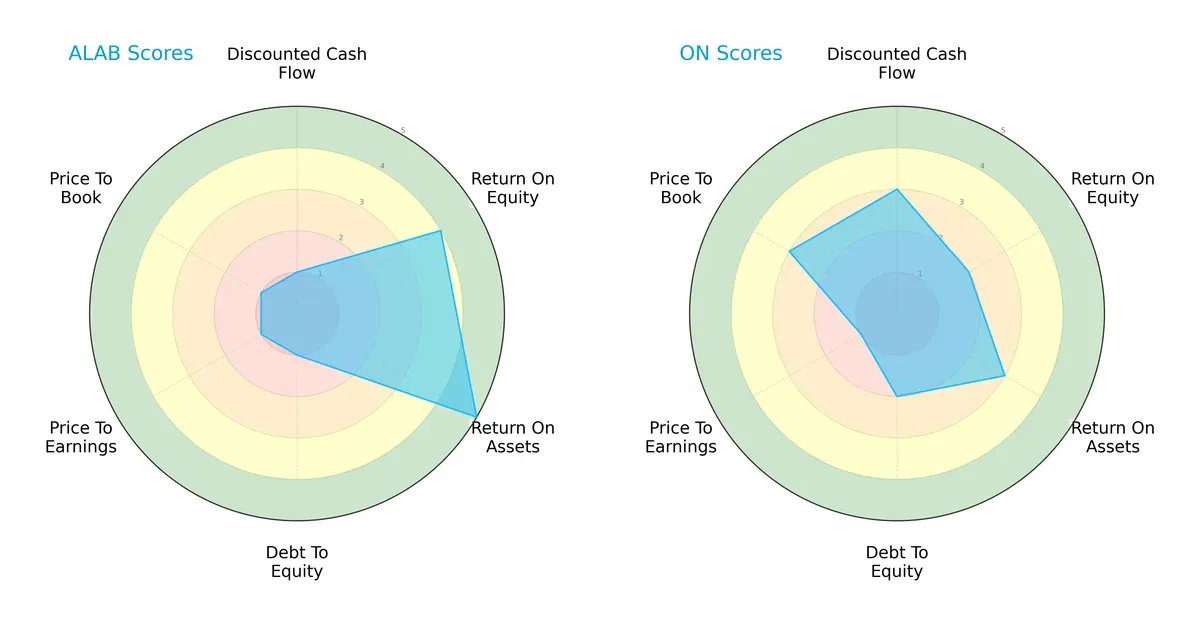
Astera Labs excels in operational efficiency with high ROE (4) and ROA (5) scores but suffers from weak valuation and leverage metrics, scoring 1 in debt-to-equity, P/E, and P/B ratios. ON Semiconductor presents a more balanced profile, showing moderate DCF (3), ROA (3), and P/B (3) scores, though its ROE (2) and debt-to-equity (2) remain unfavorable. Overall, ON Semiconductor relies less on a single financial strength and offers a steadier risk-reward trade-off.
Bankruptcy Risk: Solvency Showdown
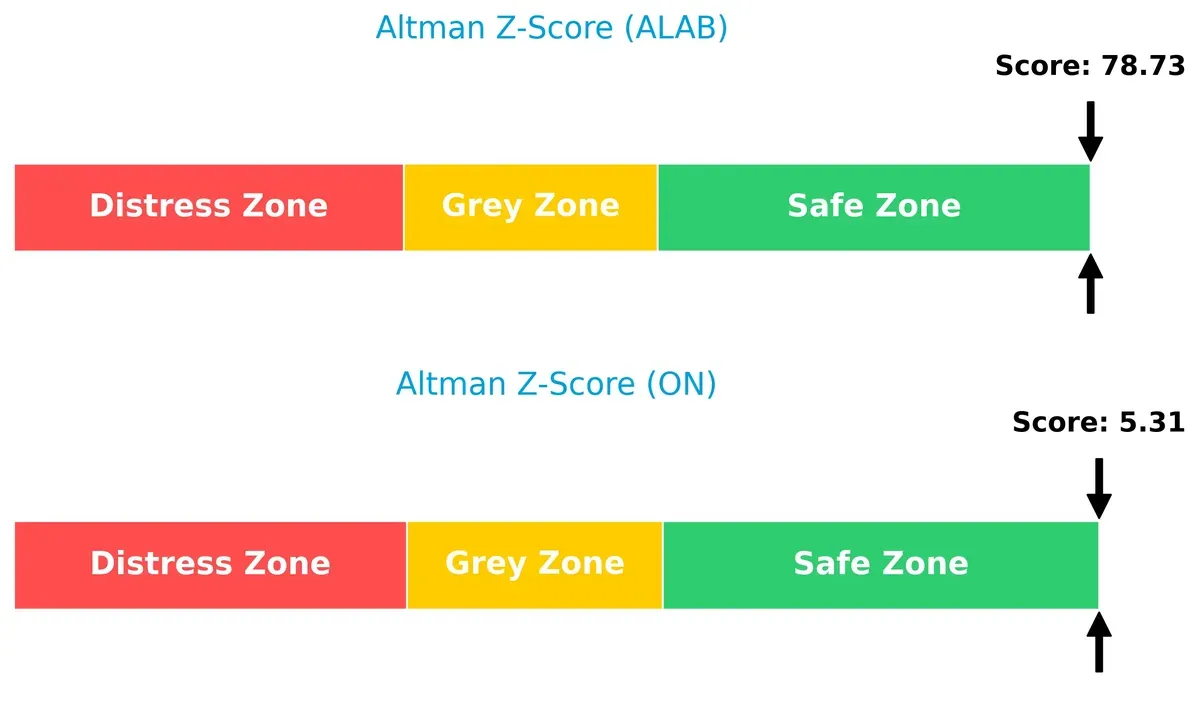
Astera Labs posts an Altman Z-Score of 78.7, vastly outperforming ON Semiconductor’s 5.3; both stand well within the safe zone, implying robust long-term survival prospects in this cycle:
Financial Health: Quality of Operations
Both firms score a 6 on the Piotroski F-Score, indicating average financial health. Neither company shows immediate red flags, but neither stands out as exceptionally strong in internal financial quality:

How are the two companies positioned?
This section dissects the operational DNA of ALAB and ON by comparing their revenue distribution and internal dynamics. The goal is to confront their economic moats and identify which model offers the most resilient competitive advantage today.
Revenue Segmentation: The Strategic Mix
The following visual comparison dissects how Astera Labs and ON Semiconductor diversify their income streams and reveals where their primary sector bets lie:
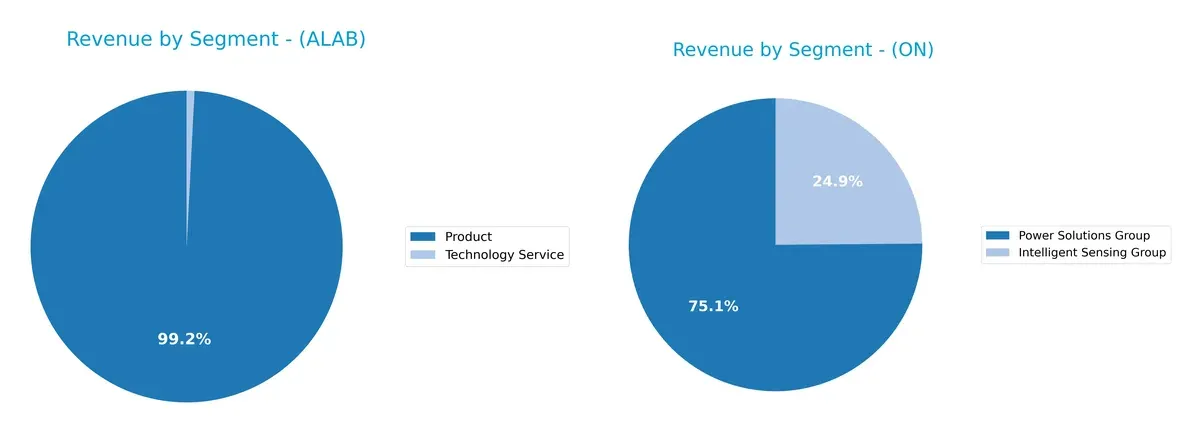
Astera Labs anchors revenue in Product sales with $393M and a minor $3.2M in Technology Service, showing heavy reliance on a single segment. ON Semiconductor boasts a diversified mix across Power Solutions ($2.8B), Analog Solutions ($2.6B), and Intelligent Sensing ($928M) in 2025. This breadth reflects ON’s ecosystem lock-in and infrastructure dominance, while Astera Labs faces concentration risk by pivoting mainly on one product line.
Strengths and Weaknesses Comparison
This table compares the Strengths and Weaknesses of Astera Labs (ALAB) and ON Semiconductor (ON):
ALAB Strengths
- High net margin of 25.7%
- Strong ROE at 16.07%
- ROIC above WACC at 12.4%
- Zero debt and infinite interest coverage
- Exceptional quick ratio near 9.79
- High fixed asset turnover at 9.26
ON Strengths
- Diversified product segments with robust revenue streams
- Favorable debt to equity and debt to assets ratios
- Global presence including US, UK, Singapore, Hong Kong
- Moderate quick ratio of 2.98
- Neutral P/B ratio at 2.9
ALAB Weaknesses
- Unfavorable WACC at 10.74% above ROIC
- Very high P/E of 126.33 and P/B of 20.3
- Extremely high current ratio at 10.24 signals inefficient asset use
- No dividend yield
- Moderate asset turnover at 0.56
ON Weaknesses
- Low profitability with net margin at 2.02% and ROE at 1.58%
- WACC at 10.08% unfavorable relative to ROIC
- High P/E of 183.93
- Unfavorable current ratio at 4.52
- Low asset turnover at 0.48
- No dividend yield
Both companies show distinct strategic profiles. ALAB excels in profitability and balance sheet strength but faces valuation and capital efficiency challenges. ON offers broader diversification and global reach but struggles with low profitability and efficiency ratios. These factors shape their financial resilience and growth outlooks.
The Moat Duel: Analyzing Competitive Defensibility
A durable structural moat protects long-term profits from relentless competition and market pressures. Here’s how Astera Labs and ON Semiconductor compare:
Astera Labs, Inc. Common Stock: Emerging Innovation in Connectivity
Astera Labs’ moat centers on proprietary semiconductor connectivity solutions for cloud and AI infrastructure. Its rising ROIC and 25%+ net margins reflect growing profitability. Expansion into AI markets could deepen this technological edge in 2026.
ON Semiconductor Corporation: Legacy Power Solutions Under Pressure
ON Semiconductor relies on scale and diversified power management products. However, declining ROIC and shrinking margins signal weakening competitive leverage. Market shifts toward electrification present risks and opportunities for strategic renewal in 2026.
Innovation Growth vs. Scale Erosion in Semiconductors
Astera Labs shows a slightly favorable moat with improving returns and margin expansion. ON Semiconductor faces a very unfavorable moat due to declining profitability and value destruction. Astera Labs is better equipped to defend market share through innovation-led growth.
Which stock offers better returns?
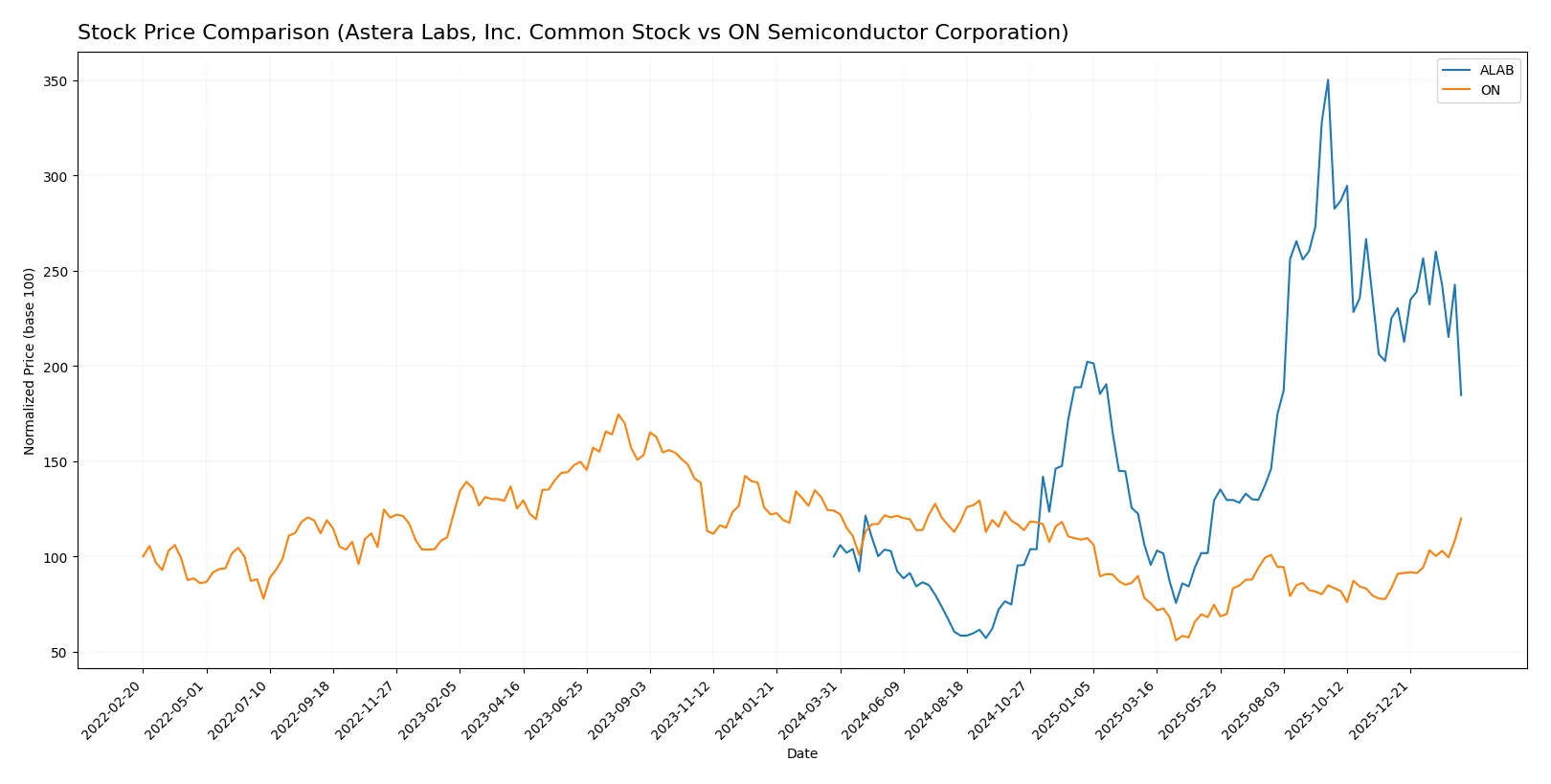
The past year shows diverging price moves: Astera Labs surged sharply but slowed recently, while ON Semiconductor declined overall with a recent strong rebound.
Trend Comparison
Astera Labs, Inc. stock rose 84.74% over the past 12 months, marking a bullish trend despite recent deceleration and a 17.93% drop since November 2025.
ON Semiconductor declined 3.31% over the same period, reflecting a bearish trend, but accelerated recently with a 43.73% gain from November 2025 to February 2026.
Astera Labs delivered the highest 12-month return, outperforming ON Semiconductor despite recent weakness and greater volatility in share price.
Target Prices
Analysts present a bullish consensus for Astera Labs and a moderate upside for ON Semiconductor.
| Company | Target Low | Target High | Consensus |
|---|---|---|---|
| Astera Labs, Inc. Common Stock | 165 | 225 | 202.14 |
| ON Semiconductor Corporation | 51 | 75 | 62.4 |
Astera Labs’ target consensus of 202.14 exceeds its current price of 129.32, signaling strong growth expectations. ON Semiconductor’s consensus of 62.4 sits below its current price of 72.21, suggesting limited near-term upside or possible valuation concerns.

Don’t Let Luck Decide Your Entry Point
Optimize your entry points with our advanced ProRealTime indicators. You’ll get efficient buy signals with precise price targets for maximum performance. Start outperforming now!
How do institutions grade them?
The following tables present recent grades issued by reputable financial institutions for both companies:
Astera Labs, Inc. Common Stock Grades
This table summarizes the latest ratings from major financial firms for Astera Labs, Inc. Common Stock.
| Grading Company | Action | New Grade | Date |
|---|---|---|---|
| Citigroup | Maintain | Buy | 2026-02-11 |
| Northland Capital Markets | Maintain | Outperform | 2025-12-09 |
| Northland Capital Markets | Upgrade | Outperform | 2025-11-17 |
| Stifel | Maintain | Buy | 2025-11-05 |
| Needham | Maintain | Buy | 2025-11-05 |
| Roth Capital | Maintain | Buy | 2025-11-05 |
| JP Morgan | Maintain | Overweight | 2025-11-05 |
| Morgan Stanley | Maintain | Overweight | 2025-11-05 |
| TD Cowen | Maintain | Hold | 2025-11-05 |
| Barclays | Downgrade | Equal Weight | 2025-10-20 |
ON Semiconductor Corporation Grades
This table lists recent grades assigned by established financial firms for ON Semiconductor Corporation.
| Grading Company | Action | New Grade | Date |
|---|---|---|---|
| JP Morgan | Maintain | Neutral | 2026-02-10 |
| Citigroup | Maintain | Neutral | 2026-02-10 |
| Wells Fargo | Maintain | Overweight | 2026-02-10 |
| Benchmark | Downgrade | Hold | 2026-02-10 |
| Truist Securities | Maintain | Hold | 2026-02-10 |
| Cantor Fitzgerald | Maintain | Neutral | 2026-02-10 |
| Rosenblatt | Maintain | Neutral | 2026-02-10 |
| Piper Sandler | Maintain | Overweight | 2026-02-10 |
| Keybanc | Maintain | Overweight | 2026-02-10 |
| Mizuho | Maintain | Outperform | 2026-02-10 |
Which company has the best grades?
Astera Labs, Inc. holds predominantly Buy and Outperform ratings, indicating stronger institutional confidence. ON Semiconductor’s grades cluster around Neutral to Overweight, implying a more cautious stance. Investors might interpret this as higher conviction in Astera Labs’ near-term prospects.
Risks specific to each company
The following categories identify the critical pressure points and systemic threats facing both firms in the 2026 market environment:
1. Market & Competition
Astera Labs, Inc. Common Stock
- Newer entrant with rapid innovation but faces intense competition in AI/cloud connectivity.
ON Semiconductor Corporation
- Established player with broad portfolio but exposed to commoditization in power semiconductors.
2. Capital Structure & Debt
Astera Labs, Inc. Common Stock
- Debt-free balance sheet reduces financial risk but may limit leverage advantages.
ON Semiconductor Corporation
- Moderate debt level (D/E 0.45) adds financial risk but supports growth investments.
3. Stock Volatility
Astera Labs, Inc. Common Stock
- Beta 1.51 indicates above-market volatility, typical of growth tech stocks.
ON Semiconductor Corporation
- Slightly higher beta of 1.54 reflects sensitivity to semiconductor sector cycles.
4. Regulatory & Legal
Astera Labs, Inc. Common Stock
- Operating in highly regulated AI/cloud sectors; potential IP and export controls risk.
ON Semiconductor Corporation
- Exposure to automotive and industrial regulations; compliance complexity increasing.
5. Supply Chain & Operations
Astera Labs, Inc. Common Stock
- Smaller scale with potential supply chain fragility amid semiconductor shortages.
ON Semiconductor Corporation
- Larger scale may offer supply chain resilience but faces global component sourcing risks.
6. ESG & Climate Transition
Astera Labs, Inc. Common Stock
- Limited ESG disclosures so far; transition risks in energy-intensive data centers.
ON Semiconductor Corporation
- Focus on power-efficient solutions supports ESG profile but manufacturing emissions remain a challenge.
7. Geopolitical Exposure
Astera Labs, Inc. Common Stock
- US-based with potential export restrictions on AI tech to China and allies.
ON Semiconductor Corporation
- Global footprint exposes it to US-China trade tensions and supply chain disruptions.
Which company shows a better risk-adjusted profile?
Astera Labs faces its largest risk in market competition and valuation froth, indicated by sky-high P/E and P/B ratios. ON Semiconductor’s biggest risk lies in operational and regulatory complexity amid modest profitability. Despite higher debt, ON’s established scale and diversification offer a more balanced risk-adjusted profile. Astera’s zero debt and strong profitability ratios contrast with its stretched valuation, exposing investors to a correction if growth slows. ON’s moderate Altman Z-Score and Piotroski scores reflect stable but challenged financial health. I lean towards ON for a more prudent risk-reward balance in 2026’s volatile semiconductor landscape.
Final Verdict: Which stock to choose?
Astera Labs (ALAB) stands out with its unmatched growth trajectory and rising profitability. Its superpower lies in rapidly expanding revenues and improving returns, signaling a company gaining operational leverage. However, its sky-high valuation and stretched liquidity ratios warrant caution. It suits aggressive growth portfolios willing to endure volatility for potential outsized gains.
ON Semiconductor (ON) offers a strategic moat rooted in established semiconductor manufacturing and steady cash flow generation. While its profitability and growth have softened, it presents a safer profile compared to ALAB’s high-flying metrics. ON fits well within GARP portfolios seeking moderate growth paired with relative stability.
If you prioritize aggressive growth fueled by innovation and market expansion, Astera Labs outshines with accelerating returns despite valuation risks. However, if you seek better stability and a proven operational base, ON Semiconductor offers a more conservative choice, albeit with subdued growth prospects. Each scenario requires balancing growth ambition against risk tolerance.
Disclaimer: Investment carries a risk of loss of initial capital. The past performance is not a reliable indicator of future results. Be sure to understand risks before making an investment decision.
Go Further
I encourage you to read the complete analyses of Astera Labs, Inc. Common Stock and ON Semiconductor Corporation to enhance your investment decisions: