In the fast-evolving technology sector, SoundHound AI, Inc. and Asana, Inc. stand out as innovative players in the software application industry. SoundHound focuses on cutting-edge voice AI platforms, while Asana excels in work management solutions that enhance productivity across diverse industries. This comparison explores their market positions and innovation strategies to help you identify which company offers the most compelling investment opportunity. Let’s dive in and uncover the best fit for your portfolio.

Table of contents
Companies Overview
I will begin the comparison between SoundHound AI and Asana by providing an overview of these two companies and their main differences.
SoundHound AI Overview
SoundHound AI, Inc. develops an independent voice artificial intelligence platform aimed at enabling businesses to deliver conversational experiences. Its flagship product, Houndify, offers tools like automatic speech recognition and natural language understanding to build voice assistants. Headquartered in Santa Clara, California, SoundHound operates in the software application industry with a market cap of 4.7B USD.
Asana Overview
Asana, Inc. operates a work management platform designed for teams and executives to orchestrate tasks and strategic initiatives across various industries. Based in San Francisco, California, Asana serves sectors including technology, retail, and healthcare. The company, with a market cap of 2.6B USD, focuses on software applications that enhance productivity and collaboration on the New York Stock Exchange.
Key similarities and differences
Both SoundHound AI and Asana operate in the software application industry, providing platforms that enhance business efficiency. SoundHound specializes in voice AI technology, while Asana focuses on work management and task orchestration. Market caps differ significantly, with SoundHound at 4.7B USD and Asana at 2.6B USD, reflecting their distinct market positions and business models.
Income Statement Comparison
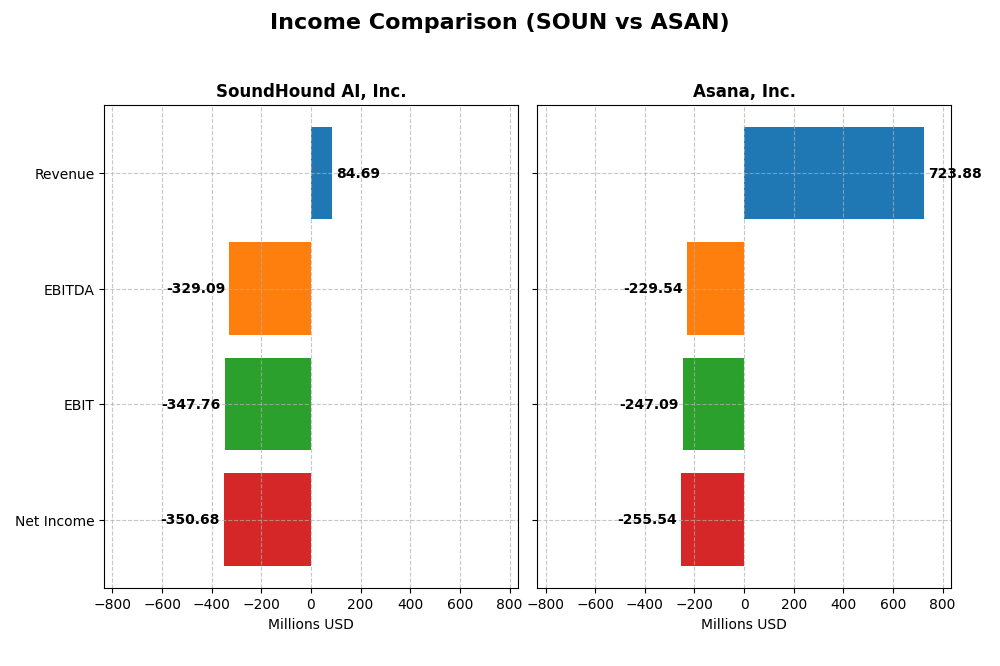
The table below compares the most recent fiscal year income statement metrics for SoundHound AI, Inc. and Asana, Inc., highlighting key financial figures for 2024 and 2025 respectively.
| Metric | SoundHound AI, Inc. (2024) | Asana, Inc. (2025) |
|---|---|---|
| Market Cap | 4.7B | 2.6B |
| Revenue | 85M | 724M |
| EBITDA | -329M | -230M |
| EBIT | -348M | -247M |
| Net Income | -351M | -256M |
| EPS | -1.04 | -1.11 |
| Fiscal Year | 2024 | 2025 |
Income Statement Interpretations
SoundHound AI, Inc.
SoundHound AI’s revenue surged impressively by 550.63% from 2020 to 2024, with a notable 84.62% increase in the last year. However, net income remained deeply negative, worsening by 371.3% overall and declining further in 2024. Gross margins were favorable at 48.86%, but operating and net margins stayed substantially negative, reflecting high expenses and losses in the most recent year.
Asana, Inc.
Asana’s revenue grew steadily by 218.88% over 2021-2025, with a 10.94% increase in the latest year. Gross margins were very strong at 89.34%, and operating expenses grew proportionally, supporting operational stability. Despite continued net losses, net margin improved by 10.38% last year, and earnings per share grew modestly, indicating gradual progress toward profitability.
Which one has the stronger fundamentals?
Asana exhibits stronger fundamentals with a favorable income statement opinion, driven by high gross margins, controlled interest expenses, and improvements in net margin and EPS growth. SoundHound AI shows robust revenue growth but faces ongoing large losses and unfavorable margin trends. Overall, Asana’s metrics suggest better operational leverage and risk management relative to SoundHound AI.
Financial Ratios Comparison
Below is a comparison of key financial ratios for SoundHound AI, Inc. (SOUN) and Asana, Inc. (ASAN) based on their most recent fiscal year data.
| Ratios | SoundHound AI, Inc. (2024) | Asana, Inc. (2025) |
|---|---|---|
| ROE | -191.99% | -112.31% |
| ROIC | -68.13% | -53.03% |
| P/E | -19.15 | -19.16 |
| P/B | 36.76 | 21.52 |
| Current Ratio | 3.77 | 1.44 |
| Quick Ratio | 3.77 | 1.44 |
| D/E (Debt to Equity) | 2.38% | 117.96% |
| Debt-to-Assets | 0.79% | 30.11% |
| Interest Coverage | -2805.33% | -7242.33% |
| Asset Turnover | 0.15 | 0.81 |
| Fixed Asset Turnover | 14.28 | 2.76 |
| Payout ratio | 0% | 0% |
| Dividend yield | 0% | 0% |
Interpretation of the Ratios
SoundHound AI, Inc.
SoundHound AI displays a mixed ratio profile with more unfavorable indicators. Key weaknesses include deeply negative net margin (-414.06%) and return on equity (-191.99%), signaling profitability struggles. Its high price-to-book ratio (36.76) and poor interest coverage (-28.58) raise concerns. The company does not pay dividends, reflecting its reinvestment strategy and growth focus without shareholder returns through dividends.
Asana, Inc.
Asana shows some financial strain with negative profitability ratios such as net margin (-35.3%) and return on equity (-112.31%). Its debt-to-equity ratio (1.18) and interest coverage (-67.09) are unfavorable, but the weighted average cost of capital (7.73%) is favorable. Asana also does not pay dividends, likely prioritizing reinvestment and growth over immediate shareholder returns.
Which one has the best ratios?
Comparing the two, SoundHound AI has a higher proportion of unfavorable ratios (64.29%) than Asana (50.0%), with Asana holding more neutral and favorable scores. Despite both companies exhibiting negative profitability and no dividend payouts, Asana’s slightly better overall financial stability and lower leverage suggest a comparatively stronger ratio profile.
Strategic Positioning
This section compares the strategic positioning of SoundHound AI and Asana, including market position, key segments, and exposure to technological disruption:
SoundHound AI
- Mid-cap with high beta, facing competitive pressure in voice AI software applications.
- Key segments include Hosted Services, Licensing, and Professional Services driving revenue.
- Positioned in AI voice technology, exposed to rapid innovation and technological disruption.
Asana
- Smaller market cap with lower beta, competing in work management software industry.
- Focused on work management platform serving diverse industries globally without segment data.
- Operates in software for work orchestration, exposed to evolving digital collaboration trends.
SoundHound AI vs Asana Positioning
SoundHound AI has a diversified revenue base across multiple AI voice service segments, while Asana concentrates on a single work management platform serving varied industries. SoundHound’s exposure to AI innovation contrasts with Asana’s focus on digital collaboration.
Which has the best competitive advantage?
Both companies are currently shedding value relative to their cost of capital. SoundHound AI shows a slightly unfavorable moat with growing profitability, whereas Asana’s moat is very unfavorable with declining profitability, indicating weaker competitive advantage.
Stock Comparison
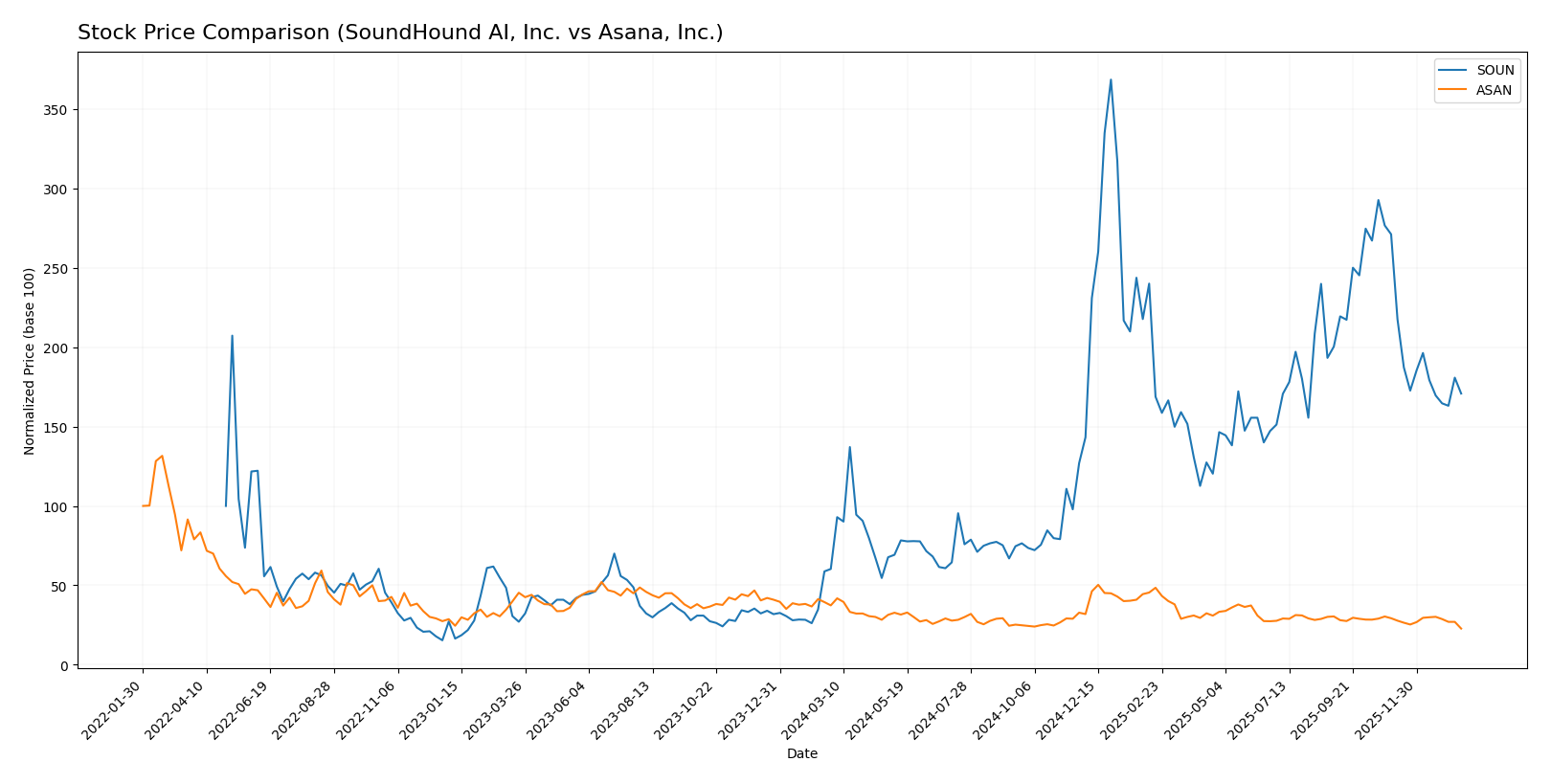
The stock price movements of SoundHound AI, Inc. and Asana, Inc. over the past 12 months reveal contrasting trends marked by significant gains for SoundHound and declines for Asana, reflecting divergent trading dynamics and market sentiment.
Trend Analysis
SoundHound AI, Inc. experienced a strong bullish trend over the past year with a 183.16% price increase, though showing deceleration and high volatility with a 4.66 standard deviation. The stock peaked at 23.95 and bottomed at 3.55.
Asana, Inc. displayed a bearish trend with a 39.07% price decline over the same period, also decelerating but with lower volatility marked by a 2.87 standard deviation. Its highest price was 24.15 and the lowest 10.93.
Comparing both, SoundHound AI, Inc. delivered the highest market performance with a substantial price increase, contrasting Asana’s significant loss in value over the last 12 months.
Target Prices
Analysts present a cautiously optimistic target consensus for both SoundHound AI, Inc. and Asana, Inc.
| Company | Target High | Target Low | Consensus |
|---|---|---|---|
| SoundHound AI, Inc. | 15 | 11 | 13.33 |
| Asana, Inc. | 18 | 14 | 15.75 |
The consensus target prices for SoundHound AI and Asana stand above their current prices, suggesting moderate upside potential according to analysts’ expectations. This indicates a positive but prudent market sentiment towards these software application firms.
Analyst Opinions Comparison
This section compares analysts’ ratings and financial scores for SoundHound AI, Inc. and Asana, Inc.:
Rating Comparison
SOUN Rating
- Rating: C-, considered very favorable
- Discounted Cash Flow Score: 1, very unfavorable
- ROE Score: 1, very unfavorable
- ROA Score: 1, very unfavorable
- Debt To Equity Score: 4, favorable
- Overall Score: 1, very unfavorable
ASAN Rating
- Rating: D+, considered very favorable
- Discounted Cash Flow Score: 1, very unfavorable
- ROE Score: 1, very unfavorable
- ROA Score: 1, very unfavorable
- Debt To Equity Score: 1, very unfavorable
- Overall Score: 1, very unfavorable
Which one is the best rated?
Both companies share very unfavorable scores in most financial metrics, except SOUN’s debt to equity score, which is favorable compared to ASAN’s very unfavorable rating. Overall, their ratings are close, with SOUN slightly better on financial stability.
Scores Comparison
Here is a comparison of the Altman Z-Score and Piotroski Score for SoundHound AI, Inc. and Asana, Inc.:
SOUN Scores
- Altman Z-Score: 6.62, indicating a safe financial zone
- Piotroski Score: 3, categorized as very weak
ASAN Scores
- Altman Z-Score: -0.27, indicating distress financial zone
- Piotroski Score: 4, categorized as average
Which company has the best scores?
SoundHound AI shows a significantly stronger Altman Z-Score within the safe zone, while Asana is in distress. Asana’s Piotroski Score is slightly better at 4 versus SoundHound’s 3, but both scores remain low.
Grades Comparison
This section compares the recent grades assigned by reputable grading companies for SoundHound AI, Inc. and Asana, Inc.:
SoundHound AI, Inc. Grades
The following table shows recent grades assigned by recognized grading companies for SoundHound AI, Inc.:
| Grading Company | Action | New Grade | Date |
|---|---|---|---|
| Piper Sandler | Maintain | Neutral | 2026-01-05 |
| Cantor Fitzgerald | Upgrade | Overweight | 2025-12-12 |
| DA Davidson | Maintain | Buy | 2025-11-18 |
| Piper Sandler | Maintain | Neutral | 2025-11-07 |
| HC Wainwright & Co. | Maintain | Buy | 2025-10-16 |
| HC Wainwright & Co. | Maintain | Buy | 2025-09-17 |
| Wedbush | Maintain | Outperform | 2025-09-11 |
| DA Davidson | Maintain | Buy | 2025-09-10 |
| Ladenburg Thalmann | Upgrade | Buy | 2025-08-11 |
| Wedbush | Maintain | Outperform | 2025-08-08 |
Overall, SoundHound AI maintains a positive grading trend, predominantly Buy and Outperform ratings with occasional Neutral grades.
Asana, Inc. Grades
The following table shows recent grades assigned by recognized grading companies for Asana, Inc.:
| Grading Company | Action | New Grade | Date |
|---|---|---|---|
| Citigroup | Upgrade | Buy | 2026-01-15 |
| RBC Capital | Maintain | Underperform | 2026-01-05 |
| Keybanc | Upgrade | Overweight | 2025-12-15 |
| DA Davidson | Maintain | Neutral | 2025-12-04 |
| Citigroup | Maintain | Neutral | 2025-12-03 |
| RBC Capital | Maintain | Underperform | 2025-12-03 |
| UBS | Maintain | Neutral | 2025-12-03 |
| Baird | Maintain | Neutral | 2025-09-04 |
| Morgan Stanley | Maintain | Underweight | 2025-09-04 |
| Piper Sandler | Maintain | Overweight | 2025-09-04 |
Asana, Inc. shows a mixed grading pattern, with several Neutral and Underperform/Underweight ratings alongside some Buy and Overweight upgrades.
Which company has the best grades?
SoundHound AI, Inc. has received more consistently positive grades, mainly Buy and Outperform, suggesting stronger analyst confidence. Asana, Inc. has more mixed ratings including multiple Underperform and Neutral grades, which could indicate greater uncertainty or risk perceived by analysts. Investors might interpret these patterns as reflecting differing outlooks on growth and stability.
Strengths and Weaknesses
Below is a comparative table highlighting the key strengths and weaknesses of SoundHound AI, Inc. (SOUN) and Asana, Inc. (ASAN) based on their recent financial performance, market position, and operational metrics.
| Criterion | SoundHound AI, Inc. (SOUN) | Asana, Inc. (ASAN) |
|---|---|---|
| Diversification | Moderate, with revenue from Hosted Services (57.2M), Licensing (17.6M), and Professional Services (9.5M) | Limited product segmentation data available; mainly focused on software collaboration tools |
| Profitability | Negative net margin (-414%) and ROIC (-68%), indicating value destruction but showing improving ROIC trend | Negative net margin (-35.3%) and ROIC (-53%), with declining profitability trend |
| Innovation | High innovation potential in AI-driven voice and sound recognition technologies | Strong innovation in workflow management software but facing profitability challenges |
| Global presence | Emerging, with growth potential but limited scale | Established global presence in SaaS market, but financials show stress |
| Market Share | Niche player in AI sound recognition, growing hosted services revenue | Major player in project management software with solid user base but profitability issues |
Key takeaways: Both companies are currently value destroyers, with SoundHound showing some improvement in profitability while Asana’s financials indicate further decline. SoundHound benefits from diversification in revenue streams, whereas Asana has a more established market presence but struggles with profitability and efficiency. Investors should weigh growth potential against financial risks carefully.
Risk Analysis
Below is a comparative table of key risks for SoundHound AI, Inc. (SOUN) and Asana, Inc. (ASAN) based on the most recent data available for 2025-2026:
| Metric | SoundHound AI, Inc. (SOUN) | Asana, Inc. (ASAN) |
|---|---|---|
| Market Risk | High (Beta: 2.88, volatile price range) | Moderate (Beta: 0.92, less volatile) |
| Debt Level | Very Low (Debt/Equity: 0.02) | High (Debt/Equity: 1.18) |
| Regulatory Risk | Moderate (Tech industry, US-based) | Moderate (Tech industry, US-based) |
| Operational Risk | Elevated (Negative margins, low asset turnover) | Elevated (Negative margins, moderate asset turnover) |
| Environmental Risk | Low (Software sector, limited direct impact) | Low (Software sector, limited direct impact) |
| Geopolitical Risk | Low (Domestic US operations) | Low (Domestic US operations) |
SoundHound AI faces the most impactful risks from market volatility and poor profitability metrics, despite low debt, while Asana’s higher leverage and negative earnings margin increase financial vulnerability. Both operate in moderate regulatory environments with low environmental and geopolitical risks.
Which Stock to Choose?
SoundHound AI, Inc. (SOUN) shows strong revenue growth at 84.6% in 2024 but suffers from unfavorable profitability and financial ratios, with a negative return on equity near -192% and a slight increase in profitability despite value destruction indicated by its ROIC below WACC. Its rating is very favorable overall due to low debt levels but poor operational efficiency.
Asana, Inc. (ASAN) presents moderate income growth of 10.9% in 2025 with a favorable gross margin and improved operating expenses, yet maintains negative profitability metrics including a -112% return on equity and a declining ROIC trend signaling ongoing value destruction. Its rating is very favorable but reflects significant concerns over leverage and earnings quality.
For investors focused on growth potential, SOUN’s rapid revenue expansion and improving profitability metrics might appear attractive despite its financial challenges. Conversely, investors prioritizing stability might see ASAN’s more moderate income growth and financial structure as slightly more balanced, though with caution due to its deteriorating profitability and distress signals in bankruptcy risk scores.
Disclaimer: Investment carries a risk of loss of initial capital. The past performance is not a reliable indicator of future results. Be sure to understand risks before making an investment decision.
Go Further
I encourage you to read the complete analyses of SoundHound AI, Inc. and Asana, Inc. to enhance your investment decisions: