Home > Comparison > Financial Services > ARES vs TROW
The strategic rivalry between Ares Management Corporation and T. Rowe Price Group defines the current trajectory of the asset management sector. Ares operates as an alternative asset manager with a capital-intensive, multi-asset approach, while T. Rowe Price focuses on traditional equity and fixed income investment management with a high-touch, research-driven model. This head-to-head reflects a contrast between diversified private market exposure and classic public market expertise. This analysis will identify which strategy delivers superior risk-adjusted returns for diversified portfolios.
Table of contents
Companies Overview
Ares Management Corporation and T. Rowe Price Group, Inc. stand as pivotal players shaping the asset management landscape.
Ares Management Corporation: Alternative Asset Specialist
Ares Management Corporation commands a diverse alternative asset management portfolio across the U.S., Europe, and Asia. Its core revenue hinges on managing credit, private equity, direct lending, and real estate investments. In 2026, Ares sharpens its strategic focus on control or majority-control investments, especially in undercapitalized companies and commercial real estate, leveraging its multi-asset expertise.
T. Rowe Price Group, Inc.: Public Market Investment Leader
T. Rowe Price Group, Inc. excels as a publicly owned investment manager serving individuals and institutions globally. It generates revenue through equity and fixed income mutual funds driven by rigorous fundamental and quantitative research. The firm’s 2026 strategy emphasizes socially responsible investing and selective late-stage venture capital, balancing traditional and innovative investment approaches.
Strategic Collision: Similarities & Divergences
Both firms excel in asset management but diverge sharply in philosophy: Ares pursues a control-driven alternative asset approach, while T. Rowe Price favors public market mutual funds with an ESG tilt. Their battleground centers on capturing institutional capital amid evolving investor preferences. This contrast creates distinct investment profiles—Ares offers exposure to private markets’ illiquidity premiums; T. Rowe Price delivers broad market access with a sustainability focus.
Income Statement Comparison
This data dissects the core profitability and scalability of both corporate engines to reveal who dominates the bottom line:
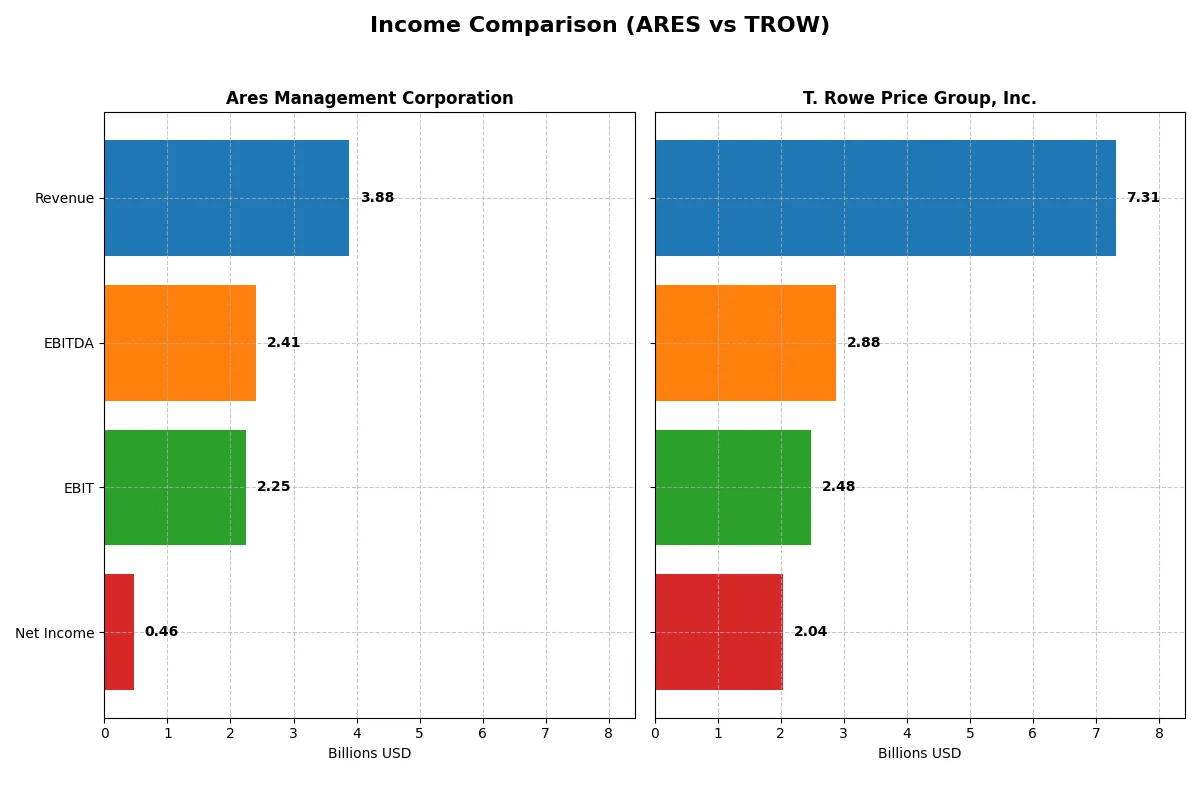
| Metric | Ares Management Corporation (ARES) | T. Rowe Price Group, Inc. (TROW) |
|---|---|---|
| Revenue | 3.88B | 7.31B |
| Cost of Revenue | 1.73B | 1.14B |
| Operating Expenses | 1.21B | 5.13B |
| Gross Profit | 2.15B | 6.18B |
| EBITDA | 2.41B | 2.88B |
| EBIT | 2.25B | 2.48B |
| Interest Expense | 978M | 0 |
| Net Income | 410M | 2.04B |
| EPS | 2.07 | 9.26 |
| Fiscal Year | 2024 | 2025 |
Income Statement Analysis: The Bottom-Line Duel
This income statement comparison reveals which company operates its business more efficiently through revenue generation and profit conversion.
Ares Management Corporation Analysis
Ares Management’s revenue climbed steadily from 1.76B in 2020 to 3.88B in 2024, doubling over five years. Gross margin remains robust at 55.4%, while net margin holds a respectable 11.9%. Despite a slight dip in net income and EPS growth in 2024, the company sustains favorable operating expense control and solid earnings momentum.
T. Rowe Price Group, Inc. Analysis
T. Rowe Price’s revenue peaked at 7.67B in 2021 but declined modestly to 7.31B in 2025. Its gross margin impresses at 84.4%, yet net margin dropped to 27.8% with a recent 6% net margin contraction. Operating expenses grew faster than revenue in 2025, signaling margin pressure despite steady EPS growth and strong absolute net income of 2.04B.
Margin Discipline vs. Scale Dominance
Ares Management delivers consistent revenue and net income growth with stable margins, signaling operational discipline. T. Rowe Price shows superior scale and higher absolute profits but struggles with margin erosion and revenue decline. For investors, Ares presents a disciplined growth profile, while T. Rowe Price offers scale tempered by recent efficiency challenges.
Financial Ratios Comparison
These vital ratios act as a diagnostic tool to expose the underlying fiscal health, valuation premiums, and capital efficiency of the companies compared below:
| Ratios | Ares Management Corporation (ARES) | T. Rowe Price Group, Inc. (TROW) |
|---|---|---|
| ROE | 13.1% | 20.3% |
| ROIC | 4.0% | 13.6% |
| P/E | 75.6 | 12.0 |
| P/B | 9.89 | 2.44 |
| Current Ratio | 0.98 | 8.01 |
| Quick Ratio | 0.98 | 8.01 |
| D/E (Debt-to-Equity) | 3.71 | 0.03 |
| Debt-to-Assets | 52.8% | 2.1% |
| Interest Coverage | 0.97 | 0 (not available) |
| Asset Turnover | 0.16 | 0.53 |
| Fixed Asset Turnover | 5.64 | 5.89 |
| Payout Ratio | 283% | 54% |
| Dividend Yield | 3.74% | 4.51% |
| Fiscal Year | 2024 | 2024 |
Efficiency & Valuation Duel: The Vital Signs
Financial ratios act as a company’s DNA, uncovering hidden risks and operational strengths that shape investor confidence and valuation.
Ares Management Corporation
Ares posts a modest 13.1% ROE and a solid 11.9% net margin, reflecting steady profitability. However, its valuation appears stretched with a P/E of 75.6 and a P/B near 9.9. The 3.7% dividend yield supports shareholder returns amid a reinvestment focus that excludes R&D, signaling reliance on mature cash flows.
T. Rowe Price Group, Inc.
T. Rowe Price delivers a robust 27.8% net margin and an attractively low P/E of 11.1, indicating efficient earnings relative to price. Its dividend yield of 5.0% enhances total returns, supported by favorable debt metrics and interest coverage. While ROE and ROIC data remain unavailable, the valuation suggests a disciplined capital allocation strategy.
Valuation Stretch vs. Operational Strength
T. Rowe Price offers a more balanced risk-reward profile with favorable valuation and strong margins. Conversely, Ares faces valuation headwinds despite steady profitability. Investors seeking operational efficiency and income might prefer T. Rowe, while those tolerating valuation risk may consider Ares.
Which one offers the Superior Shareholder Reward?
I compare Ares Management Corporation (ARES) and T. Rowe Price Group, Inc. (TROW) on dividend yield, payout ratio, and buybacks. ARES yields 3.74% with a payout ratio above 280%, signaling potential unsustainability. TROW yields 4.96% with a prudent 55% payout, supported by robust free cash flow. ARES shows heavy leverage and negative free cash flow, risking dividend cuts. TROW maintains strong margins, positive free cash flow (~$8/share), and consistent buybacks fueling total return. I conclude TROW offers a superior, sustainable shareholder reward in 2026.
Comparative Score Analysis: The Strategic Profile
The radar chart reveals the fundamental DNA and trade-offs of Ares Management Corporation and T. Rowe Price Group, Inc., highlighting their core financial strengths and weaknesses:
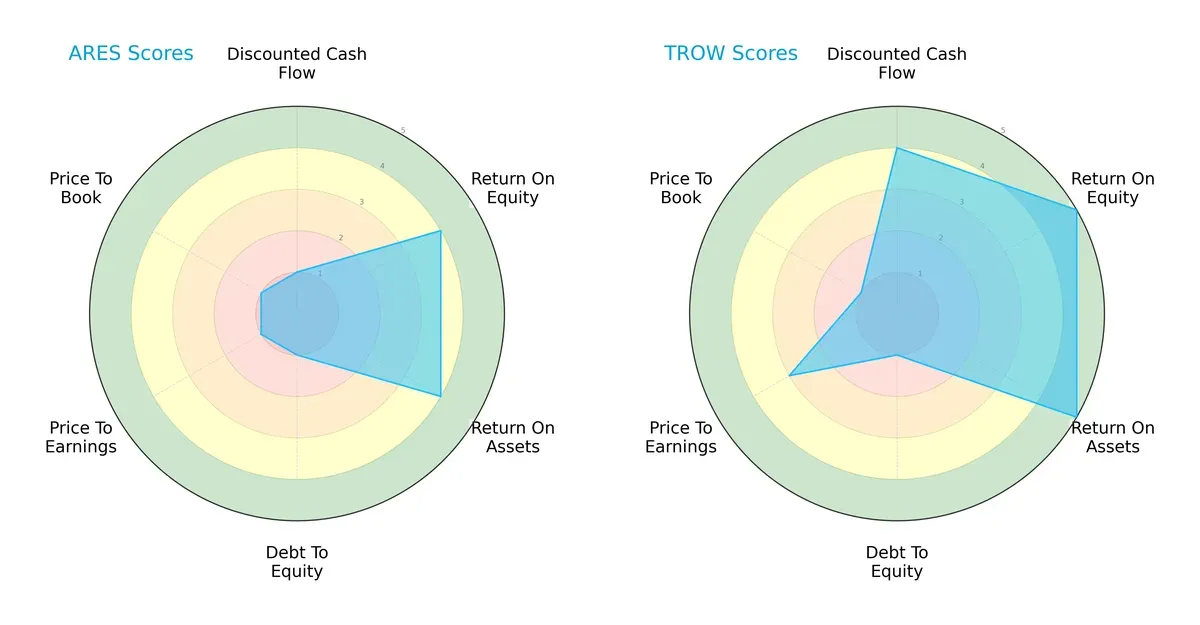
T. Rowe Price exhibits a more balanced and robust profile with top scores in DCF (4), ROE (5), and ROA (5), indicating efficient capital allocation and asset utilization. Ares Management relies heavily on operational efficiency (ROE 4, ROA 4) but struggles with valuation and leverage metrics (DCF 1, Debt/Equity 1, P/E 1, P/B 1). Both firms share a weak debt-to-equity position, but T. Rowe Price’s favorable valuation scores offer a more attractive risk-reward setup.
Bankruptcy Risk: Solvency Showdown
The Altman Z-Score comparison highlights T. Rowe Price’s superior solvency position versus Ares Management, implying stronger long-term survival prospects in the current economic cycle:
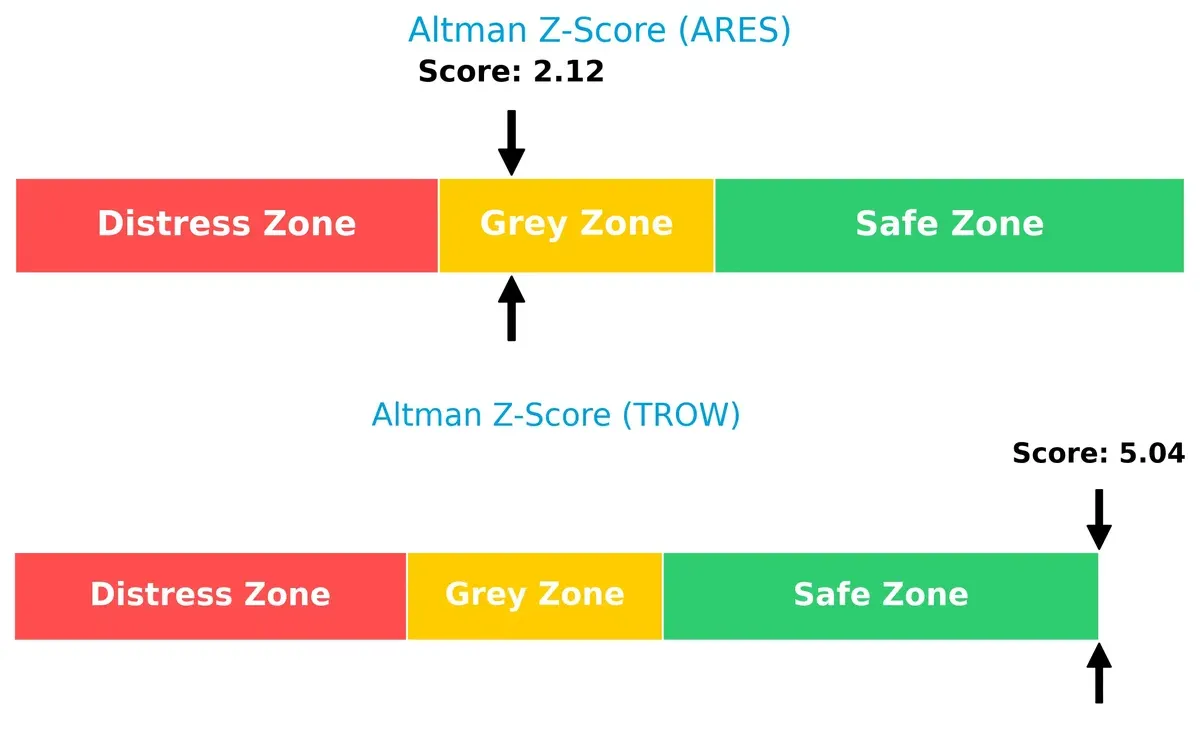
T. Rowe Price scores 5.04, safely above the distress threshold, signaling financial stability. Ares Management’s 2.12 places it in the grey zone, cautioning investors about moderate bankruptcy risk amid market volatility.
Financial Health: Quality of Operations
Piotroski F-Scores indicate Ares Management maintains stronger internal financial health compared to T. Rowe Price, suggesting higher operational quality and value potential:
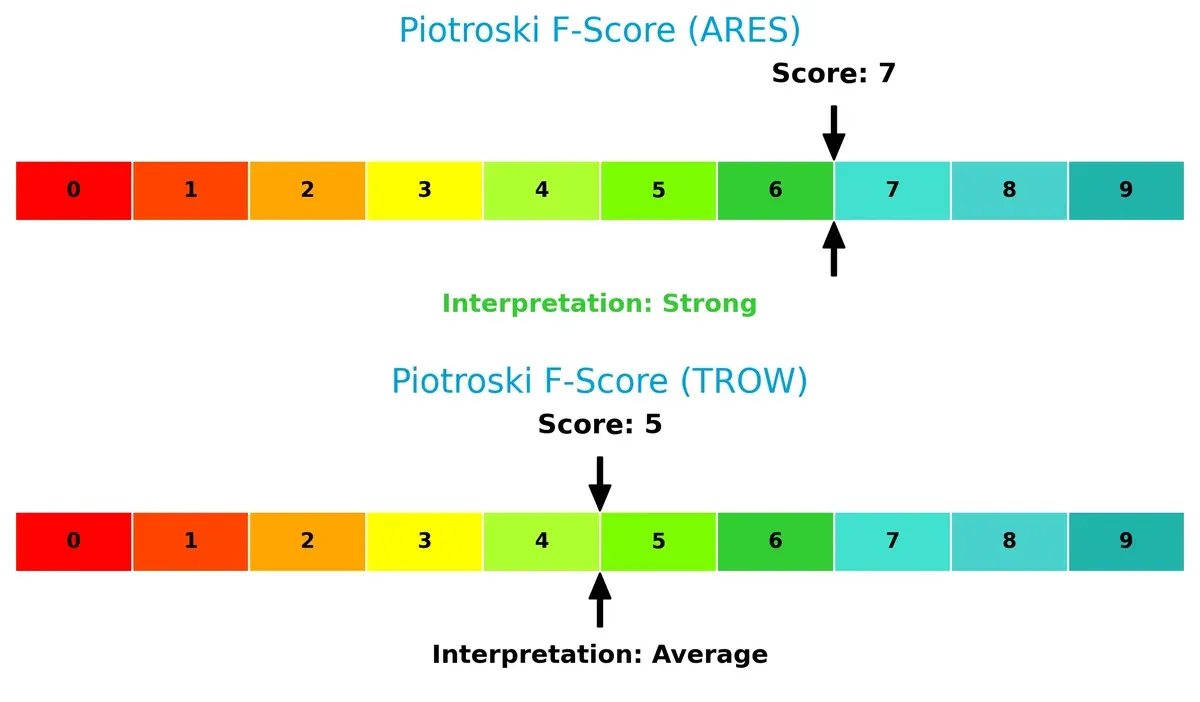
Ares posts a strong 7 out of 9, reflecting solid profitability and efficiency, while T. Rowe Price’s score of 5 signals average financial health with potential red flags. Investors should weigh this operational strength against T. Rowe Price’s better solvency and valuation metrics.
How are the two companies positioned?
This section dissects ARES and TROW’s operational DNA by comparing revenue distribution and internal dynamics. The goal is to confront their economic moats and identify the more resilient, sustainable competitive advantage today.
Revenue Segmentation: The Strategic Mix
This visual comparison dissects how Ares Management Corporation and T. Rowe Price Group diversify their income streams and where their primary sector bets lie:
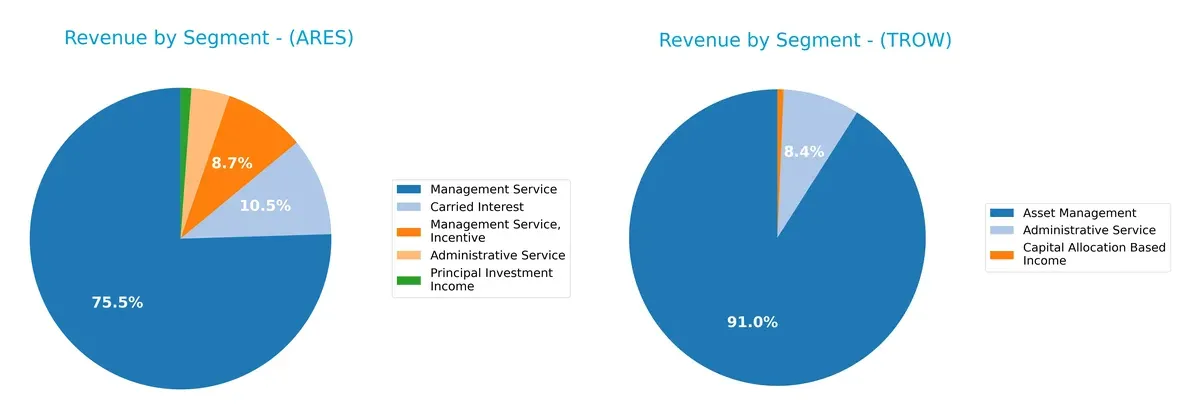
Ares Management shows a more fragmented mix, with Management Service anchoring at $3B and Carried Interest at $417M in 2024. In contrast, T. Rowe Price pivots heavily on Asset Management, generating $6.4B, dwarfing its $588M Administrative Service revenue. Ares’s diverse fee and incentive streams reduce concentration risk, while T. Rowe’s reliance on Asset Management signals strong ecosystem lock-in but greater exposure to market volatility.
Strengths and Weaknesses Comparison
This table compares the Strengths and Weaknesses of Ares Management Corporation and T. Rowe Price Group, Inc.:
ARES Strengths
- Diverse revenue streams including management, carried interest, and principal investment income
- Favorable net margin near 12%
- Strong dividend yield of 3.74%
- High fixed asset turnover indicates efficient asset use
TROW Strengths
- High net margin of 27.84%
- Favorable P/E at 11.08 and PB ratio
- Strong dividend yield of 4.96%
- No debt and excellent interest coverage ratio
ARES Weaknesses
- Unfavorable ROIC below WACC at 3.96% vs. 8.12% WACC
- High debt-to-assets ratio above 50%
- Unfavorable current ratio below 1
- Elevated P/E and PB ratios suggest overvaluation
- Low asset turnover
TROW Weaknesses
- Unfavorable zero ROE and ROIC raise profitability concerns
- Unavailable WACC data limits cost of capital insights
- Unfavorable liquidity ratios at zero
- Low asset and fixed asset turnover
Both companies exhibit solid profitability metrics but differ in capital structure and liquidity. Ares carries more leverage with weaker efficiency ratios, while T. Rowe Price shows strong profitability yet lacks liquidity and capital efficiency data, influencing their strategic risk profiles.
The Moat Duel: Analyzing Competitive Defensibility
A structural moat alone shields long-term profits from relentless competition and market pressures. Here’s how Ares Management and T. Rowe Price stack up:
Ares Management Corporation: Diversified Alternative Asset Moat
Ares leverages intangible assets and control investments, reflected in stable gross margins near 55% and growing ROIC despite current value destruction. New credit and real estate products could deepen this moat in 2026.
T. Rowe Price Group, Inc.: Traditional Asset Management Brand Moat
T. Rowe Price banks on brand loyalty and scale, with a superior gross margin of 84% and a strong net margin of 28%. However, declining ROIC trends suggest challenges sustaining this moat amid market shifts.
Alternative Assets vs. Brand Loyalty: Which Moat Prevails?
Ares’ growing ROIC trend signals a potentially deeper moat despite current value loss. T. Rowe’s high margins are impressive but face erosion risks. I see Ares better positioned to defend market share long term.
Which stock offers better returns?
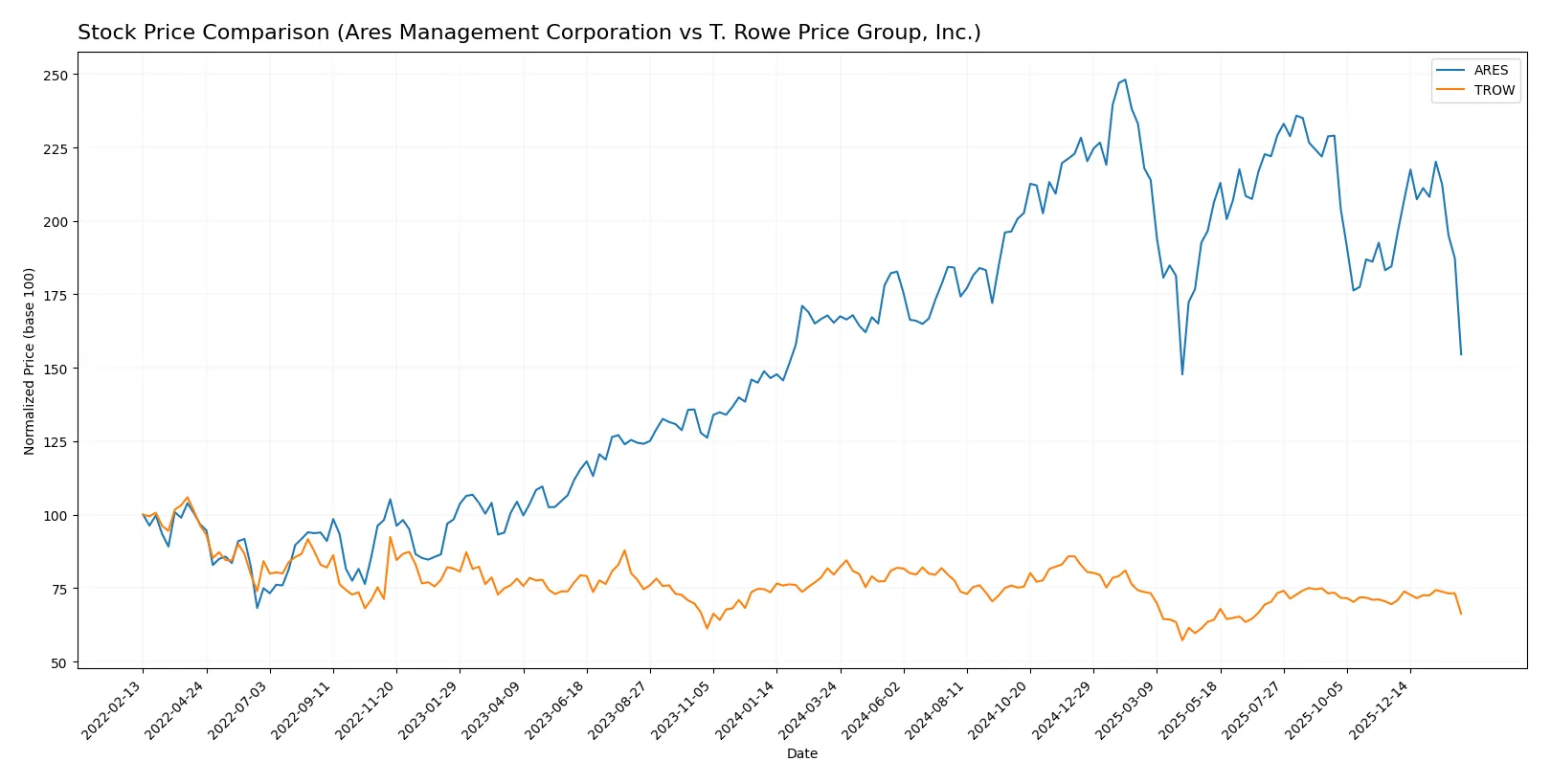
Over the past 12 months, both Ares Management Corporation and T. Rowe Price Group, Inc. experienced notable price declines, reflecting bearish trends with differing momentum and volatility profiles.
Trend Comparison
Ares Management Corporation’s stock declined 6.51% over the past year, marking a bearish trend with decelerating losses and a high volatility of 18.86%. The stock peaked at 198.22 and bottomed at 118.04.
T. Rowe Price Group, Inc. posted a steeper 16.69% decline, also bearish but with accelerating losses and lower volatility at 8.84%. Its highest price was 123.84 and lowest 82.6 during the same period.
Comparing the two, Ares delivered a smaller loss and milder bearish trend, outperforming T. Rowe Price in market performance over the past year.
Target Prices
Analysts present a moderately bullish consensus for Ares Management Corporation and T. Rowe Price Group, Inc. in 2026.
| Company | Target Low | Target High | Consensus |
|---|---|---|---|
| Ares Management Corporation | 178 | 224 | 206.4 |
| T. Rowe Price Group, Inc. | 94 | 123 | 110.67 |
The consensus targets imply upside potential of about 67% for Ares and 16% for T. Rowe Price versus current prices. Analysts expect stronger growth or valuation re-rating for Ares relative to its current 123 price.

Don’t Let Luck Decide Your Entry Point
Optimize your entry points with our advanced ProRealTime indicators. You’ll get efficient buy signals with precise price targets for maximum performance. Start outperforming now!
How do institutions grade them?
The following tables summarize the latest reliable institutional grades for both companies:
Ares Management Corporation Grades
This table presents recent grades from key financial institutions for Ares Management Corporation.
| Grading Company | Action | New Grade | Date |
|---|---|---|---|
| TD Cowen | Maintain | Buy | 2026-01-14 |
| UBS | Maintain | Neutral | 2026-01-13 |
| Barclays | Maintain | Overweight | 2026-01-09 |
| Barclays | Maintain | Overweight | 2025-12-12 |
| TD Cowen | Maintain | Buy | 2025-11-04 |
| Keefe, Bruyette & Woods | Maintain | Outperform | 2025-11-04 |
| Morgan Stanley | Maintain | Equal Weight | 2025-10-21 |
| Oppenheimer | Upgrade | Outperform | 2025-10-14 |
| Barclays | Maintain | Overweight | 2025-10-08 |
| B of A Securities | Maintain | Buy | 2025-10-03 |
T. Rowe Price Group, Inc. Grades
This table presents recent grades from key financial institutions for T. Rowe Price Group, Inc.
| Grading Company | Action | New Grade | Date |
|---|---|---|---|
| Keefe, Bruyette & Woods | Maintain | Market Perform | 2026-02-05 |
| Morgan Stanley | Maintain | Equal Weight | 2026-02-03 |
| JP Morgan | Maintain | Underweight | 2026-01-20 |
| Barclays | Maintain | Underweight | 2026-01-15 |
| TD Cowen | Maintain | Hold | 2026-01-14 |
| Keefe, Bruyette & Woods | Maintain | Market Perform | 2025-12-17 |
| Morgan Stanley | Maintain | Equal Weight | 2025-12-17 |
| Barclays | Maintain | Underweight | 2025-12-12 |
| Evercore ISI Group | Maintain | In Line | 2025-12-05 |
| Keefe, Bruyette & Woods | Maintain | Market Perform | 2025-11-03 |
Which company has the best grades?
Ares Management Corporation consistently receives higher grades such as Buy, Overweight, and Outperform. T. Rowe Price’s ratings mostly range from Market Perform to Underweight. This disparity may influence investor confidence and portfolio positioning.
Risks specific to each company
The following categories identify critical pressure points and systemic threats facing Ares Management Corporation and T. Rowe Price Group, Inc. in the 2026 market environment:
1. Market & Competition
Ares Management Corporation
- Faces intense competition in alternative asset management, with pressure on fee structures and fundraising.
T. Rowe Price Group, Inc.
- Competes broadly in traditional asset management, challenged by passive investing trends and fee compression.
2. Capital Structure & Debt
Ares Management Corporation
- High debt-to-equity (3.71) and debt-to-assets (52.84%) ratios increase financial risk and constrain flexibility.
T. Rowe Price Group, Inc.
- Virtually no debt, reflecting a strong balance sheet and lower financial risk.
3. Stock Volatility
Ares Management Corporation
- Beta at 1.524 indicates above-market volatility, raising risk during market downturns.
T. Rowe Price Group, Inc.
- Slightly higher beta at 1.546 suggests marginally more sensitivity to market swings.
4. Regulatory & Legal
Ares Management Corporation
- Operates across multiple regions, exposing it to complex regulatory frameworks and compliance costs.
T. Rowe Price Group, Inc.
- Also global but with a more traditional asset base, faces steady but manageable regulatory oversight.
5. Supply Chain & Operations
Ares Management Corporation
- Relies on alternative asset deal flow and capital markets, vulnerable to liquidity tightening and economic cycles.
T. Rowe Price Group, Inc.
- Operations focused on equity and fixed income funds, sensitive to market sentiment and fund outflows.
6. ESG & Climate Transition
Ares Management Corporation
- ESG integration less prominent, potentially lagging peers amid growing investor demand for sustainability.
T. Rowe Price Group, Inc.
- Strong emphasis on ESG investing, aligning with industry shift and regulatory pressures.
7. Geopolitical Exposure
Ares Management Corporation
- Exposed to geopolitical risks via global alternative investments, especially in emerging markets.
T. Rowe Price Group, Inc.
- Broad global footprint with diversified exposure, but sensitive to trade tensions and regulatory changes.
Which company shows a better risk-adjusted profile?
The most impactful risk for Ares is its stretched capital structure, with debt levels that could impair resilience in downturns. For T. Rowe Price, regulatory and market pressures on fee models stand out. T. Rowe Price’s strong balance sheet and favorable valuation metrics give it a better risk-adjusted profile. Notably, Ares’ Altman Z-Score in the grey zone signals moderate financial distress risk, reinforcing caution.
Final Verdict: Which stock to choose?
Ares Management Corporation’s superpower lies in its improving profitability amid challenging capital efficiency. While its high leverage and low liquidity pose risks, I see it fitting an aggressive growth portfolio that tolerates volatility for potential value creation.
T. Rowe Price Group commands a strategic moat through exceptional income quality and strong balance sheet safety. Its steady cash generation and lower financial risk appeal to investors seeking growth at a reasonable price with more stability than Ares.
If you prioritize dynamic growth and can absorb financial risk, Ares offers a compelling scenario due to its rising profitability despite leverage concerns. However, if you seek a safer growth strategy with consistent cash flow and a proven moat, T. Rowe Price outshines as the more stable choice.
Disclaimer: Investment carries a risk of loss of initial capital. The past performance is not a reliable indicator of future results. Be sure to understand risks before making an investment decision.
Go Further
I encourage you to read the complete analyses of Ares Management Corporation and T. Rowe Price Group, Inc. to enhance your investment decisions: