Home > Comparison > Technology > APP vs PEGA
The strategic rivalry between AppLovin Corporation and Pegasystems Inc. defines the current trajectory of the technology sector’s software application industry. AppLovin operates a dynamic, data-driven mobile marketing platform, whereas Pegasystems delivers enterprise-grade customer engagement and automation software. This clash represents a broader contest between high-growth digital marketing innovation and established enterprise solutions. This analysis will identify which model offers a superior risk-adjusted return for a diversified technology-focused portfolio.
Table of contents
Companies Overview
AppLovin Corporation and Pegasystems Inc. both lead in software application innovation with distinct market focuses and strategies.
AppLovin Corporation: Mobile App Marketing Powerhouse
AppLovin dominates mobile app marketing by providing a software platform that connects advertisers and publishers through real-time auctions. Its core revenue derives from marketing and monetization tools like AppDiscovery and MAX, optimizing ad inventory value. In 2026, AppLovin emphasizes expanding its in-app bidding technology to reinforce its competitive edge in mobile advertising.
Pegasystems Inc.: Enterprise Software Innovator
Pegasystems leads in enterprise software with solutions for customer engagement and digital process automation. It generates revenue from its Pega Platform and Pega Infinity, delivering automation and customer experience tools across industries. In 2026, Pegasystems focuses on enhancing cloud-based deployments and intelligent automation to deepen enterprise integration and operational efficiency.
Strategic Collision: Similarities & Divergences
Both compete in software but target different markets—AppLovin in mobile app monetization, Pegasystems in enterprise automation. AppLovin’s strength lies in real-time ad auctions, while Pegasystems excels in unified customer engagement platforms. Their battleground centers on digital transformation tools, yet their investment profiles diverge: one thrives on ad tech volatility, the other on steady enterprise SaaS adoption.
Income Statement Comparison
This data dissects the core profitability and scalability of both corporate engines to reveal who dominates the bottom line:
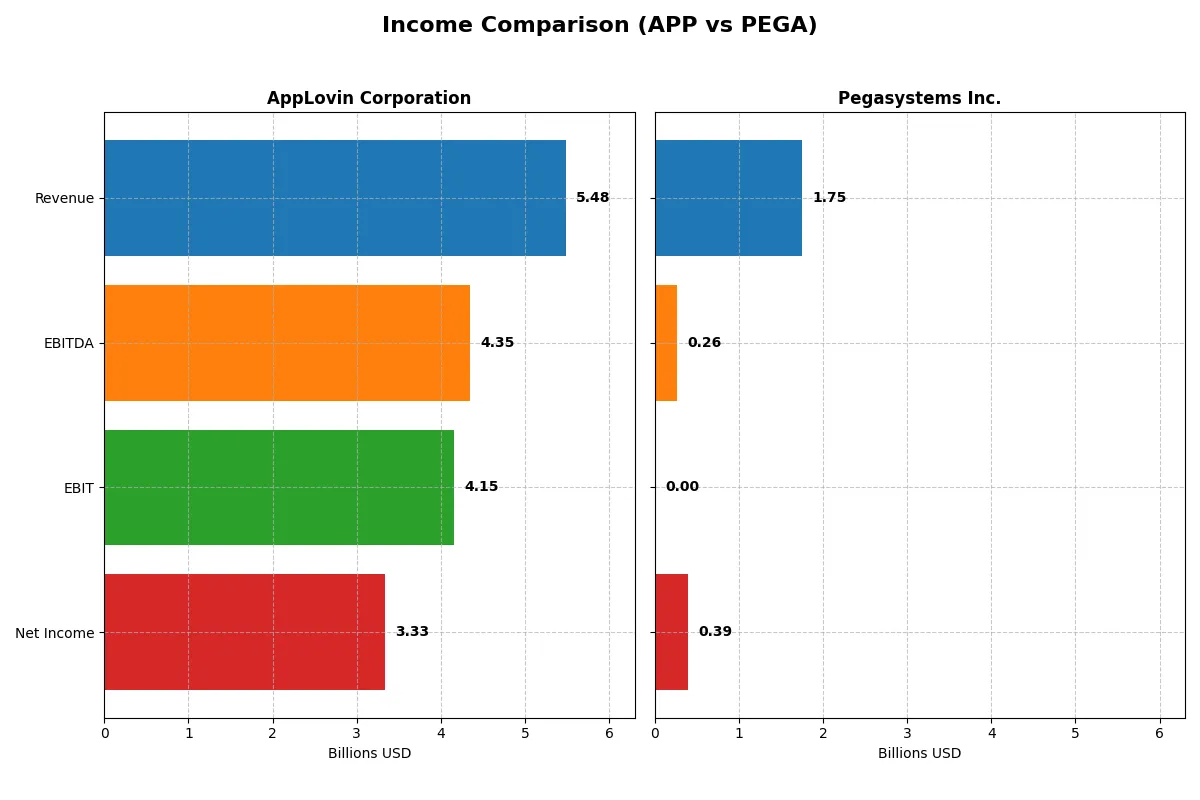
| Metric | AppLovin Corporation (APP) | Pegasystems Inc. (PEGA) |
|---|---|---|
| Revenue | 5.48B | 1.75B |
| Cost of Revenue | 665M | 421M |
| Operating Expenses | 664M | 1.04B |
| Gross Profit | 4.82B | 1.32B |
| EBITDA | 4.35B | 263M |
| EBIT | 4.15B | 0 |
| Interest Expense | 207M | -1.29M |
| Net Income | 3.33B | 393M |
| EPS | 9.84 | 2.3 |
| Fiscal Year | 2025 | 2025 |
Income Statement Analysis: The Bottom-Line Duel
This income statement comparison exposes the core efficiency and profitability dynamics driving each company’s financial engine.
AppLovin Corporation Analysis
AppLovin’s revenue nearly doubled from 2021 to 2025, reaching 5.48B in 2025. Net income surged to 3.33B, reflecting impressive scale. Its gross margin remains exceptionally high at 87.9%, and net margin expands to 60.8%, signaling outstanding cost control and operational leverage. The 2025 figures reveal accelerating momentum and robust profitability.
Pegasystems Inc. Analysis
Pegasystems’ revenue grew steadily by 44% over five years, hitting 1.75B in 2025. Net income climbed to 393M, showing solid bottom-line progress. Gross margin stands at a healthy 75.9%, but EBIT margin dropped to zero, pointing to pressure on core operations. Despite this, net margin improved to 22.5%, supported by favorable interest income and tax effects in 2025.
Verdict: High Margin Dominance vs. Steady Growth Discipline
AppLovin outpaces Pegasystems in absolute scale and margin dominance, delivering superior profitability and growth momentum. Pegasystems shows consistent revenue growth but struggles to convert it into operating profits. Investors seeking commanding margin power and rapid earnings expansion may prefer AppLovin’s profile, while Pegasystems offers steadier, albeit less efficient, income advancement.
Financial Ratios Comparison
These vital ratios act as a diagnostic tool to expose the underlying fiscal health, valuation premiums, and capital efficiency of the companies compared below:
| Ratios | AppLovin Corporation (APP) | Pegasystems Inc. (PEGA) |
|---|---|---|
| ROE | 156.2% | 49.97% |
| ROIC | 60.7% | 29.4% |
| P/E | 68.5 | 25.9 |
| P/B | 106.9 | 13.0 |
| Current Ratio | 3.32 | 1.33 |
| Quick Ratio | 3.32 | 1.33 |
| D/E | 1.66 | 0.08 |
| Debt-to-Assets | 48.8% | 3.7% |
| Interest Coverage | 20.1 | -204.7 |
| Asset Turnover | 0.75 | 1.07 |
| Fixed Asset Turnover | 37.1 | 0 |
| Payout ratio | 0% | 3.9% |
| Dividend yield | 0% | 0.15% |
| Fiscal Year | 2025 | 2025 |
Efficiency & Valuation Duel: The Vital Signs
Financial ratios act as the company’s DNA, exposing hidden risks and operational strengths critical to investment decisions.
AppLovin Corporation
AppLovin shows exceptional profitability with a 156% ROE and a robust 60.8% net margin, highlighting operational efficiency. However, its valuation appears stretched with a P/E of 68.5 and a P/B of 107. The company pays no dividend, opting to reinvest heavily in R&D for growth, balancing shareholder returns through capital deployment.
Pegasystems Inc.
Pegasystems delivers solid profitability, with a 50% ROE and a 22.5% net margin, demonstrating efficient operations. It trades at a more reasonable P/E of 25.9 and P/B of 13, though these remain elevated. The company offers a modest 0.15% dividend yield, indicating some shareholder return alongside growth investments.
Premium Valuation vs. Operational Safety
AppLovin’s superior profitability contrasts with its stretched valuation and no dividend, increasing risk despite high returns. Pegasystems offers a better risk-reward balance with solid profitability, moderate valuation, and some dividend income. Investors seeking growth may lean toward AppLovin; those preferring operational safety and income might favor Pegasystems.
Which one offers the Superior Shareholder Reward?
AppLovin Corporation (APP) does not pay dividends but reinvests heavily in growth, boasting a 0% payout ratio and zero dividend yield. Pegasystems Inc. (PEGA) pays a modest dividend yield of ~0.15% with a payout ratio near 4%. APP’s buyback intensity is not explicitly stated but its free cash flow per share of $11.7 and strong operating margins suggest ample capital for repurchases. PEGA’s dividend, though small, is supported by consistent free cash flow of $3.0 per share and moderate leverage. I see APP’s reinvestment and potential buybacks as more sustainable and value-creating in 2026, offering superior total return potential compared to PEGA’s conservative dividend approach.
Comparative Score Analysis: The Strategic Profile
The radar chart reveals the fundamental DNA and trade-offs of AppLovin Corporation and Pegasystems Inc., highlighting their core financial strengths and weaknesses:
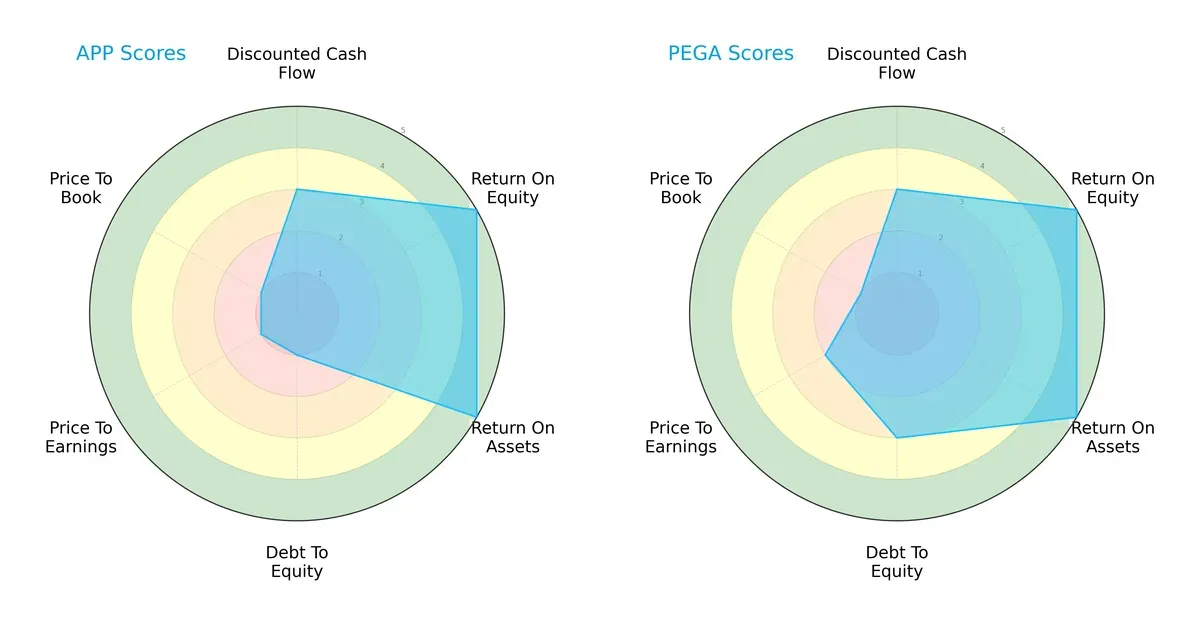
Both companies score equally on discounted cash flow, return on equity, and return on assets, reflecting efficient capital use and profit generation. However, AppLovin’s debt-to-equity and valuation metrics lag significantly, indicating higher financial risk and overvaluation concerns. Pegasystems offers a more balanced profile with moderate leverage and a slightly better price-to-earnings score, suggesting greater stability and relative undervaluation.
Bankruptcy Risk: Solvency Showdown
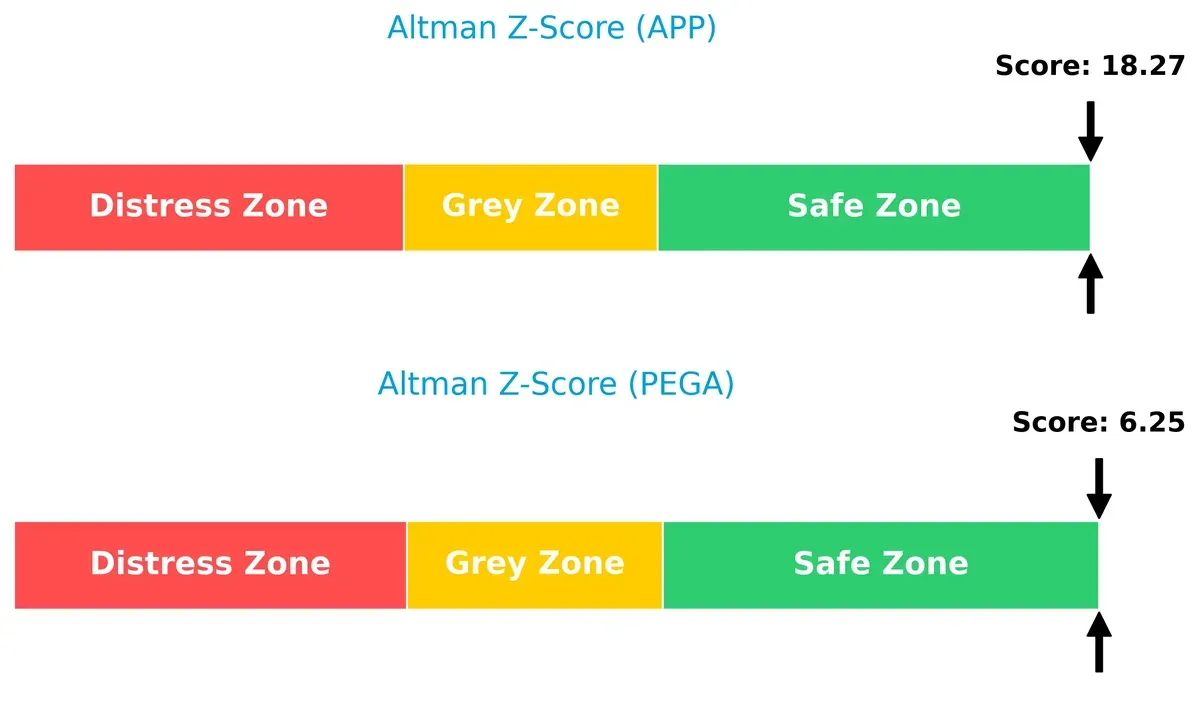
The Altman Z-Score gap shows AppLovin and Pegasystems both reside comfortably in the safe zone, suggesting strong solvency and low bankruptcy risk in this market cycle:
Financial Health: Quality of Operations
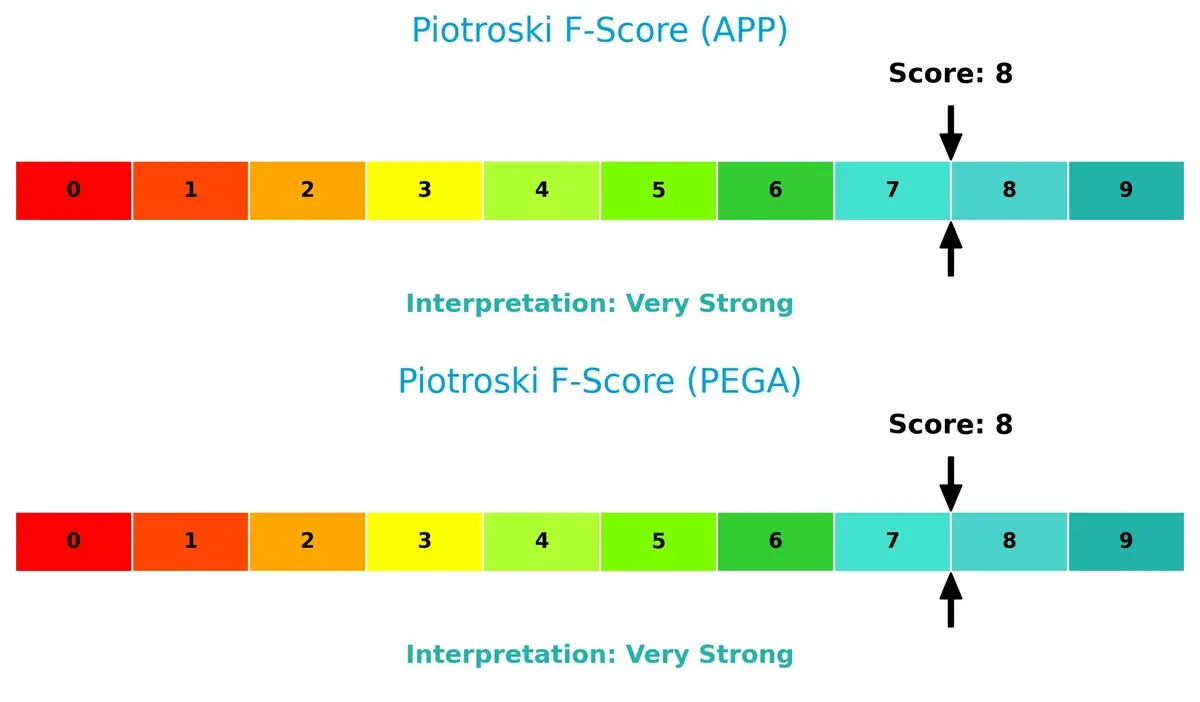
Both firms score an impressive 8 on the Piotroski F-Score, signaling very strong internal financial health and operational efficiency. Neither shows red flags in profitability, leverage, or liquidity metrics, marking them as quality operators in their sectors:
How are the two companies positioned?
This section dissects the operational DNA of APP and PEGA by comparing their revenue distribution and internal dynamics. The goal is to confront their economic moats to identify which model offers the most resilient competitive advantage today.
Revenue Segmentation: The Strategic Mix
This visual comparison dissects how AppLovin Corporation and Pegasystems Inc. diversify their income streams and where their primary sector bets lie:
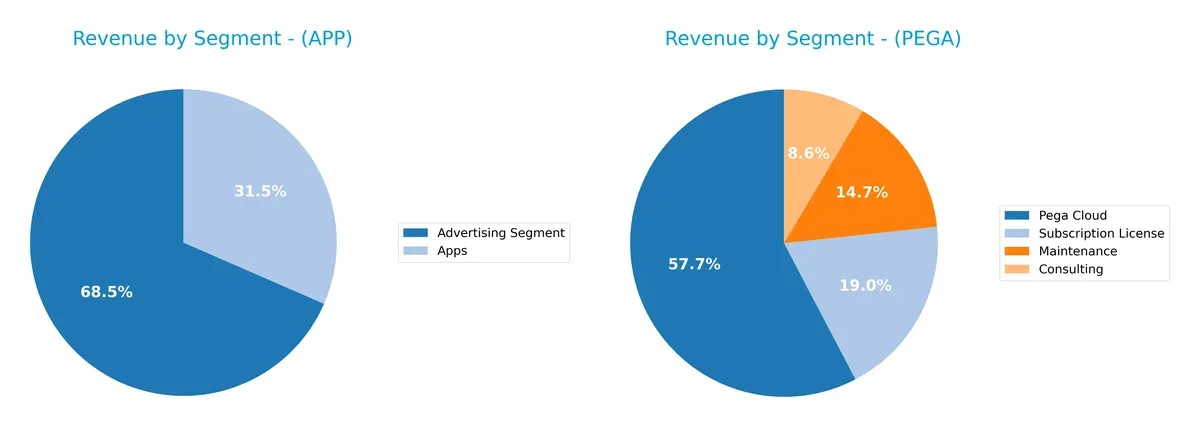
AppLovin leans heavily on its Advertising segment, generating $3.22B in 2024, which dwarfs its $1.49B Apps revenue. Pegasystems shows a more balanced mix, with Pega Cloud anchoring $1.54B and substantial contributions from Maintenance ($393M) and Subscription License ($507M). AppLovin’s reliance on advertising signals concentration risk, while Pegasystems’ diversified mix supports an ecosystem lock-in through cloud infrastructure and recurring revenue.
Strengths and Weaknesses Comparison
This table compares the Strengths and Weaknesses of AppLovin Corporation and Pegasystems Inc.:
AppLovin Corporation Strengths
- High net margin of 60.83%
- Extremely strong ROE at 156.17%
- Robust ROIC at 60.71%
- Favorable quick ratio of 3.32
- High interest coverage of 20.06
- Significant US and global revenue diversification
Pegasystems Inc. Strengths
- Solid net margin at 22.54%
- Strong ROE of 49.97%
- Favorable ROIC of 29.43%
- Low debt-to-equity ratio of 0.08
- Favorable asset turnover of 1.07
- Diverse revenue streams including cloud and consulting
AppLovin Corporation Weaknesses
- Unfavorable high WACC at 15.1%
- Expensive valuation with PE of 68.47 and PB of 106.94
- Elevated debt-to-equity ratio of 1.66
- Unfavorable current ratio of 3.32 despite liquidity
- No dividend yield
- Moderate debt-to-assets at 48.83%
Pegasystems Inc. Weaknesses
- Unfavorable PE of 25.92 and PB of 12.95
- Negative interest coverage
- Fixed asset turnover at zero
- Low dividend yield at 0.15%
- Moderate current ratio at 1.33
- Some unfavorable ratios dilute overall credit
AppLovin’s strengths lie in exceptional profitability and liquidity metrics, albeit with high leverage and valuation risks. Pegasystems shows a balanced profitability profile with conservative leverage but faces challenges in interest coverage and asset efficiency. These contrasts suggest differing strategic priorities and risk exposures.
The Moat Duel: Analyzing Competitive Defensibility
A structural moat is the only true barrier protecting long-term profits from relentless competitive erosion. Let’s dissect the moats of two software players:
AppLovin Corporation: Data-Driven Network Effects Moat
AppLovin leverages powerful network effects via its mobile app marketing platform, reflected in a stellar ROIC 45.6% above WACC and margin stability near 60%. Its expanding global reach and innovative in-app bidding deepen this moat in 2026.
Pegasystems Inc.: Enterprise Intangible Assets Moat
Pegasystems relies on entrenched enterprise software licenses and customer relationships, generating a solid ROIC 20.8% above WACC. While its moat is narrower than AppLovin’s, cloud platform expansion offers upside for broader market penetration.
Verdict: Network Effects vs. Intangible Assets in Software
AppLovin’s data-driven network effects create a wider and more scalable moat than Pegasystems’ traditional enterprise asset base. AppLovin is better positioned to defend and grow market share amid intensifying tech competition.
Which stock offers better returns?
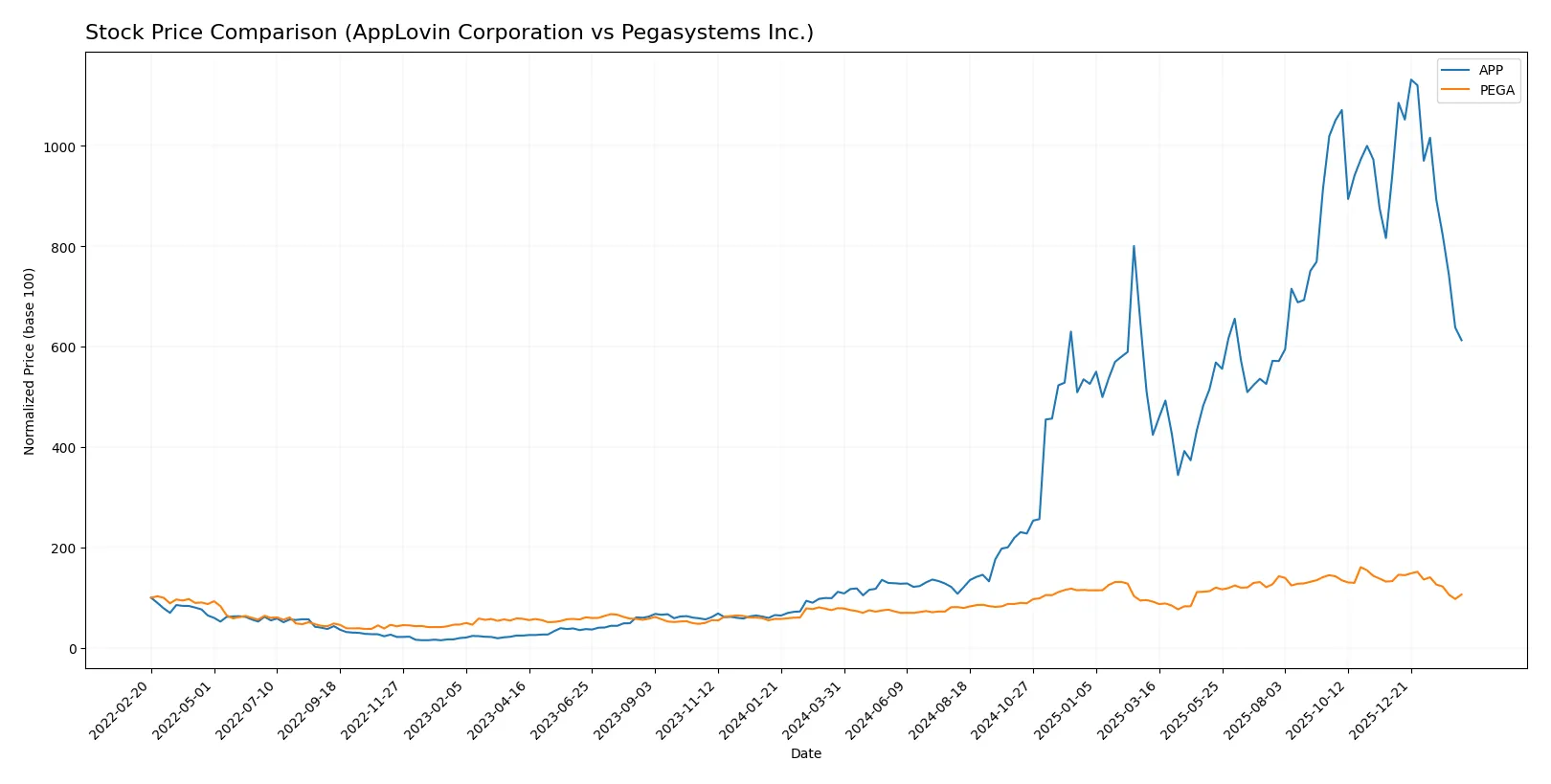
The past year revealed stark contrasts between AppLovin Corporation and Pegasystems Inc., with APP exhibiting dramatic price swings and PEGA showing steadier, modest gains.
Trend Comparison
AppLovin’s stock surged 448.29% over 12 months, signaling a strong bullish trend despite decelerating momentum. The price hit a high of 721.37 before recent declines.
Pegasystems gained 34.39% over the same period, maintaining a bullish but decelerating trend with lower volatility and a recent mild downtrend starting late 2025.
AppLovin’s performance dwarfs Pegasystems’ in total returns despite higher volatility and recent weakness, making APP the stronger performer over the last year.
Target Prices
Analysts present a moderately optimistic consensus for AppLovin Corporation and Pegasystems Inc.
| Company | Target Low | Target High | Consensus |
|---|---|---|---|
| AppLovin Corporation | 543 | 835 | 690.93 |
| Pegasystems Inc. | 48 | 65 | 58.25 |
The consensus target for AppLovin stands nearly 77% above its current price of 390.55, signaling strong growth expectations. Pegasystems’ target consensus exceeds its current 43.85 price by about 33%, reflecting moderate bullish sentiment.

Don’t Let Luck Decide Your Entry Point
Optimize your entry points with our advanced ProRealTime indicators. You’ll get efficient buy signals with precise price targets for maximum performance. Start outperforming now!
How do institutions grade them?
AppLovin Corporation Grades
The following table summarizes recent institutional grades for AppLovin Corporation:
| Grading Company | Action | New Grade | Date |
|---|---|---|---|
| Wells Fargo | Maintain | Overweight | 2026-02-12 |
| Citigroup | Maintain | Buy | 2026-02-12 |
| RBC Capital | Maintain | Outperform | 2026-02-12 |
| UBS | Maintain | Buy | 2026-02-12 |
| Wedbush | Maintain | Outperform | 2026-02-12 |
| Piper Sandler | Maintain | Overweight | 2026-02-12 |
| Jefferies | Maintain | Buy | 2026-02-12 |
| Scotiabank | Maintain | Sector Outperform | 2026-02-12 |
| BTIG | Maintain | Buy | 2026-02-12 |
| Goldman Sachs | Maintain | Neutral | 2026-02-12 |
Pegasystems Inc. Grades
The following table summarizes recent institutional grades for Pegasystems Inc.:
| Grading Company | Action | New Grade | Date |
|---|---|---|---|
| Rosenblatt | Maintain | Buy | 2026-02-12 |
| RBC Capital | Maintain | Outperform | 2026-02-12 |
| Citizens | Maintain | Market Outperform | 2026-02-12 |
| Barclays | Upgrade | Overweight | 2026-02-12 |
| Wedbush | Maintain | Outperform | 2026-02-12 |
| Citigroup | Maintain | Buy | 2026-02-12 |
| Rosenblatt | Maintain | Buy | 2026-02-06 |
| JP Morgan | Maintain | Overweight | 2025-12-05 |
| RBC Capital | Maintain | Outperform | 2025-10-23 |
| Wedbush | Maintain | Outperform | 2025-10-23 |
Which company has the best grades?
Both companies maintain predominantly positive grades from reputable institutions. AppLovin has consistent “Buy” and “Outperform” ratings but includes one “Neutral.” Pegasystems shows a slightly stronger upgrade trend, including an upgrade to “Overweight” by Barclays. Investors may interpret Pegasystems’ upgrades as a sign of improving sentiment compared to AppLovin’s stable but less upwardly revised ratings.
Risks specific to each company
The following categories identify critical pressure points and systemic threats facing AppLovin Corporation and Pegasystems Inc. in the 2026 market environment:
1. Market & Competition
AppLovin Corporation
- Faces intense competition in mobile app marketing with high innovation demands.
Pegasystems Inc.
- Competes in enterprise software with diverse industry clients but slower growth dynamics.
2. Capital Structure & Debt
AppLovin Corporation
- High debt-to-equity ratio (1.66) raises financial risk despite strong interest coverage.
Pegasystems Inc.
- Low debt-to-equity (0.08) signals a conservative balance sheet, but weak interest coverage is concerning.
3. Stock Volatility
AppLovin Corporation
- High beta (2.49) indicates elevated stock price volatility and market sensitivity.
Pegasystems Inc.
- Moderate beta (1.07) implies more stable stock price movements relative to the market.
4. Regulatory & Legal
AppLovin Corporation
- Operates globally, exposing it to data privacy and advertising regulations risks.
Pegasystems Inc.
- Faces complex compliance requirements across multiple global jurisdictions affecting operations.
5. Supply Chain & Operations
AppLovin Corporation
- Relies heavily on digital infrastructure; disruptions could impact ad delivery and analytics.
Pegasystems Inc.
- Dependent on cloud and software delivery stability; operational disruptions could affect customer engagement.
6. ESG & Climate Transition
AppLovin Corporation
- Limited ESG disclosure may pose reputational risks amid increasing investor scrutiny.
Pegasystems Inc.
- More established governance but must adapt to evolving ESG standards in tech and services.
7. Geopolitical Exposure
AppLovin Corporation
- Significant US and international exposure, vulnerable to trade tensions and data laws.
Pegasystems Inc.
- Broad global footprint with risks from geopolitical instability in Europe and Asia-Pacific regions.
Which company shows a better risk-adjusted profile?
AppLovin’s most impactful risk is its high leverage, which raises financial vulnerability despite operational strengths. Pegasystems’ key risk lies in weak interest coverage, limiting its financial flexibility. Pegasystems shows a better risk-adjusted profile with lower debt and moderated volatility. The stark contrast in debt-to-equity ratios (1.66 vs. 0.08) justifies caution toward AppLovin’s capital structure.
Final Verdict: Which stock to choose?
AppLovin Corporation’s superpower lies in its exceptional capital efficiency and explosive profitability growth. It commands a very favorable moat with a soaring ROIC well above its cost of capital, signaling robust value creation. A point of vigilance is its stretched valuation multiples and debt metrics, which could amplify volatility. APP suits investors chasing aggressive growth with a tolerance for elevated risk.
Pegasystems Inc. boasts a strategic moat anchored in steady recurring revenue streams and a lean, low-debt balance sheet. Its financial profile offers greater stability compared to APP, with consistent free cash flow and a more moderate valuation premium. PEGA fits well in a GARP (Growth at a Reasonable Price) portfolio, appealing to those seeking growth tempered by prudent capital management.
If you prioritize aggressive expansion and can accept valuation risk, AppLovin outshines with superior profitability and rapid earnings growth. However, if you seek steadier cash flow and a more defensive stance with reasonable growth, Pegasystems offers better stability and a cleaner balance sheet. Both companies demonstrate sustainable competitive advantages, but your choice hinges on risk appetite and investment horizon.
Disclaimer: Investment carries a risk of loss of initial capital. The past performance is not a reliable indicator of future results. Be sure to understand risks before making an investment decision.
Go Further
I encourage you to read the complete analyses of AppLovin Corporation and Pegasystems Inc. to enhance your investment decisions: