Home > Comparison > Technology > MU vs ADI
The strategic rivalry between Micron Technology, Inc. and Analog Devices, Inc. shapes the semiconductor industry’s competitive landscape. Micron operates as a capital-intensive memory and storage manufacturer, while Analog Devices excels as a high-margin analog and mixed-signal IC provider. This analysis contrasts their distinct models, evaluating which offers superior risk-adjusted returns amid evolving technology demands. I aim to clarify which trajectory better suits a diversified portfolio seeking balanced growth and resilience.

Table of contents
Companies Overview
Micron Technology and Analog Devices dominate distinct niches within the semiconductor sector.
Micron Technology, Inc.: Memory and Storage Powerhouse
Micron Technology leads in memory and storage solutions, designing DRAM, NAND, and NOR semiconductor products. Its revenue stems from cloud, enterprise, mobile, and automotive markets. In 2026, Micron sharpens its focus on expanding embedded and mobile memory segments, leveraging low-latency and high-speed data retrieval to maintain technology leadership.
Analog Devices, Inc.: Precision Signal Processing Innovator
Analog Devices specializes in integrated circuits and mixed-signal processing, converting analog signals to digital and vice versa. Its core revenue comes from industrial, automotive, and communications sectors. The company prioritizes advanced power management and sensor technologies in 2026, aiming to enhance performance in high-end consumer and aerospace applications.
Strategic Collision: Similarities & Divergences
Both companies compete in semiconductors but follow divergent philosophies: Micron centers on high-capacity memory storage, while Analog Devices emphasizes precision analog and mixed-signal solutions. Their battleground is the expanding IoT and automotive market, where memory meets signal processing. Investors face contrasting profiles: Micron’s capital-intensive scale versus Analog’s technology-driven niche innovation.
Income Statement Comparison
The following data dissects the core profitability and scalability of both corporate engines to reveal who dominates the bottom line:
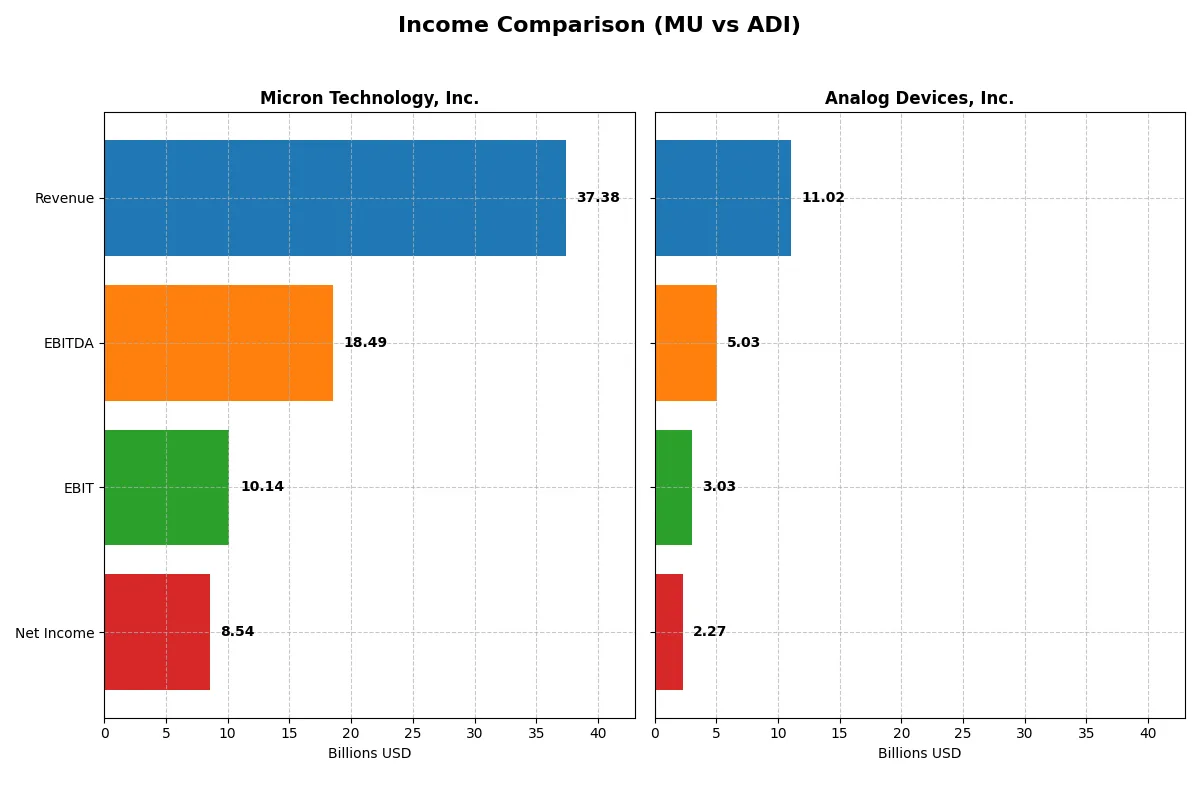
| Metric | Micron Technology, Inc. (MU) | Analog Devices, Inc. (ADI) |
|---|---|---|
| Revenue | 37.4B | 11.0B |
| Cost of Revenue | 22.5B | 5.0B |
| Operating Expenses | 5.0B | 3.0B |
| Gross Profit | 14.9B | 6.0B |
| EBITDA | 18.5B | 5.0B |
| EBIT | 10.1B | 3.0B |
| Interest Expense | 477M | 318M |
| Net Income | 8.5B | 2.3B |
| EPS | 7.65 | 4.59 |
| Fiscal Year | 2025 | 2025 |
Income Statement Analysis: The Bottom-Line Duel
This income statement comparison unveils the true efficiency and momentum driving each company’s financial engine.
Micron Technology, Inc. Analysis
Micron’s revenue surged from 15.5B in 2023 to 37.4B in 2025, with net income rebounding sharply from a 5.8B loss to an 8.5B profit. Gross margin improved to 39.8%, and net margin hit 22.8%, reflecting robust operational leverage and margin expansion in 2025, signaling strong efficiency recovery and growth momentum.
Analog Devices, Inc. Analysis
Analog Devices grew revenue steadily from 7.3B in 2021 to 11.0B in 2025, with net income rising from 1.4B to 2.3B. It maintains a superior gross margin at 54.7% and a consistent net margin around 20.6%. The 2025 results show solid margin stability and moderate revenue growth, highlighting disciplined cost management and reliable profitability.
Growth Surge vs. Margin Excellence
Micron outpaces Analog Devices in revenue and net income growth, fueled by a dramatic turnaround and expanding margins. Analog Devices impresses with higher gross margin and steadier profitability over time. For investors, Micron offers a high-growth profile with improving efficiency, while Analog Devices delivers consistent margin strength and stable earnings.
Financial Ratios Comparison
These vital ratios act as a diagnostic tool to expose the underlying fiscal health, valuation premiums, and capital efficiency of these semiconductor firms:
| Ratios | Micron Technology, Inc. (MU) | Analog Devices, Inc. (ADI) |
|---|---|---|
| ROE | 15.8% | 6.7% |
| ROIC | 12.1% | 5.5% |
| P/E | 15.9 | 51.1 |
| P/B | 2.51 | 3.42 |
| Current Ratio | 2.52 | 2.19 |
| Quick Ratio | 1.79 | 1.68 |
| D/E (Debt-to-Equity) | 0.28 | 0.26 |
| Debt-to-Assets | 18.5% | 18.1% |
| Interest Coverage | 20.7 | 9.45 |
| Asset Turnover | 0.45 | 0.23 |
| Fixed Asset Turnover | 0.79 | 3.32 |
| Payout ratio | 6.1% | 85.0% |
| Dividend yield | 0.38% | 1.66% |
| Fiscal Year | 2025 | 2025 |
Efficiency & Valuation Duel: The Vital Signs
Ratios act as a company’s DNA, revealing hidden risks and operational excellence that raw numbers alone cannot capture.
Micron Technology, Inc.
Micron demonstrates robust profitability with a 15.76% ROE and a strong 22.84% net margin, reflecting operational strength. Its valuation is moderate, featuring a P/E of 15.94 and P/B of 2.51, signaling a fairly priced stock. Dividend yield is low at 0.38%, indicating limited payout as it likely reinvests in growth and R&D.
Analog Devices, Inc.
Analog Devices posts a modest 6.7% ROE and a 20.58% net margin, suggesting efficient cost control but weaker equity returns. Its valuation appears stretched, with a high P/E of 51.05 and P/B of 3.42. The company offers a 1.66% dividend yield, balancing shareholder returns with moderate reinvestment in innovation.
Valuation Stretch vs. Profitability Balance
Micron offers a better blend of profitability and reasonable valuation, enhancing risk-adjusted appeal. Analog Devices trades at a premium, reflecting expectations of growth but carrying valuation risk. Investors prioritizing value and operational efficiency may lean toward Micron’s profile.
Which one offers the Superior Shareholder Reward?
I see Micron (MU) offers a modest dividend yield around 0.38% with a low payout ratio near 6%, signaling cautious income distribution. Its free cash flow per share is low at $1.49, reflecting limited dividend coverage. Buybacks appear minimal given the high price-to-free cash flow ratio exceeding 80, indicating less aggressive capital return. Conversely, Analog Devices (ADI) yields about 1.66% with a hefty payout ratio near 85%, well-covered by robust free cash flow of $8.65 per share. ADI executes strong buybacks supported by steady operating cash flow and conservative debt metrics. I judge ADI’s distribution strategy more sustainable and rewarding in 2026, delivering superior total returns compared to MU’s restrained payout and buyback profile.
Comparative Score Analysis: The Strategic Profile
The radar chart reveals the fundamental DNA and trade-offs of Micron Technology, Inc. and Analog Devices, Inc., highlighting their financial strengths and vulnerabilities:
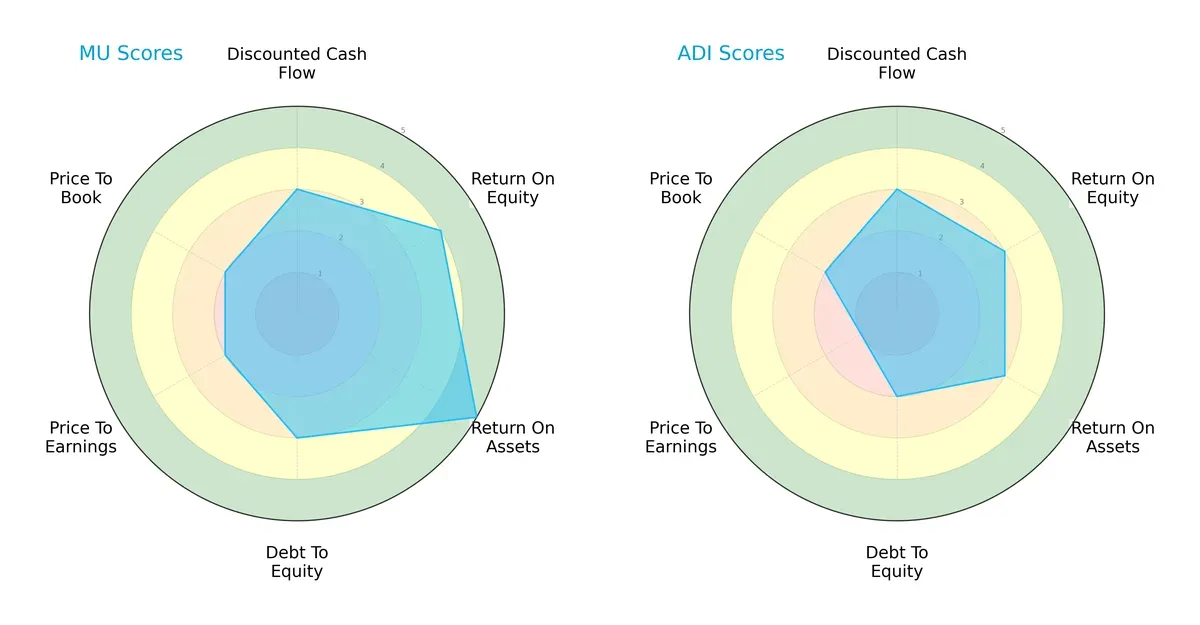
Micron Technology shows stronger operational efficiency with higher ROE (4 vs. 3) and ROA (5 vs. 3) scores compared to Analog Devices. Both firms share moderate DCF scores (3), but Micron maintains a better debt position (3 vs. 2). Analog Devices struggles with valuation, scoring very low on P/E (1 vs. 2), signaling potential overvaluation risks. Overall, Micron offers a more balanced profile, while Analog Devices relies more heavily on specific valuation edges.
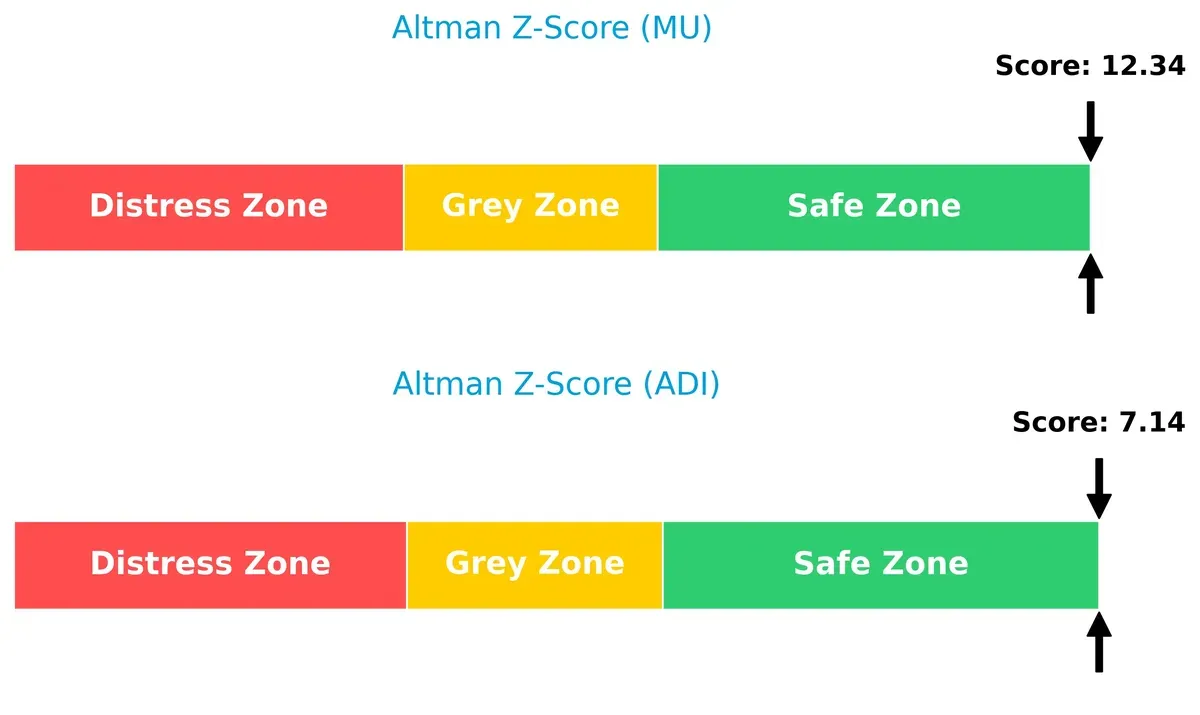
Bankruptcy Risk: Solvency Showdown
Micron Technology’s Altman Z-Score of 12.3 far exceeds Analog Devices’ 7.1, both safely above the distress threshold, indicating robust solvency but with Micron having a stronger cushion for long-term survival in this cycle:
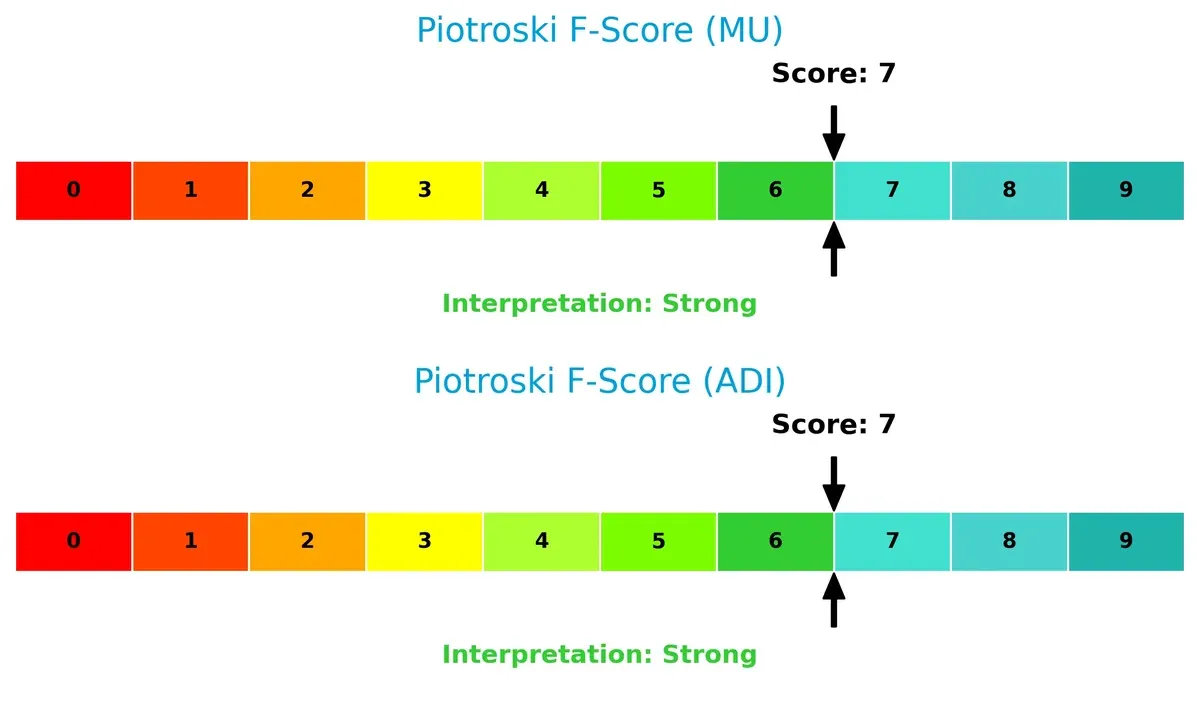
Financial Health: Quality of Operations
Both companies score a strong 7 on the Piotroski F-Score, reflecting solid financial health. Neither exhibits red flags in internal metrics, suggesting operational stability and sound financial management:
How are the two companies positioned?
This section dissects MU and ADI’s operational DNA by comparing revenue distribution and internal dynamics. The goal is to confront their economic moats to reveal which business model delivers the most resilient competitive advantage today.
Revenue Segmentation: The Strategic Mix
This visual comparison dissects how Micron Technology, Inc. and Analog Devices, Inc. diversify their income streams and where their primary sector bets lie:
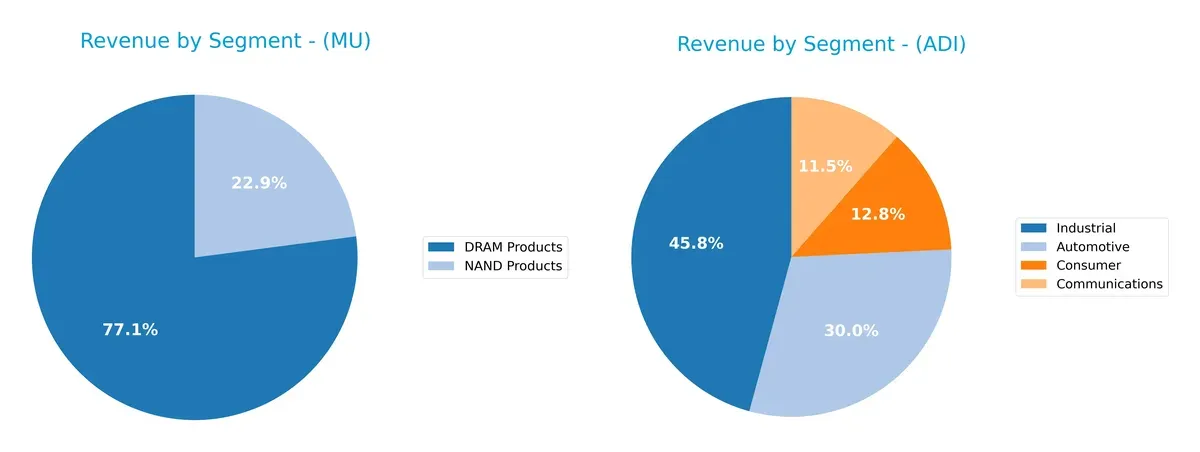
Micron anchors revenue heavily in DRAM Products at $28.6B, with NAND Products contributing $8.5B, reflecting a concentrated semiconductor focus. Analog Devices shows a more balanced mix, with Industrial at $4.3B, Automotive at $2.8B, Consumer at $1.2B, and Communications at $1.1B. Analog Devices’ diversification reduces concentration risk, while Micron’s dominance in memory chips exposes it to cyclical market swings but benefits from infrastructure lock-in.
Strengths and Weaknesses Comparison
This table compares the strengths and weaknesses of Micron Technology, Inc. (MU) and Analog Devices, Inc. (ADI):
MU Strengths
- Strong net margin at 22.84%
- Favorable ROE at 15.76%
- High liquidity ratios (current 2.52, quick 1.79)
- Low debt-to-assets at 18.45%
- Diverse product segments including DRAM and NAND
- Significant U.S. revenue at 24.1B
ADI Strengths
- Favorable net margin at 20.58%
- Strong fixed asset turnover at 3.32
- Favorable liquidity ratios (current 2.19, quick 1.68)
- Low debt-to-assets at 18.05%
- Diversified end markets: industrial, automotive, consumer
- Balanced geographic presence including Europe and U.S.
MU Weaknesses
- Unfavorable ROIC (12.12%) below WACC (22.06%)
- Low asset turnover at 0.45
- High WACC at 22.06%
- Neutral valuation multiples (PE 15.94, PB 2.51)
- Weak fixed asset turnover at 0.79
- Low dividend yield at 0.38%
ADI Weaknesses
- ROE is weak at 6.7%
- Unfavorable valuation multiples (PE 51.05, PB 3.42)
- Asset turnover low at 0.23
- Moderate interest coverage at 9.54
- Neutral ROIC (5.55%) near WACC (8.38%)
- Dividend yield moderate at 1.66%
Both companies exhibit strengths in profitability and liquidity, supporting operational resilience. MU faces challenges with capital efficiency and cost of capital, while ADI struggles with valuation and return on equity. These factors shape their financial strategies and investor considerations.
The Moat Duel: Analyzing Competitive Defensibility
A structural moat stands as the sole guardian of long-term profits against relentless competition erosion:
Micron Technology, Inc.: Cost Advantage Fortress
Micron’s moat centers on a cost advantage driven by scale in memory manufacturing. Its financials show margin stability despite cyclical volatility. New DRAM and NAND innovations could deepen this moat but geopolitical risks may pressure supply chains in 2026.
Analog Devices, Inc.: Intangible Assets and Product Specialization
Analog Devices leans on intangible assets and specialized analog ICs, contrasting Micron’s volume play. It commands premium margins and robust ROIC growth. Expanding AI and automotive markets offer fertile ground to reinforce this technological moat in 2026.
Cost Leadership vs. Specialized Innovation: The Moat Contenders
Both firms show growing profitability but fail to exceed WACC, signaling value destruction amid industry capital intensity. Analog Devices’ rising ROIC trend and niche dominance suggest a deeper moat. I see Analog Devices better poised to defend market share against evolving competition.
Which stock offers better returns?
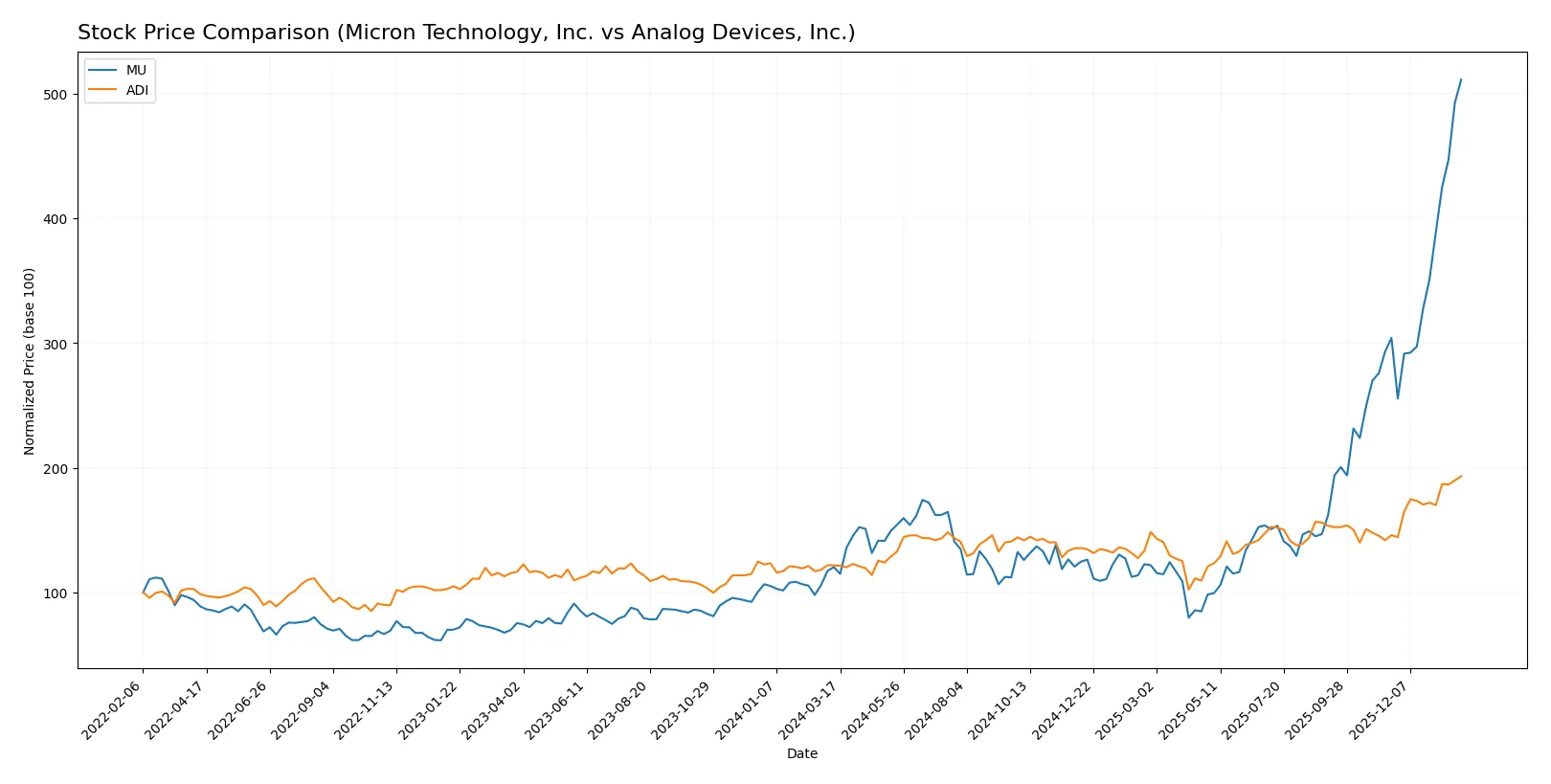
The past year shows Micron Technology’s stock surging sharply with strong buyer dominance. Analog Devices also gained steadily, but with more modest price growth.
Trend Comparison
Micron Technology’s stock rose 325% over the past year, reflecting an accelerating bullish trend with a high volatility of 70.04 and a peak price near 415.
Analog Devices gained 59% in the same period, also accelerating bullishly but with lower volatility at 26.38 and a top price around 311.
Micron Technology outperformed Analog Devices significantly, delivering the highest market returns and stronger price momentum over the analyzed year.
Target Prices
Analysts present a mixed but generally optimistic target consensus for these semiconductor leaders.
| Company | Target Low | Target High | Consensus |
|---|---|---|---|
| Micron Technology, Inc. | 190 | 480 | 346 |
| Analog Devices, Inc. | 270 | 375 | 316 |
Micron’s target consensus at $346 sits below its current $415 price, suggesting cautious upside. Analog Devices’ $316 consensus closely aligns with its $311 stock price, indicating limited near-term valuation re-rating.

Don’t Let Luck Decide Your Entry Point
Optimize your entry points with our advanced ProRealTime indicators. You’ll get efficient buy signals with precise price targets for maximum performance. Start outperforming now!
How do institutions grade them?
The following tables summarize recent institutional grades for Micron Technology, Inc. and Analog Devices, Inc.:
Micron Technology, Inc. Grades
The table below shows the latest grades from major institutional analysts for Micron Technology, Inc.
| Grading Company | Action | New Grade | Date |
|---|---|---|---|
| Mizuho | maintain | Outperform | 2026-01-27 |
| TD Cowen | maintain | Buy | 2026-01-20 |
| Stifel | maintain | Buy | 2026-01-20 |
| Rosenblatt | maintain | Buy | 2026-01-20 |
| Wells Fargo | maintain | Overweight | 2026-01-15 |
| Citigroup | maintain | Buy | 2026-01-15 |
| Cantor Fitzgerald | maintain | Overweight | 2026-01-14 |
| B of A Securities | maintain | Buy | 2026-01-13 |
| Keybanc | maintain | Overweight | 2026-01-13 |
| Lynx Global | maintain | Buy | 2026-01-12 |
Analog Devices, Inc. Grades
The following table lists recent grades from credible institutional sources for Analog Devices, Inc.
| Grading Company | Action | New Grade | Date |
|---|---|---|---|
| Susquehanna | maintain | Positive | 2026-01-22 |
| B of A Securities | maintain | Buy | 2026-01-21 |
| Stifel | maintain | Buy | 2026-01-16 |
| Oppenheimer | maintain | Outperform | 2026-01-16 |
| Wells Fargo | upgrade | Overweight | 2026-01-15 |
| Citigroup | maintain | Buy | 2026-01-15 |
| Keybanc | maintain | Overweight | 2026-01-13 |
| Truist Securities | maintain | Hold | 2025-12-19 |
| UBS | maintain | Buy | 2025-12-08 |
| Truist Securities | maintain | Hold | 2025-11-26 |
Which company has the best grades?
Micron Technology, Inc. holds consistently strong Buy and Outperform ratings from multiple firms, indicating robust analyst confidence. Analog Devices, Inc. also has solid Buy and Outperform ratings but includes some Hold ratings, suggesting slightly more cautious sentiment. This difference may influence investor perception of risk and potential upside.
Risks specific to each company
In 2026’s volatile semiconductor market, these categories highlight critical pressure points and systemic threats impacting both Micron Technology, Inc. and Analog Devices, Inc.:
1. Market & Competition
Micron Technology, Inc.
- Faces intense price competition in memory and storage segments, pressuring margins.
Analog Devices, Inc.
- Competes in niche analog and mixed-signal IC markets with slightly less commoditized pressure.
2. Capital Structure & Debt
Micron Technology, Inc.
- Maintains conservative debt levels with D/E at 0.28 and strong interest coverage of 21.3x.
Analog Devices, Inc.
- Also conservatively leveraged with D/E 0.26 but lower interest coverage at 9.5x, indicating moderate debt risk.
3. Stock Volatility
Micron Technology, Inc.
- Exhibits higher beta (1.50) signaling elevated stock price volatility and market sensitivity.
Analog Devices, Inc.
- Lower beta (1.03) reflects more stable stock price movements and reduced volatility risk.
4. Regulatory & Legal
Micron Technology, Inc.
- Subject to export controls and intellectual property litigation risk in high-tech memory markets.
Analog Devices, Inc.
- Faces regulatory scrutiny in global markets, particularly in automotive and industrial segments.
5. Supply Chain & Operations
Micron Technology, Inc.
- Vulnerable to supply disruptions due to complex wafer fabrication and capital-intensive production.
Analog Devices, Inc.
- Benefits from diversified manufacturing and strong operational execution, reducing supply chain risks.
6. ESG & Climate Transition
Micron Technology, Inc.
- Faces pressure to reduce energy-intensive semiconductor manufacturing emissions amid tightening ESG mandates.
Analog Devices, Inc.
- Invests in energy-efficient products and green initiatives, aligning with evolving ESG expectations.
7. Geopolitical Exposure
Micron Technology, Inc.
- Heavily exposed to US-China tensions impacting supply chains and sales in key markets.
Analog Devices, Inc.
- Also exposed but with a more diversified geographic footprint, mitigating geopolitical risk somewhat.
Which company shows a better risk-adjusted profile?
Micron’s largest risk is elevated stock volatility and geopolitical exposure, threatening earnings stability. Analog Devices struggles with a stretched valuation (P/E 51) and moderate ROE, raising valuation risk. Both show solid balance sheets, but Analog Devices’ lower volatility and better operational diversification give it a slightly superior risk-adjusted profile. Notably, Micron’s Altman Z-score of 12.3 confirms robust financial health despite market turbulence.
Final Verdict: Which stock to choose?
Micron Technology’s superpower lies in its rapid profit growth and improving profitability, making it a cash machine in the semiconductor space. Its point of vigilance is a ROIC below WACC, signaling value destruction despite an upward trend. It fits well in an aggressive growth portfolio seeking dynamic returns.
Analog Devices commands a strategic moat through its strong recurring revenue and superior fixed asset turnover, underscoring operational efficiency. It offers a safer profile than Micron, reflected in steadier cash flow metrics and a more conservative valuation. It suits a GARP investor who values balance between growth and stability.
If you prioritize high growth and are comfortable with cyclicality, Micron outshines with its accelerating earnings momentum and expanding margins. However, if you seek better stability and a durable moat with moderate growth, Analog Devices offers a more consistent and less volatile investment scenario. Both warrant close risk management given their ROIC challenges.
Disclaimer: Investment carries a risk of loss of initial capital. The past performance is not a reliable indicator of future results. Be sure to understand risks before making an investment decision.
Go Further
I encourage you to read the complete analyses of Micron Technology, Inc. and Analog Devices, Inc. to enhance your investment decisions: