Home > Comparison > Technology > ADI vs ALAB
The strategic rivalry between Analog Devices, Inc. and Astera Labs, Inc. defines the semiconductor sector’s innovation frontier. Analog Devices operates as a capital-intensive giant with decades of analog and mixed-signal expertise, while Astera Labs, a younger, agile player, focuses on high-performance connectivity solutions for cloud and AI infrastructure. This comparison pits legacy scale against cutting-edge specialization. This analysis will determine which trajectory offers superior risk-adjusted potential for a diversified portfolio.

Table of contents
Companies Overview
Analog Devices and Astera Labs play pivotal roles in the semiconductor sector’s evolving landscape.
Analog Devices, Inc.: Pioneer in Analog and Mixed-Signal Integration
Analog Devices dominates the analog, mixed-signal, and digital signal processing market. It generates revenue by designing and marketing integrated circuits and subsystems that convert and condition real-world signals for automotive, industrial, and communications sectors. In 2026, its strategic focus sharpens on expanding power management and sensor technologies to support diversified industrial applications.
Astera Labs, Inc. Common Stock: Innovator in Cloud and AI Connectivity
Astera Labs specializes in semiconductor-based connectivity solutions for cloud and AI infrastructure. Its Intelligent Connectivity Platform drives revenue by providing data, network, and memory connectivity products built on a software-defined architecture. The company prioritizes scaling high-performance infrastructure deployment and operational efficiency in 2026.
Strategic Collision: Similarities & Divergences
Analog Devices emphasizes a broad analog and sensor technology portfolio while Astera Labs pursues a niche in AI-driven connectivity. They compete primarily in data processing and signal management but target different infrastructure layers. Analog Devices offers a diversified legacy moat; Astera Labs presents a high-growth, specialized profile in emerging cloud architectures.
Income Statement Comparison
This data dissects the core profitability and scalability of both corporate engines to reveal who dominates the bottom line:
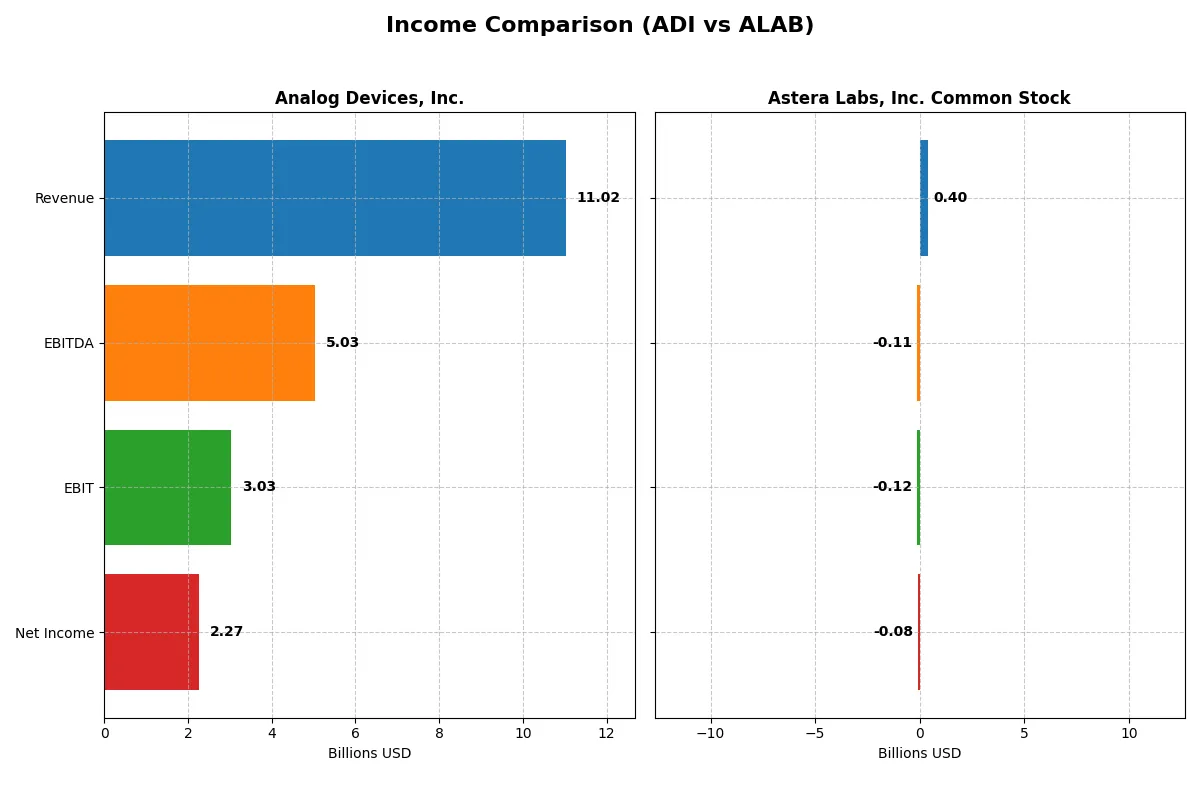
| Metric | Analog Devices, Inc. (ADI) | Astera Labs, Inc. Common Stock (ALAB) |
|---|---|---|
| Revenue | 11.0B | 396M |
| Cost of Revenue | 5.0B | 94M |
| Operating Expenses | 3.0B | 419M |
| Gross Profit | 6.0B | 303M |
| EBITDA | 5.0B | -113M |
| EBIT | 3.0B | -116M |
| Interest Expense | 318M | 0 |
| Net Income | 2.3B | -83M |
| EPS | 4.59 | -0.64 |
| Fiscal Year | 2025 | 2024 |
Income Statement Analysis: The Bottom-Line Duel
This income statement comparison reveals the true efficiency and profitability of two distinct corporate engines in competitive markets.
Analog Devices, Inc. Analysis
Analog Devices steadily grew revenue from $7.3B in 2021 to $11B in 2025, with net income rising from $1.39B to $2.27B. Its gross margin remains strong at 54.7%, while net margin expanded to 20.6%. The 2025 performance highlights impressive efficiency gains, with EBIT growth surging 44% year-over-year, reflecting disciplined cost management and robust operating leverage.
Astera Labs, Inc. Common Stock Analysis
Astera Labs posted rapid revenue growth from $80M in 2022 to $396M in 2024, yet net losses deepened from -$58M to -$83M. Despite a stellar gross margin of 76.4%, negative EBIT margin of -29.3% signals ongoing operating inefficiencies. The 2024 fiscal year saw widening operating expenses outpacing revenue gains, underscoring a high-burn growth model still distant from profitability.
Margin Strength vs. Growth Ambition
Analog Devices delivers consistent profitability with expanding margins and solid bottom-line growth, reflecting a mature, efficient business model. Astera Labs impresses with explosive top-line expansion but suffers persistent net losses and operating inefficiencies. For investors prioritizing fundamental strength and margin discipline, Analog Devices offers a superior profile over Astera’s high-risk growth trajectory.
Financial Ratios Comparison
These vital ratios act as a diagnostic tool to expose the underlying fiscal health, valuation premiums, and capital efficiency of the companies analyzed:
| Ratios | Analog Devices, Inc. (ADI) | Astera Labs, Inc. Common Stock (ALAB) |
|---|---|---|
| ROE | 6.7% (2025) | -8.6% (2024) |
| ROIC | 5.5% (2025) | -12.0% (2024) |
| P/E | 51.1 (2025) | -208.4 (2024) |
| P/B | 3.42 (2025) | 18.02 (2024) |
| Current Ratio | 2.19 (2025) | 11.7 (2024) |
| Quick Ratio | 1.68 (2025) | 11.2 (2024) |
| D/E | 0.26 (2025) | 0.0013 (2024) |
| Debt-to-Assets | 18.1% (2025) | 0.12% (2024) |
| Interest Coverage | 9.45 (2025) | 0 (2024) |
| Asset Turnover | 0.23 (2025) | 0.38 (2024) |
| Fixed Asset Turnover | 3.32 (2025) | 11.1 (2024) |
| Payout Ratio | 85% (2025) | 0% (2024) |
| Dividend Yield | 1.66% (2025) | 0% (2024) |
| Fiscal Year | 2025 | 2024 |
Efficiency & Valuation Duel: The Vital Signs
Financial ratios serve as a company’s DNA, uncovering operational strengths and hidden risks critical for informed investing decisions.
Analog Devices, Inc.
Analog Devices shows moderate profitability with a 6.7% ROE and a solid 20.58% net margin, signaling operational strength. Its valuation is stretched, evidenced by a high P/E of 51.05 and P/B of 3.42. Shareholders receive a modest 1.66% dividend yield, reflecting a balanced mix of income and reinvestment in R&D.
Astera Labs, Inc. Common Stock
Astera Labs posts negative profitability metrics, with an ROE of -8.65% and a -21.05% net margin, indicating operational challenges. Despite a distorted negative P/E, the company carries a lofty 18.02 P/B ratio, suggesting valuation concerns. It pays no dividends, instead directing cash towards heavy R&D investments to fuel growth.
Premium Valuation vs. Operational Safety
Analog Devices offers a more balanced risk-reward profile with favorable operational metrics and steady shareholder returns. Astera Labs struggles with profitability and faces valuation risks, fitting investors willing to tolerate uncertainty for growth potential. The choice depends on one’s appetite for stability versus speculative upside.
Which one offers the Superior Shareholder Reward?
I compare Analog Devices (ADI) and Astera Labs (ALAB) on their distribution strategies and shareholder returns. ADI pays a 1.66% dividend yield with a high 85% payout ratio, backed by strong free cash flow (FCF) coverage near 1.96x. It also runs consistent buybacks, boosting total returns sustainably. ALAB pays no dividend, investing heavily in growth, R&D, and acquisitions, but posts negative margins and volatile cash flows. Its negligible debt and high current ratio suggest a cautious runway but no immediate shareholder reward. I find ADI’s balanced mix of dividends and steady buybacks offers a far more attractive and sustainable total return profile for 2026 investors.
Comparative Score Analysis: The Strategic Profile
The radar chart reveals the fundamental DNA and trade-offs of Analog Devices, Inc. and Astera Labs, Inc. Common Stock, highlighting their core financial strengths:
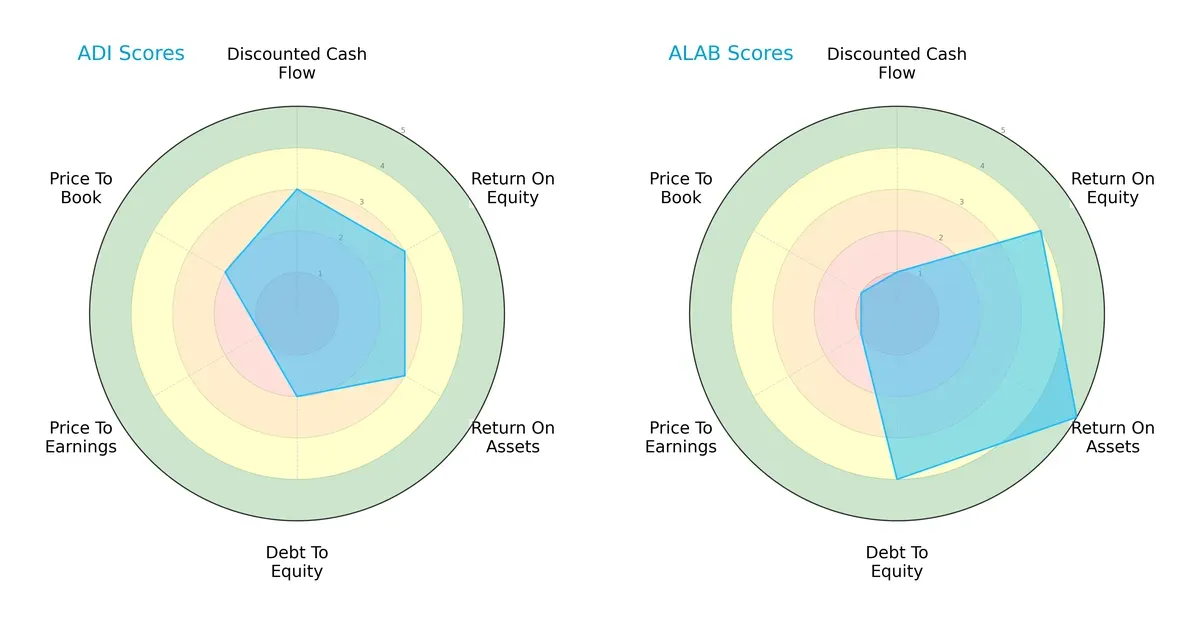
Analog Devices shows a balanced profile with moderate scores across DCF (3), ROE (3), ROA (3), and debt-to-equity (2). Astera Labs leans heavily on superior ROE (4) and ROA (5) but suffers from weak valuation scores (P/E 1, P/B 1). Analog Devices maintains steadier financial stability, while Astera Labs relies on operational efficiency over valuation metrics.
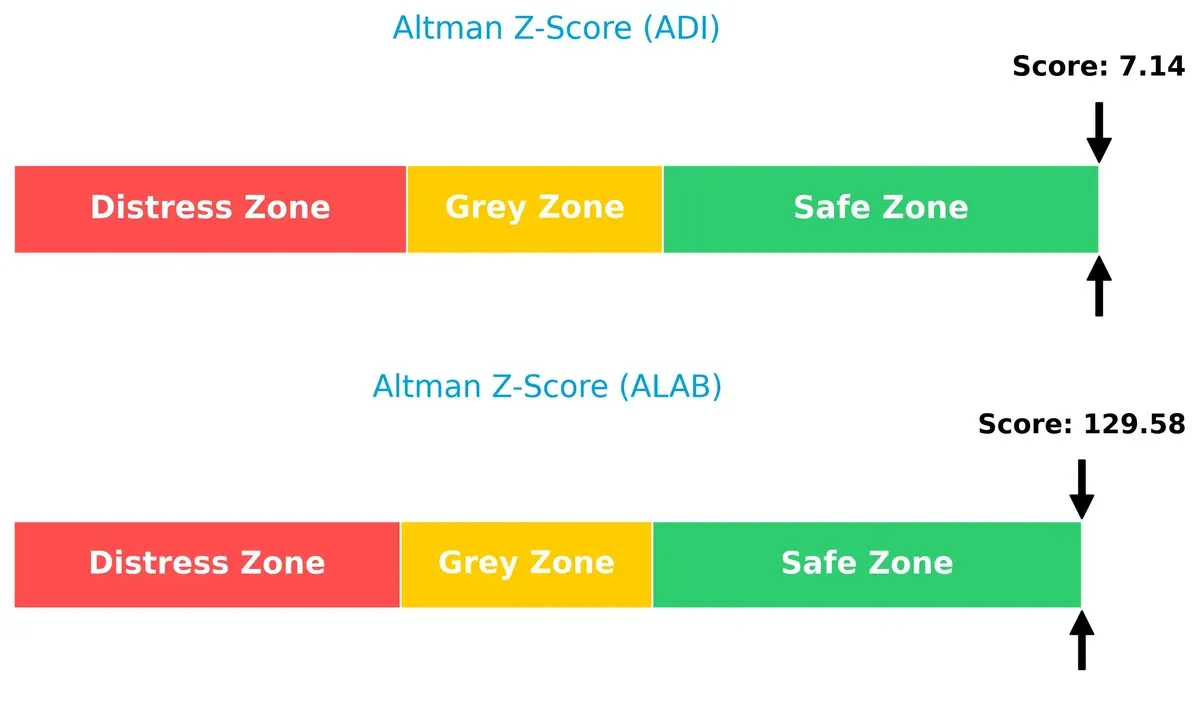
Bankruptcy Risk: Solvency Showdown
Astera Labs’ Altman Z-Score of 130 vastly outperforms Analog Devices’ 7.1, placing both firmly in the safe zone but indicating Astera Labs’ exceptionally low bankruptcy risk in this cycle:
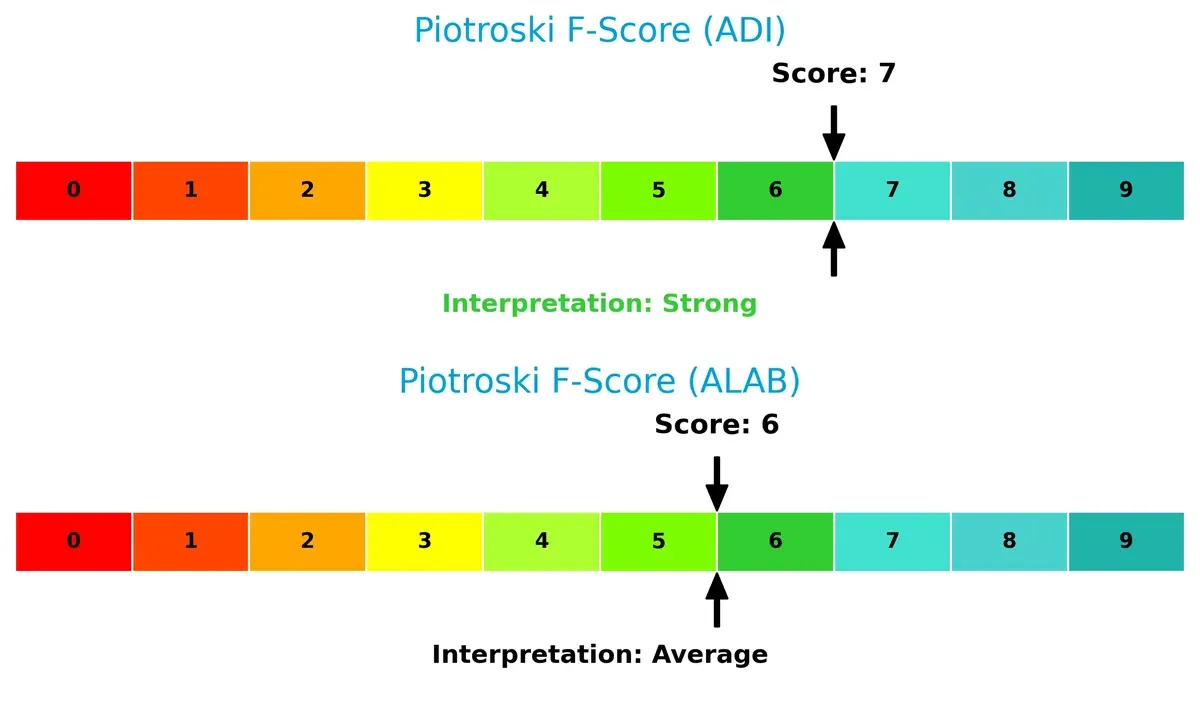
Financial Health: Quality of Operations
Analog Devices holds a stronger Piotroski F-Score of 7, signaling robust financial health and fewer red flags than Astera Labs, which scores a moderate 6:
How are the two companies positioned?
This section dissects the operational DNA of ADI and ALAB by comparing their revenue distribution across segments and examining internal strengths and weaknesses. The goal is to confront their economic moats and reveal which business model offers the most resilient, sustainable competitive advantage today.
Revenue Segmentation: The Strategic Mix
This visual comparison dissects how Analog Devices, Inc. and Astera Labs, Inc. diversify their income streams and where their primary sector bets lie:
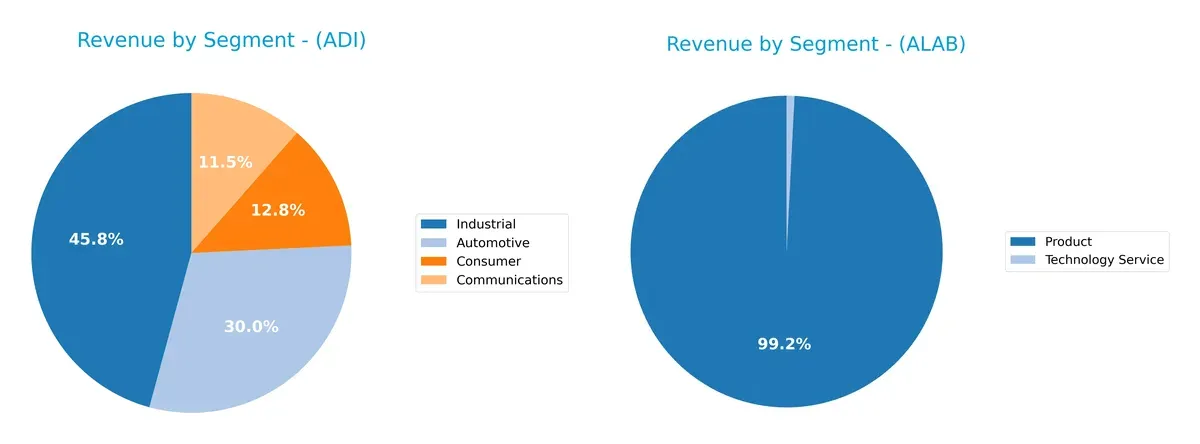
Analog Devices anchors its revenue heavily in Industrial at $4.3B, followed by Automotive at $2.8B, showing a well-diversified portfolio across sectors. In contrast, Astera Labs relies almost entirely on its Product segment at $393M, with minimal Technology Service revenue, exposing it to concentration risk. Analog Devices’ mix supports ecosystem lock-in and infrastructure dominance, while Astera Labs pivots on a singular product focus, increasing vulnerability to market shifts.
Strengths and Weaknesses Comparison
This table compares the strengths and weaknesses of Analog Devices, Inc. (ADI) and Astera Labs, Inc. Common Stock (ALAB):
ADI Strengths
- Diversified revenue across Automotive, Industrial, Communications, and Consumer segments
- Favorable net margin at 20.58% indicating profitability
- Strong global presence with significant revenues in US, China, Europe, and Japan
- Low debt-to-equity ratio of 0.26 supports financial stability
- Favorable current and quick ratios signal good liquidity
- Solid fixed asset turnover of 3.32 reflects operational efficiency
ALAB Strengths
- Favorable quick ratio and zero debt-to-equity ratio demonstrate strong liquidity and no leverage
- Favorable PE ratio suggests market expectation potential
- Fixed asset turnover of 11.12 shows asset use efficiency
- Global revenue presence including Taiwan, China, US, and Non-US markets
- Focused product and technology service revenue streams indicate specialization
ADI Weaknesses
- Unfavorable ROE at 6.7% below cost of equity
- High PE (51.05) and PB (3.42) ratios suggest possible overvaluation
- Unfavorable asset turnover at 0.23 implies lower asset utilization
- Dividend yield neutral at 1.66% may limit income appeal
- ROIC near WACC limits value creation potential
- Unfavorable PB ratio indicates market premium
ALAB Weaknesses
- Negative net margin (-21.05%) and ROE (-8.65%) show unprofitability
- Unfavorable WACC at 10.93% signals higher capital costs
- Negative ROIC (-11.97%) indicates value destruction
- Unfavorable current ratio despite high quick ratio may imply asset structure issues
- Interest coverage at 0 signals risk in meeting debt obligations
- Zero dividend yield limits investor income
Overall, ADI exhibits diversified, profitable operations with solid financial health but faces challenges in returns and valuation. ALAB shows strong liquidity and asset efficiency but struggles with profitability and capital cost management. These contrasts highlight differing strategic and operational stages for each company.
The Moat Duel: Analyzing Competitive Defensibility
A structural moat is the only true protection for long-term profits against relentless competition erosion. Let’s dissect two semiconductor players’ moats:
Analog Devices, Inc. (ADI): Engineering Excellence and Diverse Market Penetration
ADI’s moat stems from intangible assets and deep industry expertise, reflected in stable, high margins and consistent revenue growth (16.9% last year). Its broad product mix and global reach anchor its value, though ROIC trails WACC, signaling some value erosion. New industrial and automotive innovations in 2026 could widen its moat if execution holds.
Astera Labs, Inc. Common Stock (ALAB): Disruptive Connectivity Innovation
ALAB’s moat relies on cutting-edge technology in AI infrastructure connectivity, a niche unlike ADI’s broad analog focus. Despite explosive revenue growth (242% last year), negative EBIT margins show early-stage investment strain. Its rising ROIC trend offers promise; success in scaling software-defined architectures could transform its competitive landscape in 2026.
Moat Battle: Established Breadth vs. Emerging Disruption
ADI’s broad, diversified moat offers steady defense but struggles with value creation relative to capital cost. ALAB’s narrower but rapidly evolving moat shows promise through innovation and growth, yet lacks profitability. I see ADI’s moat as wider and more durable today, but ALAB’s aggressive tech push could reshape market share battles if it achieves profitability.
Which stock offers better returns?
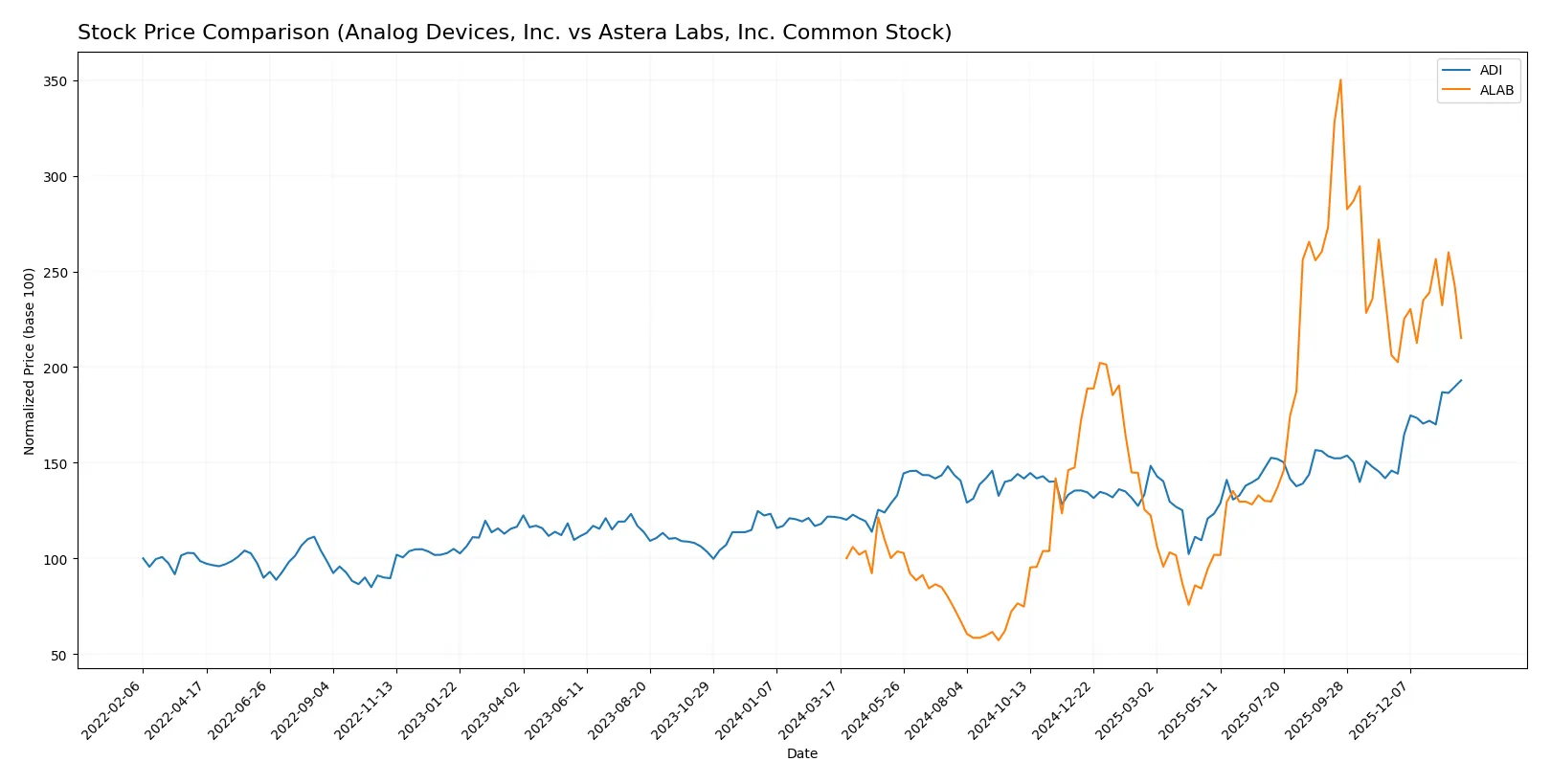
The stock price charts reveal strong bullish trends for both companies over the past 12 months, with significant gains and accelerating momentum in their market performance.
Trend Comparison
Analog Devices, Inc. (ADI) shows a 58.66% price increase over the past year, indicating a bullish trend with accelerating momentum. The stock ranged from $164.6 to $310.88, reflecting solid upward movement.
Astera Labs, Inc. (ALAB) outperformed with a 115.17% gain, also bullish and accelerating. The price fluctuated between $40.0 and $245.2, showing higher volatility but stronger overall appreciation.
ALAB delivered the highest market performance with a 115.17% gain versus ADI’s 58.66%, despite greater volatility and recent seller dominance in volume trends.
Target Prices
Analysts present a clear target price consensus for both Analog Devices, Inc. and Astera Labs, Inc.
| Company | Target Low | Target High | Consensus |
|---|---|---|---|
| Analog Devices, Inc. | 270 | 375 | 316 |
| Astera Labs, Inc. | 165 | 225 | 202.14 |
The consensus targets suggest moderate upside for Analog Devices, trading near $311, while Astera Labs shows significant growth potential above its current $151 price.

Don’t Let Luck Decide Your Entry Point
Optimize your entry points with our advanced ProRealTime indicators. You’ll get efficient buy signals with precise price targets for maximum performance. Start outperforming now!
How do institutions grade them?
Analog Devices, Inc. Grades
Here are the recent grades from leading financial institutions for Analog Devices, Inc.:
| Grading Company | Action | New Grade | Date |
|---|---|---|---|
| Susquehanna | maintain | Positive | 2026-01-22 |
| B of A Securities | maintain | Buy | 2026-01-21 |
| Stifel | maintain | Buy | 2026-01-16 |
| Oppenheimer | maintain | Outperform | 2026-01-16 |
| Wells Fargo | upgrade | Overweight | 2026-01-15 |
| Citigroup | maintain | Buy | 2026-01-15 |
| Keybanc | maintain | Overweight | 2026-01-13 |
| Truist Securities | maintain | Hold | 2025-12-19 |
| UBS | maintain | Buy | 2025-12-08 |
| Truist Securities | maintain | Hold | 2025-11-26 |
Astera Labs, Inc. Common Stock Grades
Below are recent institutional grades for Astera Labs, Inc. Common Stock:
| Grading Company | Action | New Grade | Date |
|---|---|---|---|
| Northland Capital Markets | maintain | Outperform | 2025-12-09 |
| Northland Capital Markets | upgrade | Outperform | 2025-11-17 |
| Needham | maintain | Buy | 2025-11-05 |
| JP Morgan | maintain | Overweight | 2025-11-05 |
| TD Cowen | maintain | Hold | 2025-11-05 |
| Morgan Stanley | maintain | Overweight | 2025-11-05 |
| Roth Capital | maintain | Buy | 2025-11-05 |
| Stifel | maintain | Buy | 2025-11-05 |
| Barclays | downgrade | Equal Weight | 2025-10-20 |
| Stifel | maintain | Buy | 2025-10-17 |
Which company has the best grades?
Analog Devices consistently holds strong buy and outperform ratings with a recent upgrade by Wells Fargo. Astera Labs shows mostly buy and outperform grades but includes one downgrade. Analog Devices’ steady, higher-tier grades suggest stronger institutional confidence, potentially influencing investor sentiment more favorably.
Risks specific to each company
The following categories identify the critical pressure points and systemic threats facing both firms in the 2026 market environment:
1. Market & Competition
Analog Devices, Inc. (ADI)
- Established semiconductor leader with diversified industrial and automotive markets. Competition intense but ADI benefits from scale.
Astera Labs, Inc. Common Stock (ALAB)
- Emerging firm focused on cloud and AI infrastructure connectivity. Faces fierce competition and must prove market traction.
2. Capital Structure & Debt
Analog Devices, Inc. (ADI)
- Low debt-to-equity of 0.26 signals conservative leverage and strong balance sheet. Interest coverage at 9.54 is healthy.
Astera Labs, Inc. Common Stock (ALAB)
- No debt reported, which reduces financial risk but also limits leverage benefits. Interest coverage at zero reflects no earnings cushion for debt.
3. Stock Volatility
Analog Devices, Inc. (ADI)
- Beta near 1.03 implies stock moves in line with market, moderate volatility. Price range relatively stable.
Astera Labs, Inc. Common Stock (ALAB)
- High beta of 1.51 indicates substantial volatility and risk. Wide trading range reflects speculative investor sentiment.
4. Regulatory & Legal
Analog Devices, Inc. (ADI)
- Operating globally with exposure to semiconductor export controls and IP risks. Established compliance frameworks mitigate threats.
Astera Labs, Inc. Common Stock (ALAB)
- Newer company likely faces evolving regulatory scrutiny on AI and cloud infrastructure technologies, increasing uncertainty.
5. Supply Chain & Operations
Analog Devices, Inc. (ADI)
- Mature supply chain with diversified sourcing reduces disruption risk. Operational scale supports consistent production.
Astera Labs, Inc. Common Stock (ALAB)
- Smaller scale and reliance on cutting-edge semiconductor manufacturing heighten vulnerability to supply chain bottlenecks.
6. ESG & Climate Transition
Analog Devices, Inc. (ADI)
- Established ESG policies and ongoing investments in energy-efficient products support climate transition efforts.
Astera Labs, Inc. Common Stock (ALAB)
- Early-stage ESG frameworks; must develop robust policies to meet increasing investor and regulatory expectations.
7. Geopolitical Exposure
Analog Devices, Inc. (ADI)
- Global operations expose ADI to US-China tensions and trade restrictions, but diversified geographic footprint limits impact.
Astera Labs, Inc. Common Stock (ALAB)
- Concentrated in US tech hubs; geopolitical risks tied mainly to export controls and supply chain dependencies in volatile regions.
Which company shows a better risk-adjusted profile?
Analog Devices presents a stronger risk-adjusted profile than Astera Labs. ADI’s mature capital structure and balanced market exposure offer stability. ALAB’s high volatility and negative profitability metrics pose significant risks. The most pressing risk for ADI is geopolitical exposure amid global trade tensions. For ALAB, negative profitability and cash burn represent critical hurdles. ADI’s Altman Z-score of 7.1 confirms financial robustness, while ALAB’s high volatility and negative net margin alert me to its precarious position.
Final Verdict: Which stock to choose?
Analog Devices, Inc. (ADI) shines with its consistent ability to generate strong cash flows and solid profitability, making it a resilient cash machine in the semiconductor space. Its main point of vigilance lies in a slightly unfavorable ROIC vs. WACC spread, signaling value destruction despite improving profitability. ADI suits portfolios seeking steady, slightly favorable growth with moderate risk.
Astera Labs, Inc. (ALAB) boasts a strategic moat rooted in rapid revenue growth and a clean balance sheet with near-zero debt. Its moat is less about current profits and more about future potential as it scales. ALAB offers a higher-risk profile compared to ADI but fits well with growth-at-a-reasonable-price (GARP) investors willing to tolerate volatility for asymmetric upside.
If you prioritize reliable cash generation and stable returns, ADI is the compelling choice due to its strong income statement and prudent capital structure. However, if you seek aggressive revenue growth and are comfortable with elevated risk, ALAB offers better upside potential despite value destruction and uneven earnings. Each fits distinct investor avatars navigating the semiconductor cycle.
Disclaimer: Investment carries a risk of loss of initial capital. The past performance is not a reliable indicator of future results. Be sure to understand risks before making an investment decision.
Go Further
I encourage you to read the complete analyses of Analog Devices, Inc. and Astera Labs, Inc. Common Stock to enhance your investment decisions: