In today’s fast-evolving tech landscape, choosing the right infrastructure software stock can be challenging. CoreWeave, Inc. (CRWV) and Akamai Technologies, Inc. (AKAM) both operate in the cloud infrastructure space but target different niches—CoreWeave focuses on GPU-powered compute for AI workloads, while Akamai excels in cloud security and content delivery. This article will help you identify which company presents the most compelling investment opportunity in 2026.
Table of contents
Companies Overview
I will begin the comparison between CoreWeave and Akamai by providing an overview of these two companies and their main differences.
CoreWeave Overview
CoreWeave, Inc. operates a cloud platform focused on scaling, supporting, and accelerating GenAI workloads. The company provides infrastructure services including GPU and CPU compute, storage, networking, managed services, and virtual and bare metal servers. Founded in 2017 and based in Livingston, New Jersey, CoreWeave aims to support enterprises with AI model training, inference, and rendering solutions within the software infrastructure sector.
Akamai Overview
Akamai Technologies, Inc. offers cloud services designed to secure, deliver, and optimize internet content and business applications globally. Its portfolio includes cybersecurity, web and mobile performance, media delivery, and edge computing solutions. Incorporated in 1998 and headquartered in Cambridge, Massachusetts, Akamai focuses on protecting infrastructure and enhancing digital experiences, serving a broad international customer base in the technology infrastructure industry.
Key similarities and differences
Both companies operate in the software infrastructure sector, providing cloud-based services to enhance performance and security for digital workloads. CoreWeave specializes in AI and GPU-accelerated compute solutions, while Akamai emphasizes internet content delivery, cybersecurity, and edge computing. CoreWeave is a younger, smaller firm with a niche focus on GenAI, whereas Akamai is an established leader with a wider range of cloud security and content optimization offerings.
Income Statement Comparison
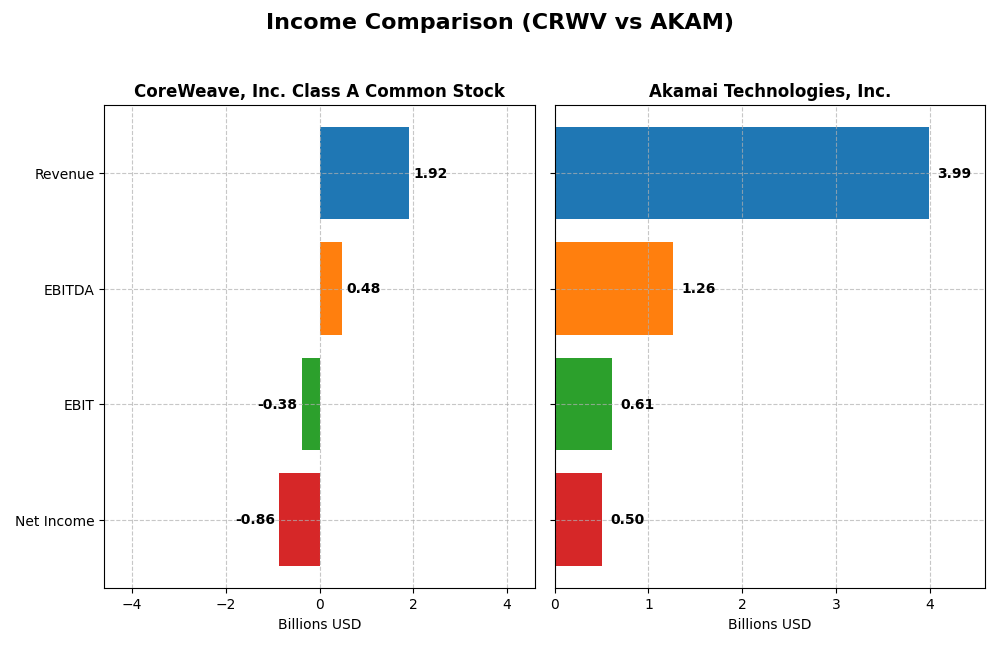
The table below compares the key income statement metrics for CoreWeave, Inc. Class A Common Stock and Akamai Technologies, Inc. for the fiscal year 2024, providing a snapshot of their financial performance.
| Metric | CoreWeave, Inc. Class A Common Stock | Akamai Technologies, Inc. |
|---|---|---|
| Market Cap | 50.4B | 13.4B |
| Revenue | 1.92B | 3.99B |
| EBITDA | 480M | 1.26B |
| EBIT | -383M | 614M |
| Net Income | -863M | 505M |
| EPS | -2.33 | 3.34 |
| Fiscal Year | 2024 | 2024 |
Income Statement Interpretations
CoreWeave, Inc. Class A Common Stock
CoreWeave experienced a sharp revenue increase from $15.8M in 2022 to $1.92B in 2024, reflecting rapid expansion. Despite this, net income remained negative, worsening from -$31.1M to -$937.8M. Gross margins stayed strong at 74.24%, but EBIT and net margins were negative in 2024. The latest year showed substantial revenue growth but continued net losses.
Akamai Technologies, Inc.
Akamai reported steady revenue growth from $3.2B in 2020 to $3.99B in 2024, with net income fluctuating but positive, ending at $505M in 2024. Margins remained stable and favorable, with a 59.39% gross margin and 12.65% net margin in 2024. However, recent growth slowed slightly, with EBIT and net margin declining modestly year-over-year.
Which one has the stronger fundamentals?
Akamai demonstrates stronger fundamentals with consistent profitability, positive net margins, and stable revenue growth over a longer period. CoreWeave shows exceptional revenue growth but sustained heavy losses and negative margins, reflecting higher risk. Akamai’s profitability and margin stability present a more favorable income profile compared to CoreWeave’s rapid scaling with ongoing losses.
Financial Ratios Comparison
The table below presents a side-by-side comparison of key financial ratios for CoreWeave, Inc. Class A Common Stock (CRWV) and Akamai Technologies, Inc. (AKAM) based on the most recent fiscal year data from 2024.
| Ratios | CoreWeave, Inc. (CRWV) | Akamai Technologies, Inc. (AKAM) |
|---|---|---|
| ROE | 2.09% | 10.35% |
| ROIC | 2.08% | 4.74% |
| P/E | -18.73 | 28.68 |
| P/B | -39.11 | 2.97 |
| Current Ratio | 0.39 | 1.23 |
| Quick Ratio | 0.39 | 1.23 |
| D/E (Debt-to-Equity) | -25.68 | 0.95 |
| Debt-to-Assets | 59.56% | 44.70% |
| Interest Coverage | 0.90 | 19.67 |
| Asset Turnover | 0.11 | 0.38 |
| Fixed Asset Turnover | 0.13 | 1.33 |
| Payout Ratio | -6.69% | 0% |
| Dividend Yield | 0.36% | 0% |
Interpretation of the Ratios
CoreWeave, Inc. Class A Common Stock
CoreWeave shows several weak financial ratios, including a very low current ratio of 0.39 and a negative interest coverage, indicating liquidity and solvency concerns. Despite a strong return on equity at 208.77%, many metrics such as net margin (-45.08%) and return on invested capital (2.08%) are unfavorable. The company does not pay dividends, likely due to its negative net income and reinvestment focus.
Akamai Technologies, Inc.
Akamai presents a more balanced ratio profile, with a favorable net margin of 12.65% and strong interest coverage at 22.65. Liquidity ratios are neutral to favorable, such as a current ratio of 1.23 and quick ratio of 1.23. However, its price-to-earnings ratio at 28.68 is unfavorable for valuation. Akamai also does not pay dividends, probably prioritizing reinvestment and growth.
Which one has the best ratios?
Akamai holds a more favorable and balanced ratio profile with better liquidity and profitability ratios compared to CoreWeave, which struggles with liquidity, profitability, and capital structure metrics. While both companies have strengths, Akamai’s neutral overall rating contrasts with CoreWeave’s predominantly unfavorable financial ratios.
Strategic Positioning
This section compares the strategic positioning of CoreWeave and Akamai, focusing on Market position, Key segments, and exposure to disruption:
CoreWeave, Inc. Class A Common Stock
- Emerging cloud platform with high market cap and competitive pressure in infrastructure software.
- Focuses on GPU/CPU compute, storage, AI workloads, VFX, and rendering driving business growth.
- Operates in a rapidly evolving cloud infrastructure sector with potential exposure to new AI and compute innovations.
Akamai Technologies, Inc.
- Established cloud services provider with lower market cap, competing in global content delivery and security.
- Key segments include cloud security, content delivery, media streaming, and edge compute solutions.
- Exposed to technological disruption through cybersecurity threats and demands for faster, secure internet services.
CoreWeave vs Akamai Positioning
CoreWeave pursues a concentrated strategy centered on AI and high-performance compute infrastructure, leveraging newer technologies. Akamai uses a diversified approach across cloud security, content delivery, and edge computing, benefiting from broader market reach but facing declining profitability.
Which has the best competitive advantage?
Both companies are currently shedding value, but CoreWeave’s stable yet unfavorable moat contrasts with Akamai’s very unfavorable moat and declining ROIC, indicating CoreWeave may have a marginally stronger competitive position based on recent MOAT evaluations.
Stock Comparison
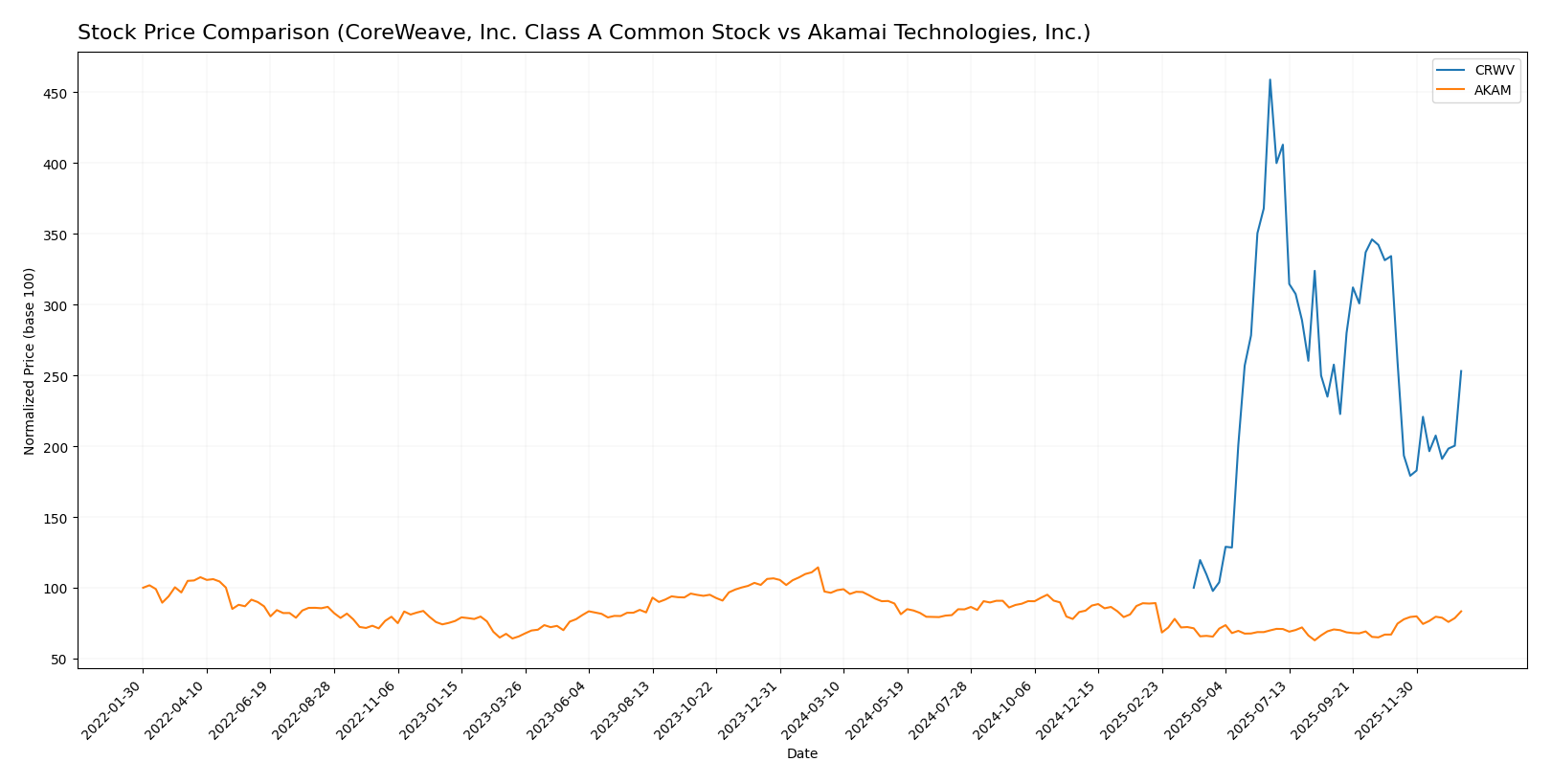
CoreWeave, Inc. Class A Common Stock (CRWV) and Akamai Technologies, Inc. (AKAM) have shown contrasting price movements and trading dynamics over the past 12 months, reflecting differing market sentiments and volatility levels.
Trend Analysis
CoreWeave’s stock exhibited a strong bullish trend over the past 12 months with a 153.08% price increase, though this growth has recently decelerated. The stock showed high volatility, with prices ranging between 39.09 and 183.58.
Akamai’s stock experienced a bearish trend over the same period, declining by 13.57%. Despite this, there has been an accelerating recovery recently, with a 24.49% price increase and lower volatility compared to CoreWeave.
Comparing both stocks, CoreWeave delivered the highest market performance over the past year, significantly outperforming Akamai despite recent short-term weakness.
Target Prices
Analysts provide a clear consensus on target prices for CoreWeave, Inc. and Akamai Technologies, Inc.
| Company | Target High | Target Low | Consensus |
|---|---|---|---|
| CoreWeave, Inc. Class A Common Stock | 175 | 68 | 115.79 |
| Akamai Technologies, Inc. | 115 | 89 | 104.8 |
The consensus target prices suggest upside potential for both stocks compared to current prices: CoreWeave trades at 101.23 while Akamai is at 93.49, indicating moderate analyst optimism for growth.
Analyst Opinions Comparison
This section compares analysts’ ratings and financial scores for CoreWeave, Inc. Class A Common Stock (CRWV) and Akamai Technologies, Inc. (AKAM):
Rating Comparison
CRWV Rating
- Rating: D+ indicating very unfavorable status.
- Discounted Cash Flow Score: 1, very unfavorable, suggesting weak future cash flow projections.
- ROE Score: 1, very unfavorable, showing poor profit generation from equity.
- ROA Score: 1, very unfavorable, reflecting weak asset utilization.
- Debt To Equity Score: 1, very unfavorable, suggesting high financial risk.
- Overall Score: 1, very unfavorable, summarizing poor financial standing.
AKAM Rating
- Rating: B indicating very favorable status.
- Discounted Cash Flow Score: 5, very favorable, indicating strong future cash flow potential.
- ROE Score: 3, moderate, indicating average profit efficiency.
- ROA Score: 3, moderate, showing reasonable asset efficiency.
- Debt To Equity Score: 1, very unfavorable, also indicating high financial risk.
- Overall Score: 3, moderate, reflecting average financial health.
Which one is the best rated?
Based purely on the provided data, Akamai (AKAM) holds a clearly better overall rating and stronger financial scores compared to CoreWeave (CRWV). AKAM shows moderate to very favorable scores, while CRWV’s ratings are very unfavorable across all metrics.
Scores Comparison
Here is a comparison of the company scores for investors to consider:
CRWV Scores
- Altman Z-Score: 0.80, indicating financial distress and high bankruptcy risk.
- Piotroski Score: 3, classified as very weak financial strength.
AKAM Scores
- Altman Z-Score: 2.46, indicating moderate bankruptcy risk in the grey zone.
- Piotroski Score: 7, classified as strong financial strength.
Which company has the best scores?
Based on the data, AKAM has higher scores with a safer Altman Z-Score in the grey zone and a strong Piotroski Score of 7. CRWV is in financial distress with very weak Piotroski metrics.
Grades Comparison
Here is a comparison of the most recent grades from reputable financial institutions for the two companies:
CoreWeave, Inc. Class A Common Stock Grades
The following table summarizes recent grades assigned to CoreWeave, Inc. by recognized grading companies:
| Grading Company | Action | New Grade | Date |
|---|---|---|---|
| Barclays | Maintain | Equal Weight | 2026-01-12 |
| Wells Fargo | Maintain | Overweight | 2026-01-08 |
| Jefferies | Maintain | Buy | 2026-01-05 |
| DA Davidson | Upgrade | Neutral | 2026-01-05 |
| Goldman Sachs | Maintain | Neutral | 2025-11-17 |
| HC Wainwright & Co. | Maintain | Buy | 2025-11-12 |
| Wells Fargo | Maintain | Overweight | 2025-11-12 |
| Barclays | Maintain | Equal Weight | 2025-11-12 |
| Loop Capital | Maintain | Buy | 2025-11-12 |
| B of A Securities | Maintain | Neutral | 2025-11-11 |
Overall, CoreWeave’s grades show a generally positive trend with multiple “Buy” and “Overweight” ratings and some neutral positions, indicating a broadly favorable outlook by analysts.
Akamai Technologies, Inc. Grades
The following table summarizes recent grades assigned to Akamai Technologies, Inc. by recognized grading companies:
| Grading Company | Action | New Grade | Date |
|---|---|---|---|
| Citigroup | Maintain | Neutral | 2026-01-16 |
| Morgan Stanley | Upgrade | Overweight | 2026-01-12 |
| Scotiabank | Maintain | Sector Outperform | 2026-01-09 |
| RBC Capital | Maintain | Sector Perform | 2026-01-05 |
| Piper Sandler | Maintain | Neutral | 2026-01-05 |
| Keybanc | Upgrade | Overweight | 2025-12-15 |
| TD Cowen | Maintain | Hold | 2025-11-13 |
| Citigroup | Maintain | Neutral | 2025-11-11 |
| Scotiabank | Maintain | Sector Outperform | 2025-11-07 |
| Piper Sandler | Maintain | Neutral | 2025-11-07 |
Akamai’s grades consist mainly of “Neutral,” “Hold,” and sector-related outperform ratings, with recent upgrades to “Overweight” reflecting some improving sentiment.
Which company has the best grades?
CoreWeave has received a stronger consensus with more “Buy” and “Overweight” ratings compared to Akamai’s predominantly “Neutral” and “Hold” grades. This may suggest that investors see greater near-term growth potential or value in CoreWeave, while Akamai’s grades reflect more cautious optimism.
Strengths and Weaknesses
The table below summarizes the key strengths and weaknesses of CoreWeave, Inc. (CRWV) and Akamai Technologies, Inc. (AKAM) based on the most recent financial and strategic data available in 2026.
| Criterion | CoreWeave, Inc. Class A Common Stock (CRWV) | Akamai Technologies, Inc. (AKAM) |
|---|---|---|
| Diversification | Limited product segmentation, focused niche | Moderate diversification with $3.99B revenue in 2024 concentrated in one main segment |
| Profitability | Negative net margin (-45.08%), unfavorable ROIC (2.08%) | Positive net margin (12.65%), ROIC (4.74%) lower than WACC |
| Innovation | High ROE (208.77%) suggests potential innovative management | Stable operations but declining ROIC trend indicates challenges sustaining innovation |
| Global presence | Smaller scale, less global footprint | Established global presence with steady revenue base |
| Market Share | Niche player with limited scale | Larger market share but facing profitability pressures |
In summary, CoreWeave shows potential through a strong return on equity but struggles with profitability and liquidity, which poses significant risks. Akamai benefits from a solid global presence and positive net margins but faces challenges with declining capital efficiency and a less favorable ROIC trend. Investors should weigh CoreWeave’s growth potential against its financial instability and Akamai’s stable yet eroding profitability when considering portfolio additions.
Risk Analysis
Below is a table summarizing key risk metrics for CoreWeave, Inc. Class A Common Stock (CRWV) and Akamai Technologies, Inc. (AKAM) based on the most recent 2024 data.
| Metric | CoreWeave, Inc. (CRWV) | Akamai Technologies, Inc. (AKAM) |
|---|---|---|
| Market Risk | Very high beta at 21.65, indicating extreme volatility | Moderate beta at 0.685, more stable |
| Debt Level | High debt-to-assets at 59.56%, poor interest coverage (-1.06) | Moderate debt-to-assets at 44.7%, strong interest coverage (22.65) |
| Regulatory Risk | Moderate, typical for tech infrastructure sector | Moderate, with global cloud service regulations |
| Operational Risk | High, due to unfavorable asset turnover and liquidity ratios | Moderate, better liquidity and operational efficiency |
| Environmental Risk | Low to moderate, standard for software infrastructure | Low to moderate, typical for cloud services |
| Geopolitical Risk | Moderate, US-based but exposed to global cloud demand | Moderate, global presence with exposure to international markets |
In synthesis, CoreWeave faces the most impactful risks in market volatility and financial instability, evidenced by its very high beta and weak liquidity and debt metrics. Akamai offers a more balanced profile with moderate market risk and stronger financial health, though debt level remains a consideration. Investors should weigh CoreWeave’s high growth potential against its elevated risk of financial distress.
Which Stock to Choose?
CoreWeave, Inc. (CRWV) shows strong revenue growth with a 12,000% increase over three years but suffers from negative net margins and weak profitability ratios. Its debt level is high, liquidity is poor, and the overall rating is very unfavorable.
Akamai Technologies (AKAM) presents stable profitability with positive net and EBIT margins and moderate revenue growth of 25% over five years. Financial ratios are mixed but lean toward neutrality, with a moderate rating and better liquidity than CRWV.
For risk-tolerant investors seeking high growth potential, CoreWeave’s rapid income expansion might appear attractive despite financial weaknesses. Conversely, more risk-averse or quality-focused investors could find Akamai’s steadier profitability and moderate rating more reassuring.
Disclaimer: Investment carries a risk of loss of initial capital. The past performance is not a reliable indicator of future results. Be sure to understand risks before making an investment decision.
Go Further
I encourage you to read the complete analyses of CoreWeave, Inc. Class A Common Stock and Akamai Technologies, Inc. to enhance your investment decisions: