Home > Comparison > Technology > AMD vs Q
The strategic rivalry between Advanced Micro Devices, Inc. and Qnity Electronics, Inc. shapes today’s semiconductor landscape. AMD operates as a diversified chipmaker, blending computing and graphics solutions with a global footprint. In contrast, Qnity Electronics focuses narrowly on electronic materials essential to semiconductor manufacturing. This analysis pits AMD’s integrated model against Qnity’s specialized approach, aiming to identify which offers superior risk-adjusted returns for a diversified portfolio in this dynamic sector.
Table of contents
Companies Overview
Advanced Micro Devices, Inc. and Qnity Electronics, Inc. both play critical roles in the semiconductor industry’s evolving landscape.
Advanced Micro Devices, Inc.: Semiconductor Innovator Powering Computing Performance
Advanced Micro Devices dominates as a global semiconductor leader with a strong emphasis on high-performance processors and GPUs. It generates revenue by selling x86 microprocessors, discrete and integrated graphics units, and server chips. In 2026, AMD focuses on expanding its computing and graphics segments, leveraging cutting-edge technology to serve OEMs, cloud providers, and system integrators.
Qnity Electronics, Inc.: Emerging Provider of Semiconductor Materials and Solutions
Qnity Electronics operates primarily in advanced electronic materials and semiconductor manufacturing solutions. Its revenue derives from supplying specialized materials critical to chip fabrication processes. Established recently, the company’s strategic emphasis in 2026 centers on scaling production capabilities and securing market share within semiconductor manufacturing supply chains.
Strategic Collision: Similarities & Divergences
While AMD pursues a vertically integrated, product-driven growth model, Qnity concentrates on supplying input materials essential to semiconductor manufacturing. Their competition unfolds in the broader semiconductor ecosystem, where AMD focuses on end-device performance and Qnity supports upstream production. This contrast defines their distinct investment profiles—AMD as an established chipmaker with broad market exposure, Qnity as a niche materials provider with growth potential but higher execution risk.
Income Statement Comparison
This data dissects the core profitability and scalability of both corporate engines to reveal who dominates the bottom line:
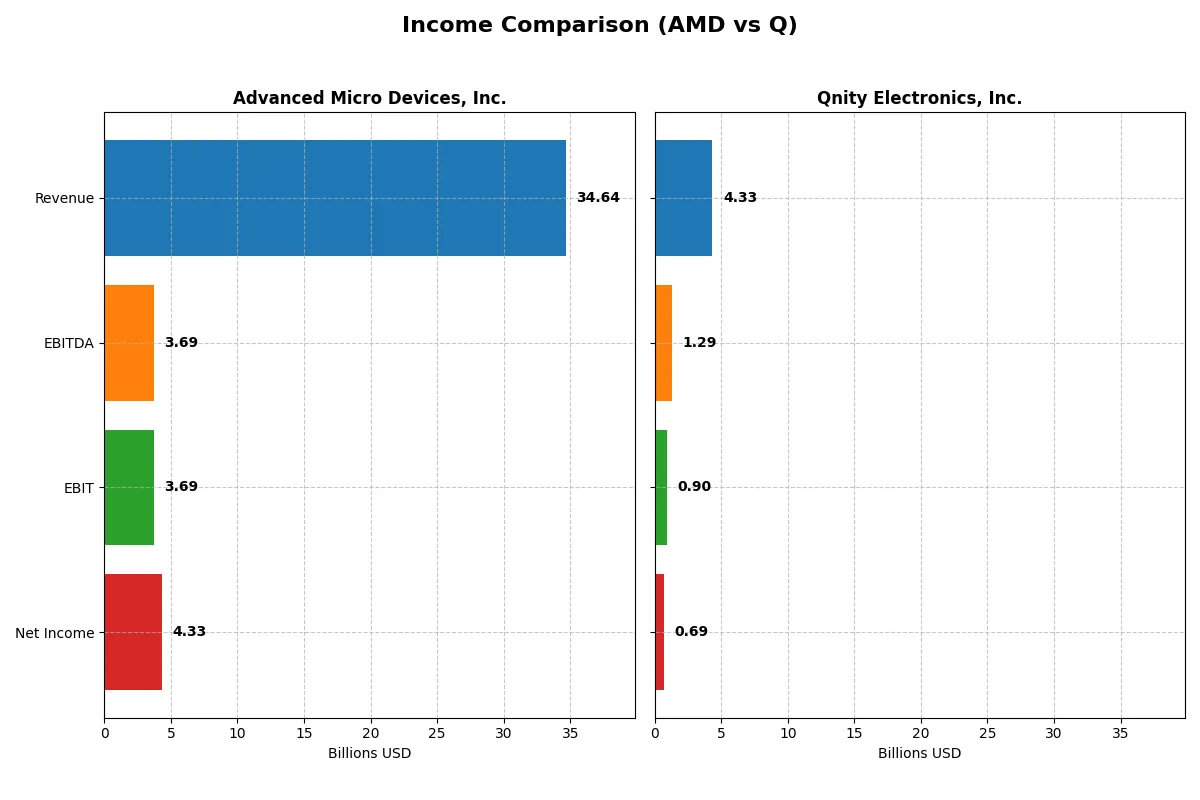
| Metric | Advanced Micro Devices, Inc. (AMD) | Qnity Electronics, Inc. (Q) |
|---|---|---|
| Revenue | 34.6B | 4.3B |
| Cost of Revenue | 17.5B | 2.3B |
| Operating Expenses | 13.5B | 1.2B |
| Gross Profit | 17.2B | 2.0B |
| EBITDA | 3.7B | 1.3B |
| EBIT | 3.7B | 0.9B |
| Interest Expense | 131M | 280M |
| Net Income | 4.3B | 693M |
| EPS | 2.67 | 3.31 |
| Fiscal Year | 2025 | 2024 |
Income Statement Analysis: The Bottom-Line Duel
This income statement comparison reveals which company converts revenue into profit most efficiently, highlighting their corporate engines’ true power.
Advanced Micro Devices, Inc. Analysis
AMD’s revenue surged from 16.4B in 2021 to 34.6B in 2025, nearly doubling in five years. Net income followed suit, hitting 4.3B in 2025, up from 3.1B in 2021. Its gross margin stands robust at 49.5%, and net margin expanded to 12.5%, signaling improved profitability and operational efficiency in 2025.
Qnity Electronics, Inc. Analysis
Qnity saw modest revenue growth from 4.75B in 2022 to 4.34B in 2024, a slight decline overall. Net income decreased from 774M in 2022 to 693M in 2024 despite a net margin of 16%, higher than AMD’s. Its EBIT margin at 20.7% reflects strong cost control, boosting profitability despite stagnant top-line momentum.
Margin Expansion vs. Revenue Acceleration
AMD demonstrates superior top-line growth and notable net income gains, driven by expanding margins and scale. Qnity boasts healthier margins but struggles to grow revenue and net income consistently. For investors prioritizing growth and scale, AMD’s profile offers greater momentum, while Qnity appeals to those focused on margin stability.
Financial Ratios Comparison
These vital ratios act as a diagnostic tool to expose the underlying fiscal health, valuation premiums, and capital efficiency of the companies compared:
| Ratios | Advanced Micro Devices, Inc. (AMD) | Qnity Electronics, Inc. (Q) |
|---|---|---|
| ROE | 2.85% (2024) | 6.51% (2024) |
| ROIC | 2.49% (2024) | 5.92% (2024) |
| P/E | 124 (2024) | 29 (2024) |
| P/B | 3.52 (2024) | 1.88 (2024) |
| Current Ratio | 2.62 (2024) | 1.77 (2024) |
| Quick Ratio | 1.83 (2024) | 1.06 (2024) |
| D/E | 0.038 (2024) | 0.018 (2024) |
| Debt-to-Assets | 3.2% (2024) | 1.6% (2024) |
| Interest Coverage | 20.7 (2024) | 3.03 (2024) |
| Asset Turnover | 0.37 (2024) | 0.35 (2024) |
| Fixed Asset Turnover | 10.63 (2024) | 2.59 (2024) |
| Payout Ratio | 0% (2024) | 0% (2024) |
| Dividend Yield | 0% (2024) | 0% (2024) |
| Fiscal Year | 2024 | 2024 |
Efficiency & Valuation Duel: The Vital Signs
Financial ratios serve as a company’s DNA, uncovering hidden risks and revealing operational strengths beneath the surface.
Advanced Micro Devices, Inc.
AMD’s net margin at 12.5% shows solid profitability, but its 80.5 P/E ratio marks the stock as stretched. Return on equity and invested capital are notably weak, signaling challenges in capital efficiency. AMD offers no dividend, opting instead to reinvest heavily in research and development for future growth.
Qnity Electronics, Inc.
Qnity posts a stronger net margin of 16%, with a more reasonable P/E of 28.8, positioning it as fairly valued. Its return on equity of 6.5% and neutral ROIC highlight moderate efficiency. The company pays no dividend, focusing capital allocation on steady operational improvements and maintaining a healthy liquidity profile.
Valuation Stretch vs. Operational Discipline
Qnity Electronics balances risk and reward better with healthier margins and a fairer valuation. AMD’s premium valuation strains its weaker capital returns. Investors seeking growth with measured risk may find Qnity’s profile more fitting, while those tolerating valuation stretch might consider AMD’s reinvestment focus.
Which one offers the Superior Shareholder Reward?
I observe that neither Advanced Micro Devices, Inc. (AMD) nor Qnity Electronics, Inc. (Q) pays dividends. Both reinvest all cash flow into growth and innovation. AMD’s share buyback program is modest but accelerating, with free cash flow per share rising to 3.4 in 2025. Q exhibits a stronger buyback intensity, supported by robust free cash flow per share of 4.1 in 2024. Q’s sustainable high operating margins (20.7% EBIT) and lower valuation multiples (P/E ~29) suggest a more efficient capital allocation and shareholder value creation. AMD’s higher P/E ratio (~80) reflects growth expectations but risks valuation compression. For 2026, I favor Q’s aggressive buybacks and superior margin profile as a more attractive total return vehicle.
Comparative Score Analysis: The Strategic Profile
The radar chart reveals the fundamental DNA and trade-offs of Advanced Micro Devices, Inc. (AMD) and Qnity Electronics, Inc. (Q), highlighting strengths and weaknesses across key financial metrics:
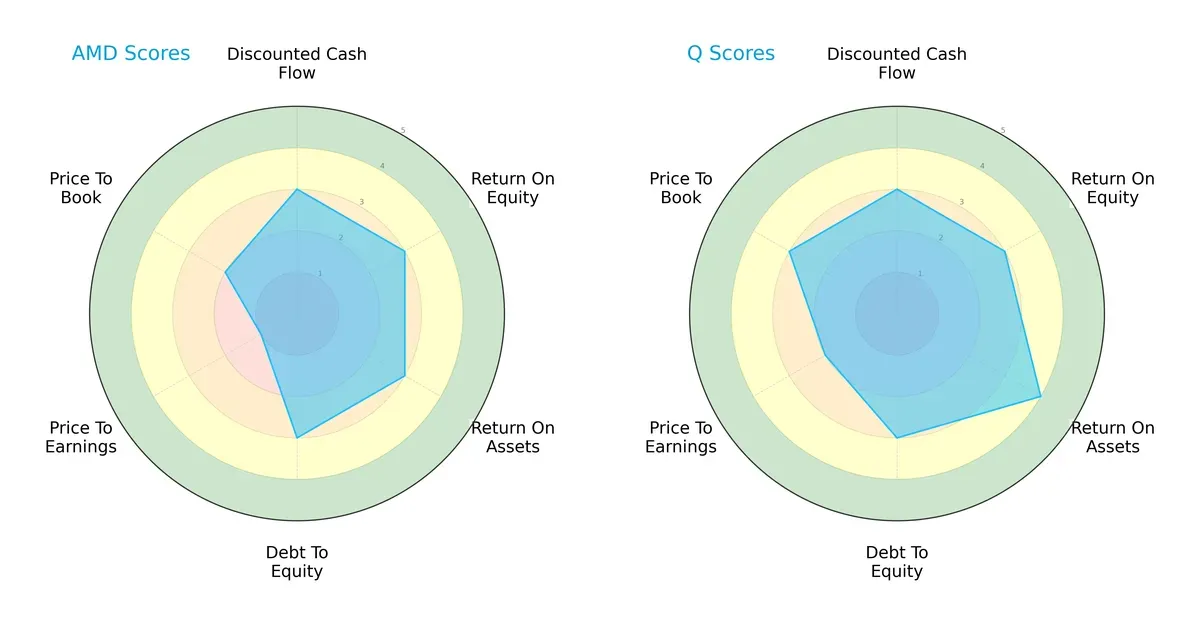
Both firms display a balanced overall score of 3, indicating moderate financial health. AMD maintains consistent scores of 3 across DCF, ROE, ROA, and Debt/Equity, but suffers from a very unfavorable P/E score of 1, signaling potential overvaluation risks. Q edges ahead with a favorable ROA of 4 and moderately better valuation scores (P/E 2, P/B 3), reflecting a more attractive market pricing. Q’s profile suggests a slight operational efficiency advantage, while AMD relies on stable but less compelling valuation metrics.
Bankruptcy Risk: Solvency Showdown
Advanced Micro Devices, Inc. (AMD) posts an Altman Z-Score of 18, placing it firmly in the safe zone, underscoring robust solvency and low bankruptcy risk in the current cycle. Qnity Electronics, Inc. lacks comparable data, so no direct risk duel is possible here:

Financial Health: Quality of Operations
Only AMD provides a Piotroski F-Score of 7, indicating strong financial health with solid profitability, leverage, and efficiency metrics. Without Q’s score, a comparative assessment is unavailable:

How are the two companies positioned?
This section dissects the operational DNA of AMD and Q by comparing their revenue distribution by segment and internal dynamics. The goal is to confront their economic moats to reveal which model offers the most resilient, sustainable competitive advantage today.
Revenue Segmentation: The Strategic Mix
This visual comparison dissects how Advanced Micro Devices, Inc. and Qnity Electronics, Inc. diversify income streams and where their primary sector bets lie:
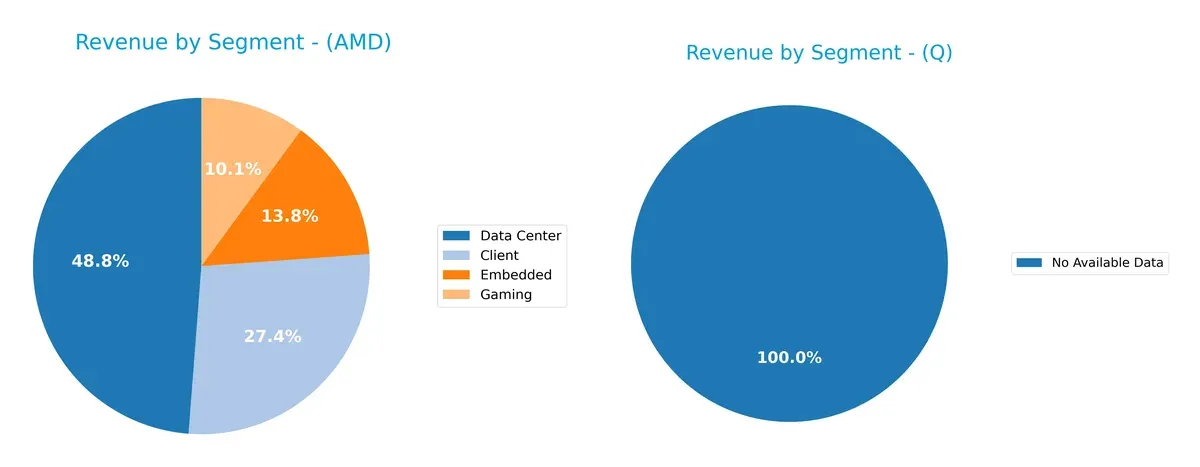
AMD’s revenue splits across Client ($7.1B), Data Center ($12.6B), Embedded ($3.6B), and Gaming ($2.6B). This mix shows a balanced portfolio anchored by Data Center dominance. Qnity Electronics, Inc. lacks available segmentation data, preventing direct comparison. AMD’s spread reduces concentration risk and leverages infrastructure dominance in data centers, contrasting with firms reliant on a single segment. This diversification underpins resilience in volatile markets.
Strengths and Weaknesses Comparison
This table compares the Strengths and Weaknesses of AMD and Qnity Electronics based on key financial and strategic criteria:
AMD Strengths
- Diversified revenue streams across Client, Data Center, Embedded, and Gaming segments
- Large global presence with significant sales in the US, China, and Singapore
- Strong net margin at 12.51%
- Favorable debt metrics and high interest coverage ratio
Q Strengths
- Higher net margin at 15.99% indicating efficient profitability
- Favorable WACC at 5.79% supports lower capital costs
- Solid liquidity ratios with current ratio 1.77 and quick ratio 1.06
- Low debt-to-assets ratio at 1.56%
AMD Weaknesses
- Unfavorable ROE and ROIC at 0%, indicating poor capital returns
- Elevated WACC at 12.94% reflects higher financing costs
- Very high PE ratio at 80.54 suggests expensive valuation
- Weak liquidity ratios with zero values for current and quick ratios
- Poor asset turnover metrics
Q Weaknesses
- Moderate ROE at 6.51%, below ideal benchmarks
- Neutral ROIC at 5.92% may limit sustainable growth
- PE ratio at 28.8 is relatively high
- Asset turnover low at 0.35, limiting operational efficiency
- No dividend yield reported
Overall, AMD shows broad diversification and strong debt management but suffers from weak capital returns and liquidity. Q offers better profitability and liquidity with lower capital costs, yet it faces challenges in capital efficiency and valuation. These profiles suggest contrasting strategic priorities for each company.
The Moat Duel: Analyzing Competitive Defensibility
A structural moat safeguards long-term profits from competition’s relentless erosion. Without it, enduring success is impossible. Let’s dissect two semiconductor players’ moats:
Advanced Micro Devices, Inc. (AMD): Innovation-Driven Cost Advantage
AMD’s moat hinges on cost leadership and cutting-edge chip design, reflected in robust revenue growth (110% over 5 years). Yet, declining ROIC signals weakening capital efficiency. Expansion into data center GPUs may deepen its moat if execution improves in 2026.
Qnity Electronics, Inc. (Q): Emerging Materials Specialist with Stable Profitability
Qnity lacks AMD’s scale but holds a niche moat in advanced semiconductor materials. Its stable ROIC and improving EBIT margin (20.7%) show operational discipline. Growth is modest but steady; future market disruptions could amplify its competitive edge.
Cost Leadership vs. Niche Specialization: The Moat Showdown
AMD’s broader scale and innovation offer a wider moat but face value destruction risks from declining ROIC. Qnity’s neutral moat is narrower yet stable. For defending market share, AMD’s scale dominates—if it reverses its capital efficiency slide.
Which stock offers better returns?
The past year shows clear upward momentum for both stocks, with distinct acceleration phases and notable price peaks and troughs reflecting dynamic trading interest.
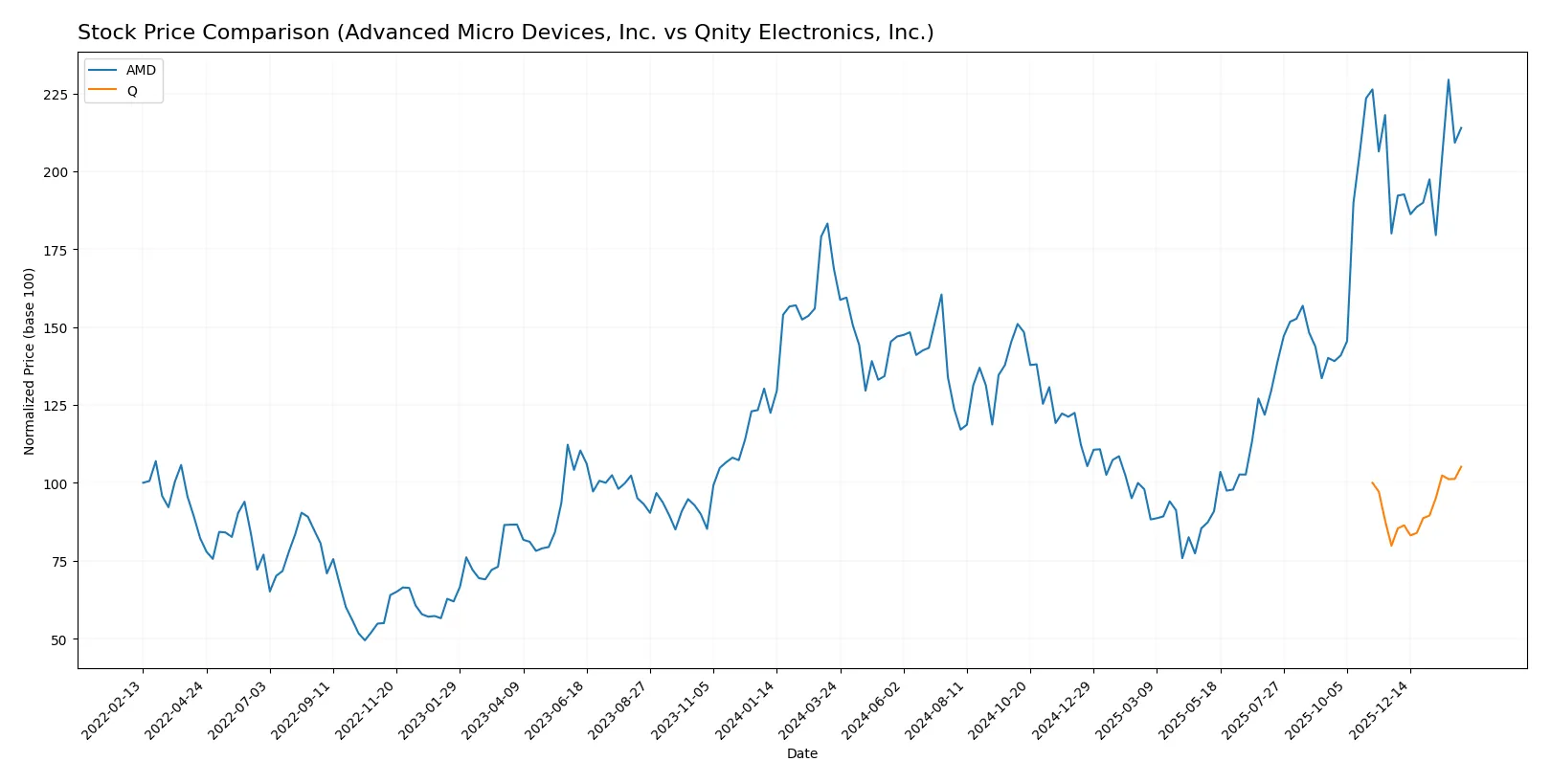
Trend Comparison
Advanced Micro Devices, Inc. (AMD) exhibits a strong bullish trend with a 26.72% price increase over 12 months, showing acceleration and high volatility with a 41.61 standard deviation. The stock peaked at 259.68 and bottomed at 85.76.
Qnity Electronics, Inc. (Q) also follows a bullish path, gaining 5.14% over the same period with acceleration but lower volatility at 7.57 standard deviation. Its highest price reached 99.88, lowest at 75.8.
AMD’s trend outperforms Q’s with a larger overall price increase, despite higher volatility and stronger buyer dominance during the recent period.
Target Prices
Analysts present a bullish consensus for both Advanced Micro Devices, Inc. and Qnity Electronics, Inc.
| Company | Target Low | Target High | Consensus |
|---|---|---|---|
| Advanced Micro Devices, Inc. | 225 | 380 | 291.56 |
| Qnity Electronics, Inc. | 92 | 118 | 106.78 |
The consensus target prices exceed current stock prices, signaling analyst optimism. AMD’s $291.56 target is 20% above its $242 price, while Qnity’s $106.78 target is roughly 7% above its $99.88 price.

Don’t Let Luck Decide Your Entry Point
Optimize your entry points with our advanced ProRealTime indicators. You’ll get efficient buy signals with precise price targets for maximum performance. Start outperforming now!
How do institutions grade them?
Institutional grading provides insight into analyst sentiment for these two companies:
Advanced Micro Devices, Inc. Grades
Here are the recent grades from prominent financial institutions for AMD:
| Grading Company | Action | New Grade | Date |
|---|---|---|---|
| Wells Fargo | maintain | Overweight | 2026-01-30 |
| Piper Sandler | maintain | Overweight | 2026-01-26 |
| UBS | maintain | Buy | 2026-01-26 |
| Bernstein | maintain | Market Perform | 2026-01-21 |
| Keybanc | upgrade | Overweight | 2026-01-13 |
| Truist Securities | maintain | Buy | 2025-12-19 |
| Cantor Fitzgerald | maintain | Overweight | 2025-12-16 |
| Morgan Stanley | maintain | Equal Weight | 2025-11-12 |
| Wedbush | maintain | Outperform | 2025-11-12 |
| Rosenblatt | maintain | Buy | 2025-11-12 |
Qnity Electronics, Inc. Grades
Below are the latest grades from respected analysts for Qnity Electronics:
| Grading Company | Action | New Grade | Date |
|---|---|---|---|
| RBC Capital | maintain | Outperform | 2025-11-25 |
| Mizuho | maintain | Outperform | 2025-11-20 |
Which company has the best grades?
AMD has a broader and more varied set of recent ratings, mostly positive with several “Buy” and “Overweight” grades. Qnity Electronics shows fewer but consistently “Outperform” ratings. Investors may interpret AMD’s diverse analyst coverage as stronger market confidence, while Qnity’s limited data suggests cautious optimism.
Risks specific to each company
The following categories identify critical pressure points and systemic threats facing both firms in the 2026 market environment:
1. Market & Competition
Advanced Micro Devices, Inc.
- Faces intense competition in semiconductors with rapid innovation cycles; sustaining market share is challenging.
Qnity Electronics, Inc.
- Newer player with limited market presence; must establish competitive moat quickly amid industry incumbents.
2. Capital Structure & Debt
Advanced Micro Devices, Inc.
- Strong balance sheet with favorable debt-to-equity and excellent interest coverage.
Qnity Electronics, Inc.
- Very low leverage and favorable debt ratios, reflecting conservative capital management.
3. Stock Volatility
Advanced Micro Devices, Inc.
- High beta at 1.95 signals significant stock price volatility relative to the market.
Qnity Electronics, Inc.
- Beta of zero suggests very low stock volatility, possibly due to shorter trading history.
4. Regulatory & Legal
Advanced Micro Devices, Inc.
- Operates globally with exposure to complex semiconductor regulations and trade policies.
Qnity Electronics, Inc.
- Focused on semiconductor materials, potentially facing evolving environmental and export regulations.
5. Supply Chain & Operations
Advanced Micro Devices, Inc.
- Vulnerable to semiconductor supply chain disruptions; scale helps mitigate some risks.
Qnity Electronics, Inc.
- As a newer company, supply chain robustness is unproven and sensitive to raw material availability.
6. ESG & Climate Transition
Advanced Micro Devices, Inc.
- Growing pressure to improve energy efficiency and reduce carbon footprint in manufacturing.
Qnity Electronics, Inc.
- ESG practices less established; climate transition risks may impact long-term sustainability.
7. Geopolitical Exposure
Advanced Micro Devices, Inc.
- High exposure to US-China trade tensions affecting semiconductor supply and sales.
Qnity Electronics, Inc.
- Limited international footprint so far, reducing immediate geopolitical risks but limiting growth.
Which company shows a better risk-adjusted profile?
Qnity Electronics faces a key risk in market competition as a new entrant without scale, but it benefits from a strong capital structure and low stock volatility. AMD’s most pressing risk is stock volatility combined with regulatory and geopolitical complexities due to its global scale. Given these factors, Qnity shows a better risk-adjusted profile supported by its conservative leverage and stable trading behavior. However, AMD’s superior market position and strong liquidity mitigate some risks, although its valuation and volatility remain concerns. The contrast in beta values (1.95 vs. 0) highlights my concern over AMD’s stock price swings amid sector turbulence.
Final Verdict: Which stock to choose?
Advanced Micro Devices, Inc. (AMD) powers the market with unmatched revenue growth and innovation focus. Its superpower lies in rapid scaling and technological leadership. However, its declining capital efficiency and high valuation are points of vigilance. AMD suits aggressive growth portfolios willing to tolerate volatility for outsized upside.
Qnity Electronics, Inc. (Q) offers a stable moat through disciplined capital use and steady profitability. Its strategic advantage centers on consistent cash flow and a conservative balance sheet, providing a safety cushion compared to AMD. Q fits well in GARP portfolios seeking measured growth with better risk control.
If you prioritize rapid expansion and market disruption, AMD is the compelling choice due to its innovation-driven momentum despite valuation risks. However, if you seek stability and capital preservation with moderate growth, Q offers better balance sheet strength and consistent returns. Each reflects distinct investor profiles navigating growth versus stability trade-offs.
Disclaimer: Investment carries a risk of loss of initial capital. The past performance is not a reliable indicator of future results. Be sure to understand risks before making an investment decision.
Go Further
I encourage you to read the complete analyses of Advanced Micro Devices, Inc. and Qnity Electronics, Inc. to enhance your investment decisions: