Home > Comparison > Technology > AMD vs LSCC
The strategic rivalry between Advanced Micro Devices, Inc. (AMD) and Lattice Semiconductor Corporation shapes the semiconductor industry’s future. AMD operates as a diversified technology powerhouse with broad computing and graphics solutions. In contrast, Lattice focuses on niche programmable logic devices catering to communications and industrial markets. This analysis explores their contrasting models to identify which company offers superior risk-adjusted returns for a diversified portfolio in a highly cyclical and competitive sector.
Table of contents
Companies Overview
Advanced Micro Devices and Lattice Semiconductor stand as key players in the global semiconductor industry with distinct market roles.
Advanced Micro Devices, Inc.: Semiconductor Powerhouse
AMD dominates as a global semiconductor leader with a diversified product portfolio spanning x86 processors, GPUs, and server chips. Its revenue primarily stems from high-performance computing and graphics solutions. In 2026, AMD’s strategic focus centers on advancing data center and gaming technologies, leveraging its broad technology stack to capture growth across cloud and consumer markets.
Lattice Semiconductor Corporation: FPGA Specialist
Lattice Semiconductor carves a niche in low-power field programmable gate arrays (FPGAs) and video connectivity products. It generates revenue by licensing its IP portfolio and selling specialized semiconductors to communications, industrial, and automotive sectors. The company’s 2026 strategy emphasizes expanding its FPGA applications and strengthening technology licensing to deepen its footprint in emerging markets.
Strategic Collision: Similarities & Divergences
Both companies innovate within semiconductors but diverge sharply in scale and focus. AMD pursues a broad-based high-performance ecosystem, while Lattice targets low-power, customizable FPGA solutions. Their primary battleground lies in embedded and communications markets, where AMD’s scale meets Lattice’s specialization. This contrast shapes distinct investment profiles: AMD’s growth ride versus Lattice’s focused niche play.
Income Statement Comparison
The following data dissects the core profitability and scalability of both corporate engines to reveal who dominates the bottom line:
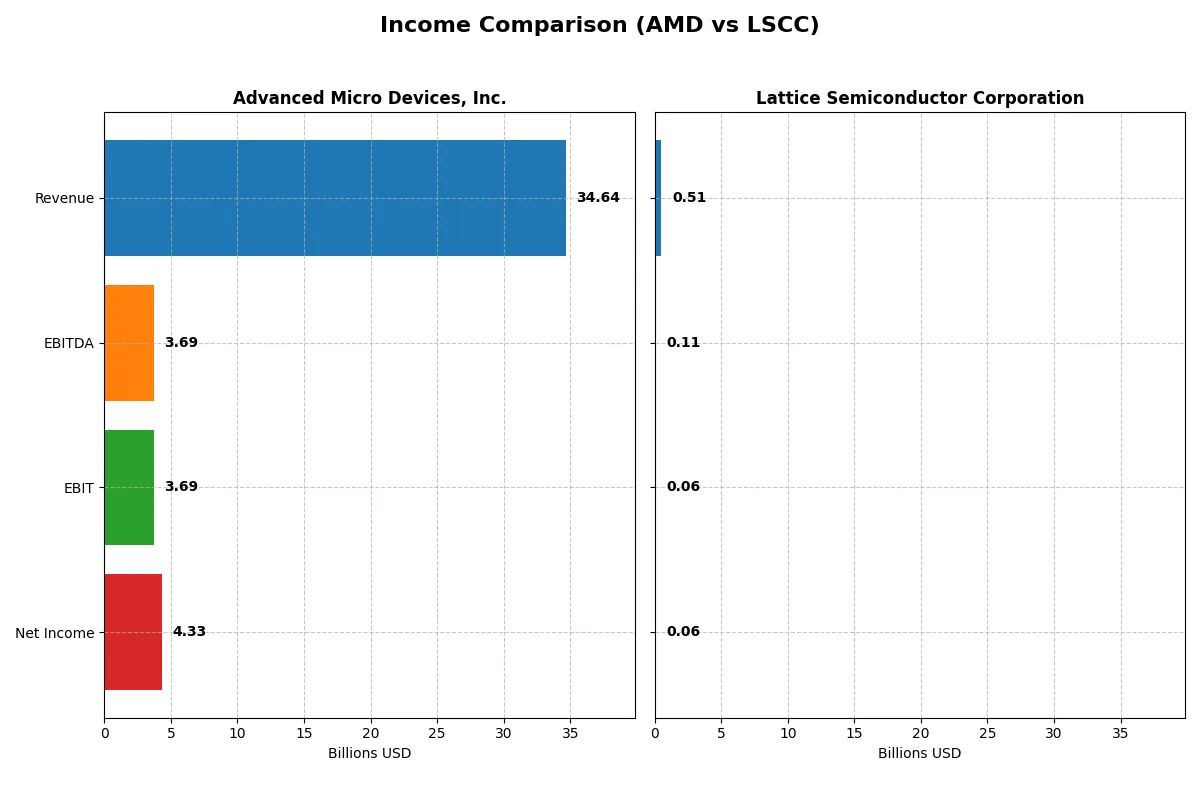
| Metric | Advanced Micro Devices, Inc. (AMD) | Lattice Semiconductor Corporation (LSCC) |
|---|---|---|
| Revenue | 34.6B | 509M |
| Cost of Revenue | 17.5B | 169M |
| Operating Expenses | 13.5B | 306M |
| Gross Profit | 17.2B | 340M |
| EBITDA | 3.7B | 107M |
| EBIT | 3.7B | 61M |
| Interest Expense | 131M | 0.3M |
| Net Income | 4.3B | 61M |
| EPS | 2.67 | 0.44 |
| Fiscal Year | 2025 | 2024 |
Income Statement Analysis: The Bottom-Line Duel
This income statement comparison will reveal which company runs a more efficient and profitable business engine.
Advanced Micro Devices, Inc. Analysis
AMD’s revenue surged from 16.4B in 2021 to 34.6B in 2025, doubling over five years. Net income advanced from 3.16B to 4.34B, showing solid profitability. Gross margin stands healthy at 49.5%, with net margin improving to 12.5%. The 2025 year marks strong momentum, with a 34% revenue jump and nearly doubling net margin.
Lattice Semiconductor Corporation Analysis
Lattice’s revenue rose steadily from 408M in 2020 to a peak of 737M in 2023, before dropping 31% to 509M in 2024. Net income followed a similar pattern, peaking at 259M in 2023 then falling to 61M. Despite a solid gross margin of 66.8% and net margin of 12% in 2024, recent declines indicate weakening momentum and efficiency challenges.
Momentum Surge vs. Recent Setback
AMD’s rapid revenue growth and margin expansion clearly outpace Lattice’s stalled top line and sharp profit drop. AMD’s superior scale and improving efficiency dominate the comparison. For investors, AMD presents a robust growth profile, while Lattice faces near-term headwinds limiting its appeal.
Financial Ratios Comparison
These vital ratios act as a diagnostic tool to expose the underlying fiscal health, valuation premiums, and capital efficiency of the companies compared below:
| Ratios | Advanced Micro Devices, Inc. (AMD) | Lattice Semiconductor Corporation (LSCC) |
|---|---|---|
| ROE | 2.85% (2024) | 8.60% (2024) |
| ROIC | 2.49% (2024) | 4.59% (2024) |
| P/E | 124x (2024) | 133x (2024) |
| P/B | 3.52x (2024) | 11.41x (2024) |
| Current Ratio | 2.62 (2024) | 3.66 (2024) |
| Quick Ratio | 1.83 (2024) | 2.62 (2024) |
| D/E (Debt to Equity) | 0.038 (2024) | 0.021 (2024) |
| Debt-to-Assets | 3.20% (2024) | 1.81% (2024) |
| Interest Coverage | 20.7x (2024) | 130x (2024) |
| Asset Turnover | 0.37 (2024) | 0.60 (2024) |
| Fixed Asset Turnover | 10.63 (2024) | 7.62 (2024) |
| Payout Ratio | 0% (2024) | 0% (2024) |
| Dividend Yield | 0% (2024) | 0% (2024) |
| Fiscal Year | 2024 | 2024 |
Efficiency & Valuation Duel: The Vital Signs
Ratios act as a company’s DNA, revealing hidden risks and operational excellence that numbers alone cannot expose.
Advanced Micro Devices, Inc.
AMD shows a favorable net margin of 12.5% but suffers from zero return on equity and invested capital, signaling inefficiency. The stock trades at a stretched P/E of 80.5, marking it as expensive. AMD does not pay dividends, instead reinvesting heavily in R&D, dedicating 25% of revenue to innovation.
Lattice Semiconductor Corporation
LSCC posts a similar net margin of 12% but delivers a modest 8.6% ROE and 4.6% ROIC, reflecting moderate operational effectiveness. Its valuation is even more stretched with a P/E of 132.7 and a high price-to-book of 11.4. LSCC also forgoes dividends, channeling capital into growth and R&D, which consumes over 31% of revenue.
Premium Valuation vs. Operational Efficiency
Both companies face stretched valuations with elevated P/E ratios well above sector averages, increasing risk. AMD’s lack of returns on equity contrasts with LSCC’s moderate profitability, though LSCC’s valuation is pricier. Investors seeking growth should weigh AMD’s innovation focus versus LSCC’s better capital efficiency but higher premium.
Which one offers the Superior Shareholder Reward?
Advanced Micro Devices (AMD) and Lattice Semiconductor Corporation (LSCC) both forgo dividends, focusing on reinvestment and buybacks. AMD’s free cash flow per share stands at $3.4 with no dividend payout, while LSCC delivers $0.87 free cash flow per share, also without dividends. AMD’s buyback intensity is moderate, constrained by its high P/FCF of 63x, signaling expensive capital deployment. LSCC’s buybacks appear more prudent, backed by a higher operating cash flow ratio of 1.41 and stronger solvency (0.81 vs. AMD’s 0.41). Historically, LSCC’s superior margin profile and disciplined capital allocation suggest a more sustainable shareholder reward model. I conclude LSCC offers a more attractive total return profile for 2026 investors due to efficient cash flow use and stronger balance sheet resilience.
Comparative Score Analysis: The Strategic Profile
The radar chart reveals the fundamental DNA and trade-offs of Advanced Micro Devices, Inc. and Lattice Semiconductor Corporation, highlighting their core financial strengths and weaknesses:
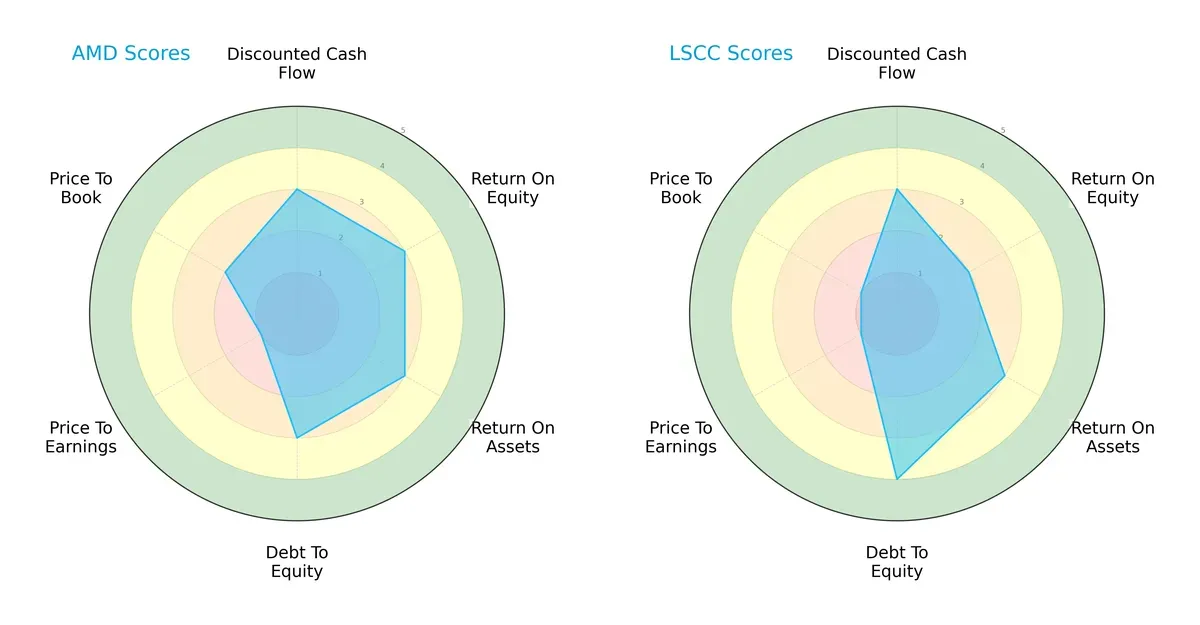
Advanced Micro Devices, Inc. shows a balanced profile with moderate scores in DCF, ROE, ROA, and Debt/Equity, but a weak valuation (PE/PB) stance. Lattice Semiconductor leans on a stronger balance sheet with a favorable Debt/Equity score but suffers from lower ROE and valuation metrics. AMD’s approach is more evenly spread, while LSCC relies on financial stability as its main edge.
Bankruptcy Risk: Solvency Showdown
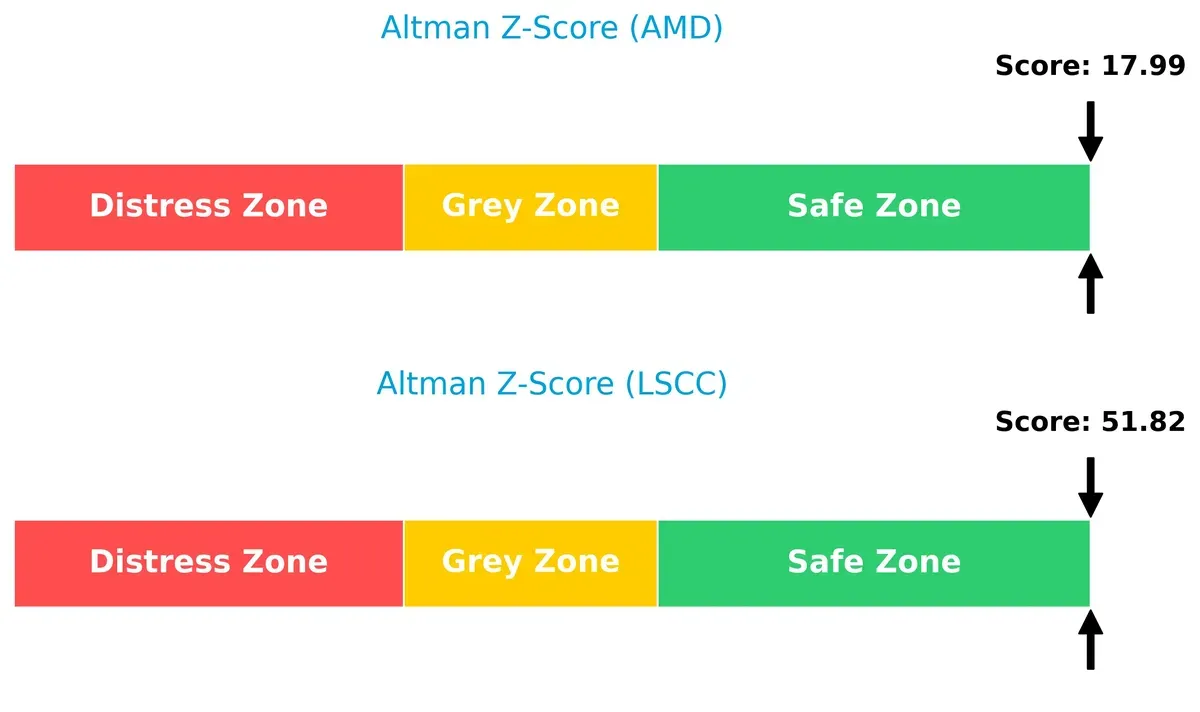
The Altman Z-Score gap strongly favors Lattice Semiconductor, though both firms reside safely above distress levels, implying robust long-term survival potential in this cycle:
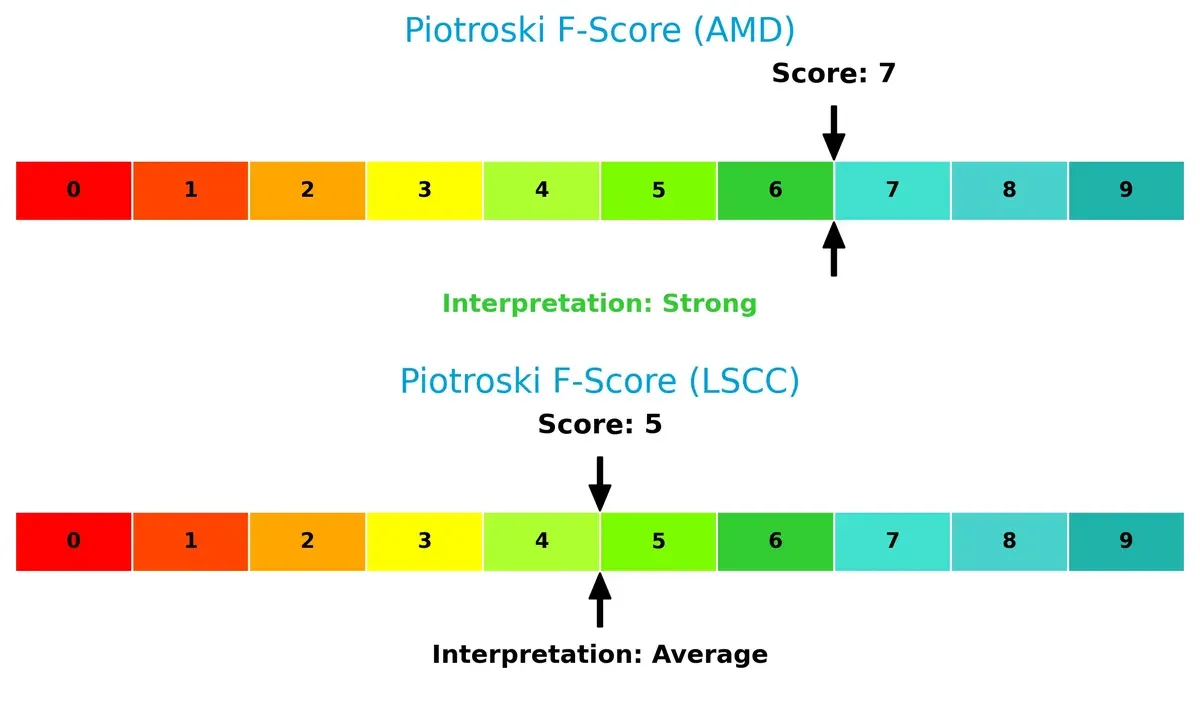
Financial Health: Quality of Operations
Advanced Micro Devices, Inc. leads with a strong Piotroski F-Score of 7, indicating healthier internal operations. Lattice Semiconductor’s score of 5 signals average financial strength and potential red flags in operational efficiency:
How are the two companies positioned?
This section dissects AMD and LSCC’s operational DNA by comparing their revenue distribution and internal dynamics. The goal is to confront their economic moats to identify the most resilient, sustainable competitive advantage in today’s semiconductor market.
Revenue Segmentation: The Strategic Mix
The following comparison dissects how Advanced Micro Devices, Inc. and Lattice Semiconductor Corporation diversify their income streams and where their primary sector bets lie:
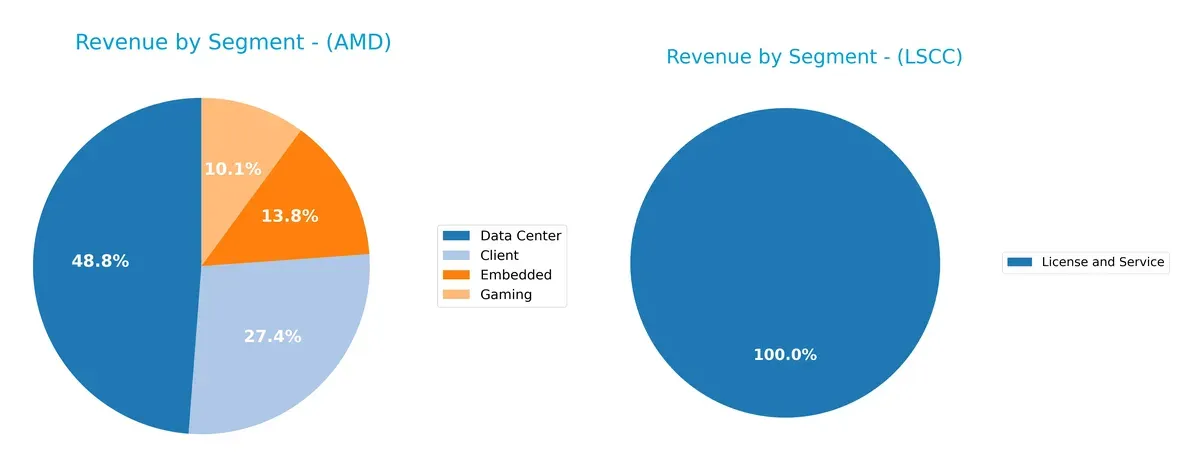
AMD anchors its revenue in Data Center at $12.6B and Client at $7.1B, with meaningful contributions from Embedded ($3.6B) and Gaming ($2.6B). This mix reveals a robust ecosystem lock-in across computing and graphics. LSCC relies heavily on Product Revenue from Distributors ($332M) and Direct sales ($50M), plus License and Service ($17M), showing less diversification and higher concentration risk in specialized semiconductor niches.
Strengths and Weaknesses Comparison
This table compares the Strengths and Weaknesses of Advanced Micro Devices, Inc. (AMD) and Lattice Semiconductor Corporation (LSCC):
AMD Strengths
- Diversified revenue streams across Client, Data Center, Embedded, and Gaming segments
- Strong global presence with significant sales in US and China
- Favorable net margin at 12.51%
- Low debt-to-assets ratio and strong interest coverage of 28.2
LSCC Strengths
- Favorable quick ratio at 2.62 indicates solid short-term liquidity
- Very strong interest coverage at 228.11
- Favorable debt-to-assets ratio at 1.81% and low debt-to-equity of 0.02
- High fixed asset turnover of 7.62 suggests efficient use of assets
AMD Weaknesses
- Unfavorable return on equity and return on invested capital at 0%
- High weighted average cost of capital at 12.94% exceeding ROIC
- Unfavorable current and quick ratios indicating liquidity concerns
- High price-to-earnings ratio at 80.54, potentially overvalued
- Unfavorable asset and fixed asset turnover ratios
LSCC Weaknesses
- Unfavorable return on equity (8.6%) and return on invested capital (4.59%) below WACC of 11.72%
- High price-to-earnings ratio at 132.74 and price-to-book at 11.41
- Unfavorable current ratio at 3.66 despite favorable quick ratio
- Net margin slightly lower at 12% compared to AMD
Overall, AMD benefits from a broader revenue diversification and stronger global footprint, which supports resilience. LSCC shows operational efficiency and excellent interest coverage but faces challenges in profitability metrics and valuation. Both companies must address capital efficiency and liquidity concerns to improve long-term financial health.
The Moat Duel: Analyzing Competitive Defensibility
A structural moat protects long-term profits from relentless competition erosion. Without it, market gains quickly vanish:
Advanced Micro Devices, Inc. (AMD): Innovation-Driven Technology Moat
AMD’s moat stems from cutting-edge chip design and high-performance computing products. Despite strong revenue growth and margin stability, its declining ROIC signals weakening capital efficiency. Expansion into data centers and AI chips may deepen this moat if profitability reverses in 2026.
Lattice Semiconductor Corporation (LSCC): Niche FPGA Specialization Moat
LSCC leverages specialized field-programmable gate arrays (FPGAs) with higher gross margins than AMD, yet suffers from recent revenue declines and shrinking ROIC. Its narrower focus limits scale but offers potential in emerging communications and automotive sectors if it rebounds.
Innovation Edge vs. Niche Specialization: Who Holds the Moat?
Both firms suffer value destruction with ROIC below WACC and negative trends. AMD’s broader market and product innovation offer a wider moat, but its capital inefficiency is a red flag. LSCC’s specialized niche is narrower and more vulnerable. AMD is better positioned to defend market share if it restores capital returns.
Which stock offers better returns?
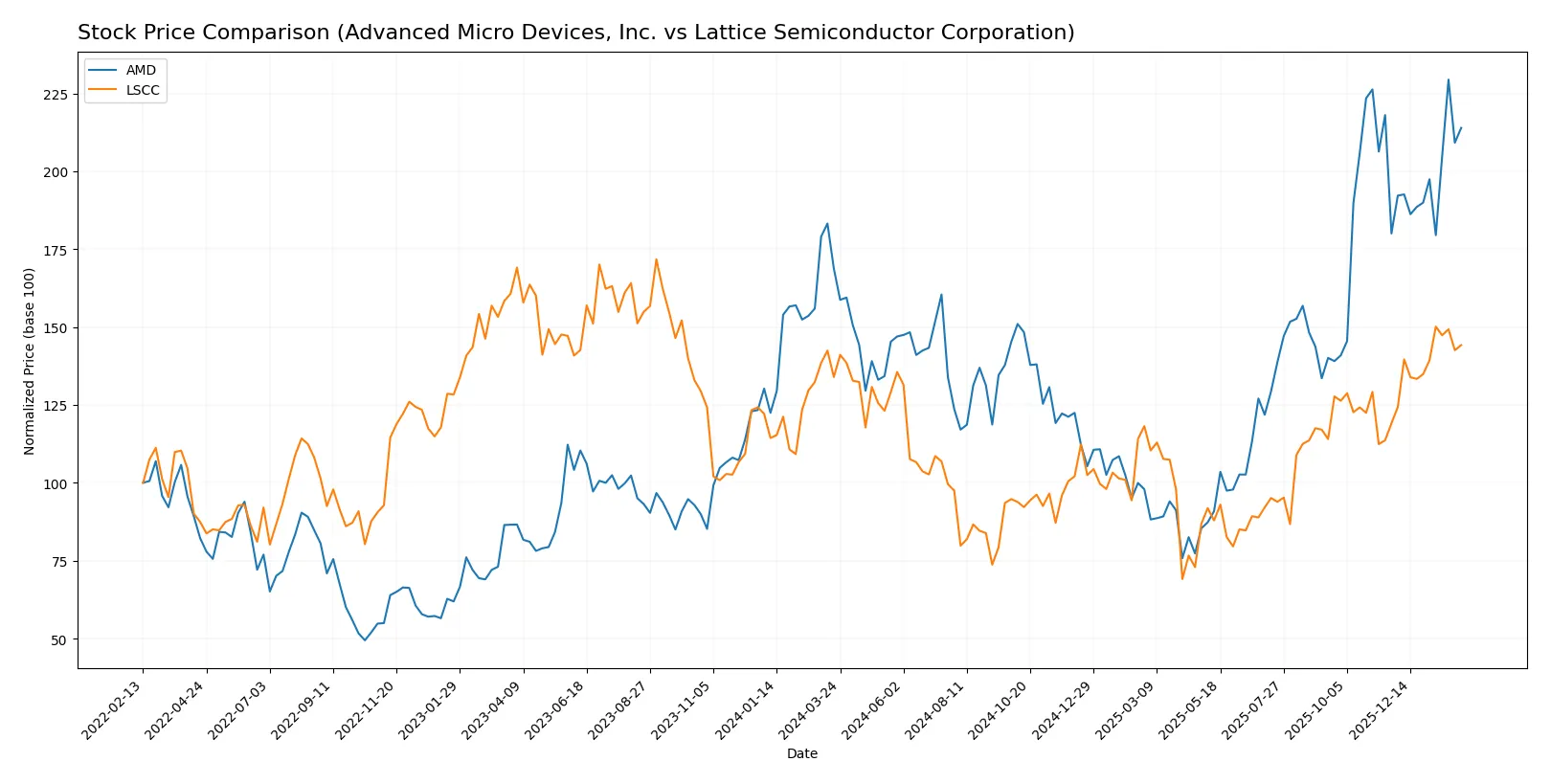
Both Advanced Micro Devices, Inc. (AMD) and Lattice Semiconductor Corporation (LSCC) show bullish price trends over the past year, with notable gains and accelerating momentum in their stock prices.
Trend Comparison
Advanced Micro Devices, Inc. (AMD) posted a strong 26.72% price increase over the past 12 months, showing an accelerating bullish trend with a high volatility level (41.61 std deviation).
Lattice Semiconductor Corporation (LSCC) delivered a 7.65% price gain over the same period, also accelerating but with significantly lower volatility (11.18 std deviation).
AMD’s stock outperformed LSCC’s by a wide margin, delivering the highest market return and demonstrating stronger upward momentum in the past year.
Target Prices
Analysts present a bullish consensus for Advanced Micro Devices, Inc. and Lattice Semiconductor Corporation.
| Company | Target Low | Target High | Consensus |
|---|---|---|---|
| Advanced Micro Devices, Inc. | 225 | 380 | 291.56 |
| Lattice Semiconductor Corporation | 65 | 105 | 84.67 |
For AMD, the consensus target of $291.56 suggests 20% upside from the current $242.11 price. LSCC’s target consensus at $84.67 is modestly above the $81.44 market price, reflecting cautious optimism.

Don’t Let Luck Decide Your Entry Point
Optimize your entry points with our advanced ProRealTime indicators. You’ll get efficient buy signals with precise price targets for maximum performance. Start outperforming now!
How do institutions grade them?
The following tables summarize recent institutional grades for Advanced Micro Devices, Inc. and Lattice Semiconductor Corporation:
Advanced Micro Devices, Inc. Grades
This table displays recent grades from major analysts on AMD’s stock.
| Grading Company | Action | New Grade | Date |
|---|---|---|---|
| Wells Fargo | Maintain | Overweight | 2026-01-30 |
| Piper Sandler | Maintain | Overweight | 2026-01-26 |
| UBS | Maintain | Buy | 2026-01-26 |
| Bernstein | Maintain | Market Perform | 2026-01-21 |
| Keybanc | Upgrade | Overweight | 2026-01-13 |
| Truist Securities | Maintain | Buy | 2025-12-19 |
| Cantor Fitzgerald | Maintain | Overweight | 2025-12-16 |
| Morgan Stanley | Maintain | Equal Weight | 2025-11-12 |
| Wedbush | Maintain | Outperform | 2025-11-12 |
| Rosenblatt | Maintain | Buy | 2025-11-12 |
Lattice Semiconductor Corporation Grades
This table shows recent analyst grades for Lattice Semiconductor’s stock.
| Grading Company | Action | New Grade | Date |
|---|---|---|---|
| Susquehanna | Maintain | Positive | 2026-01-22 |
| Keybanc | Maintain | Overweight | 2026-01-13 |
| Baird | Maintain | Outperform | 2025-11-04 |
| Rosenblatt | Maintain | Buy | 2025-11-04 |
| Benchmark | Maintain | Buy | 2025-11-04 |
| Stifel | Maintain | Buy | 2025-11-04 |
| Needham | Maintain | Buy | 2025-11-04 |
| Susquehanna | Maintain | Positive | 2025-10-22 |
| Keybanc | Maintain | Overweight | 2025-09-30 |
| Needham | Maintain | Buy | 2025-09-22 |
Which company has the best grades?
AMD and Lattice Semiconductor both receive predominantly positive grades from respected firms. AMD shows a mix of “Buy” and “Overweight” ratings with some “Market Perform” and “Equal Weight” marks. Lattice consistently earns “Buy,” “Outperform,” and “Overweight” grades. Investors may interpret Lattice’s steadier “Buy” consensus as slightly more bullish, while AMD’s diverse ratings suggest varied analyst confidence.
Risks specific to each company
In 2026’s volatile semiconductor market, these categories outline the critical pressure points and systemic threats facing Advanced Micro Devices, Inc. (AMD) and Lattice Semiconductor Corporation (LSCC):
1. Market & Competition
Advanced Micro Devices, Inc. (AMD)
- Faces intense competition from larger incumbents like Intel and Nvidia, pressuring margins and market share.
Lattice Semiconductor Corporation (LSCC)
- Competes in niche FPGA markets but with limited scale, exposing it to rapid tech shifts and larger rivals.
2. Capital Structure & Debt
Advanced Micro Devices, Inc. (AMD)
- Maintains low debt levels with strong interest coverage (28.2x), signaling prudent leverage management.
Lattice Semiconductor Corporation (LSCC)
- Also exhibits low debt (D/E 0.02) and very high interest coverage (228x), indicating a conservative capital structure.
3. Stock Volatility
Advanced Micro Devices, Inc. (AMD)
- Exhibits high beta (1.95), reflecting sensitivity to tech sector swings and cyclical risks.
Lattice Semiconductor Corporation (LSCC)
- Slightly lower beta (1.67) but still prone to semiconductor industry volatility and market sentiment shifts.
4. Regulatory & Legal
Advanced Micro Devices, Inc. (AMD)
- Subject to export controls and IP litigation common in semiconductor sector, posing operational risks.
Lattice Semiconductor Corporation (LSCC)
- Faces similar regulatory scrutiny, especially in international markets, with potential licensing disputes.
5. Supply Chain & Operations
Advanced Micro Devices, Inc. (AMD)
- Relies heavily on foundries like TSMC; supply disruptions could impact production and delivery.
Lattice Semiconductor Corporation (LSCC)
- Smaller scale and niche products amplify sensitivity to supplier delays and component shortages.
6. ESG & Climate Transition
Advanced Micro Devices, Inc. (AMD)
- Increasing pressure to improve sustainability metrics amid growing investor ESG demands.
Lattice Semiconductor Corporation (LSCC)
- ESG initiatives less mature, creating reputational and compliance risks as climate regulations tighten.
7. Geopolitical Exposure
Advanced Micro Devices, Inc. (AMD)
- Exposed to US-China tensions affecting supply chains and sales in Asia-Pacific markets.
Lattice Semiconductor Corporation (LSCC)
- Similar geopolitical risks, with additional vulnerability due to smaller global footprint and fewer diversification options.
Which company shows a better risk-adjusted profile?
AMD’s primary risk is fierce competition from tech giants, threatening its growth and margins despite solid financial footing. LSCC’s biggest risk lies in its niche market vulnerability and reliance on a smaller product range amid rapid tech evolution. AMD’s larger scale and robust capital structure give it a more resilient risk-adjusted profile. Notably, AMD’s high beta signals market sensitivity, but its Altman Z-Score (18) and strong Piotroski score (7) confirm financial stability. LSCC’s lower Piotroski (5) and higher valuation multiples increase risk exposure despite conservative debt levels.
Final Verdict: Which stock to choose?
Advanced Micro Devices (AMD) excels as a cash-generating powerhouse with strong revenue momentum and impressive margin expansion. Its main point of vigilance lies in declining returns on invested capital, signaling challenges in sustaining long-term value creation. AMD fits well within aggressive growth portfolios willing to embrace elevated valuation risks for outsized returns.
Lattice Semiconductor (LSCC) benefits from a strategic moat built on recurring revenue and operational efficiency. It offers a safer financial profile with robust liquidity and a higher Altman Z-Score, although recent revenue headwinds temper near-term growth prospects. LSCC suits growth-at-a-reasonable-price (GARP) investors seeking stability alongside innovation.
If you prioritize rapid growth and market share expansion, AMD is the compelling choice due to its accelerating revenue and profit growth despite valuation concerns. However, if you seek better financial stability and a more conservative risk profile, LSCC offers superior balance sheet resilience and operational discipline, though with slower growth momentum.
Disclaimer: Investment carries a risk of loss of initial capital. The past performance is not a reliable indicator of future results. Be sure to understand risks before making an investment decision.
Go Further
I encourage you to read the complete analyses of Advanced Micro Devices, Inc. and Lattice Semiconductor Corporation to enhance your investment decisions: